ANALYSIS OF SAWMILL WORKERS THROUGH
INTEGRATION OF VIDEO OBSERVATION AND RULA
METHOD
MUHAMMAD JAMLI BIN MOHD ALI
UNIVERSITI TEKNIKAL MALAYSIA MELAKA
ANALYSIS OF SAWMILL WORKERS THROUGH INTEGRATION
OF VIDEO OBSERVATION AND RULA METHOD
Thesis submitted in accordance with the requirements of Universiti Teknikal
Malaysia Melaka for the Bachelor Degree of Manufacturing Engineering in
Manufacturing Management
By
MUHAMMAD JAMLI BIN MOHD ALI
Faculty of Manufacturing Engineering
UTeM Library (Pind.1/2007)
UNIVERSITI TEKNIKAL MALAYSIA MELAKA
BORANG PENGESAHAN STATUS PROJEK*
JUDUL: Analysis of Sawmill Workers Through Integration of Video Observation and RULA Method.
SESI PENGAJIAN: 4/2
Saya : MUHAMMAD JAMLI BIN MOHD ALI
mengaku membenarkan projek (PSM/Sarjana/Doktor Falsafah) ini disimpan di Perpustakaan Universiti Teknikal Malaysia Melaka (UTeM) dengan syarat-syarat kegunaan seperti berikut:
1. Projek adalah hak milik Universiti Teknikal Malaysia Melaka .
2. Perpustakaan Universiti Teknikal Malaysia Melaka dibenarkan membuat salinan untuk tujuan pengajian sahaja.
3. Perpustakaan dibenarkan membuat salinan projek ini sebagai bahan pertukaran antara institusi pengajian tinggi.
4. **Sila tandakan (√)
SULIT
TERHAD
√ TIDAK TERHAD
(Mengandungi maklumat yang berdarjah keselamatan atau kepentingan Malaysia yang termaktub di dalam AKTA RAHSIA RASMI 1972)
(Mengandungi maklumat TERHAD yang telah ditentukan oleh organisasi/badan di mana penyelidikan dijalankan)
(TANDATANGAN PENULIS)
Alamat Tetap:
No 6, Jalan Masjid, Kg Kerayong, 28200, Bera,
Pahang Darul Makmur.
Tarikh: 25/03/08
Disahkan oleh:
(TANDATANGAN PENYELIA)
Cop Rasmi:
Tarikh: _______________________
FAKULTI KEJURUTERAAN PEMBUATAN
Rujukan Kami (Our Ref) : 25 Mac 2008
Rujukan Tuan (Your Ref):
Pustakawan
Perpustakawan Universiti Teknikal Malaysia, UTeM, Ayer Keroh,
MELAKA.
Saudara,
PENGKELASAN TESIS SEBAGAI SULIT/TERHAD
- TESIS SARJANA MUDA KEJURUTERAAN PEMBUATAN (PENGURUSAN PEMBUATAN): MUHAMMAD JAMLI BIN MOHD ALI
TAJUK: ASSESSMENT OF WORKING POSTURE OF SAWMILL WORKERS THROUGH INTEGRATION OF VIDEO OBSERVATION AND RULA METHOD.
Sukacita dimaklumkan bahawa tesis yang tersebut di atas bertajuk
“ASSESSMENT OF WORKING POSTURE OF SAWMILL WORKERS THROUGH
INTEGRATION OF VIDEO OBSERVATION AND RULA METHOD” mohon dikelaskan
sebagai terhad untuk tempoh lima (5) tahun dari tarikh surat ini memandangkan ia mempunyai nilai dan potensi untuk dikomersialkan di masa hadapan.
Sekian dimaklumkan. Terima kasih.
“BERKHIDMAT UNTUK NEGARA KERANA ALLAH”
Yang benar,
ISA BIN HALIM
Pensyarah,
Fakulti Kejuruteraan Pembuatan
(Penyelia Utama)
UNIVERSITI TEKNIKAL MALAYSIA MELAKA
Karung Berkunci 1200, Ayer Keroh, 75450 Melaka
APPROVAL
This thesis submitted to the senate of UTeM and has been accepted as partial fulfillment
of the requirements for the degree of Bachelor Manufacturing Engineering
(Manufacturing Management) with Honours. The members of the supervisory committee
are as follow:
Signature : ...
Supervisor : Mr. Isa bin Halim
DECLARATION
I hereby, declared this thesis entitled “Assessment of Working Posture of Sawmill Workers Through Integration Of Video Observations and RULA Method” is the results
of my own research
except as cited in references.
Signature : ………
Author’s Name : Muhammad Jamli Bin Mohd Ali
i
ABSTRACT
This study discusses the assessment of working posture of sawmill workers while they
performing the jobs at their workstation. In sawmill industry, the workers require to
perform various activities such as lifting, pulling, pushing, holding and blocking timber
products. To carry out such activities, they have to perform forward bending or side
bending of their body part especially the upper body. These working postures might be
negatively influencing workers’ health. In recognition the importance of working posture,
the study is conducted to assess working posture of workers while they performing their
jobs in existing workstation and propose appropriate solutions to improve their working
posture. To achieve the objectives, this study starts with an observation at sawmill
industry by using a video camera. Data collection process is done by capturing the
working posture images, having personal interview and distribute a questionnaire. The
captured working posture images were analyzed by RULA analysis incorporated in
CATIA software. To improve the working posture, engineering control method is applied
where the existing workstations were redesigned and analyzed through CATIA software.
The effectiveness of the proposed design is determined by comparing the RULA score of
existing workstation over proposed design. Based on the comparison, the author
concluded that the proposed design of workstations enable workers to perform their job
ii
ABSTRAK
Kajian ini membincangkan tentang penilaian postur bekerja bagi pekerja kilang balak
semasa mereka melakukan kerja di tempat kerja mereka. Di dalam industri pembalakan,
pekerja kilang balak perlu melakukan pelbagai aktiviti seperti mengangkat, menarik,
menolak, memegang dan menahan produk yang dihasilkan dari kayu balak. Untuk
melakukan aktiviti-aktiviti tersebut, mereka iaitu pekerja-pekerja balak tadi terpaksa
menunduk atau membengkokkan anggota badan mereka terutamanya bahagian atas
badan. Justeru itu, postur yang diamalkan oleh pekerja balak mungkin mempengaruhi dan
memberi kesan negatif pada kesihatan pekerja balak. Atas kesedaran akan pentingnya
postur pekerjaan pada pekerja balak, kajian ini telah dijalankan untuk mengkaji postur
pekerja semasa mereka bekerja di tempat kerja dan satu cadangan yang sesuai akan
diusulkan untuk memperbaiki postur bekerja mereka semasa bekerja di kawasan kerja
mereka. Kajian ini mempunyai beberapa objektif yang perlu dipenuhi. Untuk mencapai
objektif-objektif kajian, satu pemerhatian telah dilakukan di kilang balak dengan
menggunakan video kamera. Proses pengumpulan data telah dilaksanakan dengan
mengambil gambar postur pekerja , mengadakan sesi temubual dan mengedarkan soal
selidik di kilang berkenaan. Gambar yang dirakam kemudiannya akan dianalisa
menggunakan RULA analisis yang disediakan di dalam perisian CATIA. Untuk
memperbaiki postur pekerja yang telah dipilih untuk dikaji dalam kajian ini, kaedah
kawalan kejuruteraan telah diaplikasikan dimana tempat kerja yang sedia ada
direkabentuk semula dan dianalisa menggunakan perisian CATIA. Seterusnya,
keberkesanan rekabentuk yang diusul akan ditentukan dengan membandingkan skor
RULA bagi tempat kerja sedia ada dengan rekabentuk tempat kerja yang dicadangkan.
Berdasarkan keputusan perbandingan yang telah dilakukan, penulis merumuskan bahawa
rekabentuk yang dicadangkan membolehkan pekerja-pekerja balak melakukan kerja
mereka dalam keadaan postur yang selamat dan ternyata dibuktikan melalui keputusan
iii
DEDICATION
For My Beloved Parents:
Mohd Ali bin Abu Bakar
Salmiah binti Arshad
My Beloved Siblings:
Nor Salasiah binti Mohd Ali
Noor Zaikiah binti Mohd Ali
My Respected Supervisor:
Mr Isa bin Halim
iv
ACKNOWLEDGEMENT
Firstly, Alhamdullillah. Thank to Allah the Almighty God S.W.T for giving me
the opportunity and time to complete my thesis project for final year. Since doing this
thesis, I have an opportunity to learn something new and get extra knowledge on how to
conduct a project in industrial field.
I would like to thank my respected supervisor, Mr. Isa bin Halim for his guidance
and comments on how to developed an ergonomics assessment in real industrial field. He
have encouraged and inspired me to complete my thesis on time and very much thank
you for Mr. Isa for all his guidance and support to me. I also would like to thank my
parents for giving me the moral support and inspired me for all the hard time. Lastly, I
would like to thank all the lectures and my fellow friends whose help me a lot in
v
TABLE OF CONTENTS
Abstract………..……….i
Abstrak...ii
Dedication ……….iii
Acknowledgement ……….iv
Table of Contents ………...v
List of Figures ………...………..viii
List of Tables ……….x
List of Abbreviations...xi
1. INTRODUCTION……….1
1.1 Background of Study.……….1
1.2 Problem Statement………..3
1.3 Objectives of Study ………....4
1.4 Scope and Limitation ……….5
1.5 Potential Benefits of Study……….6
1.6 Outline of Study…………..………7
1.7 Report Structure ………8
2. LITERATURE REVIEW……….9
2.1 Working Posture……….……….…...9
2.1.1 Introduction to Working Posture………...9
2.2 Occupational Injuries Related to Working Posture ……….13
2.3 Laws, Rules, and Standard Related to Working Posture……….……….16
2.3.1 Laws and Rules………...……….16
2.3.2 Standards …...19
2.4 Sawmill Industry...22
2.4.1 Introduction to Sawmill Industry...22
vi
2.5 Recording and Measuring Working Posture Methods...28
2.6 Tools for Working Posture Analysis...30
2.6.1 Postural Analysis Tools...30
2.6.2 Computer Aided Design Software...33
2.6.3 Computer Aided Three dimensional Interactive Application...34
2.7 Previous Studies Related to Working Posture...35
3. METHODOLOGY………...40
3.1 Introduction...………..40
3.2 Phase 1: Recording and Assessment of Working Posture of Worker...…………..40
3.2.1 Recording of working posture...……….40
3.2.2 Assessment of Working Posture………...…………42
3.3 Phase 2: Redesign of Workstation to Improve Working Posture...48
3.4 Phase 3: Evaluation of The Effectiveness of Proposed Design...49
3.5 Summarization of Methodology...50
4. CASE STUDY...…...51
4.1 Background of Case Study...51
4.2 Case Study Identification...………...52
4.2.1 Factors...………...….53
4.3 Case Study 1: Working Posture during Cutting Process...55
4.4 Case Study 2: Working Posture during Arrangement of Sawn Timber...58
5. RESULTS AND DISCUSSION...………...61
5.1 Introduction...………..61
5.2 Current Workstation Design for Case Study 1...62
5.3 RULA Analysis result for Case Study 1 ...63
5.4 Current Workstation Design for Case Study 2 ...64
5.5 RULA Analysis Result for Case Study 2... 65
5.6 Redesign of Workstation Results... 66
5.6.1 Case Study 1 Result...66
vii
5.6.3 RULA Analysis Result for Proposal Design...69
5.6.4 Case Study 2 Results...70
5.6.5 Discussion on Three Stages Platform Design...70
5.6.6 RULA Analysis Result for Proposal Design...72
5.7 Comparison between Current Workstation Design and Improved Workstation Design...72
5.7.1 Case Study 1...73
5.7.2 Case Study 2...75
5.8 Discussion on Questionnaire and Personal Interview...76
6.0 CONCLUSION AND RECOMMENDATION...77
6.1 Record and Assessment of Working Posture...77
6.2 Redesign Current Workstation...77
6.3 Evaluation of the Effectiveness of Proposed Design...78
6.4 Recommendations...79
REFERENCES………...80
viii
LIST OF FIGURES
1.1 Hierarchy of study scope and focus...5
1.2 Structure of overall report...8
2.1 Sitting working posture...10
2.2 Standing working posture...10
2.3 Forward bending posture...11
2.4 Saw blades...22
2.5 Saw filers benching a double cut saw...23
2.6 Side bending posture...26
2.7 Forward bending posture...27
2.8 Excessive forward bending posture...27
3.1 Angle of working posture ...42
3.2 Angle of working posture ...42
3.3 Dimension part of anthropometric data measurement...43
3.4 RULA Analysis dialog box...45
3.5 Display button to switch the mode...47
3.6 Advance mode score display...47
3.7 Summarization of methodology ...50
4.1 Raw timbers area...52
4.2 Forklift used to transfer the raw timbers to the production site...52
4.3 Pulling posture associated with extreme manual load lifting...55
4.4 The worker has to bend to remove the timber during cutting process...57
4.5 Process flow to cut a timber...57
4.6 Install and tightening the saw blades...57
4.7 Rolling the timber to the cutter machine...57
ix
4.9 Worker bends to arrange sawn timbers on the platform...58
4.10 Worker twists his waist to placing the sawn timbers...58
4.11 Flow Chart of Sawn Timbers Arrangement Process...60
4.12 Take the sawn timbers from table...60
4.13 Put the sawn timber on the platform according to it dimensional size...60
4.14 Arranging the sawn timber...60
5.1 Current workstation design for Case Study 1...62
5.2 RULA Analysis Result (Right Side/Case Study 1)...63
5.3 RULA Analysis Result (Left Side/Case Study 1)...63
5.4 Current Workstation Design for Case Study...64
5.5 RULA Analysis Result (Right Side/Case Study 2)...65
5.6 Cart Design...66
5.7 Specification and proposed material of cart design...68
5.8 RULA Analysis Result (Right Side /Case Study 2)...69
5.9 RULA Analysis Result (Left Side /Case Study 2)...69
5.10 Three Stages Platform...70
5.11 RULA Analysis Result (Right Side /Case Study 1)...72
5.12 RULA Analysis Result (Left Side /Case Study 1)...72
5.13 Comparison Chart of RULA Score (Left and Right / Case Study 1)...74
x
LIST OF TABLES
2.1 Accident Register Records...15
3.1 Specification of Video Camera...41
3.2 Anthropometry Data of Sawmill Workers...44
4.1 Description of Cutting Process...56
4.2 Description of Sawn Timber Arranging Process...59
5.1 Tables of RULA Analysis Score Results for Case Study 1...74
xi
LIST OF ABBREVIATIONS
BCPE Board of Certification for Professional Ergonomists
BLS Bureau of Labor Statistics
CAD Computer Aided Design Software
CAE Computer Aided Engineering
CAM Computer Aided Manufacturing
CMOS Complementary Metal Oxide Semiconductor
COHFE Center of Human Factor Ergonomics
CTD Cumulative Trauma Disorder
EMG Electromyography
ILO International Labour Organization
IBM International Business Machine
ISO International Organisation of Standardisation
JPEG Joint Photographic Experts Group
LBP Low Back Pain
MSD Musculoskeletal Disorder
NIOSH National Institute of Safety and Health
OSHA Occupational Safety and Health
OWAS Ovako Working Posture Analysis System
REBA Rapid Entire Body Assessment
RULA Rapid Upper Limb Assessment
xii
WMSD Work Related Musculoskeletal Disorder
WRULD Work Related Upper Limb Disorder
1
CHAPTER 1
INTRODUCTION
This chapter provides information regarding to background of study, problem
statements, and objectives of study. Besides, this chapter also describes the scope and
limitation of study, potential benefits from the study that may significant to the
personal, authorities, or related organizations. The outline of conducted study also
presented in this chapter
1.1 Background of Study.
Sawmill industry is an enormous industry not only in Malaysia, but also in the
international level. Countries that have a wide area of forest and received a constant
rain distribution per year mainly become the role player in this industry due to the
unlimited source of timber plant. Currently, Malaysia is the largest exporters of logs,
sawntimber, and the main exporter of wood-based product such as plywood, wooden
furniture and builders’ carpentry in Asian region. Providing a job to more than 300,000
workers, the Malaysian sawmill industry had grown rapidly and significantly play a
major role to the development of socioeconomic sector in Peninsular Malaysia, Sabah
and also in Sarawak (Anon, 2007a).
Application of advanced and diverse technology machinery is vital to this type of
industry. Sawing or cutting machine application is the major type of machine used,
either automatic or manual operations. Besides using a machine to cut or process the
logs, human workforce is also needed to run the machines and perform the other job in
2
lifting, pushing and removing a processed timber, handling a manual device such as
saw blades, pushing trolley, and pulling a pulleys to remove the timber are the example
of manual task perform by the workers repetitively and done everyday in the sawmill
industry (WorkSafe, 2005).
These activities require the workers to apply a specific posture to carry out the job or
can be termed as working posture. Working posture is one of the ergonomics issues
under the industrial ergonomics discipline. Unsafe working posture while performing
job activities not only uncomfortable to the workers, but also exposed the workers to a
musculoskeletal disorders (MSD). The manual task activities perform by the workers is
believed as a major contributor to the occupational injuries in the sawmill industry
(Edwin M., 2003). Workers bending or twisting repetitively while performing their job
associated with a great risk of MSD. MSD include sprains, strains, inflammation,
degeneration, tears, pinched nerves or blood vessels, bone splintering and stress
fractures. Neck, shoulder, wrist, and low back are the common body part that has a
great potential to sustain injury or the MSD due to an awkward working posture such as
excessive forward bending to pick up a load repetitively as what the sawmill floor
workers done everyday.
In recognition of the importance of working posture issues, ergonomics assessment
needs to be carried out in order to establish safe working posture. Rapid Upper Limb
Assessment (RULA) is selected as a tool to asses and analyzes the risk factors of the
working posture as this tool is postural analysis software oriented. By using a video
observation, an image of unsafe working posture is recorded and analyzed using
RULA. The unsafe working posture that declared below the safe standard will be
improved through scope of engineering controls which is by redesigning the current
3 1.2 Problem Statements.
Sawmill industry is among the manufacturing industry that applying a working
environment which workers are requires to apply high forces, unsafe working posture,
manual handling operations, and repetitive motions in performing job task. Unsafe
working posture such as bending, twisting, pushing, and lifting a heavy load are the
major contributors to the potential occupational injuries among an industrial workers.
In sawmill industry, workers are highly expose to the occupational injuries due to the
job activities that require them to deal with the logs and processed timber. Manual
handling device and a workstation design of workers to perform their job also
contribute to the occupational injuries. The design of workstation also can be a
significant contributor to the workers to have a musculoskeletal disorder and other
occupational injuries. It is known that work-related musculoskeletal disorders are
caused by multifactor operations of various risk factors. Safe working posture is
considered as vital contributor to feasible occupational health in most industries in
Malaysia. Through feasible occupational health, the productivity and quality of
industries can be increased. Among these, the association of these risk factors with pain
symptoms and work-related musculoskeletal disorders has been reported in many
studies in all typical manufacturing settings (Bernard, 1997).
Following are problems which related to the MSD injuries among the sawmill industry
workers:
a) The sawmill industry is known to have a high level of manual handling, with
tasks often involving high loads/forces, awkward postures, and repetitive
movements; some of the key risk factors for MSDs (Tappin D. et. al, 2003).
b) At least 6500 new claims occurred during the four year period of the review,
equating to approximately 3250 new injury claims for Log Sawmilling and
Timber Resawing and Dressing. Awkward posture is among the injury cause
4 1.3 Objectives of Study.
In recognition the importance of working posture in sawmill industry, this study is
conducted to achieve following objectives:
a) To record and assess current working posture adopted by the workers in their
usual workstation.
Working postures of workers will be recorded using a video camcorder.
Recorded working posture will be evaluated using Rapid Upper Limb
Assessment (RULA) applied as a tool to assess the risk factors of posture, static
muscle contraction, repetitive motion, and force relative to a specific job by
referring to the captured image.
b) To redesign the current workstation in order to improve working posture.
One of the proposed ergonomics intervention control methods which are in the
scope of engineering control is applied in this study. The current workstation
will be observed and redesign by using the Computer Aided Design (CAD)
software which is CATIA software for this study.
c) To evaluate the effectiveness of the proposed workstation design.
Comparison method is used to achieve this objective. The working posture of
workers while performing their job at current and proposed workstation is
analyzed by using RULA. The RULA result will determine the effectiveness of
proposed workstation design in term of improvement of the workers working
5 1.4 Scope and Limitation.
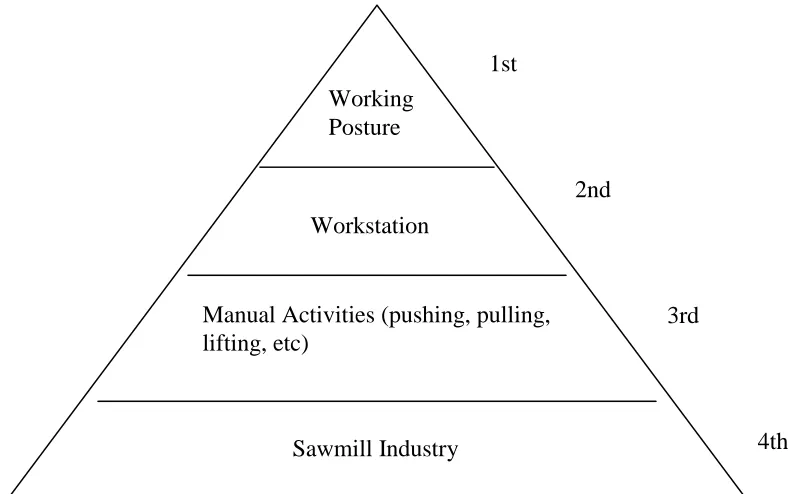
Basically, this study focuses in analyzing the working posture of sawmill industry
workers by applying the integration of video observation and Rapid Upper Limb
Assessment (RULA) associated with CATIA v5R12. Workers of sawmill industry was
selected due to their job activities that requires them to push, twist, bend, lifts, and
handling with the manual device such as trolleys, thus may lead to a MSD crisis to the
workers. A workstation design also will be proposed as a solution for improvement of
the current working posture. The design of the proposed workstation is depend on the
company consideration as it’s only a proposed solution. The limitation for this study is
the obtained results only applicable for the selected working posture in this study and
cannot be apply for other posture due to a different posture have different body part
angle. This study also only concern in a physical ergonomics which focuses on
biomechanical characteristic, human anatomical and physiological as it related to
[image:23.612.122.520.405.652.2]physical activities such as working posture that will be investigated in this study.
Figure 1.1 shows the hierarchy of focus and scope of this study:
Working Posture
Workstation
Manual Activities (pushing, pulling, lifting, etc)
Sawmill Industry 1st
2nd
3rd
4th
6 1.5 Potential Benefits of Study.
This study may offer potential benefits to the following parties:
a) Sawmill industry.
Able to promote and enhance ergonomics awareness in sawmill industry to
minimize occupational injuries in this industry.
The findings of the study can be used as a guideline for the industry owner to
design a workstation.
b) University or educational organizations.
As a reference for academic studies related to MSDs issue and working posture
analysis in industrial fields.
As a reference for future studies on ergonomic workstation design and
improvement of working posture of industrial workers.
c) Authorization party.
This study can be used by the National Institute for Occupational Safety and
Health (NIOSH) as a guideline and references to prevent MSD injuries among
sawmill industry workers.
A document to support the effort of NIOSH in promoting a safe working
condition among the industrial workers.
d) Students.
The study may improve the students’ ability and skills in developed a case study
and enhance their soft skills.
e) Country.
Reduce the occupational injuries among the industrial workers and create a
healthy working environment, thus boost up the productivity and economic