ii ABSTRAK
i
ABSTRACT
iii
DEDICATION
This report is dedicated to my supervisor, Mr. Muhamad Arfauz bin A Rahman, co-supervisor, Puan Syamimi binti Shamsuddin and lecturers for their guidance. It is not forgotten for my parents, Abu Hanipah Pandak Yahay and Suria binti Mohd Shariff, and
iv
ACKNOWLEDGEMENT
First and foremost, Alhamdulillah, thank God for giving me a chance to complete my Final Year Project and this report. I would also like to thank my supervisor, En Muhammad Arfauz A. Rahman and Puan Syamimi Samsudin for the guidance that they had given to me for my thesis.
I also would like to take this chance to thank En. Muhamad Afifi who is the programmer in CAIRO because has spent a time to guide me to complete my project.
v
TABLE OF CONTENTS
Abstract i
Abstrak ii
Dedication iii
Acknowledgement iv
Table of Contents v
List of Tables viii
List of Figures ix
1. INTRODUCTION 1
1.1 Introduction 1
1.2 Objective 2
1.3 Scope of project 2
1.4 Benefit 3
1.5 Project outline 4
2. LITERATURE REVIEW 5
2.1 Wireless technology 5
2.1.1 Bluetooth technology 8
2.1.1.1 Feature of Bluetooth technology 9
2.1.1.2 Application of Bluetooth technology 10
2.1.1.3 Advantages and disadvantages of Bluetooth technology 11
2.1.2 Infrared technology 11
2.1.2.1 Feature of Infrared technology 12
2.1.2.2 Application of Infrared technology 13
2.1.2.3 Advantages and disadvantages of Infrared technology 14
2.2 Robot slider 16
2.2.1 Specification of Robot slider 17
vi
2.2.2.1 Robot slider controller 19
2.2.2.2 AC Induction Motor 20
2.3 Similar Past Researches 22
3. RESEARCH METHODOLOGY 24
3.1 Flowchart of the whole project 24
3.2 Design and development of the circuit 27
3.3 Testing the circuit 30
4. DESIGN AND DEVELOPMENT 31
4.1 Electronic structure 31
4.1.1 Design of the circuit 31
4.1.2 Circuit components 32
4.1.2.1 Strip board 32
4.1.2.2 PIC16F877A Microcontroller 32
4.1.2.3 Bluetooth Module : KC21 Wirefree 33
4.1.2.4 Motor driver L293D 34
4.1.2.5 Voltage Regulator 35
4.1.2.6 Resistor 37
4.1.3 PIC microcontroller circuit 38
4.1.4 Power supply circuit 39
4.1.5 Bluetooth circuit 40
4.1.6 Final circuit 41
4.1.7 Circuit simulation using Proteus 42
4.2 Programming 43
4.2.1 MikroC Programming 43
4.2.2 Visual Basic Programming 46
4.2.3 Rig of the experiment 49
5. TESTING AND RESULT 51
vii
5.1.1 Connection between KC21 Wirefree Bluetooth Module with PC 51
5.1.2 Movement of robot slider 53
5.2 Result 53
5.2.1 Connection between KC21 Wirefree Bluetooth Module with PC 53
5.2.2 Movement of robot slider 54
6. DISCUSSION, CONCLUSION AND RECOMMENDATIONS 55
6.1 Discussion 55
6.1.1 Development of the circuit 55
6.1.2 Movement of the robot slider 56
6.1.3 Programming 57
6.2 Conclusion 58
6.3 Recommendations for Future Work 59
REFERENCES 61
APPENDICES
A. Schematic diagram for the circuit
B. Schematic diagram for the connection of Bluetooth with PIC microcontroller. C. Coding using MikroC programming
D. Coding using Visual Basic programming E. KC Wirefree Bluetooth Starter Kit User Manual
F. The future of mobile technology and mobile wireless computing
viii
LIST OF TABLES
2.1 The detail of robot slider 17
2.2 Detail of electrical component for robot slider controller 19 2.3 Detail of component for robot slider controller. 20 2.4 Specification of the AC Induction Motor that is use for the robot slider 21
2.5 Peripherals use by shipping companies 23
4.1 Standard Color Code 37
4.2 Detail of PIC microcontroller and motor driver circuit 38
4.3 Component for PIC microcontroller circuit 39
4.4 Components of the Bluetooth Module. 41
4.5 Detail of the interface diagram 49
ix
LIST OF FIGURES
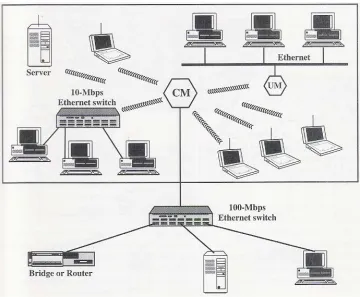
2.1 Single-cell wireless LAN configuration 6
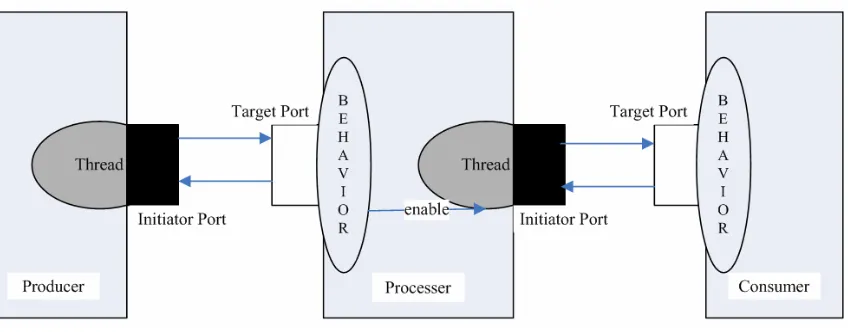
2.2 Data transfer 8
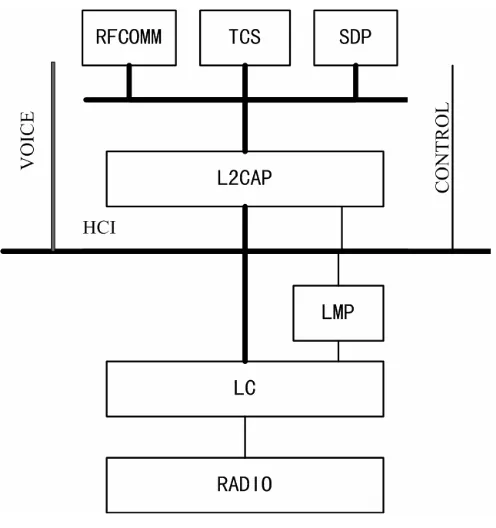
2.3 Bluetooth stack 9
2.4 Some application of Bluetooth technology 10
2.5 Classification of simple infrared links according to the degree of directionality of the transmitter and receiver
12
2.6 The communication between two devices for Infrared technology 13
2.7 Circuit for Infrared technology 15
2.8 Robot slider in FKP Robotic lab 16
2.9 Circuit diagram for robot slider controller 18
2.10 Electrical component for robot slider controller 18
2.11 Component for robot slider controller 20
2.12 AC Induction motor that is use to move the robot slider 21
3.1 Flowchart of the whole project 26
3.2 Bluetooth Module circuit 28
3.3 Circuit for the PIC microcontroller 28
3.4 Flowchart of the design and develop of the circuit 29
4.1 Strip Board 32
4.2 PIC16F877A Microcontroller 33
4.3 Pin diagram for PIC16F877 33
4.4 KC21 Wirefree. 34
4.5 Output/Input pin for KC21 Bluetooth OEM Module 34
4.6 Motor driver 35
4.7 Motor driver output pin 35
4.8 Voltage Regulator 5V 36
x
4.10 Voltage Regulator 3.3V 36
4.11 Voltage Regulator 3.3V pin 37
4.12 Resistor 37
4.13 PIC and Motor driver circuit 38
4.14 Power supply circuit 39
4.15 KC21 Wirefree Bluetooth Module 41
4.16 PIC microcontroller, motor driver and Bluetooth Module circuit 42
4.17 Final circuit 42
4.18 Simulation process using Proteus 43
4.19 Flowchart of the MikroC programming 44
4.20 Programming using the MikroC 45
4.21 Flowchart of Visual Basic programming 47
4.22 Programming using the visual basic for the interface of the motor 48 4.23 Interface diagram for controlling the robot slider motor 49
4.24 Setup of the testing process 50
5.1 Bluetooth device that is in the range of the area 52 5.2 Hyperterminal for the Bluetooth receiving signal 52 5.3 The Bluetooth device that is in the range of the PC 54
6.1 New development of controller circuit 56
6.2 Old development of controller circuit 56
1
CHAPTER 1
INTRODUCTION
In this chapter, the description about the project will briefly be explained. Other than that, the objective of the project also is included in this chapter. The scope and benefit of the project also been discussed.
1.1Introduction
This project is aimed to design and develop the controller for robot slider. It is utilize the PC base interface to control the movement of the motor. The motor will be control using the Bluetooth application. Interface for controlling the robot slider will be program using the Visual Basic programming.
Bluetooth is the new technology that is now becoming commercially available. It is also called as a cable-replacement technology. For example the technology is intended to replace the cable connection between computer, peripherals and electronic devices. The cable or wire will not be used to join the devices to the machine. Other than that, load files and applications also are not necessary. Bluetooth technology enables users to swap data and synchronize files without using devices together.
2
running in the background. The Bluetooth frequency has been set by international agreement for the use of Industrial, Scientific and Material devices (ISM) is 2.45 GHz.
The important features of the Bluetooth are it is wireless. There is no need for the cable to be attached or used with the components. In addition the set up of the devices is not needed. There also no special requirement is needed to make the technology to use. The devices will automatically find other Bluetooth devices and strike up a conversation without any user input at all.
Regarding to the benefit of the Bluetooth technology, so that the teach pendant will be improve using the Bluetooth technology. It will be improved to make sure it can be use safely and easily.
1.2Project Aim and Objectives
The aims of this project are to design and development of PC based for controlling robot slider via Bluetooth application. The aim is to be achieved through these objectives:- (a) To design and develop the PC based controller and interface using Visual Basic. (b) To design and develop motor controller for robot slider that is able to receive
Bluetooth signal.
(c) To establish connection between PC and robot slider and control the robot slider via Bluetooth technology.
1.3Scope
3
Interfacing of the controlling button will be design using visual basic programming. This is to ensure user to take the measurement more accurate.
PC based controller and the robot slider will be connected via Bluetooth technology. The controller will be program so it can control the robot slider using Bluetooth technology.
1.4Benefit
There are several benefits of using Bluetooth technology such as:-
(a) Bluetooth technology for a safer work environment because it does not need the wire to connect each other.
(b) Bluetooth devices can penetrate walls and briefcase. (c) Easy connection because there is no wire needed. (d) It is wireless and can be wirelessly from some distance.
(e) Due to its high mobility, the technology is suitable and very flexible to be used.
4
GANTT CHART FOR PROJEK SARJANA MUDA (PSM 1 & 2)
TASK
WEEK
PSM 1 2 3 4 5 6 7 8 9 10 11 12 13 14
Title Selection
Project Review
P Literature Review
S Designing The Circuit
M Develop PIC Circuit
Programming
1 Seminar
Report Writing
Submit Report
Review PSM 1
5
CHAPTER 2
LITERATURE REVIEW
In the literature review the topic that been discuss is about the wireless technology. It can be divided into two categories that are Bluetooth and infrared technology. In addition, the robot is also been discuss in this topic. The PC based also is discussing in this chapter. Then, the robot slider specification is also been discussed in this chapter.
2.1 Wireless Technology
6
[image:21.612.148.508.69.366.2]Figure 2.1: Single-Cell wireless LAN Configuration. (Stallings )
In 1980s, the primary wireless communication was developed on the Advanced Mobile Phone Service (AMPS) standard. The 1G wireless communications provide main voice service-using analogue, but no data service. The frequency of the first generation of wireless communication is 900MHz. Then the technology was advanced to 2G networks, it use a variety of standards such as Time Division Multiple Access (TDMA), Global Systems for Mobile Communications (GSM), Code Division Multiple Access (CDMA), and PDC. It provides maximum data a rate that is 14.4 kb/second and an advance in digital voice.
7
Development of wireless bandwidth increasing to 3G network. 3G rate is increase to more than 2Mbps of data transfer, coupled with ever increasing coverage. The 4G technology is being designed in making it more advances. The capability of the 4G network can be up to 20Mbps. Japanese mobile communication, DoCoMo aim to provide 100Mbps for downloads, coupled with 20Mbps for uploads on 4G.
Wireless technology had become the popular technology and been applied in the many types of devices. For example the mobile phones allow people to transmit more complex signal with the far distance. In addition each person can access internet with the mobile phone. Personal Digital Assistants (PDAs) is one of the mobile phone that has a lot of function such as an e-mail, address books and to-do lists.
In addition, there are also users that use the infrared ports for wireless communication. Infrared has a lot of shortcoming such as the range of the communication within each device is very short. Other than that the user also need to align the devices carefully while transferring data.
There are many advantage of wireless technology. It is easy to install using the wireless technology. This is because it does not require any cable or wire to communicate and connect with other devices. Other than that, regarding to the above reason, the wireless communication also save the user time to connect or communicate with other devices. Wireless technology also is more flexible because the user can move the device to communicate with other device at different location. It is not fixing at one location compare to the cable connection device. The convenient communication can be access easily using the wireless technology.
8
2.1.1 Bluetooth Technology
[image:23.612.119.543.301.467.2]Name of Bluetooth was taken from the Harald Blatand. Blatand is Danish for Bluetooth. The development of the Bluetooth Technology was started in year 1994. It has been started use by the mobile phone-maker that is the Ericsson Mobile Communications. The Bluetooth standards had been published by an industry consortium that called as Bluetooth SIG (special interest group). Bluetooth technology is designed as a peer-to-peer network which is devices can communicate each other without any additional cable or hardware so that many devices can communicate each other such as from computers to cell phones to stereo or any other type of device.
Figure 2.2: Data transfer.
9
Figure 2.3: Bluetooth stack.
2.1.1.1 Feature of Bluetooth Technology
Since the Bluetooth is suitable for low-cost radio solution so it is plan to operate in the 2.4GHz by Industrial, Scientific and Medical (ISM) unlicensed.
Bluetooth technology is inexpensive use various type of electrical equipment to communicate each other. It does not need any cable to allow communication with the other device. It is also eliminate other wireless connections such as infrared and cable synchronizing. It is because the Bluetooth use radio frequency to communicate through the device.