CITATIONS 0
READS 10
1 author:
Some of the authors of this publication are also working on these related projects:
Peridis PublishingView project
Drowning PreventionView project Shayne Baker Oam
University of Southern Queensland
17PUBLICATIONS 5CITATIONS
8-31-2019
Validating Water Safety Competence
Shayne D. Baker OAM DProf
University of Southern Queensland, [email protected]
Follow this and additional works at:https://scholarworks.bgsu.edu/ijare
Recommended Citation
Baker, Shayne D. OAM DProf (2019) "Validating Water Safety Competence,"International Journal of Aquatic Research and Education: Vol. 11 : No. 4 , Article 4.
DOI: 10.25035/ijare.11.04.05
Abstract
In early summer of 2017 and 2018 almost 200 children participated in a program
facilitated by Downs Little Lifeguards (
http://www.tr.qld.gov.au/facilities-
recreation/sport-recreation/swimming-pools-gyms/13096-downs-little-lifeguards-program), a regional community initiative developed specifically to ensure that children in regional and rural Australia are able to survive or save themselves in inland waterway settings in Australia. Downs Little Lifeguards (DLL) is an entity borne out of community concerns for the risk to children in rural areas recreating at inland waterways as was originally identified in 2014 through research by the Royal Life Saving Society Australia (RLSSA). This paper provides details on the assessment of the water competency of this cohort of swimmers from a pool environment through to open water aquatic environment with reference to the water competency framework developed by Stallman, Moran, Quan, & Langendorfer (2017). The work provides a primer for further investigation into what defines water competency in drowning prevention and water safety.
Keywords: inland waterways, drowning prevention, water safety, swimming, water competency, capability
[image:3.595.223.371.484.610.2]The Downs Little Lifeguard (DLL) program is based in a regional center 125 kilometers west of the Queensland state capital of Brisbane. Queensland is the second largest state in Australia and approximately 3 times the size of Ireland and the United Kingdom (see Figure 1). The climate is considered sub-tropical with almost half of the 5 million inhabitants based in the south east of the state.
Figure 1. Map of Queensland, Australia with the UK and Ireland superimposed.
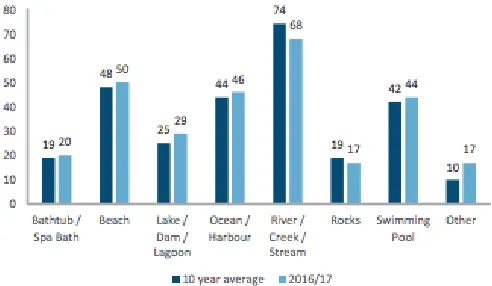
locations. This situation has not significantly changed as can be seen from last year’s statistics from the Royal Life Saving Society Australia (see Figure 2).
Figure 2. Drowning Deaths by location 2016/2017
The findings from the report further highlighted that
Inland waterways contain many aquatic environments where drowning
deaths occur such as rivers, lakes, dams, irrigation channels, water tanks and creeks.
The flat, still surface of an inland waterway can give a false sense of security
and lack of risk.
Submerged objects, like branches or rocks, are often invisible from above
the surface and present a real risk of neck and spinal injuries, especially to people diving headfirst into the water while recreating.
The conditions described are not unlike the waterways in the Northern Hemisphere although in comparison to the northern hemisphere the risks associated with cold water shock or hypothermia are not as great in this area of Australia. Nevertheless, the dangers are real and as a large regional center with a wealth of swimming pools and associated swim schools some people tend to feel that drowning prevention can be dealt with solely by enrolling children in swimming lessons. Despite the wealth of anecdotal information, the consensus of some people working in drowning prevention is that there is not enough emphasis on water safety and survival swimming for young children. Commercial swim school operators would tend to disagree and to some degree this is understandable because it is not that water safety isn’t included in the programs. There is enough evidence to suggest that it is included as the bulk of the learn to swim programs follow some well supported national curriculum.
The main point of difference of the DLL program from a commercial swim school is that the primary focus of a swim school is to show improvement to the parents that their child is building their competence as swimmers of strokes by progressing through a hierarchical range of certificates and the achievement of a desirable status. As such, competencies developed through swim schools are not necessarily applied in the context that might be encountered in a natural aquatic environment.
A community group consisting of a range of people with various interests and capability in aquatics and water safety decided to implement a program to better prepare children between the ages of 10-14 years of age for recreating in many of the natural aquatic environments in the south east of the state. This core group of six people brought capabilities in learn to swim, swim coaching, aquatic facility administration, and lifesaving, water safety and drowning prevention.
From the outset, a great deal of effort was put into communicating to the wider community and the various learn-to-swim centers that this was not an activity that competes with the commercial sector; it was intended to be strictly a water safety program designed to develop the water competency of participants in natural waterways.
Barriers such as cost and transport were addressed by the contribution of the Toowoomba Regional Council to waive entry fees to the various aquatic centers throughout the region. The team of volunteers undertook the travel component to the centers of Oakey, Crows Nest, Millmerran, and Clifton for the pool and CPR sessions. These sessions were conducted during school hours to remove any conflict and school bus commitments after school. We were also able to source government grants to purchase a range of resources and equipment such swim caps, rash shirts, brochures, rescue tubes, and boards as well as training packs from RLSSA.
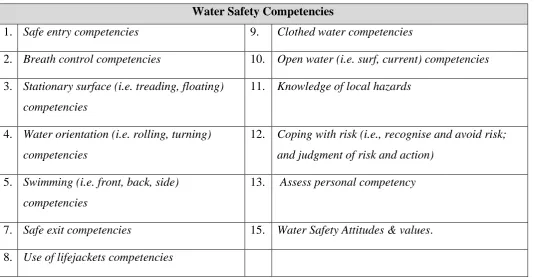
The point of reference that we applied in developing the pedagogy was based on the work of Stallman, Moran, Quan, & Langendorfer, (2017) as it provided a broad framework (see Table 1) that did not require participants to meet the requirements of a checklist mapped to a certificate.
Table 1. Water safety competencies (adapted from Stallman et al., 2017)
Water Safety Competencies
1. Safe entry competencies 9. Clothed water competencies
2. Breath control competencies 10. Open water (i.e. surf, current) competencies
3. Stationary surface (i.e. treading, floating)
competencies
11. Knowledge of local hazards
4. Water orientation (i.e. rolling, turning)
competencies
12. Coping with risk (i.e., recognise and avoid risk;
and judgment of risk and action)
5. Swimming (i.e. front, back, side)
competencies
13. Assess personal competency
7. Safe exit competencies 15. Water Safety Attitudes & values.
The core competencies that we incorporated into the program included
• Learning safe entries and exits from water
• Appropriate use of personal floatation devices (PFD)
• Identifying hazards & assessing risks associated with aquatic environments
• Use basic rescue skills to help a friend
o Reaching with limbs or objects
o Throwing a floating object
• Performing cardiopulmonary resuscitation (CPR)
• Clothed swimming
• Appropriate use of flotation aids for rescues
o Balls
o Eskys
For the open water activities such as at the beach sessions were conducted on the actual conditions such as rip currents that likely would be encountered.
Another critical aspect that was incorporated into the program was to involve parents in the water with their children, either as active participants or to provide water safety information in the water or out of the water. The expectation was that by having the parents involved, they would reinforce the messages and learn some valuable information from the program to support their children when recreating in aquatic environments.
The actual name Downs Little Lifeguards (DLL) was chosen with the intention to make a clear statement to highlight the water safety component. The Downs reference is a portion of the name Darling Downs assigned to the region (Queensland Places 2018). The other objective was to promote a strong message about personal survival of the participants and developing the capability to survive unexpected aquatic situations that might be hazardous to the individual.
As a community, the expectations and focus have been consistent and the program has received widespread acknowledgement through the local media. The DLL gained national recognition in 2017 by the Royal Life Saving Society of Australia when they received the inaugural Aquatic Industry Safety
Award (see
https://www.ausleisure.com.au/news/water-safety-education-message-secures-royal-life-saving-award-for-milne-ba/).
Defining Water Competence
Historically water safety and aquatic programs have been based on what is now widely recognized as being competency-based training (CBT). The International Life Saving Federation (ILS) qualifications that are accredited and used by member organizations currently are based on the candidates achieving competency in the respective certified courses (ILS, 2018).
From a vocational education perspective competency-based training systems have been adopted through the establishment of national Qualifications Frameworks in forty-seven countries since the latter part of the Twentieth Century with many adopting such frameworks in Europe since the outcomes of
the Bologna Process in 1999 (Reinalda, 2008).
Defining and assessing competency of participants’ in swimming and water safety is an issue that has remained somewhat unresolved for the DLL team. In the Australian context, a person who is described or recognized as being competent has the attributes to enable them to perform tasks and skills to an appropriate standard. The concept of standard ideally is a critical competence factor based upon what has been researched, identified, and documented by the relevant vocational or industry body. The endorsed industry/vocational standards can then be employed by qualified assessors to make determinations as to a person’s competence for recognition/ qualifications. For example, from a lifesaving perspective the lifeguard qualification is an example of a competency-based award that is attained by people whether they are volunteers or paid and the qualification is re-assessed each year to confirm currency.
At first glance the DLL situation, which had individuals on the team who developed the program and who had assessment expertise, seemed relatively straight forward. The challenge was more about what standards should apply when the ages and skill levels of the participants were variable (10-14 years on average) and their swimming skills were not critical components, but more of a point of reference. Examples of frameworks that could be referred to include the National Swimming and Water Safety Framework developed by the Royal Life Saving Society Australia (RLSSA, 2017). This framework is of significant value due to the high-level industry input derived through a national symposium with industry stakeholders.
The primary outcome that we wanted was to develop the competency of participants to ensure their safety in and around inland waterways, not just in a swimming pool environment. As Stevenson (2001) has said, we want to encourage a holistic approach to teaching and learning, which develops “plural ways of knowing,” or about the application of knowledge and skills, not just performance of skills.
The concerns are well based as we have witnessed a decline in the swimming skill levels of Australian children as reported by RLSSA research (2012). Even in the most recent DLL activities we had a small number of children who came along to participate in the program who could not swim. We used the opportunity to get them in the water using personal floatation devices and to participate as an active learner in CPR and the discussions about the risks associated with the water.
Another concern was that out of the total number of the participants few participated in the other aquatic settings with the clear majority being satisfied to be involved in pool activities only. Very few committed to the days at the dam and at the beach. In our view these were arguably the most important events to attend to reinforce the competency of the participants in open water environments.
More recently in the state of Queensland there has been a concerted campaign initiated through print media about swimming and water safety
programs offered by schools. The Courier Mail newspaper and its regional
centers ran a daily two-week campaign until there was some action by the government with a subsequent announcement in August of renewed effort in this area (see Figures 3, 4, & 5). The question arose then about the level of competency as perceived by the wider community and stakeholders.
Figure 4. Poorer swimming performance in Queensland
Figure 5. Announcements about new school swimming program
What About Capability?
Another stream of thought that could be relevant to planning, implementing, and evaluating an effective swimming and water safety program for inland waterways is the concept of developing capability in children in and around the water. Advocates argue that capability is an alternative that goes beyond
vocational/occupational competency approaches. Stallman et al. (2017) emphasized that all competencies are contextual. According to Hase and Kenyon (2003) a core element of capability is a self-determined continuous learning or “heutagogy.
The focus of capability is important to DLL participants to ensure that they are future-oriented in the sense of identifying what one needs to do or develop in and around the water, to be effective in extreme or unfamiliar contexts or situations that are likely to occur in inland waterways. Though as mentioned earlier, such appreciation of competence has not necessarily been understood.
Conclusion
The DLL program has demonstrated over the past four years a strong commitment to ensuring that children in regional and rural centers gain some first-hand skills and capability in and around a range of aquatic settings including pool, broken water, fast flowing water, and in surf conditions. Taking into consideration these varied aquatic contexts and tasks ought to better prepare children and build a sense of awareness of the potential risk of each encounter with water (especially inland waterways).
In each application since the inception of the program we have been able to encourage learning to achieve competency and safe practices by the participants and to involve families actively in the learning process to highlight the enjoyment of safe aquatic leisure activities. Though as mentioned earlier, the competency has not necessarily been applicable in all settings which remains a major concern because there is an existing misconception that hypothetical “swimming capability” will in some manner ‘drownproof’ our children.
Finally, we come back to the initial question that prompted this paper when we stop to consider the strategies, activities, and skills involved in our water safety and survival program: “Are the children involved in our programs safe in open water or are they simply competent to be in pool water?”
References
Hase, S., & Kenyon, C. (2007). Heutagogy: A child of complexity theory.
Complicity: An International Journal of Complexity and Education,
4(1): 111-118.
https://journals.library.ualberta.ca/complicity/index.php/complicity/arti cle/view/8766/7086
ILS International Certificates (2018). International Life Saving Federation
viewed 24 August 2018 https://www.ilsf.org/certification
Royal Life Saving Society Australia (2017). Royal Life Saving National
Drowning Report 2017 viewed 20 August 2018,
Queensland Places (2018). Darling Downs 2018 viewed 23 August 2018,
http://www.queenslandplaces.com.au/darling-downs
Reinalda, R. (2008). The Bologna Process and its achievements in Europe 1999–2007. Journal of Political Science Education, 4(4): 463-476.
https://www.tandfonline.com/doi/full/10.1080/15512160802414012
Royal Life Saving Society – Australia (2012). No child to miss out: Basic swimming and water safety education – The right of all Australian children. Sydney, Australia: Royal Life Saving Society
https://www.royallifesaving.com.au/_data/assets/pdf_file/0014/4901/R LS_BasicSwimmingReport20122.pdf
Stallman, R. K., Moran, K., Quan, L., & Langendorfer, S.J. (2017). From swimming skill to water competence: Towards a more inclusive
drowning prevention future. International Journal of Aquatic Research
and Education, 10(2), Article 3. DOI: 10.25035/ijare.11.02.03
Stevenson, J. (2001). Vocational knowledge and its specification. Journal of
Vocational Education and Training, 53(4): 647-662.
https://www.tandfonline.com/doi/abs/10.1080/13636820100200182
Wheelahan, L. (2007). How competency-based training locks the working
class out of powerful knowledge: A modified Bernsteinian analysis. British
Journal of Sociology of Education, 28(5): 637–651.