A PAIR OF GIANT PLANETS AROUND THE EVOLVED INTERMEDIATE-MASS STAR HD 47366:
MULTIPLE CIRCULAR ORBITS OR A MUTUALLY RETROGRADE CONFIGURATION
Bun’ei Sato1, Liang Wang2, Yu-Juan Liu2, Gang Zhao2, Masashi Omiya3, Hiroki Harakawa3, Makiko Nagasawa4, Robert A. Wittenmyer5,6, Paul Butler7, Nan Song2, Wei He2, Fei Zhao2, Eiji Kambe8, Kunio Noguchi3, Hiroyasu Ando3, Hideyuki Izumiura8,9, Norio Okada3, Michitoshi Yoshida10, Yoichi Takeda3,9, Yoichi Itoh11,
Eiichiro Kokubo3,9, and Shigeru Ida12 1
Department of Earth and Planetary Sciences, Tokyo Institute of Technology, 2-12-1 Ookayama, Meguro-ku, Tokyo 152-8551, Japan;[email protected]
2
Key Laboratory of Optical Astronomy, National Astronomical Observatories, Chinese Academy of Sciences, Beijing 100012, China
3
National Astronomical Observatory of Japan, 2-21-1 Osawa, Mitaka, Tokyo 181-8588, Japan
4
Department of Physics, Kurume University School of Medicine, 67 Asahi-machi, Kurume-city, Fukuoka 830-0011, Japan
5
School of Physics, University of New South Wales, Sydney 2052, Australia
6
Australian Centre for Astrobiology, University of New South Wales, Sydney 2052, Australia
7
Department of Terrestrial Magnetism, Carnegie Institution of Washington, 5241 Broad Branch Road, NW, Washington, DC 20015-1305, USA
8
Okayama Astrophysical Observatory, National Astronomical Observatory of Japan, Kamogata, Okayama 719-0232, Japan
9
The Graduate University for Advanced Studies, Shonan Village, Hayama, Kanagawa 240-0193, Japan
10
Hiroshima Astrophysical Science Center, Hiroshima University, Higashi-Hiroshima, Hiroshima 739-8526, Japan
11
Nishi-Harima Astronomical Observatory, Center for Astronomy, University of Hyogo, 407-2, Nishigaichi, Sayo, Hyogo 679-5313, Japan
12
Earth-Life Science Institute, Tokyo Institute of Technology, 2-12-1 Ookayama, Meguro-ku, Tokyo 152-8551, Japan Received 2015 October 16; accepted 2016 January 16; published 2016 February 26
ABSTRACT
We report the detection of a double planetary system around the evolved intermediate-mass star HD 47366 from precise radial-velocity measurements at the Okayama Astrophysical Observatory, Xinglong Station, and Australian Astronomical Observatory. The star is a K1 giant with a mass of 1.81±0.13Me, a radius of 7.30±0.33Re, and solar metallicity. The planetary system is composed of two giant planets with minimum masses of1.75 0.17 M
0.20 J
-+ and
M
1.86-+0.160.15 J, orbital periods of363.3-+2.42.5days and684.7-+5.04.9days, and eccentricities of0.089-+0.0600.079and0.278-+0.0940.067,
respectively, which are derived by a double Keplerian orbitalfit to the radial-velocity data. The system adds to the population of multi-giant-planet systems with relatively small orbital separations, which are preferentially found around evolved intermediate-mass stars. Dynamical stability analysis for the system revealed, however, that the best-fit orbits are unstable in the case of a prograde configuration. The system could be stable if the planets were in 2:1 mean-motion resonance, but this is less likely, considering the observed period ratio and eccentricity. A present possible scenario for the system is that both of the planets have nearly circular orbits, namely the eccentricity of the outer planet is less than ∼0.15, which is just within 1.4σ of the best-fit value, or the planets are in a mutually retrograde configuration with a mutual orbital inclination larger than 160°.
Key words:planetary systems– stars: individual(HD 47366)– techniques: radial velocities
1. INTRODUCTION
Evolved stars (giants and subgiants)have been extensively searched for the last 10 years, aiming to explore planets around more massive stars than the Sun and to investigate the orbital evolution of planetary systems during the post-main-sequence phase. Precise radial-velocity surveys have discovered about 120 substellar companions around such evolved stars13so far, and they are now known to exhibit statistical properties that are not necessarily similar to those around solar-type stars (e.g., Hatzes et al. 2005, 2006; Setiawan et al. 2005; Lovis & Mayor 2007; de Medeiros et al. 2009; Döllinger et al. 2009; Johnson et al.2011; Wittenmyer et al.2011; Omiya et al.2012; Wang et al.2012,2014; Novak et al.2013; Sato et al.2013b; Lee et al.2014; Trifonov et al.2014; Jones et al.2015; Reffert et al. 2015). Recently, very-high-precision photometry by the Kepler space telescope has succeeded in detecting planetary transits on evolved stars(Batalha et al. 2013). The discoveries include short-period planets and sub-Jupiter-mass ones around giants (Huber et al. 2013; Ciceri et al. 2015; Lillo-Box et al.
2014; Ortiz et al. 2015; Quinn et al. 2015; Sato et al. 2015), which had rarely been found by the ground-based radial-velocity surveys, and also candidates with longer periods, which could be counterparts of those found by the radial-velocity surveys.14
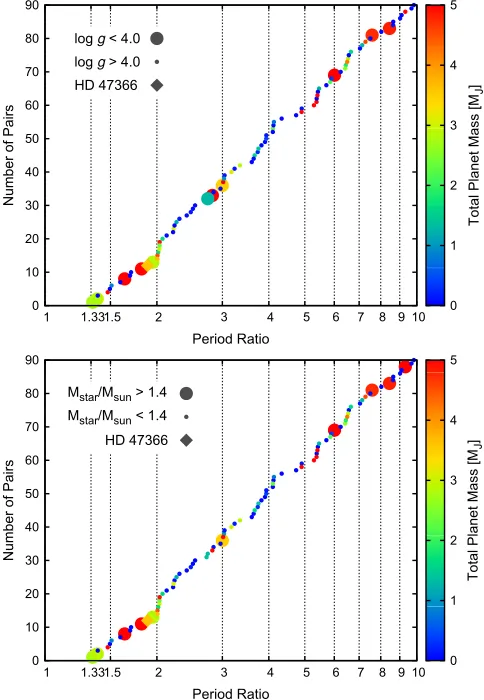
Among the planetary systems around evolved stars, multi-ple-planet systems are of particular interest in terms of the formation and evolution of planetary systems. Figure1shows the cumulative number of planet pairs in multiple-planet systems discovered by ground-based, radial-velocity, and transit surveys. The total mass of the planet pair, as well as thelog g and mass of the host star, are indicated by the color and size of the symbol, respectively. Interestingly, almost all of the giant-planet pairs with period ratios smaller than two are preferentially found around evolved intermediate-mass stars.15 For example, 24 Sex (G5 IV; Johnson et al. 2011)and η Cet (K2 III; Trifonov et al.2014)host double giant-planet systems probably in mean-motion resonances of 2:1, which suggests that these systems have experienced differential convergent © 2016. The American Astronomical Society. All rights reserved.
13
Evolved stars here include those with logarithmic surface gravity
g
log <4.0. The list of the stars harboring substellar companions is from the NASA Exoplanet Archive.
14
NASA Exoplanet Archive.
15
orbital migration(e.g., Lee & Peale2002; Kley et al.2004). In contrast, double giant-planet systems around HD 200964 (K0 IV; Johnson et al. 2011)and HD 5319(G5 IV; Robinson et al. 2007; Giguere et al. 2015) are near the 4:3 resonance, which are considered to be difficult to form either via convergent migration, scattering, or in situ formation (Rein et al.2012). BD+20 2457(K2 III)hosts two brown dwarfs that are suggested to be near 3:2 resonance(Niedzielski et al.2009). However, a detailed orbital stability analysis of the system revealed that the best-fit orbits derived by radial-velocity data are unstable, though they would be stable if the two brown dwarfs were mutually in retrograde configuration (Horner et al.2014). Giant-planet pairs with such small period ratios are rarely found around solar-type stars, though many less massive
ones including Neptunes and Super-Earths are found
around them.
Here we report the detection of a double giant-planet system
around the intermediate-mass giant HD 47366 (K1 III,
M=1.8 M), which adds to the growing population of multi-planet systems with small period ratios around evolved stars. The discovery was made by Okayama and Xinglong Planet Search Programs (e.g., Wang et al. 2012; Sato et al. 2013b) facilitated by joint precise radial-velocity
observations from the Australian Astronomical Observatory (Sato et al. 2013a). The planetary system is intriguing for several reasons: the best-fit Keplerian orbit is unstable, it is near but less likely in 2:1 mean-motion resonance, and could be stable if the orbits are nearly circular or in retrograde configuration.
The rest of the paper is organized as follows. The stellar properties are presented in Section 2and the observations are described in Section 3. The orbital solution and results of dynamical stability analysis are presented in Sections4and5, respectively. Section6is devoted to discussion and summary.
2. STELLAR PROPERTIES
HD 47366(HIP 31674, BD−12 1566, HR 2437, TYC 5373-2001-1) is listed in the HIPPARCOSCATALOGUE (ESA 1997) as a K1 III star, with a visual magnitude of V=6.11 and a color index of B−V=0.994. The Hipparcos parallax
π=12.5±0.42 mas (van Leeuwen 2007) corresponds to a distance of 80.0±2.7 pc. The reddening E(B−V)=0.028 was obtained from the Galactic dust map of Schlegel et al. (1998), with the correction given by Bonifacio et al.(2000)and a scaling factor of 1 -exp( ∣-dsinb h∣ ), where d is the distance,bis the Galactic latitude, andh=125 pc is the scale height of the reddening layer. The absolute magnitude MV=1.51 was derived from the distance and the interstellar
extinction AV=3.1E(B−V). By adopting the broadband
photometric color B−V and the estimated metallicity with the empirical calibration relation of Alonso et al.(1999,2001), we derived the bolometric correction B.C.=−0.309 and the effective temperature Teff=4866±100 K. We used a high signal-to-noise ratio (S/N∼200), iodine-free spectrum taken with HRS to measure the equivalent widths(EWs)of∼30 FeI lines, to derive the iron abundance [Fe/H]. The line lists as well as their oscillation strengths (loggf) were mainly taken from Hekker & Meléndez (2007), in which iron lines were carefully selected to avoid any blend by atomic or CN lines. The model atmosphere used in this work was interpolated from the line-blanketed, local thermodynamic equilibrium (LTE) ATLAS9-ODFNEW grid (Castelli & Kurucz 2004). The microturbulent velocity vt was obtained by minimizing the
trend between the abundances of different FeI lines and their reduced equivalent widths (log EWs( l)). The macroturbulent velocity was estimated with the empirical relations of vmacro
versus Teff given by Hekker & Meléndez (2007), and the
projected rotational velocity (vsini) was determined with the method of Fekel (1997). The stellar mass, surface gravity (logg), radius, and age were derived using a Bayesian approach with the Geneva database(Lejeune & Schaerer2001), which includes the post-helium flash phases for stars with M 1.7Me. First, we interpolated an extensive grid of evolutionary tracks, with ΔM=0.05 within 1.2M/Me
3.6, Δ[Fe/H]=0.02 within −0.4[Fe/H]+0.3, and 500 points in each track. Then, for each data point, we calculated the likelihood functions oflogL,Teffand[Fe/H]to
[image:2.612.47.289.53.403.2]match the observed values by assuming Gaussian errors. We adopted uniform prior probabilities of mass and [Fe/H]. It is noted that stars evolving more slowly have a higher probability of being observed. Without correcting this evolu-tion effect, the resulting parameters would bias toward the rapid evolution phases. We therefore weighted the probability of each point along its evolutionary track by the normalized time-step (ai+1,j−ai,j)/(an,j−aa,j), where ai,j is the age of
Figure 1.Cumulative number of planet pairs in multiple-planetary systems discovered with ground-based, radial-velocity, and transit surveys. The pairs with period ratios smaller than 10 are plotted. The color indicates the total mass of the planet pair and the symbol size indicates the log g (top) and mass
the ith interpolated point in the jth track, and n=500 is the number of interpolated points in each track. Eventually, the probability distribution functions(PDFs)of the parameters yield M=1.81±0.13Me, R=7.30±0.33Re, logg=
2.970.06, and age=1.61±0.53 Gyr. The stellar mass is particularly important to derive the minimum masses of the orbiting planets detected with the Doppler technique. However, previous spectroscopic analyses gave discrepant results (1.87Me by Liu et al. 2010; 1.2Me by Mishenina et al. 2006)for HD 47366, which may be due to the different methods on finding Teff and logg. Our determinations were
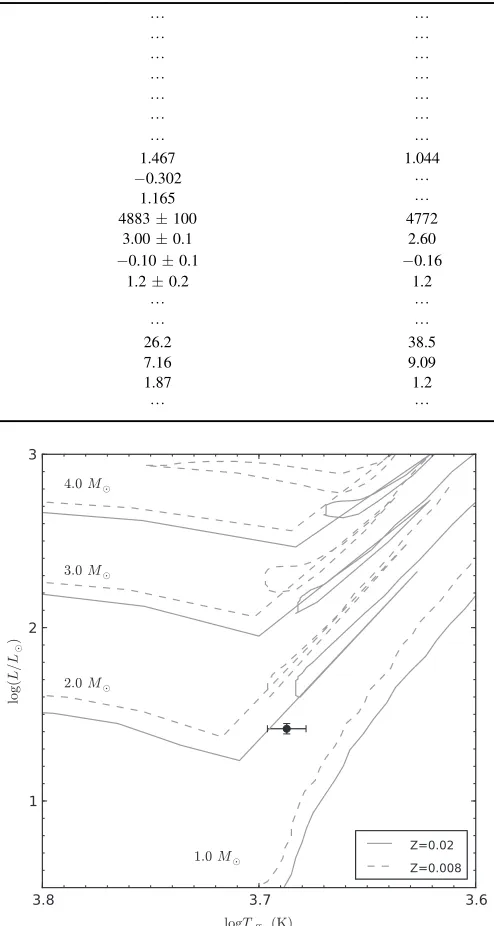
based on a similar method to that of Liu et al.(2010), but used the Geneva evolutionary tracks, instead of the Y2model (Yi et al.2003), which does not account for the evolutionary phases after the helium-core flash. We found that the probability that the star has passed through the RGB tip and in-core helium burning phase is∼88%. The stellar parameters of HD 47366 are listed in Table1. In Figure2, we plotted HD 47366 on the H-R diagram, together with the evolutionary tracks for stars with different masses and metal contents.
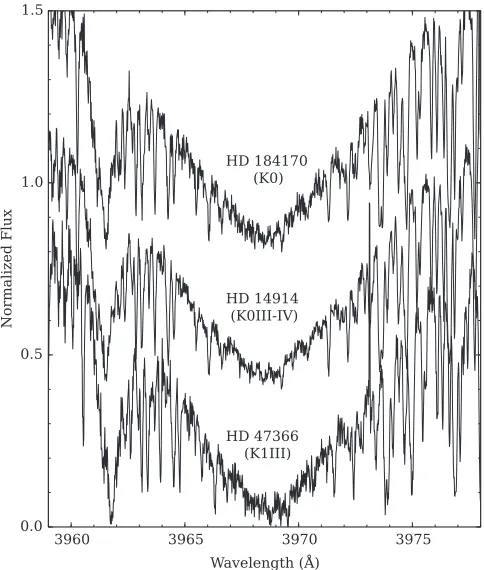
The star shows no significant emission in the core of CaII HK lines, as shown in Figure3, which suggests that the star is chromospherically inactive. We did not analyzeflux variations of CaIIHK lines for the star because of the poor S/N of the core of the lines.
3. OBSERVATIONS
3.1. OAO Observations
Observations of HD 47366 at OAO were made with the
1.88 m reflector and the HIgh Dispersion Echelle
Spectrograph (HIDES; Izumiura 1999) from 2006 December to 2014 April. We used both the conventional slit mode (HIDES-S)and the high-efficiencyfiber-link mode(HIDES-F) of the spectrograph that became available in 2010 (Kambe et al. 2013). In the case of the HIDES-S, a slit width of the spectrograph was set to 200μm (0 76) corresponding to a spectral resolution(R=λ/Δλ)of 67,000 by about a 3.3-pixel
sampling. In the case of HIDES-F, a width of the image sliced by an image slicer is 1 05, corresponding to a spectral resolution of R=55,000 by a 3.8-pixel sampling. Each observing mode uses its own iodine absorption cell for precise radial-velocity measurements (I2 cell; Kambe
[image:3.612.42.570.79.326.2] [image:3.612.320.567.89.552.2]et al. 2002, 2013), which provide a fiducial wavelength reference in a wavelength range of 5000–5800Å. We have obtained a total of 50 and 7 data points of HD 47366 using HIDES-S and HIDES-F mode, respectively. The reduction of echelle data(i.e., bias subtraction, flat-fielding, scattered-light
Table 1
Stellar Parameters for HD 47366
Parameter This Work Liu et al.(2010) Mishenina et al.(2006)
Spectral Type K1 III L L
HipparcosParallaxπ(mas) 12.5±0.42 L L
Distance(pc) 80.0±2.7 L L
Visual MagnitudeV 6.11 L L
Color IndexB−V 0.994±0.002 L L
RedenningE B( -V) 0.028 L L
Interstellar ExtinctionAV 0.087 L L
Absolute MagnitudeMV 1.51 1.467 1.044
Bolometric Correction B.C. −0.309 −0.302 L
Bolometric MagnitudeMbol 1.20 1.165 L
Effective TemperatureTeff(K) 4866±100 4883±100 4772
Surface Gravitylogg(cgs) 2.97±0.06 3.00±0.1 2.60
Metallicity[Fe/H] −0.02±0.09 −0.10±0.1 −0.16
Microturbulent Velocityvt(km s−1) 1.24 1.2±0.2 1.2
Macroturbulent Velocityvmacro(km s−1) 5.54±0.45 L L
Projected Rotational Velocityvsini(km s−1) 4.3±0.8 L L
LuminosityL(Le) 26.1±1.8 26.2 38.5
RadiusR(Re) 7.30±0.33 7.16 9.09
MassM(Me) 1.81±0.13 1.87 1.2
Age(Gyr) 1.61±0.53 L L
Figure 2. HD 47366 (solid circle) on the H-R diagram. The error bars correspond to the derived uncertainties oflogLandTeff. The solid and dashed
lines represent the evolutionary tracks from Lejeune & Schaerer(2001)for stars of M=1∼4Me with Z=0.02 (solar metallicity) and Z=0.008,
subtraction, and spectrum extraction)was performed using the IRAF16software package in the standard way.
We performed a radial-velocity analysis following the method of Sato et al. (2002, 2012) and Butler et al. (1996), in which an I2-superposed spectrum is modeled as a product of
a high-resolution I2and a stellar template spectrum convolved
with a modeled point-spread function (PSF) of the spectro-graph. We model the PSF using multiple Gaussian profiles (Valenti et al. 1995) and obtain the stellar spectrum by deconvolving a pure stellar spectrum with the spectrograph PSF estimated from an I2-superposed B-star spectrum. We
obtained a typical measurement error in radial-velocity of about 4–5 m s−1for the star, which was estimated from an ensemble of velocities from each of the∼300 spectral chunks(each∼3Å long)in every exposure. We listed the derived radial velocities
for OAO data in Table 2 together with the estimated
uncertainties.
3.2. Xinglong Observations
Observations of HD 47366 at the Xinglong Station started in 2006 November using the 2.16 m reflector and the Coudé Echelle Spectrograph (CES; Zhao & Li 2001). We used the blue-arm, middle focal length camera, and 1 K×1 K CCD (pixel size of 24×24μm2; hereafter CES-O) of the spectro-graph, which covered a wavelength range of 3900–7260Åwith a spectral resolution of 40,000 by 2-pixel sampling. Although a wide wavelength range was obtained with a single exposure,
only a wave band of Δλ∼470Å was available for radial-velocity measurements using an I2 cell because of the small
[image:4.612.48.290.51.336.2]format of the CCD. Radial-velocity analysis for CES data was performed by the optimized method of Sato et al. (2002)for
Figure 3.Spectra in the region of CaIIH lines. Stars with similar spectral types to HD 47366 in our sample are also shown. A vertical offset of about 0.4 is added to each spectrum.
Table 2
OAO Radial Velocities for HD 47366
JD−2450000 Velocity(m s-1) Uncertainty(m s-1) Mode
4093.18674 11.36 4.59 HIDES-S
4144.11514 −19.66 4.69 HIDES-S
4172.01541 −18.29 3.85 HIDES-S
4467.12999 −4.46 4.31 HIDES-S
4553.97104 −31.25 4.14 HIDES-S
4755.29094 32.92 3.46 HIDES-S
4796.25711 36.33 4.17 HIDES-S
4818.17076 19.49 3.87 HIDES-S
4823.11554 14.96 4.17 HIDES-S
4834.16358 12.38 4.36 HIDES-S
4856.08725 −6.42 3.92 HIDES-S
4863.09739 −6.67 4.41 HIDES-S
4864.03798 −11.43 3.60 HIDES-S
4883.04016 −7.18 4.55 HIDES-S
4923.93523 −17.64 3.73 HIDES-S
5108.31507 40.77 4.18 HIDES-S
5131.32409 47.90 3.57 HIDES-S
5161.34584 39.99 4.64 HIDES-S
5182.16055 11.19 4.10 HIDES-S
5204.11564 −7.29 4.29 HIDES-S
5232.99361 −43.84 3.62 HIDES-S
5267.01163 −60.09 3.57 HIDES-S
5294.93562 −62.39 3.54 HIDES-S
5471.29879 24.76 3.61 HIDES-S
5502.23739 33.89 4.15 HIDES-S
5525.22640 33.98 4.85 HIDES-S
5545.21850 18.86 3.73 HIDES-S
5581.04001 −12.92 3.75 HIDES-S
5611.01311 −8.59 4.13 HIDES-S
5625.02350 −13.62 3.49 HIDES-S
5656.93188 −10.50 3.74 HIDES-S
5854.27845 33.84 3.69 HIDES-S
5877.25348 18.63 5.42 HIDES-S
5882.29779 12.23 3.83 HIDES-S
5922.13357 −12.73 3.88 HIDES-S
5938.09758 −34.44 3.79 HIDES-S
5976.03887 −49.42 4.57 HIDES-S
6010.93116 −64.77 5.74 HIDES-S
6032.96687 −55.43 4.48 HIDES-S
6215.30762 27.47 4.04 HIDES-S
6235.27265 41.83 3.68 HIDES-S
6249.30138 27.36 4.69 HIDES-S
6284.08997 −0.00 4.69 HIDES-S
6552.29701 42.87 5.53 HIDES-S
6577.28414 4.35 4.84 HIDES-S
6578.28739 14.21 4.48 HIDES-S
6578.30265 14.55 4.27 HIDES-S
6579.25810 12.00 5.63 HIDES-S
6618.19944 4.11 3.91 HIDES-S
6753.98409 −63.39 4.45 HIDES-S
6609.21551 21.82 4.04 HIDES-F
6616.27916 33.33 3.44 HIDES-F
6664.09442 −1.41 4.02 HIDES-F
6672.05938 −16.16 3.85 HIDES-F
6697.15561 −9.17 4.70 HIDES-F
6713.98988 −17.94 4.87 HIDES-F
6727.00570 −12.14 3.47 HIDES-F
16
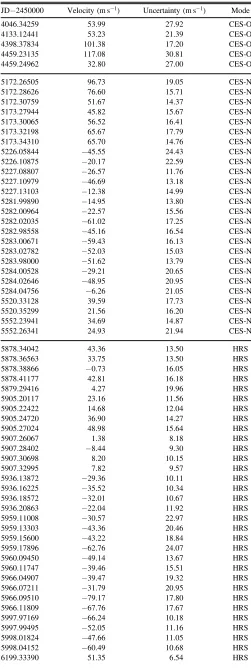
[image:4.612.316.568.73.667.2]CES(Liu et al.2008). We tookfive data points for HD 47366 using CES-O from 2006 November to 2007 December whose radial-velocity uncertainties were better than 25 m s−1. In 2009 March, the old CCD was replaced by a new CCD having a smaller pixel size (2 K×2 K, 13×13μm2), and it gave a better radial-velocity precision than before, though the wavelength coverage was unchanged (Wang et al. 2012). We made observations of HD 47366 using the new CCD(hereafter CES-N)from 2009 December to 2010 December, and collected a total of 26 data points with a radial-velocity precision of 12–25 m s−1depending on weather conditions.
Since 2011 November, we have observed HD 47366 with the newly developed High Resolution Spectrograph (HRS) attached at the Cassegrain focus of the 2.16 m telescope. The fiber-fed spectrograph is the successor of the CES, giving a higher wavelength resolution and throughput. The single 4 K×4 K CCD provides a simultaneous wavelength coverage of 3700–9200Å, and the slit width of 190μm gives a wavelength resolution of R=45,000 with a 3.2-pixel sampling. An iodine cell is installed before thefiber entrance at the Cassegrain focus. We collected a total of 60 observations for the star from 2011 November to 2014 March. Radial-velocity analysis for the HRS data was performed by the same method as Sato et al.(2002,2012), but optimized for HRS. The resulting measurement errors in radial velocity are ranging from 6 to 20 m s−1 depending on weather conditions. The derived radial velocities for Xinglong data are listed in Table3
together with the estimated uncertainties.
3.3. AAT Observations
Since the inner planet has a period near one year, and HD 47366 is quite far south for OAO, we obtained confi rma-tion observarma-tions from the 3.9-m Anglo-Australian Telescope (AAT). This multi-telescope approach was also critical for the
confirmation of the 360-day planet HD 4732b (Sato
et al. 2013a). The UCLES echelle spectrograph (Diego et al. 1990) delivers a resolving power of R∼45,000 with the 1-arcsecond slit, and has been used for 16 years by the Anglo-Australian Planet Search(e.g., Butler et al.2001; Tinney et al.2001; Jones et al.2010; Wittenmyer et al.2012b,2014). Calibration of the spectrograph point-spread function is achieved using an iodine absorption cell temperature-controlled at 60.0±0.1°C. The iodine cell superimposes a forest of narrow absorption lines from 5000 to 6200Å, allowing for the simultaneous calibration of instrumental drifts as well as a precise wavelength reference (Valenti et al. 1995; Butler et al.1996). The result is a precision Doppler velocity estimate for each epoch, along with an internal uncertainty estimate, which includes the effects of photon-counting uncertainties, residual errors in the spectrograph PSF model, and variation in the underlying spectrum between the iodine-free template and epoch spectra observed through the iodine cell. HD 47366 was observed at 13 epochs between 2013 March and 2014 April; the AAT velocities are given in Table4.
4. ORBIT FITTING AND PLANETARY PARAMETERS
[image:5.612.317.568.73.742.2]The collected radial-velocity data for HD 47366 obviously show a variation with a period near one year. Although the one- year periodicity and the relatively low declination of the star allowed us to cover only half of the cycle, we can clearly see the periodic variation of the velocity amplitude every year,
Table 3
Xinglong Radial Velocities for HD 47366
JD−2450000 Velocity(m s-1) Uncertainty(m s-1) Mode
4046.34259 53.99 27.92 CES-O
4133.12441 53.23 21.39 CES-O
4398.37834 101.38 17.20 CES-O
4459.23135 117.08 30.81 CES-O
4459.24962 32.80 27.00 CES-O
5172.26505 96.73 19.05 CES-N
5172.28626 76.60 15.71 CES-N
5172.30759 51.67 14.37 CES-N
5173.27944 45.82 15.67 CES-N
5173.30065 56.52 16.41 CES-N
5173.32198 65.67 17.79 CES-N
5173.34310 65.70 14.76 CES-N
5226.05844 −45.55 24.43 CES-N
5226.10875 −20.17 22.59 CES-N
5227.08807 −26.57 11.76 CES-N
5227.10979 −46.69 13.18 CES-N
5227.13103 −12.38 14.99 CES-N
5281.99890 −14.95 13.80 CES-N
5282.00964 −22.57 15.56 CES-N
5282.02035 −61.02 17.25 CES-N
5282.98558 −45.16 16.54 CES-N
5283.00671 −59.43 16.13 CES-N
5283.02782 −52.03 15.03 CES-N
5283.98000 −51.62 13.79 CES-N
5284.00528 −29.21 20.65 CES-N
5284.02646 −48.95 20.95 CES-N
5284.04756 −6.26 21.05 CES-N
5520.33128 39.59 17.73 CES-N
5520.35299 21.56 16.20 CES-N
5552.23941 34.69 14.87 CES-N
5552.26341 24.93 21.94 CES-N
5878.34042 43.36 13.50 HRS
5878.36563 33.75 13.50 HRS
5878.38866 −0.73 16.05 HRS
5878.41177 42.81 16.18 HRS
5879.29416 4.27 19.96 HRS
5905.20117 23.16 11.56 HRS
5905.22422 14.68 12.04 HRS
5905.24720 36.90 14.27 HRS
5905.27024 48.98 15.64 HRS
5907.26067 1.38 8.18 HRS
5907.28402 −8.44 9.30 HRS
5907.30698 8.20 10.15 HRS
5907.32995 7.82 9.57 HRS
5936.13872 −29.36 10.11 HRS
5936.16225 −35.52 10.34 HRS
5936.18572 −32.01 10.67 HRS
5936.20863 −22.04 11.92 HRS
5959.11008 −30.57 22.97 HRS
5959.13303 −43.36 20.46 HRS
5959.15600 −43.22 18.84 HRS
5959.17896 −62.76 24.07 HRS
5960.09450 −49.14 13.67 HRS
5960.11747 −39.46 15.51 HRS
5966.04907 −39.47 19.32 HRS
5966.07211 −31.79 20.95 HRS
5966.09510 −79.17 17.80 HRS
5966.11809 −67.76 17.67 HRS
5997.97169 −66.24 10.18 HRS
5997.99495 −52.05 11.16 HRS
5998.01824 −47.66 11.05 HRS
5998.04152 −60.49 10.68 HRS
indicating the existence of a second period near two years. Thus we performed the least-squares orbitalfitting by a double Keplerian model. The orbital parameters and the uncertainties were derived using the Bayesian Markov Chain Monte Carlo (MCMC) method (e.g., Ford 2005; Gregory 2005; Ford & Gregory 2007), following the analysis in Sato et al. (2013b). We took account of velocity offsetsΔRV of HIDES-F, CES-O, CES-N, HRS, and AAT data relative to HIDES-S data as free parameters in the orbital fitting. Extra Gaussian noises s for each of the six data sets were also incorporated as free parameters, though those for CES-O(s3)and HRS(s5)arefixed
to 0 since their rms scatters to the best-fit orbit are comparable to their measurement errors. We generated five independent chains having 107points with acceptance rates of about 25%,
thefirst 10% of which were discarded, and confirmed that each parameter was sufficiently converged based on the Gelman-Rubbin statistic (Gelman & Rubin 1992). We derived the median value of the merged posterior PDF for each parameter and set a 1σ uncertainty as the range between 15.87% and 84.13% of the PDF.
In Figures 4 and 5, we plot the derived Keplerian orbits together with the radial-velocity points and their measurement errors including the extra Gaussian noises. The inner planet
(planet b) has orbital parameters of a period of
Pb 363.3 2.4 2.5
= -+ days, an eccentricity of e 0.089
b 0.060 0.079
= -+ , a
minimum mass of mbsini=1.75-+0.170.20 MJ, and a semimajor
axis ofab 1.214 0.029 0.030
= -+
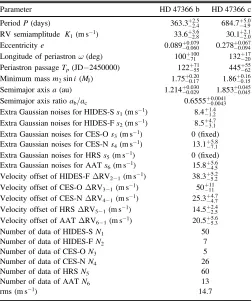
[image:6.612.324.566.51.215.2]au, and the outer planet(planet c)has Pc=684.7-+4.95.0days,ec=0.278+-0.0940.067,mcsini=1.86-+0.150.16 MJ, Table 3
(Continued)
JD−2450000 Velocity(m s-1) Uncertainty(m s-1) Mode
6199.35708 45.59 7.80 HRS
6232.33343 54.89 5.89 HRS
6232.35667 61.48 6.12 HRS
6287.18192 30.60 9.50 HRS
6287.20515 35.52 10.34 HRS
6287.22838 32.06 9.39 HRS
6287.25312 47.44 11.03 HRS
6318.08350 31.16 11.25 HRS
6318.10670 13.27 11.99 HRS
6318.13045 21.01 12.00 HRS
6318.15375 25.07 11.17 HRS
6344.02830 11.76 8.52 HRS
6344.05152 23.29 9.47 HRS
6344.07471 22.34 9.87 HRS
6583.31389 22.42 10.63 HRS
6583.33707 35.39 11.03 HRS
6583.36032 20.96 11.67 HRS
6611.28853 18.21 7.27 HRS
6611.31171 20.81 8.39 HRS
6611.33507 7.72 8.55 HRS
6645.18797 −18.03 12.37 HRS
6645.21133 9.17 12.68 HRS
6645.23463 −12.05 15.41 HRS
6645.25792 −22.92 16.31 HRS
6701.05113 −50.92 11.31 HRS
6701.07444 −55.62 15.95 HRS
6728.98753 −39.22 16.13 HRS
[image:6.612.42.296.72.380.2]6729.01088 −50.79 19.71 HRS
Table 4
AAT Radial Velocities for HD 47366
JD−2450000 Velocity(m s-1) Uncertainty(m s-1)
6374.88737 −4.3 1.2
6375.91758 1.9 1.1
6376.93270 0.0 1.1
6377.98528 −2.0 1.2
6399.91709 13.0 1.4
6526.29116 70.0 1.4
6529.31433 85.4 1.5
6555.29760 63.2 1.5
6556.21605 67.5 1.5
6686.00004 −17.2 1.6
6744.92245 −42.0 1.5
6747.92675 −46.0 1.6
[image:6.612.321.566.286.511.2]6764.87970 −40.9 1.3
Figure 4.Upper: radial velocities of HD 47366 obtained with HIDES-S(red), HIDES-F(blue), CES-O(brown), CES-N(magenta), HRS(cyan), and AAT
(green). The error bar for each point includes the extra Gaussian noise. The double Keplerian model for the radial velocities is shown by the solid line. Bottom: residuals to the Keplerianfit.
Figure 5. Phased radial velocities and the Keplerian models for the inner
[image:6.612.42.295.419.570.2]and ac=1.853-+0.0450.045au. The obtained parameters are listed in
Table5.
The Hipparcos satellite made a total of 158 photometric observations for HD 47366 from 1990 March to 1993 March, and revealed photometric stability for the star down to
σHIP=0.007 mag, though the Hipparcos observations were not contemporaneous with the radial-velocity observations. Figure 6 shows the generalized Lomb–Scargle periodogram (Zechmeister & Kürster 2009) of the Hipparcos photometric data of the star. We did notfind any clue that the radial-velocity variations correlate with the brightness variations of the star. Furthermore, the rotational period of the star can be estimated to be shorter than about 86 days based on its radius R =7.3 R and its projected rotational velocity vsini=
4.3 km s-1(see Table1). This is much shorter than either the
363-day or the 685-day periods observed in radial velocity. Thus the rotational modulation of spots on the stellar surface is not considered to be a viable explanation for the observed radial-velocity variations.
We also performed a spectral line shape analysis for the star, following the method in Sato et al. (2007). Cross-correlation profiles between pairs of stellar templates, each of which were extracted from five I2-superposed spectra at phases of velocity
30 m s 1
~ - (phase 1),~-10 m s-1(phase 2), and~-50 m s-1
(phase 3) by using the method of Sato et al. (2002), were derived for about 110 spectral segments (4–5Åwidth each). Three bisector quantities of the cross-correlation profiles, BVS, BVC, and BVD, were then calculated, which are the velocity difference between the two flux levels of the bisector, the difference of the BVS of the upper and lower halves of the
bisector, and the average of the bisector at three flux levels, respectively. The flux levels of 25%, 50%, and 75% of each cross-correlation profile were used to calculate the above three bisector quantities. As a result, we obtained BVS=
6.65.5 m s-1, BVC= -2.53.0 m s-1, and BVD= 86.1 10.8 m s 1
- - for the cross-correlation profile between
phases 1 and 3, and BVS= -4.14.9 m s-1, BVC=
3.12.6 m s-1, and BVD= -35.1 11.6 m s-1for the one
between phases 2 and 3. The BVD values are consistent with the velocity differences between the phases, and the BVS and BVC values are much smaller than the BVD values. Therefore, we conclude that the observed radial-velocity variations did not originate from the distortion of the spectral lines, but from their parallel shifts, as expected for orbital motion.
5. DYNAMICAL STABILITY
The orbital parameters obtained in Section4were derived by fitting a double Keplerian model to the radial-velocity data, which does not guarantee that the orbits are stable over long periods of time. In order to investigate the orbital stability of the system and to further constrain orbital parameters, we performed a dynamical analysis of the system. We used a fourth-order Hermite scheme for the numerical integration (Kokubo et al.1998).
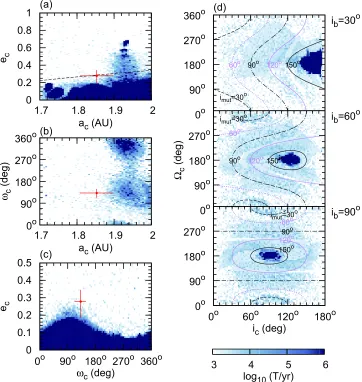
Figure7shows the lifetime of the system, calculated by the 106-year integrations. The lifetime here is defined as the time elapsing before the semimajor axis of one planet deviates by 10% from its initial value. All of the initial orbital parameters for the orbital integrations arefixed to the best-fit ones derived in Section4except for those shown in each axis of each panel. Figures7(a)–(c)shows the lifetime of the system in the(ac,ec), (ac, ωc), and (ωc, ec) planes, respectively. In the panels,
prograde and edge-on orbits(ib=ic=90°)are assumed. The
dashed line in panel (a) shows the orbit-crossing boundary where the apocenter distance of planet b is equal to the pericenter distance of planet c. The planets b and c actually have almost crossing orbits with each other in the case of the best-fit orbits(marked by a red cross in each panel), and, as shown in the figure, they are unstable. Orbits above the boundary line easily become unstable within 1000 years. Stable orbits appearing above the boundary are in the 2:1
mean-Table 5
Orbital Parameters for HD 47366
Parameter HD 47366 b HD 47366 c
PeriodP(days) 363.3-+2.42.5 684.7-+4.95.0
RV semiamplitude K1(m s-1) 33.6-+2.83.6 30.1-+2.02.1
Eccentricitye 0.089-+0.0600.079 0.278-+0.0940.067
Longitude of periastronω(deg) 100-+71100 132-+2017
Periastron passageTp(JD−2450000) 122-+5571 445-+6255
Minimum massm2sini(MJ) 1.75-+0.170.20 1.86-+0.150.16
Semimajor axisa(au) 1.214-+0.0290.030 1.853-+0.0450.045
Semimajor axis ratioab/ac 0.6555-+0.00430.0041
Extra Gaussian noises for HIDES-Ss1(m s-1) 8.4-+1.21.4
Extra Gaussian noises for HIDES-Fs2(m s-1) 8.5-+3.14.7
Extra Gaussian noises for CES-Os3(m s-1) 0(fixed)
Extra Gaussian noises for CES-Ns4(m s-1) 13.1-+7.15.8
Extra Gaussian noises for HRSs5(m s-1) 0(fixed)
Extra Gaussian noises for AATs6(m s-1) 15.8-+4.55.6
Velocity offset of HIDES-FΔRV2−1(m s-1) 38.3-+5.25.2
Velocity offset of CES-OΔRV3−1(m s-1) 50-+1111
Velocity offset of CES-NΔRV4−1(m s-1) 25.3-+4.74.7
Velocity offset of HRSΔRV5−1(m s-1) 14.5-+2.52.4
Velocity offset of AATΔRV6−1(m s-1) 20.5-+5.35.6
Number of data of HIDES-SN1 50
Number of data of HIDES-FN2 7
Number of data of CES-ON3 5
Number of data of CES-NN4 26
Number of data of HRSN5 60
Number of data of AATN6 13
rms(m s-1) 14.7
[image:7.612.321.564.52.235.2]Note.Velocity offsets are the values relative to HIDES-S data.
Figure 6.Generalized Lomb–Scargle periodogram of theHipparcos photo-metric data of HD 47366. The dotted lines indicate False Alarm Probability
[image:7.612.43.295.74.375.2]motion resonance. If ac is near 1.93au with an appropriate
argument of pericenter, the orbits are stable with up toec∼0.7
over 106years thanks to the resonance, though thisacvalue is
beyond the 3σ range of a ab c 0.6555 0.0043 0.0041
(= -+ ) that is well
determined by our radial-velocity data(panel(b)). On the other hand, if ecis smaller than ∼0.15(1.4σaway from the best-fit
value), the orbits are also stable even with the best-fit ac (1.85 au)in prograde configuration(panel(c)).
If the mutual inclination imut between the two planets is
higher than 160°, the orbit becomes stable in a wider parameter range. Figure 7(d) shows the stability map in the plane of inclination (ic) and the ascending node (Ωc) of planet c (ascending node of planet b is set to Ωb=0). The mutual
inclination of planets depends on ib, ic, and Ωc−Ωb as
i i i i i
cos mut=cos bcos c+sin bsin ccos(W - Wc b), and its con-tours are shown by black or purple lines in thefigure. Since the absolute masses of the planets depend on the angle from the line of sight, the cases of three different inclinations for planet b, ib=30°, 60°, and 90°, are shown. The absolute mass of
planet c is also changed according toic. The absolute masses of
planets b and c are inversely proportional to sinib and sinic,
respectively. As seen in thefigure, the orbits withimut∼180° (i.e., mutually retrograde)are stable in all cases. This is because planet encounters occur in a shorter time with higher mutual velocities in the retrograde system compared to the prograde system. This is similar to the case of the two brown-dwarf candidates orbiting BD+20 2457, in which the system is unstable for the prograde orbits, while it is stable for the retrograde orbits(Horner et al.2014).
Figure8 shows the 7×10⁴year evolution of the system. The upper panel shows the evolution of the coplanar retrograde system with the best-fit orbital parameters derived in Section4. Although the outer planet violates the orbit of the inner planet, they are stable over 106years. The bottom panel shows a prograde case with the same orbital parameters except assuming ec,ini=0. As seen in the figure, if the eccentricity of the outer planet is small, the system can keep stable orbits, while the system with the outer planet in eccentric orbit quickly causes orbital crossing and becomes unstable(see Figure7).
Figure 9 shows maps of the stability index
[image:8.612.126.488.53.435.2]D= á ñ - á ñ∣ n2 n1 ∣for the system. From a 5000-year numerical Figure 7.Lifetime of the system. The time elapsing before the semimajor axis of one planet deviates by 10% from its initial value is shown. Since the extent of our numerical integrations is 106years, the lifetime of 106years here means that the system is stable over 106years(dark-blue regions). The red cross represents the best-fittedacandecto the radial-velocity data with their 1σerrors.(a)The diagram ofecvs.ac.(b)The diagram of argument of pericenterωcvs. semimajor axis.(c)Theec– ωcdiagram.(d)The diagram of longitude of ascending nodeΩcvs. inclination from the line of sightic, together with the contours of the mutual inclination. From top
integration, we obtain an average of mean motioná ñn1 of planet
c and subtract it from an average of mean motioná ñn2 obtained
in the next 5000-year orbit (see Couetdic et al. 2010 for the details of the stability analysis). The left and right panels are the maps for prograde and retrograde configuration, respectively. From a comparison with panel(a)of Figure7, wefind that the system is regular when log10D-3. In the case of the retrograde orbit, the orbit is stable even if the eccentricity of the planet c exceeds the orbit-crossing boundary (dashed line) by∼0.1.
6. DISCUSSION AND SUMMARY
We have reported the detection of a double giant-planet system around the K1 giant HD 47366(Må=1.81±0.13Me, Rå=7.30±0.33Re) from precise radial-velocity measure-ments at OAO, Xinglong, and AAT. The inner(planet b)and outer planets(planet c)have minimum masses of1.75 0.17 M
0.20 J
-+ and 1.86-+0.150.16 MJ, semimajor axes of 1.214-+0.0290.030 au and 1.853 0.045
0.045
-+
au, and eccentricities of 0.089 0.060
0.079
-+ and
0.278-+0.0940.067, respectively, which were derived by fitting a
double Keplerian model to the radial-velocity data. The period ratio of the two planets is slightly smaller than 2, and thus the system adds to the growing population of such multi-giant-planet systems with small orbital separation around evolved intermediate-mass stars.
The dynamical analysis of the system revealed, however, that the best-fit orbits in prograde configuration are unstable. We found that it is stable in the following cases: (1)the two planets are in the 2:1 mean-motion resonance, (2) the eccentricity of planet c is less than ∼0.15, (3) the mutual inclination the two planets is larger than 160°(i.e., retrograde configuration).
If the two planets are in the stable 2:1 resonance, the ratio of the semimajor axis should beab/ac∼0.63(ac∼1.93 au)and
the eccentricity of planet c should be 0.5ec0.7 or
0ec0.2 (see Section 5 and the darkest-blue regions in
panel (a) of Figure 7). On the other hand, ab/ac is well
determined from our observations to bea ab c=0.6555-+0.00430.0041
and ec is determined to be ec=0.278-+0.0940.067. Both of these
values deviate from those for the high-eccentricity case with more than 3σ, and thus from the view point of the observational data, it is less likely that the planets are in the high-eccentricity resonance. We cannot completely reject the possibility of the low-eccentricity case. However, considering the semimajor-axis ratio, it is also less likely that the planets are in the resonance.
It is more plausible that the eccentricity of planet c is less than∼0.15. The value is just 1.4σfrom the best-fit value, and the best-fit orbit is consistent with a circular one to the 3σlevel. Thus, it is reasonable to think that the two planets actually have nearly circular orbits and thus they are stable. In this case, the period ratio of the planets is slightly smaller than 2, and they are not in 2:1 resonance.
The third possibility is the most extreme one. Basically, we cannot determine the inclination or the ascending node of a planetary orbit by radial-velocity measurements, and thus we cannot discriminate between prograde and retrograde orbits observationally. Gayon & Bois (2008) and Gayon-Markt & Bois (2009) studied mutually retrograde configurations for some multi-planet systems around solar-type stars and showed that the configurations are dynamically stable and consistent with the radial-velocity observations. Recently, Horner et al. (2014)studied the dynamical stability of a double brown-dwarf system around the giant BD+20 2457(Niedzielski et al.2009), and showed that the prograde orbits best-fitted to the radial-velocity data are unstable, while those in retrograde confi gura-tion are stable. The HD 47366 system is similar to the case of the BD+20 2457 system. Our dynamical analysis showed that the coplanar retrograde configuration for the HD 47366 system is stable in a wider range of orbital parameters including the eccentric ones which are unstable for prograde configuration (see Figure 8). Confirmation of the high eccentricity of the outer planet by continuous observations will strongly support the retrograde hypothesis for the HD 47366 system, though the formation mechanism of such a mutually retrograde system is largely unknown. In any of the above cases, the planetary orbits can be altered by the close encounter of the planets in a relatively short period of time, and thus more detailed dynamical modeling for the observed radial-velocity variations is necessary in order to provide a definitive orbital solution.
The stellar and planetary parameters of HD 47366 system are similar to those of the η Cet system; two massive planets (mbsini=2.6 MJ, mcsini=3.3 MJ), with periods of
Pb=407 days and Pc=740 days and eccentricities of
eb=0.12 and ec=0.08 orbit around a K giant star with a
mass of 1.7Meand a radius of 14.3Re(Trifonov et al.2014). Trifonov et al.(2014)revealed that, for a coplanar confi gura-tion, the system can be stable by being trapped in an anti-aligned 2:1 mean-motion resonance in a region with moderate eb eccentricity, which lies about 1σ away from the best-fit
Keplerian orbits. A much larger non-resonant stable region also exists in low-eccentricity parameter space, though it appears to be much farther from the bestfit than the 2:1 resonant region. This is in contrast with the case of HD 47366 in which low eccentricities of the planets are more plausible than 2:1 resonant configuration. Another possible 2:1 resonant system around an evolved star is 24 Sex, in which two massive planets(mbsini=1.99 MJ,mcsini=0.86 MJ), with periods
ofPb=452.8 days andPc=883.0 days and eccentricities of
[image:9.612.49.292.50.255.2]eb=0.09 andec=0.29 orbit around a G-type subgiant with a
Figure 8. Evolution of semimajor axis, pericenter distance, and apocenter distance of planets b(red lines)and c(blue lines)assumingib=ic=90°. Top:
mass of 1.54Meand a radius of 4.9Re(Johnson et al.2011). The period ratio of the planets is the closest to two of the three systems. Wittenmyer et al.(2012a)revealed that the best-fit orbit of the system is mutually crossing and it is only dynamically feasible if the planets are in 2:1 resonance, which can protect them from close encounters. As described, all of the above three systems are near the 2:1 resonance, but they show different properties in their orbital configuration. Further analysis and comparison of the systems would help us understand the dynamics of planetary systems in more detail.
It is unknown why multi-giant-planet systems with small orbital separations are preferentially found around evolved intermediate-mass stars (see Figure 1). It may be a primordial property of planets around intermediate-mass stars that could be an outcome of planet formation or an acquired one as a result of orbital evolution caused by stellar evolution (stellar tide and mass loss)of central stars. In the case of HD 47366, if the star is a helium-core burning star that has passed through the RGB tip (see Section 2), the planetary orbits could have been migrated outward by ∼10% (∼0.1 au) during the RGB phase because of the effect of mass loss of the central star (Kunitomo et al. 2011; Villaver et al. 2014). However, the effect works for both of the two planets and thus it could not result in making the orbital separation smaller. The star might have harbored a third planet that was engulfed and possibly partially responsible for the current orbital configuration, though the star does not exhibit a possible signature of the planet engulfment such as an overabundance of lithium (e.g., Siess & Livio 1999; Adamow et al. 2012), Liu et al. (2014)
obtained the lithium abundance of17A(Li)=0.38 for HD 47366, suggesting that the star is an Li-depleted giant. Considering also that many of the systems with small orbital separation are found around less evolved subgiants, the effect of stellar evolution may be less significant compared to that of stellar mass. Unfortunately, the ongoing Doppler planet searches cannot clearly discriminate between the above two
factors, stellar mass and stellar evolution, because the targets of the searches are both evolved and intermediate-mass stars. Investigating planets around intermediate-mass, main-sequence stars or those around evolved low-mass(∼1Me)stars would help clarify each effect separately.
[image:10.612.128.487.51.253.2]This research is based on data collected at the Okayama Astrophysical Observatory (OAO), which is operated by National Astronomical Observatory of Japan, Xinglong Station, which is operated by the National Astronomical Observatory of China, and at the Australian Astronomical Observatory. We are grateful to all the staff members of the observatories for their support during the observations. This work was partially Supported by the Open Project Program of the Key Laboratory of Optical Astronomy, National Astro-nomical Observatories, Chinese Academy of Sciences. We thank students of Tokyo Institute of Technology and Kobe University for their kind help with the observations at OAO. B. S. was partially supported by MEXTʼs program“Promotion of Environmental Improvement for Independence of Young Researchers” under the Special Coordination Funds for Promoting Science and Technology, and by Grant-in-Aid for Young Scientists (B) 17740106 and 20740101 and Grant-in-Aid for Scientific Research (C) 23540263 from the Japan Society for the Promotion of Science(JSPS). M.N. is supported by Grant-in-Aid for Young Scientists(B)21740324 and H.I. is supported by Grant-In-Aid for Scientific Research (A) 23244038 from JSPS. This work was partially funded by the National Natural Science Foundation of China under grants 111173031, 1233004, and 11390371, as well as the Strategic Priority Research Program “The Emergence of Cosmological Structures” of the Chinese Academy of Sciences, grant No. XDB09000000, and by the JSPS under Grant-in-Aid for Scientific Research(B)17340056(H.A.)and grant 08032011-000184 in the framework of the Joint Research Project between China and Japan. This research has made use of the SIMBAD database, operated at CDS, Strasbourg, France.
Figure 9. Mean motion diffusionD(stability index)of the HD 47366 system. The best-fit orbital parameters are used as the initial parameters for the orbital integrations except for the semimajor axis and eccentricity of planet c, whose best-fitted values are marked by red crosses with their 1σerrors. The absolute mass of planets used in the simulations aremb=1.75MJandmc=1.86 MJ(ib=ic=90°). The dashed lines show the orbit-crossing boundary where the apocenter distance
of planet b is equal to the pericenter distance of planet c.(a)Prograde coplanar configuration.(b)Retrograde coplanar configuration.
17
REFERENCES
Adamow, M., Niedzielski, A., Villaver, E., Nowak, G., & Wolszczan, A. 2012,
ApJ,754, 15
Alonso, A., Arribas, S., & Martínez-Roger, C. 1999,A&AS,140, 261 Alonso, A., Arribas, S., & Martínez-Roger, C. 2001,A&A,376, 1039 Batalha, N. M., Rowe, J. F., Bryson, S. T., et al. 2013,ApJS,204, 24 Bonifacio, P., Monai, S., & Beers, T. C. 2000,AJ,120, 2065 Butler, R. P., Marcy, G. W., Williams, E., et al. 1996,PASP,108, 500 Butler, R. P., Tinney, C. G., Marcy, G. W., et al. 2001,ApJ,555, 410 Castelli, F., & Kurucz, R. L. 2004, arXiv:astro-ph/0405087
Ciceri, S., Lillo-Box, J., Southworth, J., et al. 2015,A&A,573, L5 Correia, A. C. M., Udry, S., Mayor, M., et al. 2009,A&A,496, 521 Couetdic, J., Laskar, J., Correia, A. C. M., Mayor, M., Udry, S., et al. 2010,
A&A,519, A10
de Medeiros, J. R., Setiawan, J., Hatzes, A. P., et al. 2009,A&A,504, 617 Diego, F., Charalambous, A., Fish, A. C., & Walker, D. D. 1990, Proc. SPIE,
1235, 562
Döllinger, M. P., Hatzes, A. P., Pasquini, L., Guenther, E. W., & Hartmann, M. 2009,A&A,505, 1311
ESA 1997, A&A, 394, 5 Fekel, F. C. 1997,PASP,109, 514 Ford, E. B. 2005,AJ,129, 1706
Ford, E. B., & Gregory, P. C. 2007, in ASP Conf. Proc. 371, Statistical Challenges in Modern Astronomy IV, ed. G. J. Babu, & E. D. Feigelson
(San Francisco, CA: ASP),189
Gayon, J., & Bois, E. 2008,A&A,482, 665 Gayon-Markt, J., & Bois, E. 2009,MNRAS,399, 137 Gelman, A., & Rubin, D. B. 1992, StaSc, 7, 457
Giguere, M. J., Fischer, D. A., Payne, M. J., et al. 2015,ApJ,799, 89 Gregory, P. C. 2005,ApJ,631, 1198
Hatzes, A. P., Guenther, E. W., Endl, M., et al. 2005,A&A,437, 743 Hatzes, A. P., Cochran, W. D., Endl, M., et al. 2006,A&A,457, 335 Hekker, S., & Meléndez, J. 2007,A&A,475, 1003
Horner, J., Wittenmyer, R. A., Hinse, T. C., & Marchall, J. P. 2014,MNRAS, 439, 1176
Huber, D., Carter, J. A., Barbieri, M., et al. 2013,Sci,342, 331
Izumiura, H. 1999 in Observational Astrophysics in Asia and its Future, 4th East Asian Meeting on Astronomy(4th EAMA), ed. P. S. Chen(Kunming: Yunnan Univ., Chinese Academy of Sciences), 77
Johnson, J. A., Payne, M., Howard, A. W., et al. 2011,AJ,141, 16 Jones, H. R. A., Butler, R. P., Tinney, C. G., et al. 2010,MNRAS,403, 1703 Jones, M. I., Jenkins, J. S., Rojo, P., Melo, C. H. F., & Bluhm, P. 2015,A&A,
573, AA3
Kambe, E., Sato, B., Takeda, Y., et al. 2002,PASJ,54, 865 Kambe, E., Yoshida, M., Izumiura, H., et al. 2013,PASJ,65, 15 Kley, W., Peitz, J., & Bryden, G. 2004,A&A,414, 735
Kokubo, E., Yoshinaga, K., & Makino, J. 1998,MNRAS,297, 1067 Kunitomo, M., Ikoma, M., Sato, B., Katsuta, Y., & Ida, S. 2011,ApJ,737, 66 Lee, B.-C., Han, I., Park, M.-G., et al. 2014,A&A,566, 67
Lee, M. H., & Peale, S. J. 2002,ApJ,567, 596 Lejeune, T., & Schaerer, D. 2001,A&A,366, 538
Lillo-Box, J., Barrado, D., Moya, A., et al. 2014,A&A,562, 109
Liu, Y.-J., Sato, B., Takeda, Y., Ando, H., & Zhao, G. 2010,PASJ,62, 1071 Liu, Y.-J., Tan, K.-F., Wang, L., et al. 2014,ApJ,785, 94
Liu, Y.-J., Sato, B., Zhao, G., et al. 2008,ApJ,672, 553 Lovis, C., & Mayor, M. 2007,A&A,472, 657
Mishenina, T. V., Bienaymé, O., Gorbaneva, T. I., et al. 2006,A&A,456, 1109 Niedzielski, A., Nowak, G., Adamow, M., & Wolszczan, A. 2009b, ApJ,
707, 768
Novak, G., Niedzielski, A., Wolszczan, A., Adamów, M., & Maciejewski, G. 2013,ApJ,770, 53
Omiya, M., Han, I., Izumiura, H., et al. 2012,PASJ,64, 34 Ortiz, M., Gandolfi, D., Reffert, S., et al. 2015,A&A,573, L6 Quinn, S. N., White, T. R., Latham, D. W., et al. 2015,ApJ,803, 49 Reffert, S., Bergmann, C., Quirrenbach, A., Trifonov, T., & Künstler, A. 2015,
A&A,574, A116
Rein, H., Payne, M. J., Veras, D., & Ford, E. B. 2012,MNRAS,426, 187 Robinson, S. E., Laughlin, G., Vogt, S. S., et al. 2007,ApJ,670, 1391 Sato, B., Kambe, E., Takeda, Y., Izumiura, H., & Ando, H. 2002, PASJ,
54, 873
Sato, B., Izumiura, H., Toyota, E., et al. 2007,ApJ,661, 527 Sato, B., Omiya, M., Harakawa, H., et al. 2012,PASJ,64, 135 Sato, B., Omiya, M., Wittenmyer, R. A., et al. 2013a,ApJ,762, 9 Sato, B., Omiya, M., Harakawa, H., et al. 2013b,PASJ,65, 85 Sato, B., Hirano, T., Omiya, M., et al. 2015,ApJ,802, 57 Schlegel, D. J., Finkbeiner, D. P., & Davis, M. 1998,ApJ,500, 525 Setiawan, J., Rodmann, J., da Silva, L., et al. 2005,A&A,437, 31 Siess, L., & Livio, M. 1999,MNRAS,308, 1133
Tinney, C. G., Butler, R. P., Marcy, G. W., et al. 2001,ApJ,551, 507 Trifonov, T., Reffert, S., Tan, X., Lee, M. H., & Quirrenbach, A. 2014,A&A,
568, 64
Valenti, J. A., Butler, R. P., & Marcy, G. W. 1995,PASP,107, 966 van Leeuwen, F. 2007,A&A,474, 653
Villaver, E., Livio, M., Mustill, A. J., & Siess, L. 2014,ApJ,794, 3 Wang, L., Sato, B., Zhao, G., et al. 2012,RAA,12, 84