TEN SIMPLE RULES FOR LEARNING THE LANGUAGE OF STATISTICS
RICHARDSON, Alice M.1, DUNN, Peter K.2 CAREY, Michael D.2, MCDONALD, Christine3
1
Australian National University, Acton ACT 2
University of the Sunshine Coast, Sippy Downs, QLD 3
University of Southern Queensland, Toowoomba QLD [email protected]
In this paper we propose ten simple ‘rules’ for guiding students’ learning of the language of statistics. Learning any new subject brings with it the requirement to learn the language associated with that subject. Students also bring with them varying understandings about the relationship between statistics and mathematics. Many students expect the formality and precision of mathematics to transfer to statistics, and are baffled to discover this is not the case.
The first four rules will guide instructors and learners around the landscape of tricky terms, from general English to the English of mathematics, statistics and other disciplines. The remaining six rules will establish some signposts along the way to assisting students to overcome the challenges of the language of statistics. We acknowledge that there is no single route to enforce here, and that management of expectations, embracing ambiguity in terminology, and reinforcement of new language through writing and speaking all have a role to play in teaching and learning the language of statistics.
INTRODUCTION
The need for technical terms to communicate complex concepts is evident even in subject areas not traditionally associated with language, such as mathematics and statistics. Indeed, “communication is at the heart of statistics” (Rangecroft, 2002; p. 34). Further supporting this, the American Statistical Association’s Guidelines for Assessment and Instruction in Statistics Education (GAISE) committee made six recommendations (Aliaga et al., 2010) for introductory statistics courses, one of which is to emphasise statistical literacy, which they define as “understanding the basic language of statistics… and fundamental ideas of statistics” (Aliaga et al., 2010; p. 14). Teaching statistics, however, often focuses on quantitative aspects, which is often reflected in the number and the types of textbook exercises. While these quantitative aspects are important, students may not completely understand the concepts in these problems if they do not understand the language surrounding them at a deeper conceptual level. Furthermore, some students may be able to obtain correct answers for these quantitative questions, but not understand what these results mean, or be able to communicate these results.
In this paper we follow the “ten simple rules” tradition continued by Kass et al. (2016) and propose ten rules for learning the language of statistics. These rules fall into two groups. The first four rules guide instructors around the landscape of tricky terms in statistics. The final six establish signposts along the way to assisting students to overcome the challenges of the language of statistics.
THE LANDSCAPE OF TRICKY TERMS
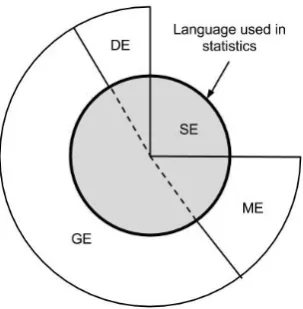
Figure 1: The language used in statistics is a combination of general English (GE), statistical English (SE), discipline English (DE), and mathematical English (ME).
Rule 1: Teach students terms they “know” but have new meanings.
Learning statistics involves learning how some terms from GE are given new meaning; these terms are also known as “lexically ambiguous”. This includes terms such as “significant”, “random” and “power”. Kaplan et al. (2011) focused on “spread” as a particularly slippery statistical term and suggest it should be avoided. More recently, Kaplan et al. (2014) have addressed “random”, though this time they do not go as far as proposing it be deleted from statistical discourse. A cause for confusion is that students need to learn which GE terms have specialised meanings. For example, “significant” has a special meaning in SE, but “substantial” does not. Lavy and Mashiach-Eizenberg (2009) encourage instructors to explicitly discuss both the GE and SE meaning of such terms, so “that students be presented with both their formal and informal definitions” of terms (p. 7) and be able to compare and contrast these definitions.
Phrases built from GE words are a second level of complication to learning the language of statistics. Some of these phrases comprise words that do not help students to understand the concept; for example (Dunn et al. 2016), “standard error” is not “standard” in any GE sense, and is not an “error” (in the sense of a “mistake”).
Rule 2: Introduce students to the meaning of terms that are completely new.
Statistical English forms a smaller but recognisable part of learning statistics. “ANOVA” and “boxplot” are two examples of terms that would not be known outside of statistical English. For many students, Greek symbols will be new also (such as μ and β), and for some students even mathematical symbols such as ± will be new. In some sense these terms and symbols are the easiest to teach since there are no prior meanings for students to unlearn.
Perhaps the hardest group of such terms with which to engage are the statistical English terms with no universal definition. Examples include “lurking variables” and “confounding variables” (for example, see Dunn et al. (2016) and Flanagan-Hyde (2005)). Other examples include “degrees of freedom” and even “discrete” and “continuous” variables.
Rule 3:Clarify terms that may have different meanings in discipline and statistical English
Statistics is usually taught to students who come from other disciplines. In some cases, terms used in statistics and their home discipline may be similar but with different meanings. Because these students are likely to study more courses in, and be more passionate about, their home discipline, statistics instructors must ensure students and discipline instructors are aware of these potential ambiguities. One complication is that the statistics instructor may not be aware of these potential overlaps.
One example is the word “sample”. In statistics, a sample is a set of observations drawn from a population. In biomedicine a sample is a single specimen (of blood, urine, etc.) rather than a set of observations. Statistics students have been heard to incorrectly state “I have taken 40 samples” rather than “I have taken one sample of 40 observations”. Other examples include the terms “blocking” and “regression” as well as symbols such as ρ (for density) and β (for beta-radiation) (Dunn et al. 2016).
Rule 4:Clarify terms that may have different meanings in mathematics and statistics
The final component of the language landscape in these ‘rules’ comprises terms taken from mathematical English (ME) and given a subtle twist in SE. One example is the word “estimate” (Dunn et al. 2016) which, in statistics, means a numerical approximation of a population quantity by a sample quantity. However, in ME it means to make a sensible guess (“estimate the results of this calculation”). Even the innocuous “linear” fits into this category. In regression, for example, the model y = a + bx + cx2 can be fitted as a “linear model” (that is, the equation is “linear in the parameters”). However, in a mathematics class, the model is called non-linear (specifically, a “quadratic”).
The symbol ± is used differently in mathematics and statistics also. In mathematics, it designated two possible solutions to (for example) a quadratic equation. When used in the context of a confidence interval in statistics, is designates a range of possible values.
When students are alerted to these differences, the shape of the landscape of statistical language becomes clearer. The same approach is advocated in the teaching of foreign languages where the concepts of a new term, a similar term and an identical term help shape the foreign language learning in terms of what learners already know from their first language.
SIGNPOSTS AS GUIDES FOR OVERCOMING CHALLENGES
Having established the landscape of statistical terms, we now discuss some basic ideas for helping students to learn their way around it. There are many ideas for how to teach students statistical terms, and many lack supporting evidence. Consequently, these remaining six rules are broad pathways rather than narrow maxims, and so we have designated them as signposts along the journey of learning the language of statistics.
Rule 5:Manage synonyms sensibly
For some statistical concepts, many synonyms exist. For example, in regression, the phrases “explanatory variable”, “independent variable”, “regressor”, “predictor” (among others) are synonymous. Synonyms may occur in multiple places in one course, such as across resources (textbook, readings, journal articles that are read, etc.) and between personnel (tutors from different discipline areas).
One solution will not suit every class here. Give every synonym, and students are likely to become overwhelmed. However, avoiding mentioning synonyms may lead to even good students becoming confused if they are reading a different text or a journal article which uses a different term. A middle path that should cater for most situations would be to make students aware that the statistical language is inconsistent and offer some common alternatives. This can be handled across the range of materials in a course as the weeks go by.
Rule 6:Embrace ambiguity
“mean” they were taught or not. Another example is “correlation”, which may refer to either a Pearson or Spearman correlation.
These are two interesting cases with different issues. With “mean”, the modifiers attached are technical terms that attempt to clarify the statistic. On the other hand, the descriptors attached to “correlation” are names honouring the discoverer of the relevant statistic and offer no clue as to the construction or use of the statistic.
An interesting example is the ambiguity attached to “significance”: this can refer to statistical, practical or clinical significance (Thompson 2002). Though all three are related, often results are presented using just the term “significant” or “significance”.
Instead of taking a deficit view of the ambiguity of statistical terms, one approach to overcoming it is to embrace it, highlight it, and discuss it, because this creates the opportunities to grasp teachable moments and explicitly clarify the ambiguity. Ambiguities can be used as a scaffold to discuss how some terms have different meanings in GE and SE, or how some concepts have many terms associated with them. Many introductory statistics classes act as service courses with students from programs as diverse as Sports Studies, Commerce and Engineering sitting in the same lectures. They will be bringing their understanding of the DE in their discipline to the statistics classroom and can help students from other disciplines to construct their own knowledge of ambiguous terms.
Rule 7:Avoid ambiguity
On the other hand, there are ways to avoid unnecessary ambiguity and be quite prescriptive, modifying potentially ambiguous terms thereby giving students firm ground to stand on when it matters. For example, instructors can use the phrase statistical significance whenever referring to the results of hypothesis tests, and otherwise shun the word “significant” in favour of, say, “important” or “substantial”.
Another pair of terms about which it would be wise if instructors made up their minds is “correlation” and “association”. “Correlation” has a fairly well-agreed specific SE definition, and has been discussed already in this paper. “Association” is a looser GE term that students are prone to use interchangeably with “correlation”, a habit which could easily lead to confusion (Kaplan, et al. 2010).
Rule 8:Introduce language recursively through authentic contexts
The reason for incorrect vocabulary learning can be attributed to a number of factors, but one of the most common causes is learning terms and expressions without a context provided (Nassaji, 2003). To maximise and consolidate the learning of new vocabulary, provide opportunities for students to “recycle” vocabulary and to make lexical inferences to generate meanings for unknown terms they encounter in context (Deschambault, 2012).
Don’t assume students know a word after defining it once: the word and its meaning need to be reinforced through many activities. Richardson et al. (2013a) found that tutors already had a sense of which terms students would stumble over, because the tutors are immersed in the language of statistics, have met tricky terms many times and have developed a deep sense of the meaning of a particular term. They can then use activities that expose students to tricky terms using two approaches: context-free exercises (“define significant”; Kaplan et al., 2009) or contextual (“What does ‘significant’ mean in this journal extract?”; Richardson et al., 2013b). A semester’s worth of activities can then expose students to appropriate use of a term. Richardson et al. (2013a) found, this type of reinforcement led to substantial gains in understanding after one semester.
Rule 9:Use verbal interaction
Verbal interaction is also important. Instructors can model correct pronunciation of terms which helps develop the sense of community in a class, with a shared way of speaking. Sound bites demonstrating correct pronunciation have migrated from the cassette decks to the websites of language courses. Why not in statistics websites too? For example, the Wikipedia pages for most common statistical terms do not include any audio or video where students would hear the terms being said aloud.
Other terms, such as “Kolmogorov” and “heteroscedasticity”, can be tricky for native English speakers.
Activities that foster conversation amongst students are useful too (see Garfield 1993). Explanations of collaborative learning appear in Willis & Willis (2008), and include techniques such as the jigsaw (Tran & Lewis, 2012), Think-Pair-Share (Rudolph, Lamine, Joyce, Vignolles & Consiglio, 2014), Read-Ask-Tell (Remsburg, Harris & Batzli, 2014) and game-based activities (Lesser et al. 2013).
Rule 10:Find your place on the implicit/explicit teaching continuum
Although this paper has been all about ‘rules’, we acknowledge that there is no single solution to the challenges of teaching and learning the language of statistics. In particular, there is a continuum with use of explicit methods on one end, and implicit methods on the other.
Instructors may help students acquire vocabulary using implicit learning or explicit teaching approaches (Carlisle, Fleming, & Gudbrandsen, 2000). Implicit learning places an emphasis on comprehending meaning rather than learning new terms, and so often uses authentic tasks such as discussing a research article. Explicit teaching focuses on teaching terminology explicitly, by (for example) matching terms to definitions.
Rumsey (2002) supports the idea of implicit teaching, suggesting that instructors should not concern themselves too greatly about specific terms and their specific meaning in some situations: “… terms, like ‘precision,’ ‘accuracy,’ ‘reliability,’ ‘bias,’ and ‘consistency’ all sound the same to students. In my opinion, splitting hairs about these terms will only create confusion and frustration. My advice is to choose the most important ideas, and stick to them.” (Rumsey, 2002, Section 3.5).
On the other hand Kaplan et al. (2011) used an explicit teaching approach, arguing in favour of using specific statistical terms where possible (and sometimes it is not possible); for example, using “dispersion” rather than the more general and potentially ambiguous “spread”.
CONCLUSION
In this paper we have introduced ten simple ‘rules’ for the teaching and learning of the language of statistics, consisting of four aspects of the landscape of tricky terms, and six signposts for navigating the landscape successfully. Just like its parent, English, the language of statistics is rich and draws from a variety of sources, including general, mathematical, statistical and discipline-specific English. We believe these rules offer statistics educators a way to welcome learners into the community of statistics speakers and enhance statistical literacy across the board.
ACKNOWLEDGMENTS
This research was partly supported by a University of the Sunshine Coast Open Learning and Teaching Grant (OLTGP2012/04).
REFERENCES
Aliaga, M., Cobb, G.,Cuff, C., Garfield, J., Gould, R., Lock, R., Moore, T., Rossman, A., Stephenson, B., Utts, J., Velleman, P., & Witmer, J. (2010). Guidelines for assessment and instruction in statistics education: College report. Technical report, American Statistical Association.
Carlisle, J.F., Fleming, J.E., & Gudbrandsen, B. (2000). Incidental word learning in science classes.
Contemporary Educational Psychology,25: 184–211.
Tran, V.D. & Lewis, R. (2012). The effects of jigsaw learning on students’ attitudes in a Vietnamese higher education classroom. International Journal of Higher Education, 1(2), 9-20.
Deschambault, R. (2012). Thinking‐aloud as talking‐in‐interaction: reinterpreting how L2 lexical inferencing gets done. Language Learning, 62(1), 266-301.
Dunn, P.K., Carey, M.D., Richardson, A.M., & McDonald, C. (2016). Learning the language of Statistics: challenges and teaching approaches. Statistics Education Research Journal 15(1). Flanagan-Hyde, P. (2005). Confound it! I can’t keep these variables straight! STATS, 43, 21–23. Garfield, J. (1993). Teaching statistics using small-group cooperative learning. Journal of Statistics
Kaplan, J. J., Fisher, D. G., & Rogness, N. T. (2009). Lexical ambiguity in statistics: what do students know about the words association, average, confidence, random and spread? Journal of Statistics Education, 17(3).
Kaplan, J. J., Fisher, D. G., & Rogness, N. T. (2010). Lexical ambiguity in statistics: how students use and define the words: association, average, confidence, random and spread. Journal of Statistics Education Education, 18(2).
Kaplan, J. J., Rogness, N. T., & Fisher, D. G. (2011). Lexical ambiguity in statistics: making a case against spread. Teaching Statistics, 34(2), 56–60.
Kaplan, J. J., Rogness, N. T., & Fisher, D. G. (2014). Exploiting lexical ambiguity to help students understand the meaning of random. Statistical Education Research Journal, 13(1), 9–24.
Kass, R.E., Caffo, B.S., Davidian, M., Meng, X.-L., Yu, B. & Reid, N. (2016). Ten simple rules for effective statistical practice. PLOS One Computational Biology 12, e1004961.
Lavy, I., & Mashiach-Eizenberg, M. (2009). The interplay between spoken language and informal definitions of statistical concepts. Journal of Statistics Education, 17(1), 1–9.
Lesser, L. M., et al. (2013). Using fun in the statistics classroom: An exploratory study of college instructors’ hesitations and motivations. Journal of Statistics Education, 21(1), 1–33.
Nassaji, H. (2003). L2 vocabulary learning from context: Strategies, knowledge sources, and their relationship with success in L2 lexical inferencing. Tesol Quarterly, 645-670.
Rangecroft, M. (2002). The language of statistics. Teaching Statistics, 24(2), 34–37.
Remsburg, A. J., Harris, M. A., & Batzli, J. M. (2014). Statistics across the curriculum using an iterative, interactive approach in an inquiry-based lab sequence. Journal of College Science Teaching, 44(2), 72.
Richardson, A. M., Dunn, P. K., & Hutchins, R. (2013a). Identification and definition of lexically ambiguous words in statistics by tutors and students. International Journal of Mathematical Education in Science and Technology, 44(7), 1007–1019.
Richardson, A. M., Dunn, P. K., & Hutchins, R. (2013b). The impact of tutor, extract and word on the correct definition of lexically ambiguous words in Statistics. In: ACSME Proceedings: Students in transition - the learners’ journey. Canberra, Australia, 185–192.
Rudolph, A. L., Lamine, B., Joyce, M., Vignolles, H., & Consiglio, D. (2014). Introduction of interactive learning into French university physics classrooms. Physical Review Special Topics-Physics Education Research, 10(1), 010103.
Rumsey. D. J. (2002). Statistical literacy as a goal for introductory statistics courses. Journal of Statistics Education, 10(3).
Thompson, B. (2002). “Statistical”, “practical,” and “clinical”: How many kinds of significance do counselors need to consider?. Journal of Counseling & Development, 80(1), 64–71.