of Queensland’s Departments of Agriculture and Fisheries, and Transport and Main Roads and the University of Southern Queensland. It is part of the broader collaborative research initiative: Facilitating transformational change in Queensland’s agricultural value chains.
Industry Collaboration
The Australian Centre for Sustainable Business and Development wishes to thank Avofresh, the Blue Ribbon Group, Kalfresh and Stahmann Farms for their participation in research which was invaluable in the preparation of this booklet.
Authors: Timothy Nugent and Professor Alice Woodhead.
Disclaimer
Contents
DIVERSIFICATION CREATES NEW OPPORTUNITIES
1
The diversification
dilemma
Growth is tricky. Agricultural businesses
today face an ever increasing number
of choices about what part they will
play in the value chain and how they
will increase returns.
Technologies such as on farm manufacturing and advanced packaging techniques present new opportunities for adding value to products. Meanwhile an increased consumer interest in food origin and method of manufacture has established a market for premium differentiated products.
These new options are complex, and different for every business. But they can be understood in terms of a simple dilemma - to choose between the competing strategies of ‘business as usual’ or ‘business unusual’. Business as usual means working with your existing business system, energy is focusing on improved production efficiency and small incremental improvements in quality. Many businesses begin with the strategy of doing one thing and doing it well. This can be a good way to start out because all effort is focused on a single area. As businesses mature, they may find that it is not always possible to just ‘scale up’ production as there is no longer an unmet consumer demand. In this environment the only means of growth is to diversify either by improving products or by finding new customers.
Business unusual is about finding new avenues for business growth. This might be developing new products through value adding and branding, or exporting to new markets. Risk reduction is a key benefit of this type of strategy, diversification reduces risk by ‘adding new products, customers or markets to your business portfolio.’1 When sales are spread across several
markets or product categories then products can be moved between channels, allowing the business to continue in difficult or uncertain times.
For example, if a domestic supermarket cancels their order, this product might be diverted to export channels.
The benefits of diversification are attractive, but diversification is not the right fit for every business. Diversification requires resources in terms of time, money and specialised skills. This booklet provides support for decisions on two major forms of diversification: product development and market development. These two forms of diversification may be adopted individually or together as shown in the diagram to the right.
There is no single answer as businesses can and do grow successfully in any number of ways. There are agricultural commodity producers with well-established markets and methods for whom the “business as usual approach” makes sense. Other operators have decided that it is time to transition to “business unusual” and have embraced change in products or markets.
1 Entrepreneur Small Business Encyclopedia, www.entrepreneur.com/encyclopedia/diversification.
The benefits of diversification are
attractive, but diversification is not the
right fit for every business.
FIGURE 1:
THE DIVERSIFICATION DILEMMA
BUSINESS UNUSUAL
BUSINESS AS USUAL
COMMODITY SALES COMPETITION
FOR MARKET SHARE
NEW PRODUCTS
From Commodities to value
added products
Commodities are standardised products that are usually sold in bulk. One unit of a commodity can generally be substituted for another, for example: cotton lint, sorghum, or beef tallow.
Value added products have been transformed to increase their market value. This might mean packaging in retail portions or even processing to make shelf stable products such as vegetable pastes or dahls. Value added products are not usually commodities, and compete with one another in terms of quality and reputation. They are often sold by brand, for example Smith’s Crisps, Wingham Beef.
Value adding can also be a way to capture value from by-products and low value products. For example vegetables that have a non-standard shape or size can be cut, mashed or stewed for sale to retail consumers.
Kalfresh is an example of a company which has embraced value adding. Kalfresh Vegetables began selling vegetables in 1992 with a vision ‘to unite growers under a common brand.2’ In 2006 they installed a washline,
allowing them to wash and package vegetables for retail sale.
Following the success of this early step into value adding, Kalfresh installed a high-care facility in 2015. This allowed for the preparation of convenient pre-cut packaged vegetables for which consumers are willing to pay a premium. Products enabled by this facility include peeled, chopped and shredded carrot, carrot sticks, and pumpkin portions. All of this value adding is undertaken close to where the produce is grown keeping transport costs low and ensuring freshness.
This is just one example of value adding, other businesses have had success with dehydrating, freezing, cooking and other production techniques. It all depends on what the market wants!
Agricultural goods can be considered in
two broad categories: commodities and
value added products.
IMAGE Kalfresh carrot high care production line
Most value chains will include some
activities which are performed in house
(vertically integrated) and others which
are performed by business partners or
third party service providers. Deciding
which part of the chain to focus on can be
a challenging decision.
Where in the supply chain
to value add?
In general tasks are suited to vertical integration when there is an efficiency gain, for example drying fruit on the farm allows for reduced shipping volumes across the value chain. Conversely, tasks which require specialist knowledge or staff located overseas might be better suited to third party providers or supply chain partners. This is often the rationale for making use of third-party logistics providers or overseas distributors. The Blue Ribbon Group is a company that has faced this decision. A pulse and seed products company, their range covers different degrees of processing from chick peas and mung beans packaged for wholesale in 25kg bags, to specialty bean flours, to cooked mung, lentil and faba bean dahls.
Blue Ribbon manage their own processing and Australian supply chains with a short-chain lean management philosophy. For overseas distribution however, Blue Ribbon uses trusted importers, relying on their country-specific knowledge and mature trade networks take the product to the end consumer.
ON-FARM VALUE ADDING
Vertical integration allows new opportunities to construct highly efficient short supply chains. One means to do this is to conduct value adding by on-farm processing.
This reduces whole of supply chain expenses in two ways:
(1) it reduces the distance to transport inputs to the processing facility; (2) it often reduces the mass of goods shipped to wholesalers and
consumers. Value added products are often lighter than their inputs, for example dressed beef is typically only 50-60% of cattle live weight.3
Noosa Yoghurt is a company that demonstrates the benefits of on-farm value adding. Australian expat Koel Thomae opened the Noosa factory in partnership with a dairy farmer in Colorado. By processing on farm, Noosa was able to avoid the cost of milk transport. Their milk is moved by pipeline direct from the dairy ensuring freshness and temperature management. There it is fermented and mixed with innovative flavours such as pineapple jalapeno, pumpkin and key lime.
Noosa yoghurts are featured in high end supermarkets such as wholefoods and often command a premium over other brands.
3 NSW Department of Primary Industries (2007) ‘Dressing percentages for cattle’ www.dpi.nsw.gov.au.
Austchilli
The company considered there might be an opportunity for Australian processed avocado products in the Japanese market. To explore this opportunity, Austchilli conducted research in Japan to identify the right product.
Avocado is a common ingredient in Australian and United States sushi. Austchilli was surprised to find that this was not the case in Japan. What they did find was an association between the promotion of avocado’s health benefits and an increase in the demand for avocado. One of the most typical ways the Japanese enjoyed avocado was to eat it fresh with soy sauce and wasabi, a way that is particular to Japanese culture. Japanese consumers also used avocado as a topping to add flavour and texture to dishes; a type of use well suited to Avofresh’s tube packaging.
With this understanding of how Japanese consumers eat avocado and the flavours they like, Austchilli is working with its Japanese partner to develop a line of avocado paste tubes which appeals to local taste. Austchilli decided to retail these tubes through vending machines distributed across the country. The logistic and cold chain is managed by Austchilli’s business partner in Japan - Austchilli believe its business partner in Japan has much better knowledge and experience of Japanese distribution system. Austchilli follow to simple philosophy: “as long as you can get the product right, everything will fall into place.”
Key concepts:
Understanding the preferences of consumers in the host country. Cooperation with business partners on market research
Working with local advisors to form distribution channels that can maintain the product quality and integrity.
Exports open up new
consumer markets
Agricultural exports are not just for large corporate businesses. Small and medium businesses from the agriculture, forestry and fishing industries exported over half a billion dollars of products in the 2014-2015 financial year.4 Value added exports range from chilled beef to chopped
vegetables to flavoured nuts.
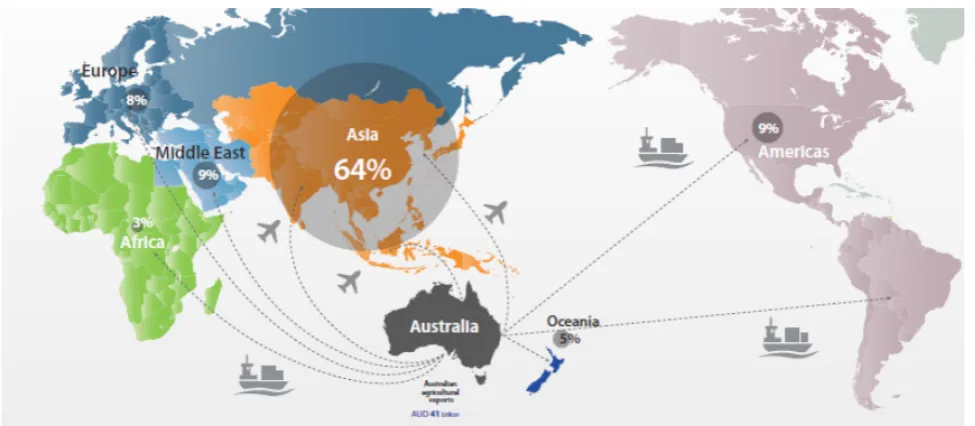
Asia is the largest destination for Australian agricultural exports accounting for 64% of export value (see figure opposite). The market for high quality agricultural produce in Asia is only expected to grow with the increasing size of the middle class.
The reduction in the Australian dollar associated with the slowing of the mining boom has greatly improved conditions for export. In this environment many agricultural businesses are considering whether exporting might provide a new avenue for growth or an opportunity to diversify their sales channels.
Australia produces more food than is
necessary for domestic consumption.
Around two-thirds of agricultural
production is exported.
4 Australian Bureau of Statistics (2016) Characteristics of Australian Exporters, 2014-15.
Asia is the largest
destination
for Australian
agricultural exports
accounting for 64%
of export value
FINDING YOUR PLACE IN ASIA
For branded products, the benefit perceived by Asian consumers may be very different to Australian consumers. In Asia, Australia enjoys a reputation as a clean and safe environment. Like German cars or Swiss watches, Australian agriculture benefits from strong positive associations. For example in Australia, milk is positioned locally as a dietary staple. In China Australian milk is sold for many times the price of the local Chinese product. It is marketed as a premium product from a clean safe country, and may carry a connotations of prestige.
The best way to understand how your product is perceived is to communicate with people in the target market.
Some businesses make use of professional market research services. It can also be valuable to speak with trusted associates or local consumers in the target market. The internet can be a good resource for early research, but should not be the sole source of knowledge. There is no substitute for direct native experience of the target market.
TRADE MISSIONS
Trade missions are trips for groups of business people arranged by government or trade organisations. These aim to build and develop trade connections across international borders. Participating in trade missions can be a useful means to explore opportunities and build new connections in the target market. Key Australian trade mission organisers include Austrade, Trade and Investment Queensland and Ausveg. The Australian Food and Grocery Council (2010)5 recommends performing due diligence and
reaching out to the overseas participants in the weeks before the mission. If opportunities are identified, trade mission events can be supplemented with private meetings with those businesses.
Foreign governments also arrange reverse trade missions, that is, trips to Australia by overseas agricultural buyers and distributers. This can be another opportunity to explore opportunities for Australian businesses. The industry and trade associations listed in the rear of this guide can provide information on reverse trade missions.
There are grant opportunities for new and established. Export market development grants can reimburse businesses for up to half of eligible expenses above $5,000 including travel, marketing and intellectual property protection. Further information can be found on the Austrade website <www.austrade.gov.au>. Some businesses make use of paid consultants to lodge. Austrade accredits consultants under the voluntary EMDG Consultant Quality Incentive programme.
[image:11.595.55.543.201.414.2]5 Australian Food and Grocery Council (2010) Trade Missions < www.afgc.org.au>.
The export process
MANAGEMENT
MARKETING
FINANCE
STAFF
PLANNING
IDENTIFY MARKETS
PLAN MARKETING STRATEGY
ALLOCATE STAFF
WRITE EXPORT PLAN
WRITE EXPORT BUDGET
WRITE MARKETING BUDGET
REGISTER TRADE MARKS
The export process
EXPORT TRAINING FOR STAFF
DEVELOP SUPPLY CHAIN CONTACTS
ATTRACT INVESTORS
EXPORT TO MARKET
PROMOTE BRAND
REVIEW BRAND RECEPTION
PREPERATION MARKET ENTRY REPEAT TRADE
Does my Australian brand
have value in Asia?
NEW MARKET, NEW BRAND?
Using existing branding can save money on packaging and marketing materials. Australian brands may also benefit from existing recognition by travelers or through expatriates. In many countries Australian brands carry prestige and positive associations. In these markets using existing Australian branding may convey authenticity. Anecdotal comments from some Chinese consumers suggest that Chinese do not look for “Chinese characters on the pack” as they do not contribute to the product’s appeal as a premium import.
In the alternative view, developing new branding provides the opportunity to create a brand that is tailored to local tastes and conventions. This might be as simple as translating some logo elements into a local language or as complex as a developing a dedicated export brand. Some businesses use export branding to fit with consumer knowledge in different markets for example, a product labelled “from the Darling Downs” for Australian domestic sales might use the more universal “from Australia” on export packaging to help foreign consumers to understand its origin.
Products sell because they offer a
perceived benefit to the end consumer.
Understanding what consumers are
looking for and how they view your
product is essential to developing your
market strategy. For commodity products
this benefit is relatively straightforward,
so long as the quality is acceptable,
price will usually be a decisive factor.
Differentiated or branded products offer
more dimensions for consumer benefit.
Consumers might purchase a product
because its brand conveys values which
align with their aspirations. They might
for example, take pride in the fact that
their wine is made in Coonawarra and
their avocadoes are shipped fresh from
Queensland.
Australian brands
When Australian tree nut company Stahmann Farms planned their entry into China, they decided to start with their existing brands of packaged shelled nuts in their original English language packaging sold via an online store on the T-mall e-store platform. This choice, they considered, would assure customers that they were receiving a premium Australian product. Further, it would save the considerable expense of developing and producing a new line. Stahmann is acquiring feedback from consumers to decide whether to develop or alter their product after market entry.
In a contrasting approach, meat sales and marketing business Sanger Australia developed their First Cut brand identity before entering the Chinese market. They met with consumers and tested different brand candidates before deciding on the First Cut identity. Importantly, the First Cut brand was never intended to look “Chinese”.
Their logo is rendered in English and the “true Aussie beef” trade mark appears on the front of every packet. Product information text is in both Chinese and English. There can be no doubt where this sirloin steak is from; the cut is proudly sold as Australia Steak. Stahmann and Sanger may have approached branding very differently, but their goal was the same. To convey to the consumer that their brand was a premium Australian imported product. Focus questions for export product development:
Is the product used in the same way in both markets?
Is the product benefit self-explanatory or does it require text in a local language?
Does the existing packaging convey the product aspects that the market is interested in?
Does national regulation affect packaging requirements?
Building a plan
This is a whole of business activity that involves discussion of production costs, logistics, marketing and legal arrangements. It is critical that the export plan is developed with diverse input, and does not overly focus on a single area (e.g. marketing).
One of the benefits of a written plan is it helps to build a clear organisational consensus among people with different viewpoints. As the business begins the export journey the export plan serves as a guide and reminder, helping to shape decisions to fit in with the business’s broader objectives. The export plan is an important source of continuity if staff or responsibilities change and a source of consistency among multiple decision makers. The export plan provides a source of counsel when things go wrong. Risks can be planned for in advance allowing a swift tactical response to common problems. This is especially important in an export circumstance where time is often of the essence.
Constructing an export plan is an
INTRODUCTION
Tells the “story” of the proposed export in as few words as possible. Explains what the business
hopes to achieve, and set out in general terms how the proposed export will work in that context.
SUMMARY OF RESOURCES
NEEDED FOR EXPORT
Key staff and professional consultants
Budget and finance Travel time and expenses
TARGET MARKET TRADE
PROFILE (DISCUSSED IN
TRADE LOGISTICS TOOL)
Target area profile i.e. Country, Province or City
Political and legal environment Tariffs, quotas and legal
barriers \Ports and airports Distribution and storage
systems Retail systems
MARKETING ANALYSIS
Target demographics Unique selling proposition Pricing strategy Promotion
Trade mark strategy (Discussed in intellectual
property decision support tool)
RISK ANALYSIS
Identifies key risks Discusses likelihood and
impact of risks
Presents contingencies (plan B)
Constructing an export
Resources for export–
getting ready
COMMON RESOURCES INCLUDE:
FINANCE AND INVESTMENT
It can take significant time for an export venture to become profitable. You should ensure that the business has access to funds to set up the export and distribution channel, engage in marketing and to absorb initial losses. In some cases it will be necessary to seek investment to support the venture. External finance can take the form of debt or equity. Debt financing involves borrowing money from a bank or private lender. Equity finance is more complex involving a change in the ownership structure of the business, it has historically been used mainly by larger operators but is increasingly attractive as an alternative to debt finance in agribusiness.
SKILLS
Export requires a specialised skill set that is different to general management. It is important to ensure that your business has staff with export knowledge. This might mean hiring new staff or sending current staff to an export course to develop new skills. Staff developing your export business will have limited time for other duties. It may be necessary to delegate or reassign responsibilities to clear time for the export venture. The contact list in the back of this booklet can provide information on export training programs and providers.
It is important to make
sure that you have the
commitment, capital and
human resources to get
export started.
MANUFACTURING CAPACITY
Exporting provides access to new customers and consequently an increase in demand. If, for example your product is taken up by a supermarket chain, it may be necessary to rapidly expand production capacity and logistics systems in order to satisfy the new demand. Determining in advance how this additional capacity can be delivered will position your business to act quickly in response to new market opportunities.
PRODUCTS AND MARKETING
Commodities can usually be exported without significant marketing or changes to the product. Branded products require greater consideration. A marketing plan should be drawn up and a budget allocated to develop your brand with consumers in the destination country. It may be necessary to translate product text or develop new packaging and brand elements to suit the destination market (see pages 14-15).
INTELLECTUAL PROPERTY PROTECTION
Most intellectual property is territorial. This means that registrations in one country do not take effect in other countries. Protecting your intellectual property overseas is an important part of the preparing for export process and is absolutely essential if you plan to ship branded products. This issue is discussed in detail in the Intellectual property decision support tool.
TRAVEL
In many cases some travel will be necessary to establish and maintain your export network. The frequency, duration and expense of trips should be accounted for in the planning stage.
Depending on the country and circumstances, several trips may be needed to build the relationships and connections needed to make your export a success. Anecdotes from new exporters suggest that time spent in the overseas market is key to success. A challenge often encountered is determining how duties will be allocated while key staff are overseas. The planning of acting roles should be conducted as part of preparation for export to minimise the impact on the business.
How to identify and
address risks
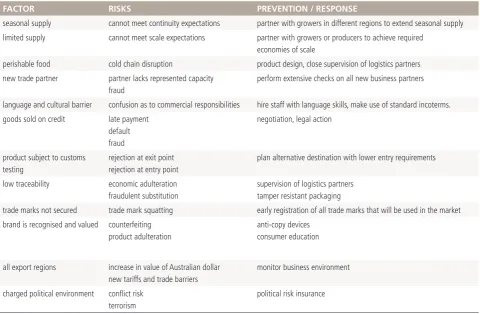
The table on the right may help you to identify some risks based on business factors. A risk plan should consider both how to minimize risk, and what contingencies are available in response to unplanned events. The descriptions below describe some of the most common types of risk encountered by exporting businesses. Table 1 links risks to common agricultural business factors and suggests possible responses. This can be a helpful exercise for businesses in the process of growth and diversification.
NON-PAYMENT RISK
Non-payment, late payment and partial payment are risks in both domestic and international business. However, differences in cultural and payment norms can place businesses at a greater risk when transacting across borders. Non-payment may occur due to fraud, or cash flow or insolvency issues within the trading partner’s business. An important precaution is to perform careful due diligence on new trading partners. Payment terms may be structured to mitigate the risk of non-payment. This may involve requesting part or all of payment in advance or requiring a documentary letter of credit issued by a reputable bank. This means that the bank will cover the risk of non-payment in exchange for a fee paid by the buyer.
FOREIGN EXCHANGE RISK
Exchange rates fluctuate in response to market needs and political events. Foreign exchange risk refers to the unexpected loss in value that can occur when your business transacts in foreign currencies. Trade transactions are conducted in the currency of the buyer, that of the seller, or a third currency. The most commonly used third party currency in Asia is the US dollar, with the Yuan Renminbi and Euro also in common use. An important step in export planning is determining which currencies your business will trade in. It is possible to mitigate exchange rate risk through financial investments called foreign exchange hedges, your bank can provide further information if you are concerned about foreign exchange risk.
POLITICAL RISK
Political risk is the risk that political decisions or events will affect the business’s profitability. These include decisions such as tax changes or trade restrictions as well as more severe circumstances such as political overhaul, revolution and war. The most straightforward means to avoid political risk is to build and maintain an understanding of the local political environment. There are resources online that can help evaluate the risks of doing business in various countries. These include Austrade export market profiles (www.austrade.gov.au), and the CIA world factbook (www.cia. gov). Specialized insurers offer policies for some forms of political risk.
INTELLECTUAL PROPERTY RISKS
Counterfeiting and brand theft are serious issues in many Asian countries. Counterfeiting is the outright copying of the protected elements of a product. Counterfeiters aim to profit from the reputation and creativity of popular brands without having to put in the necessary work to build their own. Brand theft or trade mark squatting is the registration of another business’ trade marks in order to sell them back to that business at a profit. These and other risks related to intellectual property are discussed in greater detail in the Intellectual property decision support tool.
TABLE 1:
IDENTIFYING RISKS BASED ON COMMON AGRICULTURE INDUSTRY ISSUES
FACTOR RISKS PREVENTION / RESPONSE
seasonal supply cannot meet continuity expectations partner with growers in different regions to extend seasonal supply limited supply cannot meet scale expectations partner with growers or producers to achieve required
economies of scale
perishable food cold chain disruption product design, close supervision of logistics partners new trade partner partner lacks represented capacity
fraud
perform extensive checks on all new business partners
language and cultural barrier confusion as to commercial responsibilities hire staff with language skills, make use of standard incoterms. goods sold on credit late payment
default fraud
negotiation, legal action
product subject to customs testing
rejection at exit point rejection at entry point
plan alternative destination with lower entry requirements
low traceability economic adulteration fraudulent substitution
supervision of logistics partners tamper resistant packaging
trade marks not secured trade mark squatting early registration of all trade marks that will be used in the market brand is recognised and valued counterfeiting
product adulteration
anti-copy devices consumer education
all export regions increase in value of Australian dollar new tariffs and trade barriers
monitor business environment
charged political environment conflict risk terrorism
political risk insurance
Key decisions checklist
WILL THE PRODUCT NEED DEVELOPMENT
FOR EXPORT?
Pages 14-15 look at deciding whether products should be can be exported in the same packaging that is used for domestic markets, or with minimal change, such as an adhesive product information label. Export markets may have differences in how they perceive quality and value.
WHICH MARKETS PRESENT THE BEST
OPPORTUNITIES?
Page 11 discuss how market research and trade missions can be used to understand new markets. Pages 20-21 discuss risk evaluation which is an important factor in market selection. Information to support decisions on export freight logistics can be found in the logistics decision support tool.
IS THERE ROOM FOR EXPANSION IN THE
DOMESTIC MARKET?
Pages 4-5 discuss how diversification presents and avenues for growth in a saturated domestic market where demand is fully met by current sellers. It explains the options of seeking out new consumers through export, or by making improvements to the product that differentiate it from competitor’s offerings.
WHAT DOES THE TARGET MARKET WANT?
Pages 14-15 look at how Australian brands are perceived overseas and in particular whether Australian brands benefit from product localisation. Page 11 discusses market research methods and trade missions which can help businesses to better understand new markets.
WILL WE FOCUS ON COMMODITIES OR VALUE
ADDED PRODUCTS?
Pages 4-5 discuss value added products and commodities, discussing the potential benefits of value adding and how some producers are using it to extract greater income from agricultural produce.
WHAT RESOURCES WILL SUPPORT GROWTH?
Pages 18 and 19 discuss the resources needed to support a new export venture and how they can be obtained. This includes both financial resources, and others such as time and relevant skillsets. There is substantial support available from Government agencies and trade industries including information, matching funds and development grants. Many of the organisations listed right can provide further information.
1
4
2
5
Contacts
AUSTRADE
www.austrade.gov.au p 13 28 78
AUSTRALIAN CUSTOMS AND BORDER SERVICE
www.border.gov.au p 131 881
AUSTRALIAN FOOD & GROCERY COUNCIL
www.afgc.org.au (02) 6273 1477 Locked Bag 1 Kingston ACT
AUSTRALIAN GOVERNMENT
DEPARTMENT OF AGRICULTURE AND WATER RESOURCES
www.agriculture.gov.au/about/contactus p 1800 900 090
p +61 3 8318 6700 GPO Box 858 Canberra City, ACT 2601
EFIC
www.efic.gov.au e [email protected] p +61 2 8273 5333 Lvl 10 Export House 22 Pitt Street Sydney, NSW 2000
EXPORT COUNCIL OF AUSTRALIA
www.export.org.au e [email protected] export house, lvl 2, 22 Pitt St, Sydney, NSW 2000
QUEENSLAND GOVERNMENT
DEPARTMENT OF AGRICULTURE FORESTRY AND
FISHERIES
p 13 25 23 www.daf.qld.gov.au
QUEENSLAND FREIGHT AND LOGISTICS COUNCIL
www.qtlc.com.au p 61 7 3510 2110 Po Box 355
Ashgrove West, Qld 4000
TRADE AND INVESTMENT QUEENSLAND
www.tiq.qld.gov.au e [email protected] p +61 7 3514 3147 lvl4, 400 George St Brisbane, Qld 4000 PO Box 12400, QLD 4003
HORTICULTURE INDUSTRY AUSTRALIA
www.horticulture.com.au
e [email protected] p +61 2 8295 2380
Suite 2, Level 5, 87 Wickham Terrace Spring Hill QLD 4000