High capacity tagging using
nanostructured diffraction barcodes
G. S. Galitonov, S. W. Birtwell, and N. I. Zheludev
EPSRC Nanophotonics Portfolio Centre, School of Physics and Astronomy, University of Southampton, Southampton, SO17 1BJ, UK
H. Morgan
School of Electronics and Computer Science, University of Southampton, Southampton, SO17 1BJ, UK
Abstract: We describe a new non-contact high capacity optical tagging technique based on the use of nanostructured barcodes. The tags are generated from a number of superimposed diffraction gratings. Capacity for up to 68,000 distinguishable tags has been demonstrated, however current technological capability shall allow encoding of up to 109distinguishable particles, each of which is only 100µm long.
© 2006 Optical Society of America
OCIS codes: (050.1970) Diffractive optics; (000.1570) Chemistry; (000.1430) Biology and
medicine
References and links
1. B. Yingyongnarongkul, S. How, J. J. Diaz-Mochon, M. Muzerelle, M. Bradley, ”Parallel and Multiplexed Bead-Based Assays and encoding strategies,” Comb. Chem. & High Throughput Screen. 6, 577-587 (2003). 2. L. Liu, Z. Huang, and Y. Zhao, ”Vibrational spectroscopic encoding of polystyrene-based resin beads: Converting
the encoding peaks into barcodes,” Spectrochim. Acta A (to be published).
3. X. Su, J. Zhang, L. Sun, T. Koo, S. Chan, N. Sundararajan, M. Yamakawa, and A. Berlin, ”Composite organic-inorganic nanoparticles (COINs) with chemically encoded optical signatures,” Nano Lett. 5, 49-54 (2005). 4. S. Pang, J. Smith, D. Onley, J. Reeve, M. Walker, and C. Foy ”A comparability study of the emerging protein
array platforms with established ELISA procedures,” J. Immunol. Methods 302, 253-258 (2005).
5. M. Evans, C. Sewter, and E. Hill, ”An Encoded Particle Array Tool for Multiplex Bioassays,” Assay Drug Dev. Technol. 1, 1-9 (2003).
6. S. X. Wang, S. Bae, G. Li, S. Sun, R. L. White, J. T. Kemp, C. D. Webb, ”Towards a magnetic microarray for sensitive diagnostics,” J. Magn. and Magn. Mater. 293, 731-736 (2005).
7. J. K. Jaiswal and S. M. Simon, ”Potentials and pitfalls of fluorescent quantum dots for biological imaging,” Trends Cell Biol. 14, No 9, 497-504(2004).
8. L. C. Mattheakis, J. M. Dias, Y. Choi, J. Gong, M. P. Bruchez, J. Liu, and E. Wang, ”Optical coding of mammalian cells using semiconductor quantum dots,” Anal. Biochem. 327, 200-208 (2004).
9. M. Seydack, ”Nanoparticle labels in immunosensing using optical detection methods,” Biosens. Bioelectron. 20, 2454-2469 (2005).
10. B. D. Reiss, R. Griffith Freeman, I. D. Walton, S. M. Norton, P. C. Smith, W. G. Stonas, C. D. Keating, M. J. Natan, ”Electrochemical synthesis and optical readout of stripped metal rods with submicron features,” J. Electroanal. Chem. 522, 95-103 (2002).
11. M. J. Dejneka, A. Streltsov, S. Pal, A. G. Frutos, C. L. Powell, K. Yost, P. K. Yuen, U. Muller, and J. Lahiri, ”Rare earth-doped glass microbarcodes,” PNAS 100, 389-393 (2003).
including fluorescence, IR [2], Raman [3] and optical [4, 5] tagging on microbeads. Methods using magnetic tagging are also being investigated [6]. In particular, multicolor optical cod-ing has been achieved by embeddcod-ing quantum dots of zinc sulfide-capped cadmium selenide nanocrystals into beads [7-10] while patterns can also be written in fluorescently dyed beads by spatially selective photo-bleaching to create spatially selective fluorescent tags [11]. Here we describe a new method for encoding small beads which allows for non-contact reading. The tagging technique is based on fabricating a nano-structured pattern on the surface of the parti-cle, which is only a few microns in size. The pattern is read by detecting the spatial distribution of laser light diffracted by the tag. Encoding information on the tag therefore requires creating many different patterns ,which can produce large numbers of unique distributions of diffracted light. In the simplest implementation, the pattern is no more than a miniature diffraction grat-ing, where information is coded in the pitch or spatial dimensions of the grating. However, the encoding capacity of such a tag can be greatly increased by fabricating tags with several overlapping nano-scale gratings.
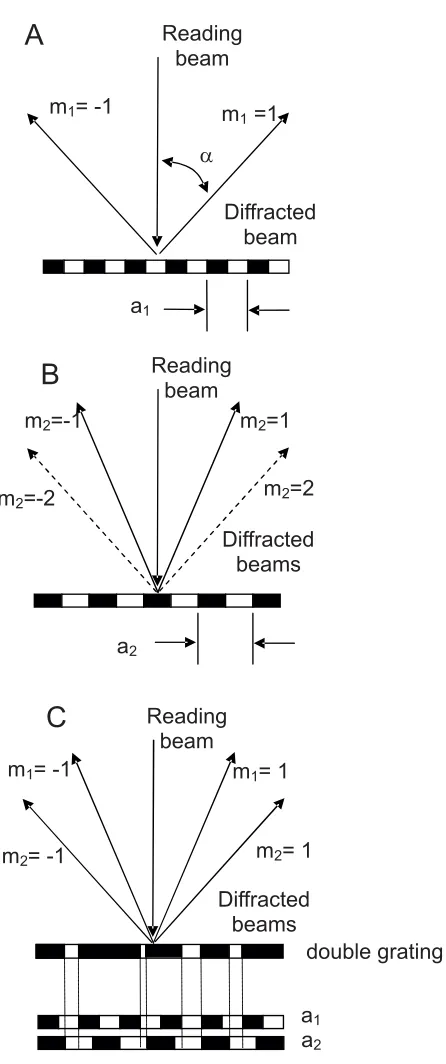
In a classical single diffraction grating, information may be encoded in the pitch or spacing of the grating, a. When such a grating is illuminated with light at wavelengthλ, for example at normal incidence, a series of diffracted beams of different order m is created, according to the equation a sinα =mλ. Here α is the angle of diffraction and m is the diffraction order. Therefore, a measurement of the first order diffraction angle, at m=1, gives direct information about the pitch of the grating a. This principle is shown in Fig. 1. The number of distinguish-able tags that can be manufactured depends on the ability to resolve a difference between two diffraction patterns. Two diffracted beams at diffraction anglesθ1andθ2can be resolved if
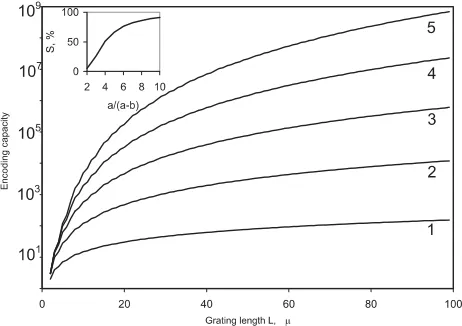
|θ1−θ2| ≥∆θ1/2+∆θ2/2, where∆θis angular width of the beam. Here∆θ=λ(Na cosθ)−1 , where N is the number of periods in the grating of length L (N≈L/a). Using this criterion it is possible to calculate the capacity of diffractive bar-codes with a single grating as a function of the grating length (neglecting all diffraction orders above m=1). The results are presented in Fig. 2, curve (1).
A much larger capacity of tag can be obtained if several gratings are superimposed on the bead, as shown on Fig. 2. Each of the superimposed gratings produces its own set of diffracted beams independently of the other gratings on the tag. If the tag has k superimposed gratings, the number of possible distinguishable codes c is then given by the number of possible com-binations of k beams in n possible positions, using the combinatorial formula c=(n−n!k)!k!. The results of calculations of the tag capacity for several superimposed gratings using the above resolution criteria is presented by curves (2)-(5), Fig. 2. In practice the maximum number kmax of superimposed gratings in the tag which can be distinguished by diffraction is limited by the resolutionδ of the tag’s fabrication process and may be estimated as kmaxλ/(2δ).
Fig. 1. A) first order diffraction from grating with pitch a1; B) first and second order
diffrac-tion from grating with pitch a2. Higher order diffraction is normally less intense and for
[image:3.612.176.399.69.601.2]Fig. 2. Encoding capacity of a diffractive bar-code tag as a function of the length of the tag for different numbers of superimposed gratings. The number on each curve corresponds to the number of superimposed gratings. The inset shows the level of intensity discrimination S necessary to ensure error-free identification of tags
the intensity of the brightest higher order diffracted beam as a fraction of the first order beam intensity. This shows that gratings with b=a/2 require the lowest level of threshold, and set-ting S = 0.05 eliminates all higher diffraction order beams and provides error-free identification of the tag (see inset of Fig. 2).
Some further reading problems can appear when gratings are superimposed: although far-field Fresnel diffraction as a Fourier transform of the far-field distribution on the grating is a linear process, superposition of gratings is not exactly equivalent to creating a linear sum of their fields. This could lead to interplay between gratings and appearance of extra ’ghost’ beams not present in individual gratings. Our modeling shows that intensities of the host beams are gener-ally much smaller than that of the main beams. They depend on the aspect ratio of the gratings and could become a serious factor at high levels of superposition. Tag capacity limitations aris-ing from the ghost beams for high order tags will have to be investigated further, but does not appear to be a major factor in the experiments reported below.
In order to demonstrate this tagging concept a chip library of chromium gratings was manu-factured on a glass substrate using direct write electron beam lithography. The library of grat-ings contains almost 7,400 unique barcode tags, 50x50µm, separated by gaps of 200 µm. SEM images of these tags showing the range of different superimposed gratings are presented in Fig. 3. With an available nanofabrication resolutionδ of about 100nm we have been able to demonstrate tags up to order three (containing three superimposed gratings) that are fully distinguishable by diffraction. This provides a capacity of about 68,000 distinguishable tags. Higher order tags have also been fabricated, but they sometimes show fails in pattern reproduc-tion which spoils the quality of diffracreproduc-tion (Fig. 3(iv))
Fig. 3. SEM images of barcode tags of different order: (i) single grating tag; (ii) two super-imposed gratings; (iii) three supersuper-imposed gratings; (iv) four supersuper-imposed gratings (note nano-lithography resolution limiting quality of this grating).
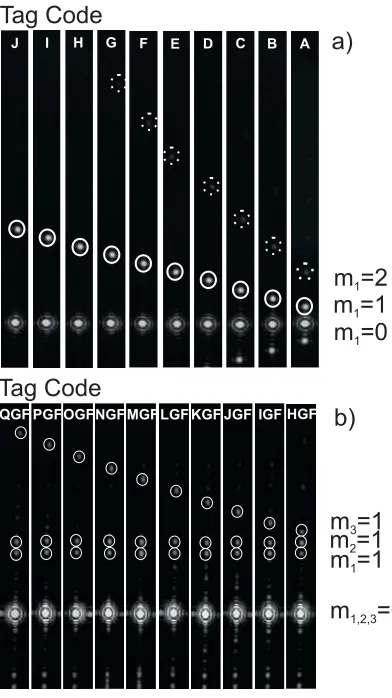
indicated by dashed circles.
Figure 4(b) shows diffraction patterns from different tags containing three superimposed gratings (patterns HFG to QFG). Here, the first grating diffracts exactly as grating G in Fig. 4(a), while the second grating diffracts as grating F. The third grating differs from pattern to pattern. The first diffraction pattern is from a grating which diffracts as grating H in Fig. 4(a), but then changes step by step to give a higher and higher diffraction angle. In this way we have resolved diffraction patterns with up to three superimposed gratings. Further increase in the number of superimposed gratings on the tags led to increasing read errors due to the limited resolution of the grating fabrication process.
In conclusion we have demonstrated a new optical, non-contact tagging technique based on superimposing large numbers of miniature diffraction gratings on a tag. With a 50nm nanofab-rication resolution now routinely available, the technique is capable of creating distinguishable tags containing at least 5 superimposed grating and encoding up to 109tags, each of which is only 100µm long and a fewµm wide. To demonstrate this technique we manufactured a library of 50µm x50µm tags on a glass wafer. We have been able to demonstrate experimentally that the principle of superimposing works. With nanofabrication resolution of about 100nm it has been possible to resolve tags containing at least three superimposed gratings providing capac-ity for more than 68,000 tags. An enormous increase in capaccapac-ity will be possible if two sets of mutually perpendicular gratings are used. Combinatorial analysis shows that up to 1018 differ-ent barcode tags can possibly be fabricated with such two-dimensional superimposed gratings up to order five. Although the principle of the technique has been demonstrated by fabricat-ing metal-on-glass tags, equally the tags could be fabricated onto a polymer material such as a small micron sized particle. The robust nature of the tags, together with the non-contact remote reading capability makes them ideal for a large variety of biochemical, cytological, proteomic and genomic applications. These tags could also have widespread use in invisible marking for security applications and product marking identification and tracking.
Fig. 4. Diffraction patterns created by a single grating tag (a), and tags containing three different gratings (b). Moving from left to right shows how a progressive decrease in the pitch of one of the gratings changes the diffraction pattern