Genetically Enhanced Performance of a UTRA-like Time-Division Duplex CDMA
Network
Song Ni, Lajos Hanzo
1School of Electronics and Computer Science, Univ. of Southampton, SO17 1BJ, UK.
Tel: +44-(0)23-8059-3125, Fax: +44-(0)23-8059-4508
Email:
lh
1@ecs.soton.ac.uk http://www-mobile.ecs.soton.ac.uk
Abstract
In this contribution a Dynamic Channel Allocation (DCA) algo-rithm is developed, which minimizes the amount of Multi-User Interference (MUI) experienced at the Base Stations (BSs) by em-ploying Genetic Algorithms (GAs). A GA is utilized for find-ing a suboptimum, but highly beneficial Uplink (UL) or Down-link (DL) Timeslot (TS) allocation for improving the achievable performance of the third generation UTRA system’s Time Divi-sion Duplex (TDD) mode. It is demonstrated that a GA-assisted UL/DL timeslot scheduling scheme may avoid the severe BS to BS inter-cell interference potentially inflicted by the UTRA TDD CDMA air interface owing to allowing all TSs to be used both in the UL and DL
1. INTRODUCTION
The UTRA Time Division Duplex (TDD) mode was contrived for the sake of improving the achievable network performance by assigning all the timeslots on a demand basis to the uplink and downlink. How-ever, we demonstrated in [1] that the arbitrary allocation of uplink and downlink timeslots may result in an excessive BS-to-BS interference and hence in a potentially reduced number of system users. We there-fore invoked both adaptive modulation and adaptive beamforming for the sake of mitigating this TDD-specific problem and demonstrated that with their advent the number of users supported may become similar, but still somewhat inferior in comparison to that of an Fquency Division Duplex (FDD) system. In this contribution our re-search evolves further and as a design alternative, we will apply a Ge-netic Algorithm (GA) [2] for improving the achievable performance of the UTRA TDD mode. More specifically, in [1] we demonstrated that the employment of adaptive arrays in conjunction with Adaptive Quadrature Amplitude Modulation (AQAM) [3] limited the detrimen-tal effects of co-channel interference on the UTRA-like TDD/CDMA system and resulted in performance improvements both in terms of the achievable call quality and the number of users supported. How-ever, in comparison to a UTRA-like FDD/CDMA system, the capac-ity of the UTRA-like TDD/CDMA cellular system was shown to re-main somewhat poorer under the same propagation conditions. It was shown that the TDD mode is more prone to avalanche-like teletraffic overload and its carried teletraffic is up to a factor two lower than that of the FDD mode. Again, this is because in the TDD mode Mobile Stations (MSs) can interfere both with Base Stations (BSs) as well as with each other. The same holds for BSs, which can interfere with
The financial support of the EPSRC, UK and the EU under the auspices of the Phonix, Newcom and Nexway projects is gratefully acknowledged.
both MSs and other BSs owing to potentially using all timeslots in both the uplink and downlink. The resultant additional interference has a detrimental impact on the system’s capacity. These conclusions were also corroborated by Wu [4], who pointed out that the inter-cell BS-to-BS interference substantially decreases the system’s user ca-pacity. Hence we can increase the total system capacity by reducing the BS-to-BS interference. One way of achieving a reduced BS-to-BS interference is by invoking beamforming [5], since the BS becomes capable of focusing its transmitted signal energy on the served MSs, while creating a radiation null in the direction of the adjacent BSs, as we have also shown in [1]. However, this desirable goal may only be achieved, if there are no MSs roaming in the immediate vicinity of the line between the serving BS and the neighbouring BS. Hence the achievable capacity of the beamforing aided UTRA-like TDD/CDMA system remains limited.
In order to mitigate these performance limitations, we designed a GA-assisted TS-scheduling scheme for the UTRA-like TDD/CDMA system. A Dynamic Channel Allocation (DCA) algorithm was devel-oped, which minimizes the amount of MUI experienced at the BSs by employing GAs [6, 7].
The structure of this paper is as follows. In Section 2 we will first describe our GA-aided UTRA-like TDD/CDMA system model used. The numerical results characterizing the various interference scenar-ios in terms of the number of users supported by the GA-assisted TDD/CDMA system are compared to those of the TDD/CDMA sys-tem dispensing with GAs in Section 3. Finally, we conclude our dis-cussions in Section 4. Let us now commence our discourse by briefly highlighting how GAs may be used for enhancing the UTRA/TDD system’s performance.
2. THE GENETICALLY ENHANCED UTRA-LIKE TDD/CDMA SYSTEM
Recently substantial advances have been made in the context of di-verse GA-aided wireless receivers, such as CDMA multiuser detec-tors [2], beamforming [8] and Space Division Multiple Access (SDMA) aided OFDM [9]. Genetic algorithms have been used as robust guided stochastic search algorithms for solving various optimization prob-lems, as diverse as multiprocessor scheduling [10], topology design and bandwidth allocation in ATM networks [11], for improving the performance of channel allocation in cellular networks [12], for code design [13] and code set selection in optical CDMA networks [14]. Despite establishing GAs as a useful optimization tool in numerous applications, the employment of GAs in the network layer of mo-bile communications, has been extremely rare. In order to probe fur-ther, in this contribution genetic algorithms have been utilized by a UTRA-like TDD/CDMA system, where the GA-assisted timeslot
fij
1
2
3
n
2 3 4 5 m
. . . . . . . . . . . . . . . . . . . . .
1 . . .
. . . 1 1 1 1 1 1 1 1 1 1 1 1 0 0
0 0 0 0 0 0 0
1 1 0 0 0 0 0 0 0
0 0 0
0 0
0
0
0 0 0 0 0 0 0 0 0 0 0 0 0 0 0 0
0 0 0
[image:2.595.314.543.83.249.2]0 0 0 0 0 0 0 0 0 0 Timeslot Index Cell Index
Figure 1: Timeslot allocation matrix used by the GA
locator assigns either uplink or downlink timeslots to MSs or BSs, while maintaining certain Quality of Service (QoS) guarantees.
The aim of this design is to maximize the achievable UTRA-like TDD/CDMA network’s capacity, quantified in terms of the mean nor-malized carried traffic expressed in units of Erlang/km2/MHz. The performance metrics used to quantify the quality of service have been described in [1]. Recall that the false termination (FT) probability, which is also often referred to as the call dropping probability,PF T, quantifies the probability that a call is forced to be prematurely termi-nated. This may be the consequence of an insufficiently high SINR encountered during the call, which is not remedied by an intra-cell handover, either due to the lack of available channels, or owing to an insufficient improvement of the SINR, which leads to successive outages and eventually to a dropped call. Calls may also suffer from forced termination, when a mobile enters a heavily loaded cell, which either suffers from a poor average SINR or has no available chan-nels for the mobile to handover to. The main performance limiting factors are constituted by potentially high interference levels and low maximum affordable transmit powers, often resulting in excessive call dropping rates. Since a dropped call constitutes an annoyance from a user’s viewpoint, the users’ SINR value has to be maintained safely, but not excessively above the target SINR value.
The interference experienced at the mobile can be divided into interference due to the signals transmitted to other mobiles from the same base station, which is known as intra-cell interference, and that encountered owing to the signals transmitted to other mobiles from other basestations, as well as to other basestations from other mobiles, which is termed inter-cell interference.
The uplink differs from the downlink in that the multiple access interference is typically asynchronous in the uplink due to the un-coordinated transmissions of the mobile stations, roaming at differ-ent distances for the BS whereas it may remain synchronous in the downlink since all signals are transmitted by the BS. To elaborate a little further, all the synchronous downlink signals of the users shar-ing a given timeslot are assumed to arrive at the MS via the same propagation channel. The pathloss and shadow fading are updated on a 10msUTRA frame by frame basis, once every 15 timeslots [2]. If this channel is dispersive, it does affect the orthogonality of each of the OVSF codes, but the amount of interference inflicted remains lower than in case of the asynchronous uplink, where all multipath components of the asynchronous users arrive at different times at the BS, as discussed in [15]. A possible solution for mitigating the prob-lem of OVSF code orthogonality degradation imposed by channel-dispersion-induced linear distortions is employing Multi-User Detec-tors (MUDs) [2] at the base stations.
2 2
11= 12= 1
12=
f11=
f12=
f11=1
0
0 0 0
( d ) ( b ) BS
1
f= 1
11=1
MS 1 12 2 MS 2 f 1 MS 1 f f 2
MS BS2
BS BS
1
MS
1
BS MS BS2
1
MS
1
BS MS BS2
f
( c )
Timeslot ID: 1
Number of MSs: 2
[image:2.595.53.284.85.213.2]Number of BSs: 2 Desired Signals Inter−cell interference ( a )
Figure 2: An example of UL/DL timeslot allocation options.
Following the above introductory considerations, let us represent the GA’s solution spaceF as ann×m-dimensional binary matrix, wherenis the number of radio cells andmis the total number of timeslots. Explicitly, the total number of timeslots is the product of the number of traffic cells, the number of RF carriers per cell and the number of timeslots per carrier. Each elementfijin the matrix is either a binary one or zero, as shown in Figure 1, where a one corresponds to UL allocation and vice versa. The optimisation task to be solved by the GA is to find the best UL/DL constellation of all the TSs of all the cells for all UTRA TDD frames. Naturally, this optimisation task would impose an excessive complexity and hence a computationally efficient suboptimum solution is sought.
In our previous investigations [1] we quantified the achievable performance of the UTRA TDD/CDMA system, demonstrating that significant performance improvements can be achieved as a direct result of the interference rejection capabilities of the adaptive an-tenna arrays and adaptive modulation invoked. Hence the reduction of the interference improved the system’s performance. The amount of inter-cell interference imposed depends on the angle of arrival of the interference imposed by the adjacent radio cell. Again, if the times-lot in the interfering cell is used as an uplink timestimes-lot, then we have
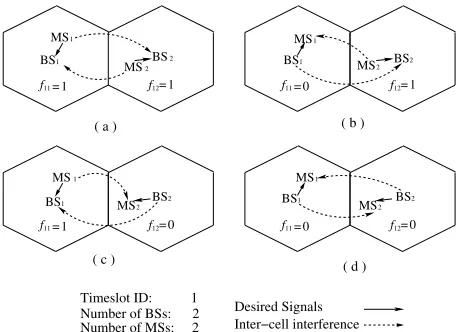
fij = 1in Table 1, and vice versa. A simple example of the possi-ble timeslot allocation scenarios is given in Figure 2, portraying four possible timeslot allocation scenarios for two BSs and two MSs.
Parameter Value Parameter Value
[image:3.595.129.473.85.197.2]Frame length 10 ms Timeslots per frame 15 TargetEb/No 8.0 dB OutageEb/No 6.6 dB Low Quality (LQ) OutageEb/No 7.0 dB BS Pilot Power -5 dBm BS/MS Minimum TX Power -44 dBm BS/MS Maximum TX Power +21 dBm Pathloss exponent -3.5 Noisefloor -100 dBm Power control SINR hysteresis 1 dB Cell radius 150 m Spreading factor 16 Modulation scheme 4QAM Max new-call queue-time 5 s Average inter-call time 300 s Average call length 60 s User speed 1.34 m/s
Table 1: Simulation parameters of the UTRA-like TDD/CDMA cellular network.
possible TS allocations, in order to find the best one, when a new TS has to be allocated to a user, who is initiating a new call. However, since this new TS allocation affects the entire system’s interference patterns, the complexity of the optimum full-search algorithm would become excessive. In order to reduce the complexity of the associ-ated decisions, we invoked a genetic algorithm for determining the advantageous scheduling of uplink and downlink timeslots. The ge-netic algorithm uses an objective function [2] to determine how ’fit’ each UL/DL TS allocation is for survival in the consecutive genera-tions of the GA, when ranking potential UL/DL TS allocation con-figurations. For instance, the aim of the GA is to determine in our example provided in Figure 2 of this section, which particular UL/DL TS allocation of the total of four different options has the best over-all connection quality, lower UL/DL average power consumption and lower interference level. The GA’s objective function will be evalu-ated for a small fraction of the entire set of possible TS allocations, while aiming for a near-optimum solution.
3. SIMULATION RESULTS
In our initial investigations we do not impose any user requirements concerning the number of uplink and dowlink TSs requested, we sim-ply aim for determining the best possible UL/DL system configura-tion, which would allow us to estimate the capacity of the system. The associated UTRA/TDD system parameters are described in Table 1. These investigations were conducted using a spreading factor of 16. Given that the chip rate of UTRA is 3.84 Mchips/sec, this spreading factor corresponds to a channel data rate of3.84×106/16 = 240 kbps. Applying 1/2 rate error correction coding would result in an effective data throughput of 120 kbps. A cell radius of 150 m was assumed and a pedestrian walking velocity of 3 mph was used. The simulation area was constituted of 49 traffic cells using the infinite mesh of wrapped-around cellular structure of Figure 4.18 in [5] .
[image:3.595.323.533.181.588.2]It was shown for example in Chapter 9 of [2] that the GA’s per-formance is dependent on numerous factors, such as the population sizeP, the number of generationsY, the choice of the parents’ se-lection method, as well as on a number of other genetic operations employed. In this section, we will quantify the system’s achievable performance with the advent of GAs, and attempt to find an appro-priate GA set-up and parameter configuration that are best suited for our optimization problem. The GA’s parameters are summarized in Table 2. Our performance metrics are, as before, the call dropping
or forced termination probabilityPF T, the probability of low quality
accessPlowand the mean transmission power [5]. The complexity of
the GA is governed by the number of generationsY required, in
or-der to achieve a meritorious TS allocation. For the sake of simplicity, the computational complexity of the GA is quantified here in the
con-Set-up/Parameter Method/Value
Individual initialization Uniform Random method
[image:3.595.326.532.234.367.2]Selection method Fitness-Proportionate Cross-over operation Single point Mutation operation Uniform random bit flip Population size VariableP= 4,10,20 Generation size VariableY=25,10,5 Probability of Mutation 0.1 Probability of Crossover 0.9 Computational complexity 100
Table 2: Configuration of the GA used.
0.0 0.5 1.0 1.5 2.0 2.5 Mean Carried Teletraffic (Erlangs/km2/MHz) 2
5 10-2 2 5
Forced
T
ermination
Probability
,
PFT
1% No GA
P=4 Y=25 P=20 Y=5 P=10 Y=10
Figure 3: Call dropping probability versus mean carried traffic of the UTRA-like TDD/CDMA based cellular network bothwith and without GA-assisted timeslots allocation as well as with shadow-ing havshadow-ing a standard deviation of 3 dBforSF=16.
text of the total number of objective function [2] evaluations, given by P×Y.
[image:3.595.323.535.367.564.2]0.0 0.5 1.0 1.5 2.0 2.5 Mean Carried Teletraffic (Erlangs/km2/MHz) 10-4
2 5 10-3 2 5 10-2 2 5 10-1 2
Probability
of
Low
Quality
Access,
Plow
1% No GA
[image:4.595.328.533.91.255.2]P=4 Y=25 P=20 Y=5 P=10 Y=10
Figure 4: Probability of low quality access versus mean carried traffic of the UTRA-like TDD/CDMA based cellular network bothwith and without GA-assisted UL/DL TS-allocation as well as with shadow-ing havshadow-ing a standard deviation of 3dBforSF=16.
fixed to a ratio of 7 : 8 (UL : DL). This fixed timeslot allocation may inflict a high BS→BS interference, when the serving cell is using up-link timeslots and the interfering cell is using downup-link timeslots, as portrayed in Figure 2 (b) or (c). The associated high cell inter-ference may result in a poor SINR, which fails to satisfy the system’s target SINR required for maintaining a high-quality connection and hence increases the probability of forced termination. By contrast, in the GA-assisted UTRA TDD/CDMA system each timeslot in a frame can be allocated to either the uplink or downlink, depending on the associated slot-SINR, potentially allowing us to allocate the timeslot by minimizing the inter-cell interference inflicted. As we mentioned in the previous section, for a UTRA/TDD system havingnBSs, there are2npossible UL/DL TS allocation schemes for each timeslot. In our simulated scenario there are 49 wrapped-around traffic cells and we use the infinite mesh of cellular structure portrayed in Figure 4.18 of [5], which results in the same amount of co-channel intereference for all cells. More explicitly, a ’desert island-like’ 49-cell structure dispensing with the wrap-around of cells would result in an irrealis-tically low co-channel interfernce along the fringes of the simulation area.
Given the above-mentioned 49 cells and that each timeslot my be used either in the UL or DL, the resultant search space size to be explored becomes249, when a new user initiates a call and has to de-cide about the choice of the serving BS, as well as whether an UL or DL timeslot activation would inflict the lower intereference. As argued before, the size249of this search-space is excessive, prevent-ing a full search. As a more attractive design option, a GA is utilized for finding a suboptimum, but highly beneficial uplink or downlink TS allocation. The computational complexity of the GA-aided search was set toP·Y = 100objective function evaluation, while using dif-ferentPandY values. The ”No GA” based TDD network was found to support 58 users atPF T = 1%, corresponding to a traffic load of 0.6 Erlang/km2/MHz. Upon employing GA-assisted UL/DL timeslot allocation before the transmission of each UTRA frame, the number of users supported by the TDD network increased to 185 users, or to an equivalent traffic load of 2.11 Erlang/km2/MHz, when invoking a GA population size ofP = 10andY = 10generations. When the population size was reduced toP = 4in conjunction withY = 25 generations, the TDD system was capable of supporting 174 users, corresponding to a teletraffic density of 2.01 Erlang/km2/MHz.
0.0 0.5 1.0 1.5 2.0 2.5 Mean Carried Teletraffic (Erlangs/km2/MHz) -1
0 1 2 3 4 5 6 7 8
Mean
T
ransmission
Power
(dBm)
No GA P=4 Y=25 P=20 Y=5 P=10 Y=10 Blank = Uplink Filled = Downlink
Figure 5: Mean transmission power versus mean carried traffic of the UTRA-like TDD/CDMA based cellular network bothwith and without GA-assisted UL/DL TS-allocation as well as with shad-owing having a standard deviation of 3dBfor a spreading factor of
SF=16.
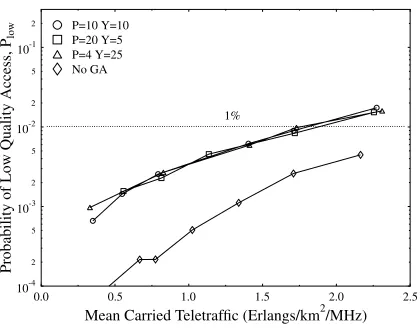
Figure 4 portrays the probability of low quality access versus var-ious traffic loads. It can be seen from the figure that the probability of low quality access for the ”No GA” scheme becomes better than that of the systems using GA-assisted UL/DL timeslot scheduling. This is a consequence of the associated high probability of forced termination for the ”No GA” scheme, as shown in Figure 3, because the higher the probability of forced termination, the lower the number of users supported by the TDD system. Hence the effects of co-channel in-terference imposed by the existing connections remain more benign, when a new call is initiated. Hence a better connection quality is maintained compared to that of the ”GA-assisted” scheme. From the figure we observe that the GA-aided TDD system’s teletraffic density was limited to 1.74 Erlangs/km2/MHz, corresponding to 151 users, which was limited by the performance metricPlow.
For the sake of characterizing the achievable system performance also from a different perspective, the mean transmission power ver-sus teletraffic performance is depicted in Figure 5. We observe in the figure that both the ”GA-assisted” and ”No GA” scenario obey a sim-ilar trend in terms of their downlink power consumption. However, in terms of uplink power consumption, the ”No GA” scheme requires an average of 2 dBm to 5 dBm more signal power than the ”GA-assisted” scheme, as the traffic load becomes higher. Again, this is because the severeBS→BSinter-cell interference degrades the quality of the call. Hence, for the sake of achieving the target SINR and maintain the existing connections, the MSs have to increase their transmission power, which results in an increased interference level imposed on other connections, hence inflicting a performance degradation upon the whole system. The ”GA-assisted” system is capable of avoid-ing the presence of severe interference by advantageously schedulavoid-ing the UL/DL timeslots, hence keeping the system’s average interference load as low as possible, hence indirectly allowing us to support more MSs.
[image:4.595.63.273.92.256.2]0.0 0.5 1.0 1.5 2.0 2.5 Mean Carried Teletraffic (Erlangs/km2/MHz) 0.8
0.85 0.9 0.95 1.0
Ratio
of
UL
versus
DL
usage
[image:5.595.62.272.92.254.2]No GA 7:8 P=4 Y=25 P=20 Y=5 P=10 Y=10
Figure 6: Ratio of uplink timeslots to downlink timeslots versus the mean carried traffic of the UTRA-like TDD/CDMA based cellular network bothwith and without GA-assisted UL/DL TS allocation and with shadowing having a standard deviation of 3dBfor a spreading factor ofSF=16.
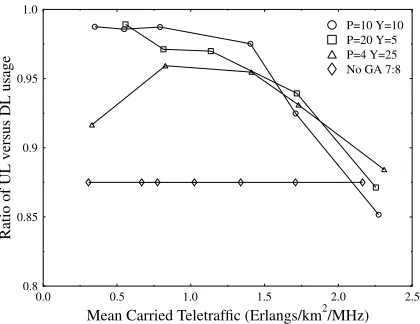
the system. From the resultant statistical results we observe that the UL/DL ratio of the ”GA-assisted” schemes was between 0.9 and 1.0, which is close to the symmetric traffic load allocation, except for high traffic loads in excess of 2 Erlang/km2/MHz.
4. SUMMARY AND CONCLUSIONS
In this paper, we introduced a GA-assisted UL/DL timeslot schedul-ing scheme for the sake of avoidschedul-ing the severe inter-cell interference caused by using the UTRA TDD/CDMA air interface. The system model and simulation parameters used in this contribution were high-lighted in Section 2 and in [1]. The GA aided UTRA TDD/CDMA system’s performance was then examined using computer simulations in Section 3. Summaries of the various parameters and the GA config-uration that were used in our simulations were listed in Tables 1 and 2. Significant system performance gains have been achieved by employ-ing the GA-aided UL/DL TS schedulemploy-ing scheme, as seen in Figure 3. The ”No GA” based TDD network was found to support 58 users at
PF T = 1%, corresponding to a traffic load of 0.6 Erlang/km2/MHz. Upon employing GA-assisted UL/DL timeslot allocation in conjunc-tion with the computaconjunc-tional complexity ofP·Y = 100, while using a population size ofP= 10andY = 10generations, the number of users supported by the TDD network increased to 185, or to an equiv-alent traffic load of 2.11 Erlang/km2/MHz. We observed in Figure 4 that it was the probability of low quality access, not the probabil-ity of forced termination, which imposed the more severe constraint on the system’s capacity. In Figure 5, we compared the power con-sumption of the ”No GA” and the ”GA-assisted” TDD system. We observed a similar trend in terms of their downlink power consump-tion. However, in terms of uplink power consumption the ”No GA” scheme requires on average approximately 2 dBm to 5 dBm more signal power than the ”GA-assisted” scheme, as the traffic load is increased. Our future research is focussed on the asymmetric GA-assisted UTRA TDD/CDMA system’s achievable performance using both AQAM and beamforming.
5. REFERENCES
[1] S. Ni, J. S. Blogh, and L. Hanzo, “On the network performance of UTRA-like TDD and FDD CDMA systems using adaptive modu-lation and adaptive beamforming,” inProceedings of the IEEE
Ve-hicular Technology Conference VTC 2003 Spring, (Jeju, Korea),
pp. 606-610, April, 2003.
[2] L. Hanzo, L. L. Yang, E. L. Kuan, and K. Yen,Single- and
Multi-carrier DS-CDMA. John Wiley and IEEE Press, 2003.
[3] L. Hanzo, C.H. Wong, and M.S. Yee, Adaptive wireless
transceivers: Turbo-Coded, Turbo-Equalised and Space-Time
Coded TDMA, CDMA and OFDM systems. John Wiley and IEEE
PRESS, 2002.
[4] X. Wu, L.-L. Yang, and L. Hanzo, “Uplink capacity investiga-tions of TDD/CDMA,” inProceedings of the IEEE Vehicular
Tech-nology Conference, VTC Spring 2002, vol. 2, (Birmingham,
Al-abama, USA), pp. 997-1001, 6-9 May 2002.
[5] J. S.Blogh and L. Hanzo,Third-Generation Systems and Intelli-gent Wireless Networking - Smart Antennas and Adaptive
Modu-lation. John Wiley and IEEE Press, 2002.
[6] D. E. Goldberg, Genetic Algorithms in Search, Optimization,
and Machine Learning. ISBN 0201157675, MA USA:
Addison-Wesley, August 2001.
[7] J. Holland, Adaptation in Natural and Artificial Systems. Ann Arbor, Michigan: University of Michigan Press, 1975.
[8] A. Wolfgang, N. N. Ahmad, S. Chen, and L. Hanzo, “Genetic al-gorithm assised minimm bit error rate beamforming,” inCDROM
of the IEEE 59th Vehicular Technology Conference, (Milan, Italy),
May, 2004.
[9] M. Alias, A. Samingan, S. Chen, and L. Hanzo, “Multiple antenna aided OFDM employing minimum bit error rate mul-tiuser detection,”IEE Electronics Letters, vol. 39, pp. 1769–1770, November 2003.
[10] E. Hou, N. Ansari, and H. Ren, “A Genetic Algorithm for Mul-tiprocessor Scheduling,”IEEE Transaction on Parallel and
Dis-tributed Systems, vol. 5, pp. 113 – 120, February 1994.
[11] K.-S. Tang, K.-T. Ko, K. F. Man, and S. Kwong, “Topology Design and Bandwidth Allocation of Embedded ATM Networks Using Genetic Algorithms,”IEEE Communications Letters, vol. 2, pp. 171 – 173, June 1998.
[12] C. Y. Ngo and V. O. K. Li, “Fixed Channel Assignment in Cel-lular Radio Network Using a Modified Genetic Algorithm,”IEEE
Transactions on Vehicular Technology, vol. 47, pp. 163 – 172,
Feburary 1998.
[13] D. Sadot, U. Mahlab, and V. Natan-Bar, “New method for de-veloping optical CDMA address code sequences using the genetic algorithm,” inProceedings of the IEEE International Conference
on Communication, ICC1998, vol. 3, (Atlanta, GA, USA), pp. 7–
11, June 1998.
[14] Y. H. Lee, S. T. Sheu, and M. H. Chen, “Application of Genetic Algorithm for Optimal Simultaneous Code Set Selection in Opti-cal CDMA,” inModelling and Simulation, MS99, vol. 3, (Philadel-phia, USA), pp. 5 – 8, May 1999.
![Figure 3: Call dropping probability versus mean carried traffic ofthe UTRA-like TDD/CDMA based cellular network both with andwithout GA-assisted timeslots allocation as well as with shadow-ing having a standard deviation of 3 dB for SF=16.text of the total number of objective function [2] evaluations, given byP × Y .](https://thumb-us.123doks.com/thumbv2/123dok_us/8512579.350527/3.595.323.533.181.588/probability-cellular-andwithout-timeslots-allocation-deviation-objective-evaluations.webp)