Project Document Cover Sheet
CORE User Requirement Study
Project
Project Acronym CORE Project ID
Project Title Collaborative Orthopaedic Research Environment
Start Date 01 November 2004 End Date 31 October 2006
Lead Institution University of Southampton
Project Manager & contact details
Dr Gary Wills
Intelligence, Agents, Multimedia Group School of Electronics and Computer Science University of Southampton
Southampton, SO17 1BJ
Project Web URL www.core.ecs.soton.ac.uk
Programme Name (and number)
Virtual Research Environments (05/04) Strand III
Programme Manager Dr Maia Dimitrova
Document
Document Title CORE User Requirement Study
Reporting Period
Author(s) & Project Role Matthew Stenning Investigator), Simon Grange Investigator), Yee Wai Sim Investigator), Chu Wang (Co-Investigator), Lester Gilberts (Technical Manager), Gary Wills (Project Manager)
Date 25/08/2005 Filename ecstr_iam05_007.doc
ISBN 0854328440
Technical Report Number ECSTR-IAM05-007
Access Project and JISC internal General dissemination
Document History
Version Date Comments
0a 18 August 2005 Initial draft of report
CORE User Requirement Study
M. Stenning, S. Grange, Y. W. Sim, C. Wang, L. Gilbert, G. B. Wills
School of Electronics and Computer Science University of Southampton
E-mail: [email protected], [email protected], {gbw, lg3, yws01, cw2}@ecs.soton.ac.uk
Technical report Number: ECSTR-IAM05-007 ISBN:0854328440
Abstract
This report describes a study undertaken as part of the Collaborative Orthopaedics Research Environment (CORE) project to determine the user requirements for a Virtual Research Environment (VRE). The study was conducted through a consultation process that involved semi-structured interviews and online survey. Requirements of users and their recommendations are presented according to the study’s objectives. The result of this study will be used to inform the development of a VRE demonstrator in the CORE project.
1 Introduction
The dynamic and technology driven research community, shares its information through approaches initiated by Gutenberg’s printing press and recognizable conceptually to scientists since the 18th century [3]. Until recently, it has been the case that scientific findings are captured, summarized, and shared through manuscripts. Nevertheless, the Web technologies have dramatically affected the practices of science already been by the Internet. For example, for biologists, the genome sequence which is gigabytes in magnitude is now available online [2]. Data is something that they find on the Web, not only in the lab. The rapidly expanding computing and storage capabilities of the federated Grid, and advances in optical networks are accelerating the trends of disseminating and sharing scientific findings over the Web.
Collaborative Orthopaedics Research Environment (CORE) [5] is a JISC funded project, which aims to provide a loosely coupled infrastructure that combines clinical practice, education and research into one working environment. The CORE builds on the work carried out under the Virtual Orthopaedic European University (VOEU) project [15].
The objective of this study is to ascertain the issues and requirements for provision of Grid/Web services that relate to the storage, access, use and reuse, of research data in repositories, and information from digital libraries and its dissemination, under a VRE. The extent to which specific users can achieve specified goals with effectiveness, efficiency and satisfaction using a VRE is largely driven by the requirements of the users. Hence the study of user requirements plays an important role when developing a VRE. The end users in this study are researchers and clinicians working in an orthopaedic (bone) laboratory, who typify a group of e-scientists working on collaborated projects and a group of e-learners studying in joint-partnership institutions.
The VRE in the CORE project will incorporate the basic science disciplines of molecular and tissue biology, engineering and computing with allied medical disciplines of pharmacology, prosthetics, trials management and the clinical disciplines concentrating upon musculoskeletal applications in rheumatology and orthopaedics. This report describes the user requirements for such a VRE in accordance with the objectives outlined below. Recommendations for each objective are also included in this report to guide further development activities in the CORE project.
2 Objectives of the Study
The objectives of this user requirement study are as follows: 1. To identify the user requirements for a VRE.
2. To elucidate enhancements for the planned functions in the CORE.
3. To assess the current practice of discovering, locating and using research findings (i.e. publications and experimental data) to focus the enhancement of such processes through the VRE.
3 Methodology
3.1 Semi-structured interviews
The resources available for this study lend itself to a semi-structured interviewing technique that is an adaptation of methods used by Wood [16] and Spradley [14]. The important principles underlying such an interviewing technique, as identified by Wood, are concerned mainly with the nature of the expert’s knowledge. End users of a VRE are usually experts in their research domain, which the VRE is intended to support. There is a body of literature in cognitive psychology [12] on the nature of expertise that has implications for how one should work with experts to gain an understanding of the way they accomplish their work within a specialised domain.
knowledge, and which uses information that they provide as the basis for further questioning [14].
In view of the translation competence issues, the authors conducted the interviews by first using very general probing techniques to persuade experts to talk freely about their domain in a global sense. Expert’s language is recorded and then examined for category labels and other domain-specific linguistic cues. The authors probe experts for additional, related information by then using domain-specific terms. For this reason, the interviewing technique described in this report is considered semi-structured rather than semi-structured [6]. Instead of designing a priori set of questions to be asked in a specified order, the authors have various types of questions at their disposal to be used in opportunistic ways, depending on the demands of the situation.
As stated earlier in this report, end users in the CORE project typify e-Scientists and e-learners in their research environment; hence, five professionals who work as researchers in the computer science field and medical field were invited to take part in this study. The participants were chosen based on their expert knowledge in the research areas of digital library, information and learning technologies, and the biomedical domain. Their expertise is appropriate in finding out the requirements involved with providing Grid/Web services that facilitate the sharing of resources (for the purpose of research and education) in data repositories and digital libraries.
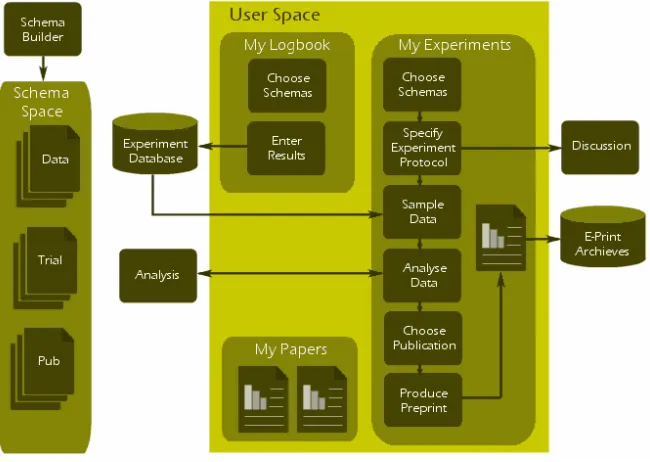
[image:4.595.137.462.446.677.2]Starting from the foundation of the VRE in VOEU, a user case scenario (see Figure 1) was worked out to explore possible functions and application settings. The scenario described several concrete activities of a fictitious user such as formalising a trial protocol, selecting a dataset, analysing a dataset and discussing results.
Figure 1: Workflow in the VRE framework
case scenario described above. Each interview was generally an hour in duration, and permission was asked to record the interviews for later analysis and interpretation. The purpose of the interviews was to stimulate individual reflection upon experience and act as a starting point to engage participants in identifying their requirements for a VRE. Some key common questions were included in order to identify strategies for discovering, locating and using/reusing of research findings (see Appendix 1).
3.2 Online survey
The aim of the online survey was to identify end user requirements in the collaborative research environment. A survey questionnaire containing nine questions (see Appendix) was designed to be completed by participants via email. A total number of 17 orthopaedic surgeons (including 14 Higher Surgical Trainee (HST), one consultant and two surgeons who did not disclose their grade) took part in this survey. HSTs are qualified surgeons training to be consultants. Their study is work based, and they are rarely co-located with others. During the six years of training, they usually move post twelve times, and they have to keep a logbook (e-Portfolio) as required by the learning contracts with their professional Colleges.
Participants who took part in the online survey responded to questions in a way that indicate that they were ‘tech-savvy’, i.e. they use computers at home and work, and they discover and locate research materials using the Web. HSTs have to conduct research and publish papers as part of their training. Hence, all of the participants (except one) are involved in research projects, where 13 of them conduct individual audits/projects for publication, and 3 others undertake part-time postgraduate degree in conjunction with their training.
4 Major
Findings
In general, the participants were very positive about the VRE and made many suggestions as to how to enhance the functions of the planned VRE. This section maps out the major findings derived from the semi-structured interviews and online survey with the objectives listed in Section 2. Recommendations for each objective will also be included in this section. Some of the recommendations overlap the objectives, reinforcing the outcomes of the study.
4.1 Objective 1: To identify the user requirements for a VRE
4.1.1 Requirements
All of the interviewed participants agreed that any scientific effort will have diachronic features, i.e. collaborative research activities may extend through time, enabling the influence of these activities to carry on beyond their timescale, disseminating research findings beyond the original boundaries of the collaboration.
One of the interviewed participants also identified that there is a loose coupling that exists between researchers as educators and their students, notability in the context of higher and further education. The findings of research activities can be used to educate the next generation of researchers.
sharing of resources can keep others in the research community up-to-date with the current development.
An interviewed participant foresees digital library as an important medium for focusing various channels into a single portal. She also recognises the need for researchers to undertake experiments, deposit scientific data, and produce pre-prints using a VRE.
There were mixed feelings about sharing resources among the participants. This was highlighted by the tension between the concept of sharing and sense of ownership of the resources. Some participants welcomed the idea of sharing as it would make their life easier; while others see that it is pointless to share resources unless some form of rewards were involved. One of the interviewees implied that resources per se do not make scientific sense; it is what the researchers do with these resources and how they are being used that adds scientific value to content materials.
The VRE should be made easy to use for users who may not be computer literate, as pointed out by all interviewed participants. For example, if users are asked to complete multiple fields (metadata) when depositing articles, they may become frustrated and give up on using the VRE.
The comments made by vast majority of the interviewed participants and survey respondents indicated the requirement to contextualise resources within a research framework that is relevant to the subject discipline. This emphasises the importance of providing resources that are of easy access to the users, delivered to them regardless of their computer platforms. Some degree of personalisation or user profiling in order to narrow the users’ inquiry on particular subjects seemed to be envisaged by all the participants.
A participant from bone laboratory identifies the need to utilise Grid services in running simulations and analysing large-scale experimental data.
Majority of the survey respondents undertake research as part of the requirements of surgeons’ Continuing Professional Development. However, a large number of them have no experience in collaborative research. The majority of those who conduct research collaboratively commented that a lack of space for sharing resources poses difficulties for them when coordinating research activities and pooling results from trials. Three of them found that collaborative research yields good results but time consuming compared to an individual project.
When asked what are the essential facilities and functions that survey respondents required in a VRE, the majority of them answered that access to shared scientific data and analysis tools is important in the VRE. Furthermore, three of the respondents emphasised that the accessibility to the shared resources should be made easy and simple.
4.1.2 Recommendation
Sharing of research resources, i.e. scientific data and publications, appears to be an attractive idea. This is supported by the comments given by survey respondents that express how time consuming it is to conduct collaborative research without a space to share scientific data and results. However, issues of both personal and institutional intellectual capital must be addressed. For example, initiatives and support to enable resource sharing should be targeted at the institutional level.
A useful definition from Andy Powell of UKLON is: “A portal is an online facility that provides a personalised, single point of access to resources that supports the end user in one or more tasks (i.e. discovery, learning and research)” [1]. Hence, a portal is an appropriate approach to construct a VRE. It can provide personalisation to users and allow them to access the VRE using Web browsers, which is platform independent.
A clear requirement priority is the design of a user-oriented portal, aimed at the non-computer specialist, with accessible resources that are easy to browse, upload and download, as suggested by the survey respondents.
Grid services make sense when running large-scale analysis and simulation since they provide secure and managed access to distributed computational power. Hence Grid services should be included in the VRE as part of its functions to support research activities.
4.2 Objective 2: To elucidate enhancements for the planned
functions in the CORE
4.2.1 Requirements
During the interviews, participants were asked to identify what would enhance the use and access to a VRE. The major concern of the participants was how to integrate a VRE into their working environment and working practice. For instance, problems could arise if users were asked to submit scientific data in XML format, which might be unfamiliar to them. Most of the participants are reluctant to change their work output formats in their research projects.
Three of the interviewed participants in this study also express the need for interaction between users and VRE administrators. This means resources should be made dynamic and responsive, where users can add/remove links to resources in the VRE.
Supporting storage and retrieval of raw scientific data was a welcome thought to all participants. The interviewed participants agreed that only a small percentage of the data generated by many scientific experiments appears in, or is referenced to the published literature. Hence, providing links between raw scientific data and articles is a desirable feature that could enhance the functionality of VRE. One of the interviewed participants added that not only data, which show positive outcomes, should be included in the VRE but those with negative results should also be made accessible.
An interviewed participant felt that the process of formalising trial protocols should be made flexible. For instance, users should be allowed to choose trial protocols from a list of available options and only include those that are relevant to them in the trial procedures. Such an approach will not only give users the flexibility in conducting their trials, but simultaneously offer them a chance to use protocols that might be unknown but yet prove useful to them.
The ability to view scientific data in various ways, i.e. numerically or graphically, was another feature that majority of the interviewed participants felt was useful. For example, a biologist might want to visualise scientific data graphically while a mathematician would prefer to see the same set of data numerically.
scientific activities. These data can in turn be used to populate the VRE once it is constructed.
In the online survey conducted, the majority of respondents suggested that the inclusion of access to a shared database, statistical analysis tools and authoring tools (i.e. word processors) are essential in the VRE. All respondents, who answered the question that explores how they integrate research resources into their work, claimed that they used Microsoft Office (mostly Microsoft Excel) and SPSS software.
4.2.2 Recommendation
Users have preconceived expectations of VRE, not only as a source of research resources, but also as a focus to share good practice. Providing examples of excellence with tools and templates can do this.
It is important to ensure that the portal involve potential users through the process of content development. A participatory-based approach (resources developed, evaluated and tested by the community) should be considered.
A loosely coupled architecture, i.e. one that based on SOA, should be used to build the VRE, as this allows the flexibility of adding, removing or modifying extra services when user requirements change.
It appears that constructing a prototype system to collect and audit scientific data is beneficial. Hence such system should be taken into consideration when constructing the VRE.
The online survey shows that the most frequently used software in respondents’ research activities is Microsoft Excel. Hence, the VRE should provide support for storing and retrieving scientific data in Excel format (files with xls extension). All interviewed participants and survey respondents agreed that the planned
functions in the VRE, as discussed in section 3.1, are essential.
4.3 Objective 3: To assess the current practice of discovering,
locating and using research findings (i.e. publications
and experimental data) to focus the enhancement of such
processes through the VRE
4.3.1 Requirements
Most participants and survey respondents claimed that Google search engine is the first place that they will be start looking for research materials. However, the interviewed participants felt uncomfortable about using some of the resources found this way due to unclear copyright and quality of these materials, or the links to the resources might be remove without notice. Google Scholar [7] is another new search engine that attempts to address some of these issues. It enables users to find articles from a wide variety of academic publishers, professional societies, preprint repositories and universities, as well as scholarly articles available across the Web.
All of the survey respondents (except one) are using PubMed [11], which is a search engine for the National Library of Medicine that includes over millions of citations from MEDLINE and other life science journals for biomedical articles. Ovid [10] is another resource on the Web that a few survey respondents visit to discover and locate research materials.
4.3.2 Recommendation
A strategy to manage the quality of resources should be devised to guarantee the flow of new materials. This could involve expert input and feedback on content renewal and, as suggested by participants in this study, peer review. On top of that, it is also important to derive a mechanism to maintain and check the resource links’ integrity.
It will be useful to be able to access the VRE (portal) from popular search engines such as Google. Metadata in the VRE should be used effectively so that research resources in the portal can be retrieved via search engines.
Providing a cross searching facility between Google and PubMed could be another desirable feature as most of the participants in this study employ these search engines to find research resources available on the Web.
5 Conclusions
The current development of Web technologies increases the effectiveness of collaboration between scientists. Digital libraries lie in the heart of these technologies, acting as an information grid that consists of a collection of resources for learning and teaching, data repositories for research purposes, or as archives of diverse cultural heritage materials [8]. The VRE has been implemented as a Web-based environment for supporting a critical subset of the e-science cycle: the collation and analysis of experimental results, the organisation of internal project discussions, and the production of appropriate outline documents depending on the requirements of conferences and journals selected for dissemination [15].
It is essential to understand (through further research and evaluation) the users’ experience and requirements for a VRE in order to promote its usage. This user requirement study has involved a total of five professionals contributing to the semi-structured interviews and 17 orthopaedic surgeons responded to the online survey. Reactions toward the proposed VRE in the CORE project were on the whole positive and users generally agreed that there is need to centralise and shared research resources. In addition, the results from this study have reinforced the necessity of adopting portal technologies in developing the VRE demonstrator.
The valuable suggestions of all participants and outcomes of their interviews will be used to gain a thorough understanding of user requirements, which should be taken into consideration when designing the Grid/Web services based demonstrator in the CORE project.
6 Acknowledgements
Reference
1. Allan, R., Awre, C., Baker, M. and Fish, A. (2004) Portals and Portlets 2003. National e-Science Centre, article available at: http://www.nesc.ac.uk/technical_papers/UKeS-2004-06.pdf
2. Bairoch, A. and Apweiler, R. (2000) The SWISS-PORT Protein Sequence Database and its Supplement TrEMBL in 2000. Nucleic Acids Research, 28(1), pp. 45-48.
3. Castells, M. (2001) The Internet Galaxy: Reflections on the Internet, Business, and Society, Oxford University Press, Inc., New York, USA.
4. Cox, A. (2004) Building Collaborative eResearch Environments. JISC, article available at: http://www.jisc.ac.uk/index.cfm?name=event_report_eresearch
5. CORE Project Proposal. University of Southampton, article available at: http://www.core.ecs.soton.ac.uk/overview/
6. Gordon, S. E. and Gill, R. T. (1992) Knowledge acquisition with question probes and conceptual graph structures. In Lauer, T. W., Peacock, E. and Graesser, A. C. (Eds.) Questions and information systems, Lawrence Erlbaum Associates, Hillsdale, New Jersey, pp. 29-46.
7. Google Scholar, available at http://scholar.google.com/
8. Lyon, L. (2002) Emerging information architectures for distributed digital libraries. In Proceedings of the International Conference of Digital Library: IT Opportunities and Challenges in the New Millennium, Beijing, China.
9. Newcomer, E. and Lomow, G. (2005) Service-Oriented Architecture. Addison Wesley.
10. Ovid, available at http://www.ovid.com/site/index.jsp
11. PubMed, available at http://www.ncbi.nlm.nih.gov/entrez/query.fcgi?DB=pubmed
12. Reimann, P. and Chi, M. T. H. (1989) Human Expertise. In Gilhooly, K. J. (Ed.)
Human and machine problem solving, Plenum Press, New York, pp. 161-191.
13. Roadmap for a UK Virtual Research Environment: Report of the JCSR VRE Working Group (2004). JISC, article available at: http://www.jisc.ac.uk/uploaded_documents/VRE roadmap v4.pdf
14. Spradley, J. P. (1979) The ethnographic interview. Holt, Rinehart and Winston, New York.
15. Wills, G., Miles-Board, T., Bailey, C., Carr, L., Gee, Q., Hall, W. and Grange, S. (2005) The Dynamic Review Journal: a Scholarly Archive. New Review of Hypermedia and Multimedia, 11(1), pp. 69-89.
16. Wood, L. E. (1997) Semi-Structured Interviewing for User-Centered Design.
Appendix 1
The following are key common questions asked during the interviews:
What are the requirements that you will envisage in a VRE?
In your opinion, what developments would enhance the planned functions of the planned VRE in CORE?
What strategies do you use to discover and locate research materials?
What collections, portals, services and networks are you aware of in the area of your research?
How do you integrate discovered research resources, i.e. raw scientific data, into your research practice?
Appendix 2
VRE User Requirements Questionnaire
Please delete question answers as necessary1) Are you currently involved in a research project?
a) Taken a year out from clinical training for dedicated research b) Part time post graduate degree in conjunction with clinical training c) Audit / project for publication
d) No involvement in a project at present
2) What form of IT do you use when undertaking research? a) PC at home
b) PC at work
c) Special equipment e.g. dedicated facilities in a university d) None
3) What are the experiences and lessons learnt from your experience in projects that involve collaborative research?
4) In your opinion, what developments would enhance the proposed virtual research environment?
a) Statistical tools
b) On – line study environment (e.g. Orthoteers) c) A trials manager
d) Other (please specify)
5) What resources do you use to discover and locate research materials? a) Google
b) Scholarly Google c) Pub Med
d) Other: - (Please specify)
6) What IT supports and resources are you aware of in the area of your research?
a) Hospital b) University
7) How do you integrate discovered research resources, i.e. raw data, into your research practice?
a) Do you use PC’s or Macs yes no
b) What file formats do you use
8) What are the essential facilities and functions that you think are required in the Virtual Research Environment?
9) Do you think the virtual research environment would be useful in your research activities?