DEVELOPING 3D DYNAMIC GEOMETRY SOFTWARE:
THEORETICAL PERSPECTIVES ON DESIGN
Christou, C.1, Pittalis, M.1, Mousoulides, N.1, & Jones, K.2 1
University of Cyprus, 2University of Southampton, UK
[email protected], [email protected], [email protected], [email protected]
This paper reports on the theoretical perspectives underpinning the design of a 3D geometry software environment called 3DMath. The idea of 3DMath is to develop a dynamic three dimensional geometry microworld, which enables (i) students to construct, observe and manipulate geometrical figures in 3D space, (ii) students to focus on modeling geometric situations, and (iii) teachers to help students construct their understanding of stereometry. During the developmental of 3DMath, the key elements of visualization (mental images, external representations, and the processes and abilities of visualization) are being carefully taken into consideration. The aim of this paper is to illustrate how the design of the 3DMath software is informed by these key elements of visualization, as well as by theories related to the philosophical basis of mathematical knowledge and to semiotics. Thus, the paper describes how the features of the software are designed to enhance the elements of visualization, and to satisfy the characteristics of instructional techniques that are appropriate to these theoretical perspectives.
INTRODUCTION
With the emergence of dynamic geometry software (DGS), the teaching of geometry in general, and geometric theorems in particular, has aroused renewed interest (de Villiers, 1996; Hanna, 2000). Many schools in different countries, especially in Europe, use DGS to improve curricula in geometry (Jones, 2000). DGS is used successfully in the teaching and learning of geometry because of its interactive style of direct manipulation of geometrical objects. However, for the most part such use remains restricted to the 2D drawing canvas on the computer screen and to Euclidean geometry. Such an approach is not necessarily appropriate for the teaching of stereometry. The construction of 3D geometry from 2D geometry is neither easy nor a natural way to achieve 3D spatial sense (Gutiérrez, 1996). DGS in its 2D form cannot provide an interactive learning environment for teaching 3D geometry as it lacks the features necessary to enable students to visualize 3D objects. The flat representation of a three-dimensional spatial figure does not have any spatial depth; it is static and incapable of correction; it cannot be manipulated and cannot be adapted to the learning and teaching of exploration processes.
relationships amongst the component parts of these objects and shapes. Furthermore, most such existing software is not designed to assist educational researchers in analyzing students’ behavior when using 3D concepts nor the ways students use to explore problems in such environments. Thus, the purpose of this paper is to present the theoretical principles underpinning a specific 3D dynamic geometry software environment, namely 3DMath, currently under development, and to present its design, capabilities and possible teaching potential. In the theoretical background below, we delineate the theories upon which the design of the software is based and in the following sections provide a description of the design methodology and the capabilities of the software for the teaching of spatial geometry.
THEORETICAL FRAMEWORK
Developing visualization skills is difficult in a traditional lecture environment using the standard chalkboard because representing 3D objects by a 2D sketch is complicated and time consuming. Thus, the main objective of 3DMath is to develop a dynamic three dimensional geometry microworld, which enables (i) students to construct, observe and manipulate geometrical figures in space, (ii) students to focus on modeling geometric situations, and (iii) teachers to help students construct their understanding of stereometry. To meet these purposes, the design of the proposed software followed three major fields of educational theory: (a) the constructivist perspective about learning which argues that learning is personally constructed and is achieved by designing and making artifacts that are personally meaningful (Kafai & Resnick, 1996), (b) the semiotic perspective about mathematics as a meaning-making endeavor which argues that any single sign (e.g. icon, diagram, symbol) is an incomplete representation of the object or concept, and thus multiple representations of knowledge should be encouraged during learning (Yeh & Nason, 2004), and (c) the fallibilist nature of mathematics which argues that mathematical knowledge is subject to revision and is a construction of humans (Ernest, 1994).
Further to the above theories, the aim of developing the 3DMath software is to develop abilities and processes in students that are closely associated with the idea of visual imagery as a mental scheme depicting spatial information (Presmeg, 1986). It is generally accepted that learning 3D geometry is strongly associated with spatial and visual ability (Dreyfus, 1991). Spatial ability has had many definitions in the literature. Tartre (1990) defines spatial ability as the mental skills concerned with understanding, manipulating, reorganizing, or interpreting relationships visually, while Linn and Petersen (1985) define it as the process of representing, transforming, generating, and recalling symbolic, non-linguistic information.
that should be taken into account in developing 3D dynamic geometry software are (following Gutiérrez, 1996): (a) “Perceptual constancy”, i.e., the ability to recognize that some properties of an object are independent of size, colour, texture, or position, and to remain unconfused when an object or picture is perceived in different orientations, (b) “Mental rotation”, the ability to produce dynamic mental images and to visualize a configuration in movement, (c) “Perception of spatial positions”, the ability to relate an object, picture, or mental image to oneself, (d) “Perception of spatial relationships”, the ability to relate several objects, pictures, and/or mental images to each other, or simultaneously to oneself and (e) “Visual discrimination”, the ability to compare several objects, pictures, and/or mental images to identify similarities and differences among them. 3D dynamic geometry software should aim to provide the learner with a variety and richness of spatial images. Yakimanskaya (1991) claims that the creation of images is possible because of the accumulation of representations that serve as the starting point. The richer and more diverse the store of spatial representations, the easier is to use images in solving problems.
Based on the above literature, a rich concept of visualization guided the design and the construction of the software. There is a general agreement that visualization is a basic component in learning and teaching 3D geometry (Gutiérrez, 1996). Visualization, according to Gutiérrez and Jaime (1998), is integrated by four main elements: mental images, external representations, visualization processes, and visualization abilities. These four elements are used in the following description of the 3DMath.
DESIGN PRINCIPLES FOR 3DMATH
General Characteristics of 3DMath
One of the distinguishing features of the 3DMath is the ability to construct geometrical objects and specify relationships between them. Within the computer environment the geometrical objects created on the screen can be manipulated, moved and reshaped interactively by means of the mouse. The tools, definitions, exploration techniques, and visual representations associated with dynamic geometry contribute to a learning environment fundamentally removed from its straightedge-and-compass counterpart (Laborde, 1998). 3DMath allows students to see a geometric solid represented in several possible ways on the screen and to transform it, helping students to acquire and develop abilities of visualization in the context of 3D geometry. Gutiérrez (1996) asserts that when a person handles a real 3-dimensional solid and rotates it, the rotations made with the hands are so fast, unconscious, and accurate that the person can hardly reflect on such actions. 3DMath limits the directions of rotation and forces students to devise strategies of movement and to anticipate the result of a given turn.
3DMath should enable teachers to integrate geometry with other areas of mathematics and other subjects (such as art, physics, etc.), and afford new conceptual and visual metaphors for building dynamic mathematical models. The teaching scenarios being designed to accompany the software should make it easy for teachers to provide opportunities for situated, authentic problem solving and modeling.
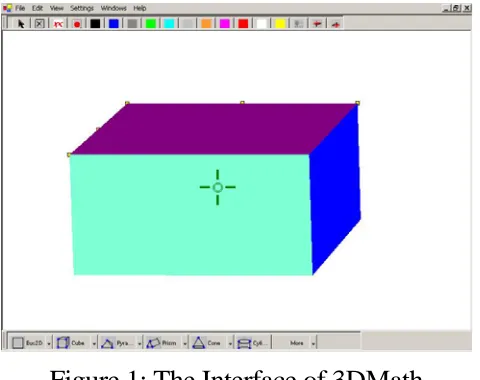
[image:4.595.168.408.316.506.2]The interface of the software aims to be simple and to provide an open and generative environment that enables learning to learn through making and designing personally meaningful artifacts (see Figure 1). It also employs rich semiotic resources that enable multiple perspectives and representations for mathematical meaning-making (for example, students can represent a solid in 3D or its correspondence in 2D). Finally, 3DMath aims to be adaptable to meet the needs of teachers and students. It allows the teacher, for example, to decide which primitives and operations are made available to the students.
Figure 1: The Interface of 3DMath
Visualization Elements in 3DMath
The usefulness of visualization and multiple representations in the teaching of mathematics is being recognized by most mathematics educators and teachers of mathematics (Booth & Thomas, 2000). Based on previous research (see Gutiérrez, 1996), 3DMath provides the means for students to focus on the mental images they create, and the processes and abilities of visualization they use to solve problems.
Mental Images: A mental image is any kind of cognitive representation of a
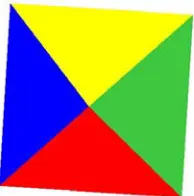
Figure 2: A Special Position of a Pyramid or Octahedron
External representations: A visual representation means the manipulation of visual images and the transformation of one visual image into another (Bishop, 1980). The 3DMath environment is rich in manipulating and transforming solids. In particular, most middle school students find it difficult to understand that Figure 2 is a representation of a pyramid or an octahedron. 3DMath provides the opportunity to students to rotate, for example, a pyramid and see that Figure 2 is a special position of it.
Processes of Visualization: According to Presmeg (1986), a process is a mental or physical action where mental images are involved. 3DMath focuses on the following processes:
(a) Observation: observation allows students to see and understand the third dimension by changing the spatial system of reference (axes), choosing perspective and displaying visual feedback on objects. With 3DMath, students can rotate a geometric figure in reference to the three axes and have a holistic view of it. The speed and the direction of the rotation are easily and directly controlled by the user of the software. The drawing style of the object can be in a solid colour view or in a transparent line view (see Figure 3). Students can select, label and colour the edges and faces of the objects.
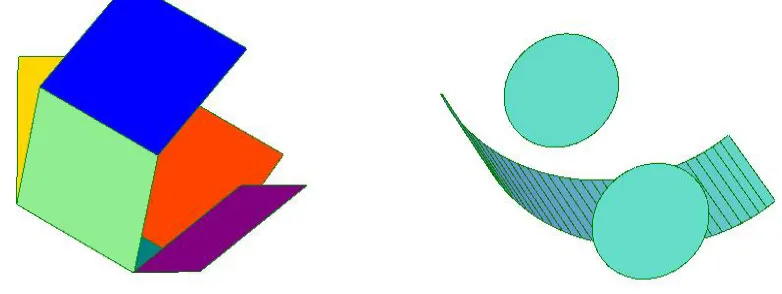
[image:5.595.141.456.562.700.2](b) Construction: construction allows a dynamic construction of geometrical figures from elementary objects (points, lines, planes) and construction primitives (intersection, parallel, etc.). Students can also construct geometrical figures by selecting the appropriate 2D figures and then forming the solids by dynamic animations (see Figure 4).
(c) Exploration: exploration allows students to explore and discover geometrical properties of the figure. This is the main procedure adopted in most of the teaching scenarios being designed to accompany the 3DMath software.
Abilities of Visualization: 3DMath is designed in such a way as to accommodate the development of the following abilities (see Gutiérrez, 1996): (a) the figure-ground perception, (b) perceptual constancy, (c) mental rotation, (d) mental rotation, (e) perception of spatial relationships, and (f) visual discrimination. 3DMath integrates the following features that contribute to the development of the above abilities:
[image:6.595.103.494.458.605.2](i) “Dragging”: the dragging capability of the software enables students to rotate, move and resize 3D objects as in 2D dynamic geometry software environment. Rotation can be executed in all directions by controlling a rotation cursor and determining the speed of the rotation. In addition, students can resize proportionally all the dimensions of the object or resize it only in one dimension, according to the requirements of the problem. For example, students can resize the cuboid (see Figure 5) by shrinking or enlarging the side AB or AC or AD and the cylinder by shrinking or enlarging the diameter KL of its base or by enlarging the height LM.
Figure 5: Resizing a Cuboid and a Cylinder
M L
K
D
C
B A
(ii) Tracing: tracing is a particular instance of the interface where only parts of the figure are displayed. The intended purpose of this feature is to provide the learners with a way to perform a visual filtering of the main construction represented on the screen, i.e., to allow them to extract and observe parts of the construction in an independent view.
(iii) “Measuring”: as in 2D dynamic geometry software, students can measure the length of edges and the area of faces. In 3DMath they can also measure the volume of a solid. All measurements are dynamic as the solids are being resized. The dynamic characteristic of the measurement facility allows the exploration of properties within and among figures e.g. children can measure the volume of a cone and then double its height and see how its volume is altered.
(iv) “History”: a textual feature, which represents the declarative description of the figure. The main function of the History is to provide the learners with a textual and chronological list of all the geometrical objects involved in the construction of the figure. Additionally, the History file can be used as input to the system. For example, a History file created by one student in one country can be used by another student in another country to reconstruct (or re-use) the same model. Using this feature, it would be possible to construct not only Interactive models, but also Declarative models (by importing History files) and Interactive Programming models.
(v) Graph: a diagrammatic feature that represents the structural dependency graph of the figure.
(vi) Output features: 3DMath exports constructions as images (BMP, JPEG, etc), or in other rendering format (PS, XML,). This should help teachers to create supporting educational materials, preparing reports, printed material, etc.
they do this correctly, the primitive may be unlocked (or made visible) so that it can be used freely in further constructions.
CONCLUSION
The design of 3DMath is in the process of development. As illustrated by this paper, it is informed by theories based on philosophy of mathematical knowledge, such as constructivism, and by semiotics. The main purpose of 3DMath is to enhance students’ understanding of 3D geometry with an emphasis on visualization. Thus, during the developmental process the key elements of visualization, as defined by Presmeg (1986), Bishop (1980), Clements (1982) and Gutiérrez (1996) (mental images, external representations, processes, and abilities of visualization), are carefully taken into consideration.
We intend that the final version of the 3DMath software constitutes a powerful tool in the teaching of geometry. Our expectation is that 3DMath might be used to enhance students’ dynamic visualization ability and enable them to gain a greater understanding of 3D mathematical concepts. The interactive, representational rich environment of 3DMath is intended to promote investigation and experimentation with 3D mathematical objects, and contribute to the integration of mathematics with other subject areas, such as art and physics
REFERENCES
Bishop, A. J. (1980). Spatial abilities and mathematics education: a review.
Educational Studies in Mathematics, 11(3), 257-269.
Booth, R. D. L. & Thomas, M. O. J. (2000). Visualization in mathematics learning: arithmetic problem-solving and student difficulties. Journal of Mathematical Behavior, 18(2), 169-190.
Clements, M. A. (1982). Visual imagery and school mathematics. For the Learning of Mathematics, 2(3), 33-38.
De Villiers, M. D. (1996). Some adventures in Euclidean geometry. Durban: University of Durban-Westville.
Dreyfus, T. (1991). On the status of visual reasoning in mathematics and mathematics education. In F. Furinghetti (Ed.), Proceedings of the 15th conference of the international group for the psychology of mathematics education (vol 1, pp. 33-48). Genova: University de Genova.
Ernest, P. (1994). Varieties of constructivism: their metaphors, epistemologies and pedagogical implications. Hiroshima Journal of Mathematics Education, 2, 1-14. Gutiérrez, A. (1996) Visualization in 3-dimensional geometry: in search of a
Gutiérrez, A., & Jaime, A. (1998). On the assessment of the Van Hiele levels of reasoning, Focus on Learning Problems in Mathematics, 20(2&3), 27-46.
Hanna, G. (2000). Proof, explanation and exploration: an overview. Educational Studies in Mathematics, 44(1), 5-23.
Jones, K. (2000). Providing a foundation for deductive reasoning: students' interpretations when using dynamic geometry software and their evolving mathematical explanations, Educational Studies in Mathematics, 44(1 &2), 55-85.
Kafai, Y. B. & Resnick, M. (1996). Constructionism in practice: Designing, thinking, and learning in a digital world. Mahwah, NJ: Lawrence Erlbaum Associates.
Laborde, C. (1998). Visual phenomena in the teaching/learning of geometry in a computer-based environment. In C. Mammana & V. Villani (Eds.), Perspectives on the teaching of geometry for the 21st century, 113-121. The Netherlands: Kluwer Academic Publishers.
Linn, M. C., & Peterson, A. C. (1985). Emergence and characterization of sex differences in spatial ability: a meta-analysis. Child Development, 56, 1479–1498. Presmeg, N. (1986). Visualization in high school mathematics. For the Learning of
Mathematics, 6(3), 42-46.
Tartre, L. A. (1990). Spatial orientation skill and mathematical problem solving.
Journal for Research in Mathematics Education, 21(3), 216-229.
Yakimanskaya, I. S. (1991). The development of spatial thinking in schoolchildren
(Soviet Studies in Mathematics Education, vol. 3). N.C.T.M.: Reston, USA.