An Econometric Analysis
of the Australian Country Party
1922-1928
Christian Leithner
A thesis submitted for the degree of Master of Arts
of the Australian National University.
Declaration
Except where otherwise indicated this thesis is my own work.
Acknowledgements
Four Canadians influenced my decision to undertake this research. Drs. Carmen Miller and John Herd Thompson of McGill University convinced me that the politics of the Canadian Prairies - and, by implication, the politics of other agrarian regions -- merit analysis. Dr. Jerome H. Black, also of McGill, impressed upon me the need to formulate precise problems and questions for research, to remain skeptical with respect to unsubstantiated assertions and to confront refutable propositions with suitable data. Finally, Principal David C. Smith of Queen’s University demonstrated to me that economics is distin guished not only by its subject matter but also by its methodology, and suggested that this methodology and its associated research techniques may be as applicable to the analysis of political phenomena as to the analysis of economic phenomena.
A Commonwealth Fellowship at the Australian National University permitted me to undertake this research. I thus wish to thank the Department of Employment, Education and Training of the Common wealth of Australia for its financial support. Professor Ian McAllister (University College, The University of New South Wales) and Mr. Scott Bennett (The Australian National University) supervised my research. They pointed out many weaknesses and saved me from many errors (the usual disclaimer applies). Dr. John Hart of the Australian National University provided sage advice on several matters. The Rl Hon. Ian Sinclair, PC, MP, Leader of the National Party of Australia and Deputy Leader of the Opposition, took an interest in my research and was generous with his time. Staff at the Australian Electoral Commission and the National Library of Australia helped me to locate the data upon which this study is based.
Abstract
This study identifies the formation, in the years immediately following the First World War, of agrarian parties in Australia, Canada and New Zealand as a relevant and unresolved problem for comparative political science research. It constructs a formal theory of agrarian party formation, electoral support and dissolution, assembles a set of electoral, census and agricultural economic data, specifies a set of statis tical models and estimates these models’ parameters at the Australian (Commonwealth) elections of 1922, 1925 and 1928.
Its results are consistent with its principal hypothesis: the formation and electoral support, in the years immediately following the First World War, of agrarian parties such as the Australian Country Party was a consequence of (1) maladjustments in primary producers’ output of agricultural and pastoral com modities and (2) the collapse, between 1921 and 1922, in the price of many agricultural and pastoral commodities below the average variable cost of production. The recovery of commodity prices after 1922, together with producers’ adjustment of their average variable cost of commodity production, weakened the Country Party’s electoral support and thereby engendered its partial dissolution.
. . . when you can measure what you are speaking about, and express it in numbers, you know something about it; but when you cannot measure it, when you cannot express it in numbers, your knowledge is o f a meagre and unsatisfactory kind.
Table of Contents
D eclaration i
A cknow ledgem ents ii
A bstract iii
PART I:
iv
1. The Problem For R esearch 2
1.1. Political Parties, Voters and Elections
1.2. Major Parties, Non-Major Parties, Minor Parties and Third Parties 1.3. Agrarian, Farmer and Peasant Parties
1.3.1. Agrarian Parties and Agrarian Factions 10
1.3.2. Peasants and Farmers 12
1.4. The Comparative Framework: The British Dominions 13
1.5. Questions For Empirical Investigation 17
1.6. The Empirical Focus 17
1.7. Summary 18
2. Previous W ork 20
2.1. Methodology 20
2.2. Interpretation 22
2.2.1. Class and Territorial Cleavages 22
2.2.2. Ideology 27
2.2.3. Party Organisation 29
2.2.4. The Volatile Economy 29
2.3. A New Look at an Unresolved Problem for Research 31
PART II:
3. Theory 34
3.1. A General Theory of Non-Major Party Formation, Electoral Support and 34
Dissolution
3.1.1. Initial Conditions 35
3.1.2. Formalisation 37
3.1.3. Analysis 39
3.1.4. Hypotheses 43
3.2. Agrarian Party Formation, Electoral Support and Dissolution 44
3.2.1. Further Initial Conditions 44
3.2.2. The Economic Antecedents of Rural Voter Dissatisfaction 44 3.2.3. Economic Adjustment and Agrarian Voter Dissatisfaction 51
3.2.4. The Commodity Price Collapse of 1921-1922 55
3.3. Summary 58
4. Data and Research T echniques 59
4.1. Econometric Analyses of Voter Behaviour 59
4.1.1. Initial Conditions 59
4.1.2. The Model 60
4.1.3. Data 61
4.1.4. Findings 61
fS
T
f
4.1.5. Assessment 62
4.2. The Econometric Analysis of Agrarian Party Formation 65
4.2.1. Data and Variables 66
4.2.2. Model Specification 67
4.2.3. Model Estimation 71
4.3. Summary 72
5. Agrarian Party Formation and Dissolution (Party Behaviour)
74
5.1. The 1922 Commonwealth Election 74
5.2. The 1925 Commonwealth Election 78
5.3. The 1928 Commonwealth Election 85
5.4. Summary and Conclusion 90
6. Agrarian Party Electoral Support (Voter Behaviour)
91
6.1. The 1922 Commonwealth Election 91
6.2. The 1925 Commonwealth Election 103
6.3. The 1928 Commonwealth Election 112
6.4. Summary and Conclusion 119
PART ID:
7. Discussion
121
7.1. Agrarian Party Formation, Electoral Support and Dissolution 121
7.2. Implications 124
7.2.1. Agrarian Parties in the British Dominions 124
7.2.2. Econometric Analyses of Voter Behaviour 127
7.2.3. Major Parties 127
7.2.4. Party Systems and Voter Alignments 129
7.2.5. Elite Mobilisation 130
7.3. The Country Party, Australian Politics and the Australian Party System 131
Appendix A. Religious, Socialist and Ethnic Minority Party Formation
135
Appendix B. Intentionalist and Theoretical Explanations
139
B .l. Intentionalist Explanations 139
B.2. Theoretical Explanations 141
Appendix C. ’’Instrumentalist" Methodology
142
Appendix D. Mathematical Derivations
145
Appendix E. A Generalised Least Squares Estimator
148
Appendix F. Agrarian Party Formation and Dissolution (Diagnostic
151
Statistics)
Appendix G. Agrarian Voter Behaviour (Diagnostic Statistics)
158
List of Figures
Figure 1-1: Agrarian, Religious, Socialist and Ethnic Minority Party For- 10
mation, Europe, North America and Oceania, 1870-1970
Figure 3-1: Non-Major Party Formation and Electoral Support in Response to 40
Two Unit Step Inputs
Figure 3-2: Non-Major Party Formation and Electoral Support in Response to 41
One Unit Step and One Kronecker Delta Input
Figure 3-3: Non-Major Party Formation, Electoral Support and Dissolution in 43
Response to Two Kronecker Delta Inputs
Figure 3-4: Price Elasticity and the Slope of a Straight-Line Demand Curve 46
Figure 3-5: Total Revenue and the Price Elasticity of a Straight-Line Demand 47
Curve
Figure 3-6: The Optimum Level of Commodity Output 52
Figure 3-7: Producer Income at the Optimum Level of Commodity Output 53
Figure 3-8: Commodity Price and the Average Variable Cost of Production 56
viii
List of Tables
Table 1-1: Agrarian Party Formation, Western Europe 7
Table 1-2: Agrarian Party Formation, Eastern Europe 8
Table 1-3: Agrarian Party Formation, Australia, Canada, New Zealand and the 9
United States
Table 1-4: Rural Exports, Australia, Canada, New Zealand and United States: 15
Primary Export Commodities and the British Market, 1919-23, 1924-28
Table 3-1: The Characteristics of the Per Capita Demand Function, Sugar, 48
United States, 1875-1936
Table 3-2: Elasticities of Demand at Selected Points on the Demand Curve, 49
Sugar, 1875-1895
Table 3-3: Selected Price and Income Elasticities, United Kingdom, 1921-1935 50
Table 4-1: The Data Set: Summary Description 67
Table 4-2: Variable Descriptions 68
Table 5-1: Non-Metropolitan Electoral Subdivisions With Country Party, 75
Nationalist Party and Australian Labor Party Candidates, Common wealth Election, 1922
Table 5-2: Country Party Formation and Dissolution, Commonwealth Election, 76
1922
Table 5-3: Nationalist Party Formation and Dissolution, Commonwealth Elec- 79
tion, 1922
Table 5-4: Non-Metropolitan Electoral Subdivisions With Country Party, 80
Nationalist Party and Australian Labor Party Candidates, Common wealth Election, 1925
Table 5-5: Country Party Formation and Dissolution, Commonwealth Election, 82
1925
Table 5-6: Nationalist Party Formation and Dissolution, Commonwealth Elec- 84
tion, 1925
Table 5-7: Non-Metropolitan Electoral Subdivisions With Country Party, 86
Nationalist Party and Australian Labor Party Candidates, Common wealth Election, 1928
Table 5-8: Country Party Formation and Dissolution, Commonwealth Election, 87
1928
Table 5-9: Nationalist Party Formation and Dissolution, Commonwealth Elec- 89
tion, 1928
Table 6-1: Electoral Support, Commonwealth Election, 1922 (Summary 92
Statistics)
Table 6-2: Preferred Models of Electoral Support, Commonwealth Election, 93
1922
Table 6-3: Country Party Electoral Support, All States, Commonwealth Elec- 95
tion, 1922
Table 6-4: Country Party Electoral Support, New South Wales, Commonwealth 96
Election, 1922
Table 6-5: Country Party Electoral Support, Queensland, South Australia, 98
Western Australia and Tasmania, Commonwealth Election, 1922
Table 6-6: Australian Labor Party Electoral Support, All States, Common- 100
Table 6-7: Nationalist Party Electoral Support, Commonwealth Election, 1922 102
Table 6-8: Electoral Support, Commonwealth Election, 1925* (Summary 104
Statistics)
Table 6-9: Preferred Models of Electoral Support, Commonwealth Election, 105
1925
Table 6-10: Country Party Electoral Support, (House of Representatives), Com- 106
monwealth Elections, 1925
Table 6-11: Country Party Electoral Support, Senate, Commonwealth Election, 108
1925
Table 6-12: Nationalist Party Electoral Support, Senate, Commonwealth Elec- 110
tion, 1925
Table 6-13: Australian Labor Party Electoral Support, House of Represen- 111
tatives and Senate, All States, Commonwealth Election, 1925
Table 6-14: Electoral Support, Commonwealth Election, 1928* (Summary 113
Statistics)
Table 6-15: Preferred Models of Electoral Support, Commonwealth Election, 114
1928
Table 6-16: Country Party Electoral Support (House of Representatives), Com- 115
monwealth Election, 1928
Table 6-17: Country Party Electoral Support, Senate, Commonwealth Election, 116
1928
Table 6-18: Australian Labor Party and Nationalist Party Electoral Support, 118
Senate, Commonwealth Election, 1925
Table A -l: Religious (Christian Democratic) Party Formation 136
Table A-2: Socialist Party Formation 137
Table A-3: National Minority (Ethnic) Party Formation 138
Table F-l: Country Party Formation and Dissolution, Commonwealth Election, 152
1922 (Summary Statistics for Alternative Estimators and Specifications)
Table F-2: National Party Formation and Dissolution, Commonwealth Election, 153
1922 (Summary Statistics for Alternative Estimators and Specifications)
Table F-3: Country Party Formation and Dissolution, Commonwealth Election, 154
1925 (Summary Statistics for Alternative Estimators and Specifications)
Table F-4: National Party Formation and Dissolution, Commonwealth Election, 155
1925 (Summary Statistics for Alternative Estimators and Specifications)
Table F-5: Country Party Formation and Dissolution, Commonwealth Election, 156
1928 (Summary Statistics for Alternative Estimators and Specifications)
Table F-6: National Party Formation and Dissolution, Commonwealth Election, 157
1928 (Summary Statistics for Alternative Estimators and Specifications)
Table G -l: Country Party Electoral Support, All States, Commonwealth Elec- 159
tion, 1922 (Diagnostic Statistics for Alternate Model Specifications)
Table G-2: Country Party Electoral Support, New South Wales, Common- 160
wealth Election, 1922 (Diagnostic Statistics for Alternate Model Specifications)
Table G-3: Country Party Electoral Support, Queensland, South Australia, 161
Western Australia and Tasmania, Commonwealth Election, 1922 (Diagnostic Statistics for Alternate Model Specifications)
Table G-4: Australian Labor Party Electoral Support, Commonwealth Elec- 162
tion, 1922 (Diagnostic Statistics for Alternate Model Specifications)
Table G-5: National Party Electoral Support, Commonwealth Election, 1922 163
(Diagnostic Statistics for Alternate Model Specifications)
Table G-6: Country Party Electoral Support, House of Representatives, Com- 164
Table G-7: Country Party Electoral Support, Senate, Commonwealth Election, 165 1925 (Diagnostic Statistics for Alternate Model Specifications)
Table G-8: Australian Labor Party Electoral Support, Commonwealth Elec- 166
tion, 1925 (Diagnostic Statistics for Alternate Model Specifications)
Table G-9: National Party Electoral Support, Senate Commonwealth Election, 167
1925 (Diagnostic Statistics for Alternate Model Specifications)
Table G-10: Country Party Electoral Support, House of Representatives, Com- 168
monwealth Election, 1928 (Diagnostic Statistics for Alternate Model Specifications)
Table G -ll: Country Party Electoral Support, Senate, Commonwealth Election, 169 1928 (Diagnostic Statistics for Alternate Model Specifications)
Table G-12: National Party and Australian Labor Party Electoral Support, 170
2
Chapter 1
The Problem For Research
1.1. Political Parties, Voters and Elections
Political parties have long been among the most persistently and intensively analysed political phenomena - indeed, they figured prominently in the first works of modem political science (von Beyme,
1985p.l). Nonetheless, for many years studies of political parties lacked an "explicitly theoretical foundation" and did not provide a valid description of the functions of political parties (Crotty, 1970p.269); (Daalder, 1983p. 10); (Duverger, 1954p.xiii); (Roberts, 1978p.419). Because "almost every thing called a party in any Western democratic nation [could] be so regarded" (Epstein, 1967p.9),
analyses of political parties were notable neither for their collection of reliable and comparable data nor for their contribution to an understanding of the wider political system (McDonald, 1955); (Neumann, 1956p.395~421).
In this respect, Sartori’s Parties and Party Systems: A Framework for Analysis is a landmark study (Sartori, 1976). Sartori clarifies many conceptual difficulties and thereby makes an important contribution to a theory of parties and party systems. Sartori argues that parties organise the legislature’s business and thereby facilitate responsible government (Sartori, 1976p.27). This term, broadly interpreted, conveys the notions of executive accountability to a legislature and collective responsibility for government decision making: in return for the constitutional authority to govern, the executive must submit its actions to legislative scrutiny and criticism (American Political Science Association, 1950); (Ranney, 1954). Parties structure opinion in the legislature, engender coherent debate and thus help to render the executive
accountable for its actions (Pomper, 1971); (Pomper, 1980); (Everson, 1980); (Sorauf, 1980); (Sartori, 1976p.l9); (Schattschneider, 1942p.208); (Beer, 1982).
At the same time, however, parties’ activities extend far beyond the confines of the legislature. A government responsible to Parliament becomes, with the extension of the suffrage, a government respon
sive to voters. Accordingly, parties organise the mass electorate and thereby constitute a sine qua non of electoral democracy. Parties solicit and articulate the public’s wants and concerns, aggregate these
preferences into policy alternatives and, if elected, undertake to implement them as policy measures. Parties structure communication between governors and the governed and thus facilitate responsive
government. Sartori, for example, argues that "parties are the central intermediate and intermediary structures between society and government" (Sartori, 1976p.ix) and that they "forcefully convey to the
authorities the demands of the public as a whole" (Sartori, 1976pp.65-66). Similarly, Key argues that "parties are the basic instruments for the translation of mass preferences into public policy" (Key,
1964p.433); (Finer, 1949p.274-282); (Dahl, 1967p.243); (Neumann, 1956p.397); (Lipson, 1959);
(Lipson, 1964); (Ranney and Kendall, 1956p.85); (Schattschneider, 1942p.35)].
commitment to parties, which takes the form of a strong consensus that parties are desirable and probably essential in democratic politics, has spurred party research (Epstein, 1983p. 127). Eldersveld, for ex ample, contends that "intellectually, we have become committed to the position in the twentieth century that parties are central to the [political] system" (Eldersveld, 1964p.20). Similarly, Pomper argues that "we must either acknowledge the mutual reliance of our parties and our democracy — or lose both" (Pomper, 1980p.5). Clearly, therefore, powerful inducements — both objective and normative -- en courage the analysis of political parties.
In modem democracies, parties and elections are inextricably intertwined. In consequence, so too is the study of parties, elections and voter behaviour (Harrop and Miller, 1987); (Budge and Farbe, 1977); (Budge, 1983); (Katz, 1980). As parties’ electoral activities have increased in importance relative to their activities in the legislature, the objective and normative justifications for the study of parties has been pitched more in electoral than in institutional terms. It is therefore not surprising that analysts of voter behaviour have uncovered most about the party-in-the-electorate (Epstein, 1983p. 140). Early studies (Lazarsfeld, Berelson and Gaudet, 1948); (Campbell, Gurin and Miller, 1954); (Berelson, Lazarsfeld and McPhee, 1954) analysed the individual’s decision to vote and his vote choice, and culminated with the construction of a causal configuration (the "funnel of causabty") of the antecedents underlying individual vote choice (Campbell, Converse, Miller and Stokes, 1960). One of these studies’ central findings relates directly to parties: party identification is a major determinant of voter behaviour (Campbell, Converse, Miller and Stokes, 1960p. 120-167); (Budge, Crewe and Farbe, 1976); (Butler and Stokes, 1974); (Crewe, Sarlvik and Alt, 1977); (Fiorina, 1976); (Jackson, 1975); (Sarlvik and Crewe, 1983); (Shaffer, 1972); (Shaffer, 1976).
Subsequent work "shifts the terms of reference from the individual voter to the mass electorate and from the individual vote to the cobective electoral decision" (Campbell, Miller and Stokes, 1966p.ix). This research examines not only the behaviour of individual voters; it also seeks to illuminate the means by which voters’ collective decisions influence the party system (Clubb, Flanigan and Zingale, 1980); (Key, 1966); (McAllister and Rose, 1984); (Müler, 1977); (Nie, Verba and Petrocik, 1979pp.47-73); (Niemi and Weisberg, 1976pp.299-332); (Rose and McAUister, 1986). These works relate data to theory in a sys tematic manner, incorporate advances in research methodology and analytic techniques, and thereby extend knowledge of voter and party behaviour. They demonstrate that analysis of the mass electorate can yield valuable insights into patterns of party competition. In sum, therefore,
the substantive findings produced by party research since World War II reflect both its strength as a rapidly maturing area of research, perhaps the most so in the discipline, and its weaknesses as an area of research in which a variety o f questions remain unresolved. Hence, as is invariably true in fields of knowledge that are rapidly progressing, two somewhat contradictory statements apply. Our knowledge is substantially improved; yet puzzling questions of great importance still exist (Cooper and Maisel, 1978p. 16); (Daalder, 1983pp.l-27).
4
1.2. Major Parties, Non-Major Parties, Minor Parties and Third Parties
Most comparative studies - particularly cross-national comparative studies - of political parties analyse "major" parties. They say little about "non-major" parties [see, for example, (Lane and Ersson, 1987); (Epstein, 1967); (Riggs, 1968); (Janda, 1970); (Day and Degenhardt, 1980); (von Beyme, 1985)]. Similarly, seminal works on voting ignore non-major parties [see, for example, (Lazarsfeld, Berelson and Gaudet, 1948); (Berelson, Lazarsfeld and McPhee, 1954); (Campbell, Converse, Miller and Stokes, 1960); (Campbell, Miller and Stokes, 1966); (Nie, Verba and Petrocik, 1979)]. They focus upon the voter’s choice between major parties, not upon his choice between major and non-major parties. In consequence, little research - and almost no explicitly theoretical research - has been directed towards non-major parties:1
there has been no shortage of historical accounts o f non-major party activity. The problem, though, is that scholars have generally examined one non-major party movement at a time. As a result, we are left with a different explanation (or sometimes more than one explanation) for each non-major party. There is no theory o f non-major party voting that can be applied across instances or can be used to predict when the two-party system is likely to deteriorate and non-major parties flourish (Rosenstone, Behr and Lazarus, 1984p.5) [see, however, (Pinard, 1975); (Mazmanian, 1974); (Hauss and Rayside, 1978); (Studlar and McAllister, 1987)].
Normative preconceptions, as well as analytical expedience, may justify this practice. The paucity of attention accorded to non-major parties may be a partial consequence of the normative prescriptions inherent in many analyses of political parties. The two-party system is widely accepted as an ideal in works that stress parties’ activities in the legislature. Where two parties structure the vote, clear winners commanding majority support emerge from elections and resultant (single-party) governments cannot evade responsibility for their actions. Conversely, where power is dispersed among party coalitions, stable government becomes more problematic (Riker, 1962) and party responsibility becomes more difficult to assign (Key, 1950); (Key, 1964p.334); (Epstein, 1983pp.l39-140). Dodd summarises the perception that a two-party system is conducive to stability, that a multi-party system is conducive to instability - and therefore that a two-party system is preferable to a multi-party system (i.e., a party system without non-major parties):
governments in multi-party parliaments must be minority cabinets, coalition cabinets, or both; by their very nature, minority cabinets and coalition cabinets are quite transient; [as a result], multi-party systems are undesirable since they produce transient governments" (Dodd, 1976p.l0).
The paucity of attention directed at non-major parties is also a consequence of the ambiguity associated with the terms "major," "non-major," "minor" and "third" party. The major parties in most party systems are easily - indeed, intuitively - identifiable: major parties possess a substantial and stable partisan following, receive the vast majority of ballots cast at elections, win elections and form governments. As a rule, therefore, a political party is a major party if it contests most constituencies and holds one of the two largest blocs of seats in the parliament (Rosenstone, Behr and Lazarus, 1984p.9). According to this definition, each party system has two - and no party system has more than two - major parties; all other parties are non-major parties:
If [following (Sartori, 1976p.65)] a political party is defined as any group seeking to elect government office-holders under a given label, then a [non-major] party is simply a political party which offers candidates to challenge the nominees o f the two major parties (Fisher, 1974p.6-7).
By definition, non-major parties have a small and sporadic following, receive a relatively small fraction of the total votes cast at elections and elect few Members of Parliament.
(Rose and Urwin, 1970p.290). Nonetheless, the terms refer to two specific entities: some non-major parties ("significant" non-major parties) influence patterns of voter and party behaviour at elections; other non-major parties ("insignificant" non-major parties) do not.
Party strength in the parliament and in the electorate is the most frequently cited criterion of non-major party significance. The parliamentary significance of a non-major party has two attributes. (1) A non- major party is a relevant parliamentary actor, no matter how small it is, "if it finds itself in a position to determine over time, or at some point in time, at least one of the possible governmental majorities" (Sartori, 1976p.l23). Conversely, a non-major party is irrelevant if "it is never needed or put to use for any feasible coalition majority" (Sartori, 1976p. 123); (Key, 1964pp.279-280); (McKean, 1949pp.423-424); (Schattschneider, 1942pp.75-83). (2) A non-major party is a relevant parliamentary actor "whenever its existence, or appearance, affects the tactics of [major] party competition" (Sartori, 1976p.l23). The parliamentary significance of a non-major party is thus not only a function of the percentage of seats it holds in the parliament. It is also a function of its relationship with the major parties.
Non-major parties’ electoral significance also has two attributes. (1) Electoral significance is assessed in terms of the number of votes won at elections. A non-major party is a significant entity at elections when its electoral support surpasses a particular numeric threshold. Chambers, for example, contends that the non-major parties in the United States which received a percentage of the total vote larger than the overall average for all non-major parties since 1828 (i.e., 5.2 percent of the total votes cast) are significant non-major parties (Chambers, 1968); (Rose and Urwin, 1970p.290). According to this criterion, three non-major parties have, in the twentieth century, been significant entities at American presidential elec tions (the "Bull Moose" party in 1912, the Progressive Party in 1924 and the American Independent Party in 1968).
Problems accompany the use of this criterion of significance. Most importantly, "the designation of any general numerical formula to separate non-major parties as important or unimportant is purely arbitrary. Chambers’s average of 5.2 percent, for example, omits such parties as the Liberal Republicans of 1872 or the Dixiecrats of 1948 - parties which most analysts include in discussions of non-major parties" (Fisher, 1974pp.30-31); (Mazmanian, 1974p.4). This criterion is also incomplete. Assessment of the significance of a non-major party must consider not only the number of votes and seats that it wins, but also its influence on voter behaviour and major party competition (Rose, 1974p.484); (Sartori, 1976p.l90, 217-221).
6
For these reasons, some non-major parties "must be regarded as integral elements of the two-party system" (Key, 1964p.279). Not only may they "break the two-party pattern of competition in a nation by winning or threatening to win enough offices to influence [but not directly control] the government" (Epstein, 1967p.64); they may also exert a "longrun influence on the composition, leadership and doctrines of the major parties" (Janda, 1970p.50) and serve as "safety valves" which stabilise the party system (Ranney and Kendall, 1956pp.455458, 505). Non-major parties with such attributes ("significant" non-major parties) may be termed "third parties."2 Non-major parties without such attributes ("insignificant" non-major parties) may be labelled "minor parties." Clearly, therefore, "third parties" merit careful analysis.
The assessment of a non-major party’s electoral significance (i.e., the designation of a non-major party, in electoral terms, as a third party or a minor party) requires that the causes of its formation, the correlates of its electoral support and its impact upon the party system be investigated. If, for example, the for mation and electoral support of a non-major party represents no more than an indistinct and ephemeral protest, the possibility of realignment within the party system is negligible; conversely, if its support is attitudinally distinct, the potential for a fundamental realignment of voters and parties exists (Studlar and McAllister, 1987p.39). What, then, underlies the emergence of non-major parties? When is their for mation most likely to occur? What kinds of conflicts, which major parties cannot manage, structure these parties’ electoral support? Responses to such questions may, as much as studies of major parties, bear considerable relevance for an understanding of voters, major parties and party systems.
1.3. Agrarian, Farmer and Peasant Parties
Key classifies non-major parties in terms of longevity (Key, 1964pp.255,278-80). Doctrinal parties are distinguished by their permanence and by their emphasis on (usually socialist or Marxist) ideology.
Transient parties arise suddenly (in response to conflicts which major parties are unable to contain) and quickly disintegrate. Doctrinal and transient parties play different roles in the party system. Ideological beliefs isolate doctrinal parties from the political mainstream. In consequence, these parties generally exert only a minimal influence upon voters and major parties. Doctrinal parties, in other words, are usually minor parties. Conversely, transient non-major parties may, under certain conditions, influence voter behaviour and major party competition. For this reason, some transient parties are third parties. Key’s insight thus suggests that analysis be directed at transient non-major parties.
Transient non-major parties are, in terms of programme and electoral support, frequently agrarian parties. Agrarian parties, however, have been the subject of almost no rigorous analysis:3
although few have investigated the [farmers’] revolts without being intrigued by their particularities [i.e., by agrarian parties’ abrupt formation and, in most instances, equally rapid dissolution], we know o f no case in which [these peculiarities] have been subjected to explanation (Campbell, Converse, Miller and Stokes, 1960p.434).
This is in part because the conceptual and definitional difficulties that long hindered the analysis of major parties continue to afflict the study of non-major (and therefore agrarian) parties. In consequence, the agrarian party has no recognised definition. Indeed, only Urwin has attempted to operationalise the concept embodied in this term:
Agrarian parties can be regarded as those which demonstrably obtain the vast majority o f their support from the countryside, specifically claim in their programmes and other pronouncements to represent agrarian interests, and/or simply include in their title some term as "agrarian," "peasant" or "farmer" (Urwin, 1980p.l65).
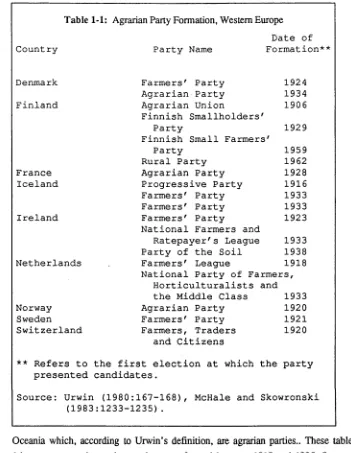
Table 1-1: Agrarian Party Formation, Western Europe
Date of
Country Party Name Formation**
Denmark Farmers' Party 1924
Agrarian Party 1934
Finland Agrarian Union
Finnish Smallholders'
1906
Party
Finnish Small Farmers'
1929
Party 1959
Rural Party 1962
France Agrarian Party 1928
Iceland Progressive Party 1916
Farmers' Party 1933
Farmers' Party 1933
Ireland Farmers' Party
National Farmers and
1923
Ratepayer's League 1933 Party of the Soil 1938
Netherlands Farmers' League 1918
National Party of Farmers, Horticulturalists and the Middle Class 1933
Norway Agrarian Party 1920
Sweden Farmers' Party 1921
Switzerland Farmers, Traders
and Citizens
1920
** Refers to the first election at which the party presented candidates.
Source: Urwin (1980:167-168), McHale and Skowronski (1983:1233-1235).
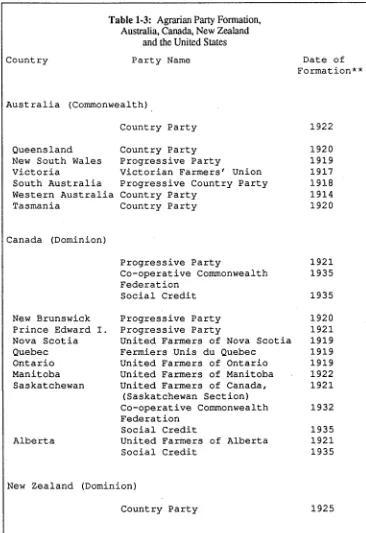
Oceania which, according to Urwin’s definition, are agrarian parties.. These tables indicate that most (sixty-one percent) agrarian parties were formed between 1918 and 1925. Seventy-five percent of the Australian and New Zealand parties, sixty-four percent of the Canadian parties, fifty-nine percent of the European parties and fifty percent of the American parties were formed during these years. The table thus indicates that most agrarian parties on these continents arose concurrently.
In contrast, other parties which may be grouped on the basis of name, programme, electoral support and international association (i.e., religious, socialist and ethnic minority parties) did not arise concurrently. Figure 1-1 plots the proportion of agrarian, religious, socialist and ethnic minority parties in Europe, North America and Oceania which were formed at each ten-year interval between 1870 and 1970.4 It indicates that forty-nine percent of the agrarian parties were formed between 1920 and 1929 but that no more than twenty-two percent of the religious, socialist or ethnic minority parties were formed during any particular decade. Figure 1-1 thus confirms that agrarian party formation was concentrated in the years immediately following the First World War and that the extent of agrarian party formation in these years (relative to the formation of religious, socialist and ethnic minority parties) is remarkable.
[image:18.552.76.427.48.501.2]8
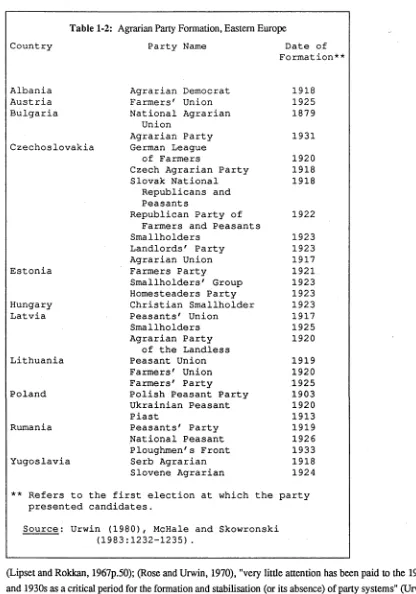
Table 1-2: Agrarian Parly Formation, Eastern Europe
Country Party Name Date of
Formation
Albania Agrarian Democrat 1918
Austria Farmers' Union 1925
Bulgaria National Agrarian
Union
1879
Agrarian Party 1931
Czechoslovakia German League
of Farmers 1920
Czech Agrarian Party 1918 Slovak National
Republicans and Peasants
1918
Republican Party of Farmers and Peasants
1922
Smallholders 1923
Landlords' Party 1923
Agrarian Union 1917
Estonia Farmers Party 1921
Smallholders' Group 1923
Homesteaders Party 1923
Hungary Christian Smallholder 1923
Latvia Peasants' Union 1917
Smallholders 1925
Agrarian Party of the Landless
1920
Lithuania Peasant Union 1919
Farmers' Union 1920
Farmers' Party 1925
Poland Polish Peasant Party 1903
Ukrainian Peasant 1920
Piast 1913
Rumania Peasants' Party 1919
National Peasant 1926
Ploughmen's Front 1933
Yugoslavia Serb Agrarian 1918
Slovene Agrarian 1924
** Refers to the first election at which the party presented candidates.
Source: Urwin (1980), McHale and Skowronski (1983:1232-1235).
(Lipset and Rokkan, 1967p.50); (Rose and Urwin, 1970), "very little attention has been paid to the 1920s and 1930s as a critical period for the formation and stabilisation (or its absence) of party systems" (Urwin, 1973pp. 183-184). Accordingly, no discussion -- let alone explanation — of the simultaneous rise of agrarian parties on these three continents has been undertaken.5
[image:19.552.81.497.39.633.2]T a b le 1-3: A g ra rian P arty F o rm a tio n , A u stralia, C a n ad a , N e w Z ea lan d
a n d th e U n ite d S tates
C o u n t r y P a r t y N a m e D a t e o f
F o r m a t i o n * *
A u s t r a l i a ( C o m m o n w e a l t h )
C o u n t r y P a r t y 1 9 2 2
Q u e e n s l a n d C o u n t r y P a r t y 1 9 2 0
N e w S o u t h W a l e s P r o g r e s s i v e P a r t y 1 9 1 9
V i c t o r i a V i c t o r i a n F a r m e r s ' U n i o n 1 9 1 7
S o u t h A u s t r a l i a P r o g r e s s i v e C o u n t r y P a r t y 1 9 1 8
W e s t e r n A u s t r a l i a C o u n t r y P a r t y 1 9 1 4
T a s m a n i a C o u n t r y P a r t y 1 9 2 0
C a n a d a ( D o m i n i o n )
P r o g r e s s i v e P a r t y 1 9 2 1
C o - o p e r a t i v e C o m m o n w e a l t h
F e d e r a t i o n
1 9 3 5
S o c i a l C r e d i t 1 9 3 5
N e w B r u n s w i c k P r o g r e s s i v e P a r t y 1 9 2 0
P r i n c e E d w a r d I P r o g r e s s i v e P a r t y 1 9 2 1
N o v a S c o t i a U n i t e d F a r m e r s o f N o v a S c o t i a 1 9 1 9
Q u e b e c F e r m i e r s U n i s d u Q u e b e c 1 9 1 9
O n t a r i o U n i t e d F a r m e r s o f O n t a r i o 1 9 1 9
M a n i t o b a U n i t e d F a r m e r s o f M a n i t o b a 1 9 2 2
S a s k a t c h e w a n U n i t e d F a r m e r s o f C a n a d a , 1 9 2 1
( S a s k a t c h e w a n S e c t i o n )
C o - o p e r a t i v e C o m m o n w e a l t h
F e d e r a t i o n
1 9 3 2
S o c i a l C r e d i t 1 9 3 5
A l b e r t a U n i t e d F a r m e r s o f A l b e r t a 1 9 2 1
S o c i a l C r e d i t 1 9 3 5
N e w Z e a l a n d ( D o m i n i o n )
C o u n t r y P a r t y 1 9 2 5
U n i t e d S t a t e s ( F e d e r a l )
G r e e n b a c k 1 8 7 6
P o p u l i s t 1 8 9 2
F a r m e r - L a b o r 1 9 2 0
P r o g r e s s i v e 1 9 2 4
** R e f e r s t o t h e f i r s t e l e c t i o n a t w h i c h t h e p a r t y
p r e s e n t e d c a n d i d a t e s .
S o u r c e s : H u g h e s ( 1 9 7 4 ) , S m i t h ( 1 9 8 0 ) , R o s e n s t o n e
[image:20.552.86.452.47.580.2]p p o P 0 p t 1
0
n
0
f P
s
p t
1
e 8
F 0 p ■ e d
Figure 1-1: Agrarian, Religious, Socialist and Ethnic Minority Party Formation, Europe, North America and Oceania, 1870-1970
- AQPapian Papty For«ationr\ - R eligiou s Papty FoPBatiön\ - S o c i a l i s t Papty Fopiation \ - Ethnic/Minopity Papty yFopiation
1870-79 1910-19 193
Yaap of Formation
1950-59 1970-79
between Western democratic systems and non-Westem countries. [For this reason], it is important to ask whether the concept of political party as used in the Western context is appropriate for a study of parties in Eastern Europe" (Urwin, 1973p.l86).
Are the "agrarian parties" of Europe, North America and Oceania sufficiently similar that they may be subjected to comparative analysis? The analysis undertaken in subsections 1.3.1 and 1.3.2 suggests that they are not. These subsections classify rural political organisations along two dimensions. Insights contributed by Sartori (Sartori, 1976) differentiate agrarian parties from agrarian factions. Works in rural sociology distinguish the peasant from the farmer. The term "agrarian party" thus refers to a political organisation that is found only in a small (and readily comparable) number of countries. The analysis undertaken in these sections finds that only in Australia, Canada, New Zealand and the United States have unambiguously agrarian (farmers') parties appeared. The rural political organisations of Eastern Europe may be more precisely termed peasant factions, and the rural political organisations of Western Europe possess traits characteristic of both peasant parties and agrarian parties. An analysis of agrarian parties thus refers to an analysis of farmers’ parties in Australia, Canada, New Zealand and the United States.
1.3.1. Agrarian Parties and Agrarian Factions
[image:21.552.77.509.65.393.2]Sartori argues that three types (or levels) of consensus exist within democracies (Sartori, 1987pp. 1-38); see also (Easton, 1965ch.l8); (Lijphart, 1968); (Neubauer, 1967). The existence of parties (as opposed to factions) is associated with the presence of these three levels of consensus. (1) Parties are found in polities where community level consensus (with respect to the principle of limited majority rule) exists. Such consensus is not an absolute pre-requisite to the existence of democracy (and parties) (Lipset, 1959); (McClosky, 1964); (Pye, 1971). Unless a political system can create this consensus, however, democracy and the party system will be fragile (Sani and Sartori, 1982); (Sartori, 1987pp.88-91):
The substantive point is, then, that no alteration in power is conceivable as a practical rule o f the game until the public and the private well-being are disconnected. Unless there is sufficient separation o f the various spheres of life — religion, politics and wealth — and a sufficient protection for individuals as such, the stakes o f political controversy are too high for politicians to surrender power according to the rules o f a competitive party system (Sartori, 1976pp.l7, 131-201); (Almond and Verba, 1963).
Factional politics (not party politics) prevails where there is no community-level consensus.
(2) Parties can exist only when regime-level consensus (an acceptance of the state’s physical boundaries and constitutional arrangements - particularly the rules that regulate the exercise of power and the resolution of conflict) exists. If this consensus is absent, political debate gravitates around fundamental questions which threaten the survival of the regime. Nie and Verba, for example, observe that "other cleavages may emerge and other problems may be successfully tackled as long as these central questions are not asked: the experience of several European countries suggests that once thay are raised, the party system will fail to function satisfactorily until they are resolved" (Nie and Verba, 1975p.533). It is for this reason that political parties took no part in Western European or American nation-building. They appeared only when consitutional rule had been fully accepted (LaPalombara and Weiner, 1966); (Daalder, 1966); (Rokkan, 1966); (Rokkan, 1970); (Lipset and Rokkan, 1967).
(3) Community-level and regime-level consensus restrict the scope of disagreement to questions (such as the programmes and the personnel of government) which are amenable to resolution in parliaments and at elections. Parties facilitate this type of consensus {policy-level consensus). Indeed, factions coalesce into parties in response to the need, concomitant with the democratisation of politics, to express and to implement policy-level consensus — i.e., to convey forcefully to authorities the demands of the public as a whole (Sartori, 1976p.27); (Dahl, 1967).
These three criteria differentiate the political organisations listed in Tables 1-1, 1-2 and 1-3. (1) With respect to community-level consensus, the principle of limited majority rule had, by 1918, been long affirmed and observed in Australia, Canada, New Zealand, the United States and most of Western Europe. In Eastern Europe, however, this constitutional principle failed to establish itself: between 1919 and 1940 authoritarian or dictatorial regimes seized power in all Eastern European states (Janos, 1970); (Macartney and Palmer, 1962); (Seton-Watson, 1964); (Tipton and Aldrich, 1987pp.266-297).
con-troversy in these countries frequently ended in secession and civil war (Deutsch, 1961); (Carsten, 1972); (Newman, 1970).
(3) Finally, the point in time at which political participation was diffused to large segments of society differentiates Eastern Europe from Western countries. Manhood suffrage was extended gradually in the West, and was an accomplished fact before 1914. In contrast, it arrived abruptly (in the immediate postwar years) in Eastern Europe (Carstairs, 1980); (Rokkan, 1970).
The Eastern European agrarian "parties" listed in Table 1-2 might for these three reasons be more accurately labelled agrarian cliques or factions. Until 1918 the parliamentary basis for political parties in Eastern Europe was almost wholly absent, and was only imperfectly present after that date. The societal pluralism required for party competition never established itself in the region. In consequence, the democratic political institutions which were established after 1918 could not sustain political parties. Societal conditions engendered political organisation along factional lines. It therefore comes as little surprise that the formation of most of Eastern Europe’s political organisations -- including agrarian political organisations - dates from the years immediately following the First World War. The ap pearance of these factions - including rural factions - in Eastern Europe after 1918 was concomitant with the introduction of mass elections in the region (Urwin, 1980).
1.3.2. Peasants and Farmers
Urwin’s definition of the agrarian party (Urwin, 1980p. 165) does not emphasise the distinction between the agrarian party and the agrarian faction.7 Nor does it emphasise the distinction between peasants and farmers. These terms lack consistent and uncontested definitions (Berger, 1972); (Paige, 1975). Nonethe less, patterns of land ownership and the degree of exposure to market (economic) stimuli best differen tiate these concepts. The term farmer, generally speaking, refers to an independent (land-owning) cul tivator whose resource inputs and commodity output is, respectively, procured from and consigned to the market. In contrast, the term peasant refers to the subsistence cultivator with hereditary obligations (often of a vestigial feudal nature) to a rural patrimonial elite (Chayanov, 1966); (Franklin, 1969); (Nash, 1966); (Warriner, 1964).
In the years immediately following the First World War, most of Eastern Europe’s population was employed in agriculture. As a rule, production for domestic consumption prevailed over production for the market (Franklin, 1969). Control and ownership of land typically rested with an absentee aristocracy which derived the major portion of its income from obligations extracted from cultivators (Zagoroff, Vegh and Bilimovic, 1955). Cultivation in Eastern Europe, in short, was undertaken by peasants. In Western Europe, cultivation was more market-oriented and was undertaken, generally speaking, by land owning entrepreneurs (Gerschenkron, 1965); (Linz, 1976); (Tracy, 1964). Nonetheless, market forces had not completely penetrated agricultural production, and as a result a complex variety of "market" and "domestic subsistence" arrangements existed side by side (Urwin, 1980p.l4); (Linz, 1976).
The distinction between parties and factions and between farmers and peasants yields a more precise definition of the term "agrarian party". Institutional (constitutional) arrangements, together with patterns of land ownership and market relationships, distinguished the peasant factions of Eastern Europe from the peasant and farm ers’ parties of Western Europe and the unambiguously farmers’ (agrarian) parties
of Australia, Canada, New Zealand and the United States. Following (Sartori, 1976p.64) a farmers’ (agrarian) party may thus be defined as any political group whose appeals are directed primarily to farm owner-entrepreneurs, whose presence is restricted largely to districts in which farm owner-entrepreneurs are concentrated and whose electoral support is composed disproportionately of farm owner- entrepreneurs "that presents at elections, and is capable of placing through elections, candidates for public office".
The analysis undertaken in sections 1.1-1.3 thus identifies a relevant problem for comparative political science research. Section 1.1 noted that, as a consequence of its importance to responsible and responsive government, as well as to voter behaviour and elections, the political party merits continued and sustained analysis. Section 1.2 argued that, for precisely the same reasons, the non-major party also merits analysis. It also argued that knowledge of political parties will remain incomplete until a greater understanding of the reasons for its emergence, electoral support and dissolution (as well as of its impact on voter be haviour and major party competition) is obtained.
Section 1.3 noted that one type of non-major party, the agrarian party, has emerged only in Australia, Canada, New Zealand and the United States. It also drew attention to the simultaneous formation, in the years immediately following the First World War, of agrarian parties in these countries and to the absence of any recognition of this striking phenomenon. An analysis of the formation, electoral support and dissolution, in the years immediately following the First World War, of agrarian parties in Australia, Canada and New Zealand has thus not been undertaken. Accordingly, this study attempts to explain the formation, pattern of electoral support and partial dissolution of agrarian parties in these countries at this point in time.
Section 1.4 sets out the framework that guides this analysis. It argues that agricultural economic links with the United Kingdom clearly distinguish these three countries from other countries (including the United States); that in the 1920s this relationship underwent changes of an unprecedented nature, and therefore that an analysis of these economic changes might be able to account for the appearance and disappearance of agrarian parties in these three countries. Questions for empirical investigation that arise from this problem for research and analytical framework are set out in section 1.5. Section 1.6 sets out an empirical setting in which an investigation of these questions for research might begin.
1.4. The Comparative Framework: The British Dominions
The simultaneous formation of agrarian parties in Australia, Canada and New Zealand suggests that common stimuli may underlie electoral behaviour in rural districts. Systematic forces, in other words, seemed to engender the concurrent formation, in the years immediately following the First World War, of agrarian parties in these three countries.
(Corry, 1946); (Miller, 1966a). Economic arrangements also make these countries readily comparable. Australia, Canada and New Zealand are "regions of recent settlement" whose formation and character is a direct consequence of European (particularly British) settlement and investment in the nineteenth century. (Nurkse, 1954); (Denoon, 1983); (Denoon, 1979); (Fogarty, 1981); (Wynn, 1982); (Drummond, 1985); (McCarthy, 1973); (Hartz, 1964); (Woodward, 1977).
Settler societies share two principal attributes. (1) The distribution of factor endowments (resources employed in production) in such societies is skewed heavily in favour of land (natural resources), so that capital and labour are relatively scarce. Patterns of comparative advantage thus dictate that they specialise in the export of primary commodities. They also encourage the importation of the capital, labour and technology (Watkins, 1963); (Pomfret, 1981).
(2) Growing European demand for primary products provided the initial impetus for settler societies’ economic development. In particular, settler societies were profoundly influenced by the emergence, in the nineteenth century, of the United Kingdom as the world’s principal trading nation. Each undertook a massive commitment to export-led primary production targetted on the British market. With respect to trade in agricultural commodities, the United Kingdom was the world’s principal importer of foodstuffs from the mid-nineteenth century until well after the First World War (Court, 1954); (Nurkse, 1954); (Malenbaum, 1953); (Brown, 1965), and during these years Australia, Canada and New Zealand were important suppliers of agricultural commodities to Britain (United Kingdom, 1925); (United Kingdom, 1929).
Table 1-4 quantifies this relationship. Included in the table are measures of each of the principal agricultural exports of Australia, Canada, New Zealand and the United States (relative to each country’s total exports of agricultural commodities), the proportion of each commodity exported from each country to Great Britain, and the proportion of each of these countries’ exports to total British import require ments. Distinctions emerge between the United States and the British Dominions and between each Dominion and the United Kingdom.
A first set of points distinguishes the United States from the British Dominions. During these years, the United States exported a wider range of rural commodities than did the British Dominions. Columns (2) and (5) indicate that America’s four most important rural commodities accounted for only one-half of its total rural exports, and that the Dominions’ principal rural commodities constituted three-fourths of their total rural exports. The United States was thus less reliant upon particular export commodities than were the Dominions.
American rural exports were also directed less exclusively towards the British market than were the Dominions’ rural exports. Only one-quarter to one-third of American rural exports (except tobacco) were consigned to the United Kingdom. In contrast, two-thirds or more of the Dominions’ exports were sent to Britain. Moreover, the relative importance of the British market for the United States declined slightly during the decade. This trend is most apparent for meat, is moderate in extent for cotton and relatively slight for wheat Tobacco is the only exception to this tendency. For the Dominions, however, Britain maintained its importance (or, indeed, grew in importance) as a destination for rural exports (Drummond, 1972); (Drummond, 1974).
com-Table 1-4: Rural Exports, Australia, Canada, New Zealand and United States: Primary Export Commodities
and the British Market, 1919-23, 1924-28
(1) (2) (3) (4) (5) (6)
1. Australia
Wool ★ ★ * 20.47 60.45 33.68 52.60 32.93
Wheat 17.74 21.40 40.77 12.99 16.76 38.74
Butter 22.89 8.73 88.08 12.79 7.52 82.43
Meat 8.57 4.70 91.33 4.62 4.89 65.88
2. Canada
Grain
and Flour 23.97 63.33 56.44 26.61 63.82 64.62 All Grains 26.02 50.29 59.95 29.27 53.17 71.03
Wheat 13.35 45.48 57.90 33.44 46.91 72.28
Flour 19.56 11.00 46.44 20.76 9.47 31.36
Oats 28.23 2.67 62.93 23.46 1.82 48.48
Meat 7.68 5.39 79.95 4.30 3.99 73.29
Cheese 32.19 4.61 93.29 34.48 3.45 89.84
3. New Zealand
Wool *** 30.94 92.11 26.85 76.08 21.81
Meat 13.29 20.00 92.61 17.46 97.25 10.72
Butter 18.69 14.60 94.19 23.09 87.31 20.92
Cheese 47.60 13.10 98.91 13.56 99.26 49.15
4. United States
Cotton 65.08 22.76 29.10 48.77 37.44 21.68
Wheat 30.05 14.63 18.36 28.99 11.77 17.54
Meat 22.04 6.67 48.08 10.32 3.95 19.30
Tobacco 80.79 5.53 52.63 75.91 5.76 50.78
Figures cited refer to percentages of values (in constant [1913] Sterling) of commodities
imported into the United Kingdom,
Where
(1) = Percentage of total British imports of the commodity from the country in question,
(for the period 1919-1923).
(2) = Percentage of the country's total rural exports, (1919-1923).
(3) = Percentage of the commodity exported to Britain, (1919-1923).
(4) = (1), for the period 1924-1928. (5) = (2), for the period 1924-1928. (6) = (3), for the period 1924-1928.
*** Indicates that data not available.
Source: Australia (1920-1940); Canada (1920-1940); New Zealand (1920-1940); United Kingdom
[image:26.552.88.422.38.778.2]modities in whose production these countries were world leaders (Fogarty, 1985p.22). In Australia, for example, the export of wool and to some extent meat increased in importance relative to wheat and butter. In Canada the export of wheat increased in relative importance. New Zealand increased its concentration on the export of butter and cheese.
A third set of points distinguishes the United Kingdom from its Dominions. Figures in columns (1) and (6) indicate that Britain imported foodstuffs from a wide range of countries. Its reliance upon any particular country, including the three Empire countries, was thus relatively low. For the Dominions, however, the British agricultural connection was vital, and in many instances was increasing in impor tance. For each commodity, Britain’s purchases from a given country were considerably less than the extent of that country’s export of that commodity to Britain.
Generally speaking, economic conditions in the years immediately following the First World War have not received attention commensurate with that given to the war years or the Great Depression (Dowie, 1975). Nonetheless, economic historians agree that primary production underwent momentous economic changes during the 1920s. Unprecedented economic problems emerged during these years, and the dif ficulties which were present in 1914 were exacerbated after the war. In particular, Svennilson charac terises this decade as a period of structural transition in the world economy (Svennilson, 1954). Most importantly, rates of economic growth declined appreciably from levels attained in the years 1896-1914 (Aldcroft, 1977p.288). Further (and partly because the war disrupted trade patterns and monetary arrangements), world trade failed to regain its pre-war momentum (Kenwood, 1971). The years 1920-21 witnessed a depression more extensive than any which preceded it and more severe (though not as prolonged) as the downturn of 1929-32 (Pilgrim, 1974). In this decade appeared new technologies that necessitated painful tranfers of resources from declining to expanding sectors (Landes, 1969). Finally, the 1920s confirmed the economic decline of Western Europe (particularly the United Kingdom) relative to the United States, and, indeed, marked America’s rise to a position economic pre-eminence (Pollard,
1973).
Since foodstuffs constituted nearly 40 percent of the volume of world trade during the 1920s (Aldcroft, 1977p.219), problems of adjustment were particularly acute for exporters of agricultural and pastoral commodities. At the same time, primary producers’ terms of trade deteriorated precipitously. Contem porary observers interpreted price declines and accumulations of stocks as symptoms of overproduction [see, for example, (Neumark, 1934)]. More recent research questions the validity of the oversupply hypothesis and points to change in market demand for primary commodities as the factor most respon sible for agrarian distress in this decade [see, for example, (Lee, 1969); (Johnson, 1985)]. These changes were commodity-specific: a decline in population growth and changes in dietary patterns in consuming countries lowered the demand for staples such as wheat; conversely, these dietary changes increased the demand for fruits, vegetables and dairy products. Regardless of their cause, however, it is clear that unprecedented economic developments which first made themselves felt in the years immediately follow ing the First World War necessitated extensive adjustments of resource inputs and commodity outputs in agriculture (Schultz, 1945); (Schultz, 1953); (Heady, 1965).