1Corresponding author. Tel.: +44 113 343 0370. Email address: (P. Purnell).
Microstructure of interface between fibre and matrix in 10-year aged GRC
modified by calcium sulfoaluminate cement
Meimei Song, Phil Purnell1, Ian Richardson
School of Civil Engineering, University of Leeds, Leeds LS2 9JT, United Kingdom
Abstract
Time-dependent property changes in glass fibre reinforced cement (GRC) mainly result from a combination of the alkalinity of the matrix and densification of the matrix (e.g. due to calcium hydroxide precipitation) within and around the glass fibre strands. The microstructure of the interface between matrix and fibres in GRC has a significant impact on its durability. This paper describes a study of two GRC formulations (with OPC, and OPC plus calcium sulfoaluminate based matrices) aged for 10 years at 25℃. Thin-section
petrography (TSP) and SEM are used to compare the microstructure of both polished surfaces and fractured surfaces. The aged OPC/GRC demonstrates significantly brittle behavior with substantial densification of C-S-H/CH intermixture occurring around glass fibres. In contrary, the aged composite made with the OPC plus calcium sulfoaluminate shows greatly retained toughness, accompanied by considerably flexible interfacial and interfilamentary areas around the glass fibres.
1. Introduction
Long term durability of GRC composites has been a major concern in limiting the widespread application of the material. OPC matrix GRC demonstrates significant reductions in tensile strength and ductility as time develops, particularly in humid environments [1, 2]. The degradation is normally associated with fibre corrosion by the high alkalinity within the matrix [3-5] and/or loss of fibre flexibility by the precipitation of CH within and around glass fibre strands [2, 3, 6]. Therefore efforts have been directed towards the study of modified matrix formulations with markedly reduced alkalinity and/or propensity to precipitate calcium hydroxide.
Calcium sulfoaluminate cement, often considered as a potential low-carbon binder [7, 8], demonstrates potential as an addition to improve the durability properties of GRC composites [4, 9, 10]. This can be attributed to the intrinsically different hydration process of CSA-OPC blended cement, which is CH free and thus provides a less alkaline and less aggressive environment for embedded glass fibres. Purnell [4, 9] reported that complete degradation of GRC made with CSA-OPC blends was reached between 6 month and 1 year during hot water accelerated ageing at 65℃, compared to between 28 and 56 days for OPC
composites. The former is equivalent to over 20 years natural ageing at UK weathering based on previous simulated modeling results [11, 12].
time-accelerate the matrix hydration process as expected, but can also have substantial influence on the intrinsic nature of hydrated matrix to some extent (e.g. different hydration products formed with elevated ageing temperature), which is a key factor deciding the degradation mechanism; different mechanisms may apply at high temperatures, limiting the usefulness of the procedure [9]. This could lead to overestimations or underestimations on the durability properties of those investigated GRC composites [4]. Data on composites aged for longer periods at modest temperatures is absent from the literature owing to the logistical limits on organizing such testing regimes.
This paper compares the microstructure and mechanical properties of GRC composites made with two different matrix formulations (OPC, and OPC-CSA blend) aged for 10 years at 25℃ in water. It is aimed to clarify whether the compatibility between AR glass fibres and
modified CSA cement matrix after ageing suggested by hot-water ageing tests applies to composites aged at moderate temperatures, and elucidate the long-term durability characteristics of GRC composites modified by calcium sulfoaluminate cement.
2. Materials and methods
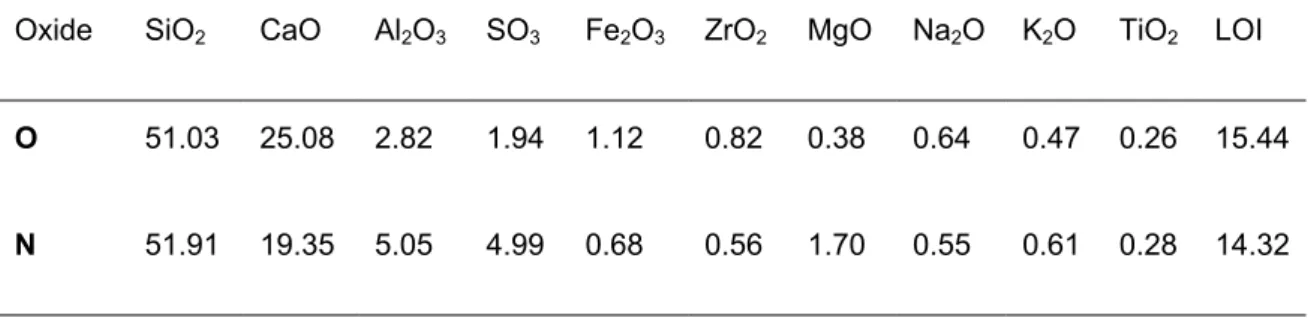
binder ratio was 0.31 for N/GRC and 0.32 for O/GRC. The boards were manufactured in a previous study [9] by the spray-up method and the chopped fibre and cement slurry were sprayed from separate nozzles onto a mould. The chemical compositions of with two matrices are given in Table 1.
Thermal analysis was carried out to study the hydrated matrix formulations using Stanton Redcroft STA1000 with TG-DTA. About 15mg fine powder was heated to 1000℃at a rate of
20℃/min under constant flow of nitrogen. Powder X-ray diffraction patterns were conducted
on Bruker D8 using CuKα1 radiation by collecting 2θ from 3° to 80°.
Thin section petrographic (TSP) specimens with a specimen thickness of 30μm were
Elemental mappings of Ca, Al, Si, S, Na and Zr were acquired with dwell time of 150𝜇𝑠 in
order to characterize the general elemental distribution at the interfacial and interfilamentary spaces. Microanalysis of the interfilamentary space was also performed to further investigate the chemistry of the phases located between the fibres. Owing to the relatively large interaction volume of X-ray signals (2-5𝜇𝑚in depth) compared to the narrow space between
the glass fibres (less than 5𝜇𝑚in width), interference from the glass fibres may occur during
microanalysis. This may result in unrealistically high proportions of silicon being recorded and a similarly high Si/Ca ratio. Therefore during the microanalysis, SiO2 signals originating from the glass fibre were deducted from the total SiO2 content examined in EDX spot analysis. Since ZrO2 is present in the glass fibre but only present at trace concentrations in the hydrated cement, it could be used as a marker to calculate the proportion of the silicon content of the spot analysis attributable to the glass fibres, by considering the composition of glass fibres (10% Na2O- 22% ZrO2- 68%SiO2by weight, own data from SEM/EDX analysis). Points for EDX analysis were randomly selected between glass fibres and corrected atomic information on each point (based on the ZrO2information) was recorded. The corresponding atomic ratios (i.e. Al/Ca, Si/Ca, S/Ca) were then calculated to generate microanalysis data.
The flexural behavior of different aged GRC composites (225mm × 55mm ×10mm) was
Table 1.Oxide composition (wt.%) of OPC (“O”) and Nashrin (“N”) modified GRC obtained from XRF
Oxide SiO2 CaO Al2O3 SO3 Fe2O3 ZrO2 MgO Na2O K2O TiO2 LOI
O 51.03 25.08 2.82 1.94 1.12 0.82 0.38 0.64 0.47 0.26 15.44
N 51.91 19.35 5.05 4.99 0.68 0.56 1.70 0.55 0.61 0.28 14.32
LOI: Loss on ignition
3. Results and discussion
3.1 DTA
A prominent composite triple endotherm at 100-180℃ is generally associated with the
presence of (in the order of dehydration temperature) weakly-bound pore water, C-S-H gel and/or ettringite [17]. Dehydroxylation of CH occurs between 500-550°C [17]. The low-temperature peak for Nashrin is significantly larger than that for OPC and the most prominent sub-peak is shifted towards higher temperature, suggesting a relative preponderance of ettringite over C-S-H. The absence of the CH endotherm is clear in Nashrin/GRC. Peaks between 600-780℃ are indicative of the existence of CaCO3 [17], but
very little seems to be apparent in either material. Both curves include another small endothermic peak at 573℃which corresponds to α → β transformation of quartz crystals in
Fig.1DTA thermograms of OPC and Nashrin matrices after ageing for 10 years at 25℃
3.2 X-ray diffraction
XRD results (Fig.2) confirm that Nashrin is free of CH; and relatively large amounts of ettringite can be observed, confirming the DTA results above. A broad band between 2θ
=32-33° reveals significant remnants of unhydrated belite clinker in Nashrin-based composites
even after 10 years of ageing; this may be attributed to rapid water consumption during the hydration of calcium sulfoaluminate within the first 1-2 days, which leaves insufficient water for the hydration of belite at later ages.
Fig.2X-ray diffraction patterns of GRC samples aged for 10 years at 25℃(E-ettringite, P-Ca(OH)2,
3.3 Thin section petrography (TSP)
At early ages the interfilamentary space in OPC/GRC (Fig.3.a) is mainly open (and thus filled with resin in TSP samples), in accordance with previous research [1]. After ageing for ten years, generated hydration phases exhibit a tendency to penetrate into the interfilamentary and interfacial spaces, as revealed in the thin section image. For the Nashrin-modified GRC (Fig.3.b) at early age, matrix has started to partially occupy the spaces within fibres. It is found that there is no obvious microstructural difference between the unaged and aged Nashrin/GRC [15], particularly focusing on the interfilamentary and interfacial microstructure, where there are hydrated phases penetrating between the fibres at early ages.
(a) (b)
3.4 SEM
3.4.1 Aged petrographic samples
Backscattered electron imaging of aged thin section petrographic Nashrin/ GRC is presented in Fig.4.a. The area studied is the same as that studied in its corresponding thin section image (Fig.3.b); a common characteristic feature (an aggregate particle) is labeled.
A substantially dense microstructure around the glass fibre bundles was observed. Spaces between the fibres were partly ingressed by small amounts of hydration products but some air voids could also be identified according to their very dark greyscales. EDX results from Point 1 showed concentrations of CaO and SiO2at the interfilamentary zone (46.0 wt. % and 28.4 wt. % respectively) with small amounts of Al2O3 and SO3 included. The Ca/Si ratio at Point 1 was 1.74 and the Al/Ca ratio was 0.33.
Elemental mappings were used to study the spatial distributions of S, Ca and Al in the interfilamentary and interfacial area. Microanalysis of the interfilamentary spaces is shown in Fig.5. In the Al/Ca to Si/Ca ratio plot, a trend line joining C-S-H gel towards AFt type phases can be clearly identified, along with some scattered data with slightly higher Al/Ca ratio. The plot of S/Ca towards Al/Ca further confirms that there is a general trend line between clusters of C-S-H and AFt phases, with a slight deficiency in sulfate at some data points. Therefore it can be concluded that the interfilamentary phases in aged Nashrin/GRC are mainly C-A-S-H gel finely intermixed with AFt phases at various levels.
interfilamentary space, further reveals dominance of CaO (55.0 wt.%) and SiO2(41.8 wt.%) at the interfilamentary space. Hardly any Al and S could be observed between fibres, thus eliminating the presence of ettringite and/or AFm in this zone. Abundance of Na and Zr on the fibre surface by mapping proves that the glass fibres used in this project belong to AR glass fibre, based on a Na2O-SiO2-ZrO2system.
(a) (b)
Fig.4Microstructure of Nashrin/GRC aged for 10 years; (a) Backscattered image at a magnification of 400, width of field 326µ𝒎; (b) spot analysis of point 1; (c) element mappings
3.4.2 Fracture surfaces
Microstructural observations of the fresh fracture surface of Nashrin/GRC demonstrated well-preserved bundled features of glass fibres after 10 years ageing (Fig.8.a). Most of the fibres were pulled out rather than fractured, indicating desirable composite mechanical properties in Nashrin matrix. Spaces between filaments were occasionally occupied by small amounts of hydration products, adhering on parts of the fibre surfaces; but the overall interfilamentary spaces remained vacant generally. This loose distribution of individual glass fibres within the bundle confers flexibility when forces are applied, which could significantly increase the post-peak toughness of such GRC composites.
Fig.8Secondary electron images of fractured GRC composites aged for 10 year at a magnifications of 200, width of field 652µm; (a) Nashrin/GRC (b) OPC/GRC
3.5 Mechanical test
Bending performances of OPC/GRC and Nashrin/GRC with different curing regimes are present in Fig.9.a and Fig.9.b respectively. Data for the unaged and accelerated aged samples was extracted from a previous study [9], compared with the normal aged samples tested in the present study. At early ages, unaged OPC/GRC and Nashrin/GRC composites exhibited comparable bending performances. Both materials demonstrated similar ductile properties with an ultimate strain value of ~0.8%.
For the Nashrin/GRC, there was insignificant change in its bending performance after 140 days cured at 50℃. With the progress of accelerated curing for 316 days (this is equivalent
to about 6 years ageing at 25℃[9]), composites exhibited a medium strength reduction from
30 MPa in the unaged to 20 MPa. Under normal ageing for 10 years at 25℃, Nashrin/GRC
remained much of its toughness; the ultimate strain value reduced to ~0.5% in comparison to ~0.7% after accelerated aged for 316 days. The fibres still showed considerable ability to carry stress alone by bridging cracks. However, composite strength of the normal aged composite maintained almost the same as that in the unaged sample, which is inconsistent with the accelerated ageing testing.
After accelerated curing for 140 days at 50℃(this is equivalent to about 8 years at 25℃[9]),
0.8% for the unaged sample and bending strength was reduced from 27 MPa to 11 MPa. After ageing for 10 years at 25℃, the OPC composite suffered significant brittleness with a
low ultimate strain value of 0.09% but unlike the accelerated ageing results, composite strength reduction was not found. In the normal aged OPC/GRC, glass fibres had lost their functions to compensate for the low toughness of the cementitious mortar. Such stress variation with strain could be explained that immediately after a crack occurred, the fibre bundles were sufficiently densified by interfacial deposition of CH/C-S-H intermixture with ageing, such that they could not arrest the crack growth. Consequently it led to the catastrophic loss of bending toughness in OPC composite. However, the microstructure observed on the fractured surfaces (Fig.8.b) also confirms such mechanism causing the toughness degradation of the OPC composite.
By comparing accelerated ageing and normal ageing for both GRC materials, it can be summarised that accelerated ageing testing cannot completely fulfill its potential to provide true information on the degradation process of GRC composites. Severe composite strength reduction has not been found in both Nashrin/GRC and OPC/GRC under normal ageing; this is different to most of the previous research [5, 9, 19], which proposed that degradation of GRC composites is a combination of significant reductions in both strength and ductility as time develops, whereas only brittleness is confirmed in the present study. It would appear that at ageing temperatures closer to those encountered in-service, mechanisms that lead to enhanced fibre-matrix bond (densification, precipitation of both CH and C-S-H at the interface and between the fibres, etc.) may have a greater role to play in degradation than mechanisms associated with fibre weakening.
(a)
(b)
Fig.9Stress-strain curves of GRC composites with different curing regimes: unaged, accelerated aged at 50℃and normal aged at 25℃; (a) Nashrin/GRC, (b) OPC/GRC
Note: the unaged and accelerated aged data of both samples was extracted from reference [9].
4. Conclusions
1. After 10 years ageing at 25℃, severe degradation was observed in OPC composites.
2. In calcium sulfoaluminate-based composites, matrix started to occupy the spaces between filaments at early age but more detrimental bundle filling and densification at the interfacial zone did not develop with ageing. Finely intermixed C-S-H gel with AFt phases is adhered occasionally near the fibre surface.
3. Bending tests of aged Nashrin/GRC indicated good flexural and toughness properties after 10 years ageing at 25℃, in contrast to OPC composites. This reinforces the
confidence of its more widespread application in industry in terms of long-term durability.
4. Samples aged at 25℃ displayed loss of toughness, but not loss of strength as
predicted by accelerated ageing models. This would suggest that densification mechanisms are more important than fibre weakening mechanism with regard to long-term performance of GRC composites.
Acknowledgement
The authors would like to thank China Scholarship Council in association with University of Leeds Scholarship to provide the funding for this project.
Reference
2. Majumdar, A. J. and V. Laws, Glass fibre reinforced cement. 1991: Oxford: BSP Professional Books.
3. Bentur, A. Mechanisms of potential embrittlement and strength loss of glass fiber reinforced cement in Proceedings of durability of glass fibre reinforced concrete symposium. 1985.
4. Purnell, P., et al., Accelerated ageing characteristics of glass-fibre reinforced cement made with new cementitious matrices. Composites Part a-Applied Science and Manufacturing, 1999.30(9): p. 1073-1080.
5. Orlowsky, J. and M. Raupach, Modelling the loss in strength of AR-glass fibres in textile-reinforced concrete.Materials and Structures, 2006.39(6): p. 635-643.
6. Devekey, R.C. and A.J. Majumdar, Interfacial bond strength of glass fibre reinforced cement composites.Journal of Materials Science, 1970.5(2): p. 183-&.
7. Glasser, F.P. and L. Zhang, High-performance cement matrices based on calcium sulfoaluminate-belite compositions. Cement and Concrete Research, 2001. 31(12): p. 1881-1886.
8. Arjunan, P., M.R. Silsbee, and D.M. Roy, Sulfoaluminate-belite cement from low-calcium fly ash and sulfur-rich and other industrial by-products. Cement and Concrete Research, 1999.29(8): p. 1305-1311.
9. Purnell, P. and J. Beddows,Durability and simulated ageing of new matrix glass fibre reinforced concrete.Cement & Concrete Composites, 2005.27(9-10): p. 875-884.
10. Pera, J. and J. Ambroise, New applications of calcium sulfoaluminate cement. Cement and Concrete Research, 2004.34(4): p. 671-676.
12. Litherland, K.L., Oakley DR, Proctor BA, The use of accelerated ageing procedures to predict the long-term strength of grc composites. Cem Concr Res, 1981. 11: p. 455-466.
13. Singh, B. and A.J. Majumdar, The effect of sand addition on the properties of grc. International Journal of Cement Composites and Lightweight Concrete, 1987.9(2): p. 75-79.
14. John, D. A., A. B. Poole. and I. Sims., Concrete Petrography, 1998: London: Arnold Publishers.
15. Purnell, P., et al., Microstructural observations in new matrix glass fibre reinforced cement.Cement and Concrete Research, 2000.30(11): p. 1747-1753.
16. Head, M., Influence on the interfacial transition zone (ITZ) on the properties of concrete, inSchool of Civil Engineering2001, University of Leeds.
17. Taylor, H.F.W.,Cement chemistry,. 2nd edition, ed. 1997, London: Thomas Telford.
18. Katz, A. and A. Bentur,Mechanisms and processes leading to changes in time in the properties of CFRC.Advanced Cement Based Materials, 1996.3(1): p. 1-13.
19. Butler, M., V. Mechtcherine, and S. Hempel, Experimental investigations on the durability of fibre-matrix interfaces in textile-reinforced concrete. Cement & Concrete Composites, 2009.31(4): p. 221-231.
20. Richardson, I.G., The calcium silicate hydrates. Cement and Concrete Research, 2008.38(2): p. 137-158.