The Information Structure and
Argument Mapping of Mandarin
Chinese Resultative Verb Construction
Master of General and Applied Linguistics (Advanced)
The Australian National University
Huade Huang
This thesis is submitted in partial fulfilment of the requirements for the degree of Master of General and Applied Linguistics (Advanced) in the College of Arts and Social
Sciences.
I hereby declare that, except where it is otherwise acknowledged in the text,
this thesis represents my own original work.
All versions of the submitted thesis (regardless of submission type) are
Contents
Abbreviation ... i
Abstract ... iii
Chapter 1: Introduction ... 1
1.1 Lexical Mapping Theory (LMT) ... 4
1.1.1 The hierarchy of semantic roles structure ... 7
1.1.2 A classification of syntactic functions ... 8
1.1.3 Lexical Mapping Principles ... 11
1.1.4 Well-formedness conditions ... 17
1.1.5 LMT in English - an example ... 18
1.2 Agent mapping as a problem in LMT ... 20
1.3 The argument-function mapping of RVC in a revised LMT ... 22
1.4 BA and BEI construction ... 33
1.5 Outline of this thesis ... 35
1.6 Data ... 36
Chapter 2: Information structure ... 37
2.1 Introduction ... 37
2.2 Components of information structure ... 39
2.3 Feature-based classifications of information structure ... 42
2.4 Components of information structure ... 45
2.4.1 Given information: Topics and Background ... 46
2.4.2 New information: Focus ... 62
2.7 Conclusion ... 65
Chapter 3: Topic as a motivation of argument mismatch ... 67
3.1 Subject properties ... 67
3.1.1 Reflexive binding ... 68
3.1.2 Control ... 70
3.1.3 Imperatives ... 74
3.1.4 Possessor relativisation ... 75
3.2 Primary Topic and Patient-Subject mapping ... 79
3.3 Contrastive Topic ... 87
3.4 Secondary Topic and Agent-Object mapping ... 88
3.5 The limitation of the mismatches ... 93
3.5.1 Patient-Subject mapping without passivisation ... 93
3.5.2 Agent-Object Mapping ... 102
3.6 Conclusion ... 107
Chapter 4: Mappings in BA and BEI construction ... 109
4.1 BA construction ... 110
4.2 BEI construction ... 114
4.3 Conclusion ... 122
Chapter 5 Conclusion ... 123
i
Abbreviation
1, 2, 3 1st person, 2nd person, 3rd person
AV active voice
CL classifier
COP copula
com.Focus completive Focus con.Focus contrastive Focus cs.Topic contrastive Topic
DEF define
DC default classification DUR durative aspect maker
GF grammatical functions
IC intrinsic classification
LMT Lexical Mapping Theory
PASS passive
PTC particle
p.Topic primary Topic
PFV perfective aspect marker
PL plural
Q question markers
ii
SG singular
iii
Abstract
This thesis will investigate the information structure and its interaction with argument mappings of Chinese resultative verb construction (RVC). One RVC may have several different mappings. This thesis proposes that these mappings have a strong relation with information structure. If a mapping is not in accord with the information structure of the sentence, this mapping will not be chosen by the speaker.
1
Chapter 1: Introduction
The syntactic properties of Chinese resultative verb construction (RVC) have been discussed widely in the literature on Chinese linguistics (Thomson, 1973; Cheng, 1993; Cheng & Huang, 1994; Li 1995; Gao, 1997; Huang 2006; Her, 2007; Li, 2007; Li, 2013 and so on). (1) and (2) give the examples of two RVCs: ‘打跑dǎ-pǎo’ and ‘打碎dǎ-suì’.
(1). 他们打跑了敌人
Tāmen dǎ-pǎo-le dírén 3PL hit-run-PFV enemy ‘they have beaten the enemy’
(2). 那个小孩打碎了花瓶
Nàgè xiǎohái dǎ-suì-le huāpíng
that child hit-fragmentary-PFV vase ‘that child broke the vase into pieces’
2 In both (1) and (2), the second sub-predicate is predicated of the Object; the enemy is the Object of (1) and they are the ones who ‘run (跑pǎo)’; the vase is the Object of (2) and it is in ‘fragments (碎suì)’. This is what is commonly expected cross-linguistically in resultative constructions (Simpson, 1983; Cheng & Huang, 1994) ; resultative secondary predicates in sentences with transitive verbs are normally predicated of the Object, while resultative secondary predicates in sentences with intransitive verbs are normally predicated of the Subject.
One interesting property of RVC is that the arguments of some RVCs can be mapped onto grammatical functions in different ways, which allows a sentence containing a RVC to be interpreted in several ways. One famous example is the RVC ‘追 累 zhuī-lèi (chase-tired)’ which has three possible interpretations (Cheng & Huang, 1994; Li, 1995; Her 2007).
(3). 张三追累了李四
Zhāngsān zhuī-lèi-le Lǐsì Zhangsan chase-tired-PFV Lisi
a. Zhangsan chased Lisi, as a result Lisi got tired. (Agent-Subject, Patient-Object)
3 c. Lisi chased Zhangsan, as a result Lisi got tired (Lisi chased Zhangsan; Zhangsan ran so fast, as a result Zhangasan caused Lisi tired). (Patient-Subject, Agent-Object)
The example (3) shows that the mapping between arguments and grammatical functions of the RVC ‘追累 zhuī-lèi (chase-tired)’ is not stable. The meaning of this sentence is highly dependent on the context. Only when given the complete context, can the listener understand what the speaker of this sentence intends to say: who is the chaser and who gets tired. This thesis will investigate the interaction of argument mappings and information structure. We will see that new information given by RVCs will update information of different entities in different mappings. When the information structure is changed, a different mapping will be chosen.
4
1.1 Lexical Mapping Theory (LMT)
A predicate usually describes a property, action or state of people or things, and these participants whose properties, actions or states are identified as arguments of the predicate. Consider examples in (4).
(4). a. John saw Mary. b. John loves Mary. c. John kicked Peter. d. John went to school.
5 (5). Inventory of semantic roles (Kroeger, 2005, p. 54)
• Agent: causer or initiator of events
• Experiencer: animate entity which perceives a stimulus or registers a
particular mental or emotional process or state
• Recipient: animate entity which receives or acquires something
• Beneficiary: entity (usually animate) for whose benefit an action is
performed
• Instrument: inanimate entity used by an agent to perform some action
• Theme: entity which undergoes a change of location or possession, or
whose location is being specified
• Patient: entity which is acted upon, affected, or created; or of which a
state or change of state is predicated
• Stimulus: Object of perception, cognition, or emotion; entity which is
seen, heard, known, remembered, loved, hated, etc.
• Location: spatial reference point of the event (the source, goal, and path
roles are often considered to be sub-types of location)
• Source: the origin or beginning point of a motion
• Goal: the destination or end-point of a motion • Path: the trajectory or pathway of a motion
• Accompaniment (or Comitative): entity which accompanies or is
associated with the performance of an action
6 require an Experiencer and a Stimulus. Kick in (4c) requires an Agent and a Patient, and arguments of go in (4d) are an Agent and a Goal. So, argument structure of these verbs can be interpreted as (6).
(6). a. see <Experiencer, Stimulus> b. love <Experiencer, Stimulus> c. kick <Agent, Patient>
d. go <Agent, Goal>
7 1.1.1 The hierarchy of semantic roles structure
Kiparsky (1987) observes that it is common to find idioms and lexicalized expressions formed by the combination of a verb and its Location and Theme arguments, while expressions formed by a verb and its Agent or Agent-like argument are infrequent. This means that the ability to participate in the process of lexicalization is different among semantic roles. Another cross-linguistic property of semantic roles is that Agent, Beneficiary and Patient arguments are more likely to have grammatical agreement with verbs (Givón, 1984). From these pieces of evidence, it can be assumed that semantic roles show different tendencies towards different syntactic structures. They are not distributed randomly.
Bresnan and Kanerva (1989) propose a hierarchy of semantic roles as (7), which captures the pattern that the more Agent-like semantic roles are more likely to be the Subject than the Patient or Locatives.
(7). Agent > Beneficiary > Recipient/Experiencer > Instrument > Theme/Patient > Locative
8 1.1.2 A classification of syntactic functions
A cross-linguistic observation is that grammatical functions vary as to what the corresponding semantic roles are. For example, in many languages Subject and Object can represent almost any semantic roles, while for languages that have ditransitive verbs, the secondary Object of ditransitive verbs and Oblique only accept a limited number of semantic roles. In other words, there is a restriction on Oblique and secondary Object linking them to a limited set of semantic roles, while Subject and Object are less restricted. Another observation related to grammatical functions is that Object and secondary Object can only be the argument of transitive predicates, such as verbs and prepositions (Bresnan & Kanerva, 1989), but Subject and Oblique are not so restricted.
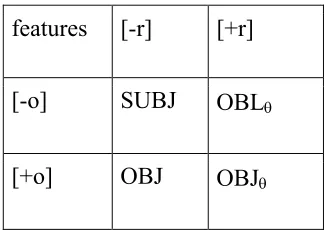
Based on these observations, Bresnan and Kanerva (1989) decompose grammatical functions into the features [+/- r(restricted)] and [+/- o(Objective)]:
(8). Explanation for each feature (Bresnan & Kanerva, 1989; Dalrymple, 2001, p.204; Bresanan, Asudeh, Toivonen, & Wechsler, 2016, p.331)
[-r]: semantically unrestricted SUBJ and OBJ: any semantic role can be mapped onto these grammatical functions
[+r]: semantically restricted OBJq and OBLq: only arguments with particular semantic roles can be mapped on these grammatical functions.
9 [+o]: Objective functions, OBJ and OBJθ: these functions appear as arguments
of transitive categories of predicates (Verbs and Prepositions) but are less likely to appear as arguments of Nouns and Adjectives which are normally intransitive categories.
Examples in (9) show grammatical functions with possible semantic roles.
(9) a. 张三追李四
Zhāngsān zhuī Lǐsì Zhangsan chase Lisi ‘Zhangsan chases Lisi’
b. 李四累了
Lǐsì lèi-le Lisi tired-PFV ‘Lisi is tired’
c. 张三在桌子上放了一本书
Zhāngsān zài zhuōzi shàng fàng-le yī-běn shū Zhangsan on table up put-PFV one-CL book ‘Zhangsan has put a book on the table’
d. 张三给了李四一本书
10 Agent ‘Zhangsan’ in (9a) and Patient/Theme ‘Lisi’ in (9b) can be the Subject, which has the features (-r, -o). The Patient ‘Lisi’ in (9a) can be the Object that has the feature (-r, -o). (9c) show the example of oblique (+r, -o): the Locative ‘zài zhuōzi shàng (on the table)’. (9d) shows that the Recipient ‘Lisi’ can be the restricted Object with the features (+r, +o).
Table (10) shows the proposed the natural classes of grammatical function:
(10). Decomposition of grammatical functions features [-r] [+r]
[-o] SUBJ OBLq
[+o] OBJ OBJq
The minus valued features are unmarked (Bresnan et al., 2016). In terms of markedness, LMT assumes that there is a hierarchy among the grammatical functions. The Subject (-r, -o) is least marked, and the restricted Object (+r, +o) is most marked. LMT proposes a partial ordering hierarchy of argument functions:
(11). Partial ordering of argument functions (Bresnan et al., 2016) SUBJ > OBJ, OBLq > OBJq
[image:17.595.133.296.331.446.2]11 1.1.3 Lexical Mapping Principles
As LMT discusses the mapping between argument structure and grammatical functions, it needs rules to classify the relation between argument structure and grammatical functions. It is lexical mapping principles that associate semantic roles and grammatical functions by the features [+/-r] and [+/-o]. There are three lexical mapping principles (intrinsic role classification, morpholexical operation and default classification). Each of them will be discussed in the following sections.
1.1.3.1 Intrinsic classification (IC)
The intrinsic classification is the basic principle for determining semantic roles mapping onto syntactic functions (Bresnan et al., 2016). The Intrinsic classification (IC) assigns the [+/- r] and [+/- o] feature to semantic roles, according to their intrinsic semantic meanings. After the features having been assigned to semantic roles, the linking between argument structure and grammatical functions can be constructed.
12 (12). a. Agent encoding:
Agent | [-o]
b. 张三打死了李四
Zhāngsān dǎ-sǐ-le Lǐsì Zhangsan hit-die-PFV Lisi ‘Zhangsan has killed Lisi (by hitting Lisi).
Thus, in (12b), ‘Zhangsan’ as Agent is assigned [-o]
Theme and Patient can be either Subject or Object in many languages. Thus, Theme or Patient requires the feature [-r], which enables them to alternate between Subject and Object:
(13). a. Theme/Patient encoding: Theme or Patient
| [-r]
b. 张三打死了李四
13 In (13b), ‘Lisi’ as Patient is assigned [-r].
Finally, a Locative argument (as opposed to locative adjuncts), similar to Agent, can be Subject or Oblique. This requires the feature [-o] to be assigned to Locative arguments:
(14). a. Locative encoding: Locative
| [-o]
b.张三在桌子上放了一本书
Zhāngsān zài zhuōzi shàng fàng-le yī-běn shū Zhangsan on table up put-PFV one-CL book ‘Zhangsan has put a book on the table’
(14b) the Locative ‘zài zhuōzi shàng (on the table)’ is assigned the feature [-o].
1.1.3.2 Morpholexical operation
14 (15) a. John saw Mary
b. Mary was seen by John.
(16) gives the examples of Chinese. (16a) and (16b) describe the same event. However, (16a) is in the canonical structure with Agent being the Subject, while (16b) expresses this event with BEI construction in which the Patient is the Subject.
(16) a. 张三打死了李四
Zhāngsān dǎ-sǐ-le Lǐsì Zhangsan hit-die-PFV Lisi ‘Zhangsan has killed Lisi (by hitting Lisi). b. 李四被张三打死了
Lǐsì bèi Zhāngsān dǎ-sǐ-le Lisi BEI Zhangsan hit-die-PFV ‘Lisi was killed by Zhangsan’
15 hierarchy) being Subject. the suppressed Agent or Experiencer argument can be unexpressed in the sentence. The encoding for the passive can be noted as (17):
(17). passive θ^
| ∅
(the highest semantic role is marked as θ^ )
For example, the English passive in (15b) suppresses the Experiencer, and the Stimulus is promoted as the Subject. This can be noted as (18).
(18). see (passive) < Experiencer, Stimulus>
| |
∅ Subject
1.1.3.3 Default classification (DC)
16 role has not already possessed an incompatible feature with default classification (Bresnan & Kanerva, 1989).
The default classification assigns [-r] to the semantic role of the predicate that is highest on the semantic hierarchy and [+r] to other roles.
(19) θ^ θ
| | [-r] [+r]
(the highest semantic role on the hierarchy is marked as θ^ )
The RVC ‘打死dǎ-sǐ’ in (20) has two arguments, the Agent ‘Zhangsan’ and the Patient ‘Lisi’.
(20). a. 张三打死了李四
Zhāngsān dǎ-sǐ-le Lǐsì Zhangsan hit-die-PFV Lisi ‘Zhangsan has killed Lisi (by hitting Lisi).
17 [+r] by the default classification will not be assigned to the Patient in (20) in order to avoid the clash of two features
1.1.4 Well-formedness conditions
The mappings are subject to well-formedness conditions. Consider examples such as (21a) and (21b), which both contain the verb ‘run’ and its Theme argument ‘the dog’.
(21) a. The dog is running. *b. Is running the dog.
In LMT, Theme argument gets a [-r] feature, which allows this Theme argument to be mapped to Subject or Object. If it is mapped to Object, this sentence will have no Subject as in (21b). This sentence is ill-formed. Therefore, LMT needs a rule, the Subject condition, to make sure that each sentence has a Subject:
(22) The Subject Condition: Every verb must have a SUBJ.
Another problem that LMT has to address is a possible mapping clash in passivization of ditransitive verbs.
18 c. *John a book was given by me.
For example, in passive voice like (23b), give takes three arguments, a Beneficiary (John), a Theme (a book) and an Agent (me). The Theme argument gets a [-r] feature by IC and the Beneficiary also gets a [-r] by DC. This indicates that both arguments can be Subject or Object of a verb like give (passive). However, a clause could not possess two Subjects; therefore, LMT need another rule called Function-argument Biuniqueness to restrict the mapping so that each argument will only be mapped onto one grammatical function, and each grammatical function only gets one argument that is mapped onto it.
(24) Function-argument biuniqueness: Each a-structure role corresponds to a unique f-structure function, and each f-structure function corresponds to a unique a-structure role.
1.1.5 LMT in English - an example
To give a clear illustration of how LMT is used, here is an example from English.
(25) John hits Peter.
a-str hit <Agent, Patient>
| |
IC: [-o] [-r] (IC = intrinsic classification)
19 (SUBJ) (SUBJ/OBJ)
GF: SUBJ OBJ
The English verb hit takes two arguments, an Agent and a Patient. The mapping takes place sequentially. The intrinsic role classification (IC) of the two roles is [-o] and [-r] respectively. Then, default classification (DC) comes in and assigns [-r] feature to the Agent argument, the highest role in this situation. Default classification would assign [+r] feature to the Patient argument, however, since Patient is already assigned [-r] by intrinsic classification, DC cannot be applied, because [-r] and [+r] are incompatible (Bresnan & Kanerva, 1989). A Patient argument with only a [-r] feature can be mapped onto either subject or object, but an Agent argument with [-o] and [-r] can only be mapped onto the Subject. Thus, two arguments of the verb hit, the Agent and the Patient, are mapped onto the Subject and the Object respectively.
(26) Peter is hit (by John).
a-str hit.passive <Agent, Patient>
∅ |
IC: [-r]
DC: [-o]
(SUBJ)
20 (26) is an example of English passivisation. IC is not changed as the semantic roles of hit are the same. The process of passivisation, in the perspective of LMT, is a process of suppression of the higher argument on the hierarchy of semantic roles. In this case, the Agent of hit is suppressed, then the Patient of hit becomes the more prominent argument in the passive of hit; thus, DC assigns [-o] to Patient. The subject condition requires that each verb has a Subject and the Agent argument is suppressed, therefore, the Patient with the features of [-r] and [-o] is mapped onto the Subject. The Agent argument can be expressed as an oblique, or omitted from the sentence.
1.2 Agent mapping as a problem in LMT
From the examples given in section 1.1.5, an obvious problem appears: the agent argument, as predicted by LMT, will never be mapped onto Object. This may be true for English and other European languages, but for many Austronesian languages, an Agent-like argument (higher on the hierarchy of semantic roles) can become an Object-like grammatical function. For example, the undergoer voice (or Objective voice) in Balinese requires the Agent argument to be linked to Object (Arka, 2003).
(27) Ida ngadol bawi-ne
3SG AV.sell pig-DEF
‘(S)he sold the pig’
21 pig-DEF UV.sell 3SG
‘the pig, (s)he sold’
(29) Bawi-ne ka-adol antuk ida pig-DEF PASS-sell by 3SG
‘The pig was sold by him/her’ (Arka, 2003, p.118)
Arka argues that in each of the 3 sentences above, the Agent ida has different grammatical functions: Subject (active voice) in (27), Object (undergoer voice) in (28) and Oblique (passive voice) in (98). This is not in accord with LMT, because the intrinsic classification [-o] prevents the Agent from acting as Object.
A similar situation is found in Mandarin Chinese. Some RVCs have interpretations with the linking that is not well-formed according to LMT. We have mentioned the well-known Chinese example of the predicate zhuī-lèi given in (3) and now repeated here in (30).
(30) 张三追累了李四
Zhāngsān zhuī-lèi-le Lǐsì
22 As the example shows above, the example can have three readings. Compare (30a) and (30c). In (30a), Zhangsan is the Agent (chaser) and Lisi is the Patient (being chased, chasee). However, in (30c), Zhangsan is the Patient (chasee) and Lisi is the Agent (chaser). It is expected that there could be three argument structures of zhuī-lèi, and one of these argument structures is interpreted as (30c), in which the Patient (Zhangsan, chasee) is linked to Subject and Agent (Lisi, chaser) is linked to Object. This is not possible in LMT, as Agent with the feature [-o] is not allowed to be Object. LMT only allows Agent to be linked with Object through morpholexical operation, but there is no obvious syntactic or morpholexical marker of a morpholexical operation having taken place, such as passive marker or an undergoer voice marker as Balinese.
1.3 The argument-function mapping of RVC in a revised LMT
The mismatch between arguments and grammatical functions in Mandarin RVC is a challenge for LMT. To address this problem, Her (2007) introduces the analysis of Cause roles (C-roles) proposed by Y.Li (1995) into LMT. This section will first introduce the analysis of C-roles by Y. Li (1995) and then show how Her (2007) applies this to LMT to address the mismatch.
23 (31) a. 张三追李四
Zhāngsān zhuī lǐsì Zhangsan chase Lisi
‘Zhangsan chases Lisi’ (no causativity involved) b. *张三累了李四
Zhāngsān lèi-le lǐsì Zhangsan tired-PFV Lisi
‘*Zhangsan tired Lisi’ (ungrammatical and no causativity involved) c. 张三累了
Zhāngsān lèi-le Zhangsan tired-PFV
‘Zhangsan was tired’ (no causativity involved)
The two sub-predicates of the RVC ‘追累zhuī-lèi’ cannot express causativity individually. The simple verb ‘追 zhuī’ only denotes the chasing action (Zhangsan chased Lisi), and it does not contain causativity, such as Lisi causing Zhangsan to chase him. (31b) is ungrammatical, because ‘累lèi’ can only take one argument. (31c) shows that this predicate just describes the state of Zhangsan. It does not clarify who or what causes Zhangsan to be tired.
24
(32). 张三追累了李四
Zhāngsān zhuī-lèi le Lǐsì Zhangsan chase-tired PFV Lisi
a. Zhangsan chased Lisi, as a result Lisi got tired. (Causative)
b. Zhangsan chased Lisi, as a result Zhangsan got tired by chasing Lisi. (non-Causative)
c. Lisi chased Zhangsan, as a result Lisi got tired. (Causative)
The readings of (32a) and (32c) contain the causativity. In (32a), the tiredness of Lisi is caused by Zhangsan, who chased Lisi. In (32c), the tiredness of Lisi is also caused by Zhangsan, who ran so fast that Lisi became tired from chasing Zhangsan. (32b) does not have this causative meaning. (32b) says that Zhangsan got tired from doing the action of chasing. This is not caused by the other argument, Lisi.
25 (33) Conditions for C-role assignment (Y.Li, 1995)
a. The argument in the Subject position receives the c-role Cause from a resultative compound only if it does not receive a theta role from Vres
b. the argument in the Object position receives the c-role Affectee from a resultative compound if it receives a theta role at least from Vres
‘追zhuī (chase)’ takes two arguments, Agent and Patient, and ‘累 lèi (tired)’ takes one argument, Theme. When these two predicates form the RVC ‘追累
zhuī-lèi (chase-tired)’, the resulting structure has three semantic roles that need to be expressed: Agent, Patient and Theme, but only two grammatical functions available to express them. Thus, the Theme will be combined with either Agent or Patient. (34) shows how the C-roles are assigned to the arguments of the RVC ‘追累zhuī-lèi’.
(34). 张三追累了李四
Zhāngsān zhuī-lèi le Lǐsì Zhangsan chase-tired PFV Lisi
a. Zhangsan chased Lisi, as a result Lisi got tired. (Causative) <Agent, Patient-Theme>
| |
Subject Object
| |
26 (via (33a)) (via 33b)
b. Zhangsan chased Lisi, as a result Zhangsan got tired. (non-Causative) <Agent-Theme, Patient>
| |
Subject (not Cause via
(33a))
Object (not Affectee
via (33b))
c. Lisi chased Zhangsan, as a result Lisi got tired. (Causative) <Agent-Theme, Patient>
| |
Object Subject
Cause (via (33a))
Affectee (via (33b))
27 of Affectee by the condition stated in (33b). The Patient is not combined with Theme and it is in the Subject position; therefore, it receives the C-role of Cause via (33a).
Y.Li (1995) claims that the Cause must be in the Subject position and the Affectee in the Object position; thus, there is a hierarchy between two C-roles: the Cause is more prominent than Affectee. The proposal of C-role does not predict the linking between argument structure and grammatical functions, because the C-role assignment is only possible when the Subject and Object have been decided in the sentence. Therefore, Her (2007) modifies the condition of causativity assignment in RVC and applies the revised causativity assignment conditions in LMT in order to get a predictable linking between argument structure and grammatical functions.
28 Therefore, the RVC ‘追累 zhuī-lèi’ can have four possible argument structures as (35) (semantic roles with strikethrough is suppressed).
(35). a. 追累 zhuī-lèi ‘chase-tired’ < Agent, Patient-Theme> b. 追累 zhuī-lèi ‘chase-tired’ < Agent, Patient-Theme> c. 追累 zhuī-lèi ‘chase-tired’ < Agent-Theme, Patient > d. 追累 zhuī-lèi ‘chase-tired’ < Agent-Theme, Patient >
The first three argument structures in (35) can have well-formed mapping onto grammatical functions as LMT predicts: the Agent is mapped on the Subject and the Patient or Theme is mapped onto Object. (36) shows the mapping process of the argument structures in (35).
(36).
a. < Agent, Patient-Theme >
Intrinsic Classification [-o] [-r]
Possible GF (SUBJ) (SUBJ, OBJ)
SUBJ OBJ
b. < Agent, Patient-Theme >
Intrinsic Classification [-o] [-r]
Possible GF (SUBJ) (SUBJ, OBJ)
SUBJ OBJ
29 Intrinsic Classification [-o] [-r]
Possible GF (SUBJ) (SUBJ, OBJ)
SUBJ OBJ
d. < Agent-Theme, Patient>
Intrinsic Classification [-r] [-r]
Possible GF (SUBJ, OBJ) (SUBJ, OBJ)
? ?
(36a) and (36b) show the argument mappings of the interpretation of (30a). These two mappings have the same meaning, but the difference is that the Theme in the combined semantic roles is suppressed in (36a), and in the (36b) the suppressed role in the combined semantic roles is the Patient. (36c) is the argument mapping of the interpretation of (30b). The Theme is suppressed in this mapping.
30 (37) Causativity Assignment in Resultative verb construction
An unsuppressed role from Vres receives Affectee (noted as [af]) iff an unsuppressed role from Vcaus exists to receive Cause (noteds as [caus]).
Thus, the argument structures of ‘追累 zhuī-lèi’ can be revised as (38).
(38) a. 追累 zhuī-lèi ‘chase-tired’ < Agent, Patient-Theme>
b. 追累 zhuī-lèi ‘chase-tired’ < Agent[caus], Patient-Theme[af]> c. 追累 zhuī-lèi ‘chase-tired’ < Agent-Theme, Patient >
d. 追累 zhuī-lèi ‘chase-tired’ < Agent-Theme[af], Patient[caus] >
31 (39) d. 追累 zhuī-lèi
‘chase-tired’
< Agent-Theme[af], Patient[caus] >
Intrinsic Classification [-r] [-r]
Possible GF (SUBJ, OBJ) (SUBJ, OBJ)
OBJ SUBJ
32
(40). 张三追累了李四
Zhāngsān zhuī-lèi le Lǐsì Zhangsan chase-tired PFV Lisi
a. Zhangsan chased Lisi, as a result Lisi got tired. (Causative)
i. < Agent, Patient-Theme >
Intrinsic Classification [-o] [-r]
Possible GF (SUBJ) (SUBJ, OBJ)
SUBJ OBJ
ii. < Agent[caus], Patient-Theme[af] > Intrinsic Classification [-o] [-r]
Possible GF (SUBJ) (SUBJ, OBJ)
SUBJ OBJ
b. Zhangsan chased Lisi, as a result Zhangsan got tired. (non-Causative) iii. < Agent-Theme, Patient > Intrinsic Classification [-o] [-r]
Possible GF (SUBJ) (SUBJ, OBJ)
SUBJ OBJ
c. Lisi chased Zhangsan, as a result Lisi got tired. (Causative)
iv. < Agent-Theme[af], Patient[caus] > Intrinsic Classification [-r] [-r]
Possible GF (SUBJ, OBJ) (SUBJ, OBJ)
33 The mappings of (40a.i), (40a.ii) and (40b.iii) are similar to the first three mappings in (36). The mapping (40c.iv) is decided by the C-roles of arguments. It can be known from these mappings that the argument mapping of RVC is complex, as the mappings involve semantic roles combination, suppression and causativity. It cannot be simply decided by the semantic hierarchy or the restricted and objective features.
1.4 BA and BEI construction
BA and BEI construction has been discussed widely in the studies of Mandarin Chinese. Unlike sentences with canonical structure which have typical post-verbal Objects, a sentence containing the BA construction has the prepost-verbal Object marked by the morpheme ‘把bǎ’. The word-class of this morpheme has been analysed as a case marker, a preposition, a coverb, or a verb (Bender, 2000). The BEI construction is considered as the passive in Mandarin Chinese. The word-class of BEI is also a controversial topic, as it has been analysed as a preposition or a verb (Her, 2009). There are two types of passive in Mandarin Chinese: long passive with an overt Agent in BEI construction, and short passive without an overt Agent in BEI construction (C.-T. J. Huang, 1999)
34
(41). 张三追累了李四
Zhāngsān zhuī-lèi-le Lǐsì Zhangsan chase-tired-PFV Lisi
a. Zhangsan chased Lisi, as a result Lisi got tired. (Causative)
b. Zhangsan chased Lisi, as a result Zhangsan got tired. (non-Causative) c. Lisi chased Zhangsan, as a result Lisi got tired. (Causative)
(42). 张三把李四追累了
Zhāngsān bǎ Lǐsì zhuī-lèi-le Zhangsan BA Lisi chase-tired-PFV
a. Zhangsan chased Lisi, as a result Lisi got tired. (Causative)
*b. Zhangsan chased Lisi, as a result Zhangsan got tired. (non-Causative) c. Lisi chased Zhangsan, as a result Lisi got tired. (Causative)
(43). 李四被张三追累了
Lǐsì bèi Zhāngsān zhuī-lèi-le Lisi BEI Zhangsan chase-tired-PFV
‘Zhangsan is tired, as the result of being chased by Lisi.’
35 The mismatch between arguments and grammatical functions in RVC has been well explained by LMT and C-roles, but there are some remaining problems: why does Chinese allow two or more different mappings in one sentence (e.g. (40))? The second problem is that morpholexical operations involving the BA construction and BEI construction with RVCs, do not allow some mappings that might otherwise seem possible.
The limitation on mappings between argument and grammatical functions in BA construction and BEI construction cannot be fully explained by Her (2007). (41b) is a possible mapping in canonical structure and it is expected that it will be also possible mapping in BA construction. However, (42b) shows that this is not possible. This problem is not addressed in Her (2007). This thesis will try to find out what the difference is between these syntactic structures that causes the limitation on mapping. I explore the idea that the BEI and BA construction have different word orders, and these have different information structure possibilities. Information structure may affect people to choose the different mappings. The choice of mapping is context-dependent. If the discourse cannot assign certain information structure roles, then certain mappings become less likely.
1.5 Outline of this thesis
36 give an account of why certain mapping is not possible in BA and BEI construction from the perspective of the information structure.
1.6 Data
This research will use data from the BCC corpus (Xun, Rao, Xiao, & Zang, 2016). This corpus is available online (http://bcc.blcu.edu.cn). This corpus contains data from academic articles, newspaper (in Mandarin) published in Xiamen, literature and Weibo (a Chinese social media). It contains around 15 billion characters, which may give adequate data for this research.
One of the advantages of this corpus is that it permits users to search by using part of speech; therefore, this make it possible to extract data of RVC directly. As mentioned before, a RVC is composed by a verb and an adjective or another verb. Thus, RVCs can be found in the corpus by searching the combination of verb-adjective or verb-verb. Due to the limitation on downloading data from the corpus, I have found 111 RVCs that occur in 537 examples in total.
37
Chapter 2: Information structure
Chapter 1 has mentioned that BA and BEI construction may possess different possibilities of the information structure, and this may affect people’s choice on argument mapping of a RVC. Before investigating the interaction between argument mappings and the information structure, we will first look at what is the information structure and the information structure in Mandarin Chinese. Chapter 2 will begin with a brief introduction of information structure and review the proposals of Vallduví and Engdahl (1996) and Choi (1996). Then, this chapter will introduce the components of information structure in Chinese, showing that the Prominence feature of Topics is not a bipartite feature, but a gradient feature.
2.1 Introduction
38 (1) Definition of information structure
Information structure: That component of sentence grammar in which propositions as conceptual representations of states of affairs are paired with lexicogrammatical structures in accordance with the mental states of interlocutors who use and interpret these structures as units of information in given discourse contexts
Here is an example to illustrate what information structure represents. Compare (2) and (3).
(2) a. What happened? b. [Jack kicked John]Focus (3) a. What happened to John?
b. [John]Topic [was kicked by Jack]Focus.
39 appear in the normal position for continuing Topics, something has to happen to the normal active voice sentence Jack kicked John in which the agent, Jack, is in the initial position. A way to do this is to use the passive voice counterpart, in which the Patient, John, becomes the Subject and appears in initial position. From this example, we can see that information structure is a useful tool to explain the variety of syntactic structures that have the same meaning.
The following sections will discuss components of information structure and information status (old versus new) in Chinese. Information structure is not only composed of Focus and Topic. Vallduví and Engdahl (1996) argue that old information can be divided as Link and Tail, and Choi (1996) proposes that the Focus can also be bipartite: completive and contrastive Focus. These four components of information structure can be categorized by two features, Newness ([+/-New]) and Prominence ([+/-Prom]) (Choi, 1996). This results in two types of Topic [-Prom, -New] and [+Prom, -New]. However, I will show that in Chinese the binary distinction of Prominence, [-Prom] and [+Prom], is not adequate to cover all Topics and that we must recognise 4 types of Topic: primary Topic, secondary Topic, continuing Topic and contrastive Topic.
2.2 Components of information structure
40 the known and expected part, namely the Ground. the other one is informative, unknown or contrary to expectation, namely the Focus. (4) shows how Ground and Focus fit in a sentence.
(4) a. What about John? What does he drink?
b. [John drinks]Ground [beer]Focus. (Vallduví & Engdahl, 1996)
Ground and Focus categorize information structure, according to whether the information is old or new. On the other hand, Topic-Comment concerns which entity or action in the utterance speakers intend to add information to. The Topic of a sentence is an entity (or action) about which speakers intend to add information in the discourse. The remaining elements in the sentence will be considered as Comment. The example (4) can be encoded as (5) by using the terminology of Topic-Comment.
(5) a. What about John? What does he drink?
b. [John]Topic [drinks beer]Comment. (Vallduví & Engdahl, 1996)
41 Because of the ambiguity between the two terminologies, Vallduví and Engdahl (1996) propose that information structure should be divided into three parts: Focus and Ground, and that the latter is further composed of Link and Tail. The Focus is new information in the discourse, which contributes to the hearer’s information state. The Ground indicates how this new information is introduced into the discourse. Tail and Link contribute to this function in different ways: Link bears the information update that is denoted by Focus, while Tail indicates how the Focus is related to the Link. Example (4b) and (5b) can be marked as (6), which shows how Link, Tail and Focus fit in a sentence.
(6) a. What about John? What does he drink? b. [John]Link [drinks]Tail [beer]Focus.
It is obvious that the new information is ‘beer’ in this conversation, thus ‘beer’ is the Focus. This conversation talks about ‘John’, so ‘John’ is the Link. The information structure proposed by Vallduví and Engdahl (1996) shows clearly that the predicate ‘drink’ is not an ambiguous element in the answer (6b); its function is to clarify that the Link ‘John’ performs the action of drinking upon ‘beer’, the Focus.
42 to be updated and the Tail further specifies how the new information (Focus) fits in this file card.
(7) a. What about the president? How does he feel about chocolate?
b. [The president]Link [HATES]Focus [chocolate]Tail. (Vallduví & Engdahl, 1996)
‘President’ and ‘chocolate’ are already given by the question (7a), and the relation between the two entries needs to be clarified. Thus, it is obvious that ‘hate’ is new information in the discourse and updates the information states of the listener. Thus, ‘hate’ is the Focus. This update goes to ‘the president’, as the ‘what about’ question shows that this conversation that ‘president’ is the Link in the answer (7b). ‘Chocolate’ is old information which is given by (7a). Vallduví and Engdahl (1996) think that this given information is already under the file-card of the Link ‘president’, and it needs the Focus to clarify the relation with the Link; therefore, it is the Tail in this discourse.
2.3 Feature-based classifications of information structure
Choi (1996) argues that not only can the old information (Ground) be divided as Link and Tail, but also it is possible to divide new information (Focus) into two parts: completive Focus and contrastive Focus. Consider the example (8).
(8) a. What did John buy?
43 c. John bought a [TOYOTA, not a VOLKSWAGEN]contrastive Focus.
(8b) is a possible answer to the question in (8a) where ‘TOYOTA’ is new information, which fills in the information gap between speaker and hearer. This is a completive Focus. (8c) can also be an answer to (8a). The difference between (8b) and (8c) is that the Focus (TOYOTA, not a VOLKSWAGEN) in (8c) is not only new information, but also indicates that this is contrary to the interlocutor’s expectation. This additional property of expressing contrast separates it from completive Focus, and it is named as contrastive Focus.
Choi (1996) further proposes that these four aspects of information structure can be categorized by two features, Newness and Prominence. A difference between Ground and Focus is the newness in the discourse: Ground is old information, while Focus is new in the discourse. Choi (1996) considers Prominence as a property of being singled out among potential alternatives. The Link is more prominent than the Tail, because Link is singled out from other old information as the most prominent element in this discourse. Contrastive Focus is more prominent than completive Focus. In the example given in (8), contrastive focus emphasises that something is different from the speech participants’ expectations, whereas completive focus simply gives the new information.
44 the information structure in terms of newness and prominence as binary features as in (9)
(9) feature-based classification of information structure
Newness Prominence
Ground Topic - +
Tail - -
Focus completive Focus + -
contrastive Focus + +
One of the advantages of this feature-based analysis of information structure is that it can further assemble Link and contrastive Focus together as [+PROM] components in information structure. That means this analysis of information structure can remove the limitation of newness, which is a traditional criterion of determining information structure. For example, Choi (1996) finds that a more prominent element will be more free in scrambling than non-prominent elements. Without having the feature of Prominence as well as the feature of Newness, this generalization is hard to express.
45
2.4 Components of information structure
Following Vallduví and Engdahl (1996) and Choi (1996), this thesis proposes that the given information can be separated into two parts: Topic and Background. This thesis makes further distinctions, following authors who have proposed different kinds of given information, for example, secondary Topic (Nikolaeva, 2001), contrastive Topic (Lee, 1999). Thus, this thesis proposes that Topic is subdivided into primary Topic, secondary Topic, contrastive Topic and continuing Topic. These components will be examined in the following sections. The new information is still composed by contrastive Focus and completive Focus. Therefore, the components of information structure in Mandarin Chinese can be concluded as (10)
(10) components of information structure in Mandarin Chinese Newness
Given information New information
Prominence
Contrastive Topic Secondary Topic Primary Topic Continuing Topic
Contrastive Focus
46 2.4.1 Given information: Topics and Background
2.4.1.1 Topics
Topics are very important elements in Chinese, as C. N. Li and Thompson (1976) suggest that Chinese is a Topic-prominent language, rather than a Subject-prominent language. An entity in a discourse should possess the following two features to become a Topic.
(11) Features of Topics:
a. The entity is already mentioned in previous discourse b. The listener receives updated information about this entity
These are the basic features of Topics, and we will see that each Topic has its own characteristics.
2.4.1.1.1 Primary Topic and Secondary Topic
A primary Topic is an entity which a discourse is mainly talk about. The notion of primary Topic is equal to the concept of Topic or Link. Here is an example of primary Topic.
(12) a. What about John?
47 The conversation in (11) talks about ‘John’, and the updated information in the answer (12b) goes to ‘John’. Thus, ‘John’ is a primary Topic in (12b). The concept of primary Topic is straightforward, as there is no difference between it and ‘Topic’ discussed in previous works. The reason why I call this Topic as primary Topic is that we need this term to be distinguished from secondary Topic in Chinese. Topic in this thesis is thus a higher category of given information, which contains primary Topic, secondary Topic and other kinds of Topics.
Chinese allows a sentence to have two Topics. Apart from primary Topic, the other given information bearing updated information is called ‘secondary Topic’. The preverbal Object marked by BA in BA construction can be a secondary Topic (Tsao, 1987). Consider example (13).
(13). a. 他们怎么处理这些石头?
Tāmen zěnme chǔlǐ zhèxiē shítouj 3PL how solve these stone ‘How did they treat these stones?’
b. 他们把石头敲碎了
Tāmen bǎ shítou qiāo-suì
3PL BA stone knock-fragmentary ‘They have cracked the stones into pieces’
48 Engdahl (1996)’s terminology, the patient here is deemed as a Tail. They consider that Tail and Link (or Topic) are two different types of old information: the update of information is completed within a Link, and a Tail is used to clarify the relation between the Link and the new information (Focus). Thus, in their analysis, a Tail is not the locus where an information update will take place. However, the old information, Patient in (13b), is not a Tail that designates a condition that Focus must complete or alter as Vallduví and Engdahl (1996) suggest. The conversation in (13) is concerned with both Agent and Patient. (13a) is asking for the action that ‘Tāmen (they)’ have taken with respect to the stones. (13b) provides this new information, and it also further specifies the resulting effect on the stone after this action has taken place. Therefore, there are two pieces of new information in (13b), the action of cracking and the result of this action (‘into pieces’). The action is obviously related to both the Agent and the Patient, but the result is only related to the Patient, the stone. These two pieces of updated information are associated with two different entities. Therefore, in this conversation, the interlocutors are dealing with two entities, and the information states of each of these two entities will be updated.
49 section. Therefore, the Patient argument, as well as the Agent argument, should be treated as Topic, rather than Tail or any other role of information structure. The conversation in (13) is mainly about the Agent ‘Tāmen (they)’, so in the example of (13b), the Agent ‘Tāmen (they)’ is the primary Topic. As the Patient ‘shítou (stone)’ marked by BA also bears the information update, it is also a Topic. In order to distinguishing with the primary Topic which the discourse is mainly about, this Topic (Patient ‘shítou (stone)’ marked by BA) is named as secondary Topic.
Apart from the NP marked by BA in preverbal position, Chinese can have other types of secondary Topic in preverbal position, such as the NP after BEI in the passive construction. (14) gives the example of BEI NP being secondary Topic.
(14). a. 张三被李四怎么了
Zhāngsān bèi Lǐsì zěnme-le Zhangsan BEI Lisi how-PFV ‘What did Lisi do to Zhangsan?’
b. 张三被李四打死了
[Zhāngsān] primary.Topic [bèi Lǐsì]secondary.Topic [dǎ-sǐ-le]com.Focus
Zhangsan BEI Lisi hit-die-PFV
‘Zhangsan was killed by Lisi’
50 the Patient ‘Zhangsan’. These are the old information in (14b). The RVC ‘打死
dǎ-sǐ (hit-die) in (14b) is one single predicate but contributes two pieces of new information into the discourse: the action hit done by ‘Lisi’ and the result die describing the state of ‘Zhangsan’ after the action. These two pieces of new information update the information state of two entities. The new information of action shows what ‘Lisi’ has done and what ‘Zhangsan’ has undergone. The new information of result shows the state of the Patient ‘Zhangsan’ after he underwent the action. The entity ‘Zhangsan’ can be labelled as primary Topic, because this discourse mainly talks about what ‘Zhangsan’ has undergone; The primary Topic in this discourse possesses two pieces of new information: the action and the result coming from the RVC. The entity ‘Lisi’ is the secondary Topic. This secondary Topic only bears the information update of the action. Unlike the secondary Topic in BA construction, the secondary Topic marked by BEI construction has the information update of the action from RVCs, rather than the resultant state from RVCs.
51 (15). a. 他们做了什么?
Tāmen zuò-le shénme
3PL do-PFV what
‘what did they do?’
b. 他们把石头敲碎了
[Tāmen]primary Topic [bǎ shítou qiāo-suì]completive Focus
3PL BA stone knock-fragmentary
‘They have cracked the stones into pieces’ (16). a. 张三怎么了
Zhāngsān zěnme-le Zhangsan how-PFV ‘What happened to Zhangsan’ b. 张三被李四打死了
[Zhāngsān] primary.Topic [bèi Lǐsì dǎ-sǐ-le]completive Focus Zhangsan BEI Lisi hit-die-PFV
‘Zhangsan was killed by Lisi’
52 in (16b) is a Topic, a primary Topic, but ‘Lisi’ in (16b) is not a Topic. ‘Lisi’ belongs to the completive Focus.
If we assume that there can be two types of Topics in one sentence, a primary Topic and a secondary Topic, then which of these two types of Topics is more prominent? I propose that the secondary Topic is more prominent than the primary Topic, because it is possible to omit the primary Topic in the discourse and the secondary Topic is marked.
(17). a. 他们i怎么处理这些石头j?
Tāmen zěnme chǔlǐ zhèxiē shítouj 3PL how solve these stone ‘How did they treat these stones?’
b. ∅i把它们敲碎了
∅i [Bǎ shítou]secondary Topic [qiāo-suì-le]completive Focus
BA stone knock-fragmentary-PFV
‘They have cracked the stones into pieces’ c. * 他们∅j 敲碎了
[Tāmen]primary Topic ∅j qiāo-suì-le
3PL knock-fragmentary-PFV
Intended meaning: ‘they cracked (something) into pieces.’
53 in (17a). However, it is not possible to just keep primary Topic (Subject) and omit the secondary Topic (Object) as (17c). (17c) itself is an ungrammatical sentence, and is not a good answer to (17a). The same situation can be found in (18), which has the BEI NP as the secondary Topic.
(18) a. 张三i被李四j怎么了
Zhāngsān bèi Lǐsì zěnme-le Zhangsan BEI Lisi how-PFV ‘What did Lisi do to Zhangsan?’
b. ∅i 被李四打死了
∅i [bèi Lǐsì]secondary. Topic [dǎ-sǐ-le]com.Focus
BEI Lisi hit-die-PFV
‘Zhangsan was killed by Lisi’ c. *张三打死了
[Zhāngsān] primary.Topic ∅j [dǎ-sǐ-le]com.Focus
Zhangsan hit-die-PFV
Intended meaning:‘Zhangsan was killed’ d. ∅j打死了张三
∅j dǎ-sǐ-le Zhāngsān hit-die-PFV Zhangsan
54 ungrammatical, because the absence of the BEI construction blocks the Patient of this RVC to be the Subject. (18c) is also not an appropriate answer to the question. Although (18d) is grammatical with an unexpressed Subject, it is not an appropriate answer to the question.
The comparison between these sentences shows that it is much easier to omit the primary Topic (which is usually the Subject) than secondary Topic (which can be Object or oblique). The primary Topic is more salient than the secondary Topic. The secondary Topic either in BA construction or BEI constrution are both marked. Therefore, I propose that the secondary Topic is more prominent than the primary Topic.
2.4.1.1.2 Continuing Topic
A part of a sentence will be (constantly) repeated as Topic in following sentences throughout the discourse. The primary Topic and secondary Topic are the role of information structure in a sentence, but this repeated Topic is a concept at the level of the discourse. Therefore, we need another term continuing Topic to distinguish with the sentential Topics. (19) shows an example of continuing Topic.
55 challenge without ever once feeling sorry for herself. In naval combat, though, she wouldn’t stand a chance. (Wolfe, 2016)
In (19), this paragraph is talking about the author’s mother, and each sentence describes a property of her mother. The entity is constantly repeated throughout the discourse. Therefore, it is the continuing Topic of this discourse.
A property of continuing Topic of Chinese is that the continuing Topic can be omitted after it has been introduced into the discourse, while English continuing Topic is required to show up in the following sentences as pronouns (unless coordinated with ‘and’). (20) is a rough Chinese translation of (20).
(20). 妈妈十八岁以后就靠着自己生活,每天打两份工来养活我们。不管
事情多么糟糕,她都能解决每一个挑战。
Māmāi shíbā suì yǐhòu kào-zhe zìjǐ shēnghuó , mother eighteen age after rely.on-DUR self live
∅ měitiān dǎ liǎng-fèn gōng lái yǎnghuo women,
i everyday hit two-CL work come raise 1PL
Bùguǎn shìqíng duōme zāogāo , ∅ dōu néng jiějué měi no.matter thing how bad i all able.to solve every yīgè tiǎozhàn.
56 In this example (20), the continuing Topic ‘my mom’ is not expressed in the following clauses and is understood from the first sentence and the whole context. Absence of a pronoun is interpreted as coreferential with something in the previous sentence.
A continuing Topic is quite similar to a Primary Topic and secondary Topic, for they are all given information. However, the difference is that primary Topic and secondary Topic might simply refer to the entity that this proposition talks about and need not be repeated in the following discourse. Continuing Topic, however, refers to the entity which repeatedly appears in the discourse. Therefore, primary Topic and secondary Topic is a concept within a sentence, but continuing Topic is a concept at the level of the discourse.
A primary Topic can be a continuing Topic. The example (20) can be an answer to a question ‘what about your mother?’. As noted by Tsao (1987), a secondary Topic can also lead a Topic chain. Consider example (21)
(21). a. 你觉得这顿饭怎么样?
Nǐ juéde zhè-dùn fàn zěnme yang? 2SG think this-CL meal how
‘how do you think about this meal?’
b. 这顿饭i 把我j吃撑了,∅*i/j休息了两个小时才缓过来。
57 This-CL meal BA-1SG eat-full-PFV rest-PFV two-CL xiǎoshí cái huǎn-guò-lái.
hour then refresh-pass-come
‘This meal filled me up, and it took me two hours to recover (to digest the food)’
(21a) asks the listener’s opinion about the meal. (21b) is the answer to this question. In (21b), it is clear that ‘the meal’ is the primary Topic and ‘wǒ (1SG)’ is the secondary. It is the secondary Topic that is continuous in the following discourse, as the omitted entity is the first person pronoun which is the secondary Topic. Therefore, a secondary Topic can also be a continuous Topic in the following clause.
2.4.1.1.3 Contrastive Topic
If the NP expressing a Topic denotes a group, or something which has parts, then a member of the group or a part of the thing can be set in contrast with the group or the other parts. This member or this part of the thing is called ‘contrastive Topic’ (Lee, 1999). The contrast lies in the difference between the actions of the group members or their properties, etc. Contrastive Topic indicates speakers’ consciousness of contrast among given information.
58 between interlocutors, while contrastive Focus also indicates that certain information is contrary to interlocutors’ expectations. The difference between contrastive Topic and contrastive Focus is that a contrastive Topic is old information in the discourse, while a contrastive Focus is new information in the discourse. (22) is an example of contrastive Topic.
(22) a. How does the couple like the decoration of their house?
b. The husband likes it very much, but [as for the wife]contrastive Topic, she hates it.
c. The husband likes it very much, but the wife hates it.
Compare (22b) and (22c). (22c) just conveys the attitude toward the decoration. An additional marker ‘as for’ on ‘the wife’ in (22b) makes it more prominent than the regular answer in (22c) and a clear contrast is built up: it is the wife, not the husband, who hates the decoration.
A similar example can be found in Chinese as (23).
(23) 玉米适合在这地方种,至于大米,产量很低。
Yùmǐ shìhé zài zhè dìfāng zhòng, corn proper in this place plant zhìyú dàmǐ, chǎnliàng hěn dī. as.for rice, yield very low
59 Two kinds of crops are compared in (23). This sentence can be used to answer a question ‘Is it appropriate to plant corn and rice in this place?’ In order to make it clear that this place is not suitable to plant rice, an adverb zhìyú is used to construct the contrast between the yield of rice and corn.
Predicates, as well as noun phrases, can also be contrastive Topics. Consider the example (24).
(24). a. 他们敲碎石头了吗?
‘Did they crack the stone into pieces’ b. 他们敲了, (但)没敲碎
‘they did crack the stone, (but) did not crack it into pieces.’
The negation is the new information in this conversation, and it updates the listener’s information state about the predicate. (24b) does two things. Firstly, it confirms that the action has been taken, and then it partially negates the result. The affirmation and negation can be seen as new information, and they are taken by the predicates. The predicates in (24b) can be considered as Topic. Because the two predicates are affirmative and negative respectively, there is a contrast
tāmen qiāo-suì shítou-le-mā
3PL knock-fragmentary stone-PFV-Q
tāmen qiāo-le (dàn) méi-qiāo-suì
60 between the two predicates. Therefore, these two predicates are contrastive Topic.
2.4.1.2 Background
Not all given information has the property of taking updated information. Some information does not refer to a concrete entity. It can be a clarification of a relation between different references. For example, (25) suggests that we should have another level of information structure to explain the information state of something like the predicate ‘drink’ in (25b)
(25) a. What about John? What does he drink? ..b. [John]Topic [drinks]tail [beer]Focus.
The question in (25a) has given a presumption that John drank something, and the Focus in (25b) provides new information to clarify what is this something. The predicate ‘drink’ in (25b) designates a condition that needs the Focus to complete it. The predicate does not get updated information. I propose that the old information that does not get information updated is Background. A simple example is (26).
(26) a. What about the hat? What color of hat did you buy? b. I bought a red hat.
61 The ‘what about’ test shows that ‘hat’ is the Topic in (26b), and (26c) shows that the new information, the color, updates the listener’s knowledge of ‘hat’. The remaining elements, the Subject (I) and verb ‘bought’ in (26b), are old information and do not get information updated. Therefore, they get the information structure role of Background. (27b) shows the information structure of (26b).
(27) a. What about the hat? What color of hat did you buy? b. [I bought]background [a red]completive.Focus [hat](primary).Topic.
The reason for building up this notion of Background is that in Chinese, a part of a predicate can be the focus, like the RVC dòng-yìng in (28b), while the other part of predicate is given information. ‘Yìng’ occurs in the first sentence as part of the predicate. In the second sentence, it appears in the RVC dòng-yìng and is not expressing new information. The new information is expressed by dòng which provides the reason why the bone is hard (Yìng). The bone is not expressed in (28b).
(28). a. 这骨头怎么有点硬
Zhè gǔtou zěnme yǒudiǎn yìng
this bone how little hard(not soft)
62 [Dòng]focus-[yìng]background de ba
freeze-hard DE PTC
‘probably because (it has been) frozen (and then became) hard’
(28a) asks the reason why the bone is hard (and so not chewable), and (28b) gives the answer that something freezes it hard. yìng in (28b) does not possess the property of taking update information, like a secondary Topic and continuing Topic. The RVC dòng-yìng denotes that the action or event that the bone has experienced and the result that the bone gets from the action or event. The two parts of this predicate are both related to ‘the bone’, which is a continuing Topic in this conversation. The new information denoted by ‘dòng’ is not updated information related to ‘yìng’. As the old information yìng does not bear any new information, it is not a Topic but Background in this discourse.
The discussion in this section has shown that the old information in Chinese Mandarin can be divided as two parts: Topics and Background. Background is the old information that does not bear information update, which Topics are old information bearing information update. Topics can be further divided as primary Topic, secondary Topic, continuing Topic and contrastive Topic.
2.4.2 New information: Focus
63 and contrastive Focus. Choi (1996) has given a good explanation of two types of Focus, so I will not repeat the explanation here. Instead, I provide an example for each type of Focus.
A completive Focus provides new information into the discourse and fills the gap of information states between interlocutors. (29) is an example of completive Focus.
(29). a.山上种满了什么?
Shānshàng zhǒng-mǎn-le shénme mountain-up plant-full-PFV what ‘what is the mountain top planted fully with?’ b.山上种满了树
Shānshàng zhǒng-mǎn-le [shù]completive focus mountain-up plant-full-PFV tree
‘The mountain top is planted fully with trees.’
The question in (29a) asks what is planted on the mountain. The ‘tree’ in (29b) provides the new information to answer the question in (29a) that it is the trees that are planted on the mountain. Thus, the ‘tree’ in (29b) is the completive Focus.
64
(30). a. 田里种的是什么?
Tián-lǐ zhǒng de shì shénme field-inside plant-DE COP what ‘what is planted in the field?’
b. 田里种的是大米,不是玉米
Tián-lǐ zhǒng de shì [dàmǐ, bùshì yùmǐ]contrastive Focus field-inside plant-DE COP rice, not corn
‘it is rice, not corn that planted in the field’
(30a) asks what is planted in the field. If the answer in (30b) just provides the information that it is rice that is planted in the field, the ‘rice’ will only be the completive Focus. However, the answer not only provides the new information to answer the question, also makes a contrast to show that the interlocutors expect that it should be the corn that is planted in the field. The utterance ‘shì dàmǐ, bùshì yùmǐ (rice, not corn)’ provides the new information and shows the contrast with interlocutors’ expectations, thus it is the contrastive Focus.
2.5 Prominence hierarchy of information structure
65 [+PROM] are not enough to mark the four given information structure roles of Topics. If only [+/-PROM] is used to encode these different types of Topics, it is hard to decide where to draw the line between [+PROM] and [-PROM]. The prominence is a gradient feature, rather than bipartite (Arka, 2016). From the discussion in section 4, we can know that a contrastive Topic is more prominent than a secondary Topic, then followed by primary Topic and Background. This indicates that there is a hierarchy of prominence among these given information structures as listed in (31).
(31) A possible hierarchy of prominence among given information: Contrastive Topic > Secondary Topic > Primary Topic > Background
2.7 Conclusion
66 This thesis follows the discussion of Choi (1996) that the new information is composed by contrastive Focus and completive Focus, and that the contrastive Focus is prominent than the completive Focus.
Therefore, the components of information structure can be concluded as the table (32) below.
(32) components of information structure Newness
Given information New information
Prominence
Contrastive Topic Secondary Topic Primary Topic Continuing Topic
Contrastive Focus
67
Chapter 3: Topic as a motivation of argument mismatch
Chapter 2 has shown that there are several different types of Topics in Mandarin Chinese. This chapter will examine the interaction between the information structure and argument mappings of RVCs. As both Topic and Subject appear in the initial position of a sentence, we need tests to distinguish between Topic and Subject. This chapter will propose some useful tests to distinguish Topic from Subject. Following that, there will be a discussion of the relation between argument mapping and information structure.
3.1 Subject properties
Keenan (1976) proposes cross-linguistic properties of Subject, but not all these properties are can be found in Chinese, such as verb agreement with its arguments. Mandarin Chinese lacks agreement of grammatical functions on verbs, so this test cannot be used. Word order is also not conclusive as a test of Subject, since both the Subject and a primary Topic usually appears in the initial position of a sentence.
From the properties proposed by Keenan (1976), Tan (1991) finds that there are four properties that are applicable in Chinese: