White Rose Research Online URL for this paper:
http://eprints.whiterose.ac.uk/93190/
Version: Publishers draft (with formatting)
Proceedings Paper:
Carsten, O and Merat, N (2015) Protective or Not? In: 4th International Conference on
Driver Distraction & Inattention. 4th International Driver Distraction and Inattention
Conference, 9-11 November 2015, Sydney, Australia. .
[email protected] https://eprints.whiterose.ac.uk/ Reuse
Unless indicated otherwise, fulltext items are protected by copyright with all rights reserved. The copyright exception in section 29 of the Copyright, Designs and Patents Act 1988 allows the making of a single copy solely for the purpose of non-commercial research or private study within the limits of fair dealing. The publisher or other rights-holder may allow further reproduction and re-use of this version - refer to the White Rose Research Online record for this item. Where records identify the publisher as the copyright holder, users can verify any specific terms of use on the publisher’s website.
Takedown
If you consider content in White Rose Research Online to be in breach of UK law, please notify us by
PROTECTIVE OR NOT?
Oliver Carsten and Natasha Merat, Institute for Transport Studies,
University of Leeds, UK
ABSTRACT
There is general consistency in research results on visual distraction and on visual-manual distraction. Visual tasks involving long periods of glance are negative for driving performance and negative for safety, while visual-manual tasks such as texting are particularly harmful to the safer performance of driving. As regards cognitive distraction, there is no such general
consensus. Simulator studies have consistently shown that even hands-free phone
conversations impair driving performance, while naturalistic studies conducted on real-world driving have generally shown that cognitive distraction in the form of hands-free mobile phone conversation is “protective”, i.e. reduces risk as compared to baseline driving without such
conversation. This paper attempts to square the circle, and assess whether cognitive distraction can indeed make driving more safe. It reviews both the simulator and naturalistic studies as well as those that have analysed accident data, and seeks to solve the puzzle of apparent
contradiction between the various research methodologies.
INTRODUCTION
Until fairly recently, there was general consensus in the research community about the implications of driver distraction for driving performance. This was that, while there were differences between different types of distraction — visual, visual/manual, cognitive — in the their impact on driver attention to the primary task of driving and particularly of maintaining safety in vehicle control and interaction with other road users, nevertheless all substantial distraction was harmful, although some activities (in particular texting were more harmful than others). Thus Kircher et al. (2011), in their review of the literature on mobile telephones and
other communication devices and their impact on traffic safety, concluded: “Deterioration of driver performance due to mobile phone use is an established fact.” They summarised prior
research as showing that “driving performance is impaired by talking on a mobile phone in controlled laboratory, simulator and field studies”, and that “there is no evidence suggesting that
hands-free mobile phone use is less risky than handheld use.”
This consensus has now broken. A series of studies, conducted using naturalistic techniques to observe and analyse real-world driving, have concluded that, far from being risky, some forms of distraction are in fact protective, i.e. it is less risky to engage in distraction than not to do so. The particular type of distraction that has been found to be protective is conversation on a mobile phone, which can broadly be labelled as cognitive distraction (the consensus position that prolonged visual and particularly visual-manual distraction is harmful has not been broken). Prior studies, which concluded that cognitive distraction led to deterioration in driving
performance, had been to a large extent conducted in the laboratory, in driving simulators, and some of the authors and institutions associated with the newer technique of studying drivers in their natural habitat were quick to pour scorn on simulator studies of distraction. Thus VTTI issued a press release in 2009, to accompany the release of one its reports, stating: “It is
important to keep in mind that a driving simulator is not actual driving. Driving simulators engage participants in tracking tasks in a laboratory. As such, researchers that conduct simulator studies must be cautious when suggesting that conclusions based on simulator studies are applicable
to actual driving” (Virginia Tech Transportation Institute, 2009). In the actual report to which this press release refers, the authors were somewhat more measured, but still disdainful of
simulator studies: “[I]t is important to highlight that some results of the current study and other recent naturalistic driving studies…are at odds with results obtained from simulator
studies…and future research should be conducted to explore the reasons why such study
results often differ from studies conducted in actual driving conditions (i.e., the full context of the
driving environment). It may be… that controlled investigations cannot account for driver choice
accurate, the generalizability of simulator findings, at least in some cases, may be greatly limited outside of the simulated environment” (Olson et al., 2009).
The new mantra was that only real-world studies of driving had validity (Carsten et al., 2013). There was no need to question any findings, to be concerned about the methodology applied or to worry about whether findings might be spurious; the fact that the studies were based on analysis of real-world driving made them irrefutable.
This paper examines seeks to understand why cognitive distraction has been found to be protective in a series of naturalistic studies of driving when the opposite has been found from simulator studies. It aims to review the mechanisms for distraction as well as the methodology used in the various studies. Finally, it seeks to identify whether the findings about cognitive distraction being protective can be generalised to all types of crashes.
PREVALENCE AND IDENTIFICATION AS A FACTOR IN
CRASHES
“Distracted driving is an epidemic on America’s roadways.” Those were the words of Ray LaHood, when he was U.S. Secretary of Transportation (LaHood, 2012). He went on: “Every
single time you take your eyes off the road or talk on the phone while you’re driving — even for just a few seconds —you put yourselves and others in danger.” Here we can see that visual
(eyes off the road) and cognitive distraction (talking on the phone) are treated as being
equivalent in safety terms. The U.S. National Highway Traffic Safety Administration reports that, in 2013, 10 percent of fatal crashes, 18 percent of injury crashes, and 16 percent of all police-reported crashes (including many damage-only crashes) had distraction coded as a contributory factor (NHTSA, 2015a). NHTSA’s estimate is that, on U.S. roads in 2013, 3154 people were
killed and an estimated 424,000 injured in crashes involving distracted drivers. The proportions of crashes coded as involving distraction can be compared with data on usage in the U.S. collected in 2013 by observation:4.6 percent of drivers were observed to holding phones to their ears while driving; 1.7 percent of drivers were observed to be visibly manipulating hand-held devices while driving; and 0.5 percent of driver were observed to be talking on while using a headset (NHTSA, 2015b). This makes a total of 6.8 percent of drivers observed as using some kind of device in 2013, which is substantially lower than the proportion of crashes of whatever severity level coded as involving distraction. However, many of those crashes would have involved more than one driver, so that the over-representation of distracted drivers in crashes may not be all that large. On the other hand, there is a substantial likelihood of distraction being under-recorded as a contributory factor in crash coding.
Other research finds a much greater impact of mobile phone use on crash risk. McEvoy et al. (2005) used a case-crossover methodology to compare mobile phone use for drivers who were involved in crashes resulting in hospital attendance in Perth, Australia, with phone usage for those same drivers in matched trips the previous week. They concluded that phone use increased crash risk by a factor of four (odds ratio 4.1). Both handheld (odds ratio 4.9) and hands-free (odds ratio 3.8) phone use were associated with increased risk, albeit with a slightly lower risk for hands-free. However, Young (2012) has criticised this study on the grounds that it assumed that driving was continuous in the control window, whereas it might not have been (i.e. an effect of recall bias). He used GPS-based data collected on driving in Puget Sound,
Washington, to calculate the consistency between different days’ data, and concluded that,
based on the adjustment factor that he calculated, the relative risk for the Perth study should be adjusted down to 1.1 (Young, 2012). He also applied the same general criticism to the earlier case-crossover study by Redelmeier and Tibshirani (1997), which found a relative risk of 4.3 for mobile phone use and no safety gain from hands-free phone use as opposed to handheld. Subsequently, one of the authors of the Perth study together with a colleague produced a robust defence of the methodology applied, stating that recall bias had indeed been taken into account in both that study and in the work of Redelmeier and Tibshirani (Kidd and McCartt, 2012). They also questioned the validity of the technique applied by Young (2012) on the grounds that it did not actually investigate recall bias but rather just GPS-based traces of vehicle movement.
resistant to legislation and campaigns. The latest observational study carried out in England and Scotland found that 1.6 percent of drivers overall and 2.7 percent of light van drivers were using a hand-held mobile phone at a given moment, even though this is illegal (Department for Transport, 2015). This latest survey did not cover hands-free usage, but an earlier survey conducted in south-east England in 2009 found that 1.4 percent of car drivers and 2.4 percent of van and lorry drivers were using a hands-free phone on weekdays (Department for Transport, 2010). A questionnaire study carried out in various European countries in 2010 found large differences between countries: 47 percent of the Italian drivers surveyed, 44 percent of the Poles and 44 percent of the Swedes reported using a mobile phone sometimes or often, as compared to 10 percent of the drivers from the UK (Janitzek et al., 2010).
AGREEMENT AND DISAGREEMENT
A number of methodologies have been applied to investigate the implications of distraction for driving performance and safety. In addition to accident studies and various forms of case-control studies, the most prominent have been laboratory investigations primarily conducted using driving simulators of varying sophistication and naturalistic studies with more or less elaborate data recording systems. But, whereas in, for example studies of driver impairment, there has been general unanimity in the results across the different investigation techniques, this has not been the case in studies of driver distraction, at least not for all types of distraction.
Visual distraction
There is consensus on the negative consequences of visual distraction, and in particular of tasks requiring substantial visual-manual interaction with a device, such as texting. Prolonged glance periods away from the road scene result in interference with steering control and vehicle tracking, and also are to the detriment of (necessary) glances to mirrors and the dashboard. This was observed, for example, in a series of simulator experiments conducted in the European HASTE project (Carsten and Brookhuis, 2005; Engström et al., 2005; Jamson and Merat, 2005).
These glances at devices and screen also result in failures to detect relevant information from the roadside (Strayer and Drews, 2007) and in slower reactions to roadside warning signs (Burns et al., 2002). The more demanding a visual task is, the more substantial its effects, with texting have particularly severe consequences for lateral control (Reed and Robbins, 2008; Drews et al., 2009). Reed and Robbins (2008) observed that a texting task led to a virtual doubling of standard deviation of lateral position in curve driving with lane departures increasing by a factor of 10.5.
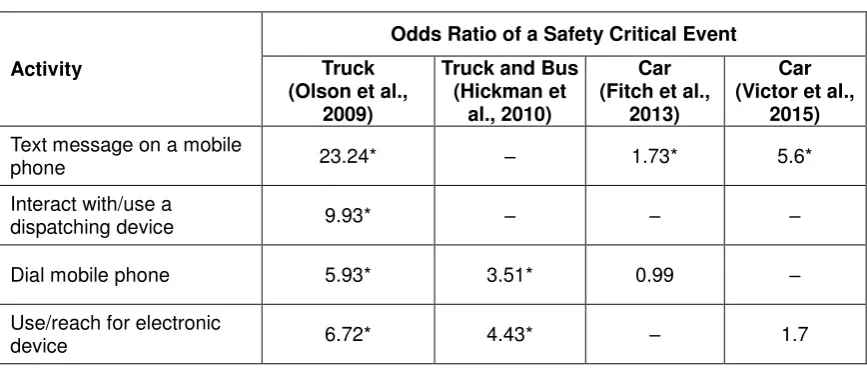
Table 1: Odds ratios of a safety critical event from various naturalistic studies (visual and visual-manual tasks)
Activity
Odds Ratio of a Safety Critical Event
Truck (Olson et al.,
2009)
Truck and Bus (Hickman et
al., 2010)
Car (Fitch et al.,
2013)
Car (Victor et al.,
2015)
Text message on a mobile
phone 23.24* – 1.73* 5.6*
Interact with/use a
dispatching device 9.93* – – –
Dial mobile phone 5.93* 3.51* 0.99 –
Use/reach for electronic
device 6.72* 4.43* – 1.7
* indicates statistically significant.
The analysis in the various studies has generally been restricted to forward events and frontal collisions. It is no pure happenstance that naturalistic studies have focused on forward events and in particular on interactions with a lead vehicle. The data acquisition systems (DAS) used have hardware that makes the forward road scene and interaction with a leading vehicle particularly salient. A radar provides time headway and time-to-collision metrics while one or more cameras provide the forward view. It follows that identification of events and video analysis of interactions and events in NDS has been concentrated on what is happening in front of the vehicle and neglected other types of interactions and conflicts.
Cognitive distraction
Simulator studies
As for visual distraction, studies carried out on driving simulators have generally found negative impacts from cognitive distraction. The studies are numerous. Jamson and Merat (2005) found that cognitive distraction, in the form of an auditory memory task, led to improved lateral control as indicated by a reduction in lane position variation and a deterioration in longitudinal control, with a smaller time-to-collision when the lead vehicle decelerated.
Strayer and Johnston (2001) investigated the effect of cognitive load on traffic light detection and on vehicle tracking. However the apparatus used was not a full driving simulator but rather a joystick controlled tracking task They found that conversation on a mobile phone led to an poorer response to road signs and an increase in missed traffic signals. A complex word generation task was associated with a deterioration in control during more difficult tracking.
Parkes et al. (2007) looked at simulator driving under four conditions — baseline driving, using the radio and the climate control system, conversation with a passenger and conversation over a hands-free mobile phone. They found all the forms of distraction both led to poorer detection of signs, with the worst performance for the hand-free conversations. But the conversations also led to a reduction in lateral variation, i.e. to an improvement in lane-keeping.
In a similar manner, Drews et al. (2008), compared driving without distraction, conversation on a hands-free mobile phone and conversation with a passenger. The two-types of conversation were a between-subjects factor. They examined impacts on all three levels of the driving task —
vehicle control, the tactical level (here in the form of car following) and navigation. They found more lane drift and a larger following distance with the mobile phone conversation than with passenger communication. The strategic task focused on participants’ ability to follow a series of
Some simulator studies have investigated the impact of distraction on more complex aspects of
the driving task. Horrey and Simons (2007) looked at both “steady-state driving” and “more tactical driving” in which drivers had to make overtaking manoeuvres in the presence of traffic in the faster lane. Cognitive distraction consisted of a serial subtraction task. They found that, while drivers increased their headway with the secondary task conditions in steady-state car following, they did not increase their safety margins during manoeuvres, such as overtaking. Indeed they tended to pull in closer to the lead vehicle. They tended to brake more frequently, which the authors attributed to delayed recognition of changes in the traffic situation.
Medeiros-Ward et al. (2014) examined the impact of cognitive distraction in the form of two levels of a numerical task on both simple lane-keeping and the more demanding task of
maintaining lane position in the face of wind gusts. They found that participants’ performance in
maintaining lateral position improved with distraction in the simple driving task but deteriorated in the more difficult driving task. To explain this, they drew on hierarchical control theory, presuming that, with the withdrawal of cognitive attention, performance in low-level (i.e.
automated) tasks would improve, but performance in higher-level tasks, which require cognitive resources, would be degraded. The paper does not report any eye movement analysis.
Real world studies
Some real-world studies, carried out using an experimental approach, have confirmed the findings of the simulator studies and found interference effects of cognitive distraction on driving performance. Anttila and Luoma (2005) used a test vehicle and in-vehicle human observer to assess the effect of distraction on driving performance and behaviour. The cognitive distraction was in the form of an auditory memory task. They found that with cognitive distraction there was an increase in inappropriate speed on the approach to intersections which had zebra crossings, as compared to baseline driving. There was a tendency for the problem to increase with higher cognitive task demand. They also noted a very substantial increase in the breakdown of interactions with pedestrians using one of the zebra crossings: the proportion of problem interactions rose from 25% in the baseline to 53% with the cognitive task. There was no
increase at another crossing, but there was a change in problem interaction types towards more severe breakdowns in which one or other participant was forced to stop.
Patten et al. (2004) used drives in an instrumented vehicle on a motorway route to assess the impact of phone use on driver workload. Performance on the peripheral detection task (PDT) was used as the measure of mental workload. All the participants were professional drivers. There were three types of task: no conversation, simple conversation and complex
conversation. The complex conversation involved both memory and mental arithmetic, while the simple task involved recall of a single digit number. There was no effect of handheld versus hands-free usage. However, conversation significantly affected reaction time to the PDT task, with reaction time increasing with task difficulty. There was an increase of 45 percent in the complex task situations as compared to no task. The authors concluded that there was a potentially serious impact on information processing: “the driver engaged in a complex conversation is appreciably less likely to detect changes in his/her traffic (road and vehicle) environment.”
Bauman et al. (2009) conducted drives in an instrumented car along a fixed route with two groups of participants: middle-aged drivers aged 30 to 45 and older drivers aged above 65. At certain times on the drive, the participants were asked to perform a mental arithmetic task (serial subtraction) while driving. An in-vehicle observer rated the drivers on their errors in car following and performing manoeuvres such as approaching a lead car and overtaking. Performance of the secondary task was associated with a small increase in incorrectly performed overtaking manoeuvres for the middle-aged drivers, but not for the older drivers who generally drove more cautiously.
Harbluk et al. (2007) observed drivers on a city route in Canada under three conditions —
baseline driving, driving with an easy cognitive task and driving with a difficult cognitive task. The easy task was the addition of two single-digit numbers; the difficult task was the addition of two double-digit numbers. The cognitive task was carried out by conversation on a hands-free mobile phone. Eye tracking and vehicle data were recorded. In general, the effects were much stronger for the difficult task. Increased cognitive demand resulted in greater gaze
instruments, with two of the twenty-one drivers completely neglecting these mirrors and instruments with the difficult task. On the approach to and when driving through intersections, the participants drivers made fewer checking glances to traffic lights when carrying out the secondary task as compared to the baseline condition. Some drivers failed to check at all in the
difficult condition. Drivers’ scanning of intersection areas to the right was also reduced. Hard brakings increased with task difficulty, which the authors attributed to delayed processing of information from outside. The authors found the degraded performance at intersection to be of particular concern. They also discussed previous studies which had shown that lane keeping
was not affected, or even improved, by cognitive load: “From a safety perspective, the detection
of events in the environment may be even more important than maintaining an ideal lane
position.”
In sum, these studies point to the potential of cognitive distraction to have negative impacts at the manoeuvring level of driving and particularly in intersection negotiation and in interaction with vulnerable road users. A reasonable interpretation might be that cognitive distraction is particularly problematic when driving task demand is relatively high and when drivers have to make judgements about whether to slow down and/or change path and about the best choice in interactions with other road users. In those interactions, there is often a need for implicit or explicit communication of intentions, and it would not be surprising to see a breakdown in such communication under cognitive load.
One significant accident-based study lends credence to the proposition that cognitive distraction has negative consequences for driver performance in manoeuvring, particularly at intersections. Neyens and Boyle (2007) carried out accident modelling on a nationally representative sample of U.S. accidents involving teenage drivers of passenger vehicles (cars and light trucks) occurring in 2003. Only cases in which the teenager was driving the striking vehicle were included. The dependent variable was crash type and independent variables were the contributory factors coded. Unfortunately the accident data used did not distinguish between activities on a mobile phone such as dialling, texting and having a conversation. In this study, cognitive distraction was defined as “looked but did not see” and being “lost in thought”. Mobile
phone use increased the probability of hitting a fixed object (presumably related to path
deviations). Cognitive distraction was found to affect accident type, with drivers for whom it was coded being more likely to be involved in a rear-end crash than in a collision with a fixed object or an angular collision. Drivers who were cognitively distracted at an intersection were more likely to be involved in a rear-end or angular collision as opposed to a collision with a fixed object. On urban roads, cognitively distracted drivers were twice as likely to be involved in a rear-end collision as opposed to an angular collision. The authors point out that, on such roads, angular collisions are typically related to poor-lane keeping.
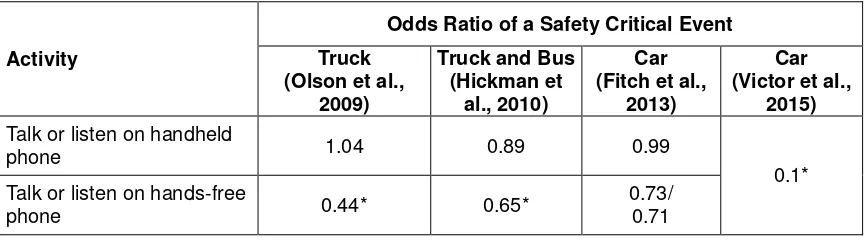
Table 2: Odds ratios of a safety critical event from various naturalistic studies (cognitive tasks)
Activity
Odds Ratio of a Safety Critical Event
Truck (Olson et al.,
2009)
Truck and Bus (Hickman et
al., 2010)
Car (Fitch et al.,
2013)
Car (Victor et al.,
2015)
Talk or listen on handheld
phone 1.04 0.89 0.99
0.1* Talk or listen on hands-free
phone 0.44* 0.65*
0.73/ 0.71
* indicates statistically significant.
That having a conversation on a mobile phone might be less risky than has been found in experimental studies could be due to self-regulation, i.e. to drivers being sensible about when to initiate or accept a phone call. However, a protective effect of the order of that estimated by Victor et al. (2015) cannot be explained by self-regulation. It can also be noted that this estimation is for handheld and hands-free combined, and therefore relates to all driver conversations on devices.
The report discusses three possible hypotheses for the protective effect of conversation on a mobile phone. The first is the potentially arousing effect of such conversation and therefore its role in maintaining alertness and counteracting fatigue. That proposition has been made for the studies of driving large vehicles carried out by Olson et al. (2009 and Hickman et al. (2010). But Victor et al.(2010) discount this explanation on the grounds that, in their study of light vehicle driving, drowsiness was rarely encountered in either baseline driving or in events.
The second hypothesis is that the gaze concentration induced by cognitive load and the
consequent focus on the forward scene leads to a greater chance of detecting a sudden closing with the lead vehicle. This gaze concentration has been observed in a number of simulator studies (e.g. Victor et al., 2005) and in real-road studies (e.g. Victor, 2005; Victor and Dozza, 2011). It can be viewed as an autonomic response to the cognitive load of the conversation.
The third hypothesis is task displacement: it is not generally feasible to carry out two distracting activities simultaneously and phone conversation therefore suppresses any possibility of engaging in other more risky activities such as texting. Victor et al. (2015) extend this task displacement to a proposition of glance displacement: while a conversation is being conducted on a mobile phone, there are comparatively few glances away from safety-relevant scanning. Drivers still consult their mirrors and peripheral areas in the windscreen, and while doing so may still be capable of peripheral detection of the looming of the lead vehicle. However, from their data, the size of this effect looks to be rather small.
Thus cognitive distraction may not interfere with detection of looming; indeed it may enhance detection by promoting gazes at angles from which the looming of the lead vehicle is more likely to be registered. Other research reinforces the notion that cognitive distraction will not interfere with the response to looming. Humans, like other zoological organisms with vision, are hard-wired to detect and respond to the stimulus from a looming object at the instinctive level. Such response to threat does not require any significant mental resource because no judgement of the situation is required. Hence even when loaded by the distraction task, drivers are able to respond to the lead vehicle decelerating. Indeed that ability to detect and therefor respond may well be enhanced by the distraction, since the chance of perceiving the looming is enhanced by the gaze concentration effect. The instinctive human response to an imminent crash has been found in both simulator and real-world studies (McGehee and Carsten, 2010).
Nothing found so far in the naturalistic studies would lead to any rejection of the hypothesis that cognitive distraction interferes with the information processing that is crucial to successful performance in the manoeuvring level of driving. That poorer performance has been shown to manifest itself in poorer traffic signal detection, in less safety-related visual scanning at
EXTRAPOLATION FROM SAFETY CRITICAL EVENTS TO
ACCIDENTS
The major safety indicator in naturalistic studies has been the number of safety critical events. Candidate events are selected by triggers from sensors and video analysis is used to confirm and interpret. Among those events have been a very small number of low-severity crashes. Injury-level crashes are simply too rare to be analysed with NDS. But of course damage-only crashes have very different distributions from injury crashes – they are typically rear-end shunts (i.e. forward events) and collisions in parking. Policy-makers and safety professionals worldwide have little interest in damage-only collisions. The focus is on injury crashes, particularly those involving serious injury. Among crash types, some of the most likely to result in severe injury or fatality are single-vehicle road departure crashes and intersection collisions. Analysis of data from the UK on-the-spot in-depth accident studies indicates that for car drivers there is a 50 percent probability of death at a Delta V of 76 km/h in frontal impacts and at a Delta V of 54 km/h in side impacts. Thus occupant protection is far less effective in side collisions than in frontal collisions (Richards, 2010). High-speed collisions at rural intersections tend to be particularly severe. In their modelling of the factors affecting crash risk on rural
single-carriageway roads in Great Britain, Taylor et al. (2002) found that at junctions accident risk went up with proportionate changes in the mean speed of the main-road traffic to the fifth power. Here, the crashes tend to be high-speed side impacts, which result in intrusion into the vehicle with a high probability of inflicting serious injury or fatality on the occupants.
As a consequence and also because conflicting manoeuvres are more likely at intersections, in many countries intersection crashes account for a very substantial proportion of the total number of injury accidents. In Great Britain in 2013 junction accidents constituted 61 percent of all injury accidents (Department for Transport, 2014)
Yet the group of events related to potential side strikes is one that the naturalistic driving studies tend to ignore, not out of an intentional desire to omit them, but rather because the Data
Acquisition Systems used are not capable of capturing them. Also omitted are collisions with vulnerable road users — pedestrians, cyclists and motorcyclists. In Great Britain in 2013, collisions between a motor vehicle and a pedestrian constituted 21 percent of fatal accidents.
The focus on forward events has the potential to provide misleading results if any
generalisations are made from naturalistic studies to a set of overall implications for road safety, including of the relationship between distraction and risk. In addition, as has been pointed out by Knipling (2015), there are no theoretical grounds to believe that it is appropriate in the analysis of naturalistic data to mix together safety critical events of differing configurations, nor to believe that the relationship between SCE distributions and crashes found for damage-only accidents will hold for injury accidents. Naturalistic studies have lacked the series of validation studies that were carried for analysing safety at intersections and other specific locations, using static observers to register traffic conflicts (e.g. Grayson et al., 1984; Hyden, 1987; Archer, 2005; Svensson and Hyden, 2006). These studies focused in particular on the relationship between traffic conflicts and injury accidents. This is very important in policy terms, because we want to target safety remedies on the reduction of injury accidents and especially the more severe ones. Learning incorrectly from low-severity events could lead to misallocation of resources.
CONCLUSIONS
There is a strong possibility that the finding from the naturalistic studies that conversation on mobile phones is protective is spurious in that it cannot be generalised to an overall safety effect. The studies have suffered from their own form of gaze concentration and focused almost entirely on forward events of rather low severity. That such incidents may indeed be reduced as a by-product of cognitive distraction is entirely plausible. But the studies have not been able to demonstrate any relationship between their major dependent measure, safety critical events, and injury crashes. And they have probably been blind to the most serious impacts of cognitive distraction in terms of information processing capability. It can be surmised that the increased workload potentially involved in a conversation on a mobile phone can lead to poorer
is quite likely that conversing on mobile phones reduces low-severity rear-end events, but leads to an increase in far more serious events involving interactions with other traffic at intersections and interactions with vulnerable road users.
REFERENCES
Anttila, V. and Luoma, J. (2005). Surrogate in-vehicle information systems and driver behaviour in an urban environment: a field study .n the effects of visual and cognitive load. Transportation Research Part F, 8(2): 147-166.
Archer, J. (2005). Indicators for traffic safety assessment and prediction and their application in micro-simulation modelling: a study of urban and suburban intersections. PhD thesis, Royal Institute of Technology, Stockholm, Sweden.
Baumann, M., Briest, S. and Knake-Langhorst, S. (2009). Cognitive distraction and drivers’
adaptation in different in real traffic: steady-state car-following vs. overtaking manoeuvres. Proceedings of the 1st International Conference on Driver Distraction and Inattention, Gothenburg, Sweden, 28-29 September.
Burns, P.C., Parkes, A., Burton, S., Smith. R.K. and Burch, D. (2002). How dangerous is driving with a mobile phone? Benchmarking the impairment to alcohol. Report TRL547, TRL,
Crowthorne, UK.
Carsten, O., Kircher, K. and Jamson, S. (2013). Vehicle-based studies of driving in the real world: the hard truth? Accident Analysis and Prevention, 58: 162-174.
Department for Transport (2010). Mobile phone use by drivers: 2009 survey results for England. Department for Transport, London.
Department for Transport (2014). Reported road casualties Great Britain 2013. Department for Transport, London.
Department for Transport (2015). Seat belt and mobile phone use surveys: England and Scotland, 2014. Statistical Release. Department for Transport, London.
Drews, F.A., Pasupathi, M. and Strayer, D.L. (2008). Passenger and cell phone conversations in simulated driving. Journal of Experimental Psychology: Applied, 14(4): 392-400.
Fitch, G.M., Soccolich, S.A., Guo, F., McClafferty, J., Fang,Y., Olson, R.L., Perez, M.A.,
Hanowski, R.J., Hankey, J.M. and Dingus, T.A. (2013). The impact of hand-held and hands-free cell phone use on driving performance and safety-critical event risk. Report No. DOT HS 811 757. National Highway Traffic Safety Administration, U.S. Department of Transportation, Washington, D.C.
Grayson, G.B., Hydén, C., Kraay, J.H., Muhlrad, N. and Oppe, S. (1984). The Malmö study: a calibration of traffic conflict techniques. Institute for Road safety Research (SWOV),
Leidschendam, The Netherlands.
Harbluk, J.L., Noy, Y.I., Trbovich, P.L. and Eizenman, M. (2007). An on-road assessment of
cognitive distraction: impacts on drivers’ visual behavior and braking performance. Accident Analysis and Prevention, 39(2): 372-379.
Hickman, J.S., Hanowski, R.J. and Bocanegra, J. (2010). Distraction in commercial trucks and buses: assessing prevalence and risk in conjunction with crashes and near-crashes. Report No. FMCSA-RRR-10-049, Federal Motor Carrier Safety Administration, U.S. Department of
Transportation, Washington, D.C.
Hydén, C. (1987). The Development of a Method for Traffic Safety Evaluation: The Swedish traffic conflicts technique. Bulletin 70, Department of Traffic Planning and Engineering, Lund University, Sweden.
Jamson, A.H. and Merat, N. (2005). Surrogate in-vehicle information systems and driver behaviour: Effects of visual and cognitive load in simulated rural driving. Transportation Research Part F, 8(2): 79-96.
Janitzek, T., Brenck, A., Jamson, S., Carsten, O. and Eksler, V. (2010). Study on the regulatory situation in the member states regarding brought-in (i.e. nomadic) devices and their use in vehicles: final report. European Commission, Directorate-General for Communications Networks, Content and Technology, Brussels, Belgium.
Kidd, D.G. and McCartt, A.T. (2012). Review of “Cell phone use and crash risk: evidence for
positive bias” by Richard A. Young. Insurance Institute for Highway Safety, Arlington, Virginia.
Kircher, K., Patten, C. and Ahlström, C. (2011). Mobile telephones and other communication devices and their impact on traffic safety: a review of the literature. VTI rapport 729A, VTI, Linköping, Sweden.
Knipling, R.R. (2015). Naturalistic driving events: no harm, no foul, no validity. Proceedings of the Eighth International Driving Symposium on Human Factors in Driver Assessment, Training and Vehicle Design.
LaHood, R. (2012). http://www.donttextanddrive.org/a-message-from-secretary-lahood/. Accessed 14 July 2015.
McEvoy, S.P., Stevenson, M.R., McCartt, A.T., Woodward, M., Haworth, C., Palamara, P. and Cercarelli, R. (2005). Role of mobile phones in motor vehicle crashes resulting in hospital attendance: a case-crossover study. British Medical Journal, 331(7514): 428-430.
McGehee, D.V. and Carsten, O.M.J. (2010). Perception and biodynamics in unalerted precrash response. Annals of Advances in Automotive Medicine, 54: 315-32.
Medeiros-Ward, N., Cooper, J.M. and Strayer, D.L. (2014). Hierarchical control and driving. Journal of Experimental Psychology: General, 143(3): 953-958.
Neyens, D.M. and Boyle, L.N. (2007). The effect of distractions on the crash types of teenage drivers. Accident Analysis and Prevention, 39(1): 206-212.
NHTSA (2015a). Distracted driving 2013. Traffic Safety Facts, Research Note. DOT HS 812 132. National Highway Traffic Safety Administration, U.S. Department of Transportation, Washington, D.C.
NHTSA (2015b). Driver electronic device use in 2013. Traffic Safety Facts, Research Note. DOT HS 812 114. National Highway Traffic Safety Administration, U.S. Department of Transportation, Washington, D.C.
Olson, R.L., Hanowski, R.J., Hickman, J.S. and Bocanegra, J. (2009). Driver distraction in commercial vehicle operations. Report no. FMCSA-RRR-09-042. Federal Motor Carrier Safety Administration, U.S. Department of Transportation, Washington, D.C.
Parkes, A.M., Luke, T., Burns, P.C. and Lansdown, T. (2007). Conversations in cars: the relative hazards of mobile phone. Report TRL664, TRL, Crowthorne, UK.
Patten, C.J.D., Kircher, A., Östlund, J. and Nilsson, L. (2004). Using mobile telephones: cognitive workload and attention resource allocation, Accident Analysis and Prevention, 36(3):341-350.
Reed, N. and Robbins, R. (2008). The effect of text messaging on driver behaviour: a simulator study. Report PPR367, TRL, Crowthorne, UK.
Richards, D.C. (2010). Relationship between speed and risk of fatal injury: pedestrians and car occupants. Road Safety Web Publication No. 16, Department for Transport, London.
Strayer, D.L. and Johnston, W.A. (2001). Driven to distraction: dual tasks studies of simulated driving and conversing on a cellular telephone. Psychological Science, 12(6):.462-466.
Strayer, D.L. and Drews, F.A. (2007). Cell-phone-induced driver distraction. Current Directions in Psychological Science, 16(3): 128-131.
Strayer, D.L. and Johnston, W.A. (2001). Driven to distraction: dual tasks studies of simulated driving and conversing on a cellular telephone. Psychological Science, 12(6): 462-466.
Svensson, A. and Hyden, C. (2006). Estimating the severity of safety related behaviour. Accident Analysis and Prevention, 38(2): 379-385
Taylor, M.C., Baruya, A. and Kennedy, J.V. (2002). The relationship between speed and accidents on rural single-carriageway roads. TRL Report 511, TRL Limited, Crowthorne, UK.
Victor, T. (2005). Keeping eye and mind on the road. PhD thesis, Uppsala University, Sweden.
Victor, T. and Dozza, M. (2011). Timing matters: visual behaviour and crash risk in the 100 car on line data. Proceedings of the 2nd International Conference on Driver Distraction and Inattention, Gothenburg, Sweden, 5-7 September.
Victor, T., Dozza, M., Bärgman, J., Boda, C-N., Engström, J., Flannagan, C., Lee, J.D. and Markkula, M. (2015). Analysis of naturalistic driving study data: safer glances, driver inattention, and crash risk. SHRP 2 Report S2-S08A-RW-1. The Second Strategic Highway Research Program. Transportation Research Board, Washington, D.C.
Victor, T., Harbluk, J.L. and Engström, J. (2005). Sensitivity of eye movement measures to in-vehicle task difficulty: findings from HASTE. Transportation Research Part F, 8(2):167-190.
Virginia Tech Transportation Institute (2009). New data from VTTI provides insight into cell phone use and driving distraction. Press release, 27 July. Blacksburg, Virginia.
Young, R.A. (2012). Cell phone use and crash risk: evidence for positive bias. Epidemiology, 23(1): 116-118.
AUTHOR BIOGRAPHIES
Oliver Carsten is Professor of Transport Safety at the Institute for Transport Studies, University of Leeds. His major research focus is on driver interaction and safety with new driver support systems. He led the UK national project on Intelligent Speed Adaptation and chairs the Road User Behaviour Working Party of PACTS, the Parliamentary Advisory Council for Transport Safety. He has provided advice on safety policy to the UK Department for Transport and the European Transport Safety Council. He is editor-in-chief of the academic journal Cognition, Technology and Work.
Natasha Merat is an Associate Professor at the Institute for Transport Studies, University of Leeds. She has a background in Psychology and her research interests relate to understanding the interaction of drivers with new technologies in and out of the vehicle. She uses the
University of Leeds Driving Simulator for most of her research and is particularly interested in understanding how driver distraction affects driving performance and also in studying the human factors implications of vehicle automation.
The Author allows ARRB Group Ltd to publish the work/s submitted for the 9th Austroads Bridge
Conference, granting ARRB the non-exclusive right to:
• publish the work in printed format
• publish the work in electronic format
• publish the work online.
The Author retains the right to use their work, illustrations (line art, photographs, figures, plates) and research data in their own future works
The Author warrants that they are entitled to deal with the Intellectual Property Rights in the works