Information Market
ISSN 0256-5066Marc
he
de l'Inf ormation
Informationsmarkt
Mercado de la Inf ormaci6n
Commission ofthe European Communities.
The E_uropean electronic information services market will see its turnover grow from 1000 million ECU today to 10 OOO million ECU m 10 years - an annual growth rate of 20 to 30 % .
IN THIS ISSUE
ECHO direct call . . . p 3
Eusidic user report . . p 5
Telecoms Green Paper p 6
Screens and your
health . . . . . . . . p 8
lnf
ormation
Market
Inventory
When Robert Schuman
be-came Minister of Finance of
Fie~ in 1946, the country • a parlous state. One of Ji. rst actions was to call for
an Inventory of the state of the economy.
Without all the facts and a
deep analysis of the situation
it is difficult to see how a sit-uation can be improved. The Schuman Inventory be-came a comprehensive gauge
of the financial state of the nation and an indispensable instrument for action by pub-lic servants. Schuman's pro-posal for the creation of a
Eu-ropean Community founded initially on coal and steel was a bold initiative. It was also
based on a careful analysis of the economic dangers of closed national markets and consequent political
upheav-als. ·
In suggesting that the Euro-pean Community have relia-ble macro-economic data on
the state of the European in-formation market, the Euro-pean Commission is now tak-ing a valuable first step in reg-ulating and encouraging a
sin-•
European market. The
ean information mar-Kc bservatory charged with this task should also provide a critical sounding board to move the industry in a direc-tion which will ensure its long term financial vitality.
Info services market by 1992
Commission launches
services action plan
·l·
·
IWRARY
! - ~
.
.
, ·
nuorma on
The establishment of a
Euro-pean internal information se rv-ices market by 1992 is one of four goals announced in a pro-posed action plan that the
Commission sent on 22 July to Council for decision. An -nouncing the proposal, Com -mission Vice President Karl-Heinz Narjes said that a major
effort was needed to help
Eu-rope catch up with its interna-tional competitors, USA and Japan. In Europe only 30 %
of databases were operated by
the private sector. Europeans
needed both better access to information and better infor-mation security.
The proposed action plan (1)
is the fruit of extensive studies and wide spread consultations with Senior Officials of Mem-ber States, Information
Serv-ice Providers and Informa -tion Service Users (see IM 47 and 48).
The three other goals of the proposed plan involve:
the stimulation and
rein-forcement of the
competi-tive capability of Euro-pean information service suppliers
the promotion of the use
of advanced information
services in the Commu -nity
and the reinforcement of joint efforts to achieve the internal and external co-hesion of the Community with respect to informa-tion services.
The task is not an easy one. Problems are complex and in-continued on page 2
Vice-President of the Commission Karl-Heinz Narjes calls for a single European information market.
Commission calls
for
ideas
for new
info services
A small number of large scale pilot or demonstration pro-jects could provide the
neces-sary break through in quality,
performance and easy use of advanced information sys-tems to demonstrate the po-tential of a single European information market.
The European Commission (DG XIII) is therefore calling for declarations of interest from firms, information pro-viders or associations with the aim of creating new services for the European professional working environment. Close cooperation between partners with similar interests will be encouraged. (1)
Some 10 to 20 million ECU is expected to be made available
to support the development of these projects.
Following intensive
discus-sions with three groups com-posed respectively of national officials, information service
providers and users, key as-pects of the demonstration projects have been defined. They should involve large projects with a big impact on a
specific market group. The
projects should answer the needs of widely-based poten-tial user groups and demon-strate commercial viability using existing infrastructures. Easy to ·use systems, with a
2
Un Plan d' Action pour le developpement d'un
marche des services d'inf ormation
La Commission vient de pro-poser un plan d'action ayant
pour but de stimuler le de-veloppement d'un marche
eu-ropeen des services d' infor-mation (1). Ce plan est le
re-sultat d'une serie d'etudes et
de consultations menees avec
Jes fournisseurs et utilisateurs de services d'information ain-si qu'avec Jes representa1_1ts des administrations nat10-nales,
a
la suite de !'adoptionen novembre 1985 d'un
pro-gramme de travail pour la creation d'un marche com-mun de !'information. La
Commission a defini quatre
objectifs principaux qu'elle considere comme une partie integrante de )'effort general
pour la construction du marche europeen:
mettre en place un marche interieur des services d' in-formation,
stimuler et renforcer la
ca-pacite d'offre competitive
des fournisseurs
euro-peens,
promouvoir )'utilisation
de nouveaux services
avances d'information dans la Communaute, renforcer la solidarite et la cohesion interne et
ex-terne de la Communaute en matiere de services
d'information.
Pour progresser avec la tlexi-bilite necessaire, la Commis-sion a defini un plan d'action
a
mettre en oeuvre en deux
etapes, la premiere, d'une duree de deux ans, constitue une phase de lancement, avec
un budget de 15 millions d'Ecus pour l'annee 1989 et
de 20 millions d'Ecus pour l'annee 1990. Elle permettra
Kommission beginnt neues
Fachinformationsprogramm
Der Aufbau eines Marktes ftireuropaische Informations-dienste ist eines von vier Zie-len, die die Kommission in ei-nem Entwurf eines Aktions-planes dargestellt hat, den sie
am 22. Juli dem Ministerrat zur Entscheidung libermittelt hat.
Bei der Vorstellung dieses Vorschlages betonte der Kommissions-Vizeprasident Karl-Heinz Narjes, daB eine gro8e gemeinsame Anstren-gung potwendig sei, damit Europa mit seinen inter-nationalen Wettbewerbern, USA und Japan, Schritt hal-ten konne. In Europa wiirden nur 30 % der Datenbanken von der Privatwirtschaft be-trieben.
Der vorgeschlagene Aktions-plan (1) ist das Ergebnis
aus-giebiger Studien und
intensi-ver Gesprache mit den Mit-gliedern der Gruppe Hoherer Beamten der Mitgliedsstaa-ten, mit Informationsanbie-tern und Nutzer angebotener Informationsdienste (ver-gleiche IM 47 und 48). Die drei anderen Ziele des vorgeschlagenen Planes sind: Anreiz ftir und Starkung der Wettbewerbsfahigkeit der europaischen Infor-mationsanbieter
Werbung ftir die Nutzung von Informationsdiensten hoher Qualitat
sowie die Starkung der ge-meinsamen Ans~rengun-gen, um die interne und externe Zusammenarbeit der Gemeinschaft im Be-reich der Informations-dienste zu erreichen.
(1) Dokument KOM (87) 360
Information Market Marche de !'Information Informationsmarkt
Mercado de la Informaci6n
Pubhshe<I by Oirectorale General XIU
Commission ol
the European Communues.
-·
~
r
~
DIAl1£ nEWS This newsletter (formerly Euronet News) is published bythe Directorate General for Telecommunications, Information
Industries and Innovation, Commission of the European Communities, Luxembourg, and is available on request from the address given here. It is published as a special supplement to Euroabstracts. Reproduction is authorised, but the CEC is not responsible for the use which might be made of the information. Editor: David J. Price.
Luxembourg. ISSN 0256-5066
Comments and inquiries to: Con1mentaires et renseignements 0: Fragen und Bemerkungen an:
INFORMATION MARKET No. 49
Information Market 177 Route d"Esch
L-1471 Luxembourg Tel.: (352) 48 80 41 Telex: 2181
le developpement d'un cer -tain nombre de grands projets pilotes avec la participation du secteur prive, ainsi que
certaines initiatives pour four-nir des donnees economiques sur ce marche et eliminer Jes
entraves techniques, regle-mentaires et juridiques
a
la libre circulation de)'informa-tion.
La Commission procedera
a
une evaluation des resultatsobtenus au cours de la phase de lancement afin de presen-ter au Conseil des proposi-tions specifiques pour la
pour-suite des differents elements
du plan d'action.
Contacter: M G Davies CEC, DG XIII B L-2920 Luxembourg
Tel: +352 4301 2881
(I) COM(87) 360 final. document de la Commission
SPRINT
The Commission has just pub-lished a Call for Proposals in relation to the newly adopted Strategic Programme for In-novation and Technology Transfer, SPRINT(l). The Call is aimed firstly at encou-raging transnational coopera-tion in Europe between firms, technology transfer institu-tions, industrial research
asso-ciations and similar bodies.
A second theme is to support
the "Europeanisation" of con-ferences and workshops on
new technologies.
The Call will also enable
sup-port to be given to transna-tional activities in the field of Traning in Innovation as well
as other specific action such as
the rejuvenation of mature in-dustries, the introduction of
new technologies in firms and
the promotion of innovation by local authoriities.
Contact: Mr Robin Miege CEC, DG Xlll-C L-2920 Luxembourg
(1) Official Journal No C 196/2
E. P. project
The European Parliament hosted a workshop with
Com-munity journalists on 4 June to study their needs and the potential of a projected
elec-tronic information system. Called EPISTEL, European
Parliament Information Sys-tem by Telephone, the system
would deliver to a portable
computer or word processor the latest news of the Parlia-ment whether from Brussels, Luxembourg or Strashourg.
Action Plan
from page Ivolve legal, fiscal, economic and linguistic barriers as well
as ingrained habits and tradi-tions of competition and sup -ply that have restricted the level and quality of service
that the average European
user can expect.
The Commission suggest. ' the action plan be i -mented in two stages in order to tackle the~<" rrohlems with the necessary flexibility. A two year 35 million ECU pre-paratory phase would cost 15 million during 1989 and 20 million ECU during 1990. Results obtained would ena -ble more specific proposals for the implementation of dif-ferent components of the ac -tion plan to be presented to
Council.
Priority activities during this preparatory phase include t_he
setting up of a European 111-formation market observa-tory to provide intelligence about the market. The
Com-mission would seek ways to eliminate technical, legal and administrative barriers to in-formation flow and at the same time explore ways to im-prove conditions for the trans-mission and accessing of infor-mation services. Ways of creating a greater synergy be-tween public and private sec-tors would also be tackled. A number of pilot an~
monstration projects ~
could stimulate the informa-tion service industry would
also be launched. Among
oth-er areas for special attention
would be the library sector, reinforcement of user support and the promotion of Euro-pean information services, in coordination with Member States.
Contact: Mr G Davies CEC, DGXIII B
L-2920 Luxembourg Tel: +352 43 01 28 81
(1) Commission document COM (87)
360 final
Call for ideas
from page 1approach are deemed
neces-sary for stimulating a Commu-nity-wide information mar-ket.
The Commission is anxious to
gather by 15 October the wi-dest possible range of poten-tially exploitable ideas. The idea would be to launch a call for proposals in the near fu-ture based on such • ground work.
Contact: Mr. Juergen Siebeck DG XIU B CEC, L-2920 Luxembourg
Tel: +352 43014226 (!) Official Journal No C 188:
ECHO breaches 3000
ECHO, the European Com-mission Host Organisation,
now has more than 3200 costomers. We announced the 2 000th customer of ECHO in the March-May issue of IM. But by the time we published,
ECHO users had already
. .
ed 2 600. There is also known number of users
w o access the host using pub-lished passwords, such as DIANEE or IES, or via ga te-ways such as Telecom Gold or DIMDI.
ECHO, which must be one of the fastest growing hosts, of
-fers the public a range of data-bases, many of them aimed at helping the beginner in online
information services.
ECHO staff suspect that they may reach 4000 before 1988!
Contact: ECHO 177 Route d'Esch L-1471 Luxembourg
Tel: +352 48 80 41 Telex: 21 81 Telecom Gold: 72: MAG036
~, r\it
;_ ~
~
to
111~ ~-
1~ ~fii"liHJi111,n,v'.,
~m
*t
~
~t~iJR
-o
1f
~Jf\
U
STIC
H
-9'4-8
A~i~
@M
~
liiJ1,i
i
mtiUPJEC
H
O)
it
i#
q:
'
In the context of the Cooperation Agreement between the People's Republic of China and the European Community, ECHO, was invited to hold a series of ECHO Training Days in Beijing during the month of August. The course was hosted by the Institute of Scientific and Technical Information of China
_C)
.
ECHO
provides direct access
ECHO is now offering itscus-tomers a direct telephone call up number to its services.
Anyone with a computer or other terminal and a modem can now phone direct to Lux-embourg and try out the range
of databases that is on offer
-FREE!
Direct dial access is not the ideal way to access databases. As it usually involves an inter-national telephone call, it can be expensive.
But for those computer users who already have communi-cations software and a mod-em, the service provides an easy way to get the feel of on-line information.
If you have this equipment, all you need to do is dial to Lux-embourg (international code: 352) 43 64 28.
When the ECHO computer
asks you to logon, use one of
our publicly available pass-words in the language which
suits you best. DIANEE in English,
DIANED in German,
DIANEF in French,
DIANEDN in Danish,
DIANENL in Dutch,
DIANEI in Italian,
DIANESP in Spanish, DIANEP in Portuguese. After being accepted, type INFO ECHO to find out what's new on ECHO. Or INFO SEARCH to help you use DIANEGUIDE on other hosts in Europe.
If you have access to a packet switched network, you will find it cheaper to use ECHO's
NUA: 270448112. If you want
access to ECHO's other data-bases, drop us a line and we will send you your own free password.
9MD1
links to
ECHO
Users of the major German
Host, DIMDI, can now access ECHO databases directly as if they were DIMDI databases.
The connection between
Ger-many and Luxembourg is made without the customer being aware of it through the
Commission supported Host-Interconnection protocol.
'
BLAISE-LINE
BRING ORDER!
TOYOUR
INTERLOANS
BLDSC book catalogue now online
The British Library Document Supply Centre is the world's largest library for interlending and document supply. Now its current book catalogue is available on BLAISE-LINE, the British
Library's online system.
Using the database you can streamline and revitalise your interloans. You can confirm the item you require is in stock at BLDSC and make your loan request instantly using BLAISE-LINE'S easy-to-use ORDER! service.
A vast resource
Any book important for businessmen, scientists and researchers can be borrowed from BLDSC. The new database contains more than 250,000 records, with BLDSC shelfmarks, for books published in 1980 or later. Over 90% of these books are in English.
A sure source of supply
The frustrations of speculative interloans work are eliminated. BLAISE-LINE's user-friendly command language makes it simple to check the details of any item. Then you have all the inform-ation you need to make a request to BLDSC. Loan request made quick and easy
ORDER! is BLAISE-LINE's direct link to Boston Spa. Using the service you can cut out postal costs and postal delays. BLDSC process ORDER! requests daily, ensuring your needs are met as soon as possible.
Cost effective
Connect time on BLAISE-LINE costs just 30p per minute(+ VAT). There'safreeprintformatfor checking that the right item has been retrieved, and there are no extra online charges for using ORDER! So its cheap to search on the new BLDSC file, and just as cheap to search the other key databases on BLAISE-LINE- including WHIT AKER (British Books in Print) and UK.MARC, the online version of the British National Bibliography.
For more information, fill in the form below, and return it today. Or ring 01-323 7074.
To: BLAISE-LINE Section, British Library Bibliographic Services
2 Sheraton Street, London Wl V 4BH Please send me information about BLAISE-LINE and the DSC Monographs file
Name and Position Address
Telephone
The British Library
Bibliographic Services
Postcode
INFORMATION MARKET No. 49
4
Present situation
Oatabaae Documentation
DOCDEL fmal report
When the Commission ini-tiated a Call to support ad-vanced electronic document
delivery and electronic pub
-lishing projects under the DOCDEL programme, it was anxious that not to create new technology systems only for
technology sake. A series of
user groups gave feedback on the ten projects and an
eva-luation of such New Data Pro-cessing Techniques (NDPT) was undertaken.
The final report on the
eva-luation of the DOCDEL ex
-periment has been presented by Bureau Marcel Van Dijk.
Projects include · electronic scientific publishing, Mathor, (see this page), scientific do-cument delivery systems, the Invisible College project, the creation of electronic journals for chemistry, the Transdoc electronic document delivery project and the German pat-ent database PATDPA. The report is available from the European Commission.
Contact: Mr Franco Maslroddi CEC, DG XIlliB Jean Monnet Baliment C4/08A
L-2920 Luxembourg Tel: +352 43013020
Future situation
D
Reading committee
INFORMATION MARKET No. 49
I
I I
iNDPT lblack
lbox
I
I
/ / , L - ---
--II
@ ReaderJi':~
@
c.::-:,~'1
~tZc.Y
Imprimer Jes symboles
mathematiques: Mathor
MATHOR est un logiciel qui a pour but d'aider Jes secreta
-riats techniques et Jes auteurs scientifiques. Ce logiciel fait partie du projet DOCDEL le-quel a rec;:u l'appui de la CCE.
MATHOR facilite la
compo-sition de documents
conte-nant des symboles mathemati-ques. Son utilisation reste tou-tefois tres simple: une serie de touches specialisees permet l'affichage directement
a
l'ecran de tous lessymbo-les mathematiques speciaux comme la barre de fraction, la "racine", l"'integrale", l'ecri
-ture en indice, etc.
La signification de chacune de ces touches est en perma-nence indiquee clairement au
bas de l'ecran.
Le logiciel contient un alpha-bet franc;:ais, deux jeux de symboles mathernatiques et
!'alphabet grec en corps nor-mal, petit corps et en italique, ainsi que d'autres alphabets speciaux.
L'empJoi de MATHOR per-met done de reduire d'environ
50 % le cofit du tirage d'une livre en 1 OOO exemplaires.
Conlacler: Novedit Ave du Hoggar
Z I de Courlaboeuf
B p 1l2
F-91944 Les Ulis Cedex Tel: + 33169073688 Telex: 692321 F
Optical Disk
latest
The proceedings of the Joint CEC/Euripa Intensive Work-shop on CD-ROM, held in Luxembourg on 12- 13 Feb-ruary are now available free of charge from the European Commission.It contains an up-to-date de-scription of the technology, new services offered, publish-ers' e,pcriences in implemta
-tion and product development and current reactions as indi
-cated by participant syndi
-cates. Tony Hendley also presents a valuable summary of optical disc technology beyond CD ROM and G Pradere from Philips gives
a. description of CD Int. -t1ve.
Conlacl: Mr Piel Van Velze CEC, DGXIII/B Jean Monnet Batiment B4/06
L-2920 Luxembourg Tel: +352 4301 2870
Chinesisches Worterbuch
1!!1/liEPJi!J aoban yinshua TIEFDRUCK GRAVURE PROCESS
/li,u banxin SATZSPIEGEL
PRINTING AREA
!Iii*
banben AUFLAGE EDITION
Midasta ist ein elektronisches
Worterbuch oder eine Terrni -nologie-Datenbank, die auch fUr Ubersetzungen einsetzbar ist. Entwickelt von der Gesell -schaft flir Information und Dokurnentation (GID), kann
Mida_sta eingesetzt werden, urn Aquivalente der Fachter-rninologie in drei Sprachen
- Deutsch, Englisch und
Chinesisch - anzubieten.
Man kann es aber auch benut
-zen als ein bequemes Werk
-zeug zur Bearbeitung und Modifikation eines Fachwor-terbuches, urn zu jeder Zeit
neue Begriffe hinzuzufligen oder zum elektronischen Pu
-blizieren von FachterminoJo
-gie. Maschinenlesbarer W.ort
-schatz flir autornatische Uber-setzung der Fachliteratur ist
eine weitere Nutzung flir die -se Datenbank-Software.
Als Geratskonfiguration be-notigt Midasta einen Perso
-nal-Computer in Verbindung mit einer Elektronischen Schreibrnaschine Olympia 1011, die als Drucker dient. Dieses Gerat hat einen·
-chensatz mit chinesi.
Schriftzeichen.
Kontakt: Yu Yong Yuan GID
Pica Host, pick a book!
Pergamon gateways to IRS
•
As an extension of its library automation activities in the area of shared catalogue and interlibrary loans, Pica, Cen-trum voor Bibliotheekauto-matisering, are now offering four databases to the public.
TACO, contains references to journal articles of general in-terest for public library users.
GLIN offers grey literature of
GBI - klein,
aber oho!
)atschsprachige betriebs-.chaftliche Information war bis vor einigen Jahren nicht verfugbar. Diese Lucke erkannten die Grunder der Gesellschaft fur
betriebswirt-schaftliche Information
(GBI). Sie begannen mit der Datenbank Bliss (Betriebs-wirtschaftliche Literatursuch-system), die inzwischen nun fast 85 OOO Dokumente hat. Hierzu kamen im Laufe der Zeit Manex (Management-Experten-Nachweis),
Semi-kon (Betriebswirtschaftliche Seminare und Konferenzen),
Progno (Prognosen), Finf
(Kennzahlen und Jahresab-schliisse von Unternehmen) und Hadoss (Online-Version der Nachweise des Hambur-ger Weltwirtschaftsarchivs mit Online Ordering).
Die GBI ist aber nicht nur Da-tenbank-Produzent, sondern selbst auch Host. Dabei wird das einfache deutschsprachige Retrievalsystem Sudok einge-setzt, welches die GBI selbst entwickelt hat. Die Daten-banken Bliss und Manex wer-den auch bei den Hosts FIZ
tik
und GENIOS ange-Kontakt: GBIDr. Peter Miiller-Bader Postfach 80 07 23 D-8000 Miinchen 80 Tel: +49 89 4 48 28 04
government and scientific in-stitutions. A VM relates to au-diovisual material for general and educational purposes.
NBLC-V AKBIB is a profes-sional library on library and information science. A uni-que feature of this is that the source documents - multil-ingual books, reports and au-diovisual material - can be borrowed free of charge, from the rrofessional library.
Contact: Pica Host PO Box 904U NL-2509 LK The Hague Tel: +31 70 14 04 60
Onliners who logon to Perga-mon Infoline to check any of its 60 databases, now have a choice of around 200 more. Gateway connection have now been made to ESA IRS in Italy as well as the recent link to BRS in the US. The 140 BRS files cover medicine and pharmacology, physical and applied sciences, the life sciences, business, education and the social sciences and hu-manities.
No additional password is re-quired and Infoline customers receive just one bill, regard-less of where they have searched. The gateway has been created as part of the European Host Network pro-gramme and the standardised interchange protocol received support from the European Commission.
Contact: Pergamon Infoline 12 Vandy Street London EC2A 2DE Tel: +44 1 377 4650
Community documents by
SCAD
The Commission databank, SCAD, contains bibliographi-cal references to principal Community Acts (including a retrospective review of their development from Commis-sion proposal stage), resolu-tions and advice of the Euro-pean Parliament and Commu-nity legislation published in Series L of the Official Jour-nal. A list of keywords in French can be consulted and
references are in English and French.
Other publications and public documents issued by Euro -pean institutions and selected articles from periodicals in their original languages are also available.
Contact: CEC DG IX/E/3 JECL 1/103 200 Rue de la Loi B-1049 Brussels Tel: +32 235 9007
*
Europe's leading Business Information database
*
Data on Companies, Products, Industries,
Economics, Public Affairs
*
International coverage (sources from Europe,
America, Middle East, Far East etc.)
*
Extensive indexing
*
Easy-to-use command language
Recently added databases:
BANKING & FINANCE, PROPERTY, INSURANCE & INVESTMENT
ELECTRONICS & COMPUTING, MARKETING, RETAILING, ACCOUNTANCY & TAX
If you are using a data transmission network, just complete and return this coupon to Finsbury Data Services and you will be sent instructions for running searches on
TEXTLINE during a week of your choice, entirely free of charge.
I
To: Finsbury Data Services Ltd .• 68-74 Carter Lane. LONDON. EC4V SEA, ENGLAND. TEL XX441 248 9828 TLX. 892520l
I
APPLICATION FOR A FREE TRIAL OF TEXTLI NEI
I would like to test the TEXTLINE service on my own terminal and look forward to receiving a password and the necessary log-on instructions.I
COMPANY ADDRESSFIRST PREFERRED TRIAL WEEK
SECOND PREFERRED
I
= =
I
THIRD PREFERRED
L
~ a _ _ _ _ _ _ ~ H ~ o _ _ _ _ _ _ _ _ ~ ~ K - -_ _ _ _..::'.:
'
J
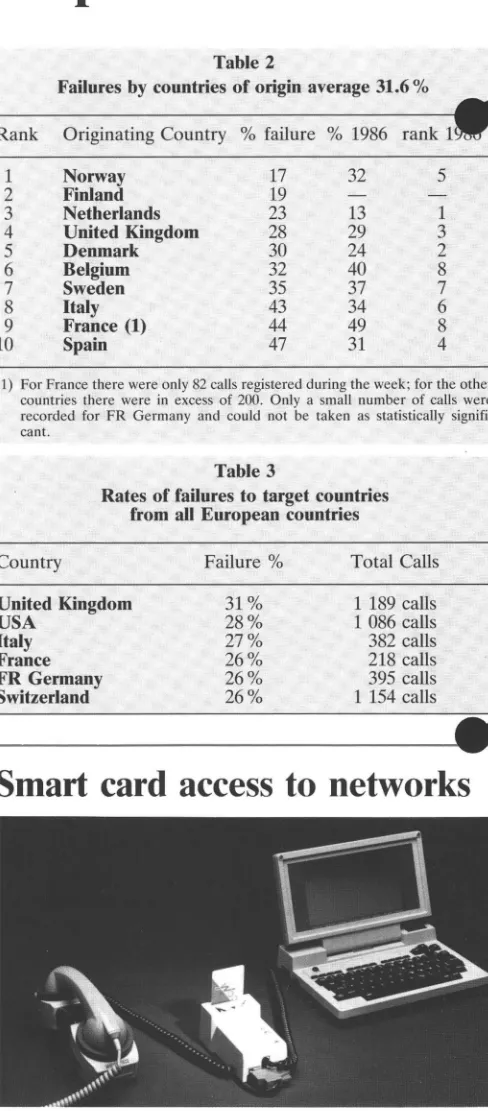
!NFORMATIO MARKET No. 49
6
Eusidic telecoms user report 1987
Small improvement on European networks
Last year in January, Eusidic,
the European Association of
Information Services,
pro-vided a systematic analysis of
the efficiency of the European
networks. A number of users
took the trouble to fill out a
log of all the calls they made
and a questionnaire on the
quality of the services offered by telecommunications
au-thorities. In 1986, 3 436 calls
were logged.
This year, during the week
26-30 January, users have
provided similar data. Some
50 % more calls were logged
( 5 223). Unfortunately there
are some important gaps
-especially FR Germany and
France where user groups did
not participate strongly
enough. Good participation
came from the Nordic
coun-tries and overall a reasonably reliable view of the state of
the networks should be
re-flected by the figures.
The telecommunications au
-thorities were well aware of
the operation. A modest
im-provement in the services
- of some 1.5 % - was
indi-cated in this year's figures.
In 1986 30.7 % of calls failed;
this year 29.2 % did not get
through.
An analysis of the network er
-ror messages suggested that two-thirds of the problems
were due to network failure; a
quarter (24 % ) were caused
by access problems at local
node; 8 % were due to pro
-blems of the host not being
accessed. Only 2 % were put
to "user" problems such as us
-ing the wrong NUI, NUA or
password. Many users,
how-ever, do not think the
net-work messages are totally
ac-curate.
For a clear understanding of
what the results mean, the
reader should bear in mind
that when a message passes
from one end of Europe to
another it could take several
possible routes depending on
the agreements between
tele-com authorities and the level
of traffic. We are, therefore, publishing a number of tables
which should give some
indi-cation of the level of service
when the message leaves a
na-tional network and the
chances of it arriving in
another.
Table 1
Failures by country of destination average 29 %
Rank Destination country Success Failure %
1 Austria 13 0 0
2 Ireland 41 13 24.1
3 Switzerland 858 296 25.7
4 FR Germany 293 102 25.8
5 Norway 143 50 25.9
6 France 161 57 26.2
7 United States 777 309 28.4
8 United Kingdom 825 364 30.6
9 Finland 74 34 31.4
10 Sweden 101 56 35.7
11 Denmark 52 29 35.8
12 Belgium 24 14 36.8
13 Japan 34 24 41.4
14 Luxembourg 48 38 44.2
15 Netherlands 5 6 54.6
Chairman's award
INFORMATION MARKET No. 49
Dr W L Renaud, chairman of
the Committee on
Informa-tion and Documentation in
Science and Technology,
which advises the
Commis-sion on its Specialised
Infor-mation Market programme,
has become an Officier in de
Orde van Oranje-Nassau in
recognition of his services to the Dutch and international
information industries.
Table 2
Failures by countries of origin average 31.6 %
Rank Originating Country % failure % 1986 rank 1 .
1 Norway 17 32 5
2 Finland 19
3 Netherlands 23 13 1
4 United Kingdom 28 29 3
5 Denmark 30 24 2
6 Belgium 32 40 8
7 Sweden 35 37 7
8 Italy 43 34 6
9 France (1) 44 49 8
10 Spain 47 31 4
(1) For France there were only 82 calls registered during the week; for the other
countries there were in excess of 200. Only a small number of calls were
recorded for FR Germany and could not be taken as statistically
[image:6.588.326.570.94.650.2]signifi-cant.
Table 3
Rates of failures to target countries
from all European countries
Country Failure% Total Calls
United Kingdom 31 % 1 189 calls
USA 28% 1 086 calls
Italy 27% 382 calls
France 26% 218 calls
FR Germany 26% 395 calls
Switzerland 26% 1154 calls
---
Smart card access to networks
-A smart card innovation,
Comco, enables a traveller to
gain access to networks in a
foreign country for which he
has not registered with the
telecoms authorities. By the
end of this year all
Communi-ty countries will be served.
The Cornea smart card is a
miniature computer that
com-municates with the ones
in-stalled by the company within
the packet switched networks
under agreements made with
the authorities.
The user calls the nearest
Comco access point and the
smart card is placed in a rea
d-er between the micro and the
telephone. The amount of
units left on the card is
dis-played on the screen - much
in the same way as a
tele-phone card. The logon
ad-dress of a normally used host
can be stored and rung up at
the touch of a button.
The smart card warns the user
when it is running out
owll
units; a new card can b patched by post.
Contact: Comco
PO Box 235 CH-Lausanne 12
Tel: + 41 21 36 51 OS
Green Paper calls for European action on
telecommunications
-
-
The lack of synergy between the European telecoms autho-rities is causing a loss in dy-namism in the European mar-ket compared with Japan or the USA, equivalent to a gap of between $ 4.5 and 15 bil-lion in telecommunicationsequipment purchases. This low consumption of advanced technology points to the vast unrealised potential of the European market which, with 320 million consumers, is far larger than its competitors, says a Commission Green Paper on Telecommunica
-tions (1).
As, by the end of the century.
nearly two out of three jobs will depend on telecommuni-cations, action needs to be taken now to maximise em-ployment opportunities and boost the economy. The Com-mission would like reactions to its proposals by October. The regulatory transforma-tion of the "current web of segmented national markets"
At
make a majorcontribu-,a,
to providing a single,more competitive, Communi -ty-wide market to the benefit of both European industry
and the European consumer, the rarer says.
The Green Paper proposes two major strands of re-regu-lation of the telecoms authori-ties.
1. Phased complete opening of the terminal equipment market to competition
In the long run, this would
comprise all terminals includ-ing the subscriber's first tele-phone set, given the change to integration of functions and
the introduction of the more powerful integrated services
digital network (ISDN). Transitional solutions may need to be made for States wanting to maintain monopo-ly suppmonopo-ly of conventional voice telephone.
Receive only earth stations (ROES) for satellite down-links should be subject to type
approval only.
2. Clear separation of regu-latory and operational functions of telecoms au-thorities
Telecoms authorities cannot be both referee and player at
the same time; they cannot both participate in the market and regulate the competition. The need for this separation is
Agreement
on Framework
programme
After many months of dis-agreement and delay, the Council arrived at a common pos1t1on on the 1987-91 Research and Development Framework programme on 20 July. A concertation pro
-cedure was opened with the European Parliament. The continuation of a number of R&D programmes can now be assured and new pro-grammes can be started. The Framework Programme comprises a global budgetary
envelope in which the priori-ties in research can be set. Programmes such as ESPRIT
• rmation technology re-h) and RACE (broad-networks in Europe) are included in the Frame
-work Programme. New
pro-grammes, such as DELTA on distance education, DRIVE on dedicated road and intelli
-gent vehicles in Europe and
AIM, European advanced in
-formatics in medicine, can, in accordance with the Single Act, now be passed by major-ity vote.
The agreement follows the line of a compromise worked out with 11 Member States and the Commission during the Belgian presidency for a budget of 6.5 billion ECUs.
About 1 billion are commit-ted to research about which decisions have already been taken. Some 4.5 billion ECUs are for new actions to be car-ried out until the end of 1991. A further 900 million ECUs
are to be spent after 1990. The United Kingdom insisted that the overall budget be
ap-proved in two phases: the main part immediately and 417 million later - it is hoped before the end of this year.
confirmed by trends and de-bates in all Member States.
The Commission also pro-poses a number of new action lines. These include the rein-forcement of the development of standards and
specifica-tions in the Community and the creation of a European Telecommunications Stan-dards Institute.
The Commission also says
that a common definition of an agreed set of conditions for
Open Network Provision
(0 N P) to service providers and users is necessary for a
competitive environment. Clear definitions of network termination points, usage conditions and tariff princi-ples and availability of fre-quencies, where relevant, are
required.
The networks must be opened, under fair condi-tions, also to providers of in-formation services based in
other Member States. The common development of new ISDN based Europe-wide services will depend on
compatibility and inter-opera-bility. This could involve joint
Community-wide
service-pro-vision, network planning and tariff principles. A number of new initiatives at the Commu -nity level promoting the emer-gence of European valu
e-ad-ded services will be proposed,
building on current efforts as the trade electronic data inter-change system, TEDIS. Pri
-vate initiatives will be fully mobilised where they can pro-mote Europe-wide informa-tion services.
Common definition of a co-herent European position on
the development of satellite
communications must be un-dertaken.
New action lines are also pro-posed in regard to the interna-tional regulatory environment
(for example in GAIT and with the International Tele-communications Union) and in achieving social consensus on the new opportunities
aris-ing in the job market. The Commission would like to receive reactions to its pro-posals by October.
Contact: Mr. T. Schuringa, C. E. C. DG XIII/D 200 Rue de la Loi B-1049 Brussels
Tel: + 32 2 235 0575
(1) Commission document: COM (87)
290 final
La
Commission adopte huit
programmes specifiques
La Commission vient d'adop-ter une serie de programmes specifiques qui feront partie du programme-cadre de la re-cherche 1987-91.
1. La Phase II de ESPRIT: un montant de 1.6 milliards d'ECUs est prevu pour pour-suivre ce programme de re-cherche d'une signification es-sentielle pour l'avenir de !'Eu-rope.
2. Le Programme DELTA
vise le developpement de techniques d'apprentissage grace
a
la technologie avan-cee. Ce programme devrait permettre un . lien entre ES-PRIT et RACE et, d'autre part, entre ESPRIT et RACE et le programme COMETT. Une somme de 20 millions d'ECUs est proposee pour cette activite nouvelle. 3. Le programme DRIVEconcerne le probleme de la
se-curite de la circulation rou-tiere en Europe sous le double
aspect de la reduction de la pollution due
a
la circulation routiere et du developpement d'un systeme de circulation routiere moderne. Un fi-nancement de 60 millions d'ECUs est propose pour ce programme de recherche. 4. Le programme AIM, Ad-vanced Informatics and Medi-cine, a pour objectif de re-duire Jes couts entra1nes par les soins de sante par le biais de !'introduction de l'informa-tique medicale et de la bio-informatique. II aura une dotation de 20 millions d'ECUs.
D'autres programmes pro-poses concernent la fusion
thermonucleaire, BRITE, la
radioprotection, et l'acces
a
de grandes installations de re-cherche.
8
Screens and your health
How countries regulate VDUs
Many people object to work-ing long intensive hours at a
terminal screen. After some
time staring at green letters on
a black screen, eyes begin to strain, colours of ordinary
ob-jects take on a purplish- red hue and back and neck mus-cles ache. Then nerves begin to fray.
Is it all the fault of the green
screen?
A recent study undertaken on
behalf of the Commission
(DG XIII and DG V) found that employees in Member States have a remarkably common approach to the is-sues associated with the use of
VDUs.
But Member States laws and
regulations show a bewilder-ing variety of ways of dealing with the health and safety im-plications of VDUs. Many countries have no specific
le-gislation on new technologies
preferring to rely on general
laws covering the subject.
These may date back to when VDUs were a twinkle in the
eyes of their inventor - some
fifty years ago.
It is doubtful whether such
laws can be relied on as the
basis of argument by analogy
to cover the needs of VDU workers today. Many of the
regulations exist only at the
level of policy of a ( usually large) company or collective
agreements with trade unions.
In several countries the results
of a questionnaire indicated the need for guidelines or
checklists rather than detailed legislative standards being created. A flexible model which could call on the best international practice illus-trated by both corporate and
trade union guidelines was
re-commended at the
Communi-ty level.
What
to do at your VDU
Should pregnant women wearspecial anti-radiation aprons
when sitting in front of a screen? A recent book on New information technology: human and managerial
impli-cations, recommends that
such clothing affords no bene-fits and should be positively avoided. One study con-cluded that it would take 50 years' exposure at the VDU to build up the same level of
radiation as one dental X-ray. Another stated that "the body burden of radiation carried by one's bed partner exposes you
to more radiation" than work-ing all day at a terminal. Lead rubber aprons could cause postural problems. In
addition, for pregnant women they may cause excessive
pressure and heat build-up in the womb.
Do VDUs produce tingles on
the skin? Electromagnetic
ra-diation such as ultra-violet, in-fra-red, microwave,
radio-fre-quency, medium low (ML) or extremely low frequency
(ELF) waves are either not
emitted from VD Us or in such
low quantities that no nega-tive effects can be detected. The book by Richard J Long cites a report by the European
Foundation for the Improve-ment of Living and Working
Conditions that concludes
that ergonomically designed VD Us should entail no
inher-ent physical or mental health hazards.
It also gives a helpful summa
-ry of exercises that terminal
Laws and
constitutions
General provisions may be found in a country's constitu-tion, for example, Articles 31 and 41 of the Italian
Constitu-tion. In other countries legis-lation dates back several years
- to the 1924 Health and
Sa-fety at Work Laws in Luxem-bourg, the 1958 Office Prem-ises Act in Ireland or the 1934 Hygiene and Safety Decree in Greece. Alternatively, as in the case of Denmark, the gen-eral law may be easily adapted
to changing working condi-tions despite the absence of
specific regulation of new technology.
Standards and
agreements
In some countries the empha-sis has been on implementing standards for the workplace COMPARATIVE TABLE In the comparative table we have sum-marised some examples.
BELGIUM GRPL
CCT
General Regulations for
the Protection of
La-bour
Convention Collective
de Travail No. 39 of 13 December 1983
con-cerning "!'Information et la Concertation sur les
consequences Sociales
de !'Introduction des nouvelles technologies"
operators could do to release
muscle tensions, minimise
fa-tigue and enhance the blood flow. Refocusing the eye on
near and distant objects can
help reduce eye strain.
Man-agerial style and employee
sa-tisfaction are more important
than hardware, it concludes. Contact: Croom Helm
Burrel Row GB-Beckenham, Kent, BR3 lAT
Normal viewing distance ranges from 1 5-32 Inches (38-81 cm)
Inclination of heed
should not exceed 20°
If keyboard exceeds 30 mm 11.2 inches) in height on home row, a wrlstrest should be provided
Adjustable beck rest for lumbar support Adjustable seat tilt
may be desirable Adjustable seat height
Swivel chair with sturdy
base and self-locking castors
INFORMATION MARKET No. 49
_J
Ergonomically-sound posture
Adjustable document-holder
Screen surface et
approximately
right-angles to line of sight
Adequate knee
clearance - at
least 8 inches (20 cm)
Adjustable footrest should be available If keyboard height
Is fixed
- such as the German DIN
standards. There are also framework agreements such as those for government
de-partments in Denmark or the banking sectors in France and Portugal. In Belgium the agreement is at a more gener-al level. '
Codes of Practice
guidelines
These types of regulations which include the U K Health and Safety Executive's guide-lines on VDUs are less easily
enforceable. They may take the form of an agreed corpo-rate policy with a multination-al company which supple-ments the local legal require-ments. Philips and IBM issue a handbook of working prac-tices. In the case of such mul-tinationals the policy may be developed on a worldwide
scale.
TB - Technologieakkoorden
in Belgie?
J. Huys and P. van der Hallen, Katholieke Uni-versiteit Leuven, Janua-ry 1983
DENMARK AWE
GB
RT
Act respecting the
work-ing environment.
No. 681, 23 December
1975
- Det grafiske Branche-sikkerhedsrad,
Skaerm-Terminaler nr. ~
and 4 c 1981/1982
"Rammeaftale on
e-ningslinier for samar-bejde ved indforelse og
brug af ny teknologi i
statens virksomheder og institutioner." 25 No-vember 1982
FRANCE
LC - Labour Code, as last
amended 28 January
1981
GERMANY
RI - The Reich Insurance
Code, 1911
ZH/618 - Sicherheitsregeln fiir
Bildschirm-Arbeits-platze im Blirobereich ZH 1/618, October 1980
DIN66234 - DIN 66 234 part 1 to 7,
German standard for
Display Workplaces
March 1980- December 1984
DIN4549 - DIN 4549
Vorausset-zung flir die zuklinftige Funktionsfiihigkeit,
March 1985
N.2.7 - Nr. 2.7
Verwaltungs-SP21.5
GREECE
Berufsgenossenschaft -Bildschirmeinsatz ja!
Aber mit Sinn und Ver-stand!, June 1985
SP21.5 Verwaltun.
-rufsgenossenscha
Mikrofilm-Leseger
im Blirobereich, No-vember 1985
HSD - Hygiene and Safety
IRELAND
OPA - Offices Premises Act,
1958
No.5 - Newsletter no. 5,
De-ITALY
CR
e
partment of Labour, Occupational Health Services February 1985
La Costituzione della Repubblica italiana, art 32 and 41
the Code Civil, art 2087
LUXEMBOURG
H&SA Hygiene and Safety Act and Orders, 28th Au-gust 1924 THE NETHERLANDS ARBO WB NS HBW
Wet ARBO, 1980; Working Environment Act.
Het Werken met
Beeldschermen, con-cept voorlichtingsblad, Arbeidsinspectie, 1981 Werken met beeldscher-men, Nederlandse Spoorwegen, January 1983
Handboek beter werken met beeldschermen,
FNV. 19Rn
PORTUGAL
RGH Regulamento Geral de Higiene e Seguranca do Trabalho nos Estabele-cimentos Comercieas, de Escritorio e Servicos, January 1982 (Bill in preparation)
CLR CoUective Labour Re-gulation for the Bank Sector
SPAIN
•
MTSUGT
General Occupational Safety and Health Ordi-nance, Order to ap-prove, 1971
"Problematica de los Trabajadores y Usuarios de la Informatica: El Trabajo con Pantallas de Visualizacion de Da
-tos", Proposal for Regu-lations sobre condi-ciones de trabajo con pantallas de vis ualiza-cion, February 1985,
Ministerio de Trabajo y Seguridad Social Institu
-to Nacional de Seguri-dad Social, Instituto Na-cional de Seguridad e Higiene en el Trabajo Guia Technica para el trabajo ante pan ta II as de datos (Directrices Sindi-cales), Union General de Trabajadores, 1985
UNITED KINGDOM
HSA - Health and Safety at work Act, 1974 HSEl - Visual Display Units, HSE2
LRDl
-
APEX.RHealth and Safety Exe-cutive, 1983
Working with VDU's, Health and Safety Exe-cutive, 1986
VDU's Health and Jobs, Labour Research De-partment, 1985 VDU workers' rights
campaign leaflets
New Technology: a Health and Safety R
e-port, Apex, 1985
APEX.G - ·New Technology: Health and Safety Gui -delines. Apex
ASTMS Guide to Health
Ha-zards of Visual Display Units, ASTMS, 1983
BTFU VDU Guidelines, BIFU
Research, 1984 T,\ <;S VDU's Health and
Safe-ty Guidelines, TASS, 1985
NALGO - Visual Display Units, a Nalgo check-list for ne-gotiators, NALGO SOGAT "VDU Guidelines",
SOGAT, June 1986 EYE Visual Display Units
and Eyestrain, recom-mendations for eye ex-aminations for VDU operators, Society of Graphical and Allied Trades. l'IXO
General Specific Law Health & on New
Safety Information Legislation Technologies
Belgium
GRPL
•
CCT
•
TB Denmark AWE GB RT FrarU.'l'
LC
•
Germany
Rl
•
ZH 1/618
•
DIN 66 234
•
N.2.7
DIN 4 549
SP 21.5 Greece
HSD
•
Ireland
OPA
•
NO.~
Hall
CR
•
cc
•
Luxembourg
H&S /\
•
The Netherlands
ARBO
•
WB NS Hfl\V
Portugal
RGH
<•l
Cl.R
Spain
GOS
•
MTS
UGT
United Kingdom
HSA
•
HSE 1 HSE 2
LRD 1 VRC APEX R
APEX G
ASTMS BIFU TASS NALGO SOGAT EYE JNT International INTTU
FIET I ECMA ISO
PHIL JAB NSB
*) is still draft
JNT Journalists & New Tech-nology, National Union of Journalists, 1980
INTERNATIONAL
DOCU-MENTS INTTU FIETl ECMA ISO Guidelines
International Trade Union Guidelines on Vi-sual Display Units,
October 1984 Health and Safety for white collar workers, Fiet Handbook No. 1,
FIET 1983
Ergonomics
Recom-mendations for VDU Work Places, TR22, ECMA, March 1984 Draft Ergonomics Re-quirements of Visual Tn
-PHIL JAP NSB formation Systems. 9241/3 Processing ISO/DP - The Visual Display
Ter-minal Workplace, a us-ers handbook, Philips, 1983 + two appendices VDT Work and Occu-pational Health - A provisionsal Guideline, Japan Industrial Safety
and Health Association,
February 1984
Ordinance (AFS 1985: 12) concerning Work with Visual Display Units, National Swedish Board of Occupational Safety and Health, June 1985
and AREAS COVERED
Agreements
on Union,
Company or
Trade
Equipment Environ- Work Operators Health
Association Station de- &Job
level design mental issues sign design Regulation
•
•
•
•
•
•
•
•
•
•
•
•
•
•
•
•
•
•
•
•
•
•
•
•
•
•
•
•
•
•
•
•
•
•
•
•
•
•
•
•
•
•
•
•
•
•
•
•
•
•
•
•
•
•
•
•
•
•
•
•
•
•
•
•
•
•
•
•
•
•
•
•
•
•
•
•
•
•
•
•
•
•
•
•
•
•
•
•
•
•
•
•
•
•
•
•
•
•
•
•
•
•
•
•
•
•
•
•
•
•
•
•
•
•
•
•
•
•
•
•
•
•
•
•
•
•
•
•
•
•
•
•
•
•
•
•
•
•
•
•
•
•
•
•
•
•
•
•
•
•
•
•
•
•
•
•
•
•
•
•
•
•
•
•
•
•
•
•
•
•
•
•
•
•
(e) (e)
•
•
•
•
•
•
•
•
•
•
•
•
•
•
•
•
•
•
INFORMATION MARKET No. 49
Agreement on Systran
The European Commission represented by DG XIII and Mr Jean Gachot, the owner of various Systran units
collectively known as "Groupe Systran", have signed a
collaborative agreement to ensure the wider ex ploita-tion of the successful computer-aided translation
sys-tem, SYSTRAN.
The agreement signed on 4 August will enable the
Com-mission to make wider and imrroved use of the system within the European institutions. It will also enable both parties to benefit from a broader feedback of users.
Dictionaries and software developments will be shared
between the two organisations. Contact: Mr Ian Pigott
CEC, DG XIII/B
L-2920 Luxembourg Tel: + 35243012903
Accord sur Systran
La Commission europeenne representee par DG XIII
et M. Jean Gachot, proprietaire de differentes unites de developpement SYSTRAN collecitvement denommes
«Groupe Systran», a signe un accord de collaboration pour assurer !'exploitation plus large du systeme reussi
de traduction assistee par ordinateur, SYS TRAN.
L'accord signe le 4 aofit permettra a la Commission de
faire une utilisation plus large et amelioree du systeme au sein des institutions europeennes. II permettra
egale-ment
a
Jes deux partis de profiter d'une retroaction plus large des utilisateurs. Des dictionnaires et des develop-pements de logiciel seront partages entre Jes deux orga-nismes.ESA-IRS, the European Space Agency's
Information Retrieval Service, offers the
widest scientific and technological infor-mation coverage, with over 70 databases containing 30 million references, worldwide access possibilities through national and international data
transmis-sion networks, and many other services ...
~---~
I
without commitment. I should like to know more aboutI
I ESA-IRSI
I
NameI
I
I
I
Company . . ... · · ·I
I
Address ...I
I
I
L~.:~-~~·~
·
~
·
~~~
-
~·~
-
~~
·
~~-~J
and send to:
ESA Information Retrieval Service C.P. 64 -00044 Frascati, Italy
.~ (3916) 94011 telex 610637
10 ..._~~~~~~~~~~~~~~~~~~~~~~
INFORMATION MARKET No. 49
Taking off
in the information industry
In business experience is often the best teacher. It can also be
costly. Mistakes can be expensive. Too many can lead you to
disaster.
Why not therefore use other people's experience about how they became successful?
That's exactly what Euripa has done. Supported by a grant from the European Commission, Euripa surveyed 27 of Eu-rope's most successful online information services.
They were asked how they went about their planning, produc-tion, marketing and distribution.
They revealed their thoughts about staff recruitment,
motiva-tion and training.
They also told Euripa about how they saw the future develop-ment of the industry.
All this is now available as a succinct analysis and summary of
how these firms went about choosing and marketing products in Europe's most dynamically growing industry.
Secrets of Success in the Information Industry will tell
you ..
What sort of market research do I need?
How much product testing and development?
How do I go about marketing?
e
And much more.
In order to make it easy for fledgling businesses to fly, each of the nine sections includes an extensive checklist so you can be
sure that you are getting the most out of other people's
exper-ience.
"Management is not as formalised as the checklist used by
pilots when an airliner takes off, but success can frequently come from the routine application of good practice," writes Brian Stanford-Smith in the introduction.
IM readers can benefit from a special reduced price offer. For a
limited time, this guide will be sold at a pre-publication price of 3 600 Belgian Francs (59 Pounds Sterling, 180 DM, 590 FF or
the equivalent in other European currencies) - postage
in-cluded. That's 20 % off the usual price of 4 500 BF or £ 75, 225 DM or 750 FF.
To European Information Market Development Group
(EIMDG), 177 Route d'Esch, L-1471 Luxembourg
Tel: +352 488041 Telex: 2181
Please rush me a copy of
Secrets of Success in the Information Industry.
Name ... .
· Company ... .
Address ... _ _
I !/ ... .
( 'u
Competitive resource
ED I Italia '87
The CICI, the British infor-mation industry grouping and the Royal Institute of
Interna-tional Affairs are holding their second joint conference on 5-6 November, 1987.
Day one will deal with Infor-mation as a competitive
re-Ace; day two with Future
.tions in information
mar-kets. Speakers include Sir
Raymond Appleyard and
Mr Brian Oakley.
Contact: Mr Louis Turner Royal Institute of International Affairs 10 St James's Square London SWlY 4LE
Tel: +44 1 930 2233
Fax: +44 1 839 3593
La prima conferenza italiana sull'Interscambio Elettronico dei Dati (EDI), EDI Italia '87 avra luogo ii 4 a ii 5 No
-vembre. Sponsorizzata da
Confcommercio,
Confindus-tria, Instituto Nazionale per ii
Commercio con l'Estero
(ICE), SIP, Unioncame re/IN-DIS, la conferenza permet-tera di fare ii pun to sullo stato
d'utilizzo delle tecniche EDI di semplificazione, standar
-dizzazione e teletrasmissione a livello nazionale, europeo e
mondiale, e come queste
pos-sano apportare dei benefici fi-nanziari notevoli.
Contatto: Sra Sonia Mattioli
XCOMS International Sri Via Popoli Uniti 24 1-20125 Milano Tel.: +39 2 2822153
Developing Countries
A conference on Computer communications for
develop-ing countries will be held in
New Delhi on 27-30 Octo-ber. Hosted by the Indian
Government's Department ol Electronics, the conference
will cover such topics as data comms infrastructure, ISDN.
satellite communications, tech-nology transfer and
socio-po-litical issues and standards.
Contact: Dr S Ramani
Director, National Centre for Software Technology Gulmohar Cross Road No 9, Juhu
Bombay -400049, India
European Electronic Mail
Association
and international bodies m
the field.
Contact: Ids Zandleven Philips International
Corporate Communications,
Bid VNS
Machine Translation
An electronic mail association
has been formed with the aim
of promoting the use of em:iil:
educating the public about the benefits and applications and to act as a forum for the
ex-change of information
opin-ions and analysis between
us-ers, vendors, service
provid-ers. PTTs and ?:Overnment
PO Box 218
NL 5600 MD Eindhoven
Tel: +31 40 783424
Telex: 35000
Aslib will hold there 9th in-ternational conference on
computer aided translation on 12- 13 November, 1987. Evaluations of latest software
packages, desk top publishing
and electronic mail system~
will be made. Expert speaker~
will assess the practicality and
.lecom
87
L'Union internationale des telecommunications (UIT) tiendra son 5e Forum mondial des telecommunications a
Geneve du 19 au 27 octohre.
Le theme L'age des communi-cations: des reseaux et ser-vices pour la communaute
user friendliness of latest ma
-chine translation systems and
address the question of inter
-national cooperation.
Contact: Aslib
Information House
26-27 Boswell Street
London WClN 3JZ
Tel.: +44 1 430 2671
Computers in the
1990s
mondiale servira de cadre aux
experts en communications pour l'examen des problemes les plus recents en matiere de telecommunications.
Contacter: UTT
Place des Nations
CH-1211 Geneve 20
Tel: +41 22 99 51 11
The computer industry has failed in many ways to live up to expectations of the early 1980s. According to Georges Anderla and Anthony Dun-ning in their book, Computer
strategies for the 1990s, the
difficulties experienced by large and small vendor organ
-isations were often self- in-flicted and exacerbated by management short-sighted-ness. Dubious ratings were as-signed to the triad of innova-tion, marketing and costs.
Computer strategies
incorpo-rates a practical set of guide-lines to use as a frame of refer-ence for cost efficient comput-er systems. The aim is to assist executives in working out ra-dically new product policies developing demand driven technology under conditions of highly competitive pric-ing.
Contact: Wiley & Sons
Baffins Lane GB-Chichester, Sussex P0191UD
Tel: +44 243 779777
Telex: 86290
AN ESSENTIAL
MONEY SAVING TOOL
FOR ONLINE USERS
BOOKS AND PERIODICALS ONLINE is a list of sources covered by databases in the busineu and legal field.
Each main entry includes:
• Publisher's Name
• Database Name
• Database Producer Name
• Online Vendor(s)
e Scope of Coverage by Database
e Publication Name
• Country of Origin of Publication
e Publication Code used by Database Producer
e Fonner Name(s) of Publication
Editor: Nuchine Nobari
Price £80 (includes BOOKS AND PERIODICALS
ONLINE
plus a semi-annual update)
Additional listings to help you search economically and efficiently include:
• Publishers' Names and Addresses • Sources Listed under Database • Database Producers' and Online Vendors' Names and Addresses
Order now from: Leamed Information Ltd, Woodside,
llinksey Bill, Oxford, OXl SAU, England. Telephone (0865) 730275.
Antworten auf Ihre Fragen?
Fangen Sie bei ECHO an!
Drucker
Beute
Bisher
Haben Sie Fragen Sie
einen Personal Computer?
ein Modem Nein Thren Computerhandler
Terminal Software
Wollen Sie 1hr System testen? ECHO hat auch eine direkte Nummer:
+
352436428Geben Sie als Password ein, entweder
DIANED
und Sie konnen einc Datenbank finden,
die fUr Sie geeignet ist. oder
TRAIND
und Sie konnen die Abfragesprache
CCL - Common Command Language lernen.
Allgemeine Informationen
ECHO's databank IRSOFT kann Ihnen helfen. Das Buch heif3t
Directory of library and information retrieval
Software for Micro-Computers
von Fr Hilary Dyer und
wird von Gower Yerlag
herausge-geben.
Aber es ist billiger, die Datenretze zu nutzen
Details online mit INFO PTT
Falls Sie nicht selber suchen wollen, hilft Ihnen
BROKERSGUIDE einen Spezialisten zu finden, der
in lhrer Nahe ist.
Allgemeine Angaben (Liste der Hosts, Postbehorden, lnformationsvermjttler, Benutzergruppen usw.) konnen Sie schriftlich anfordern bei:
ECHO
177 Route d'Esch
L-1471 Luxemburg
bei speziellen Fragen oder Problemen: Telefon: Luxemburg (352) 48 80 41 Telex: 2181
Das ECHO-Team ruft Sie zurtick, um Ihnen Telefonkosten zu sparen.