This is a repository copy of
Correlation consistent basis sets for explicitly correlated
wavefunctions: Pseudopotential based basis sets for the post-d main group elements
Ga–Rn
.
White Rose Research Online URL for this paper:
http://eprints.whiterose.ac.uk/86118/
Version: Published Version
Article:
Hill, J.G. and Peterson, K.A. (2014) Correlation consistent basis sets for explicitly
correlated wavefunctions: Pseudopotential based basis sets for the post-d main group
elements Ga–Rn. Journal of Chemical Physics, 141. 094106 . ISSN 1089-7690
https://doi.org/10.1063/1.4893989
Copyright 2014 American Institute of Physics. This article may be downloaded for personal
use only. Any other use requires prior permission of the author and the American Institute
of Physics. The following article appeared in Journal of Chemical Physics, 141, 094106
and may be found at http://dx.doi.org/10.1063/1.4893989.
[email protected] https://eprints.whiterose.ac.uk/
Reuse
Unless indicated otherwise, fulltext items are protected by copyright with all rights reserved. The copyright exception in section 29 of the Copyright, Designs and Patents Act 1988 allows the making of a single copy solely for the purpose of non-commercial research or private study within the limits of fair dealing. The publisher or other rights-holder may allow further reproduction and re-use of this version - refer to the White Rose Research Online record for this item. Where records identify the publisher as the copyright holder, users can verify any specific terms of use on the publisher’s website.
Takedown
If you consider content in White Rose Research Online to be in breach of UK law, please notify us by
Pseudopotential-based basis sets for the post-d main group elements Ga–Rn
J. Grant Hill and Kirk A. Peterson
Citation: The Journal of Chemical Physics 141, 094106 (2014); doi: 10.1063/1.4893989
View online: http://dx.doi.org/10.1063/1.4893989
View Table of Contents: http://scitation.aip.org/content/aip/journal/jcp/141/9?ver=pdfcov
Published by the AIP Publishing
Articles you may be interested in
Communication: Two-component ring-coupled-cluster computation of the correlation energy in the random-phase approximation
J. Chem. Phys. 139, 191102 (2013); 10.1063/1.4832738
Variational and diffusion Monte Carlo study of post- d group 13–17 elements
J. Chem. Phys. 129, 064316 (2008); 10.1063/1.2969098
An analysis of core effects on shape-consistent pseudopotentials
J. Chem. Phys. 121, 8687 (2004); 10.1063/1.1798976
Quality of contracted Gaussian-type function basis sets
J. Chem. Phys. 120, 5938 (2004); 10.1063/1.1650305
Systematically convergent basis sets with relativistic pseudopotentials. II. Small-core pseudopotentials and correlation consistent basis sets for the post-d group 16–18 elements
THE JOURNAL OF CHEMICAL PHYSICS141, 094106 (2014)
Correlation consistent basis sets for explicitly correlated wavefunctions:
Pseudopotential-based basis sets for the post-
d
main
group elements Ga–Rn
J. Grant Hill1,a)and Kirk A. Peterson2,a)
1Department of Chemistry, University of Sheffield, Sheffield S3 7HF, United Kingdom 2Department of Chemistry, Washington State University, Pullman, Washington 99164, USA
(Received 20 June 2014; accepted 14 August 2014; published online 4 September 2014)
New correlation consistent basis sets, cc-pVnZ-PP-F12 (n=D, T, Q), for all the post-dmain group
elements Ga–Rn have been optimized for use in explicitly correlated F12 calculations. The new sets, which include not only orbital basis sets but also the matching auxiliary sets required for density fitting both conventional and F12 integrals, are designed for correlation of valencesp, as
well as the outer-coredelectrons. The basis sets are constructed for use with the previously
pub-lished small-core relativistic pseudopotentials of the Stuttgart-Cologne variety. Benchmark explic-itly correlated coupled-cluster singles and doubles with perturbative triples [CCSD(T)-F12b] cal-culations of the spectroscopic properties of numerous diatomic molecules involving 4p, 5p, and 6p
elements have been carried out and compared to the analogous conventional CCSD(T) results. In general the F12 results obtained with an-zeta F12 basis set were comparable to conventional
aug-cc-pVxZ-PP or aug-cc-pwCVxZ-PP basis set calculations obtained withx=n +1 or evenx=n +2. The new sets used in CCSD(T)-F12b calculations are particularly efficient at accurately
re-covering the large correlation effects of the outer-core d electrons.© 2014 AIP Publishing LLC.
[http://dx.doi.org/10.1063/1.4893989]
I. INTRODUCTION
One of the major sources of error in correlated elec-tronic structure calculations is due to incompleteness of the 1-particle basis set used to describe the atomic or molecu-lar orbitals.1–3 Since the introduction of the correlation con-sistent family of basis sets,4 this error has been effectively addressed by any number of extrapolation strategies to an estimated complete basis set (CBS) for a given correlation method (see, e.g., Refs. 5–7). For high accuracy, however, large basis sets of quadruple-zeta or preferably higher must be used. Over the last several years, the use of so-called F12 explicitly correlated methods, which arose from the R12 method of Kutzelnigg and co-workers,8 has become much more widespread.9–12 These methods greatly improve the convergence with respect to basis set by including one or more nonlinear correlation factors, e.g.,e−γ r12, into the
wave-function. The F12 ansatz has now been implemented into a number of commonly used correlation methods, including MP2, coupled-cluster singles and doubles (CCSD),9–12 com-plete active space 2nd-order perturbation theory (CASPT2),13 and internally contracted multireference configuration inter-action (MRCI).14While standard basis sets can be effectively used in F12 approaches, it has been found to be advanta-geous to optimize Gaussian basis sets directly for use in F12 calculations.15,16 This has led to the series of cc-pVnZ-F12 basis sets (n=D, T, Q), which are currently available for all
the elements from H through Ar.15–17In the present work, new F12-based correlation consistent basis sets, denoted cc-pVn
Z-a)Electronic addresses: [email protected] and [email protected]
PP-F12, have been developed for all the post-dmain group
el-ements Ga–Rn. These sets are derived from the standard aug-cc-pVnZ-PP and aug-cc-pwCVnZ-PP sets,18–21 which were
constructed for use with small-core relativistic pseudopoten-tials of the Stuttgart-Cologne variety,19,20,22,23and also com-plement the standard all-electron correlation consistent basis sets, valence and core-valence, for these elements.24–26To ac-company the new orbital basis sets of this work, new auxiliary basis sets have also been determined that are needed for den-sity fitting of the standard 2-electron integrals (MP2FIT), as well as for the resolution of the identity of the many-electron F12 integrals (OPTRI). Preliminary versions of these sets have already been used in extensive coupled cluster bench-mark calculations of several diatomic molecules containing the post-3d elements Ga–Kr, where they exhibited excellent
convergence behavior to the basis set limit compared to stan-dard basis sets in conventional calculations.27
General methodology can be found in Sec.II, while de-tails of the basis set development of this work can be found in Sec.III. Benchmark calculations designed to ascertain the accuracy and efficiency of the new sets are reported and dis-cussed in Sec.IV.
II. GENERAL COMPUTATIONAL DETAILS
The MOLPRO suite of ab initio programs28 was used
throughout this work together with restricted open-shell Hartree-Fock orbitals and pure spherical harmonic an-gular momentum basis functions. All of the basis sets of this work are paired with small core, multiconfigura-tional Dirac-Hartree-Fock-adjusted pseudopotentials of the
Stuttgart-Cologne variety19,20,22,23(replacing 10 electrons for Ga–Kr, 28 electrons for In–Xe, and 60 electrons for Tl–Rn), which were previously employed in the cc-pVnZ-PP family
of basis sets for these elements.18–20
III. BASIS SET DEVELOPMENT
A. Atomic orbital basis sets, cc-pVnZ-PP-F12
The development of the F12 atomic orbital (AO) basis sets of this work closely follows the authors’ previous work in this area.15–17All exponent optimizations were carried out at the MP2-F12 level of theory with the 3C ansatz29 on the ground states of the neutral atoms. A geminal exponentγ of 1.4a0−1was used throughout. The auxiliary basis sets (ABSs) utilized in the AO exponent optimizations corresponded to the def2-QZVPP/JKFIT30 set for density fitting (DF) of the exchange terms with large, uncontracted even-tempered sets (18s17p15d12f10g8h7i) for both the density fitting of the
con-ventional 2-electron integrals and the resolution of the identity (RI) for the many-electron F12 integrals within the comple-mentary auxiliary basis set (CABS) approach.31 These latter sets can be found in the supplementary material.32
In the previously developed cc-pVnZ-F12 correlation
consistent basis sets,16,17 the sp parts of the basis sets were taken from the conventional aug-cc-pV(n+1)Z basis
sets4,33,34in order to ensure that the basis set convergence of the HF energy was on par with that of the correlation energy in explicitly correlated calculations. This approach was also followed in the present work by utilizing the (contractions and correlating) sandp functions of the aug-cc-pV(n+
1)Z-PP sets18–20 and the [1d] contracted HFd-type function from the cc-pV(n+1)Z-PP sets for use in the new cc-pVn
Z-PP-F12 basis sets (n =D, T, Q). To these base sets, groups of
correlating functions optimized at the MP2-F12/3C level of theory29were then added. These latter functions included the usual F12 groupings of valence (msp electrons) correlating
functions (defined as even-tempered expansions), i.e., 2dfor
DZ, 3d2ffor TZ, and 4d3f2gfor QZ. In the present case an
additional 1d1fset was also included that was optimized for
MP2-F12 correlation energy of the (m−1)delectrons (mwill
denote the principal quantum number in this work to avoid confusion with the basis set cardinal numbern). These latter
functions were optimized concurrently with the valence cor-relating functions in an iterative scheme until there was no significant change in the energies. The motivation for these
additional tight functions was twofold, (i) they address the known deficiency of the conventional cc-pVnZ-PP basis sets
in lacking sufficiently tight f-type functions for inner-shell
polarization21,35(similar in spirit to the “tight-deffect” in the 2nd row elements36) and (ii) they provide a minimal set of functions needed to describe the correlation of (m−1)d
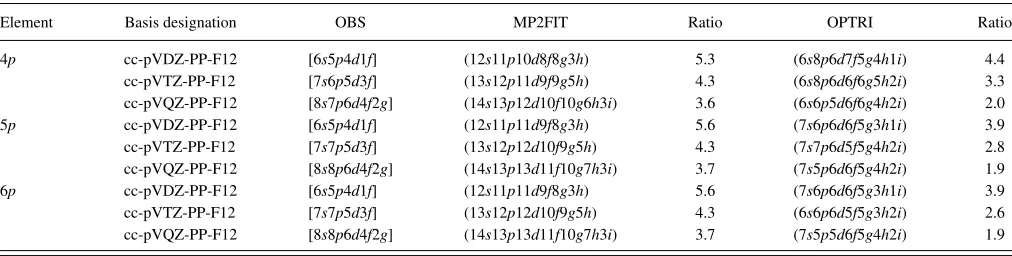
elec-trons. So while the new sets are still predominately valence correlating basis sets, they are also capable of accurately re-covering outer-core correlation effects in a very economical and reliable way. This will be shown in detail below through numerous diatomic benchmark calculations. The composi-tions of the final contracted basis sets are shown in TableI.
Figures1–3show the basis set convergence of the MP2 correlation energy both in conventional and MP2-F12/3C calculations for the rare gas atoms Kr, Xe, and Rn. In Figure 1 the frozen-core correlation energies (valence sp
electrons correlated) from conventional MP2 with aug-cc-pVnZ-PP and aug-cc-pwCVnZ-PP basis sets are compared
to MP2-F12/cc-pVnZ-PP-F12 calculations. The F12
calcu-lations utilized the new auxiliary basis sets described below. Estimated CBS limits are shown based on conventional MP2
n−3 extrapolations6,37 of the large aug-cc-pwCVnZ-PP basis
sets withn=4 (Q), and 5. As expected, the F12 correlation
energies are dramatically closer to the CBS limit compared to the conventional results. Even at the DZ level, the F12 re-sults are comparable or even closer to the CBS limits than the conventional 5Z values. The convergence with basis is seen to be monotonic in all cases. Figures 2and3 show the ba-sis set convergence of the core-valence and core-core corre-lation energies, respectively, where the core is defined as the (m−1)d electrons. Even with just the small 1d1fset of core
correlating functions contained in the new basis sets, the F12 calculations recovered a significant amount of core correla-tion energy. In fact the cc-pVnZ-PP-F12 correlation energies
are lower than the conventional aug-cc-pwCV(n+1)Z-PP
val-ues. The convergence is observed to be generally monotonic for Xe and Rn, but the F12 core correlation energies for Kr show only poor convergence towards the estimated CBS limits, with the cc-pVQZ-F12 results being similar or only slightly lower than the conventional aug-cc-pwCV5Z-PP val-ues. Similar behavior is observed for other members of this row and is presumably due to the inability of the small 1d1f
set of core correlating functions to provide accurate corre-lation energies for electrons in the compact 3dorbital, even
[image:4.612.53.559.622.750.2]with the inclusion of the F12 correlation factor. However, as
TABLE I. Composition of the basis sets developed in this work for the post-delements. The ratio of functions (MP2FIT:OBS and OPTRI:OBS) assumes spherical angular momenta.
Element Basis designation OBS MP2FIT Ratio OPTRI Ratio
094106-3 J. G. Hill and K. A. Peterson J. Chem. Phys.141, 094106 (2014)
FIG. 1. Convergence of frozen-core MP2 correlation energies from conventional (aug-cc-pVnZ-PP and aug-cc-pwCVnZ-PP basis sets) and explicitly correlated MP2-F12/3C (new cc-pVnZ-PP-F12 basis sets,γ=1.4) calculations. The estimated CBS limits are shown by the horizontal dotted lines, which were obtained
[image:5.612.58.560.292.469.2]byn−3extrapolation of conventional aug-cc-pwCVnZ-PP correlation energies withn=4, 5.
FIG. 2. Convergence of the MP2 (m−1)delectron core-valence correlation contributions using conventional (aug-cc-pwCVnZ-PP basis sets) and explicitly correlated MP2-F12/3C (new cc-pVnZ-PP-F12 basis sets,γ =1.4). The estimated CBS limits are shown by the horizontal dotted lines, which were obtained
byn−3extrapolation of conventional aug-cc-pwCVnZ-PP correlation energies withn=4, 5.
[image:5.612.58.560.536.712.2]shown below in molecular benchmark calculations, this does not seem to degrade the accuracy of the calculated core cor-relationeffectson energetic and spectroscopic properties.
B. Density fitting auxiliary basis sets, MP2FIT
Auxiliary basis sets for the density fitting (suffixed MP2FIT) of the conventional two-electron integrals were de-veloped using similar design and optimization strategies as previously employed for a large number of DF-MP2 ABSs (Refs.38–40, and references therein). In the present case they are specifically matched to the cc-pVnZ-PP-F12 orbital sets
described above, and optimization of the uncontracted expo-nents proceeded via the minimization of the functional38
δDF = −1
4
aibj
(ab||ijDF− ab||ij)2
εa−εi+εb−εj ,
where the two-electron repulsion integrals are denotedab||ij = (ai|bj) − (aj|bi), εx are Hartree-Fock orbital energies, i
andjare occupied orbitals, andaandb are virtual orbitals.
All of these optimizations used the analytical auxiliary basis set gradients within the RICC2 module41,42 of the TURBO -MOLEprogram.43 All atoms were in their respective ground electronic states and the (m−1)delectrons were included in
the correlation treatment and evaluation ofδDF. The (m−1)sp
electrons were treated with the frozen core approximation and excluded from the functional.
The pioneering work of Weigendet al.38in the
optimiza-tion of ABSs for convenoptimiza-tional frozen-core DF-MP2 estab-lished guidelines that the number of basis functions in the ABS should be no greater than four times the number of functions in the orbital set, and that the error in the corre-lation energy due to density fitting should be less than 100 μEhper atom in molecular calculations. As the energetic er-ror is not directly related toδDF, for optimization purposes this was transformed toδDF/|EMP2corr|<10−6. An additional rule-of-thumb has also been established; the error due to density fitting in molecules should be three or four orders of mag-nitude smaller than the error due to basis set incompleteness (BSIE) in the orbital basis.40,44 As the F12 methods greatly reduce the BSIE, one should be wary that the density fitting errors remain negligible. Thus in the present investigation the DF error is assessed at the MP2/DF-MP2 level but compared against the BSIE at the MP2-F12 level.
The compositions of the resulting ABSs are presented in TableI, along with the compositions of the respective or-bital basis sets. It can been seen that at the DZ and TZ levels, reaching the desired level of accuracy required more functions
than the “four times the functions in orbital basis set (OBS)” guide, but this is a necessity for the DF errors to remain neg-ligible in the F12 framework. ABSs of this size do not cause any efficiency concerns in F12 calculations, as initial testing demonstrates that the bottleneck remains the evaluation of the new many-electron integrals that arise in explicitly correlated methods (the latter are calculated using the RI basis set de-scribed in Sec. III C). Statistics of the error caused by den-sity fitting are presented on a per correlated electron basis as the mean unsigned error (MUE), standard deviation (σ), and maximum absolute error (MAX) in the quantityδDF/|Ecorr
MP2|
for the post-d elements in Table S1 of the supplementary
material.32 It can be seen that the errors in the integrals are roughly equivalent for all three basis sets, and that the overall magnitude of the error is very small.
Further validation of the new MP2FIT ABSs has been carried out by comparing the DF error in the correlation en-ergy with the BSIE for a test set of molecules containing
post-dmain group elements. Most of these were taken from Ref.30
with the addition of As2, Kr2, Sb2, and Bi2(all the molecules are listed in TableII). Estimates of the CBS limit have been obtained from (R)MP2-F12/3C(FIX) calculations carried out inMOLPROwith a Schwenke-type extrapolation of the TZ and QZ correlation energies,45 with the cc-pVnZ-F12 basis sets used for lighter elements. The large even-tempered auxiliary basis described in Sec.III Awas used for both density fitting and the RI. The coefficient used in the CBS extrapolation was optimized for lighter elements and is employed to create esti-mates of the BSIE, rather than to obtain rigorous benchmark values for the MP2 CBS limit. Separate CBS limits were pro-duced with the (m−1)delectrons on the post-delements
in-cluded or exin-cluded from the correlation treatment. All other elements used the standard frozen core definition throughout. The MUE,σ, and MAX of the BSIE for all of the molecules in the test set are presented in Tables S2 and S3 of the sup-plementary material,32where the orbital basis sets have been abbreviated as VnZ-F12.
[image:6.612.46.565.661.750.2]Tests of the error in the MP2 correlation energy due to DF quickly revealed that the magnitude of the error was very sensitive to the ABS used for the lighter elements. Previous recommendations have paired the cc-pVDZ-F12 OBS with aug-cc-pVTZ/MP2FIT, cc-pVTZ-F12 with aug-cc-pVTZ/ MP2FIT, and cc-pVQZ-F12 with aug-cc-pVQZ/MP2FIT.45 Although this DZ recommendation still works well, the other pairings resulted in DF errors that were deemed too large, roughly just two orders of magnitude smaller than the respec-tive BSIE. Increasing the ABSs to aug-cc-pwCVQZ/MP2FIT and aug-pwCV5Z/MP2FIT, for pVTZ-F12 and cc-pVQZ-F12, respectively, reduced the errors by approximately
TABLE II. Test set of molecules containing post-dmain group elements used to validate the performance of the MP2FIT and OPTRI auxiliary basis sets.
Molecules
4p(Ga-Kr) GaCl, GaCl3, GaF, GaF2, GaH3, GaO, GeCl4, GeF3, GeF4, GeH4, GeO, GeO2, As4, As2, AsCl3, AsH3, SeH2, SeO, SeO2, HBr, HCBr3, Br2, BrCl, BrO−, BrO
2−, Kr2
5p(In-Xe) InCl, InCl3, InH, InH3, InO, SnF3, SnH4, SnO, SnO2, Sb2, SbF, SbF3, SbH3, SbO2, TeF3, TeH2, TeO, TeO2, I2, IH, IO4−, IO3−, ICl, XeF2, XeF4, XeOF4
094106-5 J. G. Hill and K. A. Peterson J. Chem. Phys.141, 094106 (2014)
TABLE III. Density fitting errors (MP2FIT relative to the reference ABS) in the MP2 correlation energy per correlated electron for a test set of molecules containing post-delements. The (m−1)delectrons are frozen (d -electron correlation results in parentheses) in the correlation treatment. All values are inμEh.
ABS MUE σ MAX
VDZ-F12 4p 0.38 (0.17) 0.31 (0.11) 1.03 (0.36)
5p 0.33 (0.12) 0.30 (0.07) 1.11 (0.33)
6p 0.41 (0.18) 0.35 (0.16) 1.26 (0.63)
VTZ-F12 4p 0.37 (0.16) 0.36 (0.13) 1.26 (0.49)
5p 0.47 (0.17) 0.38 (0.11) 1.30 (0.41)
6p 0.40 (0.23) 0.41 (0.11) 1.22 (0.47)
VQZ-F12 4p 0.21 (0.09) 0.13 (0.05) 0.51 (0.20)
5p 0.17 (0.05) 0.14 (0.04) 0.47 (0.15)
6p 0.15 (0.10) 0.14 (0.06) 0.42 (0.20)
a further order of magnitude. The same recommendation has also been made earlier in the review by Hättig et al.9
This also ensured that the DF error of molecules containing both post-d and lighter elements was commensurate with
those containing only post-delements. This finding indicates
that there is scope for MP2FIT ABSs specifically matched to the cc-pVnZ-F12 OBS of the lighter elements, and this
shall be the topic of a future investigation. The MUE,σ, and MAX DF errors for the test set of molecules are presented in Table III, with the (m−1)d electrons frozen and correlated.
The molecules SnF3, TlO, and PbF3 were removed from the test set when the (m−1)d electrons were frozen; these
systems displayed a significant amount of mixing between the d electrons on the post-d element and orbitals on the
lighter elements, making the designation of a frozen core non-obvious.
A comparison of BSIE with DF errors indicates that the fitting errors are negligible in all cases, despite the large de-crease in BSIE due to the explicitly correlated wavefunc-tion. With a VDZ-F12 basis the statistics of the DF error are four orders of magnitude smaller than the BSIE, and this be-comes three orders of magnitude with VTZ-F12 and VQZ-F12 (without correlating the d electrons). Overall the
mag-nitude of the errors due to density fitting is essentially the same for all three basis set qualities, with some reduction in MAX for larger bases. The errors are also relatively con-stant whether the (m−1)delectrons are correlated or not,
in-dicating that the errors would be smaller in thed’s correlated
case on a per correlated electron basis. Reaching these de-sired levels of accuracy required a relatively large number of functions in the auxiliary basis, but, as mentioned above, this should have negligible consequences in most F12 calcula-tions, especially when more computationally expensive meth-ods [such as coupled-cluster single double triple (CCSD(T))-F12b] are utilized. Of course this may not be the case when local correlation methods are used since these could have a much stronger dependence on the size of the ABS.
C. Complementary auxiliary basis sets, OPTRI
The RI auxiliary basis sets needed for evaluation of the multielectron F12 integrals were optimized for use within
the complementary auxiliary basis set (CABS+) approach31
as implemented in MOLPRO. The resulting OPTRI auxiliary sets are specifically matched to a particular cc-pVnZ-PP-F12
orbital basis set since the former only contain the comple-mentary functions, i.e., the full CABS+basis set is formed
by the union of a particular OPTRI set and the OBS. The OPTRI sets are designed to be compact and lead to a linearly independent CABS basis set, i.e., no functions will be deleted in the CABS procedure. This leads to smooth potential en-ergy surfaces and increased numerical stability. As described in Ref.46, the general procedure is to optimize functions that minimize the value ofδRI for the atoms:
δRI= ij
Vij,ijRI −VRIref
ij,ij
2
VRIref
ij,ij
+
Bij,ijRI −BRIref
ij,ij
2
BRIref
ij,ij
,
which involves the diagonal elements of theVandBmatrices arising in MP2-F12 theory.29 The reference matrices are de-fined by the reference RI basis sets described above. In order to minimize linear dependencies of the resulting CABS basis sets, the ratio of any two exponents (with the same angular momentum) in the combined CABS basis was constrained to be≥1.5. The 3C ansatz as implemented inMOLPROwas used throughout with a geminal exponent of 1.4a0−1.
Compared to the previous development of OPTRI sets,17,46,47 the current work was complicated by having F12 basis sets designed for correlating two different orbital spaces, primarily valence spbut also a minimal set for (m−1)d. In
the present work initial sets of OPTRI exponents were first op-timized within the frozen-core approximation (valencesp
cor-relation only). Each angular momentum was optimized sepa-rately and thes,p,d, andffunctions employed a reference RI
that was truncated atf-type functions. The higher angular
mo-mentum functions utilized the full reference RI. The resulting sets were then frozen and 0–4 additional functions in each angular momentum were optimized in MP2-F12 calculations that included the valence+(m−1)delectrons. The
composi-tions of the final OPTRI auxiliary sets are given in Table I. Not surprisingly the sizes are much smaller than the MP2FIT sets since the total CABS+basis set also includes the orbital
[image:7.612.340.533.399.435.2]TABLE IV. RI errors (OPTRI relative to the reference ABS) per correlated electron in the MP2-F12/3C(FIX) correlation energies for the combined test set of molecules containing post-dmain group elements. Only the valence electrons are correlated. All values are inμEh. Excludes GeF4.
Orbital basis Error type MUE σ MAX
VDZ-F12 BSIE 1373.9 649.5 3014.4
RI 4.1 3.9 14.6
VTZ-F12 BSIE 389.2 197.0 1029.0
RI 2.8 3.4 12.1
VQZ-F12 BSIE 111.2 56.3 294.0
RI 1.3 1.4 5.2
becomes more complete. Using the same set of test molecules (shown in TableII) as utilized in the MP2FIT work, the RI er-rors were also assessed (relative to the reference RI) for the new OPTRI auxiliary sets. These results (per correlated elec-tron) are shown for both valence and valence+(m−1)d
elec-tron correlation in TablesIVandV, respectively. In general these errors are about 2 orders of magnitude smaller than the MP2-F12 BSIE. It should be noted that the results shown in these tables excludes results from GeF4as those values were anomalously large for reasons yet to be determined (GeCl4, GeF3, etc., did not show this strange behavior).
D. Choice of geminal exponent,γ
In previous work on the lighterp-block elements,45
val-ues of the geminal exponentγ were recommended based on MP2-F12/3C(FIX) calculations for each orbital basis set, i.e., 0.9a0−1(cc-pVDZ-F12), 1.0a−01(cc-pVTZ-F12), and 1.0a−01 (cc-pVQZ-F12). These represented a compromise between smaller values generally being energetically favorable for el-ements in the left half of the p-block versus slightly larger
[image:8.612.313.560.103.203.2]values for those in the rightmost half.16The sensitivity of the correlation energy with the choice ofγ decreases, however, when the size of the OBS increases. When core correlation effects were being considered, a single value of 1.4a0−1was found to be adequate for all basis sets. In the present work, recommending a single value ofγ for each basis set for all post-d elements is particularly challenging, especially when
TABLE V. RI errors (OPTRI relative to the reference ABS) per correlated electron in the MP2-F12/3C(FIX) correlation energies for the combined test set of molecules containing post-dmain group elements. The valence elec-trons and (m−1)delectrons are correlated. All values are inμEh. Excludes GeF4.
Orbital basis Error type MUE σ MAX
VDZ-F12 BSIE 2882.8 1698.8 9271.7
RI 21.0 10.1 62.7
VTZ-F12 BSIE 1234.6 714.1 3385.4
RI 4.9 2.6 11.9
VQZ-F12 BSIE 352.8 204.1 967.3
RI 3.9 2.3 11.6
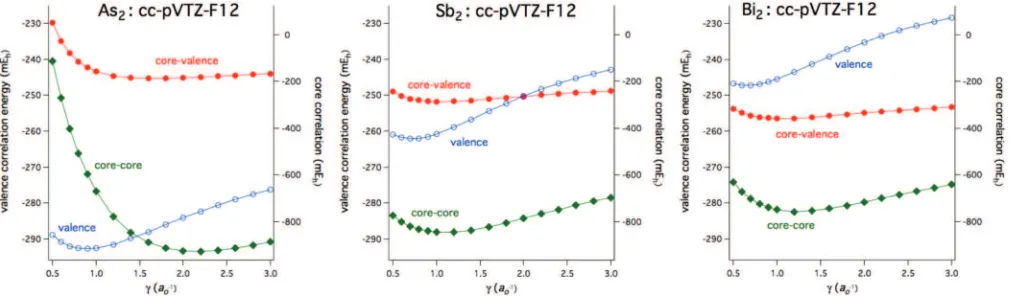
the (m−1)delectrons are correlated. Figure4shows theγ de-pendence of the MP2-F12/3C(FIX) correlation energies for As2, Sb2, and Bi2near their equilibrium bond distances using the cc-pVTZ-PP-F12 basis set. Results using the cc-pVDZ-PP-F12 set are similar but with overall smaller optimal values ofγ. From Fig.4, when only valence electrons are correlated, the optimal value ofγ is about 0.9 for As2and progressively gets smaller from Sb2to Bi2, where in the latter case the low-est energy occurs at approximatelyγ=0.65. The differences
are even more dramatic when the (m−1)delectrons are
corre-lated. The compact 3dorbital leads to a large optimal value of
γ for core-core correlation of nearly 2.2, while the analogous values for Sb2and Bi2are closer to about 1.2. For the inter-shell core-valence contribution to the correlation energy, the optimal values ofγrange from about 1.6 (As2) to 1.0 (Bi2).
There are a couple of options to attempt to address this problem of how to choose an appropriate geminal exponent, particularly ford-electron correlation. It was found in Ref.27
that more reliable results at the CCSD(T)-F12b level could be obtained by optimizing the amplitudes of the explicitly corre-lated terms at the MP2-F12 level and then fixing them in the subsequent CCSD-F12b calculation rather than fixing the am-plitudes based on the wavefunction cusp conditions27(the lat-ter of which is the default inMOLPRO). This approach, how-ever, has not been investigated further in this work. Another strategy is to use more than a single geminal in the F12 calcu-lations, each with a different exponent.48This was also inves-tigated previously27using preliminary versions of the present
FIG. 4. Dependence of the valence, core-valence, and core-core MP2 correlation energies on the geminal exponentγin MP2-F12/3C(Fix)/cc-pVTZ-PP-F12
[image:8.612.55.560.575.723.2]094106-7 J. G. Hill and K. A. Peterson J. Chem. Phys.141, 094106 (2014)
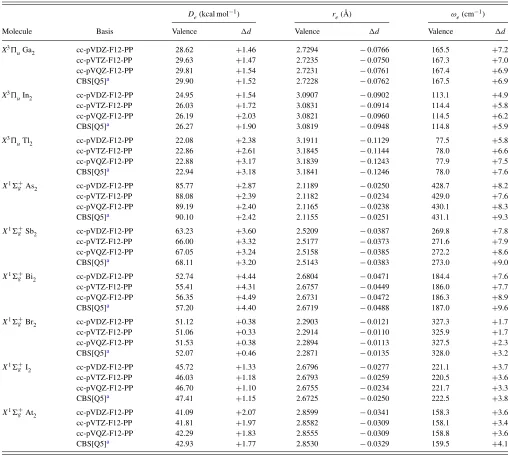
TABLE VI. Calculated CCSD(T)-F12b frozen-core (valence) andd-electron correlation contributions (d) for spectroscopic constants of various post-d homonuclear diatomics.
De(kcal mol−1) r
e(Å) ωe(cm−1)
Molecule Basis Valence d Valence d Valence d
X3uGa2 cc-pVDZ-F12-PP 28.62 +1.46 2.7294 −0.0766 165.5 +7.2
cc-pVTZ-F12-PP 29.63 +1.47 2.7235 −0.0750 167.3 +7.0
cc-pVQZ-F12-PP 29.81 +1.54 2.7231 −0.0761 167.4 +6.9
CBS[Q5]a 29.90 +1.52 2.7228 −0.0762 167.5 +6.9
X3uIn2 cc-pVDZ-F12-PP 24.95 +1.54 3.0907 −0.0902 113.1 +4.9
cc-pVTZ-F12-PP 26.03 +1.72 3.0831 −0.0914 114.4 +5.8
cc-pVQZ-F12-PP 26.19 +2.03 3.0821 −0.0960 114.5 +6.2
CBS[Q5]a 26.27 +1.90 3.0819 −0.0948 114.8 +5.9
X3uTl2 cc-pVDZ-F12-PP 22.08 +2.38 3.1911 −0.1129 77.5 +5.8
cc-pVTZ-F12-PP 22.86 +2.61 3.1845 −0.1144 78.0 +6.6
cc-pVQZ-F12-PP 22.88 +3.17 3.1839 −0.1243 77.9 +7.5
CBS[Q5]a 22.94 +3.18 3.1841 −0.1246 78.0 +7.6
X1 g+As2 cc-pVDZ-F12-PP 85.77 +2.87 2.1189 −0.0250 428.7 +8.2
cc-pVTZ-F12-PP 88.08 +2.39 2.1182 −0.0234 429.0 +7.6
cc-pVQZ-F12-PP 89.19 +2.40 2.1165 −0.0238 430.1 +8.3
CBS[Q5]a 90.10 +2.42 2.1155 −0.0251 431.1 +9.3
X1 g+Sb2 cc-pVDZ-F12-PP 63.23 +3.60 2.5209 −0.0387 269.8 +7.8
cc-pVTZ-F12-PP 66.00 +3.32 2.5177 −0.0373 271.6 +7.9
cc-pVQZ-F12-PP 67.05 +3.24 2.5158 −0.0385 272.2 +8.6
CBS[Q5]a 68.11 +3.20 2.5143 −0.0383 273.0 +9.0
X1 g+Bi2 cc-pVDZ-F12-PP 52.74 +4.44 2.6804 −0.0471 184.4 +7.6
cc-pVTZ-F12-PP 55.41 +4.31 2.6757 −0.0449 186.0 +7.7
cc-pVQZ-F12-PP 56.35 +4.49 2.6731 −0.0472 186.3 +8.9
CBS[Q5]a 57.20 +4.40 2.6719 −0.0488 187.0 +9.6
X1 g+Br2 cc-pVDZ-F12-PP 51.12 +0.38 2.2903 −0.0121 327.3 +1.7
cc-pVTZ-F12-PP 51.06 +0.33 2.2914 −0.0110 325.9 +1.7
cc-pVQZ-F12-PP 51.53 +0.38 2.2894 −0.0113 327.5 +2.3
CBS[Q5]a 52.07 +0.46 2.2871 −0.0135 328.0 +3.2
X1 g+I2 cc-pVDZ-F12-PP 45.72 +1.33 2.6796 −0.0277 221.1 +3.7
cc-pVTZ-F12-PP 46.03 +1.18 2.6793 −0.0259 220.5 +3.6
cc-pVQZ-F12-PP 46.70 +1.10 2.6755 −0.0234 221.7 +3.3
CBS[Q5]a 47.41 +1.15 2.6725 −0.0250 222.5 +3.8
X1 g+At2 cc-pVDZ-F12-PP 41.09 +2.07 2.8599 −0.0341 158.3 +3.6
cc-pVTZ-F12-PP 41.81 +1.97 2.8582 −0.0309 158.1 +3.4
cc-pVQZ-F12-PP 42.29 +1.83 2.8555 −0.0309 158.8 +3.6
CBS[Q5]a 42.93 +1.77 2.8530 −0.0329 159.5 +4.1
aConventional CCSD(T) results from Ref.21using cc-pwCVnZ-PP (n=Q, 5) basis sets.
[image:9.612.61.559.546.715.2]basis sets for the post-3d elements and valence +3d
corre-lation. Using two geminals with exponents 0.9 and 1.4a0−1, noticeable improvements were observed in thed-correlation
[image:10.612.52.559.265.736.2]effects on De,re, andωe for the DZ set when compared to the results using a single geminal with exponent 1.4a0−1. A similar study was carried out in this work, but using pairs of exponents that were a compromise between As, Sb, and Bi: [0.70, 1.20] for DZ, [0.80, 1.25] for TZ, and [0.90, 1.35] for QZ. A comparison ofd-correlation effects onDeandre
us-ing two geminals versus usus-ing a sus-ingle geminal with expo-nent 1.4a−01 was then made for As2, Sb2, and Bi2 (see be-low for other details of these calculations). At least for these 3 molecules, the only improvement from using 2 geminals was fordofDeat the DZ level, where the resulting values
for As2and Bi2were very similar to both the TZ and QZ
re-sults. For the TZ and QZ basis sets the use of 2 geminals had nearly no effect on the calculatedd-correlation effects. Since
the advantages were not so great, single values of γ have been used in the subsequent benchmark calculations of this work, 1.0a0−1for valence correlation calculations and 1.4a−01 when the (m−1)d electrons were correlated (for calculating
d a value of 1.4a0−1 was used for both the valence andd
-correlation calculations). The excellent results presented and discussed below imply this choice is adequate for most needs.
IV. MOLECULAR BENCHMARK CALCULATIONS
In order to demonstrate the effectiveness of the new ba-sis sets for both valence and (m−1)delectron correlation in
molecular systems, CCSD(T) calculations were carried out
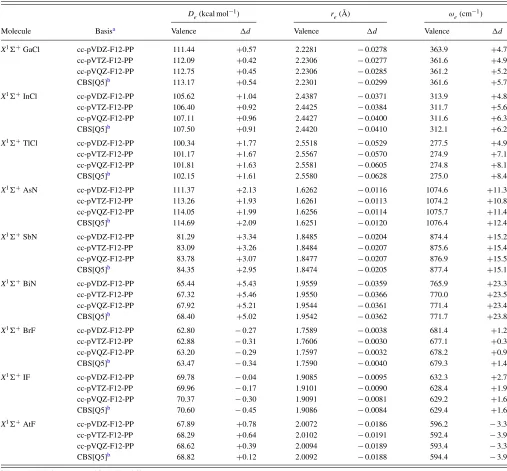
TABLE VII. Calculated CCSD(T)-F12b frozen-core (valence) andd-electron correlation contributions (d) for spectroscopic constants of various post-d heteronuclear diatomics.
De(kcal mol−1) re(Å) ωe(cm−1)
Molecule Basisa Valence d Valence d Valence d
X1 +GaCl cc-pVDZ-F12-PP 111.44 +0.57 2.2281 −0.0278 363.9 +4.7
cc-pVTZ-F12-PP 112.09 +0.42 2.2306 −0.0277 361.6 +4.9
cc-pVQZ-F12-PP 112.75 +0.45 2.2306 −0.0285 361.2 +5.2
CBS[Q5]b 113.17 +0.54 2.2301 −0.0299 361.6 +5.7
X1 +InCl cc-pVDZ-F12-PP 105.62 +1.04 2.4387 −0.0371 313.9 +4.8
cc-pVTZ-F12-PP 106.40 +0.92 2.4425 −0.0384 311.7 +5.6
cc-pVQZ-F12-PP 107.11 +0.96 2.4427 −0.0400 311.6 +6.3
CBS[Q5]b 107.50 +0.91 2.4420 −0.0410 312.1 +6.2
X1 +TlCl cc-pVDZ-F12-PP 100.34 +1.77 2.5518 −0.0529 277.5 +4.9
cc-pVTZ-F12-PP 101.17 +1.67 2.5567 −0.0570 274.9 +7.1
cc-pVQZ-F12-PP 101.81 +1.63 2.5581 −0.0605 274.8 +8.1
CBS[Q5]b 102.15 +1.61 2.5580 −0.0628 275.0 +8.4
X1 +AsN cc-pVDZ-F12-PP 111.37 +2.13 1.6262 −0.0116 1074.6 +11.3
cc-pVTZ-F12-PP 113.26 +1.93 1.6261 −0.0113 1074.2 +10.8
cc-pVQZ-F12-PP 114.05 +1.99 1.6256 −0.0114 1075.7 +11.4
CBS[Q5]b 114.69 +2.09 1.6251 −0.0120 1076.4 +12.4
X1 +SbN cc-pVDZ-F12-PP 81.29 +3.34 1.8485 −0.0204 874.4 +15.2
cc-pVTZ-F12-PP 83.09 +3.26 1.8484 −0.0207 875.6 +15.4
cc-pVQZ-F12-PP 83.78 +3.07 1.8477 −0.0207 876.9 +15.5
CBS[Q5]b 84.35 +2.95 1.8474 −0.0205 877.4 +15.1
X1 +BiN cc-pVDZ-F12-PP 65.44 +5.43 1.9559 −0.0359 765.9 +23.3
cc-pVTZ-F12-PP 67.32 +5.46 1.9550 −0.0366 770.0 +23.5
cc-pVQZ-F12-PP 67.92 +5.21 1.9544 −0.0361 771.4 +23.4
CBS[Q5]b 68.40 +5.02 1.9542 −0.0362 771.7 +23.8
X1 +BrF cc-pVDZ-F12-PP 62.80 −0.27 1.7589 −0.0038 681.4 +1.2
cc-pVTZ-F12-PP 62.88 −0.31 1.7606 −0.0030 677.1 +0.3
cc-pVQZ-F12-PP 63.20 −0.29 1.7597 −0.0032 678.2 +0.9
CBS[Q5]b 63.47 −0.34 1.7590 −0.0040 679.3 +1.4
X1 +IF cc-pVDZ-F12-PP 69.78 −0.04 1.9085 −0.0095 632.3 +2.7
cc-pVTZ-F12-PP 69.96 −0.17 1.9101 −0.0090 628.4 +1.9
cc-pVQZ-F12-PP 70.37 −0.30 1.9091 −0.0081 629.2 +1.6
CBS[Q5]b 70.60 −0.45 1.9086 −0.0084 629.4 +1.6
X1 +AtF cc-pVDZ-F12-PP 67.89 +0.78 2.0072 −0.0186 596.2 −3.3
cc-pVTZ-F12-PP 68.29 +0.64 2.0102 −0.0191 592.4 −3.9
cc-pVQZ-F12-PP 68.62 +0.39 2.0094 −0.0189 593.4 −3.3
CBS[Q5]b 68.82 +0.12 2.0092 −0.0188 594.4 −3.9
aThe cc-pVnZ-F12 sets were used for N, F, and Cl.
094106-9 J. G. Hill and K. A. Peterson J. Chem. Phys.141, 094106 (2014)
FIG. 6. Calculated CCSD(T) effects ofdelectron correlation forre(rein Å) andDe(Dein kcal/mol) for (a) As2, (b) Sb2, and (c) Bi2as a function of basis set for CCSD(T)-F12b/cc-pVnZ-PP-F12 (VnZ-F12) and CCSD(T)/aug-cc-pwCVnZ-PP (awCVnZ). The estimated complete basis set limits, CBS[45], were obtained from conventional CCSD(T) with aug-cc-pwCVnZ-PP (n=Q, 5) basis sets.
to determine the spectroscopic constants (De, re, ωe) of 9 homonuclear (Table VI and Figure 5) and 9 heteronuclear (Table VII) diatomic molecules distributed among the 4p,
5p, and 6p elements. The choice of molecules was
moti-vated by a previous benchmark study21 that reported cc-pwCVnZ-PP basis sets (n=D-5) for the same elements for
use in conventional (m−1)spdcore correlation calculations.
For the current calculations the CCSD(T)-F12b method was used (with the 3C fixed amplitude ansatz) with the new cc-pVnZ-PP-F12, cc-pVnZ-PP-F12/MP2FIT, and cc-pVn
Z-PP-F12/OPTRI basis sets (n=D, T, Q) on the post-delements.
The density fitting of the exchange terms for post-delements
utilized the def2-QZVPP/JKFIT basis sets. For the lighter elements, cc-pVnZ-F12 sets were used for the orbital and
OPTRI sets with aug-cc-pVnZ-PP and aug-cc-pwCVnZ-PP
for the MP2FIT context (see above). The auxiliary basis sets for the exchange terms corresponded to cc-pVnZ/JKFIT
(n=T for DZ and TZ orbital basis sets andn=Q for QZ).
Both frozen-core (only sp valence electrons correlated) and msp+(m−1)dcorrelation calculations were carried out. As
noted above, in the former case,γ was chosen to be 1.0a−01 throughout, while the calculations involving d-electron
cor-relation utilized γ =1.4a0−1. The (m−1)d correlation
con-tributions to the spectroscopic constants (d) were
deter-mined using frozen-core calculations with this same value of γ (1.4 a0−1). For the open-shell species, no symmetry equivalencing of the ROHF orbitals was carried out and the spin-unrestricted49,50R/UCCSD(T)-F12b method51was used throughout. For the group-13 chlorides, the ROHF orbitals were subjected to a 2×2 Boys localization in order to
mini-mize the mixing between the valence 3sorbital of Cl with the dσcore of the post-delement (see also Refs.21and27).
Focusing first on the results for the homonuclear di-atomic molecules shown in TableVI, the convergence of the frozen-core quantities with basis set is very rapid with the F12b ansatz and the new basis sets. This is also displayed in Fig.5for the group 15 diatomics, where the F12b approach with cc-pVnZ-PP-F12 basis sets yields dissociation energies
and bond lengths comparable to at least n+1 in a
conven-tional treatment. If the comparison is made to the aug-cc-pVnZ-PP results, the F12 method yields bond lengths of
ap-proximately n +2 quality or better. The convergence with
[image:11.612.53.559.592.744.2]basis set is also very monotonic, which should make the F12 results amenable to basis set extrapolation45 to recover the small amount of basis set incompleteness error at the QZ level. It can be noted from the conventional CCSD(T)
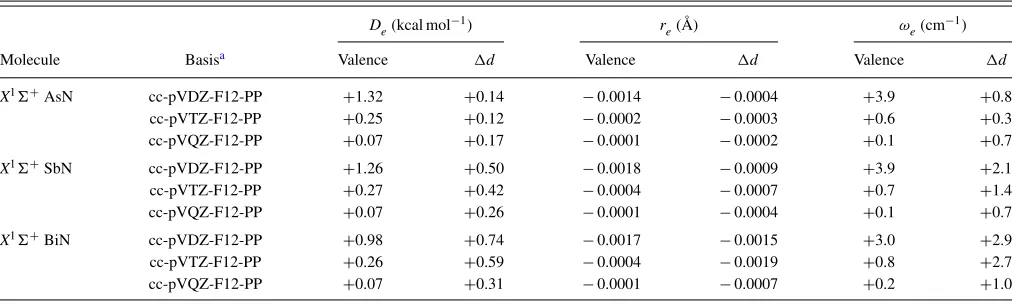
TABLE VIII. BSSE in the CCSD(T)-F12b valence andd-electron correlation contributions forDe,re, andωefor group 15 post-dnitrides (γ=1.4).
De(kcal mol−1) r
e(Å) ωe(cm−1)
Molecule Basisa Valence d Valence d Valence d
X1 +AsN cc-pVDZ-F12-PP +1.32 +0.14 −0.0014 −0.0004 +3.9 +0.8
cc-pVTZ-F12-PP +0.25 +0.12 −0.0002 −0.0003 +0.6 +0.3
cc-pVQZ-F12-PP +0.07 +0.17 −0.0001 −0.0002 +0.1 +0.7
X1 +SbN cc-pVDZ-F12-PP +1.26 +0.50 −0.0018 −0.0009 +3.9 +2.1
cc-pVTZ-F12-PP +0.27 +0.42 −0.0004 −0.0007 +0.7 +1.4
cc-pVQZ-F12-PP +0.07 +0.26 −0.0001 −0.0004 +0.1 +0.7
X1 +BiN cc-pVDZ-F12-PP +0.98 +0.74 −0.0017 −0.0015 +3.0 +2.9
cc-pVTZ-F12-PP +0.26 +0.59 −0.0004 −0.0019 +0.8 +2.7
cc-pVQZ-F12-PP +0.07 +0.31 −0.0001 −0.0007 +0.2 +1.0
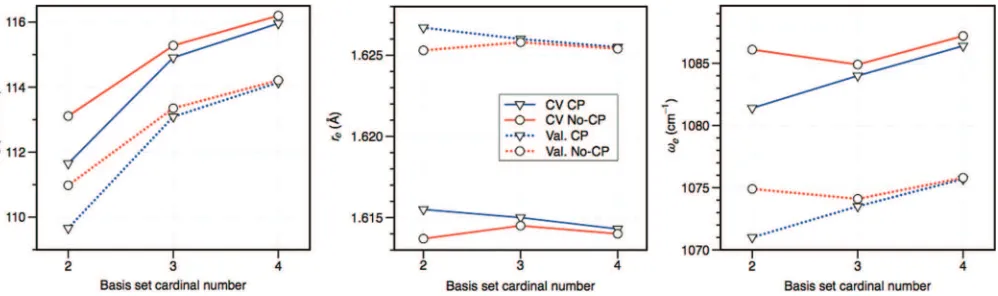
FIG. 7. Calculated CCSD(T)-F12b/cc-pVnZ-PP-F12 values ofDe,re, andωefor the AsN molecule as a function of basis set for both valence (Val.) and valence
+delectron (CV) correlation. Both counterpoise corrected (CP) and uncorrected (no-CP) values are shown.
results shown in Fig.5that the effect of tight high angular mo-mentum functions, as reflected by the difference between the aug-cc-pVnZ-PP and aug-cc-pwCVnZ-PP results, is certainly
not negligible in frozen-core calculations, particularly for the bond lengths of Sb2and Bi2. This underlines the importance of the additional tight 1d1ffunctions that have been included
throughout the new cc-pVnZ-PP-F12 basis sets. In regards
to F12 frozen-core results for the heteronuclear diatomics shown in Table VII, as well as the conventional CCSD(T) results from Ref. 21, the convergence trends are very simi-lar to those discussed above for the homonuclear diatomics. In fact for these systems, then+2 advantage of F12 seems
to nearly hold for both De andre even when compared to
the CCSD(T)/cc-pwCVnZ-PP results. Taking together all of
the diatomic results for valence correlation, the cc-pVQZ-PP-F12 results differ on average (signed) from the conventional CBS limits by just (standard deviations in parentheses)−0.47
(0.29) kcal/mol, +0.0009 (0.0009) Å, and −0.5 (0.3) cm−1
forDe,re, andωe, respectively. Even at the TZ level the agree-ment is excellent, −1.04 (0.58) kcal/mol, +0.0020 (0.0020)
Å, and−1.2 (0.8) cm−1, respectively.
As already shown in previous work,21 the effects onD e
and re from d-electron correlation can be very substantial,
but the convergence with respect to basis set in conventional CCSD(T) calculations can unfortunately be very slow. How-ever, as shown in TablesVIandVII, use of CCSD(T)-F12b with the new cc-pVnZ-PP-F12 basis sets yields very rapid
convergence towards the respective CBS limits. In these cases even DZ quality calculations yield reliable estimates of core correlation effects, to within a few tenths of a kcal/mol forDe
to a few mÅ for the bond length. This can be contrasted with conventional results whereby thed-electron correlation effect
can often be underestimated (compared to the CBS limit) by a few kcal/mol and a few hundredths of an Å for double-and even triple-zeta core-valence basis sets. As can be seen in TablesVIandVII, as well as in Figure6, the convergence of these effects with F12, while rapid, is not completely mono-tonic. Closer inspection shows this can be attributed mainly to basis set superposition error (BSSE), presumably arising from only using a 1d1fset of functions to recoverd-electron
correlation effects (in addition to the F12 correlation factor of course). This is exemplified in Table VIIIfor the
group-15 nitrides, as well as Figure7for AsN, where counterpoise calculations52 have been carried out. In particular, while the BSSE in valence-only correlated calculations smoothly de-creases in all cases as the basis set inde-creases, the BSSE in the core-valence corrections toDe,re, andωepredominately only slightly decreases. Comparison to the results shown in Table VII, however, shows that in each case the BSSE val-ues do end up at least an order of magnitude less than the to-tal magnitude of the core-valence correlation effect on each property. On average (signed), however, the cc-pVQZ-PP-F12 results for the effects ofd-electron correlation are very
close to the conventional CBS limits (standard deviations in parentheses): +0.05 (0.10) kcal/mol, +0.0008 (0.0010) Å,
and −0.3 (0.5) cm−1 for D
e, re, and ωe, respectively. The
analogous average signed deviations for cc-pVTZ-PP-F12 are just +0.04 (0.25) kcal/mol, +0.0020 (0.0027) Å, and−0.7
(0.7) cm−1. The statistics for cc-pVDZ-PP-F12 were really not much worse than TZ: +0.13 (0.34) kcal/mol, +0.0017
(0.0037) Å, and−0.8 (1.1) cm−1.
V. CONCLUSIONS
New correlation consistent basis sets for all the post-d
main group elements Ga-Rn, ranging in size from double- to quadruple-zeta, have been developed for use in explicitly cor-related F12 calculations. Orbital basis sets (cc-pVnZ-PP-F12)
have been developed along with the required auxiliary basis sets, both those for density fitting the conventional 2-electron integrals (MP2FIT) and those for use in the CABS procedure for the F12 many-electron integrals (OPTRI). The sets are designed for use with the same small-core relativistic pseu-dopotentials as employed in the standard cc-pVnZ-PP basis
sets. A number of diatomic molecule benchmark calculations were carried out at the CCSD(T)-F12b level of theory with the new basis sets for bothmspandmsp+(m−1)delectron
correlation. Compared to previously published conventional CCSD(T) results on the same molecules, the convergence of the F12 results to the estimated CBS limits was much more rapid, both in frozen-core and outer-cored-electron correlated
094106-11 J. G. Hill and K. A. Peterson J. Chem. Phys.141, 094106 (2014)
involving these elements using only relatively small basis sets.
All of the basis sets of the present work are available in the supplementary material,32as well as from the downloads section of one of the authors’ websites (http://tyr0.chem.wsu. edu/~kipeters/basis.html) and the basis set library of the MOLPROprogram (seehttp://www.molpro.net).
ACKNOWLEDGMENTS
This work was supported by the U.S. National Science Foundation (CHE-0723997). The authors are grateful to Pro-fessor Hans-Joachim Werner for many helpful discussions.
1J. G. Hill,Int. J. Quantum Chem.113, 21 (2013).
2F. Jensen,Wire Comput. Mol. Sci.3, 273 (2013).
3T. Helgaker, W. Klopper, and D. P. Tew,Mol. Phys.106, 2107 (2008).
4T. H. Dunning, Jr.,J. Chem. Phys.90, 1007 (1989).
5D. Feller, K. A. Peterson, and J. G. Hill,J. Chem. Phys.135, 044102
(2011).
6T. Helgaker, W. Klopper, H. Koch, and J. Noga,J. Chem. Phys.106, 9639
(1997).
7D. W. Schwenke,J. Chem. Phys.122, 014107 (2005).
8W. Kutzelnigg,Theor. Chim. Acta68, 445 (1985).
9C. Hättig, W. Klopper, A. Köhn, and D. P. Tew,Chem. Rev.112, 4 (2012).
10L. Kong, F. A. Bischoff, and E. F. Valeev,Chem. Rev.112, 75 (2012). 11D. Tew, C. Hättig, R. Bachorz, and W. Klopper, inRecent Progress in
Cou-pled Cluster Methods: Theory and Applications, edited by P. ˇCársky, J. Paldus, and J. Pittner (Springer, Berlin, 2010), p. 535.
12H.-J. Werner, T. B. Adler, G. Knizia, and F. R. Manby, inRecent Progress
in Coupled Cluster Methods: Theory and Applications, edited by P. ˇCársky, J. Paldus, and J. Pittner (Springer, Berlin, 2010), p. 573.
13T. Shiozaki and H.-J. Werner,J. Chem. Phys.133, 141103 (2010).
14T. Shiozaki, G. Knizia, and H.-J. Werner,J. Chem. Phys. 134, 034113
(2011).
15J. G. Hill, S. Mazumder, and K. A. Peterson,J. Chem. Phys.132, 054108
(2010).
16K. A. Peterson, T. B. Adler, and H.-J. Werner,J. Chem. Phys.128, 084102
(2008).
17J. G. Hill and K. A. Peterson, Phys. Chem. Chem. Phys. 12, 10460
(2010).
18K. A. Peterson,J. Chem. Phys.119, 11099 (2003).
19K. A. Peterson, D. Figgen, E. Goll, H. Stoll, and M. Dolg,J. Chem. Phys.
119, 11113 (2003).
20K. A. Peterson, B. C. Shepler, D. Figgen, and H. Stoll,J. Phys. Chem. A
110, 13877 (2006).
21K. A. Peterson and K. E. Yousaf,J. Chem. Phys.133, 174116 (2010).
22B. Metz, M. Schweizer, H. Stoll, M. Dolg, and W. Liu,Theor. Chem. Acc.
104, 22 (2000).
23B. Metz, H. Stoll, and M. Dolg,J. Chem. Phys.113, 2563 (2000). 24D. H. Bross and K. A. Peterson,Theor. Chem. Acc.133, 1434 (2014).
25A. K. Wilson, K. A. Peterson, D. E. Woon, and T. H. Dunning, Jr.,J. Chem.
Phys.110, 7667 (1999).
26N. J. Deyonker, K. A. Peterson, and A. K. Wilson,J. Phys. Chem. A111,
11383 (2007).
27K. A. Peterson, C. Krause, H. Stoll, J. G. Hill, and H.-J. Werner,Mol. Phys.
109, 2607 (2011).
28H.-J. Werner, P. J. Knowles, G. Knizia, F. R. Manby, M. Schützet al.,
MOLPRO, version 2012.1, a package of ab initio programs, 2012, see
http://www.molpro.net.
29H.-J. Werner, T. B. Adler, and F. R. Manby,J. Chem. Phys.126, 164102
(2007).
30F. Weigend,J. Comput. Chem.29, 167 (2008).
31E. F. Valeev,Chem. Phys. Lett.395, 190 (2004).
32See supplementary material athttp://dx.doi.org/10.1063/1.4893989for
Ta-bles S1–S10, as well as new MP2FIT and OPTRI auxiliary basis sets.
33R. A. Kendall, T. H. Dunning, Jr., and R. J. Harrison,J. Chem. Phys.96,
6796 (1992).
34B. P. Prascher, D. E. Woon, K. A. Peterson, T. H. Dunning, Jr., and A. K.
Wilson,Theor. Chem. Acc.128, 69 (2011).
35F. Weigend and R. Ahlrichs,Phys. Chem. Chem. Phys.7, 3297 (2005).
36T. H. Dunning, Jr., K. A. Peterson, and A. K. Wilson,J. Chem. Phys.114,
9244 (2001).
37A. Halkier, T. Helgaker, P. Jørgensen, W. Klopper, H. Koch, J. Olsen, and
A. K. Wilson,Chem. Phys. Lett.286, 243 (1998).
38F. Weigend, M. Häser, H. Patzelt, and R. Ahlrichs,Chem. Phys. Lett.294,
143 (1998).
39C. Hättig,Phys. Chem. Chem. Phys.7, 59 (2005).
40J. G. Hill,J. Comput. Chem.34, 2168 (2013).
41C. Hättig and F. Weigend,J. Chem. Phys.113, 5154 (2000).
42C. Hättig,J. Chem. Phys.118, 7751 (2003).
43TURBOMOLE GmbH, TURBOMOLE V6.2, 2010, a development of
Uni-versity of Karlsruhe and Forschungszentrum Karlsruhe GmbH, 1989–2007.
44F. Weigend,Phys. Chem. Chem. Phys.4, 4285 (2002).
45J. G. Hill, K. A. Peterson, G. Knizia, and H.-J. Werner,J. Chem. Phys.131,
194105 (2009).
46K. E. Yousaf and K. A. Peterson,J. Chem. Phys.129, 184108 (2008).
47K. E. Yousaf and K. A. Peterson,Chem. Phys. Lett.476, 303 (2009).
48H.-J. Werner, G. Knizia, and F. R. Manby,Mol. Phys.109, 407 (2011).
49P. J. Knowles, C. Hampel, and H.-J. Werner,J. Chem. Phys.99, 5219
(1993).
50G. E. Scuseria,Chem. Phys. Lett.176, 27 (1991).
51G. Knizia, T. B. Adler, and H.-J. Werner,J. Chem. Phys.130, 054104
(2009).