Rochester Institute of Technology
RIT Scholar Works
Theses
Thesis/Dissertation Collections
1978
The use of Fourier analyzed square waves in the
determination of the modulation transfer function
of photographic materials
David Moffett
John Stanton
Follow this and additional works at:
http://scholarworks.rit.edu/theses
This Senior Project is brought to you for free and open access by the Thesis/Dissertation Collections at RIT Scholar Works. It has been accepted for
inclusion in Theses by an authorized administrator of RIT Scholar Works. For more information, please contact
Recommended Citation
THE
USE
OF
FOURIER ANALYZED SQUARE
WAVES
IN
THE
DETERMINATION
OF
THE
MODULATION
TRANSFER FUNCTION
OF
PHOTOGRAPHIC
MATERIALS
by
David
Moffett
andJohn
Stanton
A
thesis
submittedin
partialfulfillment
ofthe
requirementsfor
the
degree
ofBachelor
ofScience
in
theSchool
ofPhotographic
Arts
andSciences
in
the
College
ofGraphic Arts
andPhotography
of the
Rochester
Institute
ofTechnology
March
1978
-TABLE
OF
CONTENTS
Introduction
pg
1
Theory
pg
3
Experimental
pg
]k
Discussion
pg
21
Conclusions
pg
31
LIST OF FIGURES
1.
MTF
-Typical
andthe
Ideal
pg
3
2.
Cascading
MTF
Curves
pg
k
3.
Application
ofMTF
Curves
pg
5
4.
Sinusoidally Varying
Transmission
Distribution
pg
7
5.
Transmission
Distribution
of aSymmetrical
Square
Wave
pg
10
6.
Transmission
Distribution
of aSymmetrical
Square Wave
andIts
First
Harmonic
7.
Master
Square Wave
Target
8.
MTF
-Conventional
andSquare Wave
Methods
9.
Characteristic
Curve
-Kodak
Fine
Grain
Aerial
Duplicating
Film
Type
2430
10.
Characteristic
Curve
-Rochester
Film
Co.
Type
3T
Reversal
Microfilm
11.
Characteristic Curve
-Rochester
Film
Co.
Type
1K
Microfi 1m
12.
Characteristic
Curve
-Intermediate
Square
Wave
Target
13.
Characteristic
Curve
-Final
Square
Wave
Target
14.
Microdensitometer
Calibration
Curve
-Sinusoidal
Target
15.
Microdensitometer
Calibration
Curve
-Sinusoidal
Sample
pg
12
pg
20
pg
27a
pg
35
pg
36
pg
37
pg
38
pg
39
pg
40
LIST
OF
FIGURES,
CONT.
16.
Microdensitometer
Calibration
Curve
-Square
Wave
Target
pg
42
17.
Microdensitometer
Calibration
Curve
-Square
Sample
pg
43
18.
Conventional
MTF
-Target
imaged
atIX
reduction with no mask
pg
44
19.
Conventional
MTF
-Target
imaged
at4X
reduction with no mask
pg
45
20.
Conventional
MTF
-Target
imaged
at4X
LIST
OF TABLES
1.
A
Typical
Set
ofFrequencies
Used
to
Determine MTF
2.
Square Wave
Frequencies
andTheir
Harmonics
3.
Frequencies
ofSinusoidal
Target
4.
Computer
Output
Sample
5.
Frequencies
ofSample
withHarmonics
6.
Frequencies
ofthe
Square
Wave
Target
andSample
7.
Processing
Data
for
Figures
8
Through
20
8.
Equations
ofthe
Microdensitometer
Calibration
Curves
pg 48
pg
9
pg
13
pg
14
pg
24
pg
26
pg
30
ACKNOWLEDGEMENTS
A
specialthanks
is
extendedto
Professor
Mohamed
F.
Abouelata
for
his
patienthelp
andinspiration
throughout
this
project.Thanks
also goto
Todd
Calvin
and
Russell
Schuter
ofthe
Rochester
Film
Company,
the
faculty
and staff ofthe
Photographic
Science
department
ABSTRACT
Fourier
analysis and a computer were used to generatethe
Fourier
series and coefficientsfor
the
transmissiondistribution
of a square wave target andthe
effectiveexposure produced on
Kodak
Plus-X
film.
This
was performedin
an effortto
find
a workable alternative to the proposed
American
National
Standards
Institue
(ANSI)
methodfor
thedetermination
of the photographic modulationtransfer
function.
The
results showed that the squarewave method generated a curve with the same general trend
as the conventional
ANSI
method.The
Fourier
analyzedsquare wave method
had
a greaterdegree
ofvariability
than
did
the standard method.The
square wavetargets
used
for
thedetermination
were manufactured at theRoch
INTRODUCTION
The
widespread acceptance ofthe
modulation transferfunction
(MTF)
as a means ofdescribing
the
band
limitations
of photo-optical systems
has
raisedinterest
in
its
deter
mination.
The
American
National
Standards
-Institutehas
setforth
a rigorous procedurefor
its
determination.
This
method utilizes targetsvarying
sinusoidally
in
transmission,
over a range offrequencies.
The
modulationof the output
distribution
is
divided
by
theinput
andplotted as a
function
of spatialfrequency,
which generatesthe
MTF
curve.This
procedureis
lengthy
as compared tothe square wave method which
is
the subject of this project.Fourier
mathematics,
long
usedin
the physicalsciences,
can
be
applied to the problem ofMTF
determination.
Fourier
mathematics
breaks
a periodicfunction
such as a squarewave,
into
aninfinite
set ofharmonic
components.Incorporating
the two aforementionedconcepts,
thephotographic
MTF
ofKodak
Plus-X
film
wasdetermined.
Both
the conventional
(sinusoidal)
and square wave methods wereas
the
conventional methodbut
with ahigher
noiselevel.
The
eight square wave targets used werebar
targetsimaged
onto
film.
The
sinusoidal target used contained19
freq
uencies.
The
proposedANSI
standard wasfollowed
or adaptedto
the
square wave method.Due
to
apparatusrestrictions,
the
tests
were aimed at thelower
frequencies
(0
to40
cyclesTHEORY
The
modulation transferfunction
(MTF)
is
a quanti tative and graphicaldescription
of the performance of an optical and/orimaging
system over a range of spatialfrequencies.
The
MTF
is
a useful measureOf
the
effects oflight
scatter and absorption within the emulsionduring
exposure and chemical
dynamics
of photographicdevelopment.
A
perfect systemwould,
if
it
existed,
reproduce small as well aslarge
subject areas with equalfidelity.
Such
a system wouldhave
aflat
response at alevel
of1.0
orat a modulation equal to
100%.
100
%
modulationspatial
frequency
Since
all physical systems areband
limited
and possessinherent
noise,
input
signals arediminished
ordistorted.
This
resultsin
aloss
ofimage
clarity
and modulation.As
the spatialfrequency
increases,
theloss
of modulationincreases
andclarity
decreases.
Modulation
transferfunction
curves are usefulin
selecting
photographic materials and optical components
for
a numberof professional applications.
In
alinear
system,
MTF
curves can
be
cascaded so that a model canbe
visualized.This
cascading
is
equivalent to pointby
point multiplicationand
is
a useful approximation to thefinal
systemMTF.
MTF
MTF
film
lens
MTF
system
[image:12.571.82.524.401.544.2]Modulation
transfer
function
curves canbe
utilizedto
selectthe
best
materialfor
ajob
if
the
frequency
range needed
is known.
This
capability
surpassesresolving
power which
only
establishes an upperlimit
offrequency.
In
otherwords,
MTF
describes
the
material'sability
toreproduce a range of
frequencies.
%
Modulation
40
cyclesProduct A
spatial
frequency
Figure
3.
Application
ofMTF Curves
Product
B
Refering
toFigure
3,
productA
will reproduce spatialfreq
[image:13.571.72.515.247.452.2]product
B.
Product
B
onthe
otherhand,
is
capable ofimaging
objects of greaterfrequency
than40
cycles/mmwith
increased clarity
over productA.
Modulation
Transfer
Function
curves,
or curvesdescribing
frequency
response,
have
long
been
used as anindex
ofband
limitation.
Amplifiers
and other electricaldevices
aredescribed
and specifiedin
terms
offrequency.
Since
allphysical systems
have
basic
aforementionedsimilarities,
Lamberts,
Nelson,
andPerrin
appliedthe
concepts offrequency
responseto
photo-optical systems.In
photo-opticalapplications,
modulationdescribes
the
illumination
ortransmission
differences
ofthe
sourceor
target
as afunction
of spatialfrequency.
The
MTF
is
determined
by
dividing
the
output or effective exposuremodulation
by
the
input
orincident
exposure modulation at specificfrequencies.
These
values are plotted versusfrequency
over a rangeto
yieldthe
MTF
curve.The
input
and output modulations are obtainedfrom
the
transmission
distributions
ofthe
target
andimage
respectively.
In
the
case ofthe
sinusoidaltarget,
the
distribution
is
ofthe
form in
figure
4.
1.
Kodak
Technical
Pamphlet,
P-315,
Kodak
Plates
andFilms
t(x)
=A0
-A(w)cos(wx)
t(x)
KL
>
J
(i)
A0
+A(w)
A0
-A(w)
position
Figure
4.
Sinusoidally Varying
Transmission
Distribution
The
transmissiondistributions
of thetargets
and theresulting
images
are obtainedby
microdensitometer scanning.The
scanning
generates a speculardensity
versus positionplot.
The
input
exposuredistribution
is
obtainedby
converting
the speculardensity
values todiffuse
values.Conversion
is
possibleusing
a calibration curve obtainedby
scanning
uniformdensity
patches with the microdensitometerand
plotting
specular versusdiffuse
density.
The
diffuse
density
values are then converted to transmissionby
the
mathematical equation:
- i /mdensity
[image:15.571.111.508.119.280.2]8
These
values arethen
subtractedfrom
the
incident
exposureto yield
the
input
exposuredistribution.
The
output or effective exposuredistribution
is
obtained
in
a similar manner.The
target
is
imaged
adjacentto a
step
wedge.The
wedgeis
then scanned with the microdensitometer
along
withthe
target
images.
Reading
thesteps with a
diffuse
densitometer
andplotting
specularversus
diffuse
density
generates the calibration curve.This
is
used to convert the speculardensities
of thetarget
image
todiffues
values.Using
theD-Log
H
relationship,
effectiveLog-H
versus positionis
generated.The
anti-log
ofthe
Log-H
values are then plotted versus positionto yield the effective exposure versus position curve.
Once
the exposuredistributions
areobtained,
modulationvalues
for
theinput
and output canbe
determined
for
eachfrequency.
Output
modulationdivided
by
input
modulationas a
function
offrequency
is
plotted to generate ariMTF
curve
(see
figure
1).
Reliable
determination
of the modulation transferfunction
is
difficult
for
severalreasons;
band
limitation
of the equipment
used,
misalignment of opticalcomponents,
and a
large
number of microdensitometer scans areneeded,
to name a
few.
The
American
National
Standards
Institute's
least
thirteen
frequencies
ranging
from
1.2
cycles/mm to200
cycles/mm with anincrement
factor
no greater than1.6.
Precision
work often requires a minimin oftwenty
frequencies
with atleast
ten cycles perfrequency.
TABLE
1
A
Typical
Set
ofFrequencies
Used
to
Determine
MTF
1.2
c/mm1.8
2.5
4.0
6.4
10.0
16.0
25.0
40.0
60.0
90.0
140.0
200.0
The
scanning
andmanipulating
of theseimages
is difficult
and susceptible to
error,
both
mechanical andhuman.
Fourier
analysisis
a methodby
which we can representany
periodicfunction
as aninfinite
series ofharmonic
components.
Cumulatively
they
areknown
as theFourier
series of the
function.
The
chief prerequisitfor
obtaining
theFourier
series of afunction
is
that thefunction
must
be
periodic.The
periodis
the smallestdistance
withwhich the
function
repeatsitself.
Mathematically
this
is
expressed
by
the equation:f(x)
=f(x
+ nL), where n
= +
1,
2,
3,...
(iii)
10
The
complexFourier
seriesis
written:oo
f(x)
= Cneinwo*(iv)
n=-oo
where
w0
=frequency
in
radians/mm=
2TTV0
whereVc
=
2TT/L
frequency
in
cycles/mmThe
Fourier
coefficientsfor
the
complexform
are:n
=
1/L
\
f(x)e"inwoxdx
Cn
=(v)
When
n =0,
thelevel
is
obtained.When
n =1,
theFourier
coefficient at the
fundamental
frequency
is
obtained.Using
n =2
yields the coefficient at the secondharmonic,
while
setting
n =3,
4,...
yields the coefficient at the third andfourth
harmonics,
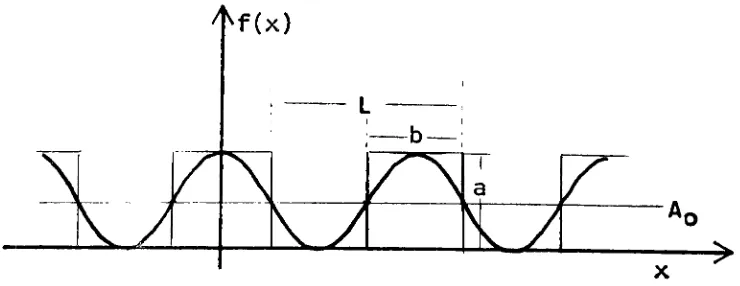
and so on.Figure
5.
Transmission
Distribution
of aSymmetrical
[image:18.571.115.485.495.638.2]11
For
the square wavein
figure
5,
the realform
of theFourier
seriesis:
Ar>
,v
f(x)
= +J>
Ancos(nwQx)
+Bnsin(nw0x)
(vi
)
2
i n =
I
where:
A0
=2C0
An
=Cn
+ Cn* =2
(real
part ofCn)
Bn
=i(cn
-cn*-
= -2(imaginary
part ofCn)
For
figure
5,
theFourier
coefficients are:cn
=ab ./.,.-_ ab
sin(TTnV0b)
.sin(nVnb)
=iL.
(vn)
L
L
TTnV0bsin(TTnV0b)
LTTnV0b
a
1
sin(TinV
b)
, sinceL
=Tin
Vc
sin(TT
)
, sinceb
=L
_
V
olln
2
2
2
Fourier
series and transformshave
been
put to usein
the electrical and mechanicalengineering
fields
to solvea
variety
of problems.Because
ofthe
similaritiesamong
physical
systems,
the principles ofFourier
mathematics12
t(x)
Figure
6.
Transmission Distribution
of aSymmetrical
Square Wave
andIts
First
Given
a symmetrical square wavetarget,
the
MTF
of animaging
system canbe
determined
from
the amplitude spectrumon the
input
target and the amplitude spectrum of the outputimage.
The
Fourier
coefficients at eachharmonic,
divided
by
the
level,
will yield a modulation value andhence,
aportion of the
data
point.MTF
(nw0)
Cn'l/
|C0'|
Cn
|
/
|
C0
|
n -
1
,
2,
3*.
(viii
)
The
primefigures
representdata
from
the
output amplitudespectrum while the others refer to the
input.
One
Fourier
analyzed square wave will yield a numberof useful modulation values.
Therefore,
the total numberof
targets,
exposures,developments,
and microdensitometerscans required to compute the
MTF
is
reduced(compared
to
[image:20.571.74.500.64.291.2]13
The
proposedANSI
standardfor
MTF
determination
requiresat
least
thirteen separate exposures.Using
a square wavetarget and
Fourier
analysis,
thenecessary
number of exposuresis
reduced with noloss
ofinformation,
since atleast
three
useable
harmonics
are present at eachfrequency.
Twenty-one
data
points canbe
obtainedusing
the
squarewave
frequencies
in
table2.
This
set meets the criterionset
forth
by
the proposedANSI
standard.TABLE
2
Square
Wave
Frequencies
andTheir
Harmonics
square wave
target
frequency
Fundamental
Cl
Third
C3
Fifth
C5
0.5
cycles/mm
0.5
1.5
2.5
1.0
1.0
3.0
5.0
2.0
2.0
6.0
10.0
2.5
2.5
7-5
12.5
5.0
5.0
15.0
25.0
20.0
20.0
60.0
100.0
25.0
25.0
75.0
125.0
14
EXPERIMENTAL
The
actuallab
work wasdivided
into
two
sections.The
determination
ofthe
MTF
using
the
conventional sinusoidal method andthe
determination
ofthe
MTF
viathe
square wavemethod.
Work
onboth
parts progressed simultaneously.MTF
viathe
Conventional
Method
The
sinusoidaltarget
usedfor
thisdetermination
wasobtained
from
the
Photographic
Science
department
atthe
Rochester
Institute
ofTechnology.
It
consisted of nineteendifferent
frequencies
ranging from
O.36
to41.6
cycles/mm.TABLE
3
Frequencies
ofSinusoidal
Target
0.36
cycles/mm2.90
9.
09
23.87
0.75
3.77
11.96
29.47
1.11
4.48
15.08
36.57
1.50
6.09
17.78
41.60
15
The
target wasimaged
ontoKodak
Plus-X
film,
using
a
Polaroid
MP-4
copy
stand with a4x5
Polaroid
Land
camera.The
target
wasbacklit
using
aGraphic
Lite
D5000
standardviewer.
To
producethe
full
range offrequencies
desired
(approximately
0.5
to160.0
cycles/mm),
the
sinusoidal targetwas
imaged
with a magnification of1.0
and0.25.
The
Plus-X
was
then
developed
in
Kodak
D-76
for
6.75
minutes at68
F
in
ahard
rubbertank.
The
resulting
images
were scannedwith the
Ansco
Model
4
Automatic
Recording
Densitometer.
The
traces
were analyzed andthe
MTF
was plottedfrom
thedata.
The
maximumfrequency
obtained withdefinite
modulationwas
36.36
cycles/mm.Since
it
wasfelt
thathigher
frequencies
should
be
possible,
the
Polaroid
system was suspected ofhaving
a ooor
quality
lens.
Since
thelens
board
mounting
systemmade
it
difficult
to substitute anotherlens,
a HoneywellPentax
35mm
SLR
with a55mm
lens
was substitutedfor
the4x5
Land
camera.The
sinusoidal target was againimaged
at1.0
and
0.25
magnifications ontoKodak
Plus-X
135
film.
A
through-focus
series was performed at each magnification.The
exposedfilm
wasdeveloped
in
D-76
for
the recommendedtime
at 68F.
The
exposures made at0.25
magnification were uselessbecause
of
heavy
streaks and abrasionsrunning
through
the
film
strip.However,
the exposures made at1.0
magnification were accept16
was
30.73
cycles/mm.This
value was alsolower
than whatwas
reasonably
expected of the system.The
resolving
powerwas measured
in
an effort todetermine
whatfactors
couldbe
responsible
for
thelow
frequency
response.A
through-focustest was performed on the
MP-4
system withthe
Polaroid
4x5
camera
head.
A
USAF
resolving
power target wasimaged
at amagnification of
1.0
ontoPlus-X
-+1
-+7film.
The
resolving
power of the system was
found
tobe
only
301ines/mm.
The
system was then examined
for
sources offlare
and a maskwas
incorporated
into
the apparatus to preventstray
light
from
the
D5000
from affecting
the exposure.Resolving
powerincreased
to45
lines/mm
with the use of the mask.Although
this was a
definite
improvement,
it
was still not at alevel
suitable
for
high
frequency
reproduction.Since
higher
frequencies
appeared tobe
difficult
toimage
withthe
existing
system,
it
wasdecided
thatonly
thefrequencies
obtainedwith the magnification of
1.0
wouldbe
used(table
3).
The
sinusoidal target was then
masked,
imaged
ontoPlus-X
film
using
thePolaroid
4x5
camerahead,
anddeveloped
in
D-76
for
7
minutes at 68F.
The
resulting
images
were scannedon the microdensitometer, the traces
analyzed,
andthe
MTF
17
MTF
via theSquare
Wave
Method
Several
methods ofmanufacturing
a suitable target wereinvestigated.
The
first
methodinvolved
the
use of twoRonchi
rulings,
1.97
and3.94
cycles/mm.These
rulings wereimaged onto
Kodak
Aerial
Film
Type
2430
using
the
MP-4 standwith a
Calumet
4x5
viewcamera,
at a magnification of1.0.
The
Polaroid
camera was not available at thistime.
The
film
was processedin
Kodak
DK-50
for
the recommended timeat
68
F.
The
resulting
images
were mottled and ofextremely
poor quality.
Variations
in
processing
time,
temperature,
and agitation
failed
toimprove
image
quality.From
theprocedures
conducted,
it
was concluded that thefilm
wasdefective
due
to poor storage.Kodak
Contrast
Process
Pan
Film
Type
4155
was substitutedfor
the2430.
The
rulingswere
imaged
againusing
thePolaroid
4x5
camerahead.
The
..o
film
was processedin
D-19
at68
F.
for
5
minutes.Although
these
images
were of suitablequality,
it
proveddifficult
and time
consuming
to adjust magnification and exposurein
order to obtain the eight targets
desired.
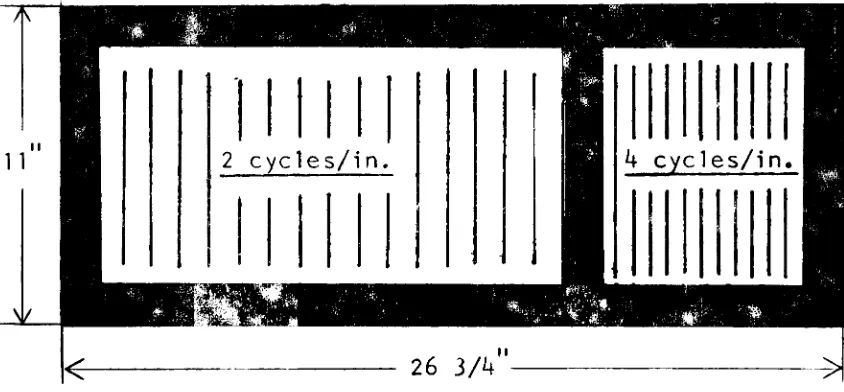
A
second method ofmanufacturing
the sauare wave targetinvolved
the use of Chart-Pak tape affixed to a piece ofwhite
mounting
board
(Figure
7).
Using
two sizes oftape,
18
simultaneously.
This
reduced the number of exposures neededfor
the
end product.The
master wasimaged
ontoGeneral
Photo
Products
lithographic film
at a3x
reductionusing
a
Kenroe
Vertical
process camera.The
film
was processedin
Kodalith
chemistry.This
system proved unsatisfactorybecause
the
maximumfrequency
reproduced wasonly
10
cycles/mm.The
same procedure was then performedusing
a RobertsonProcess
camera.
Resoution
increased
to30
cycles/mm,. It wasdecided
to use
this
system to manufacture targets of0.5,
1.0,
2.0,
2.5,
and5.0
cycles/mm.An
additional target wi thafrequency
of
1.25
cycles.mm was also made.The
1.0,
1.25,
and2.0
cydes/mm
targets
were sent toPhotographic
Sciences
Cor
poration where
they
were reduced20x
to yield targets withfrequencies
of20,
25,
and40
cycles/mm.The
contrast ratioof the
images
wasapproximately
1000:1.
These
eight targetswere then mounted on a glass support to
form
the originalsquare wave
target.
Since
it
wasdesired
tohave
the contrastratio of the square wave target equivalent to
the
contrastof the sinusoidal
target,
the original square wave targethad
tobe
duplicated
onto alower
contrast material.In
order to minimize
harmonic
distortion,
a reversal processwith a gamma of -1 was to
be
used.The
original square wavetarget was contacted onto a sheet of
Rochester
Fi lm
Co.
Type
19
for
5
and12
minutes(first
and seconddeveloper,
respectively).
Varying
development
times
failed
tolower
the
gammaappreciably.
Kodak
Plus-X
type
4147
was then substitutedfor
the
3T
microfilm and processedaccording
to
an article2
by
Arthur
S.
Beward
.Again,
the
gamma was toohigh
andvariations
in
processing
failed
to produce significant change,A
twostep
contact process was substitutedfor
the
reversalsystem.
The
original square wave targetwas
contacted ontoRochester
Film
Co.
Type
IK
microfilm which was then processedin
D-19 for
5
minutes at68
F.
Gamma
ofthe
1K
intermediate
was
2.09.
The
IK
intermediate
wasthen
contacted to a sheetof
Kodak
Plus-X
Type
4147.
The
Plus-X
wasdeveloped
in
D-76for
4
1/2
minutes to yield atheoretical
gamma of -0.48.(-0.48)(2.09)
= -1.00The
actual gammafor
the
Plus-X
was-0.42.Hence,
thefinal
gamma
for
the target was-0.88.This
last
image
is
calledthe
final
square wavetarget.
Its
contrast ratiois
approximately
10:1.
This
square wave target was thenimaged
ontoPlus-X
type
4147
film
using
theMP-4
stand withthe
Polaroid
head.
2.
Beward,
Arthur
S.,
"Reversal
Development
ofBlack
andWhite
Films,"RIT
Photo
20
A
mask was used withthe
square wavetarget
as withthe
sinusoidal
target.
The
exposedfilm
was processedin
D-76
at 68
F.
The
images
werethen
scannedin
the
microdensitometer.
The
traces
weredigitized
andthe
data
enteredinto
the
computer.The
actual calculation ofthe
MTF
is
described
in
the
discussion.
[image:28.571.66.488.297.493.2]21
DISCUSSION
This
section willbegin
with a sample calculation ofan
MTF
valuedetermined
by
square wave analysis.Computa
tion of the
sinusoidally
determined
MTF
is
explainedin
theTheory
section on page6.
For
thisexample,
frequency
patch#2
(VQ
=2.011
cydes/mm)
willbe
used.First,
the
microdensitometer traceis
examined.The
frequency
is
calculatedfrom
a minimum of10
cycles.The
maximum and minimum valuesfor
speculardensity
are then notedfor
the same10
cycles.They
are thenaveraged to yield one maximum and one minimum value.
In
this
case:
Specular
density
Dn*
=i'i?
Dmin
='7
The
nextstep
is
to "normalize" the trace to zero.Thus:
Specular
density
min
=22
The
speculardensity
is
now convertedto
diffuse
density
via
the
equation:Dd.ff
=0.751
(Dspec)
+(3.61
x10"3)
=
0.850
Only
the
maximum valueis
used as this representsthe
height
ofthe
trace.
The
diffuse
density
is
now convertedto
transmittance.According
tothe
equationfor
the
realform
of theFourier
coefficients(equation
vii),
this
willequal
(a).
transmittance
= a =0.143
(xi
)
Substituting
0.143
for
(a)
in
equation(vii)
yields thefollowing
valuesfor
Cn:
Q
Cn
1
0.146
3
0.015
5
0.009
Again,
from
the realform:
CQ
=level
=-2L-=
JL
. sinceb
= -~ andL
=23
Thus:
C0
=0.059
From
the
theory,
it
is
shownthat
the
MTF
asdetermined
by
the
square wave method of analysisis
calculatedin
the
following
manner:ICn'l/lCo'l
MTF
-nwo-jCn
|/|C,
Since
the primedfigures
representinput
values,
thedenom
inator
refersto
the
square wavetarget.
This
portionis
calculated
first.
HARMONIC
lnJ/l_Co|
1
0.639
3
0.208
5
0.125
The
nextstep
in
the
analysisis
to
examinethe
microdensitometer
trace ofthe
exposedimages
ofthe
squarewave
target
(the
Plus-X
samples).Again,
10
cycles wereused to calculate the
frequency
of the patch.Three
cycleswere then chosen at random and specular
densities
readat equal position
intervals
for
all three.The
three
readings at each position were averaged
together
to
yield24
one cycle of
the
square wave atthat
particualrfrequency.
The
computer program utilizedin
this
project wasobtained
from
the
RIT-User's
Computer
Center
library.
It
was written
by
John
R.
Merrill
ofDartmouth
College.
In
its
originalform,
the
program would generateits
own setof
data
asthe
program wasinitially
intended
for
instruc
tional
use only.The
program was modified sothat
any
periodic set of
data
couldbe
used.From
the
data,
the
Fourier
coefficients(An)
and(Bn),
andthe
value(A0)
are computed
(see
equation vi).An
example ofthe
computeroutput
for
frequency
patch#2
is
shownin
table
4.
TABLE
4
COMPUTER
OUTPUT
SAMPLE
AQ
=0.774500
HARMONIC
A
B
1
3.90585E-02 -0.3664923
-2.67930E-03 -4.60720E-025
-1.93645E-02 -2.41352E-03From
the
derivation
of the realforms
ofthe
Fourier
25
to
(An)
and(Bn)
in
the
following
manner:Cnl
= -T-\/An2+Bn2
UUi)
Sustituting
the
numerical valuesfrom
the
computer outputinto
equation(xi
i i
)
yields:HARMONIC
[Cn'l
1
0.185
3
0.023
5
0.010
The
numerator of equation(vi
i
i
)
is
now calculated.HARMONIC
lcn'l
/I
Co
1
0.477
3
0.119
5
0.026
The
numerator anddenominator
for
equation(vi
i i
)
have
now
been
computed.The
actualMTF
valueis
now calculated,HARMONIC
MTF
FREQUENCY
1
0.746
1.918
cycles/mm3
0.570
5.754
5
0.208
9.590
The
MTF
values are then plotted versusthe
corresponding
frequency.
The
total resultis
shownin
figure
8.
26
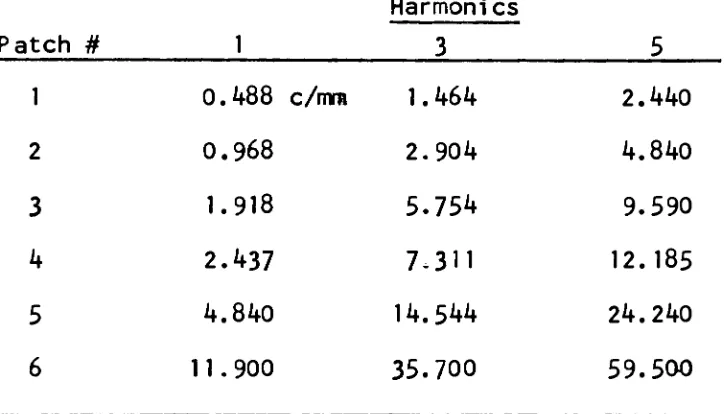
frequencies
ofthe
patches onthe
sample.They
aredirectly
proportional to
the
fundamental:
HARMONIC
FREQUENCY
1
x3
3x
5
5x
TABLE
5
FREQUENCIES
OF
SAMPLE WITH
HARMONICS
Harmonics
Patch
#
1
3
5
1
0.488
ic/mm1.464
2.440
2
0.968
2.904
4.840
3
1.918
5.754
9.590
4
2.437
7-311
12.185
5
4.840
14.544
24.240
6
1 1
.900
35.700
59.500
To
simplify
the explanation of theresults,
it
is
initially
assumed that theMTF
determined
by
the
conventional [image:34.571.105.467.311.518.2]27
then
be
compared againstthis
"correct"value
for
validity
and accuracy.
The
calculatedMTF's
for
each method ofdetermination
are plotted
in
Figure
8.
It
canbe
seen thatMTF
measuredby
the
square wave method yielded overalllower
valuesfor
the
lower
frequencies
(0
to
9
cydes/mm)
as comparedto
those
values obtained withthe
sinusoidal method.At
frequencies
higher
than
9
cycles/mm,
the
two
methods yieldedMTF
valuesthat
wereapproximately
equal.The
dashed
line
is
a plot ofthe
MTF
determined
by
the
square wave method-it has
been drawn
so asto
smooththe
trend
ofthe
actualpoints.
The
solidline
representsthe
MTF
determined
conventionally.
Both
methods show a peak atapproximately
1.5
cycles/mm,
followed
by
adecrease
for
frequencies
higher
than
7
cycles/mm.As
canbe
seen,
there
is
alarge
amountof
variability
associated withthe
square waveMTF.
In
addition,
there are two points(1.464
and7.311
cycles/mm)
which
fall
in
areasseemingly
unrelated tothe
generaltrend of the graph.
Differences
between
the
output ofthe
square wavemethod and the conventional method could
be
attributedto
several possible sources of error.The
first
ofthese
27a
CO TJ O .c jj 0) EX .* Q>
t/> >
to ro
4-> E 3
ro
SZ XI <u TJ 4J O 1_ Q) j: ro cn 3 4J 3 ro cj cr
S c E w r- O
r- 7 l W 4- ro
M (J C </)
CU ti o -u
OlTD r-C
1_ 0) 4-> T-ro u c o
h- a> a.
28
target.
When
manufacturing
the
target,
a gamma equal to-1.0 was required
to
eliminateharmonic distortion.
The
actual product gamma on
the
square wave target was equalto-0.88,
thus
indicating
the
inevitable
presence ofdis
tortion,
although minimal.When
calculating
theMTF,
harmonic
distortion
was assumed tobe
insignificant tosimplify
calculations.Related
to
this
are the computationsinvolving
thesquare wave
target
itself.
Examination
ofthe
microdensitometer
traces
ofthe
target showedthat
the
lower
frequencies
(0.5
to
5
cycles/mm) approximated perfect square waves.The
square wavetarget
was therefore assumed perfect sothat
a simplified
formula
for
computing
the
Fourier
coefficientscould
be
used.This
would thentotally
ignore
the mathematical considerations
for
any
harmonic
distortion
thatwas
present,
not to mentiondegradation
of edges and possibledevelopment
effects.Another
plausible source of error wasthe
Ansco
microdensitometer
usedto
scan theimages.
Once
calibrated,
it
would give reliable readings.Unfortunately,
due
toa
drifting
circuit,
re-calibration was requiredfrequently.
In
addition,
aboutmidway
through
theanalysis,
repai r workwas performed on
the
instrument.
At
this
time,
the
sinusoid29
method
MTF
analysis wasjust
getting
underway.Thus,
it
is
possible thatthe
adjustments made on the microdensitometercaused
the
MTF
obtainedby
the
square wave methodto
differ
from
that
ofthe
conventionally
determined MTF.
It
is
not conceivable
however,
that
the
microdensitometer wasresponsible
for
the
relatively
abnormaldeviations
in
the
MTF
valuesfor
the
square wave method.In
doing
the
calculations,
a problem was encounteredwhen
the
coefficients ofthe
target
were compared with thecorresponding
coefficients ofthe
sample.After
the
target
was
made,
it
was scanned withthe
microdensitometer,
andthe
frequency
of each patch calculated.The
target
wasthen
imaged
at a1.0
magnification ontoPlus-X
film.
This
wasthen
scanned,
andagain,
frequencies
were computedfor
eachpatch.
The
targetfrequencies
andthe
samplefrequencies,
however,
weren't equaldue
to
a magnification unequal toexactly
1.0.
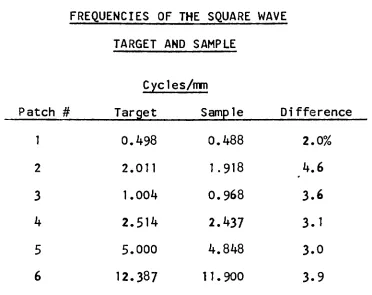
The
differences
are shownin
table6.
The
frequencies
usedfor
figure
8
were the samplefrequencies
-frequencies
ofthe
harmonics
were calculatedfrom
these
(see
table
5).
The
equationsfor calculating
the
MTF
requirethat
the
input
frequency
be
equal tothat
for
the
outputfrequency
for
that
specific point.Although
the
differences
areslight,
they
couldbe
enough to produce30
[image:39.571.93.465.79.374.2]TABLE
5
FREQUENCIES
OF THE
SQUARE
WAVE
TARGET
AND
SAMPLE
Cyc1
3s/mmPatch
#
Target
Sample
Di
fference
1
0.498
0.488
2.0%
2
2.011
1.918
4.6
3
1.004
0.968
3.6
4
2.514
2.437
3.1
5
5.000
4.848
3.0
6
12.387
11.900
3.9
Refering
to
figure
8,
there
aretwo
points(1.464
and7.311
cycles/mm) onthe
square wave methodMTF
curve whichappear to
bear
no relation tothe
generaltrend
of the graph.Both
these
frequencies
are thirdharmonics
derived
from
the
0.488
and2.437
cycles/mmfrequency
patches respectively.There
seems tobe
no obvious explanationfor
their
behavior,
as points
derived
from
the
samefrequency
patchfor
the
first
and
fifth
harmonics
follow
the general pattern setby
the31
CONCLUSIONS
The
results ofthis
research,
specifically
the
compar
i
si on of theMTF
asdetermined
by
the
twomethods,
canbe
briefly
summarized withthe
following
statements:1.
There
was morevariability
associated withthe
square wave method of analysis.
2.
Low
frequency
values(0
to9
cycles/mm)
generatedwith
the
square wave method werelower
than thosedetermined
sinusoidally
for
the
samefrequency
range.3.
High
frequency
values(9
to20
cycles/mm)
generatedwith the square wave method were
slightly
higher
than
those
obtainedconventionally
overthe
samerange of
frequencies.
4.
Both
methods yielded curves with the same generaltrend.
While
it
is
possibleto
name various sources of erroras the causes
for
thefirst
threestatements,
the
fourth
clearly
indicates
thatMTF
via a square wave method ofanalysis can
be
performedyielding
results similarto
a32
the
shape of the two curves arerelatively
similar suggeststhat
the square wave method canbe
usedfor
an accurateMTF
determination.
Elimination
ofthe
sources of errordescribed
in
the
discussion
couldeffectively
reduce theamount of
variability
in
the
square wavemethod,
thus
making
it
a reliable measurement.The
use of ahigh quality
square wave
target
in
ahigh
resolution photo-optical systemwould no
doubt
be
afirst
step
in
reducing
thevariability
encountered
in
this project.The
results ofthis
experimentare
only
valid,
ofcourse,
for
the
system that was used.By
using
Fourier
mathematics,
the square waveis broken
down
into
sinusoidal components(harmonics).
The
coefficientsof these
harmonics
are then calculated andsubsequently
used to compute the
MTF.
Thus,
severaldata
points canbe
obtainedfrom
a single square wavefrequency.
In
thisproject,
only
thefirst,
third,
andfifth
harmonics
wereused.
Three
points were therefore calculatedfrom
onefrequency
imaged
on thefilm,
thus
reducing
the
number ofrequired targets
(to
obtain al1
of the requiredfrequencies).
In
otherwords,
MTF
via square wave analysisusing
ahigh
resolution photo-optical system would entail
less
workthan an
MTF
determined
sinusoidally
and yetit
would retain33
From
the
outcome ofthis
analysis,
it
appears thatthe square wave method could
be
afeasible
routefor
deter
mining
the
MTF
of a photo-optical system.Although
ahigh
degree
ofvariability
was encounteredin
the
output ofthe
square wave
method,
it
clearly
showedthat
it
followed
the34
35
o CM O ^O o CN cn c p-P ro o <L> r-> r 1_ a ti ti o a ur-(T\ r" ro o
M r- rr\
t/> L. cn r a> cm
i u <
U- <u a;
p c a
u r- >N
ro ro
36
E * i u-o !_ u 1 2: _ ro (/) 1_ <L> <L) > > 1_ CV ti CXL of-o o m
t- 1
+- CU
m Q.
cn T >s *rmm l_ 1
37
E ^t" ^ 4-O u cj ^ cu z > l_ *: ti . o cu\ ^~ o
Q.
\ ^* 1 >
4-1 I- *
\ . (0
\
-^ r\
"p~ 1_ O\
u" QJ38
4-1 M-CU o Di L_ L. u ro r" h- z: cu *L > ro 12 CU D. CU >N u f-ro o 3 vOCT O .
CO o
1-cu E 4-J ^7-ro P" p Ll. Q CU u E CU i_ 4-1 cu in 4-J CU c X
11 CJ o
40
w c cu o
OJ
m
3
0.80
4-1
r~
in
sz CD -a
s_
ro
3 CJ CU
D.
00
0.60
0.40
41
1.00
Fig.
15
Microdensitometer
Calibration
Curve
Sinusoidal
Sample
a.
200.40
Diffuse
density
[image:50.571.71.438.148.658.2]42
4-1
r
in
c cu TJ
CU
m
3
H-
43
>-4-> ^
m
c
QJ TJ
CU
in
3
44
X. m x ro E
\ 4-J O
SL ro c
,__ TJ X
ro CU 4->
c
cnr-o ro 3
f
E 4- r- C
c O
cu 4-J
!-> CU -t-i
c cn o
o L_ 3
o ro tj
45
o^ cn -r-.* (/> ro x E u. 01 4- C
2: ro
sz
r TJ
4-ro <u
c cn 2 0
r E
c
4-> - O
c 1
cu M 4->
> CU u
c cn 3
0 U "O 0 fo cu
46
X .*
m u_ ca
1 M E S ro
X
r TJ 4-J
o ro QJ
T-CM c cn 3 o ro 1
E c U) 4-J r- O r c P" Ll. QJ 4-> 4-J
> CU CJ C cn 3 o l_ TJ o ro cu
bl
TABLE
7
PROCESSING
DATA
FOR
FIGURES
8
THROUGH
20
8.
Kodak
Plus-X
Type
4147,
developed
in
D-76
at 68F
for
7
minutes9.
Kodak
Fine
Grain Aerial
Duplicating
Film Type
2430,
developed
in
DK-50
for
5
minutes at68
F*10.
Rochester
Film
Co.
Type
3T
Reversal
Microfilm,
developed
in
D-19
(2.53
g/1NaSCN
added)
for
12
and5
minutes(1st
and2nd
developer)
at 68F
11.
Rochester
Film Co.
Type
IK
Microfilm,
developed
in
D-19
for
5
minutes at 68F
12.
Rochester
Film
Co.
Type
IK
Microfilm,
developed
in
D-19
for
5
minutes at 68F
13.
Kodak
Plus-X Type
4147,
developed
in
D-76
for
4
1/2
minutes at 68
F
14.
noprocessing
involved
15.
Kodak
Plus-X
Type
4147,
developed
in
D-76
for
7
minutesat 68
F
16.
Kodak
P
minutes
lus-X
Type
4147,
deveolped
in
D-76
for
4
1/2
, at
686
F
17.
Kodak
Plus-X
Type
4147,
developed
in
D-76
for
7
minutesat 68
F
18.
Kodak
Plus-X
Type
4147,
developed
in
D-76
for
7
minutesat 68
F
19,
Kodak
Plus-x Type
4147,
developed
in
D-76
for
7
minutesat 68
F
20.
KodakPlus-X Type
4147,
developed
in
D-76
for
7
minutes48
TABLE
8
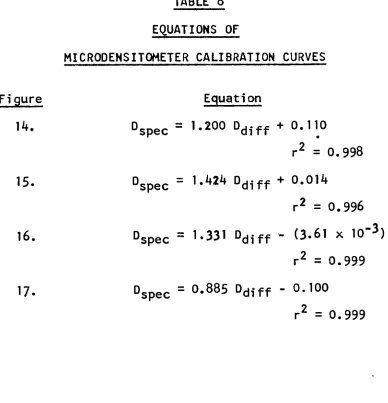
EQUATIONS
OF
MICRODENSITOMETER
CALIBRATION
CURVES
Figure
Equation
14.
Dspec
=1.200
Dd.ff
+0.110
r2
=
0.998
15.
Dspec
=1.424
Ddiff
+0.014
r2
=
0.996
.-3-16.
Dspec
=1.331
Ddiff
-(3.61
x10"J)
r2
=
0.999
17.
DSDec
=0.885
Ddiff
-0.100
specr2
=
0.999
Note:
All
microdensitometer scans were made with a [image:57.571.72.460.117.520.2]7*9
GENERAL REFERENCES
1.
Kodak
Technical
Pamphlet,
M-61,
Kodak Aerial
Films
and
Photographic Plates
2.
Kodak
Data
Book, P-52,
Techniques
ofMicrophotography
Precision
Photography
atExtended
Reductions
3.
Spiegel, Murray
R.,
Mathematical
Handbook
ofFormulas
and
Tables,
Schaum's
Outline
Series
4.
Sturge,
John
M.
,editor,
Neblette's
Handbook
ofPhoto
graphy
andReprography,
Chapter
9,
"The
Microstructure
of
the
Photographic
Image,"by
M.
Abouelata,
pg
197
5.
Shaw,
Rodney,
editor,
Selected
Readings
in
Image