1977
The CQDRNG8 - a quadratic, isoparametric,
axisymmetric finite element for the NASTRAN
computer program
John Gray
Follow this and additional works at:
http://scholarworks.rit.edu/theses
This Thesis is brought to you for free and open access by the Thesis/Dissertation Collections at RIT Scholar Works. It has been accepted for inclusion in Theses by an authorized administrator of RIT Scholar Works. For more information, please [email protected].
Recommended Citation
Approved by:
John F. Gray
A Thesis Submitted
in
Partial Fulfillment
of the
Requirements for the Degree of
MASTER OF SCIENCE
in
Mechanical Engineering
Prof.
Prof.
Wayne Walters
B. Karlekar
Prof. ____
~N~e~v~i~lIe~R~ie~g~e~r
____ _
Prof. ____
R_ic_h_a~r~d~B_.~H~e~tn~a~r~sk~i
__ _
DEPARTl'-1ENT OF MECHAJ.1I CAL
Ei~GIN EE-RING
ROCHESTER INSTITUTE OF TECHNOLOGY
ROCHESTER, NEW YORK
The success of this undertaking is
largely
due to the cooperationof many persons. I would like to express my deepest gratitude to the
following:
To my wife Phyllis and my son Kevin for their patience and under
standing throughout this time period.
To Dr. V.
Genberg
and Mr. P.Mueller,
Eastman KodakCompany,
for their suggestions and technical advice.
To S.
Wall,
J.Joseph,
and R.Harder,
The MacNeal-SchwendlerCorporation,
for their gracious assistance in providing needed insightinto the MSC/NASTRAN program.
To Professors W.
Walter,
my thesis adviser, and N.Rieger,
RochesterInstitute of
Technology,
MechanicalEngineering
Department,
for theirguidance and suggestions.
To Eastman Kodak
Company
for use of the computer facilities andMSC/NASTRAN finite element program are given. The element is an
eight-noded isoparametric quadrilateral of quadratic order. The
following
matrices and capabilities are developed:
*
1. stiffness matrix for homogeneous isotropic materials,
2. thermal conductance matrix for homogeneous isotropic materials,
3. calculation of equivalent nodal forces due to temperature
loads,
k.
calculation of stresses, and5 plotting of undeformed and deformed structures.
Several classical thermal and structural problems are solved to
demonstrate these capabilities. In all cases, the element results
compare well with theory. Comparisons are made to existing MSC/NASTRAN
axisymmetric finite elements. The new element shows increased accuracy
compared to the existing elements. Convergence of the element is
Nomenclature iii
I. Introduction 1
II. Literature Review
3
III. Axisymmetric Structures
7
IV. Element Derivations
9
A. Stiffness Matrix
9
B. Thermoelastic Loads
17
C. Stress
Recovery
19
D. Conductance Matrix 21
V. Additions to NASTRAN
25
VI. Example Problems JO
A.
Bending
ofSimply
Supported Flat Plate J2B. Thermal Expansion of Circular Disk
39
C. Thermal Expansion of Hollow Sphere
43
D. Heat Flow in a Circular Disk
47
E. Heat Flow in an Axial Rod
57
F. Heat Flow in a Hollow Sphere
59
G. Thermoelastic Stresses in a Hollow Cylinder 64
VII.
Summary
68
VIII. References 72
IX. Appendix A
75
2 Gaussian integration and stress points 20
3
Stiffness matrix partitions 284
Deflections of simply supported plate33
with center load
5
Deflections of simply supported plate35
with concentric circular load6
Stresses in simply supported plate37
with load on concentric circle
7
Plot of circular disk model40
8 Deflections of disk with center hole -
4l
uniform temperature change
9
Plot of hollow sphere model44
10 Thermal expansion of sphere
45
11 Circular disk models - CQDRNG8 elements
49
12 Circular disk models - CTRIARG elements 52
13
Circular disk temperatures-55
Convergence test14 Temperatures in axial rod - 58
enforced end temperatures
15
Temperatures in hollow sphere - 60enforced temperatures at surfaces
16 Temperatures in hollow sphere - 62
enforced temperature at ID
-convection at OD
2 Deflection of simply supported circular plate J6
with load on concentric circle
3
Stresses in simply supported circular plate 3^with concentric
loading
4
Thermal deflections in disk42
5
Thermal expansion of hollow sphere46
6
Circular disk temperatures - convergence test 567
Temperatures in hollow sphere -61
enforced temperatures at surfaces
8 Temperatures in hollow sphere
-63
enforced temperature at ID - convection at OD
9
Stresses in hollow cylinder66
ar'fl'a Normal stresses in r,6,z directions and shearing
x stress in rz plane
rz r
e >e >e Normal strains in r,9,z directions and shearing
v strain in rz plane
'rz r
E Young's modulus
v Poisson
's
ratioVOL Volume
u,v Radial and axial displacement components
N-_
Shape function associated with node ia>3 Local element coordinates
U Thermal potential function
q Heat flux
density
k Thermal conductivity
x^ Generalized coordinate
I >
Vector[ ]
MatrixL
J
Inverse of a matrixIT
{
}
,LJ
Transpose of vector or matrixI
Determinant of a matrixLkJ
Stiffness or conductance matrix(
ui
Nodal vector of unknowns(displacements
ortemperatures)
(p)
Nodal vector of applied loadsi
o}
Element stress vector{
}
Element strain vector]
Wj* Gaussian integration weighting factor
is the absence of a higher order quadrilateral axisymmetric ring element.
The objective of this thesis is to fill this void. A suitable element
with limited capabilities was developed
by
Janucik. This effort is anextension of that development. Additional capabilities are developed
and this element is implemented in the NASTRAN program as a DUMMY element.
This element, named the
CQDRNG8,
has many capabilities. Elasticstiffness is calculated for homogeneous isotropic materials. Thermo
elastic
loading
is supported. Plots for both undeformed and deformedstructures can be obtained. Element stresses are ouput at the centroid
and the four corner grids of each element. Stress invariants calculated
include the principal stresses and
directions,
the maximum shear, andthe octahedral shear. A thermal conductance matrix is calculated for
homogeneous isotropic materials thus providing a steady state heat trans
fer capability. The C(^DRNG8 is an eight noded isoparametric quadrilateral
element which allows quadratic variation of displacement and temperature
within the element. A number of user options exist with respect to
both NASTRAN and this element.
The CQDRNG8 element's capabilities are illustrated
by
solving severalclassical thermal and structural problems. In all cases, very good
correlation is observed between theoretical and finite element solutions.
Convergence of the solution for
increasingly
detailed finite elementare those
by
Zienkiewicz.
'2 in ^Btexts,
Zienkiewicz develops thegeneral
theory
for finite element analysis. His texts also includeindividual sections on specific finite element formulations. A compre
hensive treatment of the use of isoparametric shape functions is included.
Finally
Zienkiewicz devotes a discussion to solving general field problems using finite element methods. Particular references are made to
the heat transfer problem.
h
The text
by
Przemieniecki addresses itself to the solution ofstructural problems using matrix techniques. Some simple finite element
formulations are developed. This text includes a thorough treatment of
matrix substructuring the reduction of matrix size
by
partitioningoperations.
Segerlind-^
presents a finite element text which is not structures
oriented. Finite element formulations for heat
transfer,
fluid mechanics,and elasticity problems are developed. Axisymmetric field problems
(both
steady state and transient)
are discussed. Computer implementation of the various finite element formulations is discussed. A
number of instructional computer programs are listed.
Desai develops the finite element matrices for the structural
problem. Techniques for nonlinear analysis are discussed. He presents
methods, integration
In his paper, Ergatoudis describes a
family
of isoparametricquadrilateral finite elements. He presents isoparametric shape functions
for
linear,
quadratic, and cubic elements. Special variations includeadditional internal degrees of freedom and a mixed order finite element
o which can have different numbers of grids along each edge. Baldwin
gives the computer routines for a quadratic order isoparametric thin
plate element and demonstrates the accuracy of the element for the
solution of
bending
problems.Detailed derivations of finite element matrices for heat transfer
problems are given
by
Lee-0 and MacNeali Both authorsdevelop
theconductance and capacitance matrices for the finite elements in NASTRAN.
MacNeal also develops the structural, matrices for the NASTRAN elements.
Lee presents several examples
illustrating
NASTRAN's heat transfercapabilities.
Doherty's12
paper develops several higher order axisymmetric
finite elements. Quadrilateral elements are formed
by
combining variousnumbers of triangular elements then eliminating interior grid points.
In an effort to avoid midside grids, mixed order triangular elements
are combined such that a quadratic displacement function exists interior
to the element but only a linear variation occurs along exterior edges.
The developments include the effects of orthotropic and temperature
Kohler uses general quadrilateral elements
having linear,
quadratic,and cubic temperature variations. In his paper, Zienkiewicz^ presents
higher order isoparametric finite element formulations for the solution
of two and three dimensional transient field problems. He develops a
transient solution formula and solves a heat conduction problem.
The basis for this work is a thesis submitted
by
Januciki In hispaper, Janucik develops the stiffness matrix for the eight noded iso
parametric quadrilateral ring element. He presents a stand alone computer
program for utilizing this capability. He describes several limitations
relating to this program
including
numerical precision, core, and problem size constraints. The current work is designed to enhance thecapabilities of this element and to eliminate the problems
by
adding the element to the NASTRAN finite element program.The NASTRAN texts
by
Wall^U are the basis fordesigning
andadding the software to realize this new element capability. A thorough
description of the general NASTRAN techniques used in
formulating
andsolving the desired equations is presented. The texts outline the
specific capabilities needed. Detailed formats of the tables and
matrices needed
by
the programmer are presented along with instructions for utilizing available NASTRAN capabilities. The extensive NASTRANand special modeling considerations are described
by
Joseph. NASTRANcan efficiently be analysed as two dimensional ones
by
properlytreating
the components of displacement and strain. The symmetry of both structure
and
loading
allow the behaviour to be completely describedby
consideringonly a cross section of the structure. This cross section must pass
through the axis of axisymmetry and be normal to the circumferential
direction. The symmetry requires that the circumferential displacement
be zero. In the development of this element, the restriction is imposed
that the axis of axisymmetry be the z axis and that the cross section
considered lie in the x-z plane. In this paper, the cylindrical coord
inates
(r,0,z)
will be employed. The x coordinate then is the radialcoordinate r and the circumferential coordinate becomes . The z coordi
nate remains unchanged. The displacement components of interest are the
r and z translations. In the context of this geometry, four components
of stress are defined the three normal stresses
{a
, aD, a)
andr 6 z
the sheer stress in the plane
(T
).
Due to the symmetry, the shearrz
stress in the r-z plane is the only non-zero shear stress.
In heat transfer, symmetric thermal
loading
requires that the heatflow in the circumferential direction be zero. The two non-zero components
of heat flow are in the r and z directions.
In finite element analysis, this cross section is modeled using
axisymmetric elements. Axisymmetric finite elements are really rings of
re-volved through 360 to form a solid ring. The complete volume is
represented
by
modeling the right half of the cross section(
r*0).Axisymmetric loads applied to grid points represent the total force
(
or heat flow)
applied to the circular arc formedby
revolving the[K]{u}={P}
(1)
where
[
KJ
is the structural stiffness matrix,{
u}
is the vector of nodaldisplacements,
and{
P}
is the vector of applied forces.-The stiffness matrix can be derived from the structural potential
function the strain energy. In matrix notation, the strain energy
in an element is
JZS =
i
f{
a}
T{
e}
dVOL(
2)
where
{
a}
is a vector of internal stresses,{
-}
is a vector of internal strains, andthe integration is performed over the volume.
Castigliano'
s Theorem states that the derivative of the strain energy
with respect to the displacements is equal to the applied forces.
Writing
Castigliano's Theorem and substituting from equation(
1)
90
= {P}
=Q
K]
{u}
(3)
9{u}
Before the derivative can be evaluated, the strain energy must be
written in terms of the displacements.
First the constitutive equation relating
{
a}
and{
e}
can bewritten
{
a}
=[D
]
{
e}
(
4
)
{
a}
={
e}
=iQ
z
The constitutive matrix
[_
DJ
is given in Timoshenko^as
E(l-v)
(l+v)(l-2v)
1 V
i-v
V1-v
V 1 V
1-v 1-v
V V 1
1-v 1-v
0 0 0 l-2v
2(l-v)
(
5)
Substituting
into the expression for the strain energy yields?
=h
/(
e}T
[dJ
{
e}
dVOL(
6
)
Next an expression relating strains to displacements is written. The four components of strain are defined as
(
7)
'z Jr,
Continuous displacement functions are written using isoparametric
shape functions
u = I N. u.
111
(8)
v =JI. v.
11 1
where u. and v. are displacement components at the i grid point, and
N. is the shape function associated with the i grid point.
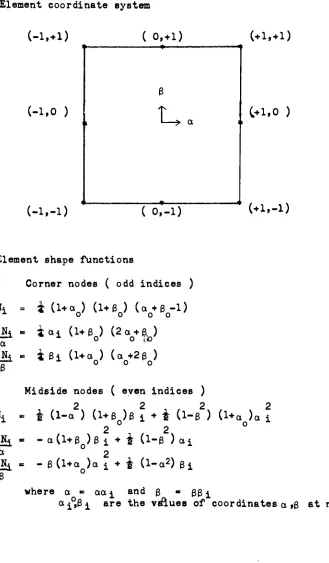
The element coordinate system and the shape functions for an eight
2
noded isoparametric quadrilateral element as defined
by
Zienkiewiczare shown in Figure 1.
Arbitrarily
shaped elements are mapped into the2
by
2 square shownby
the same shape functions:r = I N.
(a,B
)
r.
(
9)
z = Z N.(a,3)
z.
ii l
where r. and z. are the r, z coordinates at node i.
l l
Since the shape functions vary quadratically in a and
3,
the displacements also vary quadratically within the element. The mapping of coord
inates allows curved geometries to be modeled. This concept gives rise
to the name isoparametric
literally "same
parameters". The sameparameters are used to describe both the geometry and the displace
ments. One of the properties of the shape functions is that at grid
i,
the i shape function has a value of 1.0 and all other shape functions
are
identically
zero. As describedby Zienkiewicz,
isoparametric shapefunctions
inherently
satisfy the conditions necessary for convergence.These conditions are:
FIGURE 1. ELEMENT COORDINATE SYSTEM AND SHAPE FUNCTIONS
Element coordinate system
(-1,-1)
(-1,0
)
(-1,-1)
(
0,+l)
*
(
0,-1)
(+1,+1)
T
C+i,o
' ? a u
*
(+1,-1)
Element shape functions
Corner nodes
(
odd indices)
N-i
(l+a)
(1+3
J
(a
+6-1)o o
9N-.
=iai
(1+3
)
(2a
+a)
5T
o o ,o9Ni
=iei
(l+a ) (a
+26)
96Midside nodes
(
even indices)
i
-i
(l-o
)
(l+60)6
i +
* (1-6
)
(1+a
)a
t
2 2
aKj,
--a(l+B)8 i +
i
(1-6
)
oi3a 2
3N- = - 6(l+a
)a
i +
i
(1-a2)
6i
36
where a = aa
i and 3 33j_
[image:21.568.119.448.139.702.2]Substituting
the displacement relations into equation7
yields thestrain displacement relations
{
}
=[Bj
{
U}
where the matrix
[_
Bj]
is defined as(
10)
3N. 0
3N0
0 3N_ 0 9N, 0 9N 0 9N. 0 gN,. 0 9NQ 0 dv.1 y7^ ~7Z-> 3~r4 t~t> ~z~bz f 3: 9r
h
r 9r 0N2
r 3r 0 N r 3r 0h
r 3r' 0N^
J> r 3r 0Nr
r 3r^7
r 3r 0Nq
r[
B]
=| 0 M. 0 _3NQ 0
3N0
0I
9Z1 3z2 ~3
3N, 0 3N^ 0 3N^ 0 9N
3z"
9z 3z'
f?
ii"7 0 ii63Nrj
il-, M-,
MP M?
Mo Mo
Mi,
Mk
Mc
IL
M^
M-;
M7 M7 M^
MLa
I 3z 3r 3z 3r
9zJ
9r
"dT*
3r 3? 8? 3z 3? 3z'
3r' 3^ 9r
To evaluate the derivative terms in
|_
B^j
the change of independent coordinate must be considered. This is accomplished
by
applying the chainrule and
differentiating
the shape functions with respect to the localcoordinates 3 and a.
9Nj
=3Nj 3rj
+ 3Nj3_zi
933ri
333Zi
333^ = aN-
-r-+ 3M-
gz-3a 3ri 3a 3z^ 9a
In matrix notation, this becomes
9_r _z 33 33 2 a* 3a 3a 3r aiii
The squere matrix is defined as the Jacobian
LO
il
il
33' 33
3r gz
9a 3a
(
12)
The derivative in cylindrical coordinates can be determined as
j
3r X.|
Mi
i 3z[J]
-13Nj
33
Mi
^3a
;
(
15
)
The Jacobian is evaluated
by differentiating
equations 9In matrix notation this becomes
M
_gN2
M3
JE4
i^5
M6
i^7
i^6
33 33 33 33 33 33 33 33
jN-j^
jjNg
j
_3N^jjN^
_3Ny _3Ng 3a 3a 3a 3a 3a 3a 3a 9aSubstituting
into equation(
6
)
givesrl zl
T2 z2
r3
^4z5
z4r5
r65
26r7
-'8
z7
z8
(
14)
0
=\
ff{
u)T[B]TrE]
[B]
{
u} dVOL(
15
)
The displacement vectors are treated as constants, giving
0
=i
{
u}T//
Castigliano'
s Theorem can now be applied giving:
3<t> =
{
P}
= //[
B]T[
D] [
B]
dVOL{
u}
(17)
3{u}By
comparison with equation(
3)
, the stiffness matrix is seen as[K]
= //[B]T[D]
[B]
dVOL(18)
If
desired,
displacements can be transformed to a different coordinate system
by
the equation{
u}
=[T
J
{
u}
(19)
where
(_
TJ
is a coordinate transformation matrix.The stiffness matrix then becomes
[k]
= //[T]T [b]T
[
D]
[B] [Tj
dVOL(20)
In cylindrical coordinates, the volume integral can be written as
VOL = /// r dr d9 dz = 2 Tiff r dr dz
(21)
r8z rz
where r is evaluated from equation
(9).
This integral must be written in terms of the variables 3 and a.
The relation between the two coordinate systems is defined
by
2
Zienkiewicz as
dr dz =
|
J|
d6 da(22)
where
|
J|
is the determinant of the Jacobian matrix.Making
this change of integration variables, the stiffness matrixthen becomes
[
K]
= 2ir //The integration is best performed numerically using Gaussian quadrature.
Then the stiffness matrix is written as
[Kj
= 2 tt EI [TjT[B]T[D]
[B]
[T
] |J|
rW(23b)
ij
1Jwhere n is the order of the Gaussian integration required, and
W is a weighting factor.
As described
by Janucik,
a minimum integration order of3
IsB. THERMOELASTIC LOADS
Equivalent nodal forces are derived
by
assuming a virtual displacement at element nodes and equating the internal and external work.
Let
{
C}
be a vector of virtual displacements at the nodes. Thedisplacements and strains within the element then become
{u}
=[Nj
{
-.}
(
24)
{
-}
=[B]
{
5>
as defined
by
equations(
8)
and(
10).
If{F}
is the vector ofnodal
forces,
the external work is{
t\}
{
F}
. The internal workper unit volume done
by
stresses and distributed forces is{
}T{
a}
-{
u}T
{
p}
(
25
)
where
{
p}
is a vector of distributedforces;
Substituting
from equation(
24),
this becomes{
C}T
[B]T{
a}
-{
?}T
[N ]T
{P}
(
26)
The total internal work is obtained
by integrating
this expressionover the volume of the element.
Integrating
and equating the externaland internal work gives
{
?}T
{
F} ={
C }T< /
[B
]T{
a}
-[NjT{
p} > dVOL
(
27
)
Since this relation must be valid for any virtual
displacement,
theequivalent nodal forces become
{
f] = /[b]T{
a}
dVOL - /[N]T
If initial stresses are specified , the equivalent nodal forces are
{
F}
= /[B
]T{
CT}
dVOL(
29
)
If initial strains are specified instead of stresses, substitution of
equation
(
4
)
into the above gives(F>
= /[B]T[D]{e}
dVOL(
30)
Equivalent forces due to distributed loads are
{
F}
= /[
N]
T{
p}
dVOL(
31)
The thermoelastic problem is treated as an initial strain case.
The strain vector due to a temperature change DT is
{
e}
=\
a ^f
(
32)
o
I
a DTV
0J
where a is the coefficient of thermal expansion.
Nodal
forces due to a temperature change DT thus become{F}
=/[b]T[d]{q} dVOLor in cylindrical coordinates
{
F}
= 2 tt //[B]
[
DJ
{
eQ
}
r dr dz(
33
)
Transforming
to element coordinates and using Gaussianintegration,
this is expressed as
{
F}
= 2* ZZ[B]
[
D]
{
C. STRESS RECOVERY
Stresses are calculated from equation
(
4
),
{
a}
=[
D]
{
e}
The strain vector must be relieved of all strains due to thermoelastic
expansion since these are stre6s-free strains. The strain vector
thus becomes
{
e}
=[
B]T{
-}
-{
e}
(
35
)
o
where
{
}
is defined as in equation(
32)
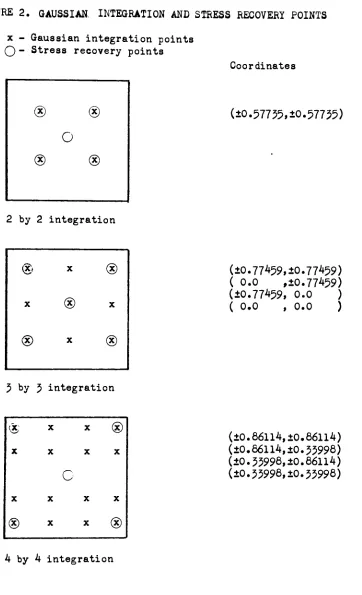
oStresses are evaluated at five points within each element the
centroid and the four cornermost Gauss points as shown in Figure 2.
Stresses are extrapolated
linearly
from the centroid through eachcornermost Gauss point to each corner node. Stresses are output at the
centroid and the four corner grids. At each stress point, stress
invariants are calculated. These include the three principal stresses,
the direction cosines associated with the first principal stress, the
FIGURE 2. GAUSSIAN.
INTEGRATION
AND STRESS RECOVERY POINTSx - Gaussian integration
points
O
- Stressrecovery points
2
by
2 integrationCoordinates
(o.57735,0.57735)
(0.77459,
0.77459)
(
0.0 ,0.77459)(0.77459,
0.0)
(
0.0 , 0.0)
3 by 3
integration(0.86ll4,0. 86114)
(0.66ll4,0. 33998)
(0.33998,
0.86114)
(0.33998,
0.33998)
[image:29.568.101.463.102.697.2]D. CONDUCTANCE MATRIX
The heat transfer equation is analagous to the structural
equilibrium equation
[
K]
U>
=(P>
In structural analysis,
[KJ
is the stiffness matrix, *{
u}
is a vector ofdisplacements,
and{
P}
is a vector of applied loads.In the thermal system, these are defined as:
LK is the heat conductance matrix,
{
u}
is the nodal temperature vector, and{
P}
is a vector of applied heat flows(P=qA).
In heat
transfer,
only one degree of freedom the nodal temperatureexists per grid point.
The thermal conductance matrix can be derived from a potential
function in the same way that the stiffness matrix was derived from
the strain energy. The thermal potential function is defined as
U =
-|/ q7u dVOL
(
36)
where q the heat flux
density,
andVu the temperature gradient are
q =
qx
i +q2
j
+q5
k(
37
)
Vu=3_u[
i +3u_]
+3_u k3 xi 9 X2 3
xj
Forming
the dot product gives~q.Vu =
qj^
^
+^2
+q3
(
38)
The components of the flux q. are related to the temperature gradient
by
2 J 3
x2
where kk^. is a component of the material conductivity matrix, and
j
J is summed over the dimensions of the space.Substituting
equation(
59
)
into equation(
38)
and expressing theresult in matrix notation yields
U, =
A/
{
[
kt
]
{
3_u> dVOL(
40
)
Xi
Xj
The temperatures are assumed to vary within the element
by
the isoparametric relation used before
u =
[Nj
{
u0
>
(
41
)
where
{
u} is a vector of constant nodaltemperatures,
andNJ
is the matrix of isoparametric shape functions.Since the nodal temperatures are constants, the derivative term is
expressed as
{
}
=[
]
{ uQ }
(
42)
3x-3x-_
Substituting
this into equation(
40
)
givesw
-*/
{uo}
[al]T[kij]
[j1{u0}
dVOL(45)
9
xi
9x{
which is of the desired form
U = i
{u/
[
K]
{u0}
(
44
)
The conductance matrix
[K
J
is[
K]
=/ [3N]T[k.j]
[
g_Nj
dVOL(
45 )
In axisymmetric analysis, the radial and axial components of heat flow
are considered. For homogeneous isotropic materials, the material
matrix is
k 0
0 k
The derivative matrix becomes
["J
(
16
)
r *
L 3*- Jj
Mi
M2
M5
M4
M5
M6
M7
Ms
'3r 3r 3r 9r gr gr gr gr
gN 9N gN
gN^
gN-gN
gN?
gN
9z!gz gz gz gz gz gz gz
(
47
)
where as before
te
- [j]-1r^i)
!
3r iJ
33(
48
)
;
sn3NJL
\ 3a1
where J 1 is the Jacobian matrix defined in equation
(
14),
and3,
a are element local coordinates as shown in Figure 1.Writing
the volume integral as before and using Gaussianintegration,
the thermal conductance matrix is written as
[k]
H
3%
3r
9NX
3zaii2
3r 3Z 9N 3 -r 3N, 3 z . .gNg
9rA
3Z k 0 0 k 3N 3N Sr1 3r 3Jl dl2 3Z 3 z 3N_ 378 a"a 3ZIn equation 49, i and
j
are summed over the order of the Gaussianintegration. W is a weighting function associated with the
V.. ADDITIONS TO NASTRAN
NASTRAN has a capability for adding additional elements. This is most readily accomplished via the DUMMY element technique.
Internal to NASTRAN exists a group of
dummy
subroutines.They
are included only so that calls to these element dependent routines canbe made. To implement a new element capability,
functioning
elementroutines must be written, compiled, and link edited into the NASTRAN
program. Each of the routines must perform a specific task. Sub
routine names include the
identifying
number of the DUMMY element(1-9).
A subroutine KDUMi
(i
is the DUMMY element number) uses a NASTRANtable of element information to calculate the element stiffness or
conductance matrix. Subroutine DUMi calculates equivalent element
nodal loads due to thermal loading. Subroutine PDUMi sets up a con
nection array of grid points for plotting the undeformed and deformed
structure. Two subroutines are used to calculate element stresses
and a third is used to output the stress information in convenient
formats. Subroutine SDUMil obtains element material data and calcu
lates quantities which are constant for each element. This information
is passed to subroutine SDUMi2 for final calculation of stresses and
invariants. Headings and stress data are output in subroutine OEUMi.
A
listing
of these subroutines is given in Appendix A.There are a number of characteristics which are common to all the
driving
subroutine until all elements have been processed.Secondly
all element information is passed to the new subroutines in labeled
common areas. Element data is in regular NASTRAN table format but
the amount of data is specified
by
the user as input data at executiontime. The number of grid points connected, the amount of property
data,
and other connection data is specified on the ADUMi card. Thisdata is used
by
thedriving
subroutines when preparing data for theelement routines. These
driving
routines place the portion of thetables needed for the element currently
being
processed into thecommon areas for use
by
the element routines.Finally
a number of NASTRAN utility subroutines are available tothe new subroutines. Some of the subroutines must be used to obtain
material properties,
temperatures,
and displacements. Other subroutinescan optionally be used for common matrix operations, such as multipli
cation and
inversion,
or to exercise other convenience options asdesired. The utility subroutines and their functions are listed in
Appendix A along with the element subroutines.
In NASTRAN all grid points are assumed to have
6
degrees of freedom
(dof
)
5
translations and5
rotations except in heat transferwhere only 1 dof per grid is defined. This convention allows connection
of many diverse element types. The matrices generated in the element
routines must associate
6
dof with each grid point. For the 8 nodedCQDRNG8 element, only 2 dof per grid have stiffness associated with
must be expanded to a
48 by
48
stiffness matrix(6
dof times 8 grids)by including
null rows and columns before it can be added into theoverall stiffness matrix for the structure. In the KDUMi routine,
the full stiffness matrix is not calculated at one time. Instead
NASTRAN uses the concept of a "pivot" grid. The element routine is
called once for each grid in the element. The grid associated with
the particular call to the element routine is called the "pivot"
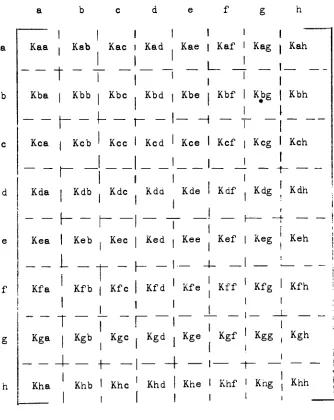
grid. The eight
6
by
6
matrix partitions, as shown in FigureJ,
which connect the "pivot* grid to each of the eight element grids
(including
itself)
are calculated and inserted into the overallstiffness matrix. This technique was used when NASTRAN was first
developed because of the relatively simple elements available then.
It was usually cheaper to recalculate portions of the element matrix
than to store and retrieve it. The advent of higher order isopara
metric elements and the numerical integration required for these
elements made this an undesireable technique. A new technique in
which the entire stiffness matrix is calculated and stored is cur
rently
being
used for all new elements added to the MacNeal-Schwendlerversion of NASTRAN
(MSC/NASTRAN).
Since this newer technique is notnow available for DUMMY elements, the older technique was used. The
matrix generation time for this element is comparable to the times
for existing elements. The new technique will be available for
DUMMY elements in the future. The generation time for a CQDRNG8
FIGURE 3- STIFFNESS MATRIX PARTITIONS
b c d e f g h
Kaa i Kab Kac I Kad
1"
I
Kba|
Kbb i Kbc KbdKca
|
Kcb'
Kcc
I
Kcdr
I
Kda Kdb , Kdc Kdd
--h-r-i-
-Kea
I
Keb , Kec|
Kedi
'
IKfa Kfb | Kfc
|
KfdKae | Kaf
_
L_
_I
Kbe
J
Kbf
-H
Kce
I
Kefl_
_Kde
I
KdfKee , Kef
Kfe , Kff
r
__T__ _r_
Kga
|
Kgb Kgc(
Kgd1-
y
-| 1- -i
Kha Khb
I
Khc ' KhdI
Khe I KhfKag
I|
KahKbg
I
|
Kbh\
I
Keg
I
Kch t 1 1l
Kdg
;
KdhKeg
KehKfg
I KfhKge Kgf
I
Kgg
, KghKng
j
Khh [image:37.568.112.446.155.575.2]times for similar elements range from .1 to .8 seconds.
Three new NASTRAN data cards are required for this element.
These data cards
(ADUM3,
CQDRNG8,
andPQDRNG8)
are described inAppendix B. The new data cards define the properties and connectivity
of the element.
Existing
NASTRAN data cards are used to locategrid points, constrain
dof,
applyloads,
and define material propVI. EXAMPLE PROBLEMS
The CQDRNG8 element has been implemented in version 34 of the
MSC/NASTRAN finite element program. A number of classical problems
have been solved using this element as implemented in NASTRAN. In
all cases, the element showed good correlation with theoretical
solutions. Three problems each will be used to demonstrate elastic
and heat transfer capabilities. In addition to these theoretical
test cases, an attempt was made to solve a thermoelastic problem
previously solved using finite difference techniques. The example
problems to be discussed are listed below in the order of presen
tation:
A.
Bending
of a circular simply supported plate.Deflections are determined for a center load. Deflections
and stresses are determined for a load on a concentric
circular ring.
B. Thermal expansion of a circular disk.
Deflections are calculated for a disk which has expanded
due to an increase in temperature.
C. Thermal expansion of a hollow sphere.
Deflections and stresses are calculated for two temperature
distributions:
1. a uniform temperature throughout tne sphere which is
higher than its reference temperature, and
2. a linear temperature variation through the thickness
of the sphere.
D. Heat flow in a circular disk.
A disk with a small center hole has the temperatures at its
inner and outer surfaces constrained. Internal temperatures
are determined using several finite element
discretizations-to demonstrate convergence. The same problem is also solved
E. Heat flow in an axial rod.
Internal temperatures in a rod with constrained end temperatures are determined.
F. Heat flow in a hollow sphere.
Temperature distributions are determined for two sets of
boundary
conditions:1. constrained temperatures at the inner and outer
spherical surfaces, and
2. constrained temperatures at the inner spherical
surface but convection at the outer surface.
G. Thermoelastic stresses in a hollow cylinder.
Stresses due to transient temperature distributions are
determined for particular times and compared to a finite difference solution.
For convenience, computer results have been reduced to tabular and
graphical form.
This element suffers the typical finite element problem with
regard to stresses.
Compatability
of stresses in adjacent elementsis not ensured
by
the formulation.Consequently
when stresses arecalculated for grid point locations which are common to several elements,
different stresses result. The most common method of
treating
thisdiscontinuity
is to average each stress component at common gridpoints. The stresses presented in this thesis were calculated in this
A. BENDING OF SIMPLY SUPPORTED FLAT PLATE
The thin circular flat plate of Figure
4
was analyzed using the21 finite element mesh shown. Theoretical results are from Timoshenko.
Two
loading
conditions were considered. First a load was applied atthe center. Figure
4
is a graph of normalized deflection versus radialposition. Results are presented for the theoretical solution, the
CQDRNG8 element solution, and the CTRIAX6 element solution. The
CTRIAX6 is the triangular counterpart of the C<}DRNG8 and currently
exists in NASTRAN. It should be noted that the theoretical solution
is for
bending
deflection only whereas the finite element solutionsinclude the effects of shear. Tabular results are presented in
Table 1. The finite element solutions are nearly identical and are
within
2.5
%
of theory.The second
loading
condition considered is that of a uniformload applied along a concentric circle. Displacement results are
presented graphically in Figure
5
and in tabular form in Table 2.Again the displacements agree very well with the theoretical result
from Timoshenko. The maximum difference was less than
1.25
%.
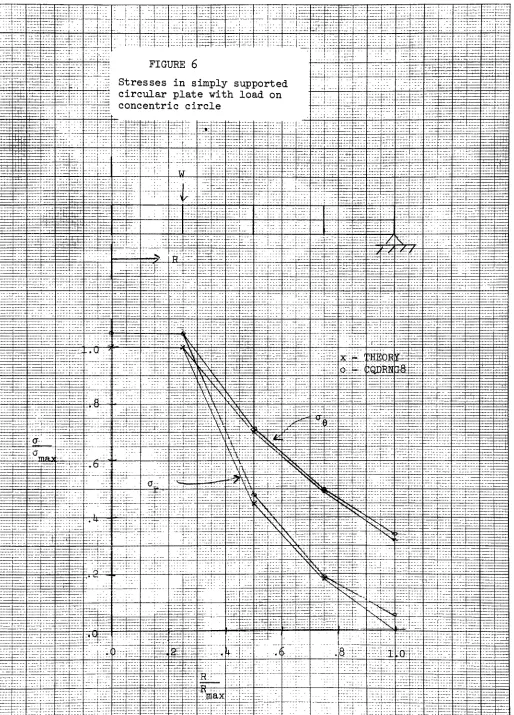
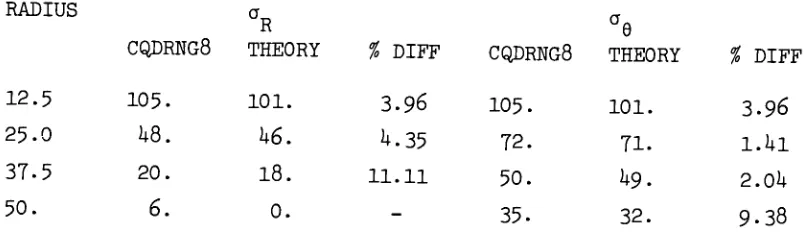
Stresses were also calculated for this case. Stress results are given
in Figure 6 and Table 3 Both the radial and
hoop
stresses agree toDeflections of simply supported
TABLE l.
Deflections
ofsimply supported plate with center load
RADIUS DEFLECTIONS
(
IO-4inches
)
CQDRNG8 THEORY
%
DIFFERENCE
CTRIAX6
0-0
1.925
1.879
2.411-25
1.824 1.802 1.21LM
2.50 1.648
1.635
.79 1.544
3-75
1.421 1.413.61
tklt
5.00 1.161 1.155
.53 150
6.25
.880 .876 .48 .6767-50 .588
.585 .47 .587
8-75 .292
.291
.59 .291
10.00 .0 .0
.0 .0
FIGURE
5
=
*
Deflections of simply supported plate with concentric circular
[image:44.568.29.540.33.698.2]TABLE 2. DEFLECTIONS OF SIMPLY SUPPORTED CIRCULAR PLATE
WITH LOAD ON CONCENTRIC CIRCLE
Radius Deflections
(
inches)
CQDRNG8
Theory
%
Difference12.5
3-6643.709
1.2118.75
3.217
3.252 1.0825.0 2.658 2.681 .86
31.25
2.0262.043
.8557.5
1.358 1.368 7343.75
.676 .681 73rtir FIGURE
6
Stresses in simply supported
circular plate with load on concentric circle
[image:46.568.50.564.27.742.2]RADIUS ct
R
ae
CQDRNG8 THEORY
%
DIFF CQDRNG8 THEORY%
DIFF12.5 105. 101. 3.96 105. 101. 3.96
25.0
48.
46.
4.35
72. 71. i.4i37-5 20. 18. 11.11 50.
49.
2.0450.
6.
0. [image:47.568.107.510.183.304.2]B . THERMAL EXPANSION OF CIRCULAR LISK
To test the thermoelastic
loading
capability, a circular diskwith a center hole was subjected to a uniform temperature change.
The temperature of the ring was raised
by
100F
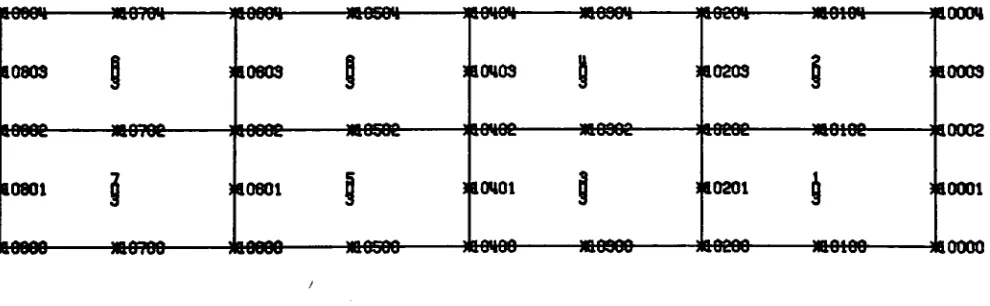
resulting in athermoelastic expansion of the disk. Figure
7
is a plot of thefinite element model. Grids are indicated with ap * . Grid identi
fication numbers are to the right of the *'s. In the center of each
element is the element identification number. The disk was unconstrained
in the radial direction and was constrained at the outside in the axial
direction. As shown in
Timoshenko,
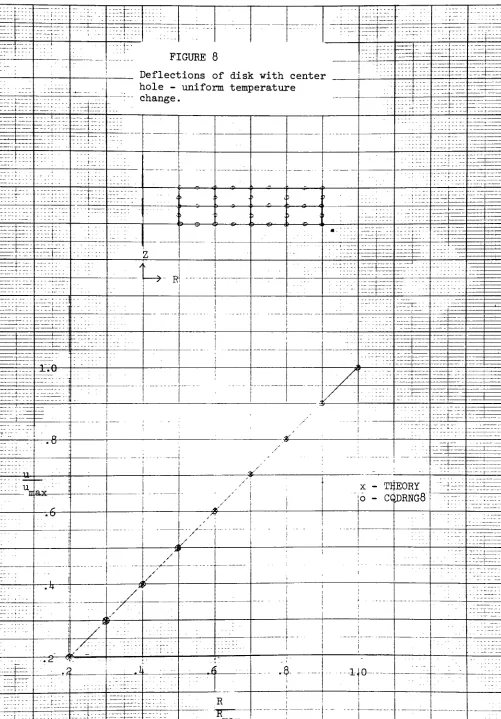
the disk should undergo a stressfree radial and axial growth. Displacement results are shown in Figure
8 and Table
4.
The predicted displacements are exactly those fromU/18/77
eeeit-)10803
W070M eeeH
310603
xaoscw 3*ete4
sResen-310U03
9ee* moiot
310203
-JjaOOOU
310003
sweee-310801
MOTOe
3weee-310801
IB050S JlOtOfi moooe JlOfiOC woioc -310002
310001
ibesee- mo70o ^aoooo 3110500
310401
3O0H00 HIOOOO
310201
itaoeoo 3P0100 -JHOOOO
FmM8fRJtlEBBflliiSST
[image:49.568.27.522.424.577.2];:; FIGURE
8
-7. :
IDeflections of disk with centei
lole
-uniform temperature
* yyy ,. .. .
rr
"
rr -IZLZZZZl-, .
1 rrjrr:
... t.
-T
fl
,
i
s..1::-] J
.. . -1 rrrrrr : ---... i !:-: -
-i -
-" i. ; 1" > ; * < > J > s
' I.i .
-
-::::::
r Jrrrr
:-::\z:s . .
-:::::_::
... <1 5 1
)
s .i C .; s < 5 .> i
t
i .
.
EErr yf.\ ;
1 rrr ffy7\ .. . z rrrr -:rrr|rr "' '---'- tr-1 -sz::: /
l
J
-77: '"77-27: ~y
.^ i
:.::
,
i .:::::r : ... .. ... ...
j r:. ..
fyy-7 zzzJxs.s -..22.
..
rrTrr:-
---:
zzzzzzsr. : :
j 1 ,.___ ! 1 :_: :..
1
j . ; :_4 1 "1" f\ _-.--rr1 - -
-1
r
_L.U
rrrr i J
: 1 rrrrrr rrr fyfy :-t=r~ | 1
zszzz.zzzz rr j -yy-yy
:rr|rrT \ ' ! .
!
.y J-2 " p -ylfs. ti : ---. 0 r /,. > ..
, ___!____ t
I
A -yj ...
rrrrrrrr
2.2 u
ax ' / \ x
- THEORY
"io - coriRNr.fi
-^
: * rr /j
-|
-J---\ D &i _: :.rrrrr
' 1
-
-/
/
i
<i
---_ 11 ' 1 1
\
a / A 1 . . --Z1f:.:
""]
f / rrrr2:
.:.-.4 : jay
_
1
j 1 rrrrrr
zz:.::-:. r; -./ 1 ::1r3-~ _. ] I " B
y
P 1 rrr : -- - -i -'--" '-i
rrrrr.. .... . .2
4
-;'
I-j
-y
--sz. -.2 -f r:r rrr 7f2l:yf --.rrrrrrrrrrr: fZffj,yf: :
'-'.._ R t
t ._ ...:.-..-. . -i i -. R -.:s z-.:r
-Z2f7\2~.~_ \ ~. -::.-:;:.
[image:50.568.41.542.26.745.2]TABLE
4
-Thermal deflections in disk
RADIUS DEFLECTIONS
CQDRNG8 THEORY
%
DIFFERENCE10.0 .0010 .0010 0.0
15.0 .0015 .0015 0.0
20.0 .0020 .0020 0.0
25.0 .0025 .0025 0.0
30.0 .0030 .0030 0.0
35.0 .0035 .0035 0.0
40.0
.0040 .0040 0.045.0
.0045 .0045 0.0 [image:51.568.123.380.184.339.2]C THERMAL EXPANSION OF HOLLOW SPHERE
A symmetric section of a hollow sphere was modeled as shown in
the plot of Figure 9. This sphere was subjected to two different
temperature distributions. Symmetric
boundary
conditions were appliedto the cuts of symmetry. Theoretical results from Timoshenko are given.
In the first case, the sphere is at a uniform temperature which
is 100 F above its reference temperature. The sphere expands radially
due to the new temperature distribution. As shown in Figure 10 and
Table
5
the CQDRNG8 displacements are exactly those expected(0.0
%
error). Since the sphere is unconstrained, all stresses are zero.
The second case considered a linear variation of temperature
through the thickness. This temperature distribution caused internal
bending
stresses. Theoreticalbending
stresses at the surface for a100aF temperature difference are 2080 psi. The CQDRNG8 predicted
stresses of 1950 psi at the OD and 2250 at the ID. These predicted
FIGURE
9
Plot of hollow sphere model
2/18/77
0104
[image:53.568.34.530.242.745.2]rrLrr
: ! r.
...:.
t . ._
ir.
1
.-!.:-. .:.:.::. rrr: L_.. 1 '^1
--i-
-.... .:::y rrrr rrr l.N. -; - -: r.r " I <>
- - ra.
--.:
I
Vr--j -..
. . B.
-3) ; -y1 ( i -22227 rrrr
- -
X
\-'.-.':
:r:r rr
te
- - j
--- rrr rrrr
R . . '. .;::.: :
rrr
r rrjrr_
50 in in '* . _..j. y . -"
^40
-: rrr - - -- - _._...rrfrrrj
: _._... -- - -1 :rrr ] .00""--''- i
. ---
-7--- -- -rrrr __.
1
__, /- -- -- -i ]-rrrr._rrrrrr
/
rrrrr
"T
.OR i
/ ' j
\I
X - THEOF Y
..rrrrr 1 i
y
i / i ----/
!
o -CQDRNG8.
i urUr
rmaxy
i
;
Lon
1 i j i - r-.PF,2.2. .
-- ..
.fio
I-'- .. . - -
-rr.:. r.
< "
30 .
35
oo95
1 (W - ___:_-..
-
j-*Wx
[image:54.568.41.547.26.750.2]---TABLE
5
-Thermal
expansion of hollow sphereRADIUS RALIAL DEFLECTION
CQDRNG8 THEORY
%
DIFFERENCE40.0
.00400 .00400 0.042.5
.00425 .00425 0.045.0
.00450 .00450 0.047.5
.00475 .00475 0.0 [image:55.568.109.368.172.267.2]D. HEAT FLOW IN A CIRCULAR DISK
To demonstrate the convergence of the C0.DRNG8 element, the prob
lem of heat flow in a circular disk was solved. The disk has a small
centerhole constrained to 0.0aF. The outer diameter of the disk is
constrained to 100. 0*F. This problem was solved using the three dif
ferent discretizations shown in Figure ll* The models contained
8,
2,
and 1 CQDRNG8 elements respectively. The problem was also solvedusing three similar gridworks of CTRIARG elements. These models are
shown in Figure 12. The CTRIARG is a three noded triangular ring
element which currently exists in NASTRAN. Each CQDRNG8 element has
been filled with eight CTRIARG elements and an additional degree of
freedom has been added at the center. The CTRIARG element has a
linear temperature variation as compared to the quadratic variation
of the CQDRNG8 element.
The results of this study are shown in Figure
13
and Table 6..22
Theoretical results are from Carslaw. For the coarsest model, the
1 CQDRNG8 element with 2 unconstrained degrees of freedom gives the
same results as 8 CTRIARG elements
having 3
dof. The temperaturesare in error
by
10.57%.
The 2 element CQDRNG8 model with7
unconstrained dof predicts temperatures which are in error
by
I.58 to12.16
%.
The CTRIARG model with 16 elements and9
unconstraineddof predicts temperatures greater in error. The error in the CTRIARG
model ranges from
2.23
to 13.70%
In the finest models, the CQDRNG8with 8 elements and
27
unconstrained dof has a maximum error of 9.96%
The CTRIARG model with 64 elements and
55
unconstrained dof had aIn all cases, the CQDRNG8 models had one-eighth the number of
elements and at least one-fourth fewer degrees of freedom than the
CTRIARG models. For the coarest model, the single CQDRNG8 element
was comparable to the eight CTRIARG elements. For the other models,
a moderate increase in accuracy was realized. The CQDRNG6 element
does exhibit the convergence characteristic. Each refinement of the
FIGURE 11 a
Circular disk model
1 CQDRNG8 element
2 unconstrained dof
tl/28/77
360002
380001
330000
FIGURE 11 b
Circular disk model
2 CQDRNG8 elements
7
unconstrained dof1/28/77
tf0002
ikiooi
^eoooo
[image:59.568.51.539.442.552.2]FIGURE 11 c
Circular disk model
8 CQDRNG8 elements
27
unconstrained dofU/28/77
3M8M-110803
I
WwC-3W070H
*wee<*-310803
3B0SOH 3I0H0H
310U03
3HW--jwse**-
3eeH-310203
310B02
W010H
3B010C
-31000U
310003
-310002
310001
-310000
M070C
310801
318888- K10700
3ieeee- mosog wosoa
310801
itaoeoo
I
3110500
3I0H01
3WWfr- 3B0800
310201
ifaoeoo 3P0100
aiSWfcWWIffl
fl L. .T.E9TFIGURE 12 a
Circular disk model
8 CTRIARG elements
3
unconstrained doftl/28/77
480002
0000
[image:61.568.64.554.430.537.2]U/28/77
FIGURE 12 b
Circular disk model
16 CTRIARG elements
9
unconstrained dof3C0002
iteoooo
[image:62.568.64.553.447.556.2]FIGURE 12 c
Circular
disk model64
CTRIARG elements35
unconstrained dof1/27/77
13
Circular disk temperatures Convergence test
L33I33L
:r}rr
^y
--.%-rfcrzr:
jy
yy.
M
THEORY
JJ: o 64 CTRIARG
(35
dof)
3L3n 16 CTRIARG
(
9
dof)
-- a 8 CTRIARG
(
3
dof)
X 8 CC4DRNG8(27
dof)
y
+ 2 CQDRNG8(
7
dof)
O 1 C<-DRNG8(
2dof)
3E-iifi
-313333E33333
^fe
703
,333
3t333
333311
33F.3
R!
iax
[image:64.568.40.546.35.744.2]TABLE
6
- Circulardisk temperatures - convergence test
RADIUS TEMPERATURES
THEORY CTRIARG RESULTS
35
dof%
Diff9
dof%
Diff3
dof%
Diff1.000 0.0 0.0 0.0 0.0 0.0 0.0 0.0
7.125
50.194244.00
12.35
13.250
66.0527
61.51
6.86
57.OO 13.7019.575
75.7660 72.464.36
25.500 82.7878
80.41
2.8677.93
5.8674.03
10.57
31.625
88.2906
86.67
I.83
57.750 92.8161 91.82
1.07
90.75
2.13
43.875
96.624696.19
.4550.000 100.000 100.00 0.0 100.00 0.0 100.00 0.0
RADIUS TEMPERATURES
THEORY CQDRNG8 RESULTS
27
dof%
Diff7
dof%
Diff 2 dof%
Diff1.000 0.0 0.0 0.0 0.0 0.0 0.0 0.0
7.125
50.194245.19
9.9613.250
66.0527
63.224.28
58.02 12.1619.375
75-7660 73.71 2.7125.5OO 82.7878 81.34 1.74 79-36
4.13
74.0210.57
31.625
88.2906 87.30 1.1237.750 92.8161 92.21 .65
91.35
1.5843.875
96.6246 96.38 .25 [image:65.568.75.461.181.572.2]E. HEAT FLOW IN AN AXIAL ROD
Temperatures were determined in an axial rod with constrained
end temperatures. The theoretical solution from Carslaw predicts
a linear temperature variation through the rod. The model and
results are shown in Figure 14. The CQDRNG8 model predicts the
F- HEAT FLOW IN A HOLLOW SPHERE
The final thermal test case is that of a hollow sphere. The
sphere is analyzed for two sets of
boundary
conditions. The firstcase is that of constrained temperatures at both the inner and outer
diameters. The theoretical solution is presented in Carslaw. The
finite element model is the same as that shown in Figure 9 Figure
15
and Table7
show both thetheory
and CQDRNG8 results. For thiscase, the CQDRNG8 results are exact
(0.0
%
error).For the second case, the inner diameter temperatures are con
strained and the outer diameter is subjected to convection. To
represent the convection
boundary
condition, special NASTRAN heattransfer
boundary
condition elements(CHBDY)
must be used in conjunction with the CQDRNG8 elements. The
theory
for this case isalso found in Carslaw. Figure 16 and Table 8 show the comparison
.rrr:rrr K.
"rtl1 T
-:::f2:i-i riil
rr.r
rr:
: 11
rr:
r:n_rnl rr rr .:.::
-,.. 33c:
,:::j
iT 1 711 _. J_+^-.rrr . : rr
-rr: rrrr_..<t..
<S
y
-._ sr:11:1sz. -222-'::'::-777r~Ki
-; r:.rrrrIr2- rrr:
'
,
--- -
-i>,._
*. -1*. .:/. .sr.
.7777 jlr..rr r. lil. zr. r :::r sly .: Tr r rrr -'----:-- - -r -r-r: -"-r -s-: -r.r -1?-y.~ 77V i-i 7 .. . f
rLrr ;;: ._..
*
L
-*T- ..:::rrr rrr: rrr
rr
A
:y -72. r
-
;-'
. : r -'2
:r:
-t
--- s- --.
K sz: ---
-\zr. \ -
V--V
.rr rr: .:..:rr: 1'
;
rrr rrlr -:r:r rr. rr: rrr: rrr r : :
R: :l:rlrrr 11:1' --v
-x
.... r n -.: rrr ..:::rr: ":z .rrr.rrrrrrr rrrrrrr T - -i i ....rr rr. rr.
r :r rrr| _ -^ ', t:
rrr"rr rrr
---rrrr
rrr1777717 rr: 1 i2z 27z'zKl Kl
..-- .
;:3:- r
-7: 7 22.7Ki
\'- -: -... -- -777-
-H-r-7-7- rrrr rrrr rrr:
rrrirrr r-rr
.. ___.- - '
~^-k
"" i ""rt" "rrrrr rrrr rl: rrr
rr rrrrrrrrrr
''-7-.::
:-_-:Kl2727rrr
x.u.
-7-rrr: rr:
1 77
"
rrrKrlri11 Kl-11: -r-rrIKrrrr. rrr rrrr r~rr_,
--Kl
rrr
-Lrrr
''-'--:::-rrr: -rrrr
I :
-rrrrrrrrr[-:r -rrr :'~-7
--___
rrrr rrrr
,---rrl
K
f""r -1. ss rt-: '& r : }
-.rrrrrrr.-777
-; - i
rrrr:rrrrr
r i
y
r" "! :rrr rrr - ---=7
:--r'lrKlrrr rrrr
-: -:. -: r
72/
szz: " ^K 7.^y
-rrr rrrrrr~r .__r
:_
rrrr rrrr:rrrr: rrrr r-.-17
:r-722
.r ;
3:;- rr -rrr
-Trr ----
---
y7-"
^r
-maxQ7-.cH
--^ ^r-rr -"j7:
f
^ II :rr --:- :s:-rr: -.:--:.-.sr1 - "
L7::
rrrr-rr
,
-7 ... - -
-- i ... ,. -: f " " .. [
-sz: /-
----rrrr rrr r :;
;-
-rrr --./ -I ..:: : r:
x :THI
OR^} -r ---(rrrrr rrrr rr: rr: j'
I
lrirrrr7227 K
::::: 6 COI RC
-K
rrt \
'
;, r
K--'- ':'--:
3-3 rlL
lr: zz . :h
- ;----__r; j rrr.
t
rrr
7-rr-/
---722: sr.
-
:..:!:--rrr
'
. . .
rrr
rrrrrrrr) -:r 7-2
-.
i: --
-'
i
rr ^__-._;rrr rrrrK rrr -sz7'7-Z rr : r
--- -7- ""
7 177 7
- -- 1
_, i
-rcr
L
-/
--- -rr ss: rrr:
- 1
K- -
-i- --
-j ;i
"I rr -.szrr rr rrrr r: rr
7 7"! 7 17Fi":
r _r rrr
;
--; s
/--'-'-'-'- ":---T rr rrr
i
-i
.: rL:. r
r rr ' j"
1 ^
Vi
, l -7y
*-i'.r l 1 r
[image:69.568.33.540.30.685.2]TABLE
7
-Temperatures in hollow sphere
Enforced temperatures at surfaces
RADIUS TEMPERATURES
CQDRNG8 THEORY
%
DIFFERENCE40.0
100.00 100.00 0.042.5
129.41 1294l
0.045.0
155.56 155-56 0.047-5
178.95 178.95 0.0 [image:70.568.116.379.177.303.2]TABLE 8
-Temperatures in hollow sphere
Enforced temperature at ID Convection at OD
RADIUS TEMPERATURES
CQDRNG8 THEORY
%
DIFFERENCE40.0
42.5
45.0
47-5
50.0
100.00
127-97
152.84
177-05
199-04
100.00 128.28 153.42
175.91
196.15
.0
.24
.38
.65
[image:72.568.140.396.125.325.2]G. THERMOELASTIC STRESSES IN A HOLLOW CYLINDER
Schlottner presented a finite difference solution for transient
thermal stresses in a hollow cylinder. The cylinder, at a uniform
initial temperature and with convection at the outer
diameter,
wassubjected to an increase in the ambient temperature. The resulting
transient temperature distributions create internal stresses. Since
the CQDRNG8 element does not include a transient heat transfer cap
ability, the heat transfer portion of the problem could not be solved.
However thermal stresses could be determined at particular time steps
if a reasonable estimate of the temperature distribution could be
made. Schlottner's solution gives the temperatures at the ID and OD
of the hollow cylinder at various times. For a first approximation,
the temperature distribution through the cylinder was assumed to be
linear. The finite element model is shown in Figure 17. As shown
in Table 9, . the stresses for the two time steps listed are approx
imately
10.0 to 25*0%
lower than those predictedby
Schlottner. Asecond approximation of the temperature distribution was arrived at
by
solving the steady state heat problem usingboundary
conditionsA-U
from Schlottner'
s solution. At the 26 time step of Schlottner
's
solution, the OD temperature was close to a steady state condition
but the ID temperature was not. For the steady state problem solved,
the ID temperature was constrained to the value predicted
by
Schlottner4/12/77
xioaco "Qoaoi xicaoa xaoaos yioao'j xioaos xioaos xioao7 3*10209
3S01CC 1D3 310102 2D3 310104 303 sa0106 403 SSOiOS
XiOOOO X10001 X10002 X100Q3 X10004 X10005 XXOCOO XG0007 3I90CG9
[image:74.568.120.484.430.554.2]TABLE
9
- Stresses in hollowcylinder
TIME SCHLOTTNER LINEAR TEMP
%
SS TEMP%
STEP STRESS STRESS DIFF STRESS DIFF
ID OD ID OD ID OD ID OD ID OD
15 16000 19000 12000 14000 25.0 26.3
shown in Table
9,
this resulted in -poorer correlation at the IDbut much poorer correlation at the OD.
This comparison is
by
no means a rigorous test of the CQDRNG8element's capabilities and is included only to provide a comparison
to another numerical method. To determine the correct thermoelastic
stresses, the correct temperature distribution must be known. Con
sidering the approximate nature of the temperature assumption, the
VII. SUMMARY
The development and application of an axisymmetric finite element
for the NASTRAN computer program has been presented. The element is
an eight noded isoparametric quadrilateral ring with an assumed
quadratic displacement and temperature function. The element has
been named CQDRNG8. Element capabilities include elastic stiffness
for homogeneous isotropic materials, thermoelastic
loading,
heatconduction for homogeneous isotropic materials, deformed and
unde-formed plotting, and stress recovery. Stress invariants calcu