This is a repository copy of Preserved differentiation between physical activity and cognitive performance across young, middle, and older adulthood over 8 years.. White Rose Research Online URL for this paper:
http://eprints.whiterose.ac.uk/84512/ Version: Accepted Version
Article:
Bielak, AA, Cherbuin, N, Bunce, D et al. (1 more author) (2014) Preserved differentiation between physical activity and cognitive performance across young, middle, and older adulthood over 8 years. Journals of Gerontology, Series B, 69 (4). 523 - 532. ISSN 1079-5014
https://doi.org/10.1093/geronb/gbu016
[email protected] https://eprints.whiterose.ac.uk/ Reuse
Unless indicated otherwise, fulltext items are protected by copyright with all rights reserved. The copyright exception in section 29 of the Copyright, Designs and Patents Act 1988 allows the making of a single copy solely for the purpose of non-commercial research or private study within the limits of fair dealing. The publisher or other rights-holder may allow further reproduction and re-use of this version - refer to the White Rose Research Online record for this item. Where records identify the publisher as the copyright holder, users can verify any specific terms of use on the publisher’s website.
Takedown
If you consider content in White Rose Research Online to be in breach of UK law, please notify us by
Appears in Journal of Gerontology Psychological Sciences (Accepted version)
January 30, 2014
Running Head: PHYSICAL ACTIVITY AND COGNITIVE CHANGE
Preserved differentiation between physical activity and cognitive performance across young,
middle, and older adulthood over 8 years.
llison A. M. Bielak1, Nicolas Cherbuin2, David Bunce3, & Kaarin J. Anstey2
1
Department of Human Development and Family Studies, Colorado State University, Fort
Collins, USA
2
Centre for Research on Ageing, Health and Wellbeing, The Australian National University,
Canberra, Australia
3
Institute of Psychological Sciences, Faculty of Medicine and Health, University of Leeds,
Leeds, UK
Corresponding author – A. Bielak
Department of Human Development and Family Studies 1570 Campus Delivery
Colorado State University
Fort Collins, Colorado 80523-1570 Ph: (970) 491-7608
Fax: (970) 491-7975
Abstract
Objectives: A critical question in the activity engagement literature is whether physical
exercise alters the trajectory of age-related cognitive decline (differential preservation), or is
associated with enhanced baseline cognitive ability (preserved differentiation). Further,
investigations considering that these relations may differ across young, middle, and older
adulthood are rare. Method: We evaluated data from the PATH Through Life Project, where
participants 20-24 years, 40-44 years, and 60-64 years at baseline (n=6869) completed physical
activity (mild, moderate, and vigorous) and cognitive measurements thrice over 8 years. Results:
Multilevel models accounting for employment status, sex, education, health, and mental and
social activity showed that between-person differences in physical activity participation
positively predicted baseline performance on fluid cognitive ability (perceptual speed, short-term
memory, working memory, and episodic memory). These effects were similar across age
groups, but strongest for the youngest cohort, for whom there was also evidence of covariation
between within-person change in physical activity and cognitive score. Physical activity was not
associated with change in cognition over time. Discussion: Results support preserved
differentiation, where physically active adults have higher initial cognitive ability, and the
advantage is maintained over time. Physical activity appears to be unique in showing differences
across young, middle, and older adulthood in predicting cognition.
Keywords: Cognitive change, Activity engagement, physical activity, adulthood, longitudinal
Being physically active or spending time engaging in mild, moderate, or vigorous
exercise has been consistently demonstrated to be one of the most effective lifestyle behaviors
one can take to reduce their risk of dementia and cognitive decline (Ahlskog, Geda,
Graff-Radford, & Petersen, 2011; Flicker, 2010). Compared to the relative risk ratios of various
modifiable factors including diabetes, midlife obesity, depression, and smoking, physical
inactivity contributed to the largest proportion of Alzheimer disease cases in the United States,
and was the third largest contributor worldwide (Barnes & Yaffe, 2011). Randomized controlled
trials and interventions introducing physical activity to older adults have demonstrated cognitive
and neurological benefits (Hillman, Erickson, & Kramer, 2008; Hindin & Zelinski, 2012;
Langlois et al., 2012)(but see (Plassman, Williams, Burke, Holsinger, & Benjamin, 2010), and
prospective studies echo the positive correlation between physical exercise and cognitive
functioning (e.g., Weuve et al., 2004). Even animal research in controlled environments has
shown consistent positive findings (Pietrelli, Lopez-Costa, Goni, Brusco, & Basso, 2012).
Physical activity levels at midlife have been shown to be related to later-life cognitive
ability, dementia risk, and likelihood of developing mild cognitive impairment years later (e.g.,
Andel et al., 2008; Dik, Deeg, Visser, & Jonker, 2003; Rovio et al., 2005). There are two
possible explanations for these associations (see Salthouse, 2006). The first is termed
differential preservation, and states that engaging in exercise changed the developmental course
of age-related cognitive development, for example allowing those who were active at midlife to
show less cognitive decline as they aged. The second possibility is that the association is instead
static, and only reflects the higher level of cognitive ability amongst those who are physically
active, and does not influence cognitive change per se. In other words, this effect termed
physically active 70 year olds show higher cognitive scores at age 80 than inactive 70 year olds)
and would simply indicate that physical activity is associated with enhanced baseline ability but
is not related to changes in the cognitive trajectory. The challenge is distinguishing which of
these two possibilities has actually occurred1.
One method of investigation is to assess both the link between level of physical activity
and baseline cognitive score, and level of physical activity with change in cognitive score. If the
latter is not significant, the initial association between exercise and mental ability is stable over
time rather than influencing developmental change. This analysis can be taken a step further and
include an examination into whether the association was caused by between-person or
within-person differences when both cognition and activity have been assessed at multiple time points
(see Hoffman & Stawski, 2009). Our earlier paper (Bielak, Anstey, Christensen, & Windsor,
2012) found participants’ average level of engagement in mental and social activities across 8
years (representing between-person differences) was positively associated with their baseline
scores on tests of perceptual speed, short-term memory, working memory, episodic memory, and
vocabulary. Average activity engagement was not linked to cognitive changes over 8 years
however, thus supporting preserved differentiation. In addition, changes in mental and social
activity across the testing occasions, or from one measurement point to the next (within-person
differences) did not significantly covary with changes on any of the cognitive tests.
1
Interventions that introduce physical activity to a group of participants and contrast any
Few studies have evaluated the issue of preserved differentiation and differential
preservation in regards to physical activity and cognition. Gow, Mortensen, and Avlund (2012)
found physical activity level at both ages 60 and 70 predicted change in general cognitive ability
from ages 60 to 80, supporting differential preservation. In contrast, coordinated analyses across
four longitudinal studies of aging (55 years and older at baseline) with four cognitive domains
found only two instances of baseline physical activity predicting cognitive change, specifically
change in verbal fluency (Lindwall et al., 2012). However, fluctuations in the amount of
physical activity corresponded with fluctuations in reasoning, verbal fluency, and memory across
time, suggesting physical engagement may demonstrate a link with cognition on a within-person
basis. Between-person changes in physical activity were found to be dynamically linked to
changes in verbal speed and episodic memory over 12 years in sample aged 55 to 94 years at
baseline, where both physical activity influenced cognitive change, and cognitive ability
influenced physical activity change (Small, Dixon, McArdle, & Grimm, 2012).
There has also been greater interest in evaluating the relative contribution of the various
activity types on cognition (Bielak, 2010; Hertzog, Kramer, Wilson, & Lindenberger, 2009),
although few studies investigating physical activity and cognition have controlled for other types
of engagement (Lee et al., 2013; Miller, Taler, Davidson, & Messier, 2012). There is some
suggestion that accounting for cognitive engagement may eliminate the predictive effects of
physical activity. Sturman et al. (2005) found physical activity no longer predicted 6-year
cognitive decline following the addition of cognitive activity to the model. Similarly, the effect
of physical activity on memory ability 9 years later was attenuated after accounting for
spare-time activity (e.g., chess, church attendance, playing a musical instrument), although the link
2003). Consequently, it is of interest to evaluate multiple activity domains within the same
analysis.
Finally, investigations covering young, middle, and older adulthood are rare in the
physical activity literature (Hillman, et al., 2008). The majority of work with cognitive ability
focuses on older adulthood, presumably when age-related cognitive change becomes noticeable.
Salthouse (2008) noted the weakness of this method which overlooks that cognitive change is a
continuous process that begins years earlier. Further, the determination of whether physical
activity and cognitive function have the same association throughout the lifespan is amongst the
pressing research problems in the exercise and cognition literature (Spirduso, Poon, &
Chodzko-Zajko, 2008). Although interventions are hypothesized to be most effective before cognitive
decline is apparent (Hertzog, et al., 2009; Salthouse, 2008), observational research is needed to
investigate the relationship between physical activity and cognition across adulthood.
Compared to younger cohorts (i.e., 15-39 years; 18-27 years), cross-sectional
comparisons have found physical activity to be a stronger predictor of executive function
(Hillman et al., 2006) and visual imagery performance (Newson & Kemps, 2006) for those
40-71, and 65 years and older, respectively. However, the associations were identical between the
age groups for processing speed (Hillman, et al., 2006). A meta-analysis focusing exclusively on
older adulthood (55-80 years) found the greatest effect of exercise specifically amongst those
aged 66 to 70 years (Colcombe & Kramer, 2003), but another meta-analysis including the full
span of adulthood (18-90 years) found the largest association was for those between 40 and 60
years old (Etnier et al., 1997). In contrast, compared to self-reported retrospective reports of
physical activity at ages 30, 50, and 70, physical engagement as a teenager was most protective
One of the few longitudinal studies including middle aged adults found higher levels of physical
activity at age 36 were associated with a reduced rate of memory decline from ages 43 to 53, but
physical activity level at age 43 attenuated the association (Richards, et al., 2003). Overall, the
conclusions regarding physical activity participation and cognitive functioning across adulthood
remain equivocal.
The present study aimed to investigate two research questions in a population-based
longitudinal dataset covering those aged 20-24, 40-44, and 60-64 years at baseline. First, we
analyzed how the between-person (level) and within-person differences (individual change) in
physical activity engagement were related to a composite of fluid cognitive ability both tested
thrice over 8 years. The differentiation of activity permitted greater evaluation of which aspect
of physical activity was related to cognitive ability: being more physically active compared to
others, or showing greater individualized change in physical activity over time. Based on earlier
results evaluating mental and social activity (Bielak, et al., 2012), we hypothesized that the
between-person effects would show a stronger relation to cognitive performance than the
within-person variations in physical activity level. Further, this evaluation allowed examination of the
type of association between physical activity and cognitive ability that existed across adulthood:
preserved differentiation or differential preservation. As the literature is inconsistent, and this
conundrum may vary by activity domain, we did not have a specific expectation about whether
between-person physical activity would be related to cognitive change over time (i.e., differential
preservation), or only be associated with average cognitive performance (i.e., preserved
differentiation). Second, we analyzed whether possible age differences existed in the
associations between physical activity and cognition. A paper focused on mental and social
2012), however, physical activity has rarely been investigated across young, middle, and older
adulthood. Consequently, we did not have a specific hypothesis about age differences. Finally,
this investigation also occurred over and above the between- and within-person components of
mental and social activity, providing comparison of the relative contribution of physically-based
engagement to cognitive performance.
Method
Participants
The study sample was drawn from the Personality and Total Health (PATH) Through
Life Project, a longitudinal study which has followed three age cohorts of adults (i.e., 20s, 40s,
60s) for 8 years with repeat testing at 4-year intervals (see Anstey et al., 2012 for further
information).
Potential participants included those aged 20-24 years on January 1, 1999; those aged
40-44 years on January 1, 2000; and those aged 60-64 years on January 1, 2001, who were
Australian citizens and living in the community in the city of Canberra or the neighboring town
of Queanbeyan, Australia. Participants were identified from the electoral roll, for which
registration is compulsory for Australian citizens. Participants who agreed to participate in the
study totaled 7, 485 (20s: n=2,404; 40s: n=2,530; 60s: n=2,551), and approximately half of each
age cohort was female.
There was limited sample attrition over the course of the study, with 6,680 participants
returning for Wave 2, and 5,996 participants also completing Wave 3. Participants who reported
having a history of stroke, and older participants who scored less than 24 on the Mini-Mental
State Examination (MMSE; Folstein, Folstein, & McHugh, 1975) at any time point were
covariates were included, resulting in 6, 869 participants. There was a mean length of follow-up
of 7.00 years (SD = 2.45). At each testing wave, participants completed a sequence of
questionnaires and tests that assessed a series of constructs, including their well-being, mental
and physical health, cognitive function, and activity participation. The majority of the
assessment was administered on a hand-held or laptop computer, and was completed under the
supervision of and with the assistance of an interviewer.
Measures
Physical Activity Participation. Participants were asked in an open-ended format to report
the average weekly number of hours spent engaging in physical activity at a level similar to
particular sports or activities. The three questions asked for time spent in a) mildly energetic
(e.g., walking, weeding, general housework), b) moderately energetic (e.g., dancing, cycling,
polishing car), and c) vigorous activity (e.g., running, squash)2. The data were first trimmed for
physical activity outliers due to the extensive range in reported activity (e.g., ten participants
reported 70 hours of mild physical activity each week, when the overall average was under 7
hours). As we wanted to focus on the average adult for the present analyses (i.e., non-athlete),
we excluded entries that were + 2 SDs for that exercise type for each wave (calculated at
baseline for entire sample). This trimming maintained physical activity data for 95% of the
sample for mild activity, and 97% of the sample for moderate and vigorous activity.
In order to provide a holistic view of physical activity level, each participant’s estimated
weekly values for the three activity types were combined. However, in order to account for the
fact that each activity type requires different energy and exertion levels, we used standard
2
metabolic equivalent values (MET; mL of used oxygen/minute) that corresponded to each
physical activity type to calculate the combined value. On average, light intensity is < 3 METs,
moderate intensity is 3-6 METs, and vigorous intensity is ≥ 6 METs (Physical activity guidelines
advisory committee, 2008). This scale parallels the assumption that light intensity exercise is 1/3
of the intensity of vigorous activity, and ½ the intensity of moderate activity. Following this
scale, physical activity for the present analyses was calculated for each individual as mild
sessions + (2 x moderate sessions) + (3 x vigorous sessions) to produce a value on the same
scale3.
The physical activity scores were converted into T-scores (M = 50, SD = 10) using the
baseline means and standard deviations across age groups. Physical activity was then divided
into two components: PA-between represented the between-person effect of physical activity,
and was obtained by calculating each individual’s average combined physical activity score
across the waves. PA-within represented the within-person effect of physical activity, and was
obtained by subtracting each individual’s combined physical activity score for that wave from
their average level of combined physical activity participation.
Fluid Cognitive Ability. A fluid cognitive composite was used as similar activity effects
were previously found across measures of perceptual speed, short-term, working, and episodic
memory (Bielak, et al., 2012), and a combined variable has greater reliability of cognitive
performance than a single construct. Participants completed a series of cognitive tests that
assessed components of fluid intelligence (Horn, 1987), including perceptual speed, short-term
memory, working memory, and episodic memory. Perceptual speed was assessed using the
3
MET has been demonstrated to vary by a multitude of individual factors including body fat percentage, sex, activity level, efficiency of movement, and age (Ainsworth et al., 2011).
Symbol Digit Modalities Test (Smith, 1982) which presented participants with a coding key
pairing numbers 1 through 9 with nine symbols. Participants were given 90 seconds to transcribe
as many numbers that corresponded to the random-ordered presented symbols as possible.
Short-term memory and episodic memory were measured by the immediate and delayed recall of the
first list of the California Verbal Learning Test (Delis, Kramer, Kaplan, & Ober, 1987).
Participants were read a list of 16 words from 4 taxonomic categories (e.g., fruits, tools)
presented in unblocked order, and asked to immediately recall as many words as possible
(short-term memory). Following a short interval (i.e., completing a grip strength task), participants
were again asked to recall as many words as possible (episodic memory). Working memory was
assessed using digit span backwards from the Wechsler Memory Scale (Wechsler, 1945).
Participants were read 10 sets of 3 to 7 numbers, and after each set asked to repeat the presented
numbers backwards.
Scores on each of the four tasks were converted to T-scores using the baseline sample.
The scores were then combined to form a fluid cognitive composite for each individual at each
wave. Further information regarding change for these individual tests can be found in Bielak et
al. (2012).
Covariates
As cognitive ability and physical activity participation may also vary by sex, employment
status, education, and physical and mental health (Paillard-Borg, Wang, Winblad, & Fratiglioni,
2009; Parisi et al., 2012), these effects were controlled for in all analyses. Employment status
was based on participant’s self-report of working full-time, part-time, or being unemployed.
Education was assessed by years of formal schooling, and diabetes was based on the
readings at each wave, and any participant scoring above 140 systolic or 90 diastolic, or
reporting taking blood pressure medication at any wave was coded as having hypertension.
Physical and mental health were measured using the RAND-12 assessment (Hays, 1988), and
the baseline score for each component was included in the analyses. Anxiety and depressive
symptoms were based on responses to the Goldberg Anxiety and Depression Scale (Goldberg,
Bridges, Duncan-Jones, & Grayson, 1988), and were entered into the models separately as
time-varying anxiety and depression scores.
Mental andsocial activity were assessed using a shortened version of the RIASEC
Activity List (Parslow, Jorm, Christensen, & Mackinnon, 2006), asking participants to report if
they engaged in 16 different activities over the past 6 months (yes/no). Examples of items
included reading, completing puzzles, artistic activities (e.g., sketched, drawn, or painted),
attending cultural activities (e.g., recitals, concerts, musicals), helping others with personal
problems, leading a group in accomplishing a goal, and serving on a committee of a group (see
Bielak, et al., 2012 for further description). The total score of mental and social activity was
recorded and divided into its between-person (individual-based average mental and social
activity score across waves; MS-between) and within-person (mental and activity score at each
wave – individual-based average mental and social activity score; MS-within) components. This
division is consistent with the procedure applied previously (Bielak, et al., 2012).
Statistical Analysis
Cognition was modeled across a time in study metric as not all participants were tested at
precise 4-year intervals. First, a model including age group as a fixed predictor of the cognitive
intercept and slope were conducted, including estimation of the random intercept and slope
status, history of hypertension and diabetes, physical and mental health, depressive and anxiety
symptoms, and education, and both between- and within-person components of mental and social
activity. This permitted evaluation of whether significant change occurred across the 8 years,
and to examine age group differences in cognitive change. Verification of significant variation
in physical activity across time was also conducted using a similar model4 with total physical
activity as the dependent variable. Next, the physical activity variables, between and
PA-within, were added to the model. PA-between was added as a time-invariant predictor of both
cognitive level and slope, allowing investigation of whether between-person differences in
activity were associated with average cognitive ability and the rate of change. PA-within values
were added as a time-varying predictor of cognitive performance, elucidating whether significant
time-varying covariation between physical activity and fluid performance existed. Finally, the
interaction between the physical activity measures and age group was added to the model. All
models were also run with physical activity in raw scores to permit easy conversion of results to
hours per week of physical activity. Results were identical to those conducted with physical
activity in T-score units.
Results
Sample Characteristics
Descriptive information by each cohort at baseline is presented in Table 1. The cohorts
significantly differed in the majority of baseline characteristics. Where significant, group
comparisons were completed using least significant difference posthoc tests. Of note, all three
groups were different from one another in mild activity participation (ps<.001), with the oldest
group engaging in the most activity. In contrast, the 20s group engaged in the most moderate
4
physical activity compared to the 40s (p<.01) and 60s (p<.001), who did not significantly differ
from one another. The youngest cohort also engaged in the most vigorous physical activity, next
followed by the middle-aged cohort, and finally the oldest cohort (all ps<.001). The overall total
of combined physical activity however was not different between the cohorts. The oldest group
engaged in fewer mental and social activities on average (ps<.001) than the two younger groups.
In contrast to the other groups, the youngest group tended to do fewer mental and social
activities at baseline than average (ps<.001), while the oldest group did more of these types of
activities at baseline than average (ps<.001). The middle-aged group showed little change at
baseline from their average. The cognitive and physical activity data for each cohort at each
wave is available in supplementary Table 1.
Change in Fluid Cognitive Composite
An initial unconditional model (i.e., random intercept only) showed an intraclass
correlation of 74.6%, indicating a large proportion of the variance in the fluid cognitive scores
over time was associated with between-person differences. The conditional model to explain
these differences with age and all covariates showed the 20s cohort had the highest initial
cognitive performance (γ00-20s=44.49), followed by the 40s cohort (γ00-40s=42.86), and finally the
60s cohort (γ00-60s=40.00). Note that group contrasts were conducted using the same model but
with different coding for age group. All groups were significantly different from one another
(γ01s; ps<.001). Only the 60s group experienced average decline in performance across the 8
years (γ10-60s=-.26), while the 20s showed an increase (γ10-20s=.29) and the 40s did not
significantly change over time (γ10-20s=.05). All group comparisons for slope were significant
(γ11s; ps<.001).
An unconditional model predicting total physical activity had an intraclass correlation of
38.8%, indicating primarily within-person variation in physical activity participation. A
conditional model found the youngest cohort participated in more hours of weekly physical
activity (γ00-20s=50.82) compared to the oldest cohort (γ00-60s=49.84; pdiff<.01), but neither group
was significantly different from the middle-aged group (γ00-40s=50.34). Both the youngest and
oldest cohorts also increased their frequency of participation over time (γ10-20s=.36; γ10-60s=.24),
but this change was greater amongst the 20s cohort (pdiff<.05). The middle age group did not
significantly change their exercise frequency (γ10-40s=.02) in contrast to the two other groups (γ11s;
ps<.001).
Relationship Between Physical Activity and Fluid Cognitive Composite
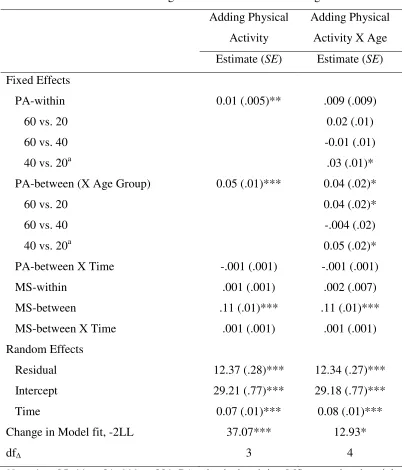
The addition of the physical activity variables significantly improved model fit (p<.001;
see Table 2). The between-person effect of physical activity was significant over and above
mental and social activity. An additional hour in average weekly physical activity participation
was associated with 0.5 higher initial score on the fluid cognitive composite. Within-person
variation in participation in physical activity across the waves also covaried with cognitive
performance. On occasions where the average individual engaged in an additional hour of
physical activity, they scored 0.1 higher on the cognitive composite for that wave. Average
physical activity level was not associated with rate of cognitive change however. The average
amount of mental and social activity across the waves was also a significant predictor of the
baseline fluid cognitive composite. The mental and social activity effect was approximately
double that associated with average physical activity. Consistent with prior work (Bielak, et al.,
2012), mental and social activity did not significantly covary with cognitive performance, nor
We next investigated possible variation in the relationship between physical activity and
the cognitive composite by age cohort. Given the lack of a significant effect of PA-between X
time, and to provide a parsimonious model, age contrasts for the PA-between X time effect were
not included in the final model5. The addition of age group by the physical activity measures
significantly improved model fit (p<.05). Variation between-persons in physical activity
participation significantly predicted baseline cognitive performance for all three age groups. Of
note, all three effects were in the positive direction, where more physically active adults showed
a higher cognitive score. The effect was largest for the 20s cohort (γ00-20s=.08, SE=.01, p<.001),
followed by the 60s (γ00-60s=.04, SE=.02, p<.05) and 40s cohorts (γ00-40s=.03, SE=.02, p<.05), who
did not statistically differ from one another. For the average individual in the 20s cohort,
regularly participating in another hour of weekly physical exercise was associated with a 0.8
increase in baseline cognitive composite. Regular physical activity participation was only
associated with baseline cognitive performance, as it did not significantly predict the cognitive
slope. Within-individual changes in physical activity engagement were associated with changes
in the fluid cognitive composite across the eight years. However, this association was only
apparent for the youngest age group (γ20-20s=.03, SE=.01, p<.001), which was significantly
different from the 40s (γ20-40s -.004, SE=.01, ns), but not the 60s cohort (γ20-60s=.01, SE=.01, ns).
Therefore, on occasions where the average person in the 20s age group exercised one hour more
than their typical exercise level, their cognitive score tended to be 0.3 higher.
Discussion
Using a population-based sample spanning young, middle, and older adulthood, the
present study investigated the associations of within-individual and between-person physical
5
activity participation in the prediction of fluid cognitive ability and change over 8 years. The
influence of cognitive and social activity engagement was additionally accounted for, and we
examined possible variations in the associations according to stage of adulthood.
Consistent with prior research (Gow, Corley, Starr, & Deary, 2012; Weuve, et al., 2004),
there was a positive association between physical activity and baseline cognition, where
individuals who exercised more on average tended to have higher initial scores on the fluid
cognitive composite. For the average adult, participating in one additional hour of physical
activity per week was associated with an additional 0.5 higher baseline cognitive score. There
was differentiation by cohort, where a young adult who tended to engage in one more hour of
physical activity than their peers performed 0.8 higher on the initial measurement of the
cognitive composite, whereas the association was approximately halved for those in their 40s and
60s. However, as noted by Lindwall et al. (2012), associations with baseline cognitive ability
fail to provide additional insight into why such a relation exists.
Rather, the presence or absence of a significant relationship between cognitive slope and
average physical activity is more informative. Cognitive change was not associated with the
between-person effect of physical activity in the present analysis, thus supporting preserved
differentiation. This indicates that physically active adults appeared to have a higher starting
point in terms of their cognitive ability, and this advantage was maintained over time, rather than
differentially affecting their trajectory of cognitive change (e.g., showing less cognitive decline).
Further, this result was consistent across adulthood. Another study dividing physical activity
into its between- and within-person components also failed to find associations with change in
semantic knowledge, memory, and reasoning, but did find a significant effect for change in
level at age 60 and 70 was predictive of slope on a cognitive composite that did not include a
metric of verbal fluency. Both studies were also limited to older age cohorts (i.e., 55 and 60
years or older), but there is evidence of baseline physical activity predicting change in verbal
memory even amongst those aged 36 years at baseline (Richards, et al., 2003). Consequently,
variation by cognitive domain may exist, but the present study is the only example of an
investigation across the adult lifespan.
The present findings of support for preserved differentiation reiterate the possibility that
finding a midlife physical activity association with later cognitive change is not necessarily
indicative of a preferential developmental trajectory for the active adults. Further, the conclusion
of preserved differentiation still adds positively to the larger aim of how to possibly improve
cognitive functioning as individuals grow older (see Bielak, et al., 2012; Hertzog, et al., 2009).
Lifestyle factors that are associated with level of cognitive ability may inform potential
interventions as possible methods of providing a one-time boost to cognition (i.e., assuming
causality), even if alterations to cognitive slope are not likely.
Unlike changes at the between-person level, individual-based changes in physical activity
level from wave to wave were associated with corresponding changes in cognitive performance,
but only for the youngest age cohort. Specifically, when an average person in the 20s age group
exercised one hour more than their own usual activity level, their cognitive performance was
approximately 0.3 higher for that wave. One possible explanation is that this finding reflects
greater neuroplasticity in earlier adulthood (Couillard-Després, 2013). Lindwall et al. (2012)
also found evidence of within-person covariation across four longitudinal studies, but the
samples were limited to those age 55 and older. The 20s cohort showed the greatest fluctuation
of life transitions that tend to occur in younger adulthood (e.g., full time employment, marriage,
and parenthood). In turn, younger adults may still be adjusting their physical activity schedule to
one that appropriately fits their new roles and demands. The greater within-person change in
physical exercise for this cohort however may be necessary to observe significant covariation
with cognition. An additional planned wave of measurement for the present sample will help to
elucidate whether within-person covariation with cognition is possible amongst middle-aged and
young-old adults. Further, studies of individuals from birth that measure the development of
cognitive ability and physical activity patterns are also required to fully understand the complex
interrelationship.
The result that the youngest adults demonstrated the strongest relation between physical
activity and baseline cognitive score is in contrast to studies that found a greater association for
older compared to younger cohorts (e.g., Hillman, et al., 2006; Newson & Kemps, 2006). Others
however, have found a superior association amongst early adulthood (Middleton, et al., 2010).
Of interest, we found no age differentiation in the present sample in the effects of mental and
social activity on cognitive functioning (Bielak, et al., 2012), suggesting that age variability in
activity-based predictive effects across young, middle, and older adulthood are unique to
physical activity. However, the measurement of the two activity types in the present paper
differed. Participation in moderate and vigorous exercise was also significantly lower amongst
the middle and older cohorts compared to the 20s group, despite no age differences in total
weekly physical exercise. Therefore, the more vigorous and physically challenging exercise of
the 20s cohort may explain the differential results, which has been shown to have unique effects
on memory (Roig, Nordbrandt, Geertsen, & Nielsen, 2013). In addition, there is the possibility
cognitive ability are reduced. For example, Bunce and Murden (2006) found the cognitive
benefit shown by the most active individuals in their 60s converged with less active individuals
by their mid-70s. Nevertheless, mild physical activities such as walking have also been linked to
better cognitive status (Andel, et al., 2008), and physical activity was linked to cognitive ability
regardless of age group, reiterating the importance of staying active throughout life.
Physical activity was uniquely associated with fluid cognitive ability over and above
cognitive and social activity participation, suggesting physical exercise has associations with
mental ability that other activity domains cannot duplicate. Research with animals and
randomized controlled trials with humans have revealed extensive brain-based changes as a
result of introducing physical exercise (Erickson, Gildengers, & Butters, 2013). However, the
predictive effect of between-person differences in mental and social activity on cognition was
nearly double that found in relation to physical activity. Consequently, all types of engagement
appear to be relevant to cognitive functioning across adulthood, a conclusion supported by
findings that the total participation (Wang et al., 2013), and variety of activity (Carlson et al.,
2012) were particularly predictive of later cognitive status.
The present analysis was unique in dividing physical activity into its within- and
between-person components in a population-based sample of young, middle-aged, and older
adults. Our measure of physical activity was based on frequency of engagement rather than a
count of specific physical activities, providing a more precise indicator of activity level and
greater variability. It also included a range of physical intensity, but the calculation of the
physical activity composite was only a general approximation of how to account for differences
in physical effort. It was necessary to investigate an overall total of physical activity
expectations and past research (e.g., negative associations). Physically active individuals may
have disproportional engagement in different intensities of physical exercise (e.g., a high
frequency of running, but little time spent walking), negatively influencing analyses focusing
only single intensity types. For this reason, we recommend combining physical activity intensity
types in future studies evaluating their link with cognition.
Although our results support the hypothesis of preserved differentiation, our analyses
cannot disentangle the directionality or causation of the relation between frequent physical
activity and higher cognitive performance. We do not know if adults who engaged in more
physical activity always had higher mental functioning, or if the best-performers on the cognitive
tests have been physically active their entire lives. It may even be the case that differential
preservation is possible later in older age, or once the effects of health and other risk factors are
more apparent. Using data from a birth cohort study, Gow, Corley, Starr, and Deary (2012)
found physical activity remained a significant predictor of concurrent cognitive ability at age 70
even after age 11 intelligence was accounted for. Similarly, Gow et al. (2012) demonstrated that
after accounting for cognitive ability at age 50, greater physical activity at ages 60 and 70 was
still associated with less cognitive decline by age 80, indicating that the impact of later physical
activity on cognitive performance was genuine. Unfortunately, few studies have the wealth of
longitudinal data required to investigate this enigma, and it remains a possibility that the present
links with physical activity were initiated by better baseline cognitive ability.
Further, although the present sample included data from adults aged 20 to 32, 40 to 52,
and 60 to 72 years, the narrow age bands of recruitment for the young (20-24 years), middle
(40-44 years), and older (60-64 years) adults precludes extrapolating the present findings across the
studies would benefit from examining the same associations in an older adults population.
The present analyses support the hypothesis that physical activity across young, middle,
and older adulthood is associated with cognitive ability by way of preserved individual
differences, rather than differential changes with age. Moreover, these effects were apparent
over and above the influence of mental and social activity participation, underscoring the unique
attributes of physical exercise. Further, unlike mental and social engagement (Bielak, et al.,
2012), the greatest physical activity effects were found for the youngest adults. It has been
suggested that far better outcomes may be possible the earlier in life an individual is active
(Hertzog, et al., 2009), but there is little evidence to support this. Our explicit examination of
how the stage of adulthood may moderate the relationship between physical activity and
Table 1. Descriptive information for sample at baseline (n = 6869).
Age Cohort Significance Test
20 40 60
n=2289 n=2426 n=2154
M (SD) M (SD) M (SD) F(df) /χ2 (df, n)
Time in Study 6.95 (2.52) 7.14 (2.27) 6.90 (2.56) 6.35 (2, 6868)**
% Female 52.8 53.2 48.9 10.45 (2, n=6869)**
Years of education 14.22 (1.50) 14.46 (2.26) 13.94 (2.61) 32.98(2, 6866)***
% Full-time employment
56.8 70.2 22.4 1785.05 (4, n=6869)***
Physical health 51.54 (6.94) 51.04 (8.02) 49.11 (9.73) 52.95 (2, 6866)***
Mental health 47.34 (9.55) 49.03 (9.43) 53.38 (8.38) 255.30 (2, 6866)***
Anxiety symptoms 3.84 (2.70) 3.49 (2.70) 2.17 (2.28) 258.90 (2, 6866)***
Depressive symptoms 2.89 (2.37) 2.40 (2.36) 1.61 (1.83) 189.52 (2, 6866)***
% Hypertension ever 22.0 45.1 81.0 1562.55 (2, n=6869)***
% Diabetes ever 0.9 3.8 12.7 314.72 (2, n=6869)***
Mental and social activity-between
51.13 (8.76) 50.84 (9.24) 48.63 (9.10) 50.49 (2, 6866)***
Mental and social activity-within
-0.63 (4.80) 0.04 (4.46) 0.62 (4.02) 43.74 (2, 6860)***
Mild physical activity 4.25 (5.36) 5.14 (4.52) 6.29 (5.18) 86.72 (2, 6478)***
Moderate physical activity
2.30 (2.82) 2.04 (2.13) 2.00 (2.74) 8.52 (2, 6309)***
Vigorous physical activity
1.29 (1.89) 0.91 (1.49) 0.43 (1.16) 162.02 (2, 6546)***
Combined physical activity
11.51 (12.74) 11.85 (9.35) 11.30 (9.96) 1.35 (2, 5912)
Table 2. Parameter Estimates from Multilevel Models Examining Physical Activity Predicting
Cognitive Performance and Change
Adding Physical
Activity
Adding Physical
Activity X Age
Estimate (SE) Estimate (SE)
Fixed Effects
PA-within 0.01 (.005)** .009 (.009)
60 vs. 20 0.02 (.01)
60 vs. 40 -0.01 (.01)
40 vs. 20a .03 (.01)*
PA-between (X Age Group) 0.05 (.01)*** 0.04 (.02)*
60 vs. 20 0.04 (.02)*
60 vs. 40 -.004 (.02)
40 vs. 20a 0.05 (.02)*
PA-between X Time -.001 (.001) -.001 (.001)
MS-within .001 (.001) .002 (.007)
MS-between .11 (.01)*** .11 (.01)***
MS-between X Time .001 (.001) .001 (.001)
Random Effects
Residual 12.37 (.28)*** 12.34 (.27)***
Intercept 29.21 (.77)*** 29.18 (.77)***
Time 0.07 (.01)*** 0.08 (.01)***
Change in Model fit, -2LL 37.07*** 12.93*
df∆ 3 4
Note. *p<.05; **p<.01; ***p<.001. PA=physical activity; MS=mental and social activity. LL =
log likelihood. 60s cohort served as reference group in models. aContrast with 40s as reference
Funding
The PATH project was supported by the National Health and Medical Research Council
(NHMRC) (grant numbers 229936, 179839, 973302, 179805, and 418039). This work was
supported by NHMRC (fellowship 1002560 to K. J. A), the Australian Research Council (ARC)
(fellowship 120100227 to N.C.), the Dementia Collaborative Research Centres, the ARC Centre
of Excellence in Population Ageing Research, and the Leverhulme Trust (UK) Research
Fellowship to D. B.
Acknowledgements
The authors are grateful to Tony Jorm, Helen Christensen, Bryan Rodgers, Simon
Easteal, Andrew MacKinnon, Peter Butterworth, Patricia Jacomb, Karen Maxwell, and the
References
Ahlskog, E. J., Geda, Y. E., Graff-Radford, N. R., & Petersen, R. C. (2011). Physical exercise as
a preventive or disease-modifying treatment of dementia and brain aging. Mayo Clinic
Proceedings, 86(9), 876-884. doi: 10.4065/mcp.2011.0252
Ainsworth, B. E., Haskell, W. L., Herrmann, S. D., Meckes, N., Bassett, D. R. J., Tudor-Locke,
C., . . . Leon, A. S. (2011). 2011 compendium of physical activities: A second update of
codes and MET values. Medicine and Science in Sports and Exercise, 43, 1575-1581.
Andel, R., Crowe, M., Pedersen, N. L., Fratiglioni, L., Johansson, B., & Gatz, M. (2008).
Physical exercise at midlife and risk of dementia three decades later: A population-based
study of Swedish twins Journals of Gerontology: Medical Sciences, 63A, 62-66.
Anstey, K. J., Christensen, H., Butterworth, P., Easteal, S., Mackinnon, A., Jacomb, T., . . . Jorm,
A. F. (2012). Cohort profile: The PATH through life project. International Journal of
Epidemiology, 41, 951-960. doi: 10.1093/ije/dyr025
Barnes, D. E., & Yaffe, K. (2011). The projected effect of risk factor reduction on Alzheimer's
disease prevalence. Lancet Neurology, 10, 819-828. doi:
10.1016/51474-4422(11)70072-2
Bielak, A. A. M. (2010). How can we not “Lose It” if we still don’t understand how to “Use It”?
Unanswered questions about the influence of activity participation on cognitive
performance in older age: A mini-review. Gerontology, 56, 507-519.
Bielak, A. A. M., Anstey, K. J., Christensen, H., & Windsor, T. D. (2012). Activity engagement
is related to level, but not change in cognitive ability across adulthood. Psychology and
Bunce, D., & Murden, F. (2006). Age, aerobic fitness, executive function, and episodic memory.
European Journal of Cognitive Psychology, 18, 221-233.
Carlson, M. C., Parisi, J. M., Xia, J., Xue, Q.-L., Rebok, G. W., Bandeen-Roche, K., & Fried, L.
P. (2012). Lifestyle activities and memory: Variety may be the spice of life. The
Women's Health and Aging Study II. Journal of the International Neuropsychological
Society, 18, 286-294. doi: 10.1017/S135561771100169X
Colcombe, S. J., & Kramer, A. F. (2003). Fitness effects on the cognitive function of older
adults: A meta-analytic study. Psychological Science, 14, 125-130.
Couillard-Després, S. (2013). Hippocampal neurogenesis and ageing. Current Topics in
Behavioral Neurosciences, 15, 343-355. doi: 10.1007/7854_2012_232
Delis, D., Kramer, J., Kaplan, E., & Ober, B. (1987). California Verbal Learning Test. San
Antonio, TX: Psychological Corporation/Harcourt Brace Jovanovich.
Dik, M. G., Deeg, D. J. H., Visser, M., & Jonker, C. (2003). Early life physical activity and
cognition at old age. Journal of Clinical and Experimental Neuropsychology, 25,
643-653.
Erickson, K. I., Gildengers, A. G., & Butters, M. A. (2013). Physical activity and brain plasticity
in late adulthood. Dialogues in Clinical Neuroscience, 15(1), 99-108.
Etnier, J. L., Salazar, W., Landers, D. M., Petruzzello, S. J., Han, M., & Nowell, P. (1997). The
influence of physical fitness and exercise upon cognitive functioning: A meta-analysis.
Journal of Sport and Exercise Psychology, 19, 249-277.
Flicker, L. (2010). Modifiable lifestyle risk factors for Alzheimer's disease. Journal of
Folstein, M., Folstein, S., & McHugh, P. R. (1975). Mini-Mental State: A practical method for
grading the cognitive state of patients for the clinician. Journal of Psychiatric Research,
12, 189-198.
Goldberg, D., Bridges, K., Duncan-Jones, P., & Grayson, D. (1988). Detecting anxiety and
depression in general medical settings. BMJ, 297, 897-899.
Gow, A. J., Corley, J., Starr, J. M., & Deary, I. J. (2012). Reverse causation in activity-cognitive
ability associations: The Lothian birth cohort 1936. Psychology and Aging, 27(1),
250-255. doi: 10.1037/a0024144
Gow, A. J., Mortensen, E. L., & Avlund, K. (2012). Activity participation and cognitive aging
from age 50 to 80 in the Glostrup 1914 cohort. Journal of the American Geriatrics
Society, 60, 1831-1838. doi: 10.1111/j.1532-5415.2012.04168.x
Hays, R. (1988). RAND-36 Health Status Inventory. San Antonio, TX: The Psychological
Corporation.
Hertzog, C., Kramer, A. F., Wilson, R. S., & Lindenberger, U. (2009). Enrichment effects on
adult cognitive development: Can the functional capacity of older adults be preserved and
enhanced? Psychological Science in the Public Interest, 9, 1-65.
Hillman, C. H., Erickson, K. I., & Kramer, A. F. (2008). Be smart, exercise your heart: Exercise
effects on brain and cognition. Nature Reviews: Neuroscience, 9, 58-65.
Hillman, C. H., Motl, R. W., Pontifex, M. B., Posthuma, D., Stubbe, J. H., Boomsma, D. I., & de
Geus, E. J. C. (2006). Physical activity and cognitive function in a cross-section of
Hindin, S. B., & Zelinski, E. M. (2012). Extended practice and aerobic exercise interventions
benefit untrained cognitive outcomes in older adults: A meta-analysis. Journal of the
American Geriatrics Society, 60, 136-141.
Hoffman, L., & Stawski, R. S. (2009). Persons as contexts: Evaluating between-person and
within-person effects in longitudinal analysis. Research in Human Development, 6,
97-120.
Horn, J. L. (1987). A context for understanding information processing studies of human
abilities. In P. A. Vernon (Ed.), Speed of information processing and intelligence (pp.
201-238). Norwood, NJ: Ablex.
Howley, E. T. (2011). Letter to the editor. Journal of Physical Activity and Health, 8, 141-142.
Langlois, F., Vu, T. T. M., Chassé, K., Dupuis, G., Kergoat, M.-J., & Bherer, L. (2012). Benefits
of physical exercise training on cognition and quality of life in frail older adults. Journals
of Gerontology Series B: Psychological Sciences and Social Sciences, 68, 400-404. doi:
10.1093/geronb/gbs069
Lee, T., Lipnicki, D. M., Crawford, J. D., Henry, J. D., Troller, J. N., Ames, D., . . . OATS
Research Team. (2013). Leisure activity, health, and medical correlates of neurocognitive
performance among monozygotic twins: The older Australian twins study. Journals of
Gerontology Series B: Psychological Sciences and Social Sciences. doi:
10.1093/geronb/gbt031
Lindwall, M., Cimino, C. R., Gibbons, L. E., Mitchell, M. B., Benitez, A., Brown, C. L., . . .
Piccinin, A. M. (2012). Dynamic associations of change in physical activity and change
in cognitive function: Coordinated analyses of four longitudinal studies. Journal of Aging
Middleton, L. E., Barnes, D. E., Lui, L.-Y., & Yaffe, K. (2010). Physical activity over the life
course and its association with cognitive performance and impairment in old age. Journal
of the American Geriatrics Society, 58, 1322-1326. doi:
10.1111/j.1532-5415.2010.02903.x
Miller, D. I., Taler, V., Davidson, P. S. R., & Messier, C. (2012). Measuring the impact of
exercise on cognitive aging: Methodological issues. Neurobiology of Aging, 33,
622.e629-622.e643. doi: 10.1016/j.neurobiolaging.2011.02.020
Newson, R. S., & Kemps, E. B. (2006). The influence of physical and cognitive activities on
simple and complex cognitive tasks in older adults. Experimental Aging Research, 32,
341-362.
Paillard-Borg, S., Wang, H. X., Winblad, B., & Fratiglioni, L. (2009). Pattern of participation in
leisure activities among older people in relation to their health conditions and contextual
factors: A survey in a Swedish urban area. Ageing and Society, 29, 803-821. doi:
10.1017/S0144686X08008337
Parisi, J. M., Rebok, G. W., Seeman, T. E., Tanner, E. K., Tan, E. J., Fried, L. P., . . . Carlson, M.
C. (2012). Lifestyle activities in sociodemographically at-risk urban, older adults prior to
participation in the Baltimore Experience Corps trial. Activities, Adaptation, and Aging,
36(3), 242-260. doi: 10.1080/01924788.2012.702306
Parslow, R. A., Jorm, A. F., Christensen, H., & Mackinnon, A. (2006). An instrument to measure
engagement in life: Factor analysis and associations with sociodemographic, health and
cognition measures. Gerontology, 52, 188-198.
Physical activity guidelines advisory committee. (2008). Physical activity guidelines advisory
Pietrelli, A., Lopez-Costa, J., Goni, R., Brusco, A., & Basso, N. (2012). Aerobic exercise
prevents age-dependent cognitive decline and reduces anxiety-related behaviors in
middle-aged and old rats. Neuroscience, 202, 252-266.
Plassman, B. L., Williams, J. W. J., Burke, J. R., Holsinger, T., & Benjamin, S. (2010).
Systematic review: Factors associated with risk for and possible prevention of cognitive
decline in later life. Annals of Internal Medicine, 153(3), 182-193.
Richards, M., Hardy, R., & Wadsworth, M. E. J. (2003). Does active leisure protect cognition?
Evidence from a national birth cohort. Social Science & Medicine, 56, 785-792.
Roig, M., Nordbrandt, S., Geertsen, S. S., & Nielsen, J. B. (2013). The effects of cardiovascular
exercise on human memory: A review with meta-analysis. Neuroscience and
Biobehavioral Reviews, 37, 1645-1666. doi: 10.1016/j.neurobiorev.2013.06.012
Rovio, S., Käreholt, I., Helkala, E.-L., Viitanen, M., Windblad, B., Tuomilehto, J., & Kivipelto,
M. (2005). Leisure-time physical activity at midlife and the risk of dementia and
Alzheimer's disease. Lancet Neurology, 4, 705-711. doi:
10.1016/S1474-4422(05)70198-8
Salthouse, T. A. (2006). Mental exercises and mental aging: Evaluating the validity of the “use it
or lose it” hypothesis. Perspectives on Psychological Science, 1, 68-87.
Salthouse, T. A. (2008). Exercise and mental resources: Methodological problems. In W. W.
Spirduso, L. W. Poon & W. Chodzko-Zajko (Eds.), Exercise and Its Mediating Effects on
Cognition (Vol. 2, pp. 111-116). Champaign, Illinois: Human Kinetics.
Small, B. J., Dixon, R. A., McArdle, J. J., & Grimm, K. J. (2012). Do changes in lifestyle
engagement moderate cognitive decline in normal aging? Evidence from the Victoria
Smith, A. (1982). Symbol Digit Modalities Test Los Angeles: Western Psychological Services.
Spirduso, W. W., Poon, L. W., & Chodzko-Zajko, W. (2008). Conclusions and future research
directions. In W. W. Spirduso, L. W. Poon & W. Chodzko-Zajko (Eds.), Exercise and Its
Mediating Effects on Cognition (pp. 211-219). Champaign, Illinois: Human Kinetics.
Sturman, M. T., Morris, M. C., Mendes de Leon, C. F., Bienias, J. L., Wilson, R. S., & Evans, D.
A. (2005). Physical activity, cognitive activity, and cognitive decline in a biracial
community population. Archives of Neurology, 62, 1750-1754.
Wang, H. X., Y., J., Hendrie, H. C., Liang, C., Yang, L., Cheng, Y., . . . Gao, S. (2013). Late life
leisure activities and risk of cognitive decline. Journal of Gerontology: Medical Sciences,
68(2), 205-213. doi: 10.1093/gerona/gls153
Wechsler, D. (1945). A standardized memory scale for clinical use. Journal of Psychology, 19,
87-95.
Weuve, J., Kang, J. H., Manson, J. E., Breteler, M. M. B., Ware, J. H., & Grodstein, F. (2004).
Physical activity, including walking, and cognitive function in older women. Journal of
Supplementary Table 1. Descriptive statistics for physical activity and cognitive measures by age
group and wave.
Measure
Fluid Cognitive Composite
Combined Physical Activity
Physical Activity Between
Physical Activity Within
Age Group n M (SD) M (SD) M (SD) M (SD)
20
Wave 1 2289 52.62 (6.70) 49.98 (11.88) 52.40 (9.26) -1.52 (7.37)
Wave 2 1987 54.55 (7.06) 53.88 (10.14) - 1.27 (6.37)
Wave 3 1821 55.44 (6.95) 53.04 (10.37) - .45 (6.84)
40
Wave 1 2426 51.18 (6.86) 50.30 (8.72) 50.50 (7.78) -.07 (5.03)
Wave 2 2249 51.88 (6.80) 50.69 (8.97) - .01 (5.01)
Wave 3 2016 52.20 (6.70) 50.42 (9.10) - .06 (5.10)
60
Wave 1 2154 47.33 (6.92) 49.79 (9.29) 50.98 (8.50) -.70 (5.11)
Wave 2 1884 46.99 (6.66) 51.63 (9.87) - .22 (5.42)
Wave 3 1660 45.93 (6.66) 51.99 (10.06) - .60 (5.68)
Supplementary Appendix A
The following models were used. The covariates of sex, employment status, ever having
diabetes, ever having hypertension, education, mental and physical health, anxiety and
depressive symptoms, and the between and within components of mental and social activity were
also included in the models.
Model 1: Cognitive change over time
Level 1: Fluid Cognitive Compositeij = β0i + β1i(Time in Study) + eij
Level 2: β0i = γ00 + γ01(Age group contrast1)+ γ02(Age group contrast2)+ u0i
β1i = γ10 + γ11(Age group contrast1)+ γ12(Age group contrast2) + u1i
The Level 1 equation examined individual rates of change across each individual’s time in study.
Specifically, the change in fluid cognitive performance for a given individual (i) at a given
occasion (j) was a function of that individual’s fluid cognitive performance at the first wave of
testing (β0i; intercept), plus that individual’s average rate of change in cognitive performance
across time in study (β1i; slope), plus an error term reflecting within-subject residual variance
remaining to be explained after controlling for time in study (eij; deviation from their individual
regression line). At Level 2, or the between-subjects level, the intercept (β0i) for each individual
was modeled as a function of the starting point for the average participant in the reference cohort
(γ00), plus the average difference in intercept between the reference group and one age cohort
(γ01), plus the average difference in intercept between the reference group and the other age
cohort (γ02), plus variation between individuals in intercept (u0i). Correspondingly, each
individual’s slope estimate (β1i) was a function of change for the average member of reference
the reference cohort and one age cohort (γ11), plus the average difference in slope between the
reference cohort and the other cohort (γ12), plus variation between persons in slope (u1i).
Model 2: Addition of physical activity measures
Level 1: Fluid Cognitive Compositeij = β0i + β1i(Time in Study) + β2i(PA-Within) + eij
Level 2: β0i = γ00 + γ01(Age group contrast1)+ γ02(Age group contrast2)+ γ03
(PA-Between) + u0i
β1i = γ10 + γ11(Age group contrast1)+ γ12(Age group contrast2) + γ13(PA-Between)
+ u1i
β2i = γ20
Model 3: Addition of Age X Physical activity interactions1
Level 1: Fluid Cognitive Compositeij = β0i + β1i(Time in Study) + β2i(PA-Within) + eij
Level 2: β0i = γ00 + γ01(Age group contrast1)+ γ02(Age group contrast2)+ γ03
(PA-Between) + γ04(Age group contrast1 X PA-Between) + γ05(Age group contrast2 X
PA-Between) + u0i
β1i = γ10 + γ11(Age group contrast1)+ γ12(Age group contrast2) + γ13(PA-Between)
+ u1i
β2i = γ20 + γ21(Age group contrast1 X PA-Within) + γ25(Age group contrast2 X
PA-Within) + u2i
Note. PA=Physical activity.1Due to the non-significant effect of PA-between X time, age