Documentation of Participatory Arts Experiences.
White Rose Research Online URL for this paper:
http://eprints.whiterose.ac.uk/87611/
Version: Published Version
Proceedings Paper:
Hook, Jonathan David orcid.org/0000-0002-0588-7013, Clarke, Rachel, McCarthy, John et
al. (3 more authors) (2015) Making the Invisible Visible : Design to Support the
Documentation of Participatory Arts Experiences. In: Proceedings of the ACM Conference
on Human Factors in Computing Systems. ACM CHI Conference on Human Factors in
Computing Systems 2015, 18-23 Mar 2015, COEX. Association for Computing Machinery
(ACM) .
[email protected] https://eprints.whiterose.ac.uk/
Reuse
Items deposited in White Rose Research Online are protected by copyright, with all rights reserved unless indicated otherwise. They may be downloaded and/or printed for private study, or other acts as permitted by national copyright laws. The publisher or other rights holders may allow further reproduction and re-use of the full text version. This is indicated by the licence information on the White Rose Research Online record for the item.
Takedown
If you consider content in White Rose Research Online to be in breach of UK law, please notify us by
Making the Invisible Visible: Design to
Support
the
Documentation
of Participatory Arts Experiences
Jonathan Hook
1, Rachel Clarke
2, John McCarthy
3, Kate Anderson
4, Jane Dudman
2, Peter Wright
21
Department of Theatre, Film and Television, University of York, UK
2
Culture Lab, School of Computing Science, Newcastle University, UK
3
People and Technology, Department of Applied Psychology, University College Cork, IE
4
Helix Arts, Newcastle upon Tyne, UK
[email protected]
ABSTRACT
We explore how digital technology might support the documentation of experiences of participatory arts engagement. During a fourteen session workshop series, we worked with artists, project managers, support workers and participants to explore the integration of digital media capture and presentation technologies into participatory arts workshops, and the implications that this would have for the experiences and practices of key stakeholders involved. We contribute insight into the social and practical challenges faced when using digital technology to create documentation of participatory arts. Our findings highlight the importance of situating documentation, sense making and re-telling of experiences in sensitive contexts such as participatory arts within the practices of skilled interpreters that are mindful of the complexities involved.
Author Keywords
Action research; documentation; experience-centered design; participatory arts; socially engaged art.
ACM Classification Keywords
H.5.m. Information interfaces and presentation (e.g., HCI): Miscellaneous.
INTRODUCTION
Participatory arts involves artists working with people who might otherwise be unlikely to become involved in the arts, to facilitate their participation in creative processes [15]. Internationally, there are many participatory arts organizations that collaborate with multiple agencies such as welfare, charitable and civic groups, to support enriching and transformative creative experiences. While artefacts, exhibitions and performances may be produced from participatory arts workshops, peopleÕs experiences of participation are often considered as important as the
products [2, 14] and projects can often be described as therapeutic and healing for those involved. Organizations that manage such projects increasingly use technology to document how participants experience engagement with the arts. However, when working with sensitive issues such as mental health, this can create highly emotive, ethical and logistical challenges relating to how creative experiences are collaboratively documented and shared over time [9]. We present insights from a long-term partnership project,
Making the Invisible Visible, which explored how digital technology might support the documentation of workshop experiences as part of long-term participatory arts engagement. In collaboration with Helix Arts, a participatory arts organization and charity, we worked iteratively and sensitively alongside artists, project managers, support workers and participants, to explore the integration of digital technology into workshops, while reflecting on its use and future desired application in group discussions. Instead of attempting to make visible the work practices and infrastructures of the organization [7, 16, 17, 18], Helix Arts were interested in using technology to make visible peopleÕs experiences of participatory arts engagement, and the transformations in attitude and outlook that can result from them. There have been some critical voices in HCI who have questioned what it might mean to capture experiences, and make the Ôinvisible visibleÕ or indeed the Ôineffable effableÕ [4]. We wanted to explore this proposition with Helix Arts, while being mindful of their commitments to social justice and the partners invested in such collaborative processes.
We discuss how the arts organizationÕs initial expectation of technology being able to capture transformational experiences of participation, were refocused to the importance of meaning making through situated annotation, curation and storytelling. We highlight the importance of the support workerÕs skill in interpreting and drawing disparate materials together over an extended period of time, and, in doing so, the crucial role that she played in making sense of workshop experiences and sharing potential meanings across different stakeholders. We argue that while the technology didnÕt make visible the transformational experiences of taking part as the Permission to make digital or hard copies of all or part of this work for personal
or classroom use is granted without fee provided that copies are not made or distributed for profit or commercial advantage and that copies bear this notice and the full citation on the first page. Copyrights for components of this work owned by others than ACM must be honored. Abstracting with credit is permitted. To copy otherwise, or republish, to post on servers or to redistribute to lists, requires prior specific permission and/or a fee. Request permissions from [email protected].
CHI 2015, April 18 - 23 2015, Seoul, Republic of Korea
Copyright is held by the owner/author(s). Publication rights licensed to ACM. ACM 978-1-4503-3145-6/15/04É$15.00
organization expected, the process helped draw attention to
subjective particularities of collaborative creative practice, support mechanisms for scaffolding reflection and approaches for organizing large quantities of documentation and re-constructing accounts of particular experiences.
BACKGROUND AND RESEARCH CONTEXT
The Making the Invisible Visible project was a long-term research partnership that explored the role that digital technology could play in documenting peopleÕs experiences of engaging with participatory arts. The project was conducted in collaboration with Helix Arts, a UK participatory arts organization. In a typical year, Helix Arts works with 30 to 50 artists to co-produce participatory art workshops across a range of art forms including visual arts, film-making, creative writing, graphic design, street dance, music, DJing and MCing, photography, drama and textiles. This program involves a broad range of participant groups, including: young people at risk, unemployed adults, people with special educational needs, and people with poor health. The work of Helix Arts is motivated by the belief that participation in creative activity is fundamental to wellbeing and, therefore, should be accessible to all. The project was conceived in response to on-going efforts by Helix Arts to better communicate the value of their organisationÕs work to their funders, who they felt often did not appreciate the positive transformational effects that participatory arts can have on peopleÕs lives. These efforts had included paper-based feedback forms, occasional audio and video capture during workshops, and recording artwork produced by participants. Some degree of success had been had in capturing information about the outcomes of workshops using these approaches (e.g. the artwork produced and participantsÕ retrospective reflection on participation). However, the organization had found that such methods were inadequate in charting peopleÕs experiences of participating in the process of a workshop series and, crucially, how those experiences might have led to transformations in the participantsÕ attitudes and outlook on the workshops and, potentially, their broader life.
Research Questions
The project commenced with a series of meetings with representatives from the arts organization, including the director, the head of workshop program, two project managers and a support worker. During these meetings two overarching research questions were developed: (i) how can new tools be developed that enhance peopleÕs ability to document their own and othersÕ experiences of participatory arts workshops and (ii) what impact might such tools have on the experiences and practices of the people involved in a workshop series. In answering these research questions, we sought to take steps towards the development of a suite of digital tools that artists could quickly and easily integrate into their workshops, as well as strategies for using these tools, and other forms of digital technology, to document participatory arts practice.
Key Stakeholders
Initial project meetings identified a number of potential ways that stakeholders involved in participatory arts practice might benefit from the ability to better document peopleÕs experiences of workshops. We introduce each stakeholder group here, and describe the benefits of documenting experience envisioned in the initial meetings.
Participants
Being able to document their experiences might offer participants, the people to whom participatory arts workshops are delivered, a record of what they have done and achieved both artistically and personally during a workshop series. This might serve as a memento or a means to help them recognize, understand and reflect on what they have experienced and how they have changed.
Artists
Artists plan and facilitate workshops. They might be offered a means to better understand how participants experience and respond to their work, which could enable them to reflect on and adapt workshop content, delivery approach and participant support. Additionally they might benefit from a portfolio of their work and its impact on participants, useful for seeking future funding.
Support Workers
Support workers, who provide emotional and practical support to vulnerable participants during a workshop series, could be provided with insight into participantsÕ progress and experiences. This might alert them of problems that participants are having and could be used to help discuss experiences in support sessions between workshops.
Participatory Arts Organizations
Helix Arts and similar organizations could gain the ability to better demonstrate the nature of the workshops they facilitate, and their impact on the lives of participants to partner organizations and funders. They may also gain a source of information to support reflection on, and subsequent development of, their workshop program.
Initial Design Considerations
Early project meetings also provided an opportunity to develop initial considerations that would affect the design of digital technology for documenting participatory arts.
Disruption of Workshop Activities
There were concerns that the use of digital technology by participants in workshops might disrupt their engagement with activities. The organizationÕs director, Theo, and one of the project managers, Fiona, were apprehensive that if participants were required to, for example, pick up and use a camera to record an important moment during a workshop, this might disrupt their creative flow and make the workshop experience overly analytical.
Participant Ownership and Control of Documentation
they might not be willing to share with their normal peer group. For these reasons, giving participants ownership of any media captured during a workshop, and control over how it is going to be used and by whom was seen as crucial in encouraging participant engagement and enabling ethical practice. Negotiating such ownership and control in the context of group workshop activities, where multiple participants with potentially differing wishes might feature in media, was seen as a particularly important challenge.
Surveillance
Concerns also arose about the perception of any technology for documenting experience as surveillance. We were told by one of the project managers, Kelly, and the support worker, Debbie, that many participants from these groups spend much of their lives presenting different aspects of their personalities in response to how they feel certain people (e.g. their peers or welfare benefits officers) expect them to behave. Workshops were said to often give these people a rare, safe environment where they could instead be themselves; a dynamic that could be disrupted if a participant felt that a surveillance technologywas allowing them to be watched by an external party.
THE WORKSHOP SERIES
We structured our research around a series of fourteen two-hour participatory arts workshops, run over the course of a six-month period. During these workshops, digital media capture and presentation technologies were integrated into the delivery of workshop activities, with the intent of exploring their impact on the experiences and practices of the key stakeholders involved. Our research during the workshop series was divided into two key phases: an initial exploratory phase, which investigated the integration of off the shelf technology into workshops, and a design response phase, wherein two bespoke tools developed by the research team were deployed and evaluated.
Participants and Artists
The workshop series guided a group of eight adult participants through a variety of creative writing, visual art and drama activities, which explored layers of public and private self and processes of inter- and intra-personal communication. Of these participants, six attended regularly throughout, one attended regularly for the first half before choosing to leave, and one only attended a single workshop. Participants ranged in age from 25 to 60, were all unemployed or employed on low incomes and had a range of educational backgrounds, from no qualifications to degree level. The participants were experiencing a range of personal issues at the time of the workshop series, which included alcoholism, drug use, offending and depression. Participants were recruited by the arts organization, from a pool of people who had previously taken part in workshop series that they had run. We chose to recruit these
experienced participants because the arts organization felt that those experiencing a participatory arts process for the first time might struggle to engage with the experimental
technology that would be deployed in the workshops. Because the workshop series was conducted as a research activity, including potential disruptions and additional activities that would not be present in a typical participatory arts process, the participants were reimbursed for their time with £300 of vouchers for a local shopping mall.
Workshops were planned and delivered by two experienced participatory artists, Bill and Adam, who had a background in the written and performed literary arts. The artists were recruited using a call for proposals published by the arts organization for a series of workshops that would be part of a research project exploring how technology could be used to Òcapture the essence of participatory arts experiencesÓ. Three proposals were shortlisted, and the final selection was made by an interview. The artists were paid at the arts organizationÕs standard rate for workshop delivery.
Research Approach
During the course of the fourteen workshops, a research team comprising the first author; the artists; a support worker, Debbie; and a project manager from the arts organization, Kelly, collaborated to deliver workshop activities that integrated a range of media capture and presentation tools for documenting experience. In the workshops, the artists led the facilitation of activities, with technical assistance from the first author. In accordance with the organizationÕs normal practices, the support worker attended all workshops while the project manager did not. Two additional university researchers joined workshops on occasion to assist in observing and taking field notes. Researchers who attended workshops were expected to participate in all activities, unless they were in a facilitation role that prevented them from doing so.
The project followed an approach influenced by Action Research [12], whereby the exploratory integration of technology into the workshop series was structured around phases of progressive planning, action and reflection. Group research meetings called Learning Groups were held at regular intervals in the project, wherein findings were analyzed and discussed and subsequent research activities planned. These learning groups were attended by the research team, along with the head of the arts organizationÕs workshop program, Sally, and two additional participatory artists, Tim and Gina. The additional participatory artists were included in the groups to help us explore how our findings would relate to a broader population of participatory artists.
PHASE 1: INITIAL EXPLORATION
involved. The phase began with a meeting where the artists were shown a variety of off the shelf technology that might be used to document workshops. Six workshops were then designed that sought to integrate a selection of this technology into activities for the purposes of documentation, while remaining sensitive to the artistsÕ goals for the workshop series and the design considerations revealed in the initial project meetings.
Introducing Technology into the Workshop Series
The first three workshops in the series were designed to give participants a gentle and enjoyable introduction to the participatory arts process that they were to undertake. The workshops began with icebreaker activities, such as drama games. The purpose of these initial activities was to give the participants, artists and researchers a chance to get to know each other, and to begin to establish the workshops as a safe environment for participants to express themselves both artistically and emotionally. The introduction of technology into the workshop series began during these initial activities. The artistsÕ traditional icebreaker activities were interspersed with activities that used technology. For instance, participants were asked to use digital cameras to take a selfie to illustrate a name they had been called in their life.
As the workshops continued into the second and third week, icebreaker activities were replaced with creative writing activities. The artists began to more actively broach, and prompt participant reflection on, the idea of portraying the self externally and internally. For example, in one activity participants explored iconography in portraiture, by writing imagined monologues about what items in portraits meant to individuals. The gradual integration of technology into the workshops continued during these activities, primarily using photographs taken by the participants using digital cameras as prompts for discussion and writing. For example, in an extension of the above-mentioned activity exploring iconography, participants were asked to take photos of objects that were important to them at home. These were then projected on a large screen in the workshop room and used as inspiration for a written piece speculating about the significance of an object shown in another participantÕs photo. Sounds recorded by participants between the second and third workshops using small audio recorders, were also used for a similar purpose, as the basis of a stream of consciousness writing activity. By gradually introducing technology into activities during the first three workshops, we intended to build up the participantsÕ trust in the idea of using technology to document their experiences, and featuring in documentation created by others. When designing the first activities using technology, we were guided by the principle that any use of technology in a workshop must have a clearly apparent purpose for the participants. We anticipated that developing activities where taking photos or capturing sounds clearly fitted in with the art practices and themes of the workshops
would instill confidence and trust amongst the participants that the technology and media captured was for them, and not just for the arts organization and their funders.
Autographers, Diary Room and Project Website
With participants becoming increasingly comfortable with technology, we chose to explore documentation approaches that were more peripheral (i.e. where technology was used during, but was not the focus of, activities).
During the third and forth workshops, the participants took turns to wear one of two ÔAutographerÕ cameras [1]. These cameras automatically took photos (approx. 50 per hour) in response to movement, and changes in lighting or temperature. While wearing the Autographers, the group visited two local art galleries, completing creative writing activities that were inspired by the artworks viewed. We intended that the Autographers would provide a way to more passively capture photographs of important moments in workshops; hence, providing opportunities to document activities in which technology could not be directly integrated, and creating chances to capture photos of the participants that would be less staged than those that had been taken previously. The images captured using the Autographers were edited into time-lapse videos, which were used as the basis of an activity in a later sixth workshop where participants further developed written work from notes taken while travelling to the art galleries. In the third and sixth workshops, a diary room, reminiscent of that featuring in the reality TV series Big Brother, was set up in a secluded corner of the workshop room. The diary room comprised a video camera on a tripod, facing a single chair. During the last 15 minutes of these sessions, participants were invited to sit in the diary room and spend a few minutes talking about their experiences of the workshop series up to that point. To assist the participants in reflecting on their experiences in the diary room, they were given a set of eleven prompting questions prepared by the artists (e.g. Òwhat have you enjoyed most so far?Ó and
Òhave the sessions taught you anything about the way you see yourself?Ó). The diary room was developed with the intent of exploring a way to capture how participants Ð and the artists and the support worker, who chose to use it as well Ð were interpreting and experiencing the ongoing workshop series. We intended that the videos captured in the diary room would be something that participants could look back on as a reminder of their experiences, as well as a way for them, and the artists and support worker, to track and reflect on their progress as the workshops went on. The diary room activity was not compulsory, and only a few participants were able to take part in it in each workshop because of time constraints.
personal entries, and the artists and support worker having access to all. We intended that the website would allow the different stakeholders in the group to begin to explore the documentation and, consequently, the different ways that they might benefit from viewing it or sharing it with others.
Taking Stock: Reflection and Planning after Phase 1
The first learning group was held towards the end of this initial phase of workshops. The session lasted three hours and took the form of a group discussion that was structured around informal presentations by the artists, first author and the support worker about their experiences of the workshops and examples of the media captured. The intention of this discussion was to provide an opportunity for the research team to analyze their own, and the participantsÕ, experiences of the first phase, and consider those experiences from the perspectives of the other learning group members. Here we summarize and reflect on the discussion in this learning group, alongside our observations and experiences from delivering and taking part in the first six workshops.
Fostering Engagement and Trust
The artists had found that making use of digital cameras and sound recorders as the primary focus of activities was a particularly successful strategy for fostering participant engagement with, and avoiding disruption from, the use of technology in workshops. The participants were observed using this technology enthusiastically, with no apparent concern for the issues of data ownership or surveillance that had been discussed in initial project meetings. The participants also engaged willingly with the more peripheral technology used in the later workshops, with all agreeing to wear the Autographers, despite the clear potential for them to be perceived as surveillance, and many volunteering to talk in the diary room, even if this meant staying on after the end of the workshop to take their turn. Informal discussions with participants during the workshops suggested that their engagement with, and trust in, the technology should be attributed to two factors. Firstly, the use of the cameras and sound recorders as the primary focus of activities, and as a tool of the artwork that they were learning, gave their use an immediate purpose for participants. Secondly, the re-introduction of media to participants, either through activities or the website, quickly established that the process of documenting the workshop series using technology was being done with the intention of benefitting them, and not, primarily at least, to enable surveillance by external parties. The second of these factors had been particularly important in fostering engagement with the more peripheral technology, with their use benefitting from a level of trust in the ways that captured media would be used that had been developed as a result of the reintroduction of media in preceding activities.
The use of images and sounds captured by, and of, the participants as the focus of workshop activities was also
found to be of particular value to the artists. They found that viewing, discussing and responding to media had provided them with a new and effective tool for broaching the topics Ð of personal and private self, and communication Ð that underpinned the series.
Capturing Fleeting Moments
During the learning group discussion, the artists and support worker identified a number of crucial moments in the initial workshops that they felt illustrated and encapsulated how the participants were experiencing, and developing during, the workshop series. These ranged from visible changes in participantsÕ body language or behavior that had been noticed during the course of activities, to moments that participants mentioned as important to them, when chatting during and after the sessions. They found that the current use of the technology in the workshops was not able to document these crucial, yet fleeting, moments. Based on these accounts, Kelly, Sally and Tim Ð the project manager, the organizationÕs head of program and one of the artists Ð raised corresponding concerns that the approach of integrating devices like cameras and sound recorders directly into workshop activities was not addressing the original project goals of supporting the documentation of participatory arts experiences. They felt that the use of media capture technology as the focus of workshop activities had led to the generation of media, such as the selfie photos, that was still too focused on the product of workshops rather than the subtle experiences had during their process. They called for a reorientation of the way technology was being used in the workshops towards the use of more peripheral tools like the Autographers, which they felt would better document the more fleeting aspects of participatory arts experiences. These calls initially concerned the artists, who wished to build upon the high levels of engagement and trust, and the enhancement of their practice, that had resulted from integrating media capture technology directly into activities.
Capturing Meaning and Context
PHASE 2: DESIGN RESPONSES
The second phase of the project involved the deployment of two prototypical tools developed by the research team, the
Something Just Happened Camera and the Prompting Diary Room. The intention of this phase was to explore how the design of bespoke digital technology might allow us to respond to the challenges that had been encountered in the first phase of the project, while maintaining similar levels of participant engagement and trust. The phase began with a planning meeting, where the artists, support worker and the first author developed designs for the two tools, as well as plans for how they would be used in workshop activities. The tools were then developed during a month-long break in the workshop series, which coincided with the Christmas holidays.
The workshops in the second phase of the series followed a similar structure and addressed similar topics to those that had gone before. The participants were introduced to further forms of creative writing and practice. During these activities the artists continued to use both the capture and reintroduction of media as inspiration for writing. In the final three workshops in the series, the participants were encouraged to reflect on their experiences, while developing creative writing performances that were based on the documentation that had been shared on the website throughout the whole process.
The Something Just Happened Camera
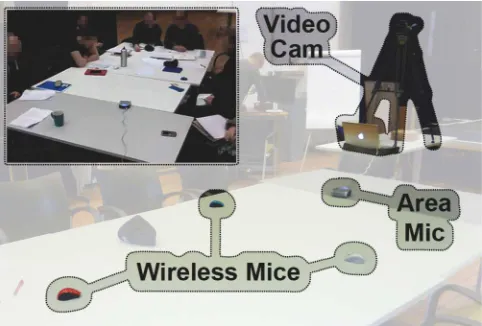
The Something Just Happened Camera enabled members of the workshop group to make recordings of the last 30 seconds of audio and video, when they felt something interesting or remarkable had just happened. The prototype, which was inspired by the ReflecTable [13], comprised an off the shelf webcam mounted on a tripod, an area microphone, three small wireless mice and a laptop (Figure 1). When one of these mice was clicked, a video showing the last 30 seconds was recorded and saved onto the laptop. In designing the Something Just Happened Camera, we intended to create a lightweight means for anyone in the workshops to document the kinds of fleeting but important moments that had been missed by the previous uses of technology. We wanted the camera to be as simple and discrete as possible, so that its use would not be disruptive or jarring to the flow of a workshop. We intended that allowing the capture of only short video clips would help us to circumvent concerns raised in the learning group, that capturing more discrete and fleeting aspects of the workshop experience might lead to the generation of hours of video footage that stakeholders would not have time to meaningfully review.
We used the Something Just Happened Camera during two workshops. In the first of these, the group worked around a table writing the opening sequence for a movie, which was inspired by a photograph taken during one of the gallery visits. During this workshop, the mice were distributed around the table, within reach of all group members, so that
anyone could quickly make a recording. Recordings were primarily made during the stages in the workshops where participants performed their work to the group and received praise and critique from the artists. The camera was also used in a second workshop, during which the participants took part in the martial art Qidong; placing the mice in their pockets so that they could record moments while up and about. We also used the prototype in a discussion at the end of this workshop, where participants reflected on the forms of writing that they had enjoyed most, and what they would like to focus on in the remainder of the series.
The Prompting Diary Room
The Prompting Diary Room prototype was designed to give group members a chance to document experiences that related to media captured during the workshops. The prototype was an app on a laptop computer that presented 10 randomly selected items of media from previous workshops alongside prompting questions. These questions were written by the artists and included prompts directly encouraging participants to provide commentaries about the media shown (e.g. ÒWhat does this photo remind you of?Ó), and others that sought to inspire broader reflection about the role that the captured media had played in the experience of workshops (e.g. ÒWho would you like to show this to?Ó). Random images were used because the artists didnÕt have time to curate the media shown. The usersÕ responses were recorded using the laptopÕs microphone and composited over the original media as a commentary track. We designed the Prompting Diary Room as an attempt to further document the participantsÕ experiences of activities during which media had been captured. We intended that the prototype would leverage the success of the traditional
[image:7.612.316.557.61.224.2]diary room in inspiring participants to talk, and reflect, about their experiences of the workshops, as the basis of an approach to document participantsÕ memories of activities. In doing so, we hoped to find a way to use the images and sounds recorded to unlock further material that would better document the more subtle and fleeting aspects of participantsÕ experiences of activities.
The Prompting Diary Room was used during three workshops. Group members were given the opportunity to step out of the activities that they were taking part in to use the prototype, during the final 30 minutes of the session. Additionally, the artists and support worker were given the chance to use the prototype once the participants had left. The Prompting Diary room was used in alternating weeks, between continued uses of the traditional Diary Room. The Prompting Diary Room was used in the same room as the main activities, but at a distance that allowed participants to speak without being overheard.
REFLECTING ON THE WORKSHOP SERIES
As the workshop series drew to a close, a second learning group meeting was held to analyze and evaluate the use of technology in the project. This meeting was structured around the discussion of short (10 minutes) presentations by one of the artists, Bill; the support worker, Debbie; the first author; and two participants, who were invited to contribute their experiences of the workshops.
Following the conclusion of the workshop series, two further learning groups were held focusing on how the documentation created in the workshops might be used in the different stakeholdersÕ practices. In the first of these meetings, group members were tasked with trying to use the media captured to document an aspect of the workshop series in a way that would be beneficial to their work. Pen drives were distributed in the week before the meeting containing all of the media captured for review by group members (approx. 221 photos, 240 minutes of video and 82 minutes of audio). During the meeting itself, participants were tasked with developing a short video or presentation using a selection of this media, which would be shown to and discussed with the remainder of the group. In the final learning group meeting, the group were asked to reflect on the process of creating these pieces, outlining which technology they considered the most and least useful, and any challenges they perceived in using them in the context of their individual future practices.
We performed a thematic analysis [6] around the learning group discussions and other sources of data collected during the project including: field notes, artist and support worker diaries, and the documentation that had been captured. Through this analysis, we sought to summarize and make sense of our own and the stakeholdersÕ positions in relation to participatory arts and the specific inquiry and, in turn, answer our initial research questions about how technology might be used to document workshops and the impact this would have for those involved.
Participants: Extending and Reflecting on Experience
The participants involved in the learning group felt that the Something Just Happened Camera had been the most successful of the tools used. Yet, as researchers we noticed that few of the participants had chosen to press the button
in sessions when using the tool. One of the participants commented that heÕd engaged less with it because it had
been forgotten when he became absorbed in an activity. However, he found that moments that he felt were important to him had been captured amongst the button presses of others. Along with other participants, he described how he valued the tool for encouraging teamwork to record moments that might be valuable for others. The support worker, Debbie, felt that having directed prompts taken from the material gathered in the workshop series as part of the Prompting Diary Room had helped some participants reflect on their experiences of the sessions in a semi-structured way. These views were echoed by the comments of one participant who said that answering questions in the traditional diary room felt too evaluative and led him to Òput on a maskÓ, while the act of openly responding to familiar images, videos and sounds when using the tool allowed him to talk more naturally and spontaneously about his experiences.
Debbie; the arts organizationÕs head of program, Sally; and one of the artists, Tim, thought that the media that had been captured could to play an important role in creating a legacy that would help the participants cope when the project ended. Many of the learning group members had witnessed participants struggle when workshop series finished. One of the participants at the second learning group recounted the sense of loss he and othersÕ had felt after a past series when there were no more workshops to go to. He, Debbie and Tim, suggested that continued engagement with the media on the project website might provide reminders of what had been achieved that would reduce this sense of loss; as well as maintaining links between participants and artists, and supporting further development of the skills and passions that they had learned in workshops.
The artists, Bill and Adam, also described a lack of control and a feeling of surveillance expressed amongst some participants in the later stages of the project. In the final Learning Group, Debbie highlighted that one participant in particular wanted all of his work to take away and all copies deleted so that no one could use it, despite having given consent at the start of the project. This raised ethical concerns around who has control of the media within such collaborative projects.
Artists: Integrating Into Practice
fleeting moments of workshop documentation into short, discrete clips made it a less useful tool for reflecting on more subtle dynamics that developed during the course of workshops.
Issues around the control of data were still considered problematic and further emphasis was placed on the need for participants to be in control of managing what was produced, so they could feel ownership of what they had achieved. However, the artists also recognized their own limits in their ability to manage and make sense of the documentation that had been produced in the sessions. They felt it was important for participants to make selections and edit their content, but thought that they would not have the skills and expertise to facilitate this.
The artists highlighted that while they felt comfortable in capturing media and incorporating this into practice, they did not feel so confident about editing this work together and otherwise managing and structuring the documentation produced. These discussions echoed calls in an earlier learning group by the artists and one of the participants for tools that would allow for easier curation of collections of discrete media into stories that might better make sense of experiences. Tim, one of the additional artists, also highlighted how he had struggled to make sense of the documentation, as it was not structured around dates, participant journeys or different contexts of media production. He wanted tools that could efficiently manage large amounts of documentation, and standardize and automate aspects of its processing and use.
Overall, the artists felt that the prototype tools had integrated into practice successfully, offering them insight into participant experience and a tool for reflection on their practice. However, there was recognition of the need for additional time to adapt and play with the digital tools if integrated into practice. For the artists, this needed to be recognized and funded as extra time in addition to that allocated for workshops themselves.
Support Worker: Promoting and Sharing Reflection
Support worker, Debbie, described many occasions where she had seen a change in participantsÕ attitudes through being involved in the project. In relation to the technology, she described how she felt that the diary rooms had been particularly successful in creating opportunities for participants to reflect on the process. In creating a presentation in Learning Group 3, she presented her own understanding of what she felt was one of the participantÕs journeys. This presentation illustrated how Òa combination of the diary rooms, the data capture (Autographer) and his written workÓ gave her insights into how this particular participantÕs sense of isolation had reduced and his outlook had become more positive over the duration of the workshops. She felt these changes had had significant impact on the participantÕs life, since as a result he was motivated to sign up to a rehabilitation program to manage his alcohol abuse. Because of these positive effects, she
described how she would have appreciated additional insights into how he was feeling throughout the process.
ÒI wouldÕve liked, in an ideal world, maybe to have a diary room of every session, but it wasnÕt possible because in some sessions we were out and about. But it wouldÕve been really handy to have more of an insight into how he felt.Ó
Debbie thought that these additional diary room accounts may have provided insights that she couldÕve potentially brought into one-to-one support meetings with clients, helping them reflect on the progress they had made and helping to support coping strategies in stressful situations. Most importantly for Debbie, the sessions had encouraged participants to open up and find ways of talking about how they were feeling in a comfortable environment. In this sense, she also saw the potential for the documentation to offer a way to show changes and achievements that participants could be proud of, or additional challenges that they were facing to other support workers. Debbie was the most able of the group to express a holistic understanding of what transformations she felt were significant for individuals. She achieved this by making sense of the materials collected in the context of her long-term professional relationships and biographical understandings of the participantsÕ lives, and the care context that the participants were also part of.
In the final learning group, similarly to the artists, Debbie also expressed concern for how support workers would need simple tools to capture and manage data, since there was very little time to engage in anything too complex within the context of the centers where she often worked and within the workshop process itself. Additional time, she felt, would not be given to activity associated with managing technology as this would be perceived as not necessarily beneficial to her clients.
Organisation: Sustaining the Arts and Meaning Making
She chose to collaborate with Debbie when completing the activity in the third Learning Group. The piece that they created stitched diary room entries, photos taken throughout the series, and videos of a participant presenting his written work, with a commentary by Debbie telling the story of one participantÕs emotional development during the course of the series. Kelly commented that this collaboration allowed her to discuss and understand what the media was showing and, therefore, to co-curate this documentation into a presentation that successfully illustrated the kind of participant transformations that she wished to make visible
to the organizationÕs funders. However, she also stressed that her ability to Òlegitimately and authenticallyÓ
demonstrate this transformative change relied on DebbieÕs identification of media that represented the important moments for participants and her explanation of what those moments potentially meant for individuals.
DISCUSSION
While research into understanding experiences of participation within co-design is starting to be explored [5], it is less common within the participatory arts. Participation within projects is often described as transitory, therapeutic and healing, and organizations engaged in the management of such projects often use technology in documenting such processes even when engaged in non-technical art forms [2, 14]. The Making the Invisible Visible project was conceived with such an intention of finding ways to make the often-invisible and subtle transformations that engagement with participatory arts can have on the lives of participants visible. The intention being that in making visible such experiences, this might be beneficial for the multiple stakeholders involved. Our purpose was to begin to explore, how technology might be practically and conceptually incorporated into such projects, but also to reflect critically on what impact this might have for those involved, and the potential consequences [16, 17] of paying close attention to such transformations.
Situating Documentation within Skilled Practice
Although the project was broad and exploratory in scope, much of the discussion in the early stages focused on the expectation that digital technology, and the media it would produce, might offer ways to create manifest evidence of peopleÕs experiences of engaging with participatory arts. While the artists, and we as researchers, were cautious and critical of such claims, we approached these expectations through experimenting with the integration of both off-the-shelf and bespoke new technology into the process of a workshop series. Attempting to put the media captured to work for various purposes in the penultimate learning group highlighted, for the organization in particular, that documentation of experiences of participatory arts practice would not be possible through digital technology alone. Rather, the media that had been captured required a re-positioning of its use as a basis for further co-constructed meaning making to be considered valuable documentation of experience. The visual and audio recordings created
offered only traces of events that required further interpretation from those who had been directly involved with the process. Attempts at communicating transformational experiences through digital documentation as anticipated by the organisation, required very particular and subjective [4] interpretation by the support worker, who had an interpretive authority stemming from her very particular relationship with participants and a holistic understanding of the care setting that they were part of. While the technology did not make visible the experience of taking part in participatory arts workshops in itself, its use
drew attention to how the practices and skills of stakeholders, particularly the support worker involved, could be a valuable resource to make sense of the complexity. In this sense, a richer understanding of the particularity of these skills could potentially lay the groundwork for the reflection, communication and evaluative uses of digital technology discussed at the outset of the project, in the emotionally complex and hectic context of participatory arts engagement. By embedding technology within existing stakeholder practices, we found ways to foster participant engagement with technology; scaffold participant reflection; inform and enhance artistsÕ workshop delivery; and draw together seemingly disparate bits of media to produce narrated accounts of peopleÕs experiences of engaging in participatory arts. The support workerÕs role stood out in her ability to ground practical uses of digital technology that would benefit both her own practice and the practices of others. For instance, DebbieÕs experiences revealed insights suggesting the potential use of documentation of workshops as a means for sensitive and guided participant reflection on progress and challenges faced within the workshops and their day-to-day lives.
Making It Work in Practice: Curation and Resources
challenges, relating to scarcity of time and financial resources in the sector. Our findings demonstrated increased workloads anticipated in both the running of workshops where technology was used and the processing, interpretation and curation of documentation captured. There was a consensus amongst the stakeholders involved that the benefits of this increased work justified the effort. However, the artists, support worker and arts organization, as those working on freelance and short-term contracts and charitable funding schemes, were concerned that they would not be able to find the time and financial resources to engage in the preparatory and analytic activities required.
CONCLUSIONS AND FUTURE WORK
The research presented in this paper contributes insight into the social and practical challenges faced by participatory arts collaborators when seeking to use digital technology to create documentation in the complex and sensitive context of their practice. In particular, we highlight the value of purposefully integrating technology use into workshops for fostering participant engagement and trust in documentation technologies, and of situating the documentation, sense-making and re-telling of peopleÕs experiences of engagement within the practices of skilled interpreters that are mindful of the complexities involved. We also contribute the design of two digital tools that respond to challenges faced by participatory arts stakeholders, when seeking to document their practices using technology. We anticipate that these research outcomes will benefit researcher and practitioner groups in three key ways. Firstly, our findings can directly inform the practices of participatory arts organizations seeking to use digital technology to document and evidence their practices, and related community and voluntary organizations working in sensitive contexts. Secondly, our work extends ongoing HCI research around participatory arts [8, 9] by considering crucial questions of technologically mediated documentation. Finally, our research stands to make a broader contribution to HCI by informing the design of approaches for documenting long-term engagements in other politically and culturally sensitive contexts [3, 10]. Future work could explore both the practical and more political concerns that the project raises. Drawing upon automated digital story telling systems that balance time required to engage with documentation with levels of curatorial control [11] might be one approach to address the aforementioned practical concerns. Further research could also consider the ways in which funding, expectation and associated care practices might also inform participatory arts practices and associated transformational experiences and their contingencies.
ACKNOWLEDGEMENTS
We thank the artists, the support worker, the participants and the staff at Helix Arts for the contribution they have made to this research. This project was funded by the SiDE RCUK Digital Economy Research Hub (EP/G066019/1).
REFERENCES
1. Autographer Ð the worldÕs first wearable camera. http://www.autographer.com
2. Bishop, C. Artificial Hells: Participatory Art and the Politics of Spectatorship. Verso Books, 2012.
3. Bjšrgvinsson, E., Ehn, P. & Hillgren, P. Participatory design and "democratizing innovation". In Proc. of PDC Ô10. ACM (2010) 41-50.
4. Boehner, K., Sengers, P., Warner, S. Interfaces with the Ineffable: Meeting Aesthetic Experience on its Own Terms. ACM TOCHI, 15, 3 (2008), 12.
5. Bowen, S., McSeveny, K., Lockley, E. & Dearden, A. How was it For You? Experiences of Participatory Design in the UK Health Service. CoDesign, 9, 4 (2013), 230-246.
6. Braun, V. & Clarke, V. Using thematic analysis in psychology. Qualitative research in psychology, 3, 2 (2006), 77-101.
7. Carroll, J. M. & Rossen, M.B. Wild at Home: The Neighborhood as a Living Laboratory for HCI. ACM TOCHI, 20, 3 (2013), 16.
8. Clarke, R., Wright, P., Balaam, M. & McCarthy, J. Digital Portraits: Photo-sharing after Domestic
Violence. In Proc. of CHI Ô13, ACM (2013), 2517-2526. 9. Clarke, R., Briggs, J., Light, A., Heitlinger, S. &
Crivellaro, C. Socially Engaged Arts Practice in HCI. In
Ext. Abs. of CHI Ô14. ACM (2014), 69-74.
10.DiSalvo, C., Boehner, K., Knouf, N. A. & Sengers, P. Nourishing the ground for sustainable HCI:
considerations from ecologically engaged art. In Proc. of CHI Ô09. ACM (2009) 385-394.
11.Frantzis, M., Zsombori, V., Ursu, M., Guimaraes, R. L., Kegel, I., & Craigie, R. Interactive video stories from user generated content: a school concert use case. In
Proc. of ICIDS Ô12. Springer (2012), 183-195.
12.Hayes, G. The relationship of action research to human-computer interaction. ACM TOCHI, 18, 3 (2011), 15. 13.Hook, J., Hjermitslev, T., Iversen, O. & Olivier, P. The
ReflecTable: bridging the gap between theory and practice in design education. In Proc. of INTERACT Ô13, Springer (2013), 624-641.
14.Kester, G. Conversation Pieces: Community and Communication in Modern Art. UC Press, 2004. 15.Lowe, T. A Quality Framework for Helix ArtsÕ
Participatory Practice. Helix Arts, 2012.
16.Star, S.L. & Strauss, A. Layers of Silence, Arenas of Voice: The Ecology of Invisible and Visible Work.
CSCW, 8, 1-2 (1999) 9-30.
17.Suchman, L. A. Making Work Visible. Comm. ACM,
38, 9 (1995) 56-64.