This is a repository copy of
Making MOOCs collaboratively: working effectively with
stakeholders
.
White Rose Research Online URL for this paper:
http://eprints.whiterose.ac.uk/86185/
Version: Accepted Version
Proceedings Paper:
Elston, C and Morris, NP orcid.org/0000-0003-4448-9381 (Accepted: 2015) Making
MOOCs collaboratively: working effectively with stakeholders. In: UNSPECIFIED eMOOCs
Summit, 18-20 May 2015, Mons, Belgium. , pp. 28-32. (Unpublished)
[email protected] https://eprints.whiterose.ac.uk/ Reuse
Items deposited in White Rose Research Online are protected by copyright, with all rights reserved unless indicated otherwise. They may be downloaded and/or printed for private study, or other acts as permitted by national copyright laws. The publisher or other rights holders may allow further reproduction and re-use of the full text version. This is indicated by the licence information on the White Rose Research Online record for the item.
Takedown
If you consider content in White Rose Research Online to be in breach of UK law, please notify us by
Making MOOCs collaboratively: working effectively with
stakeholders
Carol Elston
1, Neil Peter Morris
1,21
Digital Learning Team, University of Leeds, UK
1,2
School of Education, University of Leeds, UK
Abstract: The University of Leeds is one of the founding partners of the FutureLearn Massive
Open Online Course (MOOC) platform. During 2014, the University developed six MOOCs for the Futurelearn platform, from a wide range of academic disciplines and using a variety of instructional design and content approaches. Whilst there are common threads in the development process for every course, each MOOC has its own unique drivers and range of interested parties and stakeholders. This paper focusses on the challenges and rewards of developing MOOCs with individual academics, teams of academics and external stakeholders from the perspectives of the Digital Learning Team at Leeds. It is hoped that our experiences will highlight, through example, some of the challenges we have overcome and will help other MOOC developers who are faced with a growing portfolio and a diverse stakeholder base.
An introduction to the role of the Digital Learning Team
The University of Leeds established a new project team, the Digital Learning Team, in late 2013. This team quickly grew to 9 digital learning professionals within 18 months of conception, including those with a professional understanding of online learning pedagogy, as well as those with a more practical skill base including filming, editing and animation (Morris et al., 2014). The primary remit for the team is to work with academics from around the university drawing upon their subject knowledge and translating their ideas into an online learning journey, through the design, development and delivery of an online course. The team also produces individual learning objects and re-purposes MOOC assets for publication on other internal and external digital learning channels (e.g. Virtual Learning Environment, iTunes U, YouTube), operating in accordance with the University’s position of Open Education Resources wherever possible (University of Leeds, 2012). The University has recently affirmed Digital Learning as a core capability of its Student Education provision, paving the way for further growth and development of blended, hybrid and distance learning across the institution.
During 2014, the Digital Learning Team developed 6 MOOCs working with academics in all 9 of the faculties within the University. As a result of the intensity and time-limited nature of the MOOC development process, processes and systems for project management have been developed, including documents that identify timelines and milestones, as well as visual course maps and detailed step-by-step outlines. The team now uses an Agile project management approach (Cervone, 2011), to ensure all deliverables and outputs are completed to a high standard on time, and within budget.
Using the Futurelearn platform
The Futurelearn platform was conceived on a social constructivist pedagogy, and is defined as a social learning platform. The platform currently has over 800,000 registered users (Press Association, 2014). A core aspect of Futurelearn is the ability for user discussion alongside content, along with opportunities to follow, like and sort user contributions within discussions (Ferguson & Sharples, 2014). Within the FutureLearn platform courses are structured by weeks, with each week being broken down into activities and with each activity comprising a number of steps (Ferguson & Sharples, 2014). The platform is intuitive in layout and navigation, and is easy to use for learners. The Digital Learning Team has taken a specific design approach for all of its online courses in order to provide a clear learning journey through the weeks, ensuring that each week follows a similar pattern to aid navigation and to provide consistency.
opportunity to include exercise steps which contain resources created using HTML (e.g. time lines and interactive activities). The peer learning steps include discussions and peer review activities. The latter involves the learner posting a written response which is reviewed by at least one other learner. If a learner chooses to post to this type of step they automatically receive the opportunity to review the work of another learner. All learning activities are considered carefully, in line with principles of e-learning (Alonso et al., 2005) and building on emerging insight from other MOOC providers (Breslow et al., 2013; Kizilcec et al., 2013).
Outcomes from the first year of MOOCs
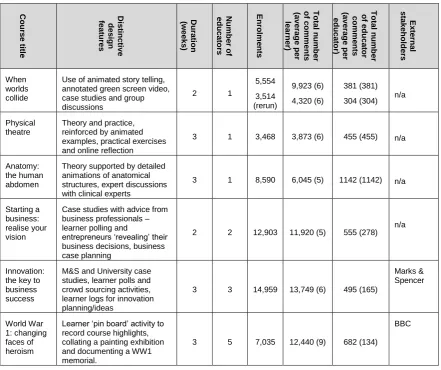
[image:3.595.72.514.322.692.2]The MOOCs developed during the first year were diverse in subject, course design approach, academic support and engagement with external stakeholders (see Table 1). This portfolio was developed strategically, to enable the University to gain detailed understanding of the benefits and drawbacks of online courses in different academic disciplines, working with individual academics and teams of academics, and working with external stakeholders to develop courses. The courses were between 2 and 3 weeks long, and attracted between 3,468 and 14,959 participants. As illustrated in Table 1, the number of educators involved with course development has increased over time, ranging from three courses with a single educator to a course with five educators. Two of the courses were developed in partnership with external organisations, Marks & Spencer and the BBC.
Table 1. Information about University of Leeds MOOCs
C ou rs e t it le D is tinct iv e des ign fe a ture s D ura tion (we e k s ) N um ber of e duca tors E nro lm e nt s Tota l n um ber of c om m e nt s (a v e ra ge per le a rne r) Tota l n um ber of e duca tor c om m e nt s (a v e ra ge per e duca tor ) E x te rna l s ta k e hol der s When worlds collide
Use of animated story telling, annotated green screen video, case studies and group discussions
2 1
5,554 3,514 (rerun) 9,923 (6) 4,320 (6) 381 (381)
304 (304) n/a
Physical theatre
Theory and practice, reinforced by animated examples, practical exercises and online reflection
3 1 3,468 3,873 (6) 455 (455) n/a
Anatomy: the human abdomen
Theory supported by detailed animations of anatomical structures, expert discussions with clinical experts
3 1 8,590 6,045 (5) 1142 (1142) n/a
Starting a business: realise your vision
Case studies with advice from business professionals – learner polling and
entrepreneurs ‘revealing’ their
business decisions, business case planning
2 2 12,903 11,920 (5) 555 (278) n/a
Innovation: the key to business success
M&S and University case studies, learner polls and crowd sourcing activities, learner logs for innovation planning/ideas
3 3 14,959 13,749 (6) 495 (165)
Marks & Spencer World War 1: changing faces of heroism
Learner ‘pin board’ activity to
record course highlights, collating a painting exhibition and documenting a WW1 memorial.
3 5 7,035 12,440 (9) 682 (134) BBC
exceeded their expectations. Further more detailed analysis of the participants and their behaviours online is available in a separate paper submitted to the eMOOC conference (Morris et al., submitted).
As might be expected there was a positive correlation between the number of course enrolments and the total number of comments posted (R2 = 0.59). However, there was no correlation between the number of enrolments or learner comments with the number of educator comments. There was a weak positive correlation between the number of educator comments posted and the learners’ overall satisfaction with the course (R2 = 0.21); however, there was no correlation between number of educator comments posted and learners satisfaction in terms of educator engagement.
Working with subject matter experts
During MOOC development, the Digital Learning Team has worked intensively with a wide range of academic colleagues and external stakeholders. For the first three courses the team worked with just one lead academic; in each case the academic was extremely passionate about their subject and keen to be part of this new and exciting opportunity to share their knowledge with an international audience. For two courses the team worked with groups of academics and external stakeholders, providing several layers of passion and commitment but also tinged with the challenges inherent when working simultaneously with a number of experts. The next section critiques the relative benefits and challenges of creating a MOOC with individual academics, teams of academics and external stakeholders from the perspective of the Digital Learning Team.
The individual academic
Working with an individual academic has both advantages and disadvantages. The positive aspects revolve around the individual control of the lead educator; the ability to define the course objectives, form a consistent approach to the content and importantly to understand the entire learning journey. There is a consistency of approach and a definite improvement in the quality of video material as the relationship between the team and the academic builds and development progresses. However, considering the more challenging aspects, the individual academic has to shoulder all of the work (which can become overwhelming) or encourage other colleagues to provide support. This is true through both the development phase as well as during course delivery. There is also the danger of course participants being ‘over-exposed’ to a single academic voice, and only seeing one face throughout the course. These challenges can be mitigated through including contributions from other subject matter experts, in the form of interviews, group discussions or bespoke material. To alleviate the workload on individual academics during course delivery, courses have been successfully supported by undergraduate and postgraduate students, and academic colleagues not involved in the course development.
Academic teams
Having worked with individual academics, or in one case a team of 2, the University’s fifth MOOC involved 4 academics each from a different faculty with no previous experience of working together: ‘a manufactured team’. Also, the last course involved working with a team but this time the academics had worked together on previous projects. Although online learning was new to them all, they had a clear methodology for collaboration and were fully aware of the team dynamic and individual strengths and weaknesses. In many ways the advantages and disadvantages of working with a team of academics are the reverse of working with an individual academic. The major positive aspects revolve around the time commitments of the team members, both during development and delivery, as the work is being spread between a number of individuals. From a learner perspective it can also be more engaging to interact with a number of academics, particularly if the course has been designed to highlight their individual expertise. The challenges of a team of educators are around consistency and the ability to maintain the learning journey through the course. With the team who had previously worked together this was not such an issue, although they did need to define ways of working that enabled them to avoid repetition. This was managed by regular meetings/communications, sharing of scripts and early viewing of rough-cut videos.
Working with the team of academics who were new to online learning, had not worked together before and had no existing digital learning materials, was a challenge for all involved. It took time for the team to get to know each other, establish the objectives of the course and articulate an agreed narrative and learner journey. From all perspectives this course was the most difficult to manage. However, once the team gelled and there was a general understanding of the individual focus of each academic, this course did come together well and formed a coherent learner journey with some inspiring case studies.
The ‘Innovation: the key to business success’ course was developed in association with Marks & Spencer. The University of Leeds has a long-standing relationship with M&S and hosts the M&S Company Archive on campus. M&S supported the course through making available learning assets from the M&S Company Archive and involving senior staff in the production of case studies. The ‘World War 1: changing faces of heroism’ course was one of a series of four courses developed in association with the BBC. Along with three other FutureLearn partner universities, Leeds worked with staff from the BBC to define the overall objectives for the course. The BBC provided support with securing third party footage and filmed a number of short videos drawing on their connections within the industry. In both these cases the external stakeholder did not contribute any financial support however they were both instrumental in providing learning content, assisting with marketing initiatives and raising the profile of the course. Their respective logos were prominent on the course sign up page and their support recognised throughout the course.
Whilst the benefits of having access to content and expertise from external sources are indisputable, developing courses that draw upon content from a third party does complicate the process. Several of the case studies in the innovation course included videoed interviews with senior M&S staff. All such content had to be approved by the member of staff and the M&S legal department. Intellectual Property for co-produced assets was shared with the external organisation and as such the University had to request permission to share resources through other external platforms such as iTunes U, which is normally standard practice as part of its commitment to Open Educational Resources.
Conclusion
To conclude, through the development of six very different MOOCs it has become apparent that the team dynamic does impact considerably on the design, development and delivery phases of courses. Whether working with just one academic or a team of academics and external stakeholders there are both advantages and disadvantages. The Digital Learning Team has appreciated the variation in approach and has enjoyed working with all stakeholders. However, each new course requires a different approach, and a period of adaptation, which can be time intensive.
References
Alonso, F., López, G., Manrique, D. and Viñes, J. M. (2005), An instructional model for web-based e-learning education with a blended learning process approach. British Journal of Educational Technology, 36: 217–235. doi: 10.1111/j.1467-8535.2005.00454.x
Breslow, L., Pritchard, D. E., DeBoer, J., Stump, G. S., Ho, A. D., & Seaton, D. T. (2013). Studying learning in the worldwide classroom: Research into edX’s first MOOC. Research and Practice in Assessment. 8, 13-25.
Cervone, H. (2011) Understanding agile project management methods using Scrum. OCLC Systems & Services. DOI: 10.1108/10650751111106528
Ferguson, R., & Sharples, M. (2014). Innovative Pedagogy at Massive Scale: Teaching and Learning in MOOCs. In Open Learning and Teaching in Educational Communities (pp. 98-111). Springer International Publishing.
Kizilcec, R.F., Piech, C & Schneider, E. (2013). Deconstructing Disengagement: Analyzing Learner Subpopulations in Massive Open Online Courses. LAK conference presentation. Accessed 15 December 2014.
Morris, N.P., Livesey, S. and Elston, C. (2014) First time MOOC provider: reflections from a research-intensive university in the UK. In: eMOOC conference proceedings, Lausanne, Switzerland.
Morris, N.P., Hotchkiss, S. and Swinnerton, B. (submitted) Can demographic information predict MOOC learner outcomes?
Press Association, (29th December 2014). ‘More turning’ to online learning. Available on FutureLearn press coverage website. https://about.futurelearn.com/press-coverage/ Accessed 23 January 2015. University of Leeds (2012) Policy on Open Educational Resources. Available at: