rssN 0378-3693
Bulletln
OF
THE
EUROPEAN
COMMUNITIES
Commission
.{ ." i.
',i-* ,t
No
1
19Bo
The Bulletrn of the European Communrttes reports on the acttvrttes of the Commrssron and the other Communrty tnstrtutrons
lt
rs edlted by the Secretarrat-General of the Commrsslon (rue de la Loi 200, B-1049Brus-sels) and publrshed eleven tlmes a year (one rssue covers July and
August) rn the offrcral Communrty languages, Spanrsh and Portuguese Reproductron rs authorrzed provrded the source rs acknowledged.
The followrng reference system rs used the frrst drgrt rndtcates the part number, the second drgrt the chapter number and the subsequent drgrt
or drgrts the pornt number Crtatrons should therefore read as follows
Bull EC 1 -1985, pornt 1 1 3 or
2236
Supplements to the Bulletrn are publrshed rn a separute sertes at rrregular
intervals They contatn offtual Commrssion ntaterral (e
g
contmuntcattons to the Counctl, programrnes, reports and proposals)Bulletin
OF THE
EUROPEAN
COMMUNITIES
ECSC_EEC_EAEC
Commission of the European Communities Secretariat-General
Brussels
co
nte
n
ts
."$
$
{i
*
's
..; J}
.{
IJ $1
s
R ""I i
d $ :i 'i
t)
$
\.
*
tl s
fls
"*
s1
g5Y fl\
fi\.f,fl:
SPECIAL
FT
TT
fr
L-.{
IX!
L
FEATURES1.
The Community of Twelve2.
lnstitutional reform3.
Action for Africa4.
Community action in the field of tourisms.,t Si$,yi:,y{el q"r,r"), - '
't,N
7 8
11
13
p&
ffi
Y
Y\e$
ffi
i-"ll'^!I'fi",,,.
1.
Building the CommunityEconomic and monetary policy lnternal market and industrial affairs Steel
Research and technology
lndustrial innovation and the information market
Customs union Competition
Financial institutions and taxation
Employment, education and social policy
-
A people's Europe-
Regional policy-
Coordinated application of structural financial instruments-
Environment and consumers-
Agriculture-
Fisheries-
Transport-
Energy16 16 16 18 20 25 26 26 29 30 32 34 36 36 36 45 47
48
..:1,i,, {:r -i*,.-,l -.
-.,
I'
2.
External relations-
Commercial policy-
Relations with industrialized countries-
o
Relations Mediterranean with other countries countries and regionso
Asiao
Latin America-
Development-
lnternational organizations and conferences3.
Financing Community activities4.
Political and institutional matters-
European political cooperation-
European policy and relations between the institutions-
lnstitutionso
Parliamentand organs of the Communitieso
Councilo
Commissiono
Court of Justiceo
Economic and Social Committeeo
European lnvestment Bank49
49
51
54 54 54 54 55 58
59 60 60
61
62 62 67 68 69 77 79
's.
!, i
ffi.e
WY
Yh$
$ryffi
ffi
DocuMENrAroN
1.
ECU2.
Additional references in the Oflicial Journal3.
lnfringement procedures4.
Statement on the Netherlands'term as Council President5.
Eurobarometer88 89 90
91
95
Supplements
1986
1/86
Programme of the Commission for 19862186
Single EuroPean Act3/86
Equal opportunities for women-
Medium-term Communityprogramme 1986-90
4186
Community action in the field of tourism,*- ',.,t'-.$r i *s.)'N\U€:
Bulletin information
service
Readers can obtain information
on
developments since this issue wentto
press (date ofadoption
of
instruments by the Council, of opinions given by Parliamentor
the Economicand Social Committee,
of
publicationirt
the Official
Journal, etc.)by
telephoning thedocument services of the Information Offices at the following numbers:
London
Belfast Cardiff
Edinburgh Dublin
M.
Clairet Mme MescarelloMme Teirlinck
222 8t22
240708
37t63r
225 2058
712244
References in text and footnotes
References to other parts of the same rssue of the Bulletin are given in parenrheses ln rext,
thus
(--
point 2.1.53).References to other issues of the Bulletin, to a Bulletin Supplement, to an Official Journal
etc. are gil'en in footnotes.
Standardtzed abbreviations for the desrgnatron of certain monetary units rn the different languages of the Community.
ECU
:
European currency unrtBFR
:
Belgische frank / Franc belgeDKR
:
Dansk kroneDM :
Deutsche MarkDR :
Greek drachmaESC
:
EscudoFF :
Franc frangaisHFL
:
Nederlandse gulden (Hollandse florrln)IRL :
lrrsh pound / puntLFR
:
Franc luxembourgeoisLIT :
Lira italranaPTA
:
PesetaUKL
:
Pound sterling1.
The
Community of
Twelve
The
institutional
consequences
of
enlargement
1.1.1.
As the currenr Member States,Por-tugal and Spain had all ratified by rhe end
of
1985,1
the instrumentsof
accession ofthe Kingdom
of
Spain and the PortugueseRepublic
to
the
European Communitiesduly entered into force on
I
lanuary 1985,taking
the
Community's population from275 million ro 327 million and its roral area
from
1 558 000to
2255 000 squarekilo-metres.
Portugal and Spain applied for membership
on 28 March and 28 July 1977 respectively, and negotiations began on 17 October 7978
with Portugal and on 5 February 1979
with
Spain. The Treaty between the 10 Member States and Spain and Portugal providing
for
Spanish and Portuguese accession was signedin
Lisbon andMadrid
on
12 June 1985.2 The six yearsof
negotiations weredue
to
the complexityof
the problems to besolved-
both for the Ten and forPorru-gal and Spain. Agreement had to be reached
on transitional measures to ensure that the
integration
of
thetwo
new Member States could go forward smoothly.Since
l
January the two new Member States have formed an integralpart
of
theCom-munity in every respect. They now
partici-pate
fully
in
the
Community institutionsand apply Community
law,
albeit subjectto
transitional provision
and
temporaryderogations which were agreed
in
rhe Actsetting out the terms of accession and which
apply both
to
the former 1O-nationCom-munity and to the two new Member States.
lnstitutional
changes
1.1.2.
Since 1 January Spain and Portugalhave been taking a
full
part in the activitiesof
the Community institutions. The Com-mission now has two Spanish Members andone
PorrugueseMember.:
rIfith
theappointment of a Spanish and a Portuguese
Judge and one Portuguese Advocate-Gen-eral the Court of Justice now has 13 Judges and 5 Advocates-General. The new Judges are
Mr
Jos6 Carlos de Cavalho Moitinho de Almeida, whowill
serve until 5 October 1988,4 andMr Gil
Carlos Rodriguezlgle-sias, who
will
serve until 5 October 1991.sThe new Advocate-General is
Mr
Jos6 Luisda
Cruz
Vilaga,who
will
serveuntil
5October 1988.4
The
155 Membersof
theEconomic and Social Committee have been
joined
by
21, Spanish and 12 PortugueseMembers, and the number
of
Membersof
the European Parliament has risen from 434
to
518with
the arrivalof
50 Spanish and24
PortugueseMembers.
The
political groupsin
Parliament are now made up as follows:1
Bull. EC 12-1985, ponZ.2.7.2
Bull. EC 6-1985, pol[i,t 7.7.1 et seq.3
Bull. EC 12-1985, pornt 7.3.7 et seq4
oJ L 8, 11.r.1985.5
oJ L 18,24.1,.i,986.198.5 1986 Increasc
Socialists
European People's Party European Democrats Communrsts
Liberal, Democratic and Reform Group European Alliance for Renewal and Democracyl Rainbow
European Right Non-affrliated
Total
130 109 50 43
3l
30
1.9
15 6
172 118 63 45
42
34 20 15 7
42 9
13 3 7l
4
1
1
434 518 84
lnstitutional reform
In addition, Parliament's rules of procedure
have been amended so as:
(i)
to
increase the numberof
Vice-Presi-dents from 12to
1.4; and(ii)
to raise the minimum number ofMem-bers needed to form a political group from
27 to 25 (if they belong to a single Member State),
from
15to
18
(for two
MemberStates), and
from
10to
12 (three MemberStates).
In the Council, the number of Members has
risen to 12, one for each Me mber State, with
the following weightings: France, Germany,
Italy
andthe
United Kingdom, 10 votes;Spain, 8 votes; Belgium, Greece, the
Nether-lands and Portugal, 5 votes; Denmark and
lreland,
3
votes; Luxembourg,2
votes,bringing the total number of weighted votes
to
76. The
minimum number
of
votesrequired for a decision to be taken by
quali-2.
lnstitutional
reform
Final meetings
of
the
I
ntergovernmental
Conference
and agreement on
the
Single
European
Act
Parliament's debate and resolution
on the outcome
of
the
work
of
the
lntergovernmental Conference
of
16and 17
December
The debate
1.2.1.
On 15 January, after a short debate,Parliament adopted a resolution moved by
Mr
Spinelli, Chairman of the Committee onInstitutional Affairs, by 206 votes to 63 with
40 abstentions.
I
This reaffirmed thejudg-8
fied
majority
is
54.
In
other
words, thenumber of votes needed to block a majority decision is 23. As a result, in contrast to the
situation
in
the
Communityof
Ten, two'large' Member States may find themselves
in a minority.
One Spanish Member,
Mr
Josep SubiratsPifrana, and one Portuguese, Mr Carlos
Bot-elheiro Moreno, were
appointedto
theCourt of Auditors. At the European
Invest-ment Bank,
the
Boardof
Governors wasincreased
to
12with
the incluslionof
oneSpanish and one Portuguese minister
(nor-mally the Finance Minister) and the number
of Directors
from
19 to 22,with
a parallel increasefrom
11to
12in
the number ofalternates (the new Member States
app-oint-ing one alternate jointly).
Mr
Miguel Angel Arnedo of Spain was appointedVice-Presi-dent. Spain and Portugal also subscribed to
the Bank's capital, which was doubled at the same time (--+ point 2.4.38).
ment made
in
Parliament's resolution of11 December 1985
on
the
resultsof
theLuxembourg European Council
2
andcon-cluded
'that the
SingleAct
can produceonly modest progress
in
certain spheresof
Community activity, and that
it
is very far from constituting the genuine reform of theCommunity that its people need to consoli-date their economic and political position in the world...'.
However, despite these reservations,
Parlia-ment stated that it would exploit to the very
limit
the possibilities offered by the Single Act and instructed its Committee onInsti-tutional
Affairsto
drawup
by
1 January1988 a review
of
the results obtained fromI
oJ c 36, 17.2.1996.,
oJ c 352,31.12.1985; Bull. EC 12-1985, pornt 1.1.2.lnstitutional reform
the
implementationof
the
SingleAct
in orderto
prepare,in
due course, proposalsfor
reformto
be putto
the citizensof
theCommunity at the 1989 elections.
This
resolution wasa
compromise which had survived assaults bothfrom
the hard-line 'rejectionists' such asMr
Hinsch (SoclD),
whose amendment obtainedonly
76 votes, and the supportersfrom
theEuro-pean
Democrats,
whose
amendments receivedlittle
support.Opening
the
debate,Mr
van den Broek,President of the Council, attempted to
per-suade the House
that
the outcomeof
theConference was relatively positive and that
Parliament had gained a concrete involve-ment
in
the legislative process over a wide field. He also argued that the presentagree-ment represented
the
maximumthat
theConference have agreed upon.
Mr
Delors, Presidentof
the
Commission, said that the Commission had three princi-pal reasons to be dissatisfied, relating to theinternal market, coherence and the powers
of
Parliament,yet
it
neverthelesshad
toconsider
the
result
a
step
forward.
Heexplained the Commission's reservations on
each
of
thesepoints and
concluded thatmuch would depend on making the
arrange-ments
work
whichwould
in
turn
dependon new forms
of
behaviourin
all theinsti-tutions.
Mr
Delors listedthe
threeinsti-tutional
conditionsfor
success, stressingthat he was doing so forcefully because the
Commission would be meeting Parliament
and
the
Council. These werethe
use ofqualified
majority
voting,
recognition ofeffective implementing powers for the
Com-mission
and
full
participation
by
Parlia-ment.
Mr
Spinelli
(Com/l) was
unenthusiasticabout the
outcomeof
the
Conference ,which was unworthy
of
an electedParlia-ment
that
oughtto
have been entitled to take partin
it.
'The Council has produceda
mouse,a
miserable stillborn mouse', headded.
For
Mr
Dankert (SoclNL) the outcome wasless
than
satisfactory.He
consideredMr
van den Broek's speech disappointing since
it
had not
covered unemployment, ownresources or the structural Funds.
Mr
Penders (EPPINL) stated that theCom-mittee on Institutional Affairs took note of
the results of the Conference under protest and certainly did not welcome them.
How-ever, Parliament should make the best
of
what little had been obtained.Mr
Croux (EPP/B) andMr
Nord
(LiblNL)concentrated on the powers of Parliament.
Mr
Croux
demanded new powers beforethe
third
direct electionsin
1989, andMr
Nord
emphasized the samepoint
in
refer-ring to the review period. He also asked thePresidency
for
its view on the amendmentof
the
Council's rulesof
procedure.Mr
van der Waal
(NA/NL)
askedfor
a
cleartimetable for implementation of the
amend-ments.
Only
Mr
Christensen (RainbowlDK) expressed a radically opposed view.
The resolution
1.2.2.
The text of the resolution isrepro-duced below.
'The European Parliamenr,
A.
Whereasit
is
undemocratic that an insti-tutional reform of the Community and of politrcal cooperation, a reform which directly concerns all the -citizens of the Community as such, should have been worked out wrthout public debate and keeping at arm's length the Assembly which isthe legitimate representatlon of those citizens at European level;
B.
Stressrng that the parliaments o[ severalMem-ber States had formally requested their govern-ments to uphold at the Conference views anal-ogous to those put forward by the European Parlia-ment ln rrs draft Treaty;
C.
Stressing the ambigurtres and shortcomings of the Act which wrll allow utterly contradictory interpretattons since, proclaiming rmportant obiec-tives, rt fails to make any provision for methodsof
decision-takrng and execution which wouldallow the Communtty to act effectively, or for a
legislative procedure whrch would make it possrble
lnstitutional reform
the national parliamenrs and rransferred ro the European level, or for any legal backrng for the deadhnes for the internal marker, or for the
necess-ary reform
of
the Community's finances, and imposes new obstacles ro rhe developmenr of rhe EMS and maintains the separarion betweenpoliti-cal cooperation and Communrty affairs;
D.
Convinced that the possrbiLties opened up in Luxembourg for progress in some limited freldscannot compensate
for
the serious democraticshortcomings of the reform;
1.
Is compelled to reaffirm rhe judgment made in its resolution of 11 December 1985 on the results of the work of rhe Conference and to conclude thar the Single Act can produce only modest progress in certain spheres of Community activity, and that it is very far from constituting the genuine reform of the Community that its people need to consolidare their economic and polrtical posrtion in the worldand to meet their requirements as regards harmoni-ous growth, job creation, solidanty, security and internatronal responsibrlitres;
2.
Requests that, at the very least, the govern-ments undertake to:(i)
amend the rnternal rules of rhe Council so asto compel rt to hold a vote when the Commission or three Member States so request,
(ri)
reconsider the resultsof
the workof
the Conference before 1989;3.
Notes that the Luxembourg decrsions meanthat the governments have not yet achieved the
task of creating European Unron to whrch they have formally committed themselves, and that they consequently remain bound by that commitment;
4.
Wrll obviously explort ro the very limit the possibilities offered by the SingleAct-rf
it is rati-fied-and instructs its Polrrcal Affairs Committee to ensure that thrs is done; reaffirms thatit
will pursue its endeavoursin
rhe spiritof
its draft Treaty of Union wrrh the aim of a genuine politicaland economic union between rhe States
of
the Community and, if necessary, rhe definition of the relatrons to be marntained between such a unionand those States which are nor yet prepared to take rhis extra step;
5.
Calls on the Commission to draw up a reporr on the operatron of the Single Act as soon aslr rspossible to assess thrs after implementatron;
6.
Formally appeals to rhe cirizens of theCom-munity, the narronal parliaments and the parties whose Members are battling in this Assembly for
a genuine unron to reahze that, without the cre-ation of a European Unron, there wrll be no future for the peoples of Europe, and to commrt
them-10
selves to its construction togerher with those of a
like mrnd, accordrng to a democratic procedure rnvolving the representatrves of rhose peoples;
7.
Instructsits
Committeeon
Institutional Affairs to:(r)
pursue its conracrs with rhe narionalparlia-me nts so that rt can take account of their positions and observations;
(ii)
draw up by 1 January 1988 a review of the results obtained from rhe rmplemenrarion of rhe Single Actin
order to prepare,in
due course, proposalsfor
reform ro be putto
rhe citizens during the 1989 elections;Agreement on the
text
of
the
Single
European
Act
1.2.3.
The Conferenceof
theRepresenta-tives
of
the Governmentsof
the Member States held its last three meerings on 22 and24 lanuary
at
ambassadorial level and on27 January at Foreign Minister level. At the
last meeting
it
reached agreementon
thetext of the Single European
Ac,1
with
theaddition
of
a statement on social policy, astatement on the installation of the political
cooperation secretariat
in
Brusselsand
a unilateral statement by Denmark on Article100A(4) concerning the procedure for
dero-gating
from
Community
harmonizationmeasures on one
of
the grounds providedin
Article 35or
in
grounds relatingro
theprotection
of
working
conditionsor
theenvironment.2
On
21.January
the
Danish
Parliament adopted by 80 votes to75 a resolutionstat-ing that the Single European Act was
unac-ceptable as
it
srood and asking theGovern-ment
to
renegotiateits
termswith
otherMember States.
Once this had been shown to be impossible,
the
Government secured parliamentaryapproval
by
82
votesin
favour
and 66abstentions
for a
consultative referendumon the Single Act, to be held on 27 February.
I Reproduced rn Supplement 2/86
- Bull. EC. 2 Bull. EC 11-1985, pornt 1.1.1.
Action for Africa
The
Act
was
openedfor
signature byMember States f.rom 17 February, and nine
Member States announced that they would sign on that date. They
did
soin
Luxem-bourg on the occasionof
a Councilmeet-3.
Action
for
Africa
1.3.1.
Continuing
immediateand
long-range efforts to combat famine and drought
in Africa, the Commission adopted a
num-ber
of
financing decisionson
15 Januaryunder the plan for rehabilitation and revival
adopted in November (--+point 1.32).1 On
27 lanuary,
in
responseto
the instructionsformulated
by
the
EuropeanCouncil
inMilan
last June,2it
sent the Council andParliament
a
plan
of
action
for
naturalresource conservation and
the control
ofdesertification. 3
Immediate and long-term action: implementation of the rehabilitation and revival plan
1.3.2.
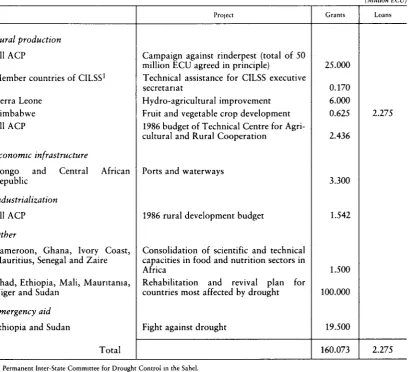
Last autumn, following implemen-tation of the Dublin Plan,4 the Community launched a rehabilitation and revival planto
help the African countries worsthit
bydrought,5 the aim being
to
meet the shortand medium-term needs arising
from
thelack of rain
in
1985.The situation
in
these countriesstill
gives causefor
concern, asin
some areas thepopulation is
totally
destitute, Iacking theieeds and tools needed
to
preparefor
thenext harvest.
On
15 January the Commission approved programmes under the rehabilitation planio
itotal
value of 100 million ECU, and on20
Januaryit
signed financing agreementswith
representativesof
the countriescon-cerned: Chad, Ethiopia,
Mali,
Mauritania,ing
of
Ministersof
Foreign Affairs. Greecehas
not
yet
determinedits
position,
andItaly,
at
the'requestof
theItalian
Parlia-ment,will
not
signuntil
after the Danish referendum.Niger and Sudan. The money comes from
unillocated resources of the fourth and
fifth
EDFs.
The
Commissionalso
approvedemergency aid
of
8 million ECU (from thebudget) for Angola and Mozambique.6
The
programmes areto
be
put
in
hand immediately since many of the agricultural projects haveto
be undertaken before theMay-June
rainy
season.The
Commissionwill
be coordinatingthe
activitiesof
the Member States and other donors concerned.Long-term resource conservation plan:
the fight against desertificaion
1.3.3. In
responseto a
requestfrom
theMilan European Council in June 1985,2 the
Commission formulated
a
plan
of
actionfor
the
conservationof
Africa's
natural resourceswhich
it
transmitted
to
theCouncil and Parliament in January. T
lt
re'presents
the
Community's answerto
theunderlying Iong-term problems
facingAfrica, and forms one part of a more
com-prehensive approach.
1
Bull. EC 10-1985, point 1.4.1 et seq.;Bull. EC 6-1985,porm 2.3.46.
2
Bull. EC 5-1985, pornt 1.2.8.3
coM(85) 15 final.a
Bull. EC 12-'1984, pornr 1.2.7; Bull. EC 5-1985, pornt 2.3.45, Bull. EC 10-1985, point 1.4.2.5
Bult. EC 10-1985, pornt 1.4.1 et seq.;Bull. EC 11-1985,pornt 2.3.25.
6
Bull. EC 12-1985, pornt 2.3.49.Action for Africa
The Dublin Plan, followed by the
rehabili-tation and
revival
plan,
represented theinitial
responseto
the
urgent short-term problems and to famine.The
third
Lom6 Convenrion is designed toaddress structural economic problems.
Pro-gramming of Lom6 III aid is currently under way and reveals the high
priority
the ACPStates are giving
to
rural development andin particular to food strategies.
The development of Africa is, however,
rak-ing place
in
a
contextof
growing erosionof
its
natural
resources,a
process whichfinds
its
most extreme expressionin
theprocess of desertification. The launching of
a systematic programme
of
environmentalprotection
and
restorationis
therefore amatter of some urgency.
This is
the purposeof
the
Commission's communication,which,
startingfrom
an analysisof
the problemof
desertification and its principal causes, suggests guidelinesand general priorities for a policy to combat
desertification
in
productive sectors (agri-culture and cattle raising) through specificme asures
to
protect natural
resourcesinvolving appropriate research and
popu-lation policies.
Implementation
of
these guidelines andpriorities
will
require policy reforms in thecountries concerned and the active partici-pation oI their inhabitants.
Measures to combat desertification must be
on a large enough scale to trigger the desired
changes (the concept of the 'critical mass').
This
will
requirea
global approach, thecoordination of the work of aid agencies to ensure consistency and a continuing
long-term commitment,
all
arrangedin
consul-tation with the recipient countries.
Because
of
the
importanceof its
cooper-ation with
Africa,
Europe hasa
spetial responsibility for the implementation of this strategy. On a more general level,it
must:(i)
increasethe
proportion
of
its
aiddevoted to rural development with
particu-lar
emphasison
more intensivefirming,
t2
while maintaining the long-term ecological
balance of peasant agricultural systems;
(ii)
givepriority to
specific,direc
action on natural resources;(iii)
givepriority
where necessary rosup-port
for
population policies drawnup
byrecipient countriesl
(ir)
make
appropriate
administrative arrangementsto
ensurethat
it
has
thehuman
and
technical resources necessaryfor
effective implementationof
environ-mental operations.
At
Community level the Commissionwill
endeavour to coordinate all the means at its
disposal: Lom6
III,
food aid,
cofinancingwith
NGOs, financial protocolswith
thecountries
of
the
southern Mediterraneanand specific budget headings.
1.3.4.
Most
of
the
programming now being carriedout
under LomeIII
ieflectsthis new
objective.It
is
proposed that, implementingthe
indicativeand
regional programmes, the Commission should reachagreement
with
the ACP States onquanri-fied targets
for
measures specifically-aimed at desertification control.Similarly,
priority
will
be
givento
suchmeasures under the new financial protocols
for southern Mediterranean countiies. Food aid too
will
play a part, viafood-for-work programmes or the use of counterpart
funds
to
pay local costsof
environmental conservation measures. Foodaid may
be allocated expressly for this purpose.Non-governmental organizations are well
placed both organizationally and
operation-ally to help in this work.
There
will
continueto
be special budgetappropriations
to
finance dese rtificationcontrol measures, since this gives the
Com-munity
grearer scopefor
initiative
andmanceuvre
in
undertaking measures whichpoor countries may tend to put off.
If
Community aid isto
reach the 'criticalmass' required
for
it
to
playa
significantpart
in
thefight
against desertificition,it
must be backed up by efficient coordination
Tourism
with
bilateral aid from the Member States.For
thetwo
aid
effortsto work
togetherharmoniously, common principles of action based on guidelines and priorities laid down in the communication must be defined and
closely coordinated in the field.
By working
together and involving other donors, the Community and the MemberStates can make a significant contribution
to the implementation of an environmental protection policy
in
Africa, a policy whichis vital
to
the
long-term survivalof
thecontinent.
The document concludes by citing as
exam-ples a number of significant measures taken
to combat desertification.
1.3.5.
The Commission's communication offers a basis for discussion with theMem-ber States
on the
formulationof a
Com-munity
positionfor
various internationalconferences:
(i)
Silva, an international forestry confer-ence being organized by the French Govern-ment from 5 to 7 February in Paris;(ii)
theApril
meeting of theVorld
Bank/IMF
Development Committee, whichwill
be discussing the problems
of
Africa, withparticular reference
to
long-termdevelop-ment;
(iii)
the special session of the UN GeneralAssembly in May, which
will
be looking atthe
various aspectsof
Africa's
economiccrisis,
againincluding
longer-term pros-pects.Following
discussionswith
the
MemberStates, a number
of
decisions are likely tobe taken by the Council when
it
meets to consider development issues on 17 April.4.
Community
action
in
the
field
of
tourism
1.4.L. Tourism
in
the
Communrty hasbeen expanding constantly
in
recent years.There are four major reasons why the
Com-munity should take action
in
this field: theeconomic importance
of
the
industry; itsrole
in
employment(5
million
peopledirectly
employed);its
contribution
to greater mutual understanding among ourcitizens; and the need for the Community to
maintain its competitive position on world
markets.
On 31 January, therefore, the Commission
sent to the Council a communication
toge-ther with three specific proposals for Com-munity action in the field of tourism. 1 This
follows
on from
the June 1982communi-cation setting
out initial
guidelinesfor
aCommunity
policy
on
tourismz
and
theCouncil resolution of 10
April
1984 invitingthe Commission to present proposals based on consultations
wiih
the Member States.3The
report
from
the
ad
boc
Committeeon a
People's Europe,4 endorsedby
theEuropean Council in Milan in June 1985,5
similarly called
on
'the
Communityinsti-tutions and the
competent authorities to give special attentionto
issues relating to tourism, which isof
particular importanceto the people of the Community'.
The measures proposed by the Commission
in its communication have the aims set out below.
I Supplement 4/85
- Bull. EC; COM(85) 32. 2 Supplement 4/82
- Bull. EC; Bull. EC 5-1982, point
1..4.1.
r oJ C 11.5,30.4.1984; Bull. EC 4-1.984,potm2.1.9.
4 Supplement 7/85
Tourism
Facilitating tourism
within the Community
1.4.2.
The
Commission advocates theremoval
of all
obstaclesto
the freemove-ment of persons in the Community by 1992,
and proposes a number
of
practicalmeas-ures: better information for tourists;
simpli-fication
of
social security procedures;har-monization
of
visas; legal aid; the transferof
foreign currencies and the introductionof
a
health cardfor
tourists belonging to certain high-risk categories.Improving the seasonal
and geographical distribution of rourism
1.4.3.
With a view to reducing theconcen-tration
of
holidays,which
causes seriousproblems both
for
individual tourists andfor the tourist industry, the Commission is
putting forward a proposal for a resolurion
on a better seasonal and geographical
distri-bution
of
tourism and intendsto
use allthe means at its disposal
to
overcome thisdifficult problem, in particular by
encourag-ing social, rural and cultural tourism. Better use
of Community financial instruments
1.4.4. Through
its
various
financing instruments (the ERDF,the
Social Fund,the
EAGGF,the
IMPs and theNCI)
theCommunity already contributes
in
varyingdegrees
to
tourism projects submirted bythe
Member States.The
Commission isplanning
to
optimizethe
useof
existingfinancial instruments to assist tourism, and
particularly to improve its seasonal and
geo-graphical distribution,
by
all
appropriatemeans.
Better information
and protection for tourists
1.4.5. In
aneffort
to
improvethe
infor-mation available to Community tourists onall aspects of travel within the Community,
the Commission is presenting to the Council a proposal for a recommendation on
stand-ardized
information
on
hotels.It
is
alsoplanning to produce a practical travel guide
or
vade-mecum providing as much usefulinformation as possible
to
assist tourists,and
to
bring forward
a
Directiveon
theharmonization
oI
legislation
concerningpackage tours.
Improving working conditions
in the tourist industry
1.4.5.
Special attention is given to working conditionsin
thetourist
industry.In
par-ticular,
measuresto
promote
vocationaltraining
by
meansof
student exchanges, facilitate the introduction of the newinfor-mation technologies and further the study
of
problems peculiarto
certain typesof
occupation, notablythat
of
tourist guide,may be noted.
Increasing awareness of the problems
of tourism and organizing consultation
and cooperation
1.4.7.
With
a viewto
providing aframe-work
for
consultationand
coordination betweenthe
Member
States,the
Com-mission and the industry's specialist bodies,the
Commissionis
proposing
that
theCouncil adopt
a
Decision introducing a flexible procedure in this respec. The Com-missionwill
also be putting to rhe Council a proposal for a Directive on theharmoniza-tion of
statisticson
tourismin
the
Com-munity. Lastly, a number of surveys are to be conductedto
supplement the available data in this area; one of these , byEurobaro-meter,
will
concern Europeans' holidaypreferences.
ACTIVITIES
1.
Building
the
Community
Economic and
monetary policy
Council
2.1.1.
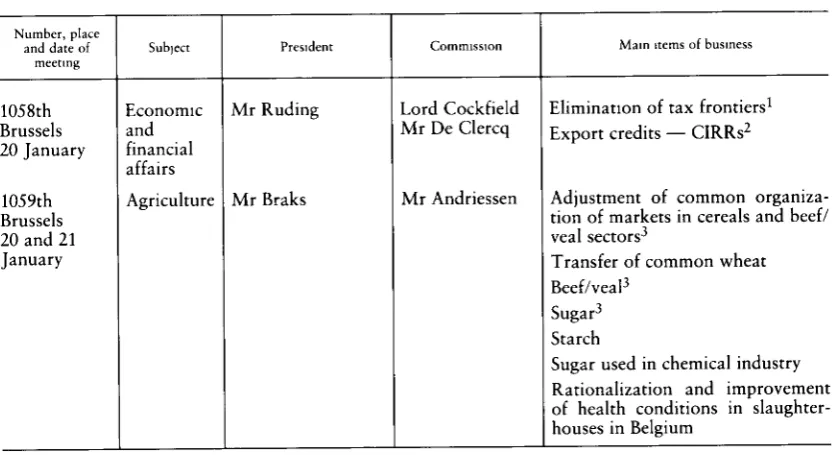
The Council met on20 January to discuss economic and financial affairs.It
gave
its
endorsementto
the brief
for
the ad hoc high-level working party set up to examine the problems connectedwith
theabolition
of
tax
frontiers (--+point
2.1.5).It
also issued to the Commission directivesfor the forthcoming OECD negotiations on
commercial interest reference rates (CIRRs)
(--+ point 2.2.5).
Economic
situation
2.1.2.
As part of their work on Europeaneconomic problems,
the
Commission departments published a study on thesec-toral
and structural aspectsof
economicdevelopments
in
the major
industrialized areas
(Community,
United
States
andJapan) since the
first
oil crisis.l
The firsttwo chapters analyse industrial
competitive-ness and the reasons
for
the Community'sreduced share
in
high-technology sectors.The
third
chapter examinesthe
growing economicrole
of
the
service sector andshows that the key determinant
of
growthin
this
sector was higher consumption ofservices
by
industry. Thefourth
and finalchapter attempts a more theoretical formu-lation of the relationships between research,
product and process innovation, and
struc-tural adjustment and unemployment. In the
OECD area as
a
whole, thereis no
indi-cation that technological change has caused a net loss of jobs.
Community
borrowings
Loan to Greece
2.1.3.
On24 JanuaryMr
Matutes,Mem-ber
of
the
Commission
with
specialresponsibility
for
Community
financial instruments,and
Mr
Papantoniou, State Secretaryin
the GreekMinistry
of
Econ-t6
omic Affairs,
signedthe
contractfor
thefirst instalment of the loan which the
Com-munity decided
to
grantto
Greeceon
18November 1985.2
In accordance with that decision, the
Com-mission had begun to carry out the
necess-ary borrowing operations
on
capitalmar-kets. In January
it
floated three bond loansof
350million
ECU, USD 150million
andDM
500million
(--+point
2.3.4).It
will
shortly complete the operations to raise theremainder of the finance for the first instal-ment of the loan.
Economic
Policy Committee
2.1.4. The
EconomicPolicy
Commimeeheld
its
164th meeting on 7 January. WithMr
Guillaumein
the chair,it
discussed, inits'medium-term'
composition, flexibilityin
goods and service markets and publicmeasures to assist firms.
lnternal
market
and
industrial
affairs
Completing
the
interna! market
2.1.5. On 20
Januarythe
Ministers of
Economic and Financial Affairs instructed the ad hochigh-level working party set up atthe December Council meeting 3 to examine
what tax measures are needed to ensure that the internal market is
fully
established andworking
by
the
endof
1992,taking
the Commission White Paper on completing theinternal market
4
as its starting point. Theworking party
will
report
back
to
theCouncil regularly, starting in March.
1 European Economy No 25, Office for Offrcral Publi-catrons of the European Communrtres, Luxembourg.
2 Bull. EC 11-1985, point 1..j.2.
3 Bull. EC 12-1985, pornt 2.1.8.
a Bull. EC 5-1985, pornt 7.3.1 et seq.
lnternal market and industrial affairs
2.1.5.
At
the
Council
meetingon
agri-culture on 20 and 21 lanuary the Presidentemphasized the importance
of
harmoniza-tion
in
the
veterinary,plant
health
andfoodstuffs sectors and announced
that
he intendedto
pay very close attentionto
all these issuesat
forthcoming Councilmeet-'ings on agriculture. He appealed
to
all the Member States to help make fresh progressin the.months ahead with a view to creating a genuine unified market in these areas. The Commission endorsed this appeal and
stressed
the
importanceof
its
communi-cation on a new approach to harmonizationin
the
foodstuffs sector,
which
should improve Community decision-making pro-cedures.l
2.1..7.
On the
1,4January
Parliament adopted a resolution (--+ point 2.4.10)2 onthe \White Paper on completing the internal
market.
r
It
broadly supported the action programme envisagedin
the White Paper,but
hopedthat the
Community's social,regional and environmental policies would
also be expanded.
During the debate on the motion, the
Com-mission undertook to make a written report
to
Parliament every yearon
the measures taken to implement the action programme.Free
movement
of
persons
and
freedom
to
provide services
Mutual recognition
of
diplomasand access to occupations
Accession-related measures
2.1.8.
On 27 January the Council adopteda
f)irectivea adding
civil
engineeringdegrees to the Portuguese architects'
qualifi-cations listed
in
the
Directive
of
20 December 1985,5 which had amended thearchitects' Directive 5 to take accoullt of the
accession of Spain and Portugal.
Doctors
2.1.9.
On
15 January Parliament gave itsopinion 2 on a proposal
for
a Directive onspecific training in general medical practice
transmitted
by
the
Commissionto
theCouncil
in
December 1984.7 Parliamentwarmly welcomed both the
spirit
and thesubstance of the Commission proposal.
General system for the recognition
of higher education diplomas
2.1.10.
At
its
January session theEcon-omic and Social Committee endorsed a pro-posal
for
a Council Directive on a generalsystem
for
the recognitionof
higheredu-cation
diplomaswhich
involvesa
newapproach
to the
question
(--+ point 2.4.28).8Removal of technical and
administrative barriers
to
tradeIndustrial products
Fire safety in hotels
2.1.11.
On
15
January Parliamentde-livered
its
opinione
on a
proposalfor
arecommendation
on fire
safetyin
existing hotels,l0 which the Commission had trans-mitted to the Council in January 1984. Par-liament regretted that the form chosen for the Commission proposal hadnot
been a regulation.It
was essential,in
its view, forthe minimum fire safety requirements to be established
in
theform
of
a
codethat
all Member States would be legally bound to applv.The
Commission, representedby
LordCockfield,
whoseportfolio
includes theinternal market, stated that it was prepared
to accept some of the technical amendments
I
Bull. EC 11-1985, point 2.1.18.2
oJ c 36, 17.2.1986.3
Bull. EC 5-1985, poinr 7.3.1 et seq.4
oJ L 27,1,.2.1995.,,
oJ L 376, 31,.tz.t9qs.6
oJ L 223,21.8.1985; Bull. EC 5-1985, point 2.1.16.7
OJ C 13, 15.1.1985; Bull. EC 12-1985, pornt 2.1.10.8
Supplenrent 8/85-
Bull. EC; OJ C 217,28.8.1985; Bull.E C 7 /8-1985, pornt 1.4. 1.
e
oJ c 36, 17.2.1986.Steel
sought by Parliament. As regards the legal
form
of
the proposal, however, theCom-mission
could
not
accept
the
changerequested by Parliament and
did not
wishto go beyond a proposal for a directive. The
Commission intended
to
present further proposals relatingto fire
safetyin
public buildings in the form of directives, but in themean time only a recommendation could be
envisaged.
Pharmaceuticals
2.1.12.
On
1,6 January Parliament de-livered a favourable opinion,I
subject to a numberof
amendments,on the five
pro-posals for Directives and a recommendation
on
high-technologymedicinal
products,particularly those derived
from
biotechno-logy,
that
the Commission transmitted tothe Council in October 1984.2
Business
law
Economic and commercial law
Patents
2.1.13.
On 15 January Parliament adopteda resolution emphasizing the need
for
theLuxembourg
Convention
on
the
Com-munity Patent to enter into force (--+ point 2.4.7q.1
Trade marks
2.1.14. On
27
Januarythe
Commission sent the Council a proposal3for
aRegu-lation implementing the Regulation on the
Community trade mark.
a
The purposeof
this proposal is, pursuantto
Article 725 ofthe proposed Regulation on the Community
trade mark,
to
determinethe
rules
toimplement
the
Regulation
once
it
is adopted.It
deals in particularwith
the for-malities for applying for a Community trademark, the calculation and laying down of
the time
limits
to
be observedin
dealingswith
the Community Trade Marks Office,the items to be published in the Community
Trade Marks Bulletin and the rules
govern-18
ing the opposition, appeals, revocation and
invalidity procedures.
Small
business
-Business
Cooperation Centre
-Distributive
trades
Small business
2.1.15.
Mr
Abel Matutes, the newMem-ber
of
the
Commission whose portfolioincludes
the
Communitypolicy
on
smallbusinesses, made
a
statementon
taking office on 1 January.He emphasized that Europe had to come to
grips with the challenges facing our societies
as a result
of
industrial restructuring, newtechnology
and
loblessness,and
assertedthat small and medium-sized firms
operat-ing in a healthy economic climate would be
the genuine architects of economic recovery
in
Europe-
just as they are now provingto be in the United States.
2.1.16. on
15Jr"r;,
Parliament adopteda
resolutionon
the helicopter industry in Europe (---r point 2.4.1,q.sStee!
The Community steel
industry
Market management
Crisis measures
O rganizational de c i s i ons
2.1.17.
The
measures introducedat
thestart of the year to revert to a free market in
,
oJ c 36, 77.2.19s6.,
OJ C 293,5.11.1984, Bull. EC 10-7984, pornt 2.1.16.I
CoM(85) 8,t4 final.a
Supplement 5/80-
Bull. EC; OJ C 351, 31.12.1980;Bull EC 11-1980, pornt 1.5.1 et seq.; OJ C 230, 31.8.1984; Bull. EC 7 /8-7984, pont 2.1.21.
,
oJ c 36,77.2.7986.Steel
concrete reinforcing bars and coated sheet other than galvanized sheet appear to have had the desired effect.
I
Contrary to all the fears, prices for reinforcing bars in theCom-munity remained
firm
despite the seasonalslackening
of
demandfrom the
building industry. Sustained demand from the motor industry kept sheet prices buoyant.Exports weakened somewhat.
In
the pasttheir
valuehad
been basedon
a
strong dollar; now the fall of the dollar, combinedwith
the restrictions on exportsto
the USmarket
and the
subsequent deflection oftrade, has reversed the situation.
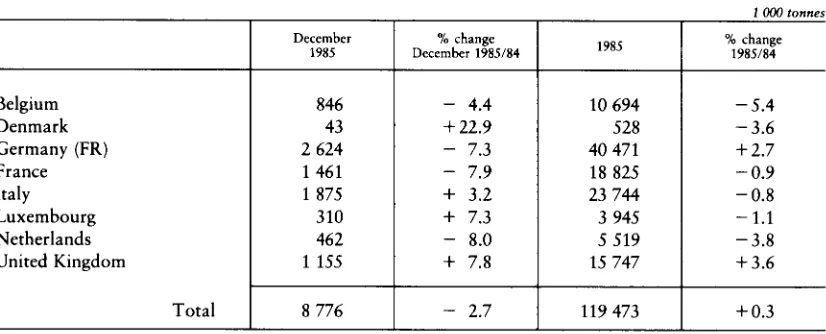
Table 7
-
Community steel production, December 1985Production
in
the countrieswhich
supply figuresto
the InternationalIron
and SteelInstitute totalled 435.3
million
tonnes in1985, 0.6o/o up
on
1984. US and Japanesesteel production
fell by
4.3"/. and
0.3%respectively, while Community production
rose by 0.3o/o.
World
steel production was 720 milliontonnes in 1985, 10 million tonnes (1.4%) up
on
1984.The bulk
of
this
increase camefrom
the
developing countries.output
in the industrialized '!7est held steady.lnvestment
2.1.19.
At
the end of December the Com-mission published its report on invesLmentin the coal and steel industries in the
Com-Sales prospects
for
the
Community steelindustry
could
well
be slightly poorer in1985
than
in
1985, evenon
the
internal market. But the restructuring and rational-ization completed should lower production costs.Market situation
2.1..1.8. Table 1 gives details
of
steelpro-duction
in
the
Community
(excludingGreece and lreland) in December 1985 and
for the
full
year in comparisonwith
1984.munity.
z
This 1984 review was sent to rhe ECSC Consultative Committeefor
infor-mation.
Trade
with
non-member
countries
Exports
Retaliatory measures against the USA
2.1.20.
On 30 December the United Statesannounced that it would be restricting
semi-finished steel imports from the Community
t
OJ L 340, 18.1.2.1,985; Bull. EC 11-1985, pornts 2.1.23ro 2.1.25; Bull. EC 72-7985, pornr 2.7.26.
2
sEC(8s) 1853.1 000 tonnes
December
1985
% change
December 1985/84 r985
% change 1985/84
Belgium Denmark Germany (FR) France Italy Luxembourg Netherlands United Kingdom
Total
845
43
2 624
I
46t1875 310 462 1 155
-
4.4 +22.9-
7.3-
7.9+
3.2+
7.3-
8.0+
7.8t0 694
528
40 471 18 825
23 744 3 945 5 519
15 747
-
5.4-
3.5+2.7
-
0.9-
0.8-
1.1-
3.8+3.5
[image:21.466.24.437.262.429.2]Research and technology
to 400 000 tonnes a year with effect from
I
January,
with
the
possiblityof
a
further200 000 tonnes being added at the discretion
of the Administration. 1
In response to this unlawful measure, on 27 January the Council introduced
compensa-tory
restrictions
on
fertilizers
(512 000 tonnes), bovinefats
(107 000 tonnes) andcoated paper (10 000 tonnes)
with
effectfrom
15 Februaryuntil
a
satisfactorysol-ution could be negotiated.2
The
restrictionsfor
fertilizers and bovinefats roughly reflect
the
1984 levels,corre-sponding
to
reductionsof
23o/oin
the caseof fertrlizers and 20o/o
for
bovine fatscom-pared
with
1985.For
coatedpaper
thereduction is 8% compared
with
1985. The total value of business affected by theseretaliatory measures is 55
million
ECU orUSD 42.8
million
comparedwith
1985, although the trade loss asa
resultof
US measures is estimated to be USD 48 million.Research
and
technology
Community R&D policy
Senior officials concerned with Eureka
2.1.2L.
Senior
officials
concerned withresearch
and
technology
from
the
18countries taking part
in
the Eureka project metin
London on22
and 23 January andreached agreement
on
the composition of the project's secretariat, whichwill
consistof
six
members, three appointedby
theCommunity countries,
two by the
otherEuropean countries and
the sixth
by
theCommission, which
will
also contribute to its financing. The main purpose of the sec-retariatwill
be to maintain liaison betweenresearch institutes, governments
and
theCommunity institutions, and
its
memberswill
be drawn from the seniorcivil
serviceor from industry.
20
Structures and procedures
2.1.22.
As part
of
the
Commission'sefforts
to
promote international scientificcooperation, particularly between the
Com-munity and the EFTA countries,
Mr
Karl-Heinz Narjes, the Vice-President
with
spe-cial responsibilityfor
research, science andinformation
technology, recently invited Sweden,Norway,
Finland,
Austria
andSwitzerland to appoint representatives to a strategic discussion group on the future
of
the European Technology Community.Among
other
tasks,this
group
will
be requiredto
advise on research policymat-ters. Together
with the
membersof
theCommittee
for
the European Developmentof Science and Technology (Codest),
it
will
draw
up
recommendationson
the
future managementof
Community research andtechnology
policy
as
summarizedin
theframewoik
programme.3This was
themain discussion topic at the inaugural
meet-ing
of
the group, held
in
Brusselson
9January. The Commission
will
take accountof
the problems raised on that occasion inpreparing
the
revised
framework
pro-gramme (1987-92).Once
the
necessaryparticipation
agree-ments have been signed, the
joint
meetingsof
this group and
Codestwill
also
be devoted to the selection of suitable proiectsfor
inclusion
in
stimulation
actions, in which laboratories in the five countriescon-cerned
will
be involved.Stimulation of European scientific
and
technical
cooperation
and
inter-change
2.1.23.
In accordance with therecommen-dations made at the meeting of the Commit-tee
for
the European Developmentof
Sci-ence
and
Technology (Codest)
on
9 December 1985,the
Commissionis
cur-rently preparing contracts for the executionI
Bull. EC 12-1985, pornt 2.1.35.2
oJ L 30, s.2.1986.3
Supplement 5/83-
Bull. EC ; OJ C 208,4.8.1983; Bull. EC 5-1983, pornts 1.3.1 to 1.3.5.Research and technology
of
30
new projects underits
stimulationplan.
I
This brings the total number of these projectsto
777 and theirtotal
valueto
21million
ECU. They cover a wide rangeof
disciplines,
including
mathematics andinformation
technology,
biocommunica-tion,
solid-state physics,
soil
sciences,instrumentation, surface chemistry
and physics, advanced optics and oceanography.Important 'operations' include the
demon-stration of the feasibility at microionic level of miniaturized solid cells, the development
of
instrumentsfor
the spectroscopicresol-ution of high-energy X-rays using
synchro-tron
radiation, the
developmentof
lightmodulators based
on
the
holographicillumination
of
non-linearoptical
filters, researchon the
developmentand
appli-cation
of
permanent iron/rare-earthmag-nets, and the study at the molecular-mech-anism level of chemical and physical forces
and
of
energy conversion through naturaland artificial membranes.
At the same time, more than 400 laborator-ies employing some 1 200 research workers
will
be linked under international twinning arrangementsin
different fields.Many of
these researchers
will
have the opportunityto make working visits to partner
laborator-ies
in
other Member Statesfor
periods ofup
to
three months.In
addition, 'researchgrants'
will
enable50
scientiststo
beseconded for longer periods of study (up to
three years) in other laboratories.
A
meetingof
all
the
experimental-phase(1983-84) contractors whose activities have
been completed
will
beheld
in
May
foran exchange of experience and to compare
results. 2
Horizontal activities
FAST
2.1.24.
On
23
Januarythe
Commission sentthe
Council and Parliamentits
firstactivity report 3 on FAST (1983-87). a After
noting
that
the
resultsof
FASTI
17978-83)5
had been used mainlyto
prepare aCommunity biotechnology
policy and
toprovide
initial
conceptsfor
the Esprit pro-gramme, the report outlinesinitial
trends,problems and prospects
in
the five
fieldsunder review:
technology-work-employ-ment relations, services and technological
change, the new strategic industrial system
of
communications, the futureof
the food system and the integrated development ofrenewable
natural
resources
(Syrena). Under FASTII
(1983-87) thesefive
fieldsare being studied via a European forecasting
cooperation network based on 55 research
contract teams,
a
networkof
10 nationalunits designated by the Member States and
scientific fellows seconded to the FAST pro-gramme by national authorities.
I ntern atio na I coo perati o n
EFTA countries
2.1.25. Two
important agreements wereconcluded under the guidelines drawn up
at
the
EEC-EFTA ministerial meeting in Luxembourg on 9April
1984,5 which hadencouraged scientific and technical
cooper-ation
betweenthe
countriesof
Europe, thereby stressing its importance.On 8 January in Berne, the Community and
Switzerland signed a framework agreement
on
scientific
and
technical cooperation. Cooperation between thetwo in
thescien-tific and technical field is already well
estab-lished;
in
addition
to
its
involvement inseveral COST projects (oceanography,
tele-communications, information technololgy, metallurgy, environment) and JET,
Switzer-land
is
linkedto
the Euronet system andparticipates
in
Community research pro-jects in the medical and other sectors. The framework agreement which has just beent
OJ L 83,25.3.1985; Bull. EC 12-1984, pornts 1.7.1 and1,.7.2.
2
oJ L 181,,6.7.1983; Bull. EC 5-1983, pornt 2.1.59.3
coM(86) 1o frnal.4
OJ L 293,L5.10.1983; Bull. EC 6-1983,potnt2.7.257.5
OJ L 225, 76.8.7978; Twelfth General Report, point421,.
Research and technology
signed
will
makeit
possibleto
systematizethe cooperation and to ensure greater inter-action between the scientific policies of the
two parties. A joint committee set up under
the agreement
will
meet shortly to examine,in particular, the question
of
Swiss partici-pation in the Brite and Esprit programmes.A
similar
framework agreement betweenthe Community and Sweden was signed in Brussels
on
12 January.The
Communityand
Swedenare
already cooperating infusion
research,the
COST
programme, Euronet, research on wood as a renewableraw material and in other areas. The
agree-ment should make
it
possibleto
extendcooperation
to
other sectors, including thenew technologies.
2.1.26.
On 20 January the Councilautho-rized the Commission to negotiate a
frame-work agreement on scientific and technical
cooperation with Austria. 1
2.L.27. On
22
Januarythe
Commission sentthe
Counciltwo
recomendations fordecisions concerning
the
conclusion offramework
agreementson
scientific andtechnical cooperation
with
Norw ay2
andwith Finland.3
Canada
2.1.28. On
20 Januarythe
Council alsoauthorized
a
the Commissionto
negotiatea
Memorandumof
Understanding withCanada concerning cooperation in th-e field
of fusion research and development. )
COST proiects
2.1.29.
On 20
January
the
Council amended5
its
Decisionof
13
December19827 concerning a Community
concerted-action project relating to shore-based mari-time nivigation aid systems. s
2.1.30.
The
COST Committeeof
SeniorOfficials met
in
Brusselson
10 January.Among other matters,
it
took
noteof
theinformation provided
by
the chairman ofthe
relevantworking
group concerning a new proposalfor
a COST project onseis-22
mological research and by the Commission
representative on the inclusion of an
'inten-sified' concerted-action project on this topic
in
the Community's new environment andclimatology
programme
(1986-90), the financial and technical scope of which had, in principle, been approved by the Council in December 1985. eThe Committee also took note of the report
of
the ad hoc groupon a
proposalfor
anew COST project in the field of advanced
light metallic materials for transport
appli-cations and of the information provided by
the Commission on the Community's new
'Euram'
programme(raw and
advancedmaterials, t986-89) which involves related fields, the financial and technical scope
of
whichlo
had,
in
principle,
also
beenapproved
by
the
Council
in
December1995.11
Sectoral R&D
activities
Energy
Nuclear fusion energy
2.1.31.
An
important internationalcoop-eration
agreementon
researchinto
con-trolled
nuclear fusion was signedby
the Community, the United States and Japan in Munich on 15 January. This agreementwill
Iink the three largest tokamak experimentalfusion facilities
in
theworld,
namely theJoint
European
Torus
established at Culham, UK, as part of the European Com-munities'fusion programme,ll the TFTR at Princeton in the US and the NakamachiJT-I
Bull. EC 11-1985, point 2.1.184.2
coM(85) 855 final.3
coM(85) 854 final.4
oJ L 3s,11.2.1996.5
Bull. EC 11-1985, pornt 2.1.185.6
oJ L 19,24.1.1986.7
oJ L 378,31.12.7982; Bull. EC t2-1982, point 2.7.779.8
oJ c 182,20.7.1985; Bull. EC 7/8-1985,pornt2.7.279.e
Bull. EC 12-1985, point2.7.239.10 Bull. EC 12-1985, point 2.1.235.
1r OJ L 83,25.3.1985; Bull. EC 12-1984, points 1.7.1 and
1.7.2.
Research and technology
50 in Japan. As described in the agreement,
cooperation between the three centres
will
take numerous forms, including
the
pro-motion
o[
exchangesof
information andresearch workers, the
joint
preparationof
certain research programmes and the joint
organization
of
seminars, eachof
theseactivities being conducted on a trilateral or bilateral basis according to preference.
Given the present state
of
research, physi-cists are generallyof
the opinionthat
thescientific feasibility of fusion is most likely to be demonstratedin a tokamak. In
particu-lar,
they
believethat this goal can
be achievedin
second-generation large-scaletokamaks such as JET, TFTR
or
JT-60.It
is this fact
which makesthe
cooperation agreementlinking
these three facilities so important, since it provides for furthercon-solidation
of
the world's
most advancednuclear fusion system and
will
contribute to its accelerated development in the future.From the
Community's standpoint, thisagreement
will
make it possible to maintainand reinforce
the
leading position whichit
has achieved asa
resultof
20 yearsof
unremitting
effort
in
this field.
It
formspart
of
a
resolutepolicy
of
international cooperation on fusion.2.1.32.
On 8 January the Commission sent the Council a communication 1 concerningthe fusion programme,2 in which it stressed
that the Council's reduction
on
12 March1985 of the financial allocation proposed for
the research programme on thermonuclear
fusion
2
was incompatiblewith
thepro-gramme's objectives
and
threatenedEurope's leading position
in
this field. The Commission therefore intended to proposean increase in the total appropriation at the
time of the programme's revision.
lndustry
New technologies
Information te ch nology
Esprit
2.1.33.
Following the supplementary callfor
proposals under the Esprit programmemade in September 1985,3 11 new projects
in the software technology
^rea were select-ed for the negotiation of contracts.
Reaction
to
the call
for
proposals wasimpressive: more than 40 were received, and
the financing requested far outstripped the
18.9
million ECU
availablefrom
Com-munity funds. The whole software side
of
the
programmenow
hasthe
potentialit
needs to make a substantial improvement in
the productivity
of
the European softwareindustry and the quality of its products.
Microelectronics
2.1.34.
On 7 January the Commission sentthe
Council
and
Parliament
the
thirdreport 4 on Community actions in the field
of microelectronic technology. 5
Data processing
2.1.35.
On 14 January Parliament adopted a resolution on theCommunites'data-pro-cessing equipment
policy
(--+ point 2.4.Lq.6Telecommunications
STAR programme
2.1..36.
On
20
Januarythe
Commissionsent the Council a proposal for a Regulation instituting a Community programme for the
development
of
certain
less-favouredregions
of
the
Communityby
improving access to advanced telecommunications ser-vices (STAR programme) (--+ points 2.1.80