I
NFORMATICS IN THE
UK:
C
URRENT
P
ERSPECTIVES
Su White
Electronics and Computer Science,
University of Southampton Southampton, UK +44(0)23 8059 4471 [email protected] http://www.ecs.soton.ac.uk/
Alastair D. Irons
School of Computing, Engineering and Information Sciences University of Northumbria Newcastle upon Tyne, UK
+44(0)191 227 3603 [email protected]
http://northumbria.ac.uk/
A
BSTRACTComputing, Computer Science and Information Science are the nearest UK equivalents of the European Informatics degree. Informatics is a term more often associated with research or multidisciplinary applications of Computing. Barely five percent of UK departments concerned with the discipline actually use the word Informatics in their title, and potential students searching the application clearing house for university undergraduate courses would not find Informatics in its subject index. However the components of European understanding of the Informatics discipline are widely researched, taught and studied throughout UK Higher Education.
If we are to support mobility of study in Europe or to successfully pursue international educational collaboration, then understanding the realisation of the discipline in the UK and how it relates to understanding in other countries, is important and necessary to support constructive future discussion, planning and action.
This paper presents data collected via surveys of existing practice, individual interviews and group discussions. It summarises and analyses the structure of current practice, and draws on current debate and technological trends to suggest future direction of our fields of study in the short and medium term.
Keywords
Computers and education, Informatics education, Computer Science Curriculum design.
1.
B
ACKGROUNDA. an overview of the current state of UK informatics education;
B. a discussion of the concept of "informatics" and how it might be usefully applied to university-level "computing" education in the UK; C. a discussion about the future directions in UK "computing" education The analysis is designed to contribute to a number of developments and surrounding debates. Firstly, Institutions across Europe are examining curriculum in order to evaluate current practice against the demands of the Bologna Process. Secondly, in the UK the computing area was amongst those STEM Subjects (Science, Technology, Engineering and Mathematics) which were identified as being “Strategic and Vulnerable”; academics , especially departmental heads, are concerned to understand how the field can remain viable by attracting and adequate number and diversity of student who go on to graduate with appropriate skills and qualifications. Thirdly there has been a related, sometimes intense and heated, debate on “the future direction of computer science” to which this paper may make a small contribution.
Mapping current practice, and exploring its complexities is also of value in the context of increased student and labour mobility, globalisation as a
consequence of new technologies, and the internationalisation as a policy agenda for higher education institutions
1.1. Existing Practice in the UK
The data used in this paper was collected during 2006. Part of the data was collected through interviews with UK academics conducted as part of an initiative in the UK to identify agendas for change in Information and Computer Science Education.
The initial data was collected from a small number of semi structured interviews seeking to identify current key topics within the broad computing curriculum. Interview subjects came from some of the seventeen institutions in the South of England. Further data was collected via a survey and workshop discussions with academics drawn from across the UK who are active in the ICS education community.
Information has also been drawn from The Council of Professors and Heads of Computing (CPHC), and from statistics gathered using official sources in the public domain including the Universities and Colleges Admissions Service (UCAS) and the Higher Education Statistics Agency (HESA). Information was derived by identifying and analysing the range and relative popularity of degrees offered, and the actual curriculum areas offered for study.
2. I
NFORMATICS AND RELATED AREASThe International Encyclopaedia of Information and Library sciences definition of informatics (Fourman, 2002) states:
“Informatics is the science of information. It studies the representation, processing, and communication of information in natural and artificial systems. Since computers, individuals and organizations all process information, informatics encompasses computational, cognitive and social aspects. Used as a compound, in conjunction with the name of a discipline, as in medical informatics, bio-informatics, etc., it denotes the specialization of informatics to the management and processing of data, information and knowledge in the named discipline”.
According to Dahlbom considering curriculum changes in Scandinavia informatics is:
“the term used on the European continent and in Norway, for all the computer science disciplines” (Dahlbom, 1996)
He compares this with the new informatics:
“A theory and design oriented study of information technology use, an artificial science with the intertwined complex of people and information technology as its subject matter.
2.1 International understandings of the
Informatics Curriculum
UNESCO (United Nations Educational, Scientific and Cultural Organization), IFIP (the International Foundation of Information Processing) and the ACM (Association for Computing Machinery) have each provided a definition of subjects which fall within the Informatics area. UNESCO’s framework for an informatics curriculum developed jointly with IFIP in 2000 states that
informatics refers to “a diverse, yet related family of domains” (Mulder and van Weert, 2000a). Alongside the range of sub fields within the discipline, it suggests that we might simply equate informatics with computing science. There are clear similarities to be found in the domains identified for the ACM Computing Curriculum (Shackelford et al., 2006). Table 1 below compares the two.
The ACM curriculum has been widely discussed and collaboratively
developed. Like other contributors from around the world, academics from the UK have been closely involved in this work and some UK institutions
consciously develop their curriculum with reference to the ACM standards. The complexity of the area is widely recognised; useful work to aid
UNESCO/IFIP ACM
computer engineering computer engineering
Computing computer science
computer science
software engineering, artificial intelligence (AI)
software engineering
information systems,
computer information systems
information systems
management information systems information science
information technology (IT)
[image:4.595.117.493.145.286.2]information and communication technology(ICT) information technology
Table 1 – UNESCO/IFIP and ACM curricula compared
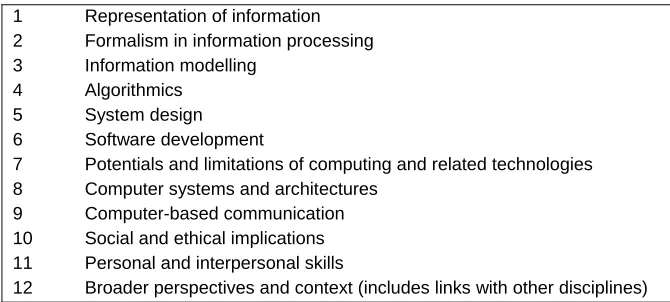
There is significant existing work already done which maps the informatics curriculum some has been from a general educational perspective, some have also had a particular agenda to consider the use of new technologies for teaching (Montgomery, 1998). Explorations of Informatics resulting from work done for UNESCO have been published by Mulder and van Weert (Mulder and van Weert, 2000b, a, van Weert and Mulder, 2002). Figure 1 below shows the contents on their proposed informatics curriculum.
1 Representation of information
2 Formalism in information processing
3 Information modelling
4 Algorithmics
5 System design
6 Software development
7 Potentials and limitations of computing and related technologies
8 Computer systems and architectures
9 Computer-based communication
10 Social and ethical implications 11 Personal and interpersonal skills
12 Broader perspectives and context (includes links with other disciplines)
Figure 1 IFIP/UNESCO’s proposed informatics curriculum (Mulder and van Weert, 2000a)
[image:4.595.129.464.410.561.2]3 I
NFORMATICS IN THEUK
While departments in the UK might describe parts of their research as informatics, it is unusual to off taught informatics programmes; with the exception of specialist areas discussed later in this section.
UK university departments most commonly teach degrees in computer science, computing, computer engineering, information and business technology. This reflects everyday usage but may also be because school children in the UK are most likely to have studied computing, computer science, information technology, or information and communication technology. The rest of this section will explore what is typically offered in greater detail.
3.1 UK Subject Categories
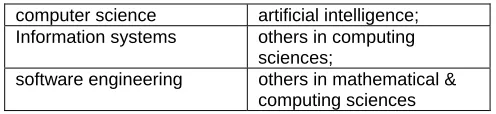
In the UK the official subject categories formally classified for statistical analysis, to determining levels of funding and as a means of identifying like groups of teaching interests for quality assurance purposes. The official view is that students study and universities teach in the six different areas shown below in Table 2:
computer science artificial intelligence;
Information systems others in computing
sciences;
[image:5.595.174.422.415.472.2]software engineering others in mathematical & computing sciences
Table 2 – UK Informatics subject categories
At a national level the whole of the subject area is also sometimes referred to as Information and Computing Science (ICS). This naming convention has been adopted by national academic and educational development initiatives.
The actual organisation of taught programmes is discussed in greater detail in Section Four below, however as is common in our subject, we need to
3.2 Student numbers and choices
In the academic year 2004-05 there were a total of 132,580 applications recorded by HESA within the computing and related discipline areas1. This figure covers all undergraduate and postgraduate students, and both full and part time mode of study. Applications have been declining, UCAS data since 2001 show a decline of about 50 percent in the numbers of students applying to read computing in UK universities.
Using the UCAS course descriptions for 2007 as a guide, it is possible to gain some indication of the relative distribution of study areas, although the numbers should not be taken as definitive since there are many overlaps. However they can be used as an indication of the way in which computing and related areas are presented to would-be students. The largest number of courses within the discipline area are found under the computing heading; information studies and information science are less numerous, Information Technology is least numerous. Most students study single honours degrees, and UK higher education continues the tradition of high levels of specialisms which is begun in secondary schooling. A small number of students take joint honours degrees, and a small number of universities offer modular degrees where students choose a range of subjects rather than studying a specifically designed coherent programme.
According to the UCAS undergraduate level information for 2007 one
institution in the UK offers “Computing Informatics” as a BSc degree, another has “Web Informatics”, it is possible to take “Informatics with a Foundation Year” and just one University offers simply Informatics BSc. A few other universities offer Health Informatics, Music Informatics, Physics and
Chemistry with Informatics; one Scottish university offers a range of arts and humanities subjects with an informatics core. However, this is just a small proportion of the 91 institutions whose computing degrees are accredited by British Computer Society in UK. No accounts or analysis of these experiences have yet been published in the UK, although an interesting account of the introduction of an informatics curriculum has arisen from some work at Irvine in the US (Kay et al., 2005).
3.3 Types of programme
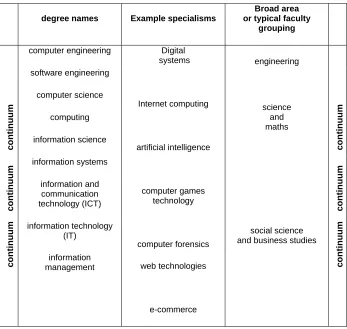
As shown in Figure 2 below there is a wide variation across UK institutions in the balance between theoretical, formal and practical approaches. The style of programmes offered by different institutions can be roughly cast across four dimensions; accredited/non accredited and classical or modern.
1
degree names Example specialisms
Broad area or typical faculty
grouping computer engineering software engineering engineering computer science computing information science science and maths information systems information and communication technology (ICT) c ontinu u m c onti nuum c onti nuum information technology (IT) information management Digital systems Internet computing artificial intelligence computer games technology computer forensics web technologies e-commerce social science and business studies
[image:7.595.120.467.168.497.2]c ontinu u m c onti nuum c onti nuum
Figure 2 – Informatics in the UK degree names and specialisms
When comparing UK “computing” to our European Informatics counterparts the strongest correspondence is with the “classical”, relatively theoretical programmes offered as computer science. Many other UK programmes are more contemporary or modern. Some of these will also be multidisciplinary. Contemporary programmes can be based around a small classic core of computer science, but may often also have clear vocational intentions, for instance, including work placements as an explicit requirement of the programme.
which impact upon areas such as entry requirements, curriculum content, and assessment methods.
3.4 Mapping Subject Areas
Figure 2 above below has drawn together these various understandings and is designed to illustrate ways in which informatics is realised in the UK. It was derived from information found in official publications by the Higher Education Statistical Agency (HESA) and UCAS, the organisation which centrally processes undergraduate applications.
The curricula which have been considered include:
• two year foundation degrees, a relatively new and small offering;
• three year undergraduate degrees (BA and BSc, BEng), the most frequently occurring;
• four year undergraduate masters degrees (MEng);
• one year post-graduate masters degrees (MSc).
In the UK undergraduate and taught masters courses range from heavily theoretical computer science, through to more vocational and application oriented courses. Computer science courses typically have a core
scientific/technical foundation, and late stage specialisms aligned to current research agendas. Course titles and module content may also be named to be recognised by and marketed to potential students. During the late 20th century numerous variations on multimedia degrees emerged, of which few remain today. Contemporary specialisms which have emerged include interactive computer entertainment, computer games technology, forensic computing, web technologies and e-commerce.
4 UK
C
URRICULUM ANDC
HANGEAlthough the analysis of informatics in the UK starts from the curriculum, related factors of organization, student experience and context are important. The framework has four distinct components; which can also be expressed in the language used by the Higher Education Academy subject centre for information and computer science shown in Table 3 below. It will be further referenced in section 4.2.
Curriculum Components HEA-ICS target areas
1) Course Content Curriculum
2) Course Organisation
3) Student Experience Learning and Teaching
4) Drivers Policy
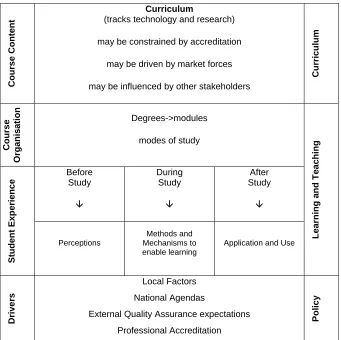
The framework laid down in Figure 3 below summarises current practice by considering activities in relation to the four components. It can also be used to identify targets for change.
Cours e Conte n t Curriculum
(tracks technology and research)
may be constrained by accreditation
may be driven by market forces
may be influenced by other stakeholders
Curriculum Cours e Orga nis a
tion Degrees->modules
modes of study
Before Study È During Study È After Study È Stude nt Ex pe rie n c e Perceptions Methods and Mechanisms to enable learning
Application and Use L
earn in g an d T each in g Drive rs Local Factors National Agendas
External Quality Assurance expectations
Professional Accreditation
Po
[image:9.595.119.460.191.531.2]licy
Figure 3 Components of the field of study
4.1 Change: Motivations and Agents
Change in the curriculum can be seen to be associated with the contexts and components identified in Figure 3 above. Some changes will be internal resulting from local observations and experience. Other change will be external driven by policy sometimes led by government objectives and funding.
The computing subjects, by virtue of their relationship with technology experience frequent changes especially in areas outside the tight theoretical core. Popularity of the subject area has changed over time; currently student numbers appear to be declining. As a consequence, ways of increasing the appeal of our subject areas to potential students has become a regular subject for academic discussion. Furthermore, a number of disciplines within the field have been included in the group of subjects which have been
nationally identified as being “strategic and vulnerable” (HEFCE, 2005). These additional factors may have major implications for the focus and content of programmes of study within our subject area both in the near and distant future.
4.1.1 Higher Education Academy
Specific change agents exist in the form of the Higher Education Academy for Information and Computer Science (HEA-ICS) and The Council of Heads and Professors of Computing (CPHC)
HEA-ICS supports educational and staff development across the subject area. The Centre’s work is wide ranging, designed to create an information and activity hub. The centre has identified priorities in Policy, Curriculum
Development and Learning and Teaching. The latter is concerned with issues associated with a wide area encompassing activities such as pedagogic research, classroom methods and management, and understanding and enhancing student learning.
4.1.2 Quality Assurance Agency
4.1.3 Conference of Professors and Heads of Computing
CPHC is the subject body for university computing in the United Kingdom. It exists to promote public education in computing and its applications and to provide a forum for those responsible for management and research in university computing departments.
Members of CPHC actively discuss ways of taking the discipline forward, ensuring its sustainability and continuity and ensuring that the discipline contributes to the greater good of science and society. The role and future of informatics education is also a key agenda for the CPHC’s Learning
Development Group (LDG). The group aims to address strategic pedagogic issues in the domain of informatics. The LDG promotes the identification and discussion of strategic learning and teaching issues in informatics and identifies and shares good pedagogic practice in the informatics community. They seek to support academics and practitioners in learning and teaching activities by focussing on the strategic management of learning and teaching issues and innovations.
CPHC is concerned about the image of computing, computer science and related disciplines. It members, in meetings and electronic discussions have debated ways in which to make the subject interesting to potential students, challenging to existing students, and stimulating for those who wish to pursue a career in computing.
Despite the ubiquity of computing there are thought to be serious problems associated with how the discipline is perceived by the public and by potential students. There is a disparity between the educational experience of school pupils and the realisation of our discipline area as it is presented and studied at undergraduate level. Many students study ICT at school and think that because they can play computer games, create a spreadsheet or design a PowerPoint presentation they already know all there is to know about computing and will not gain further benefit from studying the subject at university.
4.1.4 Professional Organisations and Government
As was mentioned above the professional bodies have some power to impact on the curriculum; sometimes they are a conservative force, but in other instances their expectations can be used to drive change – especially since many students perceive currency from the additional achievement of professional accreditation. In the UK those influences come from the British Computer Society (BCS), the Institution of Engineering and Technology (IET) and the US Academy for Information Systems (UKAIS). The research councils and funding councils exert indirect influence driven by government policy imperatives. The expectations of the Engineering and Physical Sciences Research Council (EPSRC), in terms of future research direction, influences the careers and interests of researchers who are also academic teachers. As such it will trickle down into the curriculum. The funding councils in the UK determine levels of funding for the subject (indirectly determining the nature of educational interactions) and influence institutional policy objectives.
Government policy can set in place drivers for change in educational practice by Initiatives such as the National Student Surveys. Currently major drives which place emphasis on student employability have the potential to change the shape of the curriculum.
4.1.5 The students
Another stakeholder who can bring about change is the student and the potential student. Departments may change the curriculum in order to attract more students, or to maintain the share of total undergraduates. The
curriculum may be changed in an attempt to redress the balance in student numbers across the genders, currently female students appear to be under-represented. Another driver comes from the desire to make positive and constructive links between the university curriculum and what is taught at schools and colleges at A Level.
4.2 Academics’
Perspectives
Internal change is often motivated by academics experience of the teaching process and subsequent reflection. Data collected through interviews with colleagues and during workshop sessions at the HEA-ICS 2006 conference have been used to identify some of the matters which are considered to be important to academics. The data has been clustered under three areas of Curriculum, Policy and Learning and Teaching. The items are presented below.
4.2.1 Curriculum
Some academics expressed a concern that their teaching is “over burdened with Computer Science theory”. It was pointed out that our curriculum spans Computer Science, Information Technology, Multimedia, Library and
balance between education and training?” There were related concerns about the administrative demands caused by the need to maintain quality standards. Finally returning to content, one question frequently raised was “What is the role of programming in curriculum?”
4.2.2 Policy
Many policy issues were raised. Key areas of concern were related to declining student numbers and an imbalance in the proportion of male and female students, and a similar imbalance in the gender distribution of
academic staff. Associated issues included enhancing the public reputation of the discipline. Colleagues were concerned to improve school liaison and to increase recruitment levels. In matters of the perception of the discipline, colleagues were concerned that the school experience of ICT mislead students’ understanding of the content which university students study and the skills, knowledge and understanding which are gained and developed by undergraduates.
4.2.3 Learning and Teaching
Issues associated with the need to deal with student plagiarism can be considered from both a policy and teaching and learning perspective. Issues which colleagues raised included “How do students go about learning, and how do we engage students more?” Colleagues pointed to the need to “Think beyond assessments” and to focus on “project work and integrated
assessment. Associated this was a concern to identify “The relationship between student learning and feedback.” In terms of classroom techniques colleagues asked “What techniques are most appropriate for which topics?” and “How can we exploit and understand new and emerging technologies?” Environmental factors raised included a demand for “Rethinking physical learning environment”, and “understanding the relationship between the physical environment and motivation of students”.
This section has demonstrated that the subject areas in the UK which relate to informatics are subject to various pressures to bring about change. Those changes are inevitably linked to the dynamic nature of a fast moving technological discipline.
5 S
OMEP
OSSIBLEF
UTURESDebate on the future of computing education sometimes exposes the tensions which come from accommodating the twin perspectives of research and teaching. The name given to the discipline in a department will be a
compromise between something which proclaims the research interests of the academics something which is understood by would be undergraduate and taught post-graduate students.
it perhaps unsurprising that informatics is more often associated with the name of research groups, and academic endeavour than in department names and degree titles.
Some say that our discipline will disappear – a change predicted by the plethora of informatics studies, begun in the science area, but is extending across technology, social science and arts and humanities. We will become an adjunct to other disciplines. Blends of informatics seem endless; arts and media informatics, bio informatics, construction informatics, forensic
informatics, health informatics, humanities informatics, medical informatics, music informatics, social informatics, social and business informatics and veterinary informatics can all be studied at UK universities. Perhaps the future for our discipline may be in multi-disciplinary, informatics where the most significant part of informatics is as part of the fabric of multidisciplinary
studies, leaving a small core to study the discipline in its own right much in the way that maths exists.
Recent speculation in the UK educational press which suggested that pure forms of computer science degrees would be of limited value in the long term produced an avalanche of discussion and disputation which is indicative of the tight sense of self identify which academics invest into their chosen subject specialism.
There is no doubt that individuals and departments create and teach degrees which they believe are of the highest value, and which they will defend to the death. It can be observed in the UK, and across Europe, America and beyond that degree foci range from the hard pure abstract through to the more vocational mixed and multidisciplinary. These are often flavours of existing disciplines rather than specific disciplines in their own right.
Where we might be more likely to see radical change might be at the intersections of existing well defined disciplines. Alongside the convergence we see through the many varieties of informatics, technological advances are bringing the boundaries of many previously distinct disciplines closer together. New methods and understandings are being produced by collaborations across discipline boundaries. It is because of technological evolution that in the near future it seems likely that we may see the emergence, or perhaps evolution of a new science to supersede computer science.
technology for some is so pervasive that it will inevitably impact on their interpretation of the world, and if they are scientists and engineers it will also impact on their educational expectations and needs.
6 C
ONCLUSIONS,
REFLECTIONS ANDF
UTURE WORKThe development and evolution of informatics as a research area promises some sort of future for the discipline, even if we cannot accurately predict the details of that future. These changes will necessarily impact on university level education. Increasing pan European collaborations in research need to be complemented by educational collaborations. This trend can only be accelerated by the demands of administrative changes brought about by activities such as the Bologna agreement. In the area of computer science educational research into the potential gains of collaborative working and learning are being demonstrated by activities such as the Disciplinary
Commons (Tenenberg and Wang, 2005, Fincher et al., 2006). These activities are acknowledged to have impact beyond the scope of the original project domain in terms of information sharing and understandings of practice.
Much work remains to be done in clarifying our mapping of the curriculum if we are to build up a realistic pan-European picture of the current shape of informatics. This discussion could be considerably enhanced by a detailed knowledge of the actual numbers of students studying the different types of computing degrees. CPHC could play a useful role in gaining this data; as could its European equivalents. With the help of some international
collaboration it might then be possible to go forward and gain a deeper insight into the undergraduate experience, both in terms of nature of the degree and relative distribution of core and specialist study areas.
If researchers are successful in establishing a “Science of the Web”
(Berners-Lee et al., 2006) they may help clarify new research domains which will in turn
determining the syllabi we use in Informatics Education. In that case it is likely that we will be working full tilt to modify our programmes and tailor our
curriculum to equip our students to be the researchers and informed decision makers of the future. That said we need to be beginning to design the future form of informatics which we desire right now.
7 A
CKNOWLEDGEMENTS8 R
EFERENCESBerners-Lee, T., Hall, W., Hendler, J., Shadbolt, N. & Weitzner, D. J. (2006) Creating a Science of the Web. Science 11 August 2006 313:5788,
769 - 771.
Cassel, L. N., Hacquebard, A., McGettrick, A., Davies, G., LeBlanc, R., Riedesel, C., Varol, Y. L., Finley, G. T., Mann, S. & Sloan, R. H. (2005) A Synthesis of Computing Concepts. SIGCSE Bulletin, 37:4,
162-172.
Dahlbom, B. (1996) The New Informatics. Scandinavian Journal of
Information Systems, 8:2, 33-47.
Fincher, S., Lister, R., Pears, A., Sheard, J., Tenenberg, J. & Young, A. (2006) Multi-Institutional Teaching Communities in Computer Education. 8th Austalian conference on Computing Education. Hobart, Australia, ACM.
Fourman, M. (2002) Informatics. in Feather, J. & Sturges, P. (Eds.) International Encyclopaedia of Information and Library Science. Routledge
HEFCE (2005) The Roberts Report on Strategically Important and Vulnerable Subjects: HEFCE 24/05. Bristol, Higher Education Funding Council for England
Kay, D. G., van der Hoek, A. & Richardson, D. J. (2005) Informatics: A Focus on Computer Science in Context. Proceedings of the 36th SIGCSE
technical symposium on Computer science education, 551-555.
Montgomery, T. (1998) Informatics Knowledge Mapping and Curriculum Design: A Clear Role for IFIP and UNESCO. Teleteaching’98: Distance Learning, Training & Education Proceedings of the XV IFIP
World Computer Congress, 747–758.
Mulder, F. & van Weert, T. (2000a) IFIP/UNESCO's Informatics Curriculum Framework 2000 for Higher Education. Paris, UNESCO.
Mulder, F. & van Weert, T. (2000b) Informatics Curriculum Framework 2000 for Higher Education. Proceedings of Conference on Educational Uses of information and Communication Technologies, pp151-156, at
16th World Computer Congress, Beijing, August, 21-25.
Shackelford, R., McGettrick, A., Sloan, R., Topi, H., Davies, G., Kamali, R., Cross, J., Impagliazzo, J., LeBlanc, R. & Lunt, B. (2006) Computing Curricula 2005: The Overview Report. ACM SIGCSE Bulletin, 38:1,
456-457.
Tenenberg, J. & Wang, Q. (2005) Using Course Portfolios to Create a Disciplinary Commons across Institutions. Journal of Computing
Sciences in Colleges, 21:1, 142-149.
van Weert, T. J. & Mulder, F. (2002) Modern Curriculum Development for Informatics (Computing Science). Proceedings of the IFIP TC3/WG3 1&3 2 Open Conference on Informatics and The Digital Society: