Bulletin
with Technical Updates from
The Organic Advisory Service
No. 80 October 2005
ELM FARM RESEARCH CENTRE
is an international research, advisory and educational organisation based in the UK.
The business of Elm Farm Research Centre is to develop and support sustainable land-use, agriculture and food systems, primarily within local economies, which build on organic principles to ensure the health and wellbeing of soil, plant, animal, man and the environment.
www.efrc.com
Patrons of EFRC
Graham Pye
Peter Kindersley Jan Sundt The Lord Poole Juliet Kindersley The Countess of March and Kinrara
Director:Lawrence Woodward OBE
Council of Management:
Chairman:Christopher Bielenberg
Trustees: Alexander Bielenberg James Cornford
Roger Harrison Rachel Hood James Skinner
Prof. Dr. Hartmut Vogtmann
Research Director: Prof. Martin Wolfe
Head of Operations:Dr Bruce Pearce
Bulletin Editors and Designers:
Lawrence Woodward, Pat Walters and Alison Walters
Reg. Charity No: 281276
ISSN 1367-6970
MEACHER'S GE ALBATROSS
HITS AGAIN
The Farm Scale Evaluation Trials (FSE) - the albatross that Michael Meacher launched over the GE sector - has marked its presence again. A new report from the Centre of Ecology and Hydrology (CEH) has confirmed that genetically modified, herbicide tolerant, cropping regimes: "significantly affected weed seed banks for at least two years after the crops were sown, potentially causing long-term effects on other taxa".
The researchers involved were not surprised by the result but it does raise significant questions about the longer-term effects of GMHT cropping on farmland biodiversity. Published in "Biology Letters", the full paper can be accessed on the CEH website and, together with their earlier reports, makes interesting reading.
As interesting, and arguably more significant though, is to recall the years before Mr. Meacher, then a Defra Minister, forced the FSE trials on his reluctant government colleagues, an arrogant GE industry and a generally scornful scientific establishment. "There is no scientific reason to suppose there will be any difference between conventional and GE cropping" was the party line - alongside industry chanting about wasting money and time and losing our competitive edge.
This inherently unscientific invocation of science to promote the GE cause and oppose dissenters has been a hugely concerning characteristic of the way the GE issue has unfolded - it has also occurred in other food and farming issues in recent years.
Thankfully, the dissenters continued to press their points, the media continued to ask questions and Michael Meacher bravely withstood departmental pressure.
Consequently, as a result of the FSE trials, we now have a reasonable amount of genuine scientific evidence about the impact of GE (and non GE conventional) cropping on the farmed environment - much of which shows the earlier voices of "scientific reason" to have been hollow and mistaken.
But we don't have the same evidence about the impact of GE technology on food, diet and health. We do have the same hollow voices invoking science and the dubious concept of substantial equivalence and making the disingenuous case that there is no "scientific reason" why there should be a difference or a problem.
Nor, regrettably, do we have a Meacher equivalent. Lawrence Woodward
1-4 Policy UK vaccination policy on FMD CAP reform
Silly season Observer uncovers "organic food scam" Taste and quality matter!
5-11 Research Quality and Environmental Benchmarking for organic agriculture New BTO study
Do Farm Management practices alter soil biodiversity and ecosystem function? Assessment of cereal varietal characteristics for low-input systems
12-15 Technical The Horticultural Market
Research into the prevalence of hock and breast burns
For that matter, what is the CAP? An agricultural policy; a rural and social policy; a corrupt cash machine for big farmers; a mechanism for preserving small farmers and rural livelihoods; a protectionist policy that does down third world countries; the policy that new entrants to the EU most want to participate in; the biggest obstacle to creating a competitive agriculture; the building block of the EU; the burden that will destroy the EU; the whipping boy of some politicians; the sacred child of others; maybe all of these things?
It does symbolise, for many, their perception of the EU. Arguably, more than anything else, it does define what the EU is today - and maybe always has been. It has good bits and bad bits but it is monumentally incoherent. It does have sense and does have logic, sometimes, but, as its default and defining condition is incoherence, nonsense and illogicality predominate. Attempts to develop it or reform it, however well intentioned, quickly become infected with those conditions.
The latest reform is an example. It is hard to find more incoherence than a reform policy which seeks to move away from subsidising farmers for commodity
production (the illogically named 1st Pillar) and encourages them to take up more environmentally friendly farming by paying for environmental goods and services (the 2nd Pillar), yet rewards for ten years those commodity producers by paying them to do next to nothing (Single Farm Payment) to the extent that the new policy (the 2nd Pillar) is funded, under-promoted and under-valued by consumers and taxpayers. The Irish Prime Minister, Bertie Ahern, believes that the current CAP reform: "will ensure that farmers produce in response to market forces rather than to subsidies" and that this will keep Europe's smaller farmers in business. In fact, the response to market forces of a depressing number of farmers, and many of them have largish not smallish acreages, is to take the Single Farm payment and give up production and positive land management completely. Which, from the farmer's perspective, is a sound and logical response to a nonsensical policy leading to a confused and incoherent situation. The CAP needs reform because it is not a coherent policy and not for the other reasons often cited including its cost. In fact, in broad terms, it does not take up much more of the EU's gross domestic product than US agriculture takes out of its economy.
But the U.S. agricultural policy does have a coherence -open as many markets as possible for its exports, protect as much of the domestic market as it can, maintain
supports to the sector where soil and water are issues, maintain an agriculture research, education and training infrastructure to a relatively large degree and support agri-industry through light regulatory touch, export promotions, aid policy and WTO initiatives.
For all the EU bureaucracies' plans, frameworks and declarations, it comes nowhere near the U.S in its coherence or effective implementation: although the policies of some individual member states do. Spain, for example has voraciously helped itself to CAP support for its agriculture to the detriment of its own environment and farm production in other member states.
This is the heart of the matter. There can be no coherent CAP reform because there is no common agricultural perspective and, therefore, no common policy in Europe. Indeed, it is questionable how many member states actually have a coherent agricultural policy. There is a miss-mash of views and goals that rarely blend together, some of which are fundamentally at odds. For example Spain's goal is export at all costs. Water and soil conservation do not figure at all and consequently the hidden price of salads sold in the UK supermarkets is the depletion of water and soil in southern Spain - aided of course by EU grants, largely funded by northern European taxpayers.
Whether in the UK or in Europe as a whole, there is no commonly held view as to what agriculture is for in today's world - is it primarily a trading industry or is it producing food for domestic security; is it a commodity producer or is it producing food for health; does it have a primary role in landscape, environment and conservation management or is it something to be avoided or
regulated?
Even worse, there is at the moment no forum where a valid discussion on these issues can take place and no authority willing to recognise that it is needed or to face up to the fact that the mantra of international
competitiveness and sustainable agricultural development is an illogical cliché that fosters the continuance of an incoherent policy.
Lawrence Woodward
Policy
WHAT IS CAP REFORM?
Rachel Carson Memorial Lecture:
Sex, Lies and Herbicides: the truth about atrazine; The corporate influence on independent science
The lecture will be held in London on 1 December 2005.
Tickets are £30 or £25 if booked by 31st October. For more details or to book, contact
Four years on from the UK disaster of foot and mouth disease (FMD) in 2001 and Defra is still consulting on what Government policy should be next time the tiny virus wreaks such enormous havoc in our agriculture and countryside.
In December this year the new EU Foot and Mouth Directive (EU Council Directive 2003/85) must be implemented across the UK. Three pieces of legislation will be used here by the English, Welsh, Scottish and NI administrations to do so.
New vaccination provisions are contained in The Foot and Mouth Disease (Control of Vaccination) regulations 2005. Detailed control provisions are listed in The Foot and Mouth Disease Order 2005while The Animal Health Act (Amendment) Regulations 2005now contain a change in the Defra Secretary of State's discretionin slaughtering in certain situations (including on infected premises) to a dutyof slaughter. Let's hope the labour and resources deployed to draw up this mountain of bureaucracy are matched with resources and action on farms when next they're required.
EFRC has responded in detail to the latest Defra call for consultation on how the EU legislation will be
interpreted here. Not surprisingly, building on our extensive research and lobbying in 2001 for a change in vaccination policy, much of our submission relates to vaccination. (The full EFRC consultation response can be viewed at www.efrc.com).
Our most serious concerns relate to the attitude of major supermarkets and other key retailers to trade in meat and other products from FMD vaccinated livestock. It is currently impossible to divine what supermarket reaction to a real, rather than hypothetical, UK FMD vaccination scenario would be. In 2001 the supermarkets here apparently backed Government attempts to build
consumer confidence in produce from vaccinated animals. As the prospect of vaccination drew closer, Tesco said it would be prepared to put such meat and dairy goods on its shelves if scientific advice said "it was safe". What a marvelous caveat - whose scientific advice, whose definition of "safe" to Tesco?
At the same time a Sainsbury spokesman said its
customers appeared far more pre-occupied with BSE and vCJD than any threat to human health from FMD.
In its FMD ruminations after the 2001 disaster, the Royal Society admitted that if vaccination is used to help control future UK outbreaks of the disease, it is crucially important to ensure that the public is content to eat produce from vaccinated stock.
Our suspicions that supermarkets have said one thing publicly and plotted the opposite in private are shared by others, even the Government's own officials. In 2001 Alex Donaldson of the Institute for Animal health, Pirbright in Surrey, raised real doubt about supermarket commitment to trade in such vaccinated goods and condemned them for adding to the lobbying pressure that opposed vaccination.
EFRC is urging Defra to lead debate now with
supermarkets, other major retailers, the IGD, BRC and other retail consortia to gain real, rather than notional, commitment to consumer education and trading in produce from FMD vaccinated animals, particularly without the unnecessary hindrance of additional labeling.
We're not naïve enough to suggest that any government can legislate consumer demand, but without the biggest guns of the supermarkets and other retailers sincerely being on-side for real trade in vaccinated produce, any UK vaccination effort in future FMD outbreaks will be still born.
Supermarket attitude is key to UK vaccination policy on Foot and
Mouth Disease
Silly season Observer uncovers "organic food scam"
Mid August and the nation's newspaper editors are gnawing their pencils, desperate to fill acres of pages while the rest of the world disappears with bucket and spade to Barbados and Barnstaple. The silly season was here again.
Down at the Observer a crack investigative team leapt on their bicycles, their mission to get the dirt on the UK's organic food trade. A front page story "Britain's organic food scam exposed" and a “special report” feature were the result.
The central thrust from the Observer was that farmers, retailers and food inspectors have "disclosed a catalogue of malpractice", with food passed off as organic and consumers being ripped off. The story was based on what the Observer believes is the first concerted investigation by trading standards officers into organic food.
Somerset where a £3000 fine was handed out to a farmer falsely using organic accreditation.
Whilst EFRC is always delighted to see organic production splashed in the media (better to be talked about than not be talked about) such journalistic effort by the Observer seems to have missed the point.
All trade is at risk of passing off, scams and fraud and sadly the organic food sector is not immune. Just like the computer and motoring industries, the home
entertainment sector, luxury goods market and even in wine supplies there are dodgy traders with a mission to rip-off consumers. Detecting them is the bread and butter of trading standards officers.
Hats off to Richmond and Somerset trading standards departments for their eagle eyes on food illegally labeled and supplied as "organic".
The article missed the point because all genuine organic produce is certified along the length of the food chain and, as we know, has an openly available and easily policed paper trail.
Let's take heart, that after such an extensive investigation by the Observer in concert with trading standards
departments, firstly, that they un-earthed so few
examples of abuse; secondly, that they did not pierce the murky fog of different standards, dubious interpretation of standards and loopholes and dodgy inspections.
Policy
Taste and quality matter!
Taste and quality are more important criteria when buying food than price, claims new research from the UK.
Recent findings contradict the line from supermarkets that low prices are the deciding factor in purchasing decisions. The study, by the Soil Association, on over a thousand consumers, found 95 per cent of respondents said, "taste and quality of food" was a vital factor when buying food for a meal to serve to family or friends. Only 57 per cent said low prices were important. The results were consistent across all social classes. Even among the least well off, quality easily beat price -quality and taste were considered important by 94 per cent and low prices by 65 per cent. Support for all indicators of food quality was higher among women than men.
Making the leap between taste and quality, and organic food, the findings "give public backing to the
government's support for organic farming, and their efforts to increase production of organic food in the UK." Soil Association.
Organic food is taking off across Europe, driven by a multitude of reasons including environmental and food safety concerns, as well as a rejection of the ceaseless growth of mass food production.
Two years after the UK government, for example, launched an organic action plan for the entire food supply chain, the country has seen a 46 per cent rise in organic produce provided by UK farms. At the beginning of 2004, about 4 per cent of UK farmland - 696,000 hectares - was under organic production, up from 30,000 hectares in 1993. The market is projected to grow by 9 per cent a year to 2007.
Overall, the EU organic market reached around 10 billion in 2002, according to data from UK market analysts Organic Monitor, but growth has slowed in recent years: an increase of 8 per cent between 2001 and 2002 shrunk to an estimated 5 per cent between 2002 and 2003.
According to the market researchers, dairy is one of the fastest growing organic categories, with 2004 sales up on the previous year by 12.5 per cent. Within the category, organic milk and yoghurt reported the highest levels of growth.
Over two thirds of all those questioned also rated avoidance of artificial colouring or additives as
important. High animal welfare standards (71 per cent), avoiding food grown with pesticides (65 per cent), and farming methods that encourage wildlife (63 per cent), were all rated higher than low prices.
Our article in Bulletin 79 July 2005 contained an article on Cereal Mycotoxins - Risks, Regulations and Resolutions.
We would like to clarify that Ergot LINK is a Defra LINK funded project led by NIAB, and is a collaboration between the research partners, NIAB, Rothamsted Research, ADAS, Vencourt (R&D), and the industry partners, HGCA, Advanta Seeds Ltd., Agrovista, Banks Cargill, BASF plc, Farmlink, Monsanto, Unilever, Velcourt Farm Management
http://sf1.novisgroup.com/n.php?n=60497&m=1fne607&c=hjgholscpvwvgxc source Food navigator.com
The March Bulletin, issue 77, contained an article Organic Agriculture in the Humid Tropics.
We have further information on the contributors should you wish to contact them
Elba Rivera Urbina is working atLa Esperanzita, Escuela Campesina de Agricultura Ecológica en el Trópico Húmedo, Nueva Guinea, RAAS, Nicaragua- email: [email protected] and Gerd Schnepel is working withSano y Salvo - Safe and Sound, Primera Asociación Campesina de Cultura y Producción Ecológicas en las Regiones Autónomas del Atlántico Sur y Central, Nicaragua
Elm Farm Research Centre has secured a one-year Defra contract to develop and trial environmental benchmarking for organic farms, where, it is argued, the delivery of public and environmental goods and services is as important as food and fibre output.
The project will be based on previous R&D work but is innovative in that it is seeking to link measurement of financial performance with measurements of non-financial goods and services in a way that the overall and total performance of a farm business can be assessed and improved.
The close involvement of farmers in the production of a workable benchmarking tool/s and process is also a relatively novel feature in this kind of work. The final outcome; a benchmarking system that encompasses non-financial outputs fits squarely with new policy
requirements and will be a valuable technical support to farmers and policy makers.
In recent years benchmarking has been seen as of paramount importance in improving the performance of UK agriculture. Promoting "business performance in the organic sector through benchmarking and value chain analysis" is a major action point in the Organic Action Plan for England.
EU Regulation 2092/91 sets out the principles for organic production, and sets constraints on inputs that may be used by farms operating under organic
certification. These system boundaries and constraints on productivity are, to a significant extent, responsible for the public and environmental goods and services delivered by organic farming.
It is clear, therefore, that linear measures, which assume that performance or yield can continually be improved without constraint, have limited value in assessing the overall efficiency of organic farms. It is necessary to devise benchmarks which assess how successful the organic farm is in delivering these public and
environmental goods and services; what the relationship is between that success and the output of food and fibre; and whether there is a net loss or gain in underlying sustainability.
The project will use a core expert group and a range of stakeholders. The project team will: identify the public and environmental goods and services purported to be delivered by organic farming; assess and evaluate the literature on sustainability indicators and benchmarks; develop a benchmarking protocol using that information for trial on a range of organic farms.
Consideration will be given to benchmarks that are well
established within the industry, and to others that might require development and will include water (use and impacts including storage), soil, carbon storage, labour, energy use and generation, food, fibre and renewable energy crop production, genetic resources, crop diversity, animal health and welfare, habitats and farmland bird species, use of agro-chemicals. Other business and economic measures, such as interactions between system ideals and costs and contributions made to local
economies will also be considered.
These will be grouped according to four primary measures of system efficiency: Financial Stability, Energy Efficiency, Multifunctional Outputs and Soil Fertility.
The pilot farm trials of the proposed benchmarking tool, being essentially participative, will utilise the expertise of EFRC's research and advisory team and Organic Centre Wales.
Expert Group and Stakeholder Workshops will consider the results of the pilot trials, refine criteria, and identify means of wider adoption. The final phase will report on the usefulness of different aspects of the benchmarking tool and process, the best approach for wide uptake, and potential wider implementation across non-organic agricultural systems. It will include a discussion of all the potential measurements and rationale for including or excluding them. It will also provide the framework documentation for a comprehensive "quality and environmental benchmarking package".
This project addresses one of the key action points in the English Organic Action Plan, namely the commitment to investigate quality and environmental benchmarking as corollary to basic financial benchmark development. Defra has supported a significant amount of work on sustainable indicators etc but this project is the first time that environmental and public good parameters have been merged with business performance assessments in order to give a whole picture of total farming system efficiencies. This innovation will therefore have
relevance beyond organic farming as CAP reforms move towards the delivery of environmental and public goods and services by farms alongside more traditional food and fibre outputs.
The project will help improve individual farmer and public understanding of the degree to which organic farming achieves its stated aims. It will also assist policy makers in developing the organic farming sector and the overall farming sector in meeting the requirements of CAP reform and agro-environment schemes.
"Benefits of organic farming to biodiversity vary among taxa", has been produced by R.J. Fuller, L.R. Norton, R.E. Feber, P.J. Johnson, D.E. Chamberlain, A.C. Joys, F. Mathews, R.C. Stuart, M.C. Townsend, W.J. Manley,
M.S. Wolfe (Research Director Elm Farm Research Centre), D.W. Macdonald and L.G. Firbank and is published in the Royal Society journal Biology Letters, 3
August 2005.
A large-scale survey by the British Trust for Ornithology (BTO) and other wildlife research organisations has found that the organic farms in lowland England with cereal crops are supporting: 32% more birds and 35% more bats, as well as 109% more wild plants within the cropped area. In
addition, there was a far greater diversity of wild plant species, with 85% more species in the organic field cropped areas.
The project was funded by Defra and carried out by the BTO, Centre for Ecology & Hydrology and the Wildlife Conservation Research Unit (University of Oxford) Professor Martin Wolfe, Research Director of the Elm Farm Research Centre and experimental farmer, who worked in an advisory capacity on the study, found that the results were no surprise, but were distinguished from previous findings because the project was “particularly well designed”.
Where other studies had attempted to match organic farms with similar conventional farms, thus eliminating many of the differences between the two types of farming, this study had been done on a random basis. The only restriction had been geographical, ensuring that regional variations in biodiversity were taken into account.
“The other thing that was really quite striking in a sense [was the] very small scale of organic production.” Organic farms were 'very small islands' of biodiversity -raising the prospect that larger islands, linked together, could significantly boost the variety of plant and animal life in the British countryside. This could work in a similar way to nature reserves for endangered species, which often include corridors linking one breeding ground with another.
On the issue of whether it was purely the lack of pesticides, or a more rounded approach to the environment which led to this divergence between organic and conventional farming, Professor Wolfe
believes that differences in farmer attitude has shown through in the study, which revealed organic farms tended to have longer, bigger and fuller hedgerows than their conventional counterparts.
But restrictions on the use of pesticides, and the way crops were fertilised were also “significant factors”. This is the most comprehensive study of biodiversity on organic farms in the UK, and confirms the positive findings of all the previous smaller-scale studies. Researchers conclude that a greater area of organically managed land in the UK would help restore the farmland wildlife that has been lost from our countryside in recent decades with intensive farming.
The researchers said a key difference was the non-use of agrochemicals: according to the study "the exclusion of synthetic pesticides and fertilizers from organic is a fundamental difference between systems". Additionally, the much greater length and size of hedges on organic farms was found to be a significant factor (there was 71% more hedge length on the organic farms, and the hedges were larger).
Data on wildlife levels was collected from 2000 to 2003 from 89 organic farms and compared with data from non-organic farms within the vicinity of each organic farm (mostly within 10 km). The survey included most of the organic farms with cereals at the time. The researchers have confirmed that there were 5% more numbers of bird species. The average difference in bird abundance was 32%.
Methodology
• plants were sampled at the field boundary, crop margin, and every 2m up to 32m into the cropped area of the cereal field, on 89 farm pairs from 2000-2003
• birds and bats were sampled by observation over several fields. Birds were sampled on 61 farm pairs over two winters (2000/01 and 2002/03). Bats were sampled on 65 farm pairs in summer 2002 and 2003.
• invertebrates were sampled by a grid of pitfall traps covering the uncropped boundary and the within-crop area, on 89 farm pairs
• farmers completed a questionnaire of 40 questions about the management of the farm and the target cereal field
Research
Findings - biodiversity
• abundance: there were 109% more plants within the crop, 32% more birds, 16% more spiders (average of boundary and crop data) and 35% more bats. Of 30 bird species analysed, 15 were more abundant on the organic farms.
• non-statistically significant abundance results included that they found only 4% more plant
abundance at the field boundaries [but there was 50% more boundary length so presumably 56% more plants at the boundaries in total over the whole farm]; and no difference in overall carabid abundance.
• diversity: there were 85% more plant species in the cropped area of organic farms (35 species vs. 19 on non-organic), 17% more spider species in the cropped area and 33% more bats. Non-statistically significant diversity results included 5% more birds species and less carabid species (only 94% of conventional).
• overall all statistically significant results for the wildlife groups were positive for organic farming except one (carabid beetles at the boundary post-harvest)
• there was no significant 'edge effect' for wild plants in the cereal fields in either the organic or non-organic farms, ie. only a slight fall away in wild plant numbers from the edge to 32m into the field.
Findings - features of organic farming
• organic fields are 32% smaller on average (7.3ha compared to 10.7ha) and there is an average of 50% more boundary length per unit area on organic farms (150m per ha compared to 100m per ha on non-organic)
• organic farms had better hedge habitats which is important for invertebrates, birds and bats: 71% more hedge length, larger (wider and taller), cut less frequently and more likely to be traditionally laid. There was no significant difference in the numbers of hedge species.
• organic farms have a much higher proportion of grassland (38% of the land is grass compared to only 17% on the non-organic farms). 58% of the organic farmland was arable, compared to 70% of the non-organic.
• there was also more non-cropped habitat (important for birds) and open water (important for bats) in the wider landscape around organic farms
Other factors which the researchers identified from the farmer questionnaires that are "likely to
influence biodiversity":
• organic farmers sow their crops later in all three years (eg. to avoid the weed flush in winter cereals)
• the rotations were different. The organic rotations always included a grass ley as part of a
cereal/vegetable rotation. Conventional farmers had a break crop or vegetables or set-aside in a cereal rotation.
• no organic farmers cropped continuously but 22% of the non-organic farmers did.
• many organic farmers undersowed their spring cereals with a ley, but none of the conventional farmers did
• more likely to include livestock (important for bats), had a greater variety of livestock and were more likely to graze them on the arable land (eg. on the stubble or during the leys)
• all non-organic farmers used fertilisers
• weediness had a significant impact on invertebrate abundance and diversity
• more likely to be in an agri-environment scheme other than the Organic Farming Scheme (64% compared to 43% for non-organic farmers).
• set-aside management - organic farmers were less likely to use the natural regeneration option, and twice as many used no set-aside. No difference in use of rotational or permanent set-aside.
• no significant difference in farm size, woodland area or extent of permanent pasture
• no significant effect of organic farming duration was picked up (except a small tendancy for more spiders; but there were not many which had been farming organically for a very long time)
Comments and conclusions
farmed land. The researchers therefore conclude "Strategies aimed at increasing both the total extent of organic farming and the size and contiguity of individual organic farms, could help to restore the biodiversity in agricultural landscapes".
Quotes from the BTO press release and the study
• "the exclusion of synthetic pesticides and fertilizers from organic is a fundamental difference between systems" (quote from the study)
• Dr Rob Fuller, Director of Habitat Research for the British Trust for Ornithology (BTO), and lead author of the paper said: "There were very large benefits and right across the species spectrum" and "Organic farms clearly have positive biodiversity effects for wild flowers."
• Dr Lisa Norton of CEH, who carried out the work on plants said "Organic farmers try to work with natural processes to increase productivity, using sustainable farming practices. Increased biodiversity is a happy by-product of this approach. For example, hedges on organic farms are kept in good stock-proof condition"
• Dr Rob Fuller: "less than 3% of English farmland is organic, so there is plenty of scope for an increase in area. Such an increase would help to restore biodiversity within agricultural landscapes"
• at the stakeholder meeting last July, one researcher showed a photo and said "some of the organic fields were absolutely stunning"
The published paper may be found on EFRC's website: www.efrc.com.
Research
Do Farm Management practices alter soil biodiversity and
ecosystem function?
Recent reviews (Hole et al, 2005, Fuller et al 2005) have highlighted that a wide range of taxa, including birds and mammals, invertebrates and arable flora, benefit from organic management of land through increases in abundance and/or species richness.
These reviews took some account of studies that included impacts on below-ground biodiversity i.e. soil microbes (as a single group) and earthworms. Three broad management practices (prohibition/reduced use of chemical pesticides and inorganic fertilisers; sympathetic management of non-cropped habitats; and preservation of mixed farming) that are typical of organic farming, and particularly beneficial for farmland wildlife, were identified from the review of comparative studies of conventional and organic farming systems.
However for below-ground biodiversity, a focus simply on the biodiversity of below-ground species misses the important consideration of the contribution of below-ground biological processes to the maintenance and enhancement of a range of ecosystem services. For example the analysis of Constanza et al(1997) led to an estimate of US $ 33.3 trillion per year for the total value of the ecosystem services provided by Planet Earth and it has been estimated that 80% of this can be linked to the effective functioning of soil (Lal, 2001).
Using the review of Hole et al(2005) and Fuller et al
(2005) as a starting point, a new project being
undertaken by Elm Farm Research Centre with SAC and University of Newcastle funded by English Nature, Defra, Countryside Council for Wales and Scottish Natural Heritage will review the existing literature to:
• Detail the direct and indirect functions of below-ground biological activity and link this, where possible, to species richness and overall below-ground biodiversity;
• Draw together and critically review the evidence of the impacts of land management practices on species diversity and function. It is intended that the review will include vegetable production systems, upland and lowland situations. It is also proposed to include specific environmental enhancement schemes such as buffer strips, 6m margins and beetle banks,
and;
• In addition we will hold a series of one-to-one meetings with researchers in soil biodiversity and links between the function and diversity of the soil biomass; this will particularly include researchers who were involved in the NERC thematic
programme on Soil Biodiversity.
• Using the information gathered above we will critically evaluate the implications for soil biodiversity and ecosystem function of land management approaches that aim for either generalised farm scale or targeted sub farm scale extensification.
• It will draw out recommendations for further research work and for approaches to practical management that can be applied within the framework of agri-environment schemes.
In June 2005 the 20th International Grassland Congress was held in Dublin. The main Congress brought together over 1000 scientists, policy makers, consultants,
producers and associated industries from 80 different countries. The theme of the congress was "Grasslands -a Glob-al Resource". The congress was divided into three main thematic areas:
• Efficient production from grassland
• Grassland and the Environment
• Delivering the Benefits from Grassland
Many of the papers given in the 'efficient production from grassland' were worrying and provide substance to the claims that globally we continue to put pressure on scarce and vulnerable resources, soils, water and non-renewable energy. This was highlighted in the keynote presentation for the session given by Dr Delgado from the International Food Policy Research Institute. The key points were:
• Meat and milk consumption in developing countries has grown three times as fast as in developed countries in the past 30 years.
• By 2020 developing countries will consume 72 million tonnes more meat and 152 million tonnes more milk than they did in 2002-03.
• Ruminant livestock will account for 27% of the increase in global meat consumption between 2003 and 2020.
However, rather than sounding the warning bell this author was surprisingly upbeat about the potential for further intensification and growth of grassland and ruminant livestock systems. A view that seems
remarkably blinkered to the reality of the limits to growth.
One paper, which did carry an interesting message, was that presented by Nigel Scollan et alon improving the quality of products from grassland. The key points from the paper were:
• Consumers are increasingly aware of the links between diet and health and place increasing emphasis on nutritional quality as a component of product quality.
• Meat and milk products are rich sources of nutrients such as omega-3 (n-3) fatty acids and conjugated linoleic acids, which offer health benefits to the consumer.
• Green plants are the primary source of n-3 fatty acids in the food chain.
• Grassland (and forage based) production systems have potential to enhance the content of beneficial fatty acids, improve stability and alter sensory attributes of meat and milk.
• Grassland offers considerable scope to help create product differentiation in increasingly competitive markets.
What research has not yet answered is whether or not there is a definable difference between products
produced from organic grassland and conventional, in so far as its impact on n-3 fatty acids.
Grassland and Environment and Grassland Benefits Sessions to follow in Bulletin81
Lois Philipps, Senior Researcher
International Grassland Congress
Assessment of cereal varietal characteristics for low-input systems
Researchers from 24 EU countries and two others converged on Edinburgh in early July, just prior to G8, to focus on the latest developments in the EU sustainable low-input cereal production initiative, SUSVAR. The meeting was organised as an activity of the COST 860 network in cooperation with the European Consortium for Organic Plant Breeding (ECO-PB). Each activity provides a forum for the exchange of results and ideas, as well as an avenue, in this case, to discuss techniques and methods for the assessment of cereal varieties in the field.
COST 860 (SUSVAR) is organised around six working groups (WGs), though all six are encouraged to interact as much as possible with each other. WG1 is concerned particularly with genetics and plant breeding, together with WG2 (bio-statistics) and WG6 (variety testing and
certification). WG3 concentrates on plant-soil
interactions, WG4 on plant-plant interactions and WG5 on plant disease complexes. Currently, EFRC has a particular interest in WG1 because of its involvement in the production of wheat composite cross populations. Consequently, this article concentrates on this aspect from the Edinburgh meeting.
project based in the UK involves wheat populations in their second field year, but in France a related
programme has been coordinated by INRA for 21 years. Three different composite cross populations (with one containing a male sterile gene to favour out-crossing) have been cultivated in a diverse array of field conditions across France. Assessments of these populations have identified a rapid differentiation with the populations in the south developing an 'earliness' characteristic in contrast to a cline towards later maturity and selection for a vernalisation requirement in the populations in the north. The level of out-crossing in the 2 sets of self-fertilizing populations was found to take place at a level of 2-10%; a high enough level to enable the formation of favourable genetic combinations and to permit the relatively rapid removal of more unfavourable linkages. Genetic drift (random genetic change) was apparently unimportant but mutations were detected. Further details relating to the evolution of populations, together with the level of selection, were provided by the analyses of plant resistance genes associated with yellow rust and with powdery mildew. Over 10 years, a unique insight has been obtained into the behaviour of 2 sets of genes in these populations, in response to strong, and variable, environmental pressures. The number of yellow rust (Yr) resistance (R) genes existing in the population remained constant, but their relative
frequency varied according to the disease pressure. For instance, between generation 5 and 10, the frequency of R gene Yr17 increased as a result of a strong and
sustained attack of yellow rust. However, the yellow rust strain evolved to overcome the R gene, with a
subsequent decrease of the frequency of Yr17 in the population. In contrast, all powdery mildew resistance genes were overcome at the initiation of the breeding programme. However, the levels of frequency of some powdery mildew R genes were found to increase overall, with some plants accumulating a number of genes. It became evident that an advantage was conferred to plants that possessed more than one gene, despite the fact that the R genes had apparently been overcome by previous powdery mildew populations.
Superior performances of composite cross populations
have been observed not only in France, but in Hungary and the UK. However, despite the relative advantages of composite cross populations with respect to stability of yield in low input and organic systems, there remain several possible barriers to their commercial use. To meet these challenges EFRC will be inviting breeders to the composite cross trial sites to compare the populations and parents. Interested breeders will be able to grow sample populations themselves so as to isolate
phenotypes that can be further developed in the commercial arena. However, it needs to be recognised that the stable performance of composite crosses over diverse environments is due partly to interactions among the varied components. For this reason, single lines isolated from the populations may not perform as well when grown as single genotypes. However, to further facilitate the transfer of valuable genetic material between researchers, and perhaps ultimately breeders, a SUSVAR germplasm exchange database has now been created that enables the sharing of germplasm throughout Europe.
One of the potential barriers to commercial
application of composite cross populations in wheat is the registration of populations - the existing legislation to the ownership of breeding lines relates to pure line hybrids. There is scope nevertheless, to develop regulations similar to those for out-breeding rye populations. In contrast, such barriers to
commercialisation do not exist for mixtures of varieties, which offer some of the advantages evident in composite populations. Hanne Østergaard of the Risø National Laboratory in Denmark demonstrated that mixtures over a diverse range of conditions provide greater yield stability, if the component varieties are compatible. It was also confirmed that mixtures perform better than the individual varieties under years of high disease pressure. However, with low disease pressure, many other factors can be involved in determining which varieties are suitable for mixing.
Mixtures, for practical reasons, must be composed, firstly, of varieties that have reasonably similar maturity, and secondly that are accepted by the end user. The general guidelines for mixtures indicate that the individual characteristics are usually an average of the varieties, and that mixtures should aim to:
• Contain 3 or 4 components in equal parts;
• Contain Danish or European varieties;
• Have culm lengths that do not vary more than 15cm among components;
• Have an average disease severity equal to, or less than, the average severity of the 5 most commonly grown varieties, in the last 5 years;
• Have an estimated difference in maturity of not more than 5 days; and
• Have an estimated average yield which is at least 95% of average yields of the last 5 years.
However, the German mixture of Achat: Tamaro: Bussard (1:1:1) had an overall quality that was higher than that of the components. Indeed, the understanding of the yield potential of mixtures remains unsatisfactory;
other factors need to be considered such as the influence of soil borne chemical interactions between and within varieties (allelobiosis), induced resistance to disease, and nutrient uptake between varieties. The level of nutrient uptake alone is influenced by a large number of steps and rates that vary with each nutrient and cereal genotype. Advantages have been observed in mixtures compared to their component varieties through
improvements in overall biomass and in grain yield and nutrient uptake, particularly at low soil fertility.
The SUSVAR meetings bring together an extraordinary array of experts, covering the breadth of expertise in the development of cereal varieties, in genetic and statistical analysis, field assessments, pest and disease scoring through to nutrient uptake analyses. Workshop sessions
enable far-ranging discussions on these various topics, introducing many novel ideas and approaches. Perhaps of most importance for EFRC is the development of a collaborative approach to the development of composite cross populations. Our own material will be grown in France, Germany and Hungary to broaden greatly the range of selection. In addition, we will be growing similar material in the UK that has been developed in Hungary. These extensions to the composite cross approach should help to generate even more novel genotypes that will be potentially useful for sustainable agriculture and for the rigours of global climate change.
Prof Martin Wolfe, Dr Hannah Jones , Senior Researcher Crops Programme
Kay Hinchsliffe, Researcher
CORE - organic news!
What are latest organic farming research publications in Switzerland, Germany and Denmark? What are the trends in organic farming research in the Netherlands? Which organic research projects are taking place in Italy, Finland and France? How is organic farming research contributing to the environmental discussion in Sweden? How is the structure of the Austrian organic research programme? Which institutes are working with organic research in Norway? What are the research priorities in Great Brittan? Which organic research events will take place in the coming year?
These are questions that the new electronic newsletter
CORE Organic newswill deal with. The newsletter is published by CORE Organic, which is a European coordination project in the so-called ERA-NET scheme. The ambition of CORE Organic is to develop synergy between national activities within research in organic agriculture and to secure better access to research results.
The rationale for the project is that in order to promote a more sustainable agriculture many European countries have initiated research in organic food and farming. However, in many cases the national research is
characterised by small research communities, which can make it difficult to tackle the most comprehensive issues in the area.
Increased trans-national collaboration and coordination between national research programmes is seen as a way to improve the competitive quality and relevance of the overall research. In this connection, transparency and information are essential ingredients.
The ambition of the new electronic newsletter is thus to provide information, both on the national and European research activities and on the joint coordination activities in the CORE Organic project.
CORE Organic news can be found via the project website www.coreorganic.org
ORGANIC & CONVENTIONAL FARMING FACE-OFF
IN 22-YEAR STUDY
The July 2005 issue of the journal Bioscience reviewed a 22-year-long field study by the Rodale Institute which compared organic and conventional farming on similar plots of land with similar crops. The study found that in the initial five years of the study, the conventional crops (i.e. crops grown with pesticides and synthetic fertilizers) had slightly better yields than the organic crops. But during that same initial period, the organic farming practices were building up higher levels of soil mass and biodiversity which then allowed the organic land to generate yields equal to or greater than the conventional crops. The conventional crops collapsed during drought years, while the organic crops fluctuated only slightly, due to greater water holding potential in the organic enriched soil. The conventional crop also had pesticides leaching into the water at levels exceeding the EPA's safety limits. Over the 22 year period, the organic crops used 30% less fossil energy inputs than the conventional crops.
A considerable amount of light has been shone on the organic fruit and vegetable market in the last five years. We now know that contrary to received opinion in the late 1990s the level of UK self-sufficiency in organic vegetable and salad cropsis at least respectable, though still lagging behind the conventional market. The irony here is that the level of self-sufficiency in conventional vegetables is moving in the opposite direction i.e. downwards. We also know that the position as regards organic fruit is terrible and there are few signs that it will improve substantially in the near future. This does not help the development of local procurement schemes for schools, hospitals, etc., as few would argue against the fact that tasty, juicy fruit are an easier option to sell than most vegetables.
Much of this information has come from the Organic Vegetable Market Project (OF0342) and I have written before on this informative project. Copies of the 2001-02, 2002-03 and 2003-04 reports are available from HDRA, Ryton Gardens, Coventry CV8 3LG (02476 303517) and the 2004-05 report is expected soon. The trend over the last 4 seasons has been for an overall increase in UK self sufficiency, though there are individual crop variations. Imports of vegetables (and fruit) outside the usual UK season are understandable but to import when supplies of UK crops are flowing seems unforgivable, given the protestations that major retailers want to source more UK produce.
Why does it happen? This is one of the objectives of a new Defra project (OF0349) that will seek to examine the reasons why certain commodity lines of produce are imported when they are being produced in the UK. The detail of this project has been covered in earlier Bulletins
and you will hear regular updates as the work
progresses. The point here is that we are moving on from merely identifying the level of imports to examining the supply chain that brings them to the UK. The initial work in identifying the relevant countries to visit has been assisted by an excellent survey of supermarket shelves carried out by HDRA members between April and December 2004.
I will review this report in detail in a later edition of the
Bulletinbut for now I would note that price is not always the reason why imports are preferred. There are in fact times when UK produce is significantly cheaper than the imported equivalent in retail price terms. The other point worthy of note is the concern raised by the HDRA members about what they saw as high levels of imports and associated food miles. Several said they had never
thought about it until they started to examine the labels in detail. I hope the new project can answer some of the concerns and also raise awareness of the many issues involved.
The other main trend to come out of the various projects and surveys is the increase in local marketing and wholesaling and the reduction in the proportion of organic fresh produce sold through the supermarkets. It is important to realise that the market for fresh
produce continues to expand overall and that sales in both supermarkets and the local routes are both
increasing. The difference lies in the rate of increase and here the box schemes and farmers markets are winning hands down. There are several reasons for this, though freshness has to be one of the most significant - many of the 12 month schemes have to import produce for a short time but once the UK crop becomes available it tends to be used exclusively. Many of the smaller schemes and markets can provide crop that was picked the same day or the night before. There is nothing in the world that can beat the taste of fresh vegetables.
Customer service is another key factor - this will vary of course, but even the large box schemes have regular newsletters and bulletins while, in smaller schemes, face to face contact is often the norm. On market stalls the personal touch cannot be avoided even if you want to. A further point of advantage is value for money. It is not always easy to allocate cost to individual components of a vegetable box but, whichever way you unpick it (sterling or avoirdupois), it will win over an equivalent basket bought at a supermarket. There are many other winning factors but the last one I will mention is
variety. It is significant that the HDRA members survey noted that, while the availability of staple vegetables appeared to be generally satisfactory, the overall range was often restricted. Anyone who receives a decent vegetable box will know that there's never a dull moment in terms of colourful, unusual and challenging
vegetables.
I am always intrigued to hear the response of
supermarkets to these surveys that show that their overall share of the market is reducing over time. 'Not in our experience' they say, but if they took a moment or two to consider the statistics it should give them pause for thought. Let's just run through a little thought
experiment. It is surely not unreasonable to estimate that there could be up to 100,000 vegetable boxes delivered to customers each week across the UK (if we are not quite there, it will not be long before we are). Let us
Technical
further imagine that the average overall weight is 5kg (I think that that is conservative but never mind) then some 500,000kg (500 tonnes) of fresh produce is delivered every week for at least 45 weeks of the year (that is 22,500 tonnes of produce annually).
If we turn to the monetary side of the equation then the figures again give us pause for thought. On the
assumption that each box is valued at an average of £10 per box (easy calculation) then we are talking one million pounds per week and upwards of £45 million per year. That's not counting the farmers markets, farm shops and other local outlets, so do not let anyone kid us that this is just a minor blip and that the supermarkets will recover this position. Rumours suggest that a
well-known supermarket chain is considering offering vegetable boxes in store. Such a venture may well succeed in the short term, but it is surely such a
contradiction in terms that it could not last. How could it replace the service, variety, freshness and value that I discussed above?
I have met some well-established organic growers recently who feel that at last growers are taking control of the food chain, as perhaps should have been the case when the whole thing kicked off. Who knows, they might even be suggesting the revival of the Organic Growers Association next!
Roger Hitchings, Head of Advisory Services
RESEARCH INTO THE PREVALENCE OF HOCK AND
BREAST BURNS
A short report by Josie O’Brien, poultry researcher
There has been recent coverage in the national press relating to the welfare of both broiler and organic chickens. In particular, the Daily Telegraph (26/07/2005) published an article on the suffering of chickens on farms due to burns. This article stated that 'eight out of 10 supermarket chickens have suffered potentially painful chemical burns, either on their bodies or legs'. This is certainly not the case at Sheepdrove Organic Farm where recent research showed less than three out of 100 birds with any sign of such burns due to the extremely high welfare standards in place.
The study in the Telegraph article quotes data on 'burns and marks'; scientifically referred to as contact
dermatitis. Contact dermatitis can be superficial, like the 'marks' suggested in the study, but can also be large lesions with deep ulcers. Severe contact dermatitis can cause welfare problems, but small marks are not noted as a welfare issue.
'Marks' on the hocks of chickens are superficial and appear as small, light or dark brown patches on the rear of the hock. Burns are much larger and can cover the
entire rear of the hock - perhaps as large as a two pence piece. These have a scabby and black appearance. The data from the article states that 80 per cent of the British Farm Standard broiler chickens inspected from supermarket shelves had marks and 82 per cent had burns. Of these animals 42 per cent suffered from medium or large burns. The article went on to relate data on organic birds as well; stating 42 per cent of the organic chickens observed had burns.
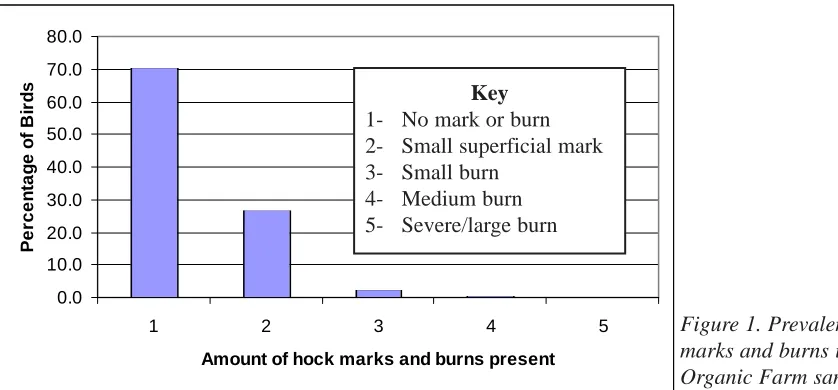
Elm Farm Research Centre has carried out extensive poultry research at Sheepdrove Organic Farm, which has involved the recording of marks and burns on the bodies and hocks of organic table birds. In the study of over 800 birds, ninety seven per cent had no burns and only 27 per cent had superficial marks on the hocks. Less than three per cent of all the birds sampled exhibited small or medium burns. None of the birds in the sample displayed any evidence of marks or burns on the breast - a severe form of contact dermatitis.
The results are summarised :
Burn Type Percentage of birds
No mark or burn 70.5
Small superficial mark 26.8
Small burn 2.3
Medium burn 0.4
Severe/large burn 0.0
Technical
0.0 10.0 20.0 30.0 40.0 50.0 60.0 70.0 80.0
1 2 3 4 5
Amount of hock marks and burns present
P
e
rc
e
n
ta
ge
of
B
ir
d
[image:14.595.62.481.74.269.2]s
Figure 1. Prevalence of hock marks and burns in Sheepdrove Organic Farm sample birds
Thoughts on HARDWICK ORGANIC GARDENS
From Tim Deane, OAS Adviser
Key
1- No mark or burn 2- Small superficial mark 3- Small burn
4- Medium burn 5- Severe/large burn
It is a truism that the hardest part of any farm to convert is that bit between the farmer's ears. To put it another way - it takes longer to convert the understanding than it does the land. For anyone with the eyes to see and the wit to listen (and a brain to make use of the information) going to Hardwick Organic Gardens will speed up the conversion process like nothing else - not that you should ever expect to get to the end of it! Here, since 1987, Iain and Lyn Tolhurst have developed an organic horticultural system which is both commercially viable and uncompromising in its practical expression of the organic philosophy.
The theoretical basis of organic agriculture is simple and logical. It can be summed up in a few words
-photosynthesis and the carbon cycle, the living soil and ecological stability, these will about do it. In practice the simplicity of the foundation tends to be obscured by the baggage we bring to it from mechanistic science and a commercialised society, but at Hardwick it is as plain as can be.
The only external inputs used in maintaining fertility on the 1 ½ acre walled garden and about 17 acres of field are (annually) 50 small bales of straw (used for clamping potatoes and ultimately going to make compost) and 10
tons of green waste compost. The latter is a recent innovation which takes some account of what leaves the land in 350 boxes each week - over 70 tons of vegetables each year. No livestock are present, and no materials derived from animals are used. The Hardwick experience has underlain the creation of the Vegan Organic Trust's Stockfree-Organic Standards, and Hardwick was the first holding to be certified to them.
Photosynthesis and the carbon cycle: Fertility in the field comes from green manures, in the garden from composted residues and green manures. 25 to 30% of the land is in long term green manures at any one time, and short term ones are used at every opportunity. Using light as the energy source for the process, plants fix carbon from the atmosphere and transmit it to the ground. All life is carbon based (and all that is carbon based is organic). Add water to carbon and you have carbohydrates animal food. This is what plants do -they get their sustenance from thin air and give life to everything else. They create new matter. We can't do it -but they can; and at Hardwick they do, unaided except by husbandry alone. No manufacturers, no middle men, no monkeys. Inputs are not the basis of fertility. Fertility, Tolly tells us, is about plugging leaks from the system. The results, published in the article, give a combined
figure for the percentage of burns and marks encompassing data on leg and breast burns. As the Sheepdrove birds suffered no breast burns the overall figure is the same as that for hock burn, with just twenty seven per cent of the Sheepdrove birds marked and less than 3 per cent exhibiting burns. This compares very favorably with the data from the article for both
conventional and other organic birds.
The way to do this is to keep the ground covered with vegetation, which keeps nutrients in active circulation and prevents them from being leached out of the top soil, and to cherish the residues.
The living soil: The soil is where carbon is stored. Its organic matter content gives life to the soil and to what grows out of it. The more vegetation land produces and the more that is returned to it the greater its productive capacity will be. The Hardwick rotations are designed on this basis.
The field rotation covers seven years. The first two of these years are entirely occupied by green manures (red and white clover and lucerne, singly or in combination). In three of them green manures are grown concurrently with the crops or are established immediately after them to provide winter cover and growth the following spring. Once the practical difficulties of under-sowing brassicas are resolved, only the ground occupied by carrots and parsnips in year 6 will be without a concurrent or following green manure.
The garden rotation covers 9 years. The walled garden, which has been worked for generations, provides a more kindly microclimate and inherent fertility is higher than in the fields. This is where the intensive and generally more demanding crops are grown on a nine year rotation, one of which is dedicated to green manures. Cucurbits are grown through living mulches and some other crops are undersown, white clover or trefoil being used in either case. Short term stands of buckwheat, phacelia and fenugreek are sown wherever possible. Compost for use in the walled garden is hand-made in considerable quantities from residues and packhouse leavings - nothing is overlooked. Well-made compost has recognised beneficial effects on soil life, and through that an influence on crop quality. Its use has always been central to the idea of organic production. At Hardwick,
without the crutch of imported fertility, it is central to the practice too.
Ecological stability: The more complex and inter-related an eco-system, i.e. the more "diverse", the more stable it is. The stability ensures that no one species gets out of hand. It is the ultimate defence against the loss of crops to pest damage. In a simple system, as in a field planted to one crop, there is every encouragement for pest organisms to become plagues - they have all the advantages. In that case there is no stability other than the illusory one offered by agrochemical merchants. At Hardwick diversity is inherent in the length of the rotation and in the variety of crops grown, both for harvesting and for fertility building. Tolly illustrates how diversity supports ecological stability by pointing out the clumps of nettles. These are valued in their place for two reasons. - in the winter hollow, dead stems provide a refuge for predatory species; in the spring new growth supports early aphids, thus ensuring that predators are present when aphids later appear on the crops. Annual flowers are dotted around as a nectar source for the many predatory insects, for example hoverflies and ichneumons, which in their adult stage are nectar feeders. An ancient sprawling mulberry tree embraces several square yards of undisturbed habitat. In the fields there are permanent beetle banks of tuft-forming grasses and flowering plants like clover and yarrow. The green manures themselves provide shelter and sustenance for all manner of creatures both on the surface and beneath it.
Organic producers were at one time accused of spreading pests and diseases onto non-organic land. Hardwick shows that when the whole ecology of a holding, its crops and its environment, is given due honour, the opposite scenario holds true. Organic agriculture will work best when all land is organic.
GASEOUS COWS ON FACTORY FARMS: IT AIN'T NO JOKE
Thanks to dense populations of bovines in California's heavily factory farmed San Joaquin Valley, cow burps and flatulence are now creating more smog and greenhouse gases in the local area than cars. Each and every one of the valley's 2.5 million cows excretes nearly 20 pounds of gas per day, causing new policy debates between air quality regulators and the dairy industry. "This is not some arcane dispute about cow gases," said Brent Newell, an
attorney for the Center on Race, Poverty & the Environment. "We are talking about a public health crisis. It's not funny to joke about cow burps and farts when one in six children in Fresno schools is carrying an inhaler."
Elm Farm Research Centre, Hamstead Marshall, Nr. Newbury, Berkshire
RG20 0HR United Kingdom
Tel: +44(0)1488 658298 Fax: +44(0)1488 658503 E-mail: [email protected]
News and Events
Do you know where £2 million a year is spent on organic research in the UK or know how to get access to the results?
Have you wondered if there is another adviser out there who has the answer to your problem, or if there is useful
information elsewhere in Europe?
Do you struggle to keep up to date with all the information, standards and regulations?
The Institute of Organic Training and Advice (IOTA) helps its members by providing answers to these questions and
supporting the work of advisers, trainers and others working in organic farming throughout the UK. It is a professional body that offers accreditation, information and access to training, supported by Elm Farm Research Centre.
Access to Organic Research
IOTA is delighted to have secured a contract with Defra to provide access, collation and analysis of organic research. For the first time ever, advisers and others will be able to easily and quickly find out what research has been done on a particular topic and get a summary of the results. We will be using the fully searchable website Organic E-Prints
www.orgprints.org, which is now becoming the common database for all organic research results throughout Europe. IOTA will upload some two hundred research results from the last four years of Defra funded research. Not only this, we will also be reviewing the research on over twenty topics, from blight to budgets, and varieties to environment. For a summary of the various research projects on a particular topic and analysis of its implications all you will have to do is click on the IOTA website www.organicadvice.org.uk. This three-year project is now getting underway and we welcome your input to identify which topics should be given priority. Next year we will be providing a seminar on using Organic E-Prints
followed by a series of workshops which will bring
researchers, advisers and trainers together in order to get first hand dissemination of results.
European Network of Organic Advisers
IOTA is a partner in this new initiative which will provide a network for organic extension workers throughout Europe. The inaugural meeting in August was held in Denmark - the Danish organic advisory service is leading this project - and included 30 advisers from 12 countries. There were
inspirational presentations form Germany, Denmark, Holland and Switzerland where the level of support, training and information exchange between advisers is quite remarkable. Hopefully IOTA will be able to build on these links and provide new opportunities for its members here in the UK. A key part of the meeting was to develop a proposal to the EU seeking funding for technical information and research exchange, training and the development of new advisory approaches and tools. IOTA is the UK representative for this Network; for further information and an update on progress keep in touch with IOTA.
IOTA Seminar
IOTA is holding its first seminar at Abbey Home Farm, Cirencester, on Friday 28th October; we will be covering a range of topics of interest to organic advisers and trainers and others working in organic extension, such as inspectors and researchers. In particular, we will include information on the Organic Entry Level Scheme, latest results from the SA Market Review, operating standards for advisers and soil and manure planning. The seminar will cover horticulture, arable and livestock production and is open to everyone. For further information on the seminar and subsequent IOTA events see the website www.organicadvice.org.uk
Mark Measures [email protected]
Organic Advisers and Trainers: News and updates
How You Can Help Elm Farm Research Centre
The work of EFRC is unique and vital to the health of the organic sector covering, as it does, research, information, dissemination, training and policy work.
You, as an individual, or an organisation, can make a great difference if you help us in one of the following ways:
• You could leave a legacy to EFRC. By including EFRC in your will, you are enabling us to continue to develop our work and activities. As a charity, all legacies to EFRC are free from inheritance tax, so your family has less to pay. Please contact us for a Legacy Leaflet.
• You can donate shares to EFRC and thereby also reduce your income tax bill. There is no capital gains tax to pay on such donations. This applies to a wide variety of listed shares, unit trusts and investment trusts.
• You can make a donation to EFRC and if you gift aid this, and any previous donations, we can claim back the basic rate of tax on your gift, increasing its value by 28%! Please contact us for a gift aid form.