ZESZYTY PROBLEMOWE POSTqPOW NAUK ROLNICZYCH 2010 z. 557: 95-102
CULTIVATION OF ORGANIC POTATOES WITH THE USE
OF MULCHING MATERIALS
1Petr Dvorak, laroslav Tomasek, Karel Hamouz
Department of Crop Production, Czech University of Life Sciences, Prague
Introduction
Mulching has become more popular for the last 10 years and it is an im portant way of soil protection in plant production. Mulching significantly de creases soil erosion [DORING et al. 2005], virus vector in seed potatoes [DORING et al. 2006] and it may also act as a tool for the control of nitrogen losses by the immobilization of pQst-harvest nitrate [DORING et al. 2005].
Mulch especially reduces water evaporation from the soil arid helps to maintain stable soil temperature' [JI, UNGER 2001; KAR, KUMAR 2007]. For that rea son, the cover of mulch infiuenc~'s the soil moisture as well [BRANT et al. 2006].
Next, mulching has a positive effect on the weed density, which was documented by the results of. some authors [JOHNSON et al. 2004; DORING et al. 2005; SINKEVICIE
NE et al. 2009]. -, .
. The aim of this paper was to evaluate the effect of different mulch materi als (organic and plastic mulch) on the yield and on some other factors which have an effect on potato production in the potato growing region of the Czech Republic. The studies were mainly focused on the effect of mulching on the gro wing temperature of plants, the level of soil moisture and the occurrence of the late blight.
Materials and methods
Field experiments were conducted in Leskovice in the Czech-Moravian Highlands (potato growing region) in 2008 and 2009. Leskovice is situated at 498 m over sea level with the average annual temperature of 6.9°C and annual rainfall of about 630 mm.
In
this regjon the soil is of pseudogleyic acid cambisol (brown gleysol) type and mostly outbalances lighter, loam-sandy soils. Further information such as pre-crops, dates of planting, mulching and harvesting are described in Table 1.1 This study was financed from the Research Proposal of the MSMT CR No. 6046070901
16
In the experimental field in Leskovice (LE) variants with chopped grass mulch (GM) and black textile mulch (TM) were compared with a non-mulched control variant with mechanical cultivation (C). In the plots with TM ridges were formed at the beginning which afterw~rds became covered with the black poly propylene non-woven textile. Mter potato tubers were manually planted into holes prepared in the textile at the required spacing (450 mm x 800 mm) GM was spread by hand in a 25 mm thick layer, on 14th day after planting (immedi ately after the second hoeing). All treatments were divided into four parallel de terminations (plot trials 7.2 m2).
Table 1; Tabela 1
Pre-crop, dates and harvesting terms in the experimental years of 2008-2009 Przedplon, daty i terminy zbior6w w latach 2008 i 2009
Factor; Czynnik 2008 2009
Pre-crop; Przedplon grass-clover; koniczyna broad bean; bobik
Planting date; Data sadzenia
Mulching date; Data przyorania mulczu
Date of harvest; Data zbioru
29.04.
28.4. MT; MW 12.5. GM; TM
12.09.
14.04.
14.4. MT; MW 27.4. GM; TM
20.08.
In all treatments (MT, GM and C) the air temperature and the relative humidity were continuously measured from planting to the harvest at 15 min in~
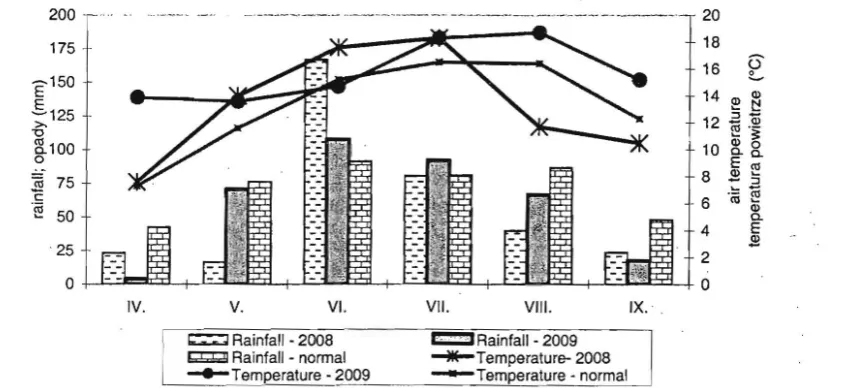
tervals with the use of Minikin TH (EMS, Brno). During the vegetation period (from April to September) an average temperature and total rainfall were of 13.3°C/ 351 mm and 15.7°C and 359 mm respectively in 2008 and 2009:
Manually harvested tubers _with late blight, necrosis or grow green were removed, tubers infested by late blight were counted out and weighted. -The re':' maining tubers were sorted out with the use of commercial potato sorters into
fou~ fractions (under 40 mm, 40-55 mm, 56-60 mm and over 60 mm), in which the number of tubers and their weight were determined.
--- --- ---- --- --- --- -- 20 18 200
175
'E15O
$125
>
"0
~100
0
]j 75 c:
.~
50
25
0
IV. V. VI. VII. VIII. IX.- _
~Rainfall - 2008 r:::::IRainfall· 2009
~Rainfall - normal ""'*-Temperature- 2008 - - - Temperature - 2009 -Temperature· normal I
Fig. 1. The range of air temperature and the rainfall during the vegetation period in
the Leskovice region (in 2008 and 2009)
[image:2.611.116.539.580.774.2]97 CULTIVATION OF ORGANIC POTATOES ...
Statistical calculations were done with the SAS statistic program veL 9.1.3. (SAS Institute Inc., 2003). The GLM procedure and Tukey test (P value 0.05) were used to determinate the effect of tHe two mulching materials (MT and GM) on the crop properties .
. Results and discussion
The air temperature, relative humidity and Phytophtora infestans
It was observed that the use of mulch had slightly reduced the air tempera ture at the level of 250 mm above the soil surface. During the first experimental year (2008) the temperature of the air decreased by about 0.2°C in the mulch textile (MT) and by about OAoC in the-grass mulch (GM) as compared to the non-mulched control variant (C). In 2009 similar trends were observed. The air temperature decreased by 0.3°C in MT and by 0.2°C in GM as compared to the control plot (C). Table 2 shows temperatures and humidity of air conditions dur ing the period from the close of growth to the removal of potato haulm.
Table 2; Tabela 2,
The effect of mulching on the temperature and relative humidity of air (from the close of growth to the removal of potato haulm)
Wplyw rodzaju okrycia uprawy ziemniaka na temperaturtt CC)
i wilgotnosc wzglttdnq. powietrza (%) (od zakrycia mittdzyrzttdzi do usunittcia naci)
Mulching variant; Rodzaj okrycia (mulczu)
Temperature CC) Temperatura CC)
Relative humidity (%) Wilgotnosc wzgltfdna (%)
2008 2009 2008 2009
Without mulch (C); Bez mulczu (K)
Textile mulch (MT); Okrycie wl6kninq (MW)
Grass-mulch (GM); Mulcz z trawy (TM)
17.1
17.0
16.6
16.5
16.2
16.5
88.1
87.2
86.8
92.5
92.4
90.4
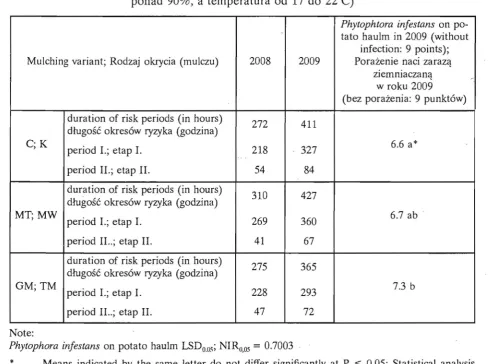
Table 3 gives further information about the possible utilization of mulch as a protection material from the infestation of haulm with Phytophtora infestans. This table evaluates the risk periods (from close of growth) for the expansion of Phytophtora infestans and its duration (risk period L - 100% air humidity and air temperatures from 10 to 22°C, risk period II. - air humidity of over 90% and air temperatures from 17 to 22°C). The shortest period convenient for the expansion of Phytophtora infestans (as a sum of durations of risk period Land risk period II.) was observed in GM (320 hours) on the average both in 2008 and 2009 (Tab. 3).
Table 3; Tabela 3
The duration of risk periods for the occurrence of late blight
(period I. - 100 % of air humidity and the temperature from 10 to 22°C;
period II: air humidity of over 90% and the temperature from 17 to 22°C)
D!ugosc okresu ryzyka pojawienia sit:( zarazy ziemniaczanej (okres I: 100% wilgotnosci wzglt:(dnej i temperatury powietrza od 10 do 22°C; okres II: wilgotnosc powietrza
ponad 90%, a temperatura od 17 do 22°C)
Mulching variant; Rodzaj okrycia (mulczu) 2008 2009
Phytophtora infestans on po tato haulm in 2009 (without
infection: 9 points); Poraienie naci zarazq
ziemniaczanq w roku 2009 (bez porazenia: 9 punktow)
"
C; K
duration of risk periods (in hours) dlugosc okresow ryzyka (godzina)
period I.; etap I.
period II.; etap II.
272
218
54
411
327
84
6.6 a*
MT;MW
duration of risk periods (in hours) dlugosc okresow ryzyka (godzina)
period I.; etap I.
period II .. ; etap II.
310
269
41
427
360
67
6.7 ab .
GM;TM
duration of risk periods (in hours) dlugosc okresow ryzyka (godzina)
period I.; etap I.
period II..; etap II.
275
228
47
365
293
72
7.3 b
Note:
Phytophora infestans on potato haulm LSDo.o5 ; NIRo•o5
=
0.7003* Means indicated by the same letter do not differ significantly at P :5 0.05; Statistical analysis was made separately for each characteristics; Srednie oznaczone tq samq literq nie rMniq sit! istotnie przy P :5 0,05. Analiza statystyczna zostala wykonana oddzielnie dla kaidej cechy
It was planned to verify !he hypothesis that mulch could behave as a bar
rier (a filter) for the interception of spores of Phytophtora infestans, thereby re
duce the expansion of late blight into potato tubers. In the year of 2008 the con
ditions for the expansion of Phytophtora infestans were unsuitable, thus none of ·
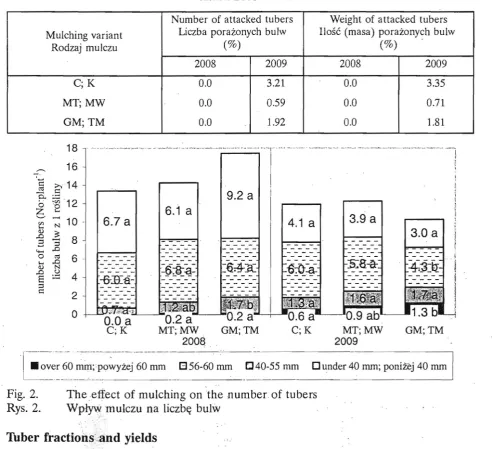
potato tubers in any of the experimental treatments were affected by late blight and the hypothesis could not be verified. However, in 2009 the effect of mulch as tuber protection from late blight could be evaluated because of the favorable
conditions for the expansion of Phytophtora infestans (Tab. 4). .
[image:4.611.63.556.182.546.2]99
CULTIVATION OF ORGANIC POTATOES ...
Table 4; Tabela 4
The effect of mulching on the late blight (Phytophtora infestans) attacking tubers
. in 2008 and 2009
Wplyw mulczowania na porazenie zaraZq ziemniaka (Phytophtora infestans) bulw
w latach 2008 i 2009
Mulching variant Rodzaj mulczu
Number of attacked tubers Liczba poraionych bulw
(%)
Weight of attacked tubers Ilose (masa) poraiony~h bulw
(%)
2008 2009 2008 2009
C;K
MT;MW
GM;TM
0.0
0.0 0.0 3.21 0.59 1.92 0.0
0.0
0.0
3.35
0.71
1.81
~ : . . .' ... -.... -- ..•...• -"" '" .' .--" .... - ... .. - ...•. _ ... _ .•..._... "-1,," . - 0 • • •_ _ •• •• _ • • ' •• • _ . _. _ ' . _ _. '. _ " • •_ • •• _ •••~ . . . .. . .. . . _ . . .. . . _ _ • • • • • • • _ _ •
1
C >->14
-a
.5 9.2 a io
~ '12Z .... ' ; ; -< 10·
.... N 6.7 a
6.1 a
4.1 a 3.9 a
15 ::l ~ ::l 8 .::: .0
o ro
.... <U .0 E ::l t:: .0 N ~ 6 4 2 0
0.0 a 0.2 a
C;K MT;MW GM;TM C;K MT;MW GM;TM
2008 .. 2009
Fig. 2. The effect of mulching on the number of tubers
Rys.2. Wplyw m ulczu na liczbl:( buhv
Thber fractions .:and yields
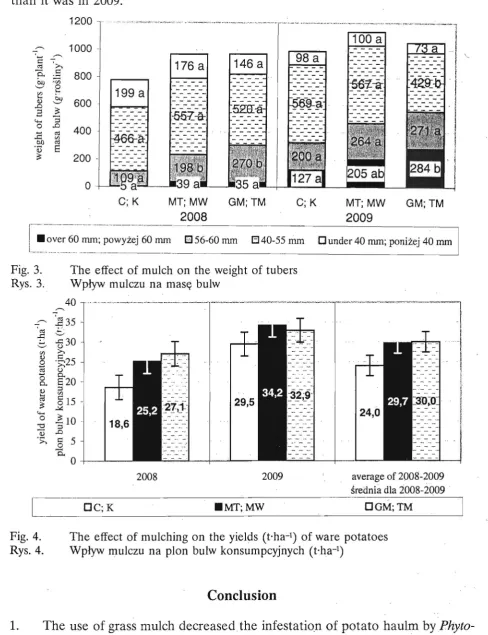
A two~yc%ir experiment (2008~2009)confirmed the effect of GM on the structure of potato yield in LE. The application of GM (Fig. 2, 3) resulted in the increase of the number and the weight of tubers of over 56 mm (tuber fraction 56-6.Q mm and over 60mm) as compared to the C treatment. On the other hand the weight of tubers under 40 mm (non ware potatoes) was lower in GM than in C.
Similar trial conducted in Uhffneves showed that the . highest weight pro portion of tuber size fractions of over 60 mm and ' 55-60 mm were also found in the variants with GM [DvoRAK et al. 2010]. Positive effect of the organic mulch (air-dry material from natural meadows Festucetum falax rubrae) on the structure of potato seed crop (Solanum tuberosum L) cv. Desiree was also mentioned by
MOMIROVIC et al. [1997]. . . ' . '.
[image:5.611.39.537.161.610.2](24 t·ha-1) on the average in the years 2008-2009. It resulted of the different dis tribution of tuber size fraction mentioned above. The significant differences in
the yield of ware potatoes between MT (29.7 t'ha-1) and the control (C) were
also observed (Fig. 4) as well as with yield of tubers which strongly differed be
tween the experimental years, with generally lower yields in 2008 (by 8.6 t'ha-1)
than it was in 2009.
1200
1000
-; ,-..,
C
o:l >. 0. .S 800
CJJ .~
"-' 0....
ClJ
I1.l "-'
.0 ~
600
~
[image:6.611.55.544.162.798.2]2
... ::s
0 .0
400
o:l
:c
VJbI) o:l
.iii E
~ 200
0
MT; MW GM;TM C;K MT; MW GM;TM
2008 2009
r---
L~_~_~~~_~_o_~;
powytej 60 mm 856-60 mm El40-55 mm 0 under 40 mm; ponizej 40 mm IFig. 3. The effect of mulch on the weight of tubers Rys.3. Wplyw mulczu na mast( bulw
199 a
176 a
C;K
40
,-.., ~35
.;,:.
o:l
..c "-'
~
-5 30 "-'
VJ >.
I1.l t:: 0 ·;;:::25
~ u
a
0.0. E20
::s
I1.l VJ ~
~ ..::.:: 615
...
-0
0 ZlO
::s ~ .>-' .0
0 t:: 5 0.
0
2008 2009 average of 2008-2009
srednia dla 2008-2009
DC;K .MT;MW DGM;TM
---~---~~
Fig. 4. Rys.4.
The effect of mulching on the yields (t'ha-1) of ware potatoes Wplyw mulczu na pIon bulw konsumpcyjnych (t'ha-1)
Conclusion
1. The use of grass mulch decreased the infestation of potato haulm by Phyto
101
CULTIVATION OF ORGANIC POTATOES ...
mulch). Also the duration of the period convenient for the expansion of Phytophtora infestans was shorter in the case of GM than it was stated for
C the treatment.
2. The use of mulching textile decreased the affection of potato tubers by late
blight~by 2.6% as compared to the C treatment.
3. Grass mulch influenced the distribution of tuber size fractions by the in
creased number and the weight of tubers of over 56mm and on the other hand by the decreased weight of tubers of under 40 mm (non ware pota toes) as comparison in the C treatment.
4. On the average in the experimental years (2008-2009) the use of mulch
had a positive effect on the yield of ware potatoes (the yield was higher by
6.0t.ha-1 in grass mulch and by 5.7 t·ha-1 in mulch textile than it was stated
for the C treatment).
References
BRANT
v.,
PlVEC J., VENCLovAv.,
SOUKUP J., HOLEC J. 2006. The influence of differentsoil vegetation covers onto the volumetric water content in upper soil layers. Plant, Soil and Environment 52: 275-281.
DORING T., BRANDT M., HEn J., FINCKH M.R., SAUCKE H. 2005. Effects of straw mulch
on soil nitrate dynamics, weeds, yield and soil erosion in organically grown potatoes. Field Crops Res. 94: 238-249.
DORING T., HEIMBACH
u.,
THIERNE T., SAUCKE H. 2006. Aspect of straw mulching inorganic potatoes - II Effect on Potato Virus Y, Leptinotarsa decemlineata (Say) and tuber yield. Nachrichtenbl. Deut. Pflanzenschutzd 58: 93-97.
DvoRAK P., TOMAsEK J., HAMouz K. 2010. Ecological growing of potatoes with using of
grass mulch and black textile mulch. Proc. of 45th Croatian & 5th International Symposium on Agriculture. 15.2.2010, Opatija, Croatia: 65-69.
JI S., UNGER P.w. 2001. Soil water accumulation under different precipitation, poten
tial evaporation and straw mulch conditions. Soil Sci. Soc. of Amer. 1. 65: 442-448.
. .
JOHNSON J.M., HOUGH-GoLDSTEIN' J.A., V ANGESSEL MJ. 2004 . .Effect of straw mulch on
pest insects, predators and weeds in watermelons and potatoes. Environmental En tomology 33: 1632-1643.
KAR G., KUMAR A. 2007. Effects of irrigation and straw mulch on water use and tuber yield of potato in eastern India. Agriculture Water Management 94: 109-116.
MOMIROVIC N.M., MISOVIC M.M., BROCIC Z.A. 1997. Effect of organic mulch applica
tion on the yield of potato seed crop. Acta Horticulturae (ISHS) 462: 291-296.
SINKEVICIENE A., JODAUGIENE D., PUPALIENE R, URBONIENE M. 2009. The influence of
organic mulches on soil properties and crop yield. Agronomy Research, 7 (Special issue I): 485-491.
Key words: mulch, air temperature, aIr relative humidity, Phytophtora infes
Summary
The experiment was conducted during two years (2008-2009) in Leskovice (the Czech Republic) on potato cv. 'Finka and Katka' at 0.45 x 0.80 m spacing. In the experiment 2 types of mulch were used: textile mulch and grass mulch. The use of grass mulch decreased the attack of potato haulm by Phytophtora infestans by 8.2'% as compared to the control variant (without mulch) and textile mulch decreased the late blight attack on tubers by 2.6% (as compared to the control variant). Grass mulch influenced the number and size of tubers, increas ing the number and the weight of tubers of over 56 mm and on the other hand decreasing the weight of tubers of under 40 mm as compared to the control vari ant. The yield of ware potatoes was higher in the plots with mulches on the aver age in 2008-2009 (as compared to non-mulched control variant where the yield was higher by 6.0 t·ha-l in grass mulch and by 5.7 t·ha-l in textil~ mulch).
UPRAWA ZIEMNIAKOW W SYSTEME EKOLOGICZNYM Z ZASTOSOWANIEM MULCZU
Petr Dvohik, laroslav Tomasek, Karel Hamouz
Katedra Produkcji Roslinnej, Czeski Uniwersytet Rolniczy w Pradze
Slowa kluczowe: mulcz, temperatura powietrza, wilgotnosc wzgh(dna powiet~ rza, Phytophtora infestans, zbi6r
Streszczenie
Badania przeprowadzono w latach 2008-2009 w Leskovice (Republika Czeska). Przedmiotem badan byly ziemniaki odmian 'Finka i Katka' uprawiane w rozstawie 0,45 x 0,80 m. W badaniach uwzgl((dniono 2 rodzaje mulczu: wl6knin(( i skoszonCl: traw((. UZycie trawy jako mulczu zmniejszylo porazenie naci zarazCl: ziemniaczanCl: 0 8,2%, a uZycie wl6kniny 0 2,6% w por6wnanie z kontrolCl: (upra-.
wa bez uZycia mulczu). Trawa zastosowana jako okrycie wplyn((la na liczb(( i wiel kosc bulw (zwi((kszyla licZb(( i mas(( bulw 0 wymiarach ponad 56 mm i odwrotnie
zmniejszyla mas(( bulw 0 srednicy mniejszej niz 40 mm). PIon bulw konsumpcyj
nych byl srednio w latach 2008-2009. wyzszy 0 6,0 t·ha-l gdy uZyto trawy jako
mulczu i 0 5,7 t·ha-I po zastosowaniu wl6kniny . .
Ing. Petr Dvorak, PhD
Department of Crop Production
Faculty of Agrobiology, Food and Natural Resources, Czech University of Life Science Prague
Kamycka 129
POLSKA AKAD
.
EMIA NAUK
WYDZIAt. NAUK ROLNICZVCH, LESNYCH
I WETERYNARYJNYCH
'
ZESZVTYPROBLEMOWE
,
POST~POW,NAUK'
ROLNICZVCH
Z
e s z
yt
557
Katedra Technologii Rolnej i Przechowalnictwa
Uniwersytetu
PrzyrodniczegoweWroc~awiuKomitet Nauk
0Zywnosci
"
,
Polskiej Akademii Nauk
Sekcja Technologii
W~glowodanowPolskiego Towarzystw'
aTechnologow Zywnosci
'
Czl. rzecz. PAN Andrzej Gr.zywacz
- przewodniczqcy
Czl. rzecz. PAN Eugeniusz Bernadzki
- czlonek
Czl. rzecz. PAN Stanislaw Nawrocki
- czlonek
Czl. rzecz. PAN Zygmunt Reklewski
- czlonek
Czl. rzecz. PAN Marian Saniewski
- czlonek
Czl. koresp. PAN Wojciech K. Swittcicki
- czlonek
Czl. koresp. PAN Franciszek Tomczak
- czlonek
RECENZENT Z RAMIENIA RADY REDAKCYjNEj
Czl. rzecz. PAN Adolf Horubala
KOMITET REDAKCYjNY
Prof. dr hab. Waclaw Leszczynski - redaktor naczelny
.
Prof. dr hab. Antoni Golachowski
Prof. dr hab. GraZyila Lisinska
Dr hab. Anna Pttksa, prof .
.
nadzw.
Prof. dr hab. Urszula Prosba-Bialczyk
Dr inz. Elzbieta Rytel - sekretarz
©