Made Multiple.
By
Lucia Usmiani
BFA (Honours, First Class)
Submitted in fulfillment of the requirem
ents for the
degree of
Doctor of Philosophy
University of
Tasmania
This thesis contains no material which has been accepted for a degree or
diploma by the University or any other institution. To the best of my knowledge and belief, it incorporates no material previously published or written by
another person except where due acknowledgement is made in the text.
Lucia Usmiani
This thesis may be made available for loan and limited copying in accordance with the Copyright Act 1968.
Lucia Usmiani
There are many people who have helped to make this thesis possible. Firstly, I would like to thank my son, Christopher Francis, whose faith and patience over the last three years I have valued more than he realises. Secondly, I'd like to thank my supervisor Paul Zika for his support and guidance throughout the project.
Many thanks also go to Michael Clarke and Bryony Nainby for their excellent editing.
This research investigates the aesthetic of the multiple with an emphasis on material and process. Through a series of artworks both formal and informal displays of repetition are explored, focusing on the three dimensional object in multiple and investigating links to repeat surface pattern.
The project is placed in context with art practices that employ the use of the multiple, exploit the value of banal objects and demonstrate a labour intensive approach in the making process. These artists include Tom Friedman, Donna Marcus, Fiona Hall, Leonardo Drew and Do-Ho Suh. The theoretical investigation into pattern and ornament, installation, order and mass production and modernism includes a reflection on the writings of E.H.Gombrich, Debra Schafter, James Trilling, Claire Bishop, Brigitta Olubas, Z. Kracauer, Ray Batchelor, Susan Stewart and Nicolas Bourriaud.
Strong influencing factors from primary experiences impact on the process. Factory work embedded the effects of repetitive labour and its accumulative outcome on production and the body. A life-long interest in decorative domestic crafts has established direct repetitive processes in the art making. Memories of these experiences are reflected in the final aesthetic.
to an unfamiliar form and treated as pure material. Although alien appearance, the material is familiar enough for recognition to play a part in the spectator's engagement with the work.
CHAPTER ONE : Introducing The Aesthetics of the Multiple ... 1
PART I: The Aesthetics of Mass ... 1
PART II: The Material.. ... 11
PART Ill: The Look of Order. ... 15
PART IV: Mass Production and Modernism ... 18 PART V: Labour and the Living Machine ... 21
PART VI: The Sorcerer's Apprentice ... 26
PART Vll: What this Project is Not About. .. 1. Recycling ... .30
2. Obsession ... 31
PART VIII: Summary ... 34
CHAPTER TWO : Context.. ... 36 PART 1: Something out of Nothing: Tom Friedman ... 36
PART II: Trash and Treasure: Donna Marcus ... ..41
PART In: Accumulation: Anthony Cragg & Leonardo Drew ... .45
PART IV: Installation ... 49
PART V: Transforming Mass: Tom Friedman & Do-Ho Sub ... 52
PART VI: Handcrafting the Machine-Made: Fiona Hall, Ricky Swallow & Andy Warhol. ... 57
PART Vll: Summary ... 63
CHAPTER THREE: How the Project was Pursued ... 65
Introduction ... 65
PART 1: Lace Work and the Two Dimensional Surface ... 67
PART II: Plastic: Wallflowers ............. ... 78
PART ill: 'Drunken Bums" ... 81
PART IV: Ophidia ................... .... 86
PARTY: Store ...... 90
PART VI: Try Again ........ ... 96
PART Vll: Support Pieces: (not included in the final submission) l. Well Stacked ........................................ 98
2. Machine-Made ....... ... 10 l PART VDJ: Summary ... 102
APPENDIX 11: Bibliography ... 116
APPENDIX ill: List of Works ... 121
APPENDIX IV: Map of Gallery ... 122
INTRODUCING THE AESTHETICS OF THE MULTIPLE
PART I:
The Aesthetics of Mass
The mass aesthetic can be seen all around us, in arrangements of cereal. boxes on supermarket shelves, in stacks of car tyres outside service stations and cardboard boxes stored in warehouses. There is no intention in these displays to create an 'aesthetic' as in an art context; they are merely the outcome of convenience. The resulting mass aesthetic occurs accidentally and often goes unnoticed, perhaps because the individual object and the environment in which it is displayed are equally banal.
Fig. 1; Roofrng shingles in Japan
I have always been drawn to these simple arrangements of objects. Always
viewed as accidental, the process of making the stacks involves a degree of intent. The wood pile requires stability and displays of consumer goods require precise presentation. Both involve thoughtful planning and labow· to execute the construction.
Fig. 2; Overcoats in Copenhagen (archival photograph)
The retail display is designed to draw our attention. Products that the retailer wishes to promote are generally displayed at the fi·ont of the store so that customers are immediately engaged and encouraged to buy. Those products like bread and milk, which are bought regularly, don't need to be promoted so they can afford to be placed on the outer perimeter of the store knowing that customers will seek them out regardless of how non-visible they are. This position is also at the rear end of the long diagonal to maximize the shopper's exposure to products as they pass through on their way to the milk.The intent of the product display is to create a commercial impact rather than an omamental one with the intended focus on the individual object. We are drawn to the display of mass and after we have quickly scanned it, unaware that we have even done so, we extract the individual from it. Aesthetically these displays only work as ornament as long as no one removes a unit from the whole. If one
order of the multiple. It breaks the reading of the surface as a plane which relies on the consistency of the repeated units. The formality of the pattern may be compromised bnt the mass, however, remains intact.
Fig. 3; Supermarket shelves
The factory environment is the ideal repository for the mass aesthetic. For a period of time I worked in an industrial laundry. The factory was, for me, a totally immersive experience of mass. I passed my time there not only as a
contributor to the aesthetic but as an observer. Nothing new was manufactured there. SoiJed linen entered and clean linen left. The laundry catered for major hospitals and institutions so there was plenty of opportunity to observe bulk. Up to 400 kilograms of pressed linen was processed from one industrial ironer every 15 minutes. I remember there being at least five ironers. Nearly all processes were mechanised with the workers facilitating the movement of linen in and out of machinery. Setting belts, washers, dryers, ironers, dry cleaners, mending and dispatch operated as an automaton processing vast quantities of materials that relied on a highly ordered system to function productively. lt was an environment of mass that kept workers and machinery operating in perpetual
The experiences I had at the laundry allow me now to look at a store of bed sheets and dissect the sequence of events that led to its final arrangement because of the memory of my own experience. As John Berger states "The way we see things is affected by what we know or what we betieve."1 How we look at a wood pile involves perceptive faculties other than vision, that is, we don't simply read it as a pattern. We know that the logs are roughly cylindrical and must be stacked in an order that will be stable. We know they are heavy so we understand that hard work is needed to complete the task. We have a sense of the texture and smell of wood even if we view it from a distance. These perceptions are based on past experience which we bring to our comprehension of the wood pile and how it came to be.
We try to apply this same knowledge to other displays of order, such as surface pattern and ornament, to make sense of what we are looking at. Debra Schafter describes the role of ornament as perceptual signifier. She states that " ... Ornament stimulates optical and tactile sensations by recalling past sensory events and, consequently, helps the viewer understand formal elements and their
relationships" and that it can trigger in the viewer a perceptual memory of past sensory activity.2 As displays of order, pattern and ornament also follow the principles of repetition and continuity. The rules that govern pattern and ornament, however, are incumbent upon tradition and laws of geometry and are unlikely to result from accident. Although pattern and ornament can encompass mass, they are more likely to be classified as applied arts such as wall paper, textiles and intricate carvings.
In 1927 Siegfried Kracauer wrote The Mass Ornamen? as a key to interpreting the social conditions of the times. Kracauer's 'mass' refers to the populace and 'ornament' to the geometric patterns formed by large numbers of people,
1
Berger, John; Ways Of Seeing; BBC and Penguin Books; London; 1972; p. 8. 2
Schafter, Debra; The Order ()_(Ornament, The Structure Of Style; U.K. University Press; Cambridge; 2003; p. 3.
sometimes thousands as in the "Tiller" displays. Working with ordinary people such as office girls, John Tiller organized choreographed displays of pattern and
synchronized movement, ornaments which were enjoyed by the masses "who
themselves were aiTanged in row upon ordered row".4 Kracauer's belief was
that these displays of ornament were a reflection of contemporary situations.
The arms and legs of the individuals, who themselves were unable to view the
whole, became meaningless in the sight of the overal.l omament. Sin1ilarly,
individual workers on assembly lines became meaningless in the capitalist profit
system5.
Fig. 4; The Tiller Girls
The American photographer Eugene 0. Goldbeck used the spectacle of mass
public displays as a tool for documentation. He toW'ed the country
photographing troops of soldiers and marching bands as well as popular public
events that drew vast crowds of spectators. The troops were often arranged to
form the shape of their state of residence or the emblem associated with their
unit.
4
Kracauer, Zeigfi'ied; p. 462. 5
Fig. 5; E.O.Goldbeck, Living Air Service Insignia, San Antonio, Texas, 1926
Similarly, contemporary artist Spencer Tunic arranges masses of naked bodies but informally and packed tightly. United by nudity and similar stances the mass
of individuals becomes one body, a vulnerable living organ at rest on the
surface of the land.
Fig. 6; Spencer Tunnick installation
The Tiller Girls belong to an entertainment history which preceded the likes of
the Zeigfie/d Follies and Busby Berkeley. As a vehicle showcasing beauty,
The creation of beauty to elicit pleasure, so often attributed to the lower forms
of art, is still an authentic experience for the senses. James Trilling states that
"ornament is decoration in which the visual pleasure of form significantly
outweighs the communicative value of content,"6 declaring also that if the
viewer cannot enjoy the form without understanding it, then it is probably not
ornament. Trilling stresses that visual pleasure must be paramount for ornament
to succeed .7
The films of Busby Berkeley transferred the extravaganza and pageantry of
Broadway onto the cinema screen. These films which were designed purely for
spectacle and entertainment fired my imagination as a child. The dancers were
arranged in tightly choreographed symmetrical dance sequences in linear and
circular patterns, where the movement and ornament radiated from a central
axis. Often it was difficult to know exactly what I was looking at. With the
camera suspended directly above the dancers, Berkeley was able to capture the
geometrical arrangements of the dancers as they bad never been seen before.
The dancers became an 'artificial' circular motif similar to rose windows and
[image:15.546.215.391.448.633.2]kaleidoscopes.
Fig. 7; Busby Berkely, Gold Diggers of/933, 1933.
6
Trilling. James; Omament, a Modern Perspective; University of Washington Press; Seattle and London; 2003; p. 23.
7
Gombrich sees the kaleidoscope as the ideaJ starting point for the exploration of the interaction between objects and patterns. 8 Our acceptance of pattern allows
us to read the arrangement of ordinary objects as constructs of simple order. In Berkeley's fLlms separate objects, or dancers, are transformed into things of beauty and can be viewed as an ornament. Colour was unnecessary to the illusion, as the black and white tones created a focus on movement and form
and camouflaged the reality ofthe bodies.
Aesthetically, the ornament of Busby Berkeley's dancers is no different to the
spectacle of military marches. The arrangement of identically uniformed
soldiers marching in unison still demands to be perceived as a whole rather than as separate units. Unlike Berkeley's intention to evoke beauty and pleasure, the desired effect here is patriotism and might, the moral transcending the ocular. Nevertheless this aesthetic also relies on mass to be effective.
Fig. 8; E.O.Goldbeck, Corps of Cadets, WestPoint, 1938
Meg Keating is a Hobart artist who draws the themes for her paper cuts from
first hand experience of displays of military might. In 2000 she was overwhe.lmed by the intense scale of a military rally in Tiananmen Square. She described it as a celebratory spectacle, a sublime experience that simultaneously
defined absolute beauty and sheer terror.9 Her work, The Great March, 2001,
8
Gombrich, E.H.;The Sense of Order; Phaidon Press; second edition; London; 2002; pp. 150& 151.
9
replicated the formations of marching soldiers through Tiananmen Square. The
280 or more identical silhouettes were individually cut by hand. This attention
to the singular, instead of employing laser cutting techniques to rapidly produce
multiples, confronts the notion of mass production and the subsumed individual.
The scale of the piece is almost too large to take in all at once, hinting at the
artist's own experience.
Fig. 9; Meg Keating, The Great March, 200 I
Such animated ornamental spectacles need to be experienced in person to solicit
a full emotional response. Conversely, the Busby Berkeley sequences were
designed to be viewed in reproduction on the cinema screen. With tbe goal
being nothing more than a visual spectacle designed to entertain, the viewer
does not need to be present in order for the ornament to work. Military marches
and mass gymnastic displays rely on the spectator being moved by the
experience in order to be effective. As the viewer engages with the crowd and
the display, his/her senses are assaulted by sight, smell and sound and the
closeness of other bodies that are equaJiy aroused. The viewer's or spectator's
presence allows for an immediate and shared sensorial experience. In the
television documentary A State of Mind, 2004, interviews with the participants
of the Mass Games in North Korea which are political spectacles of
synchronized gymnastics involving thousands of athletes, expose their
Daniel Gordon introduces the Games as ''North Korea's socialist realism extravaganza and a perfect example of the state's ideology; the subordination of the individual to the needs of the collective.''10 The elaborate display is intended, as Gordon states, for the eyes of the citizen and not the outsider as an
effective reminder of the power of a unified consciousness.
The overriding purpose of these mass ornaments is the manipulation of the
viewer. The ornament or spectacle is engineered to be viewed as a whole, the
same way that it is performed. On television or in photographs the image is
condensed to a size where the viewer can take in the entire image. It is impossible to feel. engulfed by the spectacle. The position of the viewer differs
from being contained to that of containing. 11
The closest I've come to being present at such an event is as a spectator at a big
soccer game. As Kracauer acknowledged the audience at a
Tiller
display being ordered in their seating, so were we arranged in ascending rows framing thegrassy oval where the event was to take place. A sea of spectators in a full to
capacity stadium is a prime example of mass aesthetic where even the metaphor
of the sea confums the loss of the individual to the whole. As a frame, the spectators were already ornamental, like a carved frame around a painting
designed to draw attention to the central focus. The ornament became animated when the crowd spontaneously broke into a "Mexican Wave". The magic of the wave was its totally unrehearsed quality. It was an impromptu orchestration of
sequential body movements where the entire stadium appeared to move as a
single body. Even the mistimed mistakes of individuals disappeared in the giant
swe11 as arms and bodies became absorbed into a singular moving line. As a participator
it
was impossible to see the full effect of the ornament. What partcould be seen was what lay across the other side of the ovaJ; however the
10 Gordo~
Daniel; A State of Mind; BBC/ARTE; 2004
11
feeling of being a part of the wave transcended any dissatisfaction of being
unable to observe the whole.
As examples of the mass aesthetic The Tiller Girls, military marches and
Mexican Waves all represent living ornaments. They also represent organized
cultural displays where the intended outcome is creative, political or emotional.
It is important to see the whole and not the individual, and in some cases to be
bodily present, if they are to extract the desired response from the viewer. More
importantly, the wonder of their precision provokes desire in the viewer to see
the display as a single body and therefore become willing participants in the
illusion.
PART II
The Material
The material employed in this research is common place and discarded. My
relationship with it begins on rubbish collection day. I walk the neighbourhood
early in the morning armed with garbage bags and hoping to stay ahead of the
official council truck. I search for P.E.T. bottles and aluminium cans in all sizes,
shapes and colours. As they are recyclable, household recycle bins are the ideal
places to find them. Always in fear that someone will prevent me from
gathering material I am grateful that I live
in
a state that doesn't provide arefund for these materials.12
As I search for bottles I also scout for other items that are being discarded in
large numbers that may provide material for futme work. Mostly these are food
12
and beverage containers. The supply of bottles tends to vary based on the
seasons. In the colder months I usually have to cast my net further afield to
reach my "quota". In warm weather or following a public holiday I can expect
to fill my bags very quickly and closer to home. Generally, patterns of
consumption ensw·e a steady source of material for collection.
Several trips home with garbage bags full of bottles on a weekly basis keeps the
project in supply. After the collection I go through the process of washing and
de-labelling. I get to know where the dirt tends to collect and I can assess the
condition of each bottle. The contact feels intimate, almost sensual. My hands
glide over the fonns in the warm water and I become familiar with each curve
and crevice. Touch becomes such an ingrained part of the process that my visual
assessment of each work cannot be detached from the tactile. It pleases me to
see them clean, sparkling, and waiting to dry. I have removed the marks of
ownership and those of rejection. They look virginal once again. I begin to
group them in their different types and can see the beginnings of mass. They
have already become a different object.
The use of found objects in Art has already established the notion that the meaning of an object changes through the artist's gaze. In his text
Postproduction, Nicolas Bourriaud returns to Marcel Duchamp whom, he
explains, introduced the act of choosing as artistic process; asserting that giving
a new idea to an object is where production begins. 13
Brigitta Olubas looks at the practice of collecting or foraging in her review of
work by Donna Marcus and Bruce Reynolds. She states that ''such practices,
through their elevation of the everyday, worked to nominate a new contingency
of the self at the core of Modernist aesthetic experimentation,"14 and that these
practices are being re-tested by these attists: "This altered perspective on the
13
Bourriaud, Nicolas; Postproduction; Lukas & Sternberg; N.Y.; 2002; p. 25. 14
Olubas, Brigitta; The Dirt Does My Thinking; The UTS Review; Vol. 7; No.2; Nov. 200J;
meanings of the self who makes is invoked firstly through the initial practice of
scavenging for the materials themselves, in op-shops and in rubbish on our own
or unfamiliar streets; the probing into piles of unknown objects from someone
else's home ... BanaJly, obviously, such a practice is an antidote to the
seductions of modern consumer culture; released from the anxiety of choosing
well, of making just the right purchase, with scavenging and op-shopping we
are, for once, positioned by, found by, the thing we buy, retrieve or collect".15
Bourriaud's text extends the meaning of these objects by indicating that rather
than imposing a form on a raw material, artists are using objects that are already
in circulation on the cultural market; they are applying processes to a material
that is already processed. 16 Bourriaud introduces the flea market (which can
encompass garage and car boot sales) as the "omnipresent referent for
contemporary artistic practices"17• He describes it as a place where products of
multiple provenances converge, waiting for new uses. It is the place where "past
production is recycled and switches direction", where "an object is given a new
idea"18•
The discarded materials I use are commonplace, mass produced and mass
consumed. Passing briefly through our lives they are referred to as banal. The
dictionary describes banal as "boringly ordinary and lacking in originality".
When this project began, the focus was on surface pattern, which, through the
viewer's familiarity with its common occw-rence in the domestic/architectural
environment, can itself be classified as banal. With the aim of slowing down the
process of looking and thereby provoking a closer inspection of surface pattern,
I introduced an unexpected element to the aesthetic, something that provoked
the viewer to notice, even scrutinise the pattern. I sought to provide that
unexpected element by employing everyday objects as source material for
making the motifs. Beer cans cut into ribbons and then curled were turned into
15
Olubas, Brigitta; p. 118 16
Bourriaud, Nicolas; p. 13 17 Ibid; p. 28
18
delicate arabesque patterns. The effect of the aluminium's coloured reflections aroused interest which was then followed by recognition of the material.19
Fig. 1 0; Doily, 2003, showing the reflections from the aluminium ribbons.
An interest in the change of value of an object from highly desired to worthless during the course of one shopping week led me to examine the object from each end of the consumer relationship. Rows of soft drink bottles on supermarket shelves shine and sparkle with their sweet and thirst-quenching contents. Advertising promises us an improved lifestyle should we consume their products. John Berger asserts that publicity, as a system, makes only one proposal; "that we transform ourselves, or our lives, by buying something more."20 Some labels are so iconic as to need little prompting to buy. Most of us are convinced that a particular product is the best and perhaps, unconsciously, we may be sure that we will be introducing a little glamour or 'cool' into our refrigerators.21 Judging by my personal observations on collection days there
19
Curiously, in terms of the research, the viewer's interest in the making came last in the sequence.
20
Berger, John; Ways ofSeeing; p. 131. 21
exists very definitely a preference for a particular brand. Regardless of brand I
do think that the rows of bottles on the shelves look appealing. The individual
bottles have attractive shapes and, if the rows are neat, they present a formidable mass aesthetic. One week later the empty container is thrown into the recycle
bin and subsequently on a massive pile at the depot. Returning it to the
production line, albeit my studio, seems somehow appropriate.
These cast-offs are not used as they are. I alter their appearance enough to
remove obvious links to their original identity or intention. This is not to
deceive the viewer as to the origin of the material. It is to restore the material to
a pure form. The peculiar characteristics of the material are harnessed in this
way and its identity is reinvented. Stripped of its brand and of any logical
function it becomes merely a unit in the final assembly. Using a systematic
method of combining the separate units creates an orderly pattern of mass and
abundance, an aesthetic that everyone can relate to although we are not always
aware of it. The combination of formal elements and everyday materials
provides direct access for the viewer. Everyday things and familiar shapes allow
the viewer to access their own experiences.
PART
III
The Look of Order
Early within this project Ernst Gombrich's Sense of Order provided a
framework to understanding part of the psychology behind ow· drive to make
patterns and the ways in which we perceive them. I responded positively to the notion that we have an inbuilt system of ordering our environment and that
perception is not a passive activity. Gombrich explains; "The force of habit may
ever be predicted, habit establishes a frame of reference against which we can plot the valiety of experience."22
In other words we naturally look for something familiar on which to base our understanding of how things work in our field of vision. With surface pattern,
we understand the underlying principle ordering it is in the repetition of the same motif at regular intervals. Through our familiarity with this technique we feel no surprise when we see it and we rarely look closely to see how it works. We generally notice surface pattern in our peripheral vision and accept it as a decorative surface. If, however, the regularity of the surface is broken or interrupted by something alien within the pattern itself, our gaze will stop and pause at this point until we have discerned what it is we are looking at.
Decorative surface pattern serves as a starting point in this investigation into visual order. As an ornamental strategy to cover a two dimensional plane with repeat motifs it is normally associated with the architectural plane.
In 1851, Gottfried Semper asserted that "the human urge to decorate and create order gave birth to craft skills, the products of which provided the primary elements of the earliest constructed dwellings."23 He recognized that the early Egyptians transformed the primitive textile enclosure into glazed terracotta and other hard claddings.24 The pattern fonned by the functional material becomes abstracted into pure ornamental motif. By conveying the idea of the plane these
motifs operate as structural signs to give greater articulation to the surface. The concept of planarity - the idea of the flat plane - conforms to precise laws of arrangement (symmetry, propmtion, balance and repetition). As an example, Debra Schafter refers to the continuous organic decoration on the facade of the Majolikahaus. The curvilinear elements of this ornament create a network of
22 Gombrich, E. H.; Sense of Order; p. 171. 23
Schafter, Debra ; p. 32. 24
verticals and diagonals which unify the surface plane and provide directional
cues to carry the eye upward?5
Fig. II; Otto Wagner, Majolikahaus, 1898-9
Similarly, the orderly arrangement of identical objects provides the same visual
cues as two dimensional smface patterns to indicate planarity. Symmetry,
proportion, balance and repetition are the elements displayed in an arrangement
of common objects. Although the units may be three dimensional, the sequential
regularity of the objects leads the eye across the arrangement in horizontal,
vertical and diagonal scans. We read the surface value of the patterns made by
objects such as a row of book spines or the edges of a pile of folded linen in a
similar way that we read surface pattern. The shape of one object - the curve of
its form, the shadow at the point of contact with the next object~ the identical
reflection on the surface of the material, aU lead the eye sequentially from one
to the next in rapid succession until we have scanned the arrangement as we
would a two dimensional plane. This is how Semper's notion of the abstract
ornamental motif works. A construction built from three-dimensional objects is
represented in abstract form as two dimensional motifs which in turn represent
the architectural plane.
PART IV
Mass Production and Modernism
The objective of commercial mass production is to create uniform perfection, to
eliminate the errors of the hand and thereby deny individuality. The individual
is sacrificed for the benefit of the whole. Through the repetition or replication of
the individual unit the whole is transformed into the singular. It becomes the
aesthetic of mass production. It is not sufficient for an object to look machine
made for it to indicate that it is mass produced. It must also exist in quantity.
The ideals of mass production sat comfortably with the modernist movement.
The designer Peter Behrens believed that "the artist designer had a profound
duty to supervise and encourage the production of sober, machine-made forms
which would in turn foster a stable, orderly society sharing common values."26
Ray Batchelor sees them sharing the ideals of rationality and uniformity.
In this aesthetic there is no room for the original (as Walter Benjamin sees iti7
because the original is nothing but the prototype. Thereafter all repetitions are a
recurrence of what has gone before with each act being unique in its own time
and space. The original is the design, the idea for the multiple. Perhaps in a
museum somewhere Henry Ford's very first Model T to come off the assembly
line is displayed as the original vehicle that all others were copied from. This is
a romantic concept that might be artificially presented as the original for
sentimental reasons. With such an icon as the first car to ever come off an
assembly line, society might see a need to ensru·e its preservation for posterity
26
Batchelor, Ray; Hemy Ford, Mass Production Modernism and Design; Manchester
University Press; Manchester England; 1994; p. 95
27
encoding it with the status of holy relic, a beginning that can be seen, touched,
smelled, real. But in critical terms it would really only be a token that stands for
the idea of the original. The Model T was constantly undergoing minor
improvements. Although the changes were slight, each car was consistently sold
as the Model T, not as a copy. Ford instilled the value of the original i.n every
car be sold. How could one be more original than another? In these terms, each
Model T owns the 'aura' of the original, each owns "the unique value of the
authentic"?8 The same can be said for any mass produced object. There is no
original plastic Coke bottle from which all others are copied.
Fig. 12; The Model T Ford, 1927 Fig. 13; George Ebling, Moulding Head/amp Shells, Ford Motor Company, 1932- 34
To Lhe modernist movement, Ford's ideals of rationality and uniformity went a
long way towards instilling the values of the Modern perspective in ordinary
people. Homogenisation of the masses through attitude and living conditions
was seen as the way towards creating a stable society. The Modernists looked
forward to a culture uncluttered with emotional attachments to objects and a
nostalgia for the past; valuing instead a futme with new materials and new
ideas. In his book Apocalypse Postponed, Umberto Eco sees mass culture as
anti-culture. He argues that to conceive of a cultw-e that is shared and tailored to
suit everyone contradicts the notion of culture as a solitary, aristocratic
28
cultivation of an inner life that opposes the vulgarity of the crowd. Rather than
mass culture being a passing phenomena, he fears that it is the mark of an
irretrievable loss.29
The combination of mass production and modernism represents a shift from the
solitary to the mass, from the personal to the public. We moved from studio
based workshops where work was performed by skilled tradesmen to
mechanized industry where factory production lines focused on speed, accuracy,
continuity and economy and machines replaced human skill. Workers on the
production line facilitated the flow of production through the machinery and
generally performed unskilled functions. The products of the assembly line were
identical with no personal individuality. Cultural attitudes moved away from the
desire to own lasting unique objects to a desire for cheap easily replaceable
items (ultimately the idea was to democratize style and make it available for
everyone not just those who could afford it.)
Modernist rationality was one of the main forces driving mass production.
SimpLifying and streamlining production and design went hand-in-hand.
Ornament gave way to the grid. Narrative and the single point perspective gave
way to the universality of all-over compositions. The individual mark of the
hand was replaced by universal design.
This project borrows from modernism the idea of paring down to basic
essentials - the repetition of single unjts - but infuses it with intensive human
involvement. Each individual unit created in this project is handled and
manually manipulated, making each one unique. At the same time each urut
represents a repeated motif which, in the mass aesthetic, is again absorbed by
the whole.
PART V
Labour and the Living Machine
In mass production the power of the labourer as an individual is subsumed into
the overall production mechanism of the assembly line. Karl Marx descdbed the
transformation of the labourer as a )jving accessory of the machine, the means
whereby its action can take place.30 Having been a labourer on an assembly line,
I can testify that this is not merely an abstract concept. The feeling of being an
active part of the machinery like a flesh and blood cog was real. Although I was
aware of my unskilled position which offered nothing more to the production
process than the facilitation of the flow of activity, the sense of being part of
something (physically large) and powerful was, for me anyway, palpable and in
a strange way (briefly) fulfilling.
Unlike the machinery components of the factory I worked in, the human
components were regularly rotated to avoid breakdown. Some stations I worked
required more than a single (human) action thereby removing me, by degrees,
slightly further away from the flow of mechanised activity. Here I was
responsible for a bigger chunk of the action, a wider step in the production
process. I developed a sense of being a pivot between order and disorder as
material passed from one side of me to the other, more than just a cog. All jobs
required repetitive movement and so a symbiotic relationship developed
between my rhythmic actions and the pulse of the machinery. I was absorbed or
integrated into the functions of the machine.
The lack of variation and unrelenting repetition without corresponding mental
input initiates the notion of the worker turning into a machine. The nature of
repetitive work has often been described as mechanical. Unlike a machine,
30
McLellan, David; Karl Marx: Selected Writings; Oxford University Press; Oxford; 1977;
though, a human being is prone to fatigue and boredom which introduces the
possibilities of error and change. Therefore a more apt description would be that
the actions of the worker become machine -like.
In my own artwork the tasks are broken down to the simplest functions to
facilitate speed. No matter how absorbed I become in the repetitive task at hand
there is always a point where I slow down a little or pause to think of something
or even change tasks. When working on an assembly line there isn't the choice
to alter one's actions. The labour is regulated by the machine and the worker
must surrender to the system.
Walter Gropius cited Behrens, along with Ruskin and Morris, as attempting to
establish a creative union between Art and industry. The development of a new
generation of talented individuals who were trained in industry and handicraft
were hampered, he believed, by a firmly established academy approach to
design which was far too removed from life. He declared, in an early Bauhaus
text that "So long [ however ] as machine economy remains an end in itself
rather than a means of freeing the intellect from the burden of mechanical
labour, the individual will remain enslaved and society will remain disordered."
"Mechanised work is lifeless," he writes, "proper only to the lifeless machine.31
Charlie Chaplin's 1936 film Modern Times had his character, "The Little
Tramp," become physically absorbed into the workings of the machinery after a
day's work on the assembly line. Unlike me, "The Little Tramp" went mad; his
body twitching like a machine to the bewilderment of his fellow workers who
seemed more resigned to their circumstances. He danced around spasmodically
until he was caught on the conveyer belt and continued to tighten imaginary
nuts and bolts with his spanner as he was dragged through the gigantic cogs and
pulleys of the machine. Chaplin sought to highlight the unnatural conditions of
31
factory work. John Ruskin extended his criticism to industrial manufacture
entirely by arguing that the idea was wholly inconsistent with Christian faith
and that the human touch provided evidence of life. 32
Fig. 14; Charlie Chaplin, A scene from Modern Times, 1936
The fear of our humanity being altered as a consequence of mechanisation by
turning us into robots (or going mad doing the same repetitive thing for eight
hours or more a day ) and equally of machinery or technology taking over the
world as conscious beings has been a scenario constantly revisited. It is most
potent as a theme in film where we share this collective fear. Most depictions
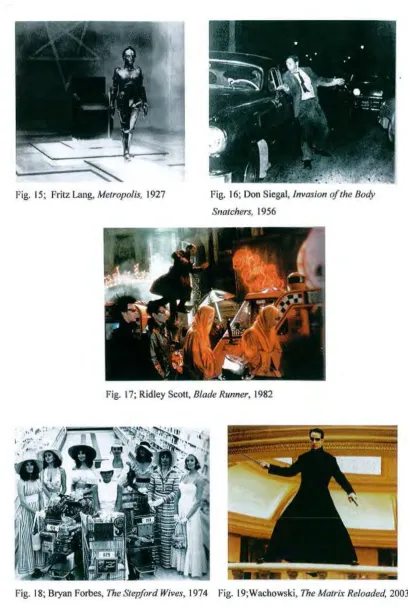
are frightening. Metropolis, Invasion of the Body Snatchers, The Stepford
Wives, Terminator, Blade Runner and The Matrix have a sense of the
apocalyptic about them. All are connected to a fear of the material gaining
control over humanity. As technology continues to advance at a rate that we fear
we cannot keep up with, we will always have a need to express our concerns
critically and artistically.
Fig. 15; Pritz Lang, Metropolis, 1927 Fig. 16; Don Siegal, Invasion of the Body
Snatchers, 1956
Fig. 17; Ridley Scott, Blade Runner, 1982
[image:32.542.94.503.47.656.2]l came closest to the experience of Living Labour that is, working like a machine
on a production line, when working on
Store
during 2005.33 In its making I wasthe sole worker, responsible for every step of the process. There was no
machinery involved in the fabrication. Production was staggered over almost a
year but in the final six weeks the workload was constant to the exclusion of all
else. During this time I experienced the mental and physical rhytluns that the
body slips into when committed to a repetitive task. In his novel Rivethead, Ben
Hamper described his position on the assembly line as a job that kept him
forever in motion. He called it "the absurdity of the regimen".34 The regimen I
worked within was self-imposed, it was not governed by another's schedule.
Perpetual motion made the task easier for me to complete.
The need to get the job done demanded a rigid schedule of work and breaking
this schedule caused havoc. The gap in the process created time to think about
which stage the work was at and how I felt physically. It made me lose track of
what I was doing so I learned to keep a concise record of progress. It made me
aware of aches and pains and fatigue and at times I was reluctant to begin again.
The beauty of the labour lay in maintaining the momentum -a rhythm of bodily
movement which facilitated progress without the need for conscious
intervention.
33
Strictly speaking, living labour describes a human who works alongside a machine, an assembler on the assembly line.
34
PART VI
The Sorcerer's Apprentice
The works in tills submission allude to an over-production of the artefact, the
scale indicating a barely controlled containment of the objects.
Walt Disney's 1950's cartoon depiction of the Sorcerer's Apprentice helps to
explain this sense of over-production. The apprentice (Mickey Mouse) used the
sorcerer's magic hat, which was strictly forbidden, to enchant the mop to carry
buckets of water to fill a tub thereby making his task of cleaning the floor
easier. lie then cloned the mop, halving the time to complete the job. His lack of
skills in the spell department, however, prevented him from being able to end
the enchantment and so, the mops kept dividing like reproductive cells. The
buckets of water kept coming and soon there was an army of mops and a great
flood. Only the intervention of an angry sorcerer, woken from sleep, could
restore control to the mayhem and allay disaster. The drama was enhanced by
the addition of tumultuous music which heightened the viewer's tension as the
mops in their hundreds relentlessly pounded the scene with water and the young
apprentice with terror.
The apprentice, having set the process in motion through casting of the spell,
bad no control over the action. The "machinery" had grown in power with each
replication of the unit (this being the object and its accompanying action). He
couldn't halt the spell, he couldn't physically stop the mops from marching and
he was beginning to drown in the flooding waters. The mops pursued their tasks
with no apparent understanding and oblivious to the creature who had given
them life in the first place.
Each mop was identical, appearing with a monotonous regularity and
programmed to complete its task without interference. The action occurred
rhythmically and in unison like that taking place on an assembly line.
My personal connection with the idea underpinning The Sorcerer's Apprentice
stems from my laundry hand experience. I recall my training as a catcher at the
end of the ironing machine that pressed pillow cases and small surgical cloths.
There were perhaps ten different items all of the same size but with different
codes. Training consisted of being told to separate the codes. The articles exited
the machine with the speed of what seemed like machine gun fire. I did my best
but the machine was relentless and l was very quickly drowning under an
avalanche of hot littJe neatly pressed cloths. The machine was stopped, I cleared
the mess and the ritual began again only to be repeated with unforgiving
regularity. I felt like Lucy in the chocolate factory! After a few days of
'training' I mastered the speed and accuracy needed for production to work
smoothly. I learned that I could divide one hand into four separate catchments,
in between the fingers, and could feed them with the other. I learned the subtle
differences between the items as well as reading the codes swiftly. I also
managed the heat better so that I didn't bum so easily. In effect I learned to
manage the product so that
it
didn't control me and I ultimately became anOne of the first pieces made in this project was a two dimensional arabesque
design from ribbons of aluminium. In an attempt to rationalize the work,
making it easier to install, I cropped the edges of the overall pattern into a
square format and placed it in a frame. The severed sides of the curvilinear
pattern pushing up against the frame created a tension that did not exist prior to
framing it. It was like I had placed a restraint around a living organic line. The
pattern threatened to burst free and spread across the wall in a frenzy of
curlicues but was held in place by the frame surrounding it. This tension was the
rcsull of my eye wanting to extend the severed ends of the pattern by visually
completing the arabesque.
When using architcctm·e to curtail a pattern, the eye expects to stop where the
wall stops or the ceiling begins. Clues as to where a work begins and ends relate
directly to the space within which it is situated. The ceiling, walls and floor
prevent the work going any further thereby giving the viewer the sense that if
there were no physical barriers then the work would go on forever.
Fig. 21; This image shows an impression of how the original
The scenario was replicated in my own studio where the material accumulated
so fast it began to spill out into the haJlway. It seemed to be duplicating
overnight and each time I entered the room quantities had grown. Until I
managed to control some of the material by shaping it into a piece, 1 felt
overwhelmed and did not know where to put my hands. The fmished pieces, for
me, generate a strong feeling of restraint, holding their place only because I
fixed them there.
Fig. 22; Inside the studio Fig. 23; Outside the studio door
One of the consequences of working this way - accumulating before making
-is that it -is often difficult to stop accumulating and so the mountain of material
grows even after the work is made. Underlying this habit is a fear of not having
enough. I believe that painters suffer a parallel dilemma about when to stop
applying paint to the canvas. There is always a voice in my head that tempts me
to prepare more material and make the piece bigger.
I believe I am guilty of the condition of 'Horror Vacui'. Ernst Gombrich
describes this as the urge which drives the decorator to go on filling any
resultant void. He then goes on to say that perhaps the term 'Amor lnfiniti ', the
love of the infinite may be a more fitting description.35 I agree.
35
PART VII
What this project is not about ...
1. Recycling
The work 1 do has often been described as recycling. Reintroducing waste
products back into the system generally does come w1der the banner of
recycling. I've always felt uncomfortable with the term primarily because it puts
me in the position of doing something honourable, that in some way J was
trying to make a difference to the environment. Michael Owen Jones wt·ites
about 'recyclia' (the growing tradition of fashioning artefacts from cast-offs,
also called folk-recyclia) as bearing the fragments of other sign systems that
have been inverted; "For this reason, many view the creations as evidence of a
material, if not moral, triumph over the cultural hegemony exerted by the
industrial societies that spew mass-produced objects into world markets."36
Frankly, l fmd that too much responsibility to take on. Besides, if anyone was to
scrutinize my process they'd see that quite a lot of my off cuts go back into
landfill because the recyclers won't accept them.
My concern has always been to make the mundane noticeable rather than the
waste. Recycling suggests a technological intervention with the core structure of
the material, reducing it to a base level from whence a new product is made.
The word also alludes to a moral point of view. It brings up the question of
responsibility - who's responsible for making the waste? - who's responsible
for doing something about it? This is an area T don't wish to explore and I don't
think will assist in the development of my research.
Nor does the term re-use fit my practice. Re-use implies a general clean up of
the object before putting it back into circulation as it was originally intended
-36
Correl and Polk; The Cast-off Recast. Recycling and the Creative Transformation of
second time around. Second band and tip shops are full of objects that can be
reused. The plastic bags we use again and again are an example of re-use.
1 came across the term 'refabrication' in the book The Cast-off Recast edited by
Correll and Polk?7 It is the term I beljeve best suits my studio practice.
Refabrication, implies reworking the object into a different guise where the
component parts of the object may be separated and altered but the base
material remains fundamentally intact. Refabrication does not necessarily make
use of plant machinery but allows for manual fabrication. The object is retumed
from waste and fashioned into a different object. The maker responds to the
material and the form in a creative and imaginative way.
Fig. 24; Ostrich made from tin cans, Africa.
2. Obsession
Fig. 25; Jessie Tarula, Devil made from car
mufflers, mid- 1990s.
Another term that has often been used to describe my work practice has been
'obsessive'. I can understand why someone would come to that conclusion. The
nature of repetitive work can be regular and monotonous. Coupled with the
scale of the work and a commjtted ambition to maintain regular and continuous
37
production it would appear to some to be an obsessive practice. Obsession is the complete domination of the mind by one idea.38 It alludes to a complete loss of control to that idea. Obsession can't be helped. I have never identified my work as obsessive; I have always considered myself committed to an idea rather than obsessed by it
It has become apparent to me that artists, who work in a repetitive manner,
particularly when the work involves intense hand work, are referred to as
obsessive. It is a convenient label that is too often uttered lightly perhaps because, to do the same, in the mind of the critic, would mean an altered state of mind that sits somewhere between eccentricity and madness. Although this sounds extreme I do believe that the word is used with some degree of wonder or endearment, however, for me it sounds almost dismissive, describing an uncontrolled state of mind rather than artistic intent.
When asked by Dennis Cooper about how his work is often referred to as
obsessive the artist Torn Friedman replied that he thought artists often obsess
over their work. However, he said that; "Obsessive is a convenient word to describe one aspect of my work, but it doesn't take into account the reasons
behind the acts that are characterized as obsessive, so it's a failed approach."39 Another artist who objects to the word obsessive is Liza Lou. Her room size sculptures are made entirely of tiny glass beads. Her Kitchen, complete with floor, walls, cabinet work, furniture and even water flowing from the tap in the sink took her five years to complete. First impressions give rise to the word obsessive. In contrast to the notion of obsession Peter Schjeldahl describes the work of Kitchen as a sum of choices, bristling ~ th determination with no evidence of pathological predictability. He describes obsession as one damned
thing over and over whereas Kitchen is one damned thing after another.40
38 Collins English Dictionary
39
Tnterview with Dennis Cooper; Tom Friedman; Phaidon Books; London; 200 I; p. 39 40
Fig. 26; Liza Lou, Kitchen (detail), 1991 - 95. Fig. 27; Liza Lou, Backyard (detail)
Yayoi Kusama, on the other hand, is the artist who confidently exploits the
concept of obsession in her work. Described by Joanna Mendelssohn as the
emotionally bereft child looking for comfort in obsessive behaviour,41
-Kusama's work could be described as a celebration of her mental illness. Words
like obsession, obliteration and compulsion are often associated with titles of
her work. Her environments are so complete with the multiplication of dots,
there seems to be no apparent escape. Often appearing in photographs of her
installations she becomes a part of the work, covered in dots herself she is
engulfed and threatened with obliteration, her frame almost disappearing in the
mass of repetition that characterises her environment. It would be folly,
however, states Mendelssohn, to describe this artist's work as therapy. Kusama
"is fully awar·e of the visual impact of her small body in apparently infinite
spaces. "42
Fig. 28; Yayoi Kusama, Dot's Obsession- New Century, 2000
~1
Mendelssohn, Joanna; Yayoi Kusama; Artlink; vol22; no 2; June 2002; p. 89 42
PART VUI
Summary
This research explores the aesthetic of mass as a display of order that functions not only with the rigidity of formal arrangements but also with the informality of instinctual organization. It presents artworks as the organized assembly of multiple identical units. The sequential reading of such displays is similar to repeat surface pattern which is also formed from multiple units. As such,
different avenues of investigation are drawn upon as foundations for the work. Traditional forms of pattern making, dance, public spectacles and accidental
arrangements, as mass aesthetics, collectively influence the studio experiments.
In a series of individual works/installations a connection is established between mass production and modernism where the individual becomes assimilated into the universal whole. Mass production produces identical objects in bulk.
Singularly, their value is usually brief and meaningless beyond immediate use. United as a large body the meaning alters to include the impact of mass as it reveals uniformity and evidence of overproduction. As viewers we are aware of
the machine fabrication required to produce significant quantities of objects and
accept that there are no variations in the manufacture. We observe the mass as an uninterrupted field with no focal point.
The role of the maker is questionable in the mass aesthetic. The machine-like qualities of the uniform mass deny the mark of the individual. On the assembly
line the worker contributes to the production as an adjunct to the machinery. This research looks at the maker as the primary labour behind the production.
Notions of repetition and uniformity are extracted from the mass produced
of vernacular crafts. The actions are accumulated and stored in the body of the maker as both knowledge and muscle memory.
J am interested in how we apply the act of crafting to an art practice that has no
technical language. The development of new technical know-how is acquired through the slow process of trial and error, through learning about the material, and is generally supported by a strong commitment to making it work. The handcrafting of an object allows for the development and refinement of skills whilst at the same time allowing for alterations in the intent of the work. It
showcases the thought processes of the artist and the hand of the maker. The
contrast between the distinct machine fabrication of the object and the hand fabrication of its transformation creates a tension that is added to by the object's
apparent lack of value. The degree of attention that is focused on such material
is not normally expected but has become current practice in contemporary art.
This project brings together some of the elements that go unnoticed in our daily
living, combinations of banal elements, that allow them to be seen in a different way. The mass aesthetic is so entrenched in our visual expectation of order that we notice it only when unexpected elements attract our attention or when we have a direct interest in the individual object. The relationship between discreet
objects and pattern is established through repetition and order which allows us to observe the mass in the same terms as decorative surface pattern. Hand
CHAPTER 2
CONTEXT
PART
r
Something out of Nothing: Tom Friedman
Tom Friedman looks for an aesthetic that "re-situates how one looks at
something, not looking from the standpoint of participating, or fulfilling a type
of dialogue, but as the personal bare bones essentials of making something out
of nothing."43 His practice often involves the close introspection of an object or
an act which culminates in many hours spent extracting a particular
characteristic. These objects are always mundane, dismissed as nothing of
vaJue; soap, pubic hair, an eraser, a picture in a magazine, a pencil, a sharpener.
The acts associated with the objects are also mundane; getting hair stuck in
soap, erasing a picture, sharpenjng a pencil. The outcome, however, produces
objects that demand attention because in their simplicity they present the
extraordinary. In Untitled, 1990, the bar of soap is imbedded with pubic hairs
laid in a perfect spiraJ radiating out from the centre. 11 x 22 x . 005 appears to be
a blank piece of paper but is instead a 'Playboy' centrefold which has been
completely erased. Untitled, 1992, is simply a pencil shaving, but a uniquely
unbroken one. Friedman uses direct processes as precisely as he can,
transforming familiar things into strangely unfamiliar ones. He starts with
'nothing' from which he creates 'something'.
43
Fig. 29; Tom Friedmnn,Untitled, 1990
Fig. 30; Tom Friedman, Untitled, 1992
Fig. 31; Tom Friedman, II x 22 x .005, 1992
In the "mass" aesthetic we lose focus on the individual unit and we gain a sense
of order, abundance, and the illusion of in·finity. There appears to be no
beginning and no end. Nothing indicates an intention to stop the action therefore
which rhythmically churns out unit after unit, replicants of each other, is imitated by the movement of the eye as it scans across the orderly arrangement of Tom Friedman's piece Untitled 1993.lt is not necessary to know that this is a piece made of cheap plastic drinking cups inserted one inside the other in order to respond to it. The cups are not obvious. What we see is a white ring resting
on the floor with ridges evenly spaced around its circumference. The ridges manipulate our gaze to follow from one to the next and so on around the circumference of the ring. Unless we take a pen and mark the ridge we started
at, we are given no visual clue to where the piece begins and where it ends.
Fig. 32; Tom Friedman, Untitled, 1993
This piece is approximately one metre in diameter and nine centimetres high. It
rests quietly on the floor, a perfect white ring of undisclosed material. It could be a length of hose expertly joined together. There are no visible signs of how it is made. It looks like it was extruded from an impossible machine. An
impossible circle. A minimal Zen circle. Does knowing it to be an assemblage of disposable plastic cups change our reading of it? It must, because once we know they are cups we know they are individual objects. We can imagine them
of the cups but once we become aware of the material we also become aware
that what we supposed was a light-weight and hollow hose is actually dense
and full of matter.
.
...~
..
Fig. 33; Tom Friedman, UntiLled (detail), 1993
The rim segments of the cups are so evenly spaced and so close together that
they could be part of each other, separate from their bodies. Even once we know
the truth we can still imagine a ridged hose filled with stacked rimless cups
threaded into its hollowness. We see it either as a filled hose or as a ring of cups
and can switch quickly from one to the other but we cannot see both at the same
time. (It is difficult to see the ring as a hollow hose once we become aware of
the cups.) This is a type of illusion that Gombrich44 discusses in order to explain
how complex our perceptive capabilities are and how illusions function.
The fact that we cannot experience alternative readings at the same time can be
perplexing, creating ambiguity that cannot be explained easily. In the case of the
ring of cups it is our knowledge of the reality and our ability to play with this
~" Gombrich, E.H.;Art and 1//usion; Phaidon Press; 61
knowledge that provides the illusion and therefore extends the reading of the
work without detracting from its reading as a whole.
Fig. 34; Joseph Jastrow's duck/rabbit illusion, 1888. Gombrich uses this figure as an example of
how we can experience two readings of the same image but we can not perceive them at the
same time. We can switch from seeing the rabbit to the duck rapidly but not simultaneously.
Gombrich also states that our process of perception is based on the rhytluu of
schema and correction.45 We make guesses, about what it is we are looking at,
according to previous experiences (schema), and when they don't make sense
we try again (correction). We have seen ridged hoses in the forms of irrigation
tubing and vacuum cleaner hoses and apply those memories to the ring of cups.
When we come up against an obstacle that doesn't fit with our image of the
hose- the closed circle-we search for another familiar reading that will bring
us closer to the tmth. The ring of cups is an example of how a very familiar
object, presented to us in an unfamiliar form, becomes ambiguous in the light of
its own simplicity and challenges ow· sense of perception.
Tom Friedman has taken a quantity of very mundane objects, the kind whose
use expectancy extends to a drink and that we can see every time we go to the
supermarket or get take-away coffee, and transformed them into an object that
demands our attention. He has not altered the integrity of the material in any
way nor has he camouflaged their identity. The cups remain cups. What he has
done is exploited the stacking property of the plastic cups and assembled them
45
as if in storage, ready for use. By forming them into a circle rather than in
upright columns he has distanced the cups from their normal context. The new
arrangement is the making that brings about their 'wholeness'. It has become a
reductive geometric form that is closely aligned with Minimalism -an aesthetic
that Friedman says he relies on in the same way he relies on the whole art
context.46 We, as spectators, by trying to comprehend what it is we are looking
at, bring other associations to our understanding of the piece that initially causes
us to see the work as something other than a series of plastic cups.
PART II
Trash and Treasure : Donna Marcus
Donna Marcus is concerned with the transformation of the everyday into
something unique. She works tightly within the confines of the domestic sphere,
plundering op-shops and recycle bins for relics of the recent past - mass
produced aluminium kitchenware.47 Veterans of the assembly lines of post
World War Two these utensils served in the working kitchens of Australia in aU
their shiny aluminium glory until they became dulled and dented from use.
Ultimately, they were superseded by, perhaps, the more up-market display of
affluence- stainless steel (and an arguably unsuccessful attempt by plastic to
overtake our cooking practice when microwave ovens fust came into use). The
perfect material for the modern world, thls pure element (aluminium) can be
recycled indefinitely. From pots and pans to Spitfires and back again these
humble utensils were surely destined for reconstituted glory in a newly
mechanised guise of the future. Marcus has other ideas.
46 Cooper, Dennis; Tom Friedman; p. 39