The Sc ot tish Parliament and Scottis h Parliament I nf or mation C entre l ogos .
SPICe Briefing
Draft Budget 2013/14: Higher
Education
19 October 2012
12/65
Fiona Mullen and Greig Liddell
2
CONTENTS
EXECUTIVE SUMMARY ... 3
HIGHER EDUCATION FUNDING: BACKGROUND ... 4
SCOTTISH GOVERNMENT DRAFT BUDGET 2013/14 ... 5
Funding for Higher Education Student Support - SAAS Budget (Level 3) ... 5
Funding for Teaching, Research and Strategic Investment in HE – SFC Budget (Level 3) ... 8
SFC Allocations to individual Higher Education Institutions (HEIs) for Academic Year 2012/13 ... 9
POLICY ANALYSIS ... 9
MINISTERIAL GUIDANCE ... 9
Ministerial Guidance to the SFC for the HE Sector in 2013/14 ... 9
MAINTAINING A COMPETITIVE HE FUNDING SITUATION WITH REST OF UK ... 10
The introduction of rest of UK (RUK) fees in Scotland ... 11
Changes to SFC funding model resulting from the introduction of RUK Fees ... 12
EU service charge ... 13
Further sector efficiencies ... 13
Acceptances at Scottish universities in AY 2012/13 by country of domicile ... 13
IMPACT OF SCOTTISH GOVERNMENT SPENDING REVIEW ON SECTOR COMPETITIVENESS ... 14
COMMERCIALISATION OF HE OUTPUTS AND THE RESEARCH EXCELLENCE GRANT ... 15
ANNEX 1: SUMMARY OF MINISTERIAL GUIDANCE AND SFC POLICY AY 2012/13 ... 17
SOURCES ... 19
3
EXECUTIVE SUMMARY
Public funding for Higher Education Institutions (HIEs) is provided by the Scottish Government through the Scottish Funding Council (SFC) and the Student Awards Agency Scotland (SAAS).
The SFC budget helps fund teaching and research in Scottish HIEs, and is granted on the condition that institutions provide an agreed number of funded places to Scottish and EU students. In the Scottish Government‟s Draft Budget 2013-14 document the headline figures are:
Current funding for HEIs is set to increase from £1,002.2 million in FY
2012/13 to £1,041.6 million in 2013/14, an increase of £39.4 million or 3.9% in cash terms; or £14.0 million or 1.4% in real terms
projected SFC capital expenditure for the HE sector is set to fall from £33 million in 2012/13 to £19 million in 2013/14, rising again to £29 million in 2014/15 in cash terms
The SAAS budget funds tuition fees for Scottish-domiciled students and EU students studying in Scotland. It also funds maintenance (living) support to students through a mixture of bursaries, grants and student loan provision. Analysis of the Draft Budget 2013-14 document shows:
the SAAS budget will increase by £186.4 million from £558 million in financial year (FY) 2012/13 to £744.4 million in 2013/14, a 33.4% annual rise in cash terms (30.2% in real terms)
The majority of this increase is in the „Net Student Loans Advanced‟ budget line, which funds student loan payments to students. This is partly explained by the introduction of the Government‟s commitment to a „minimum student income‟.
4
HIGHER EDUCATION FUNDING: BACKGROUND
On average Scotland‟s nineteen Higher Education Institutions (HEIs) receive around 40% of their income from core public funding, although this varies greatly between institutions. In 2010/11 the income of Scottish HEIs amounted to £2.86 billion, with core public funding accounting for 37% of total income (Universities Scotland, 2012a). Other funding sources include research contracts, European funding and fees from students (the SAAS budget pays/administers fees/loans on behalf of Scottish domiciled and EU students).
The Scottish Government budget for higher education (HE) is allocated mainly through two bodies; the Scottish Further and Higher Education Funding Council (SFC) and the Student Awards Agency Scotland (SAAS).
The SFC is the non-departmental public body responsible for funding teaching and learning provision, research and other activities in Scotland‟s HEIs and colleges. Funding through the SFC is allocated on the basis that universities provide an agreed number of funded places to Scottish and EU students. For example, in his letter of guidance to the SFC for academic year 2012-13, the Cabinet Secretary for Education and Lifelong Learning requested „that the total number of Scottish domiciled and European Union (EU) student places are maintained at academic year (AY) 2011-12 levels‟ (SFC Conditions of Grant annex 2012). SFC funding is supplemented by a student fee that is charged per place. For Scottish and EU students this is met through the SAAS „tuition fee and student support‟ DEL budget line.
5
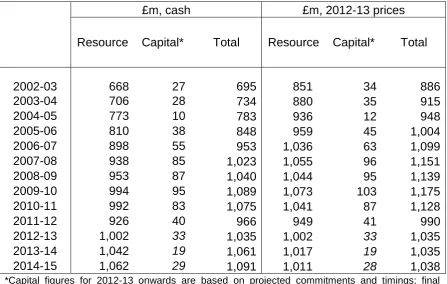
Table 1: SFC HE budget, (£m, cash and real)
£m, cash £m, 2012-13 prices
Resource Capital* Total Resource Capital* Total
2002-03 668 27 695 851 34 886
2003-04 706 28 734 880 35 915
2004-05 773 10 783 936 12 948
2005-06 810 38 848 959 45 1,004
2006-07 898 55 953 1,036 63 1,099
2007-08 938 85 1,023 1,055 96 1,151
2008-09 953 87 1,040 1,044 95 1,139
2009-10 994 95 1,089 1,073 103 1,175
2010-11 992 83 1,075 1,041 87 1,128
2011-12 926 40 966 949 41 990
2012-13 1,002 33 1,035 1,002 33 1,035
2013-14 1,042 19 1,061 1,017 19 1,035
2014-15 1,062 29 1,091 1,011 28 1,038
*Capital figures for 2012-13 onwards are based on projected commitments and timings; final figures may vary
Source: previous budget documents (Scottish Government, 2012a) and personal correspondence with Scottish Government. Figures converted to real terms using HM Treasury GDP deflator (HMT, 2012) as at 13 Sep 2012
The SFC‟s total HE budget peaked in 2009/10 (in real terms) and fell by a total of 16% over the next two financial years. This was followed by a rise of 5% in 2012-13 and a stable budget in real terms for the remainder of the spending review period which runs to 2014-15. The capital budget has seen sharp cuts and is anticipated to fall by 73% in real terms between 2009/10 and 2014/15 (although the final split of capital spend between FE and HE may differ from these projections). Over the same period, the resource budget is set to fall by 6%.
SCOTTISH GOVERNMENT DRAFT BUDGET 2013/14
The Draft Budget for 2013/14 for HE is provided in four Scottish Government budget lines at „Level 3‟ expenditure: the SAAS budget, the SFC Revenue, the SFC capital budget line, and to a far smaller extent, „other skills and employability‟ funding (such as „widening access‟ and funding for the „Royal Society of Edinburgh‟).
Funding for Higher Education Student Support - SAAS Budget (Level 3)
6
conjunction with Skills Development Scotland. SAAS is only responsible for administering higher education student support.
The SAAS budget includes funding for HE fees, grant and bursary support, all student loans and associated costs to the Scottish Government of student loan provision, as well as the running costs and capital charges of SAAS. The vast majority of the SAAS budget is demand-led, in that it is determined by the number of HE students requiring financial support in a given year. The Scottish Government controls this, to some extent, by setting the maximum number of funded student places available in Scottish institutions per year (through guidance to the SFC), in order to control the size of the overall student support budget.
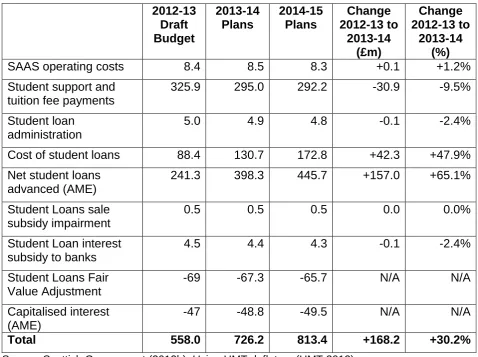
Tables 2 and 3 below detail the proposed SAAS budget for 2013-14 at level 3 expenditure, in both cash and real terms. Also included are planned spending figures for 2014-15.
TABLE 2: SAAS BUDGET 2012-13 – 2013-14, LEVEL 3, CASH TERMS, £M 2012-13 Budget 2013-14 Draft Budget 2014-15 Plans Change 2012-13 to 2013-14 (£m) Change 2012-13 to 2013-14 (%)
SAAS operating costs 8.4 8.7 8.7 +0.3 +3.6%
Student Support and Tuition fee payments
325.9 302.4 307.0 -23.5 -7.2%
Student loan administration
5.0 5.0 5.0 0.0 0.0%
Cost of student loans 88.4 134.0 181.6 +45.6 +51.6%
Net student loans advanced (AME)
241.3 408.3 468.3 +167.0 +69.2%
Student Loans sale subsidy impairment adjustments (AME)
0.5 0.5 0.5 0.0 0.0%
Student Loan Interest Subsidy to banks
4.5 4.5 4.5 0.0 0.0%
Student Loans Fair Value Adjustment (AME)
(-69) (-69) (-69) N/A N/A
Capitalised interest (AME)
(-47) (-50) (-52) N/A N/A
Total 558.0 744.4 854.6 +186.4 +33.4%
7
TABLE 3: SAAS BUDGET 2012-13 – 2013-14, LEVEL 3, REAL TERMS £M (12-13 PRICES) 2012-13 Draft Budget 2013-14 Plans 2014-15 Plans Change 2012-13 to 2013-14 (£m) Change 2012-13 to 2013-14 (%)
SAAS operating costs 8.4 8.5 8.3 +0.1 +1.2%
Student support and tuition fee payments
325.9 295.0 292.2 -30.9 -9.5%
Student loan administration
5.0 4.9 4.8 -0.1 -2.4%
Cost of student loans 88.4 130.7 172.8 +42.3 +47.9%
Net student loans advanced (AME)
241.3 398.3 445.7 +157.0 +65.1%
Student Loans sale subsidy impairment
0.5 0.5 0.5 0.0 0.0%
Student Loan interest subsidy to banks
4.5 4.4 4.3 -0.1 -2.4%
Student Loans Fair Value Adjustment
-69 -67.3 -65.7 N/A N/A
Capitalised interest (AME)
-47 -48.8 -49.5 N/A N/A
Total 558.0 726.2 813.4 +168.2 +30.2%
Source: Scottish Government (2012b); Using HMT deflators (HMT 2012)
It can be seen from Tables 2 and 3 that the SAAS budget has increased by £186.4 million from £558 million in financial year (FY) 2012/13 to £744.4 million in 2013/14, a 33.4% annual rise in cash terms (30.2% in real terms).
The majority of the increase over the period is in the „Net Student Loans Advanced‟ budget line, which funds student loan payments to students. This budget line is due to increase by £167.0 million in cash terms between 2012-13 to 2013-14, an increase of 69.2%.This increase will be used to support the commitment to minimum levels of support available to Scottish Students (see Scottish Government press
release from the 22nd August 2012 (Scottish Government, 2012c), and details of
proposed support reforms (Scottish Government, 2012d)).
8
The budget line for HE „student support and tuition fee payments‟ (which includes funding for HE bursary/grant support) will fall from £325.9 million in 2012-13 to £302.4 million in 2013-14, a reduction of 7.2% in cash terms and 9.5% in real terms. This is partly explained by a reduction in the amount payable in bursaries to some undergraduates, as well as a move away from postgraduate tuition grants towards
postgraduate tuition fee loans (SAAS, 2012).
Funding for Teaching, Research and Strategic Investment in HE – SFC Budget (Level 3)
Tables 4 and 5 below detail the proposed Scottish Government HEI revenue and capital budget for the SFC, at level 3 expenditure, in both cash and real terms, for the next 2 years. (These include capital grants for both HEIs and colleges, as shown in the Draft Budget document. For HEI only capital projections see Table 1, page 5).
Table 4: SFC Budget for HEIs 2012-13 – 2013-14, Level 3, Cash Terms, £mill
2012-13 Budget 2013-14 Draft Budget 2014-15 Plans Change 2012-13 to 2013-14 (£m) Change 2012-13 to 2013-14 (%)
Current Funding for HEIs 1002.2 1,041.6 1,061.8 +39.4 +3.9% Capital Grants for FE
Colleges and HEIs
60.7 45.9 56.4 -14.8 -24.4%
Source: Scottish Government (2012b)
Table 5: SFC Budget for HEIs 2012-13 – 2013-14, Level 3, Real Terms, £mill
2012-13 Budget 2013-14 Draft Budget 2014-15 Plans Change 2012-13 to 2013-14 (£m) Change 2012-13 to 2013-14 (%)
Current Funding for HEIs 1,002.2 1,016.2 1,010.6 +14.0 +1.4% Capital Grants for FE
Colleges and HEIs
60.7 44.8 53.7 -15.9 -26.2%
Source: Scottish Government (2012b); Using HMT deflators (HMT 2012)
SFC - Current Expenditure for HEIs
9
SFC - Capital Expenditure for HEIs
Table 1 (see page 5) shows that projected SFC capital expenditure for the HE sector is set to fall from £33 million in 2012/13 to £19 million in 2013/14, rising again to £29 million in 2014/15 (cash terms). Future and current year estimates were provided by the Scottish Government. These figures were attained through personal correspondence and officials were keen to stress that figures are subject to change.
SFC Allocations to individual Higher Education Institutions (HEIs) for Academic Year 2012/13
In March 2012, the SFC confirmed allocations of £1,021,923 million revenue funding to 19 HEIs in AY 2012-13 for teaching, research and knowledge transfer, and strategic funding (inclusive of £26.5 million in SFC revenue funding for capital). The SFC also allocated Scottish Government ring-fenced funding of £67 million which contributed to medical, teaching, dentistry, nursing and midwifery places. Full details of the allocations can be found in the SFC's grant letter to HEIs for AY 2012/13 (SFC, 2012a)
Indicative SFC allocations by institution for AY 2013/14 will not be announced until December 2012.
POLICY ANALYSIS
MINISTERIAL GUIDANCE
Ministerial Guidance to the SFC for the HE Sector in 2013/14
Following the publication of the 2013-14 Draft Budget the Scottish Government outlined its key priorities for the FE and HE sector in a letter of Ministerial Guidance
to the SFC (Scottish Government, 2012e) released on 4 October 2012. On receiving
this guidance, the SFC determines the strategic actions needed within each sector and allocates the public resource accordingly. The Cabinet Secretary for Education and Lifelong Learning is keen to emphasise Scottish universities‟ „competitive settlement compared to universities elsewhere in the UK‟. In return, and in line with the post-16 education reform agenda, the Government expects universities to focus on widening access to students from Scotland‟s most deprived areas.
In addition, during academic year 2013-14 the Cabinet Secretary expects universities to deliver the following outcomes through „robust outcome agreements‟ which will take precedence over the existing conditions of SFC grant:
“securing real term efficiencies of around 2% per annum which, along with the savings from Rest of UK student places phasing out, can be reinvested in additional provision;
investment in an incentive scheme to widen access at the most selective institutions through additional targeted places;
10
places in colleges. Ministers expect this to be part of a step change in the amount of articulation from colleges;
targeted investment in skills priorities relating to key industries. We would expect a significant proportion of this investment to be at taught postgraduate level and be aligned with initiatives such as Innovation Centres;
targeted investment in large items of equipment what associated with Innovation Centres, thereby further supporting this important contribution to the innovative economy.”
(Scottish Government, 4 October 2012) The Scottish Government and SFC envisage outcome agreements will drive efficiencies, improve performance, match capacity to needs and enhance quality within the university sector. Outcome agreements provide a new approach to accountability for, and allocation of, public funding to a system of legally autonomous institutions that rely on public finance to a highly varying degree and have autonomy in how they allocate their income.
Ministerial Guidance to the SFC for the HE Sector in 2012/13 is summarised in
Annex 1 (Scottish Government, 2012f).
MAINTAINING A COMPETITIVE HE FUNDING SITUATION WITH
REST OF UK
The introduction of a cap of £9,000 on variable tuition fees in England, as well as a move towards the marketisation of the English HE sector, has provided a significant challenge to the Scottish Government in terms of filling the resulting „funding gap‟ and therefore maintaining the competitiveness of teaching and research in Scotland. UK Minister for Universities and Science, David Willets MP was quoted in the House
of Commons on 28 June 2011 as saying “We estimate that there could be a cash
increase in funding for higher education [in England] of around 10% by 2014-15” (in terms of total funding from teaching grants, tuition fees and research grants) (House of Commons, 2011). As a result, the Scottish Government announced the formation of a technical working group (TWG) to examine the extent of any future „funding gap‟. The working group reported that a gap could develop of between £97 million and £263 million in teaching income between Scotland and England by AY 2014-15, depending on the fee levels set by English institutions, as well as cross-border flows of students.
The technical working group set out a number of potential solutions to 'filling the
funding gap' (Scottish Government, 2011a). These included: the state maintaining
primary responsibility for funding (with the possible introduction of a graduate contribution from Scots-domiciled students1), introducing variable fees in Scotland
1
11
for RUK students, potential for an EU management fee, further sector efficiencies, with the remaining estimated gap being filled by public funding. All these suggestions are considered below in more detail.
The introduction of rest of UK (RUK) fees in Scotland
In autumn 2011, the Scottish Parliament agreed to allow Scottish HEIs to set variable fees for students from the rest of the UK (Scottish Parliament, 2011b). RUK students are defined as „students who normally live in another part of the UK outside Scotland‟. However there has been some controversy (see for example the BBC
Northern Ireland, May 2012) surrounding an apparent loophole which enables
Northern Irish students to use their Republic of Ireland status to apply to Scottish universities as EU students, and therefore receive free tuition from the Scottish Government (EU treaties oblige the students from other member states to be treated in the same way as Scottish domiciled students). The Scottish Government intends to introduce legislation closing this loophole in time for the 2013/14 academic year. This legislation „will require dual-national students to provide evidence that they have previously exercised their right of residence elsewhere and will prevent the use of dual-nationality solely to benefit from free tuition‟ (Scottish Government, 2012g). According to the Scottish Government, introducing fees for RUK students could help bring the „net‟ funding gap to £93 million per year. This is based on a „starting point‟ funding gap of £155 million, calculated using average English non-indexed fees of £7,500 (see Technical Working Group final report, (Scottish Government, 2011a)). The Government then deducted £62 million from the starting point figure using estimated income raised from charging students from the Rest of the UK, assuming RUK student numbers in Scotland were maintained at 2011 levels (see Scottish
Government press release (Scottish Government, 2011b). This £62 million income
estimate is based on an assumed Scottish RUK variable fee of £6,375 (4 year equivalent to £8,500 in England for a 3 year degree).
Clearly a better understanding of the extent of any net funding gap will be realised once the actual income generated from the introduction of variable tuition fees for RUK students is known.
Furthermore, since the publication of the technical working group‟s report, the average fee at English HEIs for 2012/13 has been confirmed at £8,385 (£8,123 after fee waivers are taken into account). This figure is index linked, so recent estimates published by the Office for Fair Access in England (OFFA, 2012) show that in AY 2013/14, the average tuition fee in England is estimated to rise to over £8,507 (£8,263 after fee waivers are taken into account). When all financial support from universities and colleges is taken into account, the estimated average fee cost is £7,898 (£7,789 in £2012-13) (OFFA, July 2012).
If these figures were used, it is highly likely that that the overall funding gap would be greater than the £155 million funding gap initially estimated (for example the technical working group estimated that with an average English fee of £8000 which is index-linked, the funding gap could be equal to £263 million by 2014-15).
12
courses in the future, which courses are taken up (some HEIs have varied fees by type of course), what bursary support English and Scottish institutions are offering and what teaching grant they are losing as a result (the net income effect of variable fees); how HEIs will change their fees in future years; and whether SFC maintains the real terms value of funding for teaching. Nevertheless in evidence to the
Education and Culture Committee on the 2nd October 2012, Alastair Sim, Director of
Universities Scotland, stated: „Our view is that the spending review settlement met the teaching funding gap as best it could. We are certainly pleased to see that being perpetuated in the budget proposals‟ (Scottish Parliament, 2012).
For further details on changes to tuition fee arrangements across the UK, please see SPICe briefing: Higher Education: Tuition Fees and the Funding Gap. Universities Scotland have also produced a „no nonsense guide‟ to the funding gap facing
Scotland‟s universities(Universities Scotland, 2011).
Changes to SFC funding model resulting from the introduction of RUK Fees
Changes have been made to the way the SFC allocates its teaching grant from AY 2012/13, as outlined in the SFC‟s technical guidance (SFC, 2012a).
In AY 2012/13, as a result of the deregulation of variable RUK fees, the SFC has removed 5,787 funded student places (the estimated number of RUK entrants in AY 2012/13, based on 2009/10 HESA data) from its public funding methodology and is only providing „funded student places‟ for Scottish and other European Union (EU) students.
The removal of these places has freed up £28.6 million of the HEI teaching budget in AY 2012/13 (at 2012/13 prices). The SFC will then remove the balance of 12,062 funded student places (FSPs) currently held by continuing RUK students in four equal tranches over AYs 2013-14 to 2016-17. By removing RUK students from the SFC‟s public funding methodology, this suggests a total reduction of RUK FSPs over 2012/13 to 2016/17 of 17,849.5 FTEs, at a total value of £96.3 million (in cash terms). The SFC has published the illustrative future amounts and values of rest of UK funded student places to be removed over the Spending Review period by institution (see Updated funding allocations to universities - technical guidance (SFC, 2012a)).
The SFC guidance states that funds released through the removal of RUK funded student places will be used firstly to provide compensation for higher cost and strategically important subjects (as the RUK fee cap of £9,000 does not cover the full cost of teaching provision for all subject price groups), with the remainder being added into the general unit of resource for teaching.
13
impact upon some institutions more than others. The Cabinet Secretary, in his
announcement to Parliament, was therefore keen to stress that any additional
income generated would benefit all Scottish HEIs (Scottish Parliament, 2011b).
EU service charge
One of the potential funding gap solutions identified by the technical working group was to charge EU students some sort of service charge. The actual legality in terms of complying with EU law of introducing a service charge for EU students has been challenged, (see, for example, Holyrood Magazine, June 2011) and whilst the Scottish Government has been actively seeking a solution to this, progress has been limited. A Scottish Government news release in April 2012 stated that the cost of providing free tuition fees to EU students was approximately £75 million and that negotiations at an EU level have been on-going. The Cabinet Secretary for Education and Lifelong Learning was quoted saying:
“Students from other EU countries cost us around £75 million every year and we need to resolve this. Austria finds itself in a similar situation and we have agreed to share and analyse information on the destinations of graduates. I will also continue to work with the Commissioner to try and find a suitable solution.”
(Scottish Government, 2012h)
Further sector efficiencies
The Technical Working Group also cited „sector efficiencies‟ as a way of reducing the funding gap, with the sector having „a proven track record on efficiency‟. Universities Scotland‟s „Working Smarter: Progress Report 2012‟ outlines the strategy developed by the HE sector in working to deliver £26 million worth of efficiencies for each of the next three years (Universities Scotland, 2012b). Measures include encouraging universities to collaborate on procurement, shared data storage and virtual learning environments, as well as developing other shared services. The Technical Working Group acknowledges, however, that HEIs across the UK will be going through similar processes and hoping to achieve the same sector efficiencies. Hence it is difficult to argue that efficiency savings will have any net impact on reducing the funding gap between Scottish and English universities.
Acceptances at Scottish universities in AY 2012/13 by country of domicile
The Scottish Government committed itself to „protecting places‟ for Scottish and EU
students following changes to fees for RUK students (Scottish Government, 2012i). There has been significant recent media coverage of a potential issue surrounding Scottish universities and the „clearing‟ system (for example courses being „closed‟ for Scottish students whilst still open to RUK and International students (see Telegraph
17 August 2012 for an example)). However this issue is more directly related to the
14
In AY 2012/13 the number of „funded student places‟ was set at 116,330.2 FTEs (plus 8,862 FTE Scottish Government ring fenced funded places) for Scottish, EU and continuing RUK students following the removal of 5,787.4 RUK student places from the baseline (table 5 of SFC Grant letter to HEIs for AY 2012/13 (SFC, 2012a)). There are now no longer limits on the number of RUK students or international students that institutions can recruit. However it is worth noting that the SFC still sets (non-binding) intake targets for controlled subjects such as medicine and dentistry.
Latest Statistics from UCAS (14 September 2012), looking at applicants and
acceptances by entry year across the UK show that
UK and EU domiciled acceptances to the 2012-13 entry year at this point are 408,500. This is a change of -56,600 (-12 per cent) compared to acceptances into the 2011-12 entry year at the equivalent point in the previous cycle.
On the same basis, by country of institution: England: 340,500, -54,200 (-14 per cent) Northern Ireland: 9,700, +200 (+2 per cent) Scotland: 36,700, +700 (+2 per cent) Wales: 21,500, -3,300 (-13 per cent)
(Statistical Note: the reference point for these statistics is four weeks after the release of A level results (13 September 2012 and the equivalent point in previous cycles)).
Table 6 (below) uses the UCAS report data to show that as at 13 September 2012, acceptances to Scottish HEIs from Scottish students had risen by 1.2%, with RUK and EU acceptances rising by 5.1% and 3.3% respectively. Figures on international students are not included in the analysis. So far the introduction of RUK fees has not resulted in a reduction of the number of Scottish students being accepted onto courses in Scottish HIEs (UCAS, 2012).
Table 6: UK and EU acceptances to Scottish UCAS institutions by entry year and country of domicile of applicant
2010/11 2011/12 2012/13 % change 11/12-12/13
Scotland 27,759 27,229 27,554 1.2%
England/Wales/NI 4,858 4,623 4,858 5.1%
EU 3,857 4,147 4,284 3.3%
ALL 36,474 35,999 36,696 1.9%
(Source: UCAS, 2012)
15
The Scottish Government funding settlement for the 2012-15 spending review period has provided universities and the SFC with some certainty on income streams for their sector. For example, in AY 2012-13, the SFC has restored teaching funding levels back to 2010-11 levels, increased funded places and increased the teaching unit of resource (£15.2 million in 2012/13, followed by uplifts in AY 2013/14 and 2014/15) with an additional £3.6 million for strategically important, high cost subjects (see SFC, 2012a).
The SFC proposes that the Scottish Government settlement, taken with the funds made available from changes to RUK student funding means that „general teaching funding will increase by approximately 5% (cash terms) in each year and will maintain competitiveness of the Scottish system with the RUK and internationally’ (SFC, 2012a).
COMMERCIALISATION OF HE OUTPUTS AND THE RESEARCH
EXCELLENCE GRANT
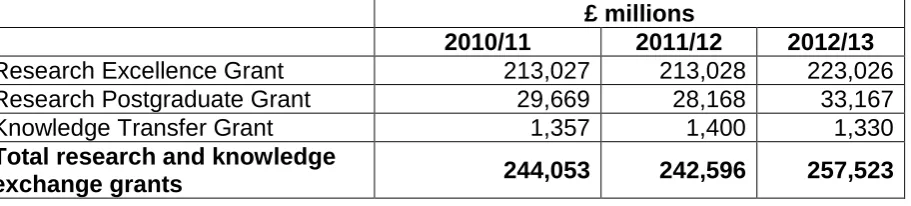
Research and knowledge exchange is crucial to Scotland‟s economy and public funding is closely tied to Scottish Government economic priorities (see Scotland Performs, National Indicator „Knowledge Exchange‟). The Scottish university research base has historically punched above its weight in terms of competing for research funding. According to the SFC the country produces 1.2 per cent of all new knowledge and is second in the world in terms of impact of its research (Scottish Funding Council, „World Class Research‟ (SFC, 2012b)). It wins over 13% of UK Research Council funding and 12% of the UK sector‟s funding from industry commerce and public corporations, with 86% of all Research Assessment Exercise (RAE) research judged as being of international quality or better (Universities Scotland „University research: facts and figures‟ (Universities Scotland, 2011b)). As with teaching, the research missions of institutions are diverse, as is their research capacity and ability to generate research income. In AY 2012/13 the SFC is allocating £258 million in research and knowledge exchange grants. The specific allocation for AY 2013/14 is not currently known.
Allocation of Research Funding
16
Table 7: Research and Knowledge Exchange Funding, AY 2010/11 to AY 2012/13
£ millions
2010/11 2011/12 2012/13
Research Excellence Grant 213,027 213,028 223,026 Research Postgraduate Grant 29,669 28,168 33,167
Knowledge Transfer Grant 1,357 1,400 1,330
Total research and knowledge
exchange grants 244,053 242,596 257,523
Source: SFC, 2012a and previous year allocations
The REG was introduced in 2009/10 and its formulaic calculation has largely been informed by the results of the 2008 Research Assessment Exercise (RAE). The RAE will be replaced in 2014 by the UK-wide Research Excellence Framework (REF), which will assess the outputs and impact of HE research across the UK. This is significant as the results of the REF exercise will be used by the SFC from 2015-16 onwards to inform its model for allocations of its two research grants.
Knowledge exchange and transfer
The Knowledge Transfer Grant (KTG), provides a baseline £70,000 to each university to fund dedicated staff to plan exchange projects and work with businesses (£1.3 million in AY 2012/13 and 2013/14) (SFC, 2012a). Other Knowledge Exchange (Strategic) funding for AY 2012-13 totals £15.4 million, which supports universities‟ innovation activities. In 2012/13, it is being allocated formulaically, but the SFC intends to start using knowledge exchange funds to support larger scale strategic structural projects in future.
The Scottish Government has asked the SFC to use strategic funds to develop, in partnership with Scottish Enterprise and HIE, Innovation Centres (ICs) in the key sectors over the next three years. This follows from the successful establishment of
the Technology Innovation Centre (TIC) for energy at Strathclyde University, funded
from a variety of public funding sources including EU regional development funds. The intention is that ICs will provide direct industry and academia links, foster entrepreneurship and support industry level skills development. The SFC is allocating £10 million in 2012/13 and £20 million in 2013/14, which will require additional support from other income sources. The Innovation Centres will be developed through an application process, underway at present.
To provide greater strategic and cohesive support to the HE sector, Universities Scotland, SFC, Interface, SE and HIE are working together to deliver a single
'Knowledge Exchange Office' (KEO) within the next two years. This will support
[image:16.595.76.532.71.174.2]17
ANNEX 1: SUMMARY OF MINISTERIAL GUIDANCE AND
SFC POLICY AY 2012/13
Ministerial Guidance to the Scottish Funding Council for Academic Year 2012/13
On 21 September 2011 the Scottish Government set out more specific priorities for investment in colleges and universities over the spending review in a Letter of
Guidance to the SFC. The Scottish Government provided a further Letter of
Guidance on 25 January 2012, on the funding position for colleges for the academic
year 2012-13. This content of this guidance is summarised for both colleges and universities below:
Higher Education
The Ministerial Guidance to the SFC stated that the budget settlement given to HEIs in Scotland, along with the proposals for fees for students from the Rest of the UK (RUK) would ensure that the sector remains competitive. The Scottish Government asked the SFC to seek improved outcomes in:
Retention;
Articulation from College;
Accelerated degrees, including entry into second year of the undergraduate degree programme from school;
Access to university for people from the widest possible range of backgrounds;
International competitiveness in research;
University and Industry collaboration and the exploitation of research; The pattern and spread of provision;
Efficiency, both in the learner journey and of institutions; The entrepreneurial and employability skills of graduates. It outlined the following specific guidance for the SFC:
1. To restore the unit of resource for teaching to AY 2010-11 levels;
2. To maintain the total number of places for Scottish-domiciled and EU students that were available in Scottish HEIs in 2011-12 and to consider restoring these places to being „fully funded‟ as opposed to „fees only‟ places;
3. To prioritise the full funding of „fees only‟ places at institutions with research strengths in science;
4. To protect subjects where changes to RUK fees do not adequately reflect the cost of provision. In this regard, the SFC should allocate additional funding to ensure that science and small specialist institutions are protected (particularly those who play a key role in the creative industries), as well as possible adjustments for subjects with a clinical component;
5. To concentrate funding for research in those institutions where Scottish Government funding will lever in the greatest additional resource from the UK Research Councils, the European Commission and other major research funders;
18
7. To remove any barriers to the exploitation of university research and work towards expanding the „Easy-Access‟ IP model, established by the University of Glasgow, across all institutions in order to make as much intellectual property (IP) available to business and industry;
8. To work with institutions to establish a single HE sector „Knowledge Exchange Office‟ within the next 2 years;
9. To work towards securing a more coherent spread of provision in teaching across Scotland, seeking substantial efficiency savings through changing the learner journey, collaboration and merger where an educational and financial case exists (currently there are overlaps between what some of the more „regional‟ universities teach, in urban areas in particular);
10. Where these efficiencies are not achieved, the SFC should consider mechanisms to reflect this in future funding decisions;
11. The SFC should work with the relevant colleges and universities towards increasing provision for regional areas covered by the University of the Highlands and Islands, and in doing so should consider altering its funding method to an outcomes based method, particularly concentrating on retention; 12. The Scottish Agricultural College (SAC) should be encouraged to continue to
work with its three land-based colleges with a view to merger;
13. The SFC should develop „widening access outcome agreements‟ with financial penalties where insufficient progress on access is made (these agreements would differ by institution and the Scottish Government is consulting upon whether these agreements should be backed by statutory force);
19
SOURCES
BBC Northern Ireland (2012), Irish passport key to fee waiver in Scotland (1 May 2012). Available at: http://www.bbc.co.uk/news/uk-northern-ireland-17900220 House of Commons (2011) Hansard 28 June 2011, column 769). London: House of Commons:
http://www.publications.parliament.uk/pa/cm201011/cmhansrd/cm110628/debtext/11
0628-0001.htm
HM Treasury (2012), September 2012 deflator update. Available at:
http://www.hm-treasury.gov.uk/Search.aspx?terms=deflator
Office for Fair Access (2012) OFFA announces decisions on 2013-14 access agreements. Available at:
http://www.offa.org.uk/press-releases/offa-announces-decisions-on-2013-14-access-agreements/
Scottish Funding Council (2012a), Updated funding allocations to universities for academic year 2012-13. Edinburgh: Scottish Funding Council. Available at:
http://www.sfc.ac.uk/news_events_circulars/Circulars/2012/SFC0512.aspx
Scottish Funding Council (2012b), World-class research. Available at:
http://www.sfc.ac.uk/research/research.aspx
Scottish Government (2011a), Expert Group Report (TWG) – Final Report. Edinburgh: Scottish Government. Available at:
http://www.scotland.gov.uk/Topics/Education/UniversitiesColleges/16640/stakeholde
rgroups/FinalReport
Scottish Government (2011b), University funding (press release). Available at:
http://www.scotland.gov.uk/News/Releases/2011/02/28150040
Scottish Government (2012a), Previous Budget documents. Available at:
http://www.scotland.gov.uk/Topics/Government/Finance/18127/Documents
Scottish Government (2012b), Scottish Budget: Draft Budget 2013-14. Edinburgh: Scottish Government. Available at:
http://www.scotland.gov.uk/Publications/2012/09/7829/downloads
Scottish Government (2012c), UK’s best student support package. Available at:
http://www.scotland.gov.uk/News/Releases/2012/08/student-support22082012
Scottish Government (2012d), Post-16 education reform programme. Available at:
http://www.scotland.gov.uk/Topics/Education/post16reform/student-support
Scottish Government (2012e), Ministerial letter of strategic guidance for 2013-14 to the SFC. Edinburgh: Scottish Government. Available at:
http://www.sfc.ac.uk/about_the_council/lettersofguidance/letterofguidance.aspx
Scottish Government (2012f), Ministerial letter of strategic guidance for 2012-13 to the SFC. Edinburgh: Scottish Government. Available at:
20
Scottish Government (2012g), Action on fees for dual nationality students (press release). Available at:
http://www.scotland.gov.uk/News/Releases/2012/09/EU-students14092012
Scottish Government (2012h), Support for universities across Europe (press
release). Available at:
http://www.scotland.gov.uk/News/Releases/2012/04/support-for-universities27042012
Scottish Government (2012i), Increase in university places for young Scots (press release). Available at:
http://www.scotland.gov.uk/News/Releases/2012/08/increaseuniversityplaces150820
12
Scottish Parliament (2011a), Official Report for 16 March 2011. Edinburgh: Scottish Parliament. Available at:
http://www.scottish.parliament.uk/parliamentarybusiness/28862.aspx?r=6188
Scottish Parliament (2011b), Official Report for 29 June 2011.. Edinburgh: Scottish Parliament. Available at:
http://www.scottish.parliament.uk/parliamentarybusiness/28862.aspx?r=6577&mode
=html#iob_59834
Scottish Parliament (2012), Official Report for Education and Culture Committee for 2 October 2012. Available at:
http://www.scottish.parliament.uk/parliamentarybusiness/28862.aspx?r=7400&mode
Student Awards Agency for Scotland (SAAS)(2012), What financial support can I get? Postgraduate student guidance. Available at:
http://www.saas.gov.uk/student_support/special_circumstances/postgrad_support.ht
m
Universities Scotland (2012a), Income and expenditure of Scotland’s universities. Edinburgh: Universities Scotland. Available at:
http://www.universities-scotland.ac.uk/uploads/University%20incomeandexpenditure201011.pdf
Universities Scotland (2012b), Working Smarter: progress report 2012. Edinburgh: Universities Scotland. Available at:
http://www.universities-scotland.ac.uk/uploads/US-WorkingSmarterProgress2012.pdf
Universities Scotland (2011), The Funding Gap Facing Scotland's Universities. Edinburgh: Universities Scotland. Available at:
http://www.universities-scotland.ac.uk/uploads/briefings/Sizeofthegap%20%283%29.pdf
Universities Scotland (2011b), University research: facts and figures. Available at:
http://www.universities-scotland.ac.uk/uploads/briefings/ResearchFF120511.pdf
University and College Admission Service (UCAS) (2012), „Interim assessment of UCAS acceptances by intended entry year, country of institution and qualifications held‟. Available at:
21
22
23
24
RELATED BRIEFINGS
SB 12-61 Draft Budget 2013-14
SB 11-57 Higher Education Institutions: Subject Profile
SB 11-07 Widening Access to Higher Education: Admissions briefing
Scottish Parliament Information Centre (SPICe) Briefings are compiled for the benefit of the Members of the Parliament and their personal staff. Authors are available to discuss the
contents of these papers with MSPs and their staff who should contact [INSERT] on extension [INSERT] or email [INSERT]. Members of the public or external organisations may comment on this briefing by emailing us at [email protected]. However, researchers are unable to enter into personal discussion in relation to SPICe Briefing Papers. If you have any general questions about the work of the Parliament you can email the Parliament‟s Public Information Service at [email protected].
Every effort is made to ensure that the information contained in SPICe briefings is correct at the time of publication. Readers should be aware however that briefings are not necessarily updated or otherwise amended to reflect subsequent changes.