Open Access
Research
Moderators and mediators of pedometer use and step count
increase in the "10,000 Steps Ghent" intervention
Katrien De Cocker*
1, Ilse De Bourdeaudhuij
1, Wendy Brown
2and
Greet Cardon
1Address: 1Department of Movement and Sports Sciences, Ghent University, Ghent, Belgium and 2School of Human Movement Studies, University
of Queensland, Brisbane, Australia
Email: Katrien De Cocker* - [email protected]; Ilse De Bourdeaudhuij - [email protected]; Wendy Brown - [email protected]; Greet Cardon - [email protected]
* Corresponding author
Abstract
Background: The European pedometer-based "10,000 Steps Ghent" whole community intervention for 228,000 residents was found to be effective in increasing step counts by an average of 896 steps/day in a sub-sample of adults. The present study aimed to examine the characteristics of intervention participants (n = 438) who (1) used a pedometer and (2) increased their step counts. Additionally, the third aim was to examine the mediational effect of pedometer use on step count change.
Methods: The study sample consisted of 438 adults (207 male, mean age 49.8 (13.1) years). Binary logistic regressions were used to examine whether individual characteristics (gender, age, educational level, employment status, self-reported health condition, baseline step counts, baseline sitting time, baseline transport-related PA) and intervention exposure variables (having heard/seen a PA promotion message, being aware of the PA guidelines, and knowing about "10,000 Steps Ghent") were associated with (1) pedometer use and (2) a step count increase of 896 steps/day or more. Using pooled data (n = 864) from the intervention and comparison participants, a mediation analysis was conducted to see if the change in step counts was mediated by pedometer use.
Results: Age (49 years or more: OR = 3.19, p < 0.005), awareness of a PA promotion message (OR = 2.62, p < 0.01) and awareness of "10,000 Steps Ghent" (OR = 2.11, p < 0.05) were significantly associated with pedometer use. Participants with a college or university degree (OR = 1.55, p < 0.05) and those who used a pedometer (OR = 2.06, p < 0.05) were more likely to increase their steps by 896 steps/day or more. This increase was less likely among those with baseline step counts above 10,000 steps/day (OR = 0.38, p < 0.001). The mediation analysis revealed that pedometer use partly mediated step count change.
Conclusion: Pedometer use was more likely in older participants and in those who were aware of the "10,000 Steps" campaign. Increasing step counts was more likely among those with higher education, baseline step counts below 10,000 steps/day and those who used a pedometer. Pedometer use only partly mediated the intervention effect on step counts.
Published: 12 January 2009
International Journal of Behavioral Nutrition and Physical Activity 2009, 6:3 doi:10.1186/1479-5868-6-3
Received: 11 June 2008 Accepted: 12 January 2009
This article is available from: http://www.ijbnpa.org/content/6/1/3
© 2009 De Cocker et al; licensee BioMed Central Ltd.
Background
Low levels of physical activity (PA) are associated with an increased risk for adverse physiological and mental health outcomes including cardiovascular diseases, obesity, hypertension, diabetes mellitus type 2, different types of cancer, osteoporosis, and depression and anxiety [1]. Therefore, international guidelines recommend that all healthy adults aged 18–65 should engage in moderate-intensity aerobic PA for a minimum of 30 minutes on five days each week, or in vigorous-intensity aerobic PA for a minimum of 20 minutes on three days a week [2]. Never-theless, the majority of American (60%) [1], Australian (43%) [3], and European (43–87%) [4] adults do not meet this recommendation. Consequently, diverse inter-ventions in various settings and specific populations have been developed and implemented to promote PA [5].
Pedometers, which objectively measure ambulatory activ-ities throughout the day in the form of step counts, have become popular as monitoring and motivational tools in PA interventions. Pedometers are easy to use and rela-tively inexpensive compared with other motion sensors (pedometer: approximately US $ 20–50; accelerometer: approximately US $ 150–500). Evidence suggests that the use of pedometers is associated with significant increases in PA levels [6,7] and significant improvements in health outcomes among adults [6]. In addition, step count goals such as '10,000 steps/day' have been used in the promo-tion of PA [8].
Pedometer interventions appear to be effective both in smaller settings (e.g. workplaces [9,10], churches [11], primary care [12,13]), and in whole community-based tri-als (e.g. "The Step-by-Step Trial" [7], "10,000 Steps Rock-hampton" [14], "10,000 Steps Ghent" [15], and "Canada on the Move" [16]). The Australian "Step-by-Step Trial" showed that pedometer use can enhance the effects of a self-help walking program. The main outcome of the "10,000 Steps Rockhampton" intervention was that the downward trend in the percentage of citizens classified as active in the comparison community was not evident in the intervention community [14]. The "10,000 Steps Ghent" whole community intervention succeeded in increasing step counts (average step count increase of 896 steps/day, p < 0.001) after one year of intervention [15]. Despite the overall effectiveness of these community-based interventions, it is possible that they only reached people who were already active, or that the intervention was more efficient for isolated subgroups (e.g. 20–30 year olds). In the "10,000 Steps Rockhampton" project, women were the early adopters of pedometer use; people aged 45 or more, those with higher levels of education, employed people, and those with an 'obese' BMI were more likely to report using a pedometer [14,17]. The results of the "Canada on the Move" project also showed
that pedometer use was more likely among women and older people (44–64 years) [16].
Data from the "10,000 Steps Ghent" intervention provide an opportunity to examine whether the characteristics of people who used a pedometer and increased their step counts in this European whole community intervention, were similar to those seen in Australia and Canada. Dur-ing the multi-strategy intervention, pedometer use was promoted in Ghent at different locations: pedometers could be bought or borrowed at the participants' own dis-cretion. The first aim of the present study was to examine whether self-selected pedometer use in the intervention sample was associated with individual characteristics (gender, age, education, employment status, self-reported health, baseline step counts, baseline sitting time, and baseline transport-related PA) and intervention exposure variables (hearing or seeing a PA promotion message, knowing the amount of PA required for health benefit, and knowing about "10,000 Steps Ghent"). The second aim was to compare the individual characteristics and intervention exposure variables in intervention partici-pants who increased their step counts considerably and those who did not. Using pooled data from the interven-tion and comparison participants, the third aim was to examine the potential mediating effect of pedometer use on step count change.
Methods
Procedures
Prior to the "10,000 Steps Ghent" whole community intervention for 228,000 residents, 2081 randomly selected 25–75 year old adults, living in the city of Ghent (Belgium), were invited to participate. Of those, 872 were interested, 648 completed baseline measurements and 440 participated in the one year follow-up. Baseline and follow-up measures consisted of the completion of the tel-ephone-administered long version of the International Physical Activity Questionnaire (IPAQ) and the self-mon-itoring of pedometer steps for 7 consecutive days, using a daily activity log. At follow-up, participants were asked to also complete a questionnaire relating to awareness of the "10,000 Steps Ghent" project. Participants had to return the pedometer after baseline and follow-up data collec-tion. Details of the study procedures have been described previously [15].
Participants
min-utes/day in transport-related PA and 396 (164) minutes/ day sitting. For aim 3, pooled data from these 438 inter-vention participants and from 426 participants from the comparison city of Aalst [15] were used. All participants provided written informed consent and the study was approved by the Ethical Committee of Ghent University.
"10,000 Steps Ghent" intervention
During the intervention, PA was promoted in the entire city of Ghent, using the central theme of '10,000 steps/ day', with secondary taglines of 'every step counts' (elke stap telt) and 'every revolution (of bicycle pedals) counts' (elke trap telt). The guidelines, recommending 30 min-utes of moderate-intensity PA on five days a week, or 20 minutes vigorous-intensity PA on three days a week [2], were also promoted. Multiple strategies, based on the social ecological model, were designed to intervene at the individual, social and environmental level. A local media campaign (street signs, press conferences, advertise-ments), the sale and loan of pedometers, the use of a web-site, workplace projects, projects for older people and the dissemination of information through health profession-als, schools and associations were concurrently imple-mented. More details on the intervention strategies can be found elsewhere [15].
Instruments
IPAQ
The long version of the IPAQ was used to assess sitting and PA in different domains (work, transport, household and leisure time) in a usual week. The IPAQ is known to be a valid and reliable instrument for assessing PA in Europe [18] and Belgium [19]. In the present study, only sitting time and transport-related PA items were used, since walking and biking for transport reflect the concept of lifestyle PA promoted through "10,000 Steps Ghent".
Pedometer
The valid, accurate, and reliable Yamax Digiwalker SW-200 (Yamax Cooperation, Tokyo, Japan) was used in the present study to measure free-living step counts [20].
Activity log
Participants were asked to record the date, steps taken at the end of each day, and the type and duration of non-ambulatory activities (i.e. biking and swimming). For every minute of reported biking and/or swimming, researchers added 150 steps to the daily total number of reported step counts [15,21]
Questionnaire relating to awareness of the project
The following questions, asked at one-year follow-up, were used in the present study: Have you heard or seen any messages about PA promotion? (yes/no); Do you have any idea about the amount of PA that is required for
health benefit? (yes/no + open ended); Have you heard of the "10,000 Steps Ghent" project? (yes/no); Have you used a pedometer in the last 10 months? (yes/no). A time-frame of 10 months was used to avoid inclusion of base-line pedometer measurements.
Data Analysis
All individual characteristics (gender, age, education, employment status, self-reported health, baseline step counts, baseline sitting time, and baseline transport-related PA) and intervention exposure variables (hearing or seeing a PA promotion message, knowing the PA guide-lines, knowing about "10,000 Steps Ghent", and self-selected pedometer use during the intervention) were interpreted as categorical variables and dichotomized using median scores as follows: age (M = 49 year), base-line sitting time (M = 6.2 hours/day) and basebase-line trans-port-related PA (M = 10.7 minutes/day). Descriptive statistics (numbers and percentages) were calculated using cross tabs. Binary logistic regression was used to examine whether individual characteristics and interven-tion exposure variables were associated with (1) pedome-ter use during the inpedome-tervention and (2) greapedome-ter than mean step count increase (> 896 steps/day). Results are expressed as odds ratios with 95% confidence intervals and p values. All data were analyzed using SPSS 15.0 for Windows (SPSS Inc., Chicago, USA) and statistical signif-icance was set at 0.05.
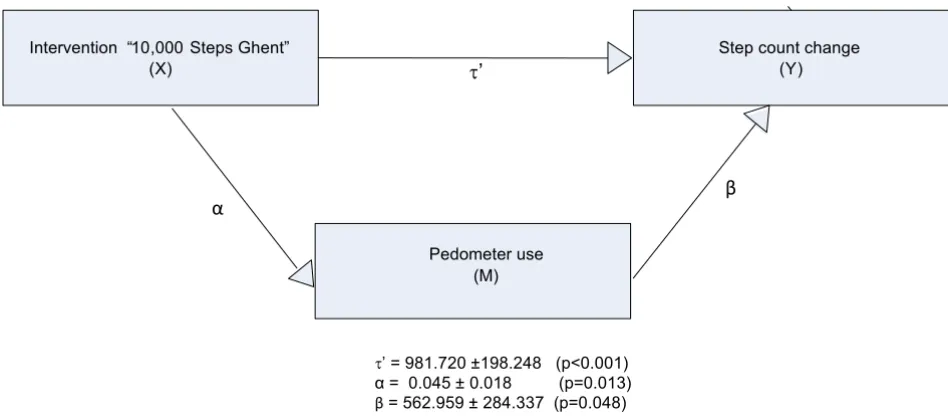
As suggested by Cerin et al [22], the Freedman-Schatzkin difference-in-coefficients test was used to assess the medi-ational effect of pedometer use on step count change. A measure of step count change between baseline and one year follow-up, free of auto correlated error, was recreated by regressing the step counts at follow-up onto the step counts at baseline. The Freedman-Schatzkin test assesses a mediational effect by comparing the relationship between the independent variable (the intervention) and the dependent variable (step count change) before and after adjustment for the mediator (pedometer use) (see figure 1). It tests the null hypothesis that the difference between
the unadjusted (without pedometer use as mediator: τ)
mediational effect is computed by dividing (τ - τ') by its standard error and comparing the obtained value to a distribution with N – 2 degrees of freedom [22]. If the t-value is > 1.984 there is a significant mediation effect at the 5% level. The proportion of the intervention effect mediated by pedometer use was calculated by subtracting the adjusted relationship between the intervention expo-sure and step count change (τ) from the unadjusted
rela-tionship (τ'), and dividing the sum by the unadjusted
value ((τ - τ')/τ) [23].
Results
Only 72 (16.4%) intervention participants used a pedom-eter during the one-year intervention period. Participants older than 49 years (p = 0.001), those who reported hav-ing heard or seen a message about PA promotion (p = 0.006), and those who knew about "10,000 Steps Ghent" (p = 0.047) were more likely to report pedometer use. None of the other potential explanatory variables was sig-nificantly associated with pedometer use during the inter-vention (see Additional file 1). Post hoc chi-square
[image:4.612.65.539.348.557.2]Path diagram for the analysis of the mediational effect of pedometer use on step count change Figure 1
Path diagram for the analysis of the mediational effect of pedometer use on step count change. Intervention “10, 000 Steps Ghent”
(X)
Step count change (Y) W
Intervention “10,000 Steps Ghent” (X)
Step count change (Y) W’
Pedometer use (M)
ɴ ɲ
W=1009.824 ±197.919 (p<0.001)
W’ = 981.720 ±198.248 (p<0.001)
analyses examined the inter-relationship between these significant moderating variables. There was a strong posi-tive relationship between PA promotion message recall and project awareness (χ2 = 58.7, p < 0.001). About 44.2%
of those who reported having heard or seen a PA
promo-tion message (χ2 = 7.3, p = 0.007), and 46.5% of those
aware of the project (χ2 = 3.2, p = 0.074), were older than
49 years.
Overall, 209 (47.5%) participants showed an increase in average step counts of 896 steps/day or more at one-year follow-up. Participants with a college or university degree (p = 0.046), and those who used a pedometer during the intervention (p = 0.014) were more likely to have increased their step counts by 896 steps/day or more, while those with a baseline average step count level of more than 10,000 steps/day were less likely to have increased their step counts by 896 steps/day or more (p < 0.001). None of the remaining variables was significantly associated with the step count increase of 896 steps/day or more (see Additional file 1). Post hoc analyses revealed that more than half those with a college or university degree (54.8%), had fewer than 10,000 steps/day at base-line (χ2 = 3.8, p = 0.051).
Regression coefficients of the different paths are shown in Figure 1. Results revealed that the intervention "10,000 Steps Ghent" was a significant predictor of step count change (p < 0.001) before adjusting for the mediator, ped-ometer use. After adjusting for pedped-ometer use, the inter-vention condition remains a significant predictor of step count change (p < 0.001), however the value of the adjusted regression coefficient (τ') is significantly lower than the regression coefficient before adjusting for ped-ometer use (τ) (t = 2.1), pointing to a significant media-tion effect. This analysis revealed that pedometer use partly mediated ((τ - τ')/τ = 0.028 or 2.8%) the effect of the intervention on step count change.
Discussion
The "10,000 Steps Ghent" whole community intervention was effective in increasing step counts: almost half the intervention participants increased their step counts on average by 896 steps/day or more at one-year follow-up. However, the proportion of intervention participants using a pedometer through loan or sale service during the intervention was modest (16%). The purpose of the present study was to investigate which individual charac-teristics and exposure variables were associated with ped-ometer use and step count increase.
Pedometer use in Ghent (16%) was remarkably similar to that in the Australian "10,000 Steps" intervention in Rockhampton (18%) [17]. The predictors of pedometer use were also very similar in these two studies and in the
"Canada on the Move" intervention. For example, in all three studies older people (over 49 in Ghent, over 45 in Rockhampton [17], and in the 44–64 year age group in Canada [16]) were more likely to have used a pedometer. Other previous pedometer-based studies have shown that PA is inversely associated with age [24-26], so the finding that pedometer use is more prevalent among older people is encouraging. Furthermore, in all three studies, individ-uals being exposed to program variables (having heard or seen a message about PA promotion and knowing about the "10,000 Steps" project in Ghent; having seen the street signage/walking trials and visited the website in Rock-hampton [17]; and campaign awareness in Canada [16]) were more likely to report using a pedometer. The latter seems a logical finding, however explaining why older participants were more likely to use a pedometer is diffi-cult, as participants who were aware of PA promotion messages or the "10,000 Steps Ghent" project, were no more likely to be older than 49 years than those who were unaware. It is possible that older people had more time or more interest in trying out a pedometer. Mostly, they care for their health, and like to have defined guidelines and goals concerning their health behavior. Using a pedome-ter gives them the opportunity to set and reach goals regarding their PA.
Although pedometer use was more likely among women, and employed and higher educated individuals in Rock-hampton [17], and more likely among women, college and university graduates, and high-income earners in Canada [16], gender, education and employment status were not significantly associated with pedometer use in the present Ghent study.
As pedometer use was only one of the strategies promoted during this multi-component intervention, it was interest-ing to find that it was associated with the observed increase in step counts. Our analyses showed that the multi-strategy intervention was successful in promoting and stimulating pedometer use, which in turn resulted in positive step count changes. The intervention effect was however only partly mediated by pedometer use (2,8%), which is not surprising as only one in six people reported using a pedometer. The findings suggest that, although the pedometer was valuable in promoting increased step counts in a whole community, the other strategies (the media campaign, street signs, website, workplace projects, working with health professionals and targeting older people) could also be important. Post hoc mediation analyses showed that the intervention was significantly mediated by awareness through street signs (11.1% medi-ation) and workplace projects (7.3% medimedi-ation). This suggests that promotion, available for the whole commu-nity (i.e. street signs), or in smaller settings (i.e. work-places) has an effect on step count change. The latter mediating effects were even greater than that of pedome-ter use, which was thought to be an important mediator of the intervention. Notwithstanding, this is the first time that the mediating effect of pedometer use on increasing activity has been demonstrated in a whole community intervention.
One limitation of this study is that the questions about pedometer use were not asked at baseline, so information on pre-intervention pedometer use was not available. However, a previous Belgian study [27] has shown that pedometer use was not common in East-Flanders at the time that this intervention was implemented. A second limitation is the lack of information on BMI or other health variables, and additional socio-demographic varia-bles like marital status, income and job classification. The strengths of this study include the large sample size, the random sample of participants for the evaluation (i.e. they were not 'volunteers' in the intervention program), the age range (25–75 years), and the longitudinal step count data.
Conclusion
The findings suggest that age and intervention awareness were positively associated with pedometer use, which was in turn (along with education and low baseline step counts) a significant predictor of step count increase in this whole community intervention. Mediation analyses showed that the intervention effect on increasing step counts was only partly mediated by pedometer use, illus-trating the importance of the other strategies used in this campaign.
Competing interests
The authors declare that they have no competing interests.
Authors' contributions
KDC participated in the design of the study, collected and analyzed the data, and led the writing of the paper. KDC wrote the manuscript, while IDB, WB and GC participated in the design of the study, collaborated with partners on the development of the intervention, discussed the analy-sis plan, and provided substantive feedback on the manu-script. All authors have read and approved the final manuscript.
Additional material
Acknowledgements
None.
References
1. U.S. Department of Health and Human Services: Physical activity and health: a report of the Surgeon General. 1996.
2. Haskell WL, Lee IM, Pate RR, Powell KE, Blair SN, Franklin BA, Mac-era CA, Heath GW, Thompson PD, Bauman A: Physical activity and public health: updated recommendation for adults from the American College of Sports Medicine and the American Heart Association. Med Sci Sports Exerc 2007, 39:1423-1434. 3. Bauman A, Armstrong R, Davies J, Owen N, Brown W, Bellew B, Vita
P: Trends in physical activity participation and the impact of integrated campaigns among the Australian adults, 1997–99.
Aust N Z J Health 2003, 27:76-79.
4. Varo JJ, Martínez-González MA, de Irala-Estévez J, Kearney J, Gibney M, Martínez JA: Distribution and determinants of sedentary lifestyles in the European Union. Int J Epidemiol 2003,
32:138-146.
5. Marcus BH, Williams DM, Dubbert PM, Sallis JF, King AV, Yancey AK, Franklin BA, Buchner D, Daniels SR, Claytor RP: Physical activity intervention studies: what we know and what we need to know: a scientific statement from the American Heart Asso-ciation Council on nutrition, physical activity, and metabo-lism (subcommittee on physical activity); council on cardiovascular disease in the young; and the interdisciplinary working group on quality of care and outcomes research. Cir-culation 2006, 114:2739-2752.
6. Bravata DM, Smith-Spangler C, Sundaram V, Gienger AL, Lin N, Lewis R, Stave CD, Olkin I, Sirard JR: Using pedometers to increase physical activity and improve health: a systematic review. J Am Med Ass 2007, 298:2296-2304.
7. Merom D, Rissel C, Phongsavan P, Smith BJ, Van Kemenade C, Brown WJ, Bauman AE: Promoting walking with pedometers in the community: the Step-by-Step Trial. Am J Prev Med 2007,
32:290-297.
8. Choi BCK, Pak AWP, Choi JCL, Choi ECL: Daily step goal of 10,000 steps: a literature review. Clin Invest Med 2007,
30:E146-E151.
9. Chan CB, Ryan DA, Tudor-Locke C: Health benefits of a pedom-eter-based physical activity intervention in sedentary work-ers. Prev Med 2004, 39:1215-1222.
10. Thomas L, Williams M: Promoting physical activity in the work-place: using pedometers to increase daily activity levels.
Health Promot J Austr 2006, 17:97-102.
11. Wyatt HR, Peters JC, Reed GW, Grunwald GK, Barry M, Thompson H, Jones J, Hill Jo: Using electronic step counters to increase
Additional file 1
Table 1: Analysis of the moderator effects on pedometer use and step count increase.
Click here for file
Publish with BioMed Central and every scientist can read your work free of charge "BioMed Central will be the most significant development for disseminating the results of biomedical researc h in our lifetime."
Sir Paul Nurse, Cancer Research UK
Your research papers will be:
available free of charge to the entire biomedical community
peer reviewed and published immediately upon acceptance
cited in PubMed and archived on PubMed Central
yours — you keep the copyright
Submit your manuscript here:
http://www.biomedcentral.com/info/publishing_adv.asp
BioMedcentral
lifestyle physical activity: Colorado on the Move™. J Phys Act Health 2004, 1:178-188.
12. Stovitz SD, Van Wormer JJ, Center BA, Bremer KL: Pedometers as a means to increase ambulatory activity for patients seen at a family medicine clinic. J Am Board Fam Pract 2005, 18:335-343. 13. Aittasalo M, Miilunpalo S, Kukkonen-Harjula K, Pasanen M: A rand-omized intervention of physical activity promotion and patient self-monitoring in primary health care. Prev Med 2006,
42:40-46.
14. Brown WJ, Mummery WK, Eakin E, Schofield G: 10,000 Steps Rockhampton: evaluation of a whole community approach to improving population levels of physical activity. J Phys Act Health 2006, 3:1-14.
15. De Cocker KA, De Bourdeaudhuij IM, Brown WJ, Cardon GM:
Effects of "10,000 Steps Ghent": a whole-community inter-vention. Am J Prev Med 2007, 33:455-463.
16. Craig CL, Cragg SE, Tudor-Locke C, Bauman A: Proximal impact of Canada on the move: the relationship of campaign aware-ness to pedometer ownership and use. Can J Public Health 2006,
97:S21-S27.
17. Eakin EG, Mummery K, Reeves MM, Lawler SP, Schofield G, Marshall AL, Brown WJ: Correlates of pedometer use: results from a community-based physical activity intervention trial (10,000 Steps Rockhampton). Int J Behav Nutr Phys Act 2007, 4:31. 18. Craig CL, Marshall AL, Sjöström M, Bauman AE, Booth ML,
Ains-worth BE, Pratt M, Ekelund U, Yngve A, Sallis JF, Oja P: Interna-tional Physical Activity Questionnaire: 12-country reliability and validity. Med Sci Sports Exerc 2003, 35:1381-1395.
19. Vandelanotte C, De Bourdeaudhuij I, Sallis J, Philippaerts R, Sjöström M: Reliability and validity of a computerized and Dutch ver-sion of the International Physical Activity Questionnaire (IPAQ). J Phys Act Health 2005, 2:63-75.
20. Crouter SE, Schneider PL, Karabulut M, Bassett DR: Validity of 10 electronic pedometers for measuring steps, distance and energy cost. Med Sci Sports Exerc 2003, 35:1-17.
21. Miller R, Brown W, Tudor-Locke C: But what about swimming and cycling? How to 'count' non-ambulatory activity when using pedometers to assess physical activity. J Phys Act Health
2006, 3:257-266.
22. Cerin E, Taylor LM, Leslie E, Owen N: Small-scale randomized controlled trials need more powerful methods of medita-tional analysis than the Baron-Kenny method. J Clin Epidemiol
2006, 59:457-464.
23. MacKinnon DP: Analysis of mediating variables in prevention and intervention research. NIDA Res Monogr 1994, 139:127-153. 24. Tudor-Locke C, Ham SA, Macera CA, Ainsworth BE, Kirtland KA, Reis JP, Kimsey CD: Descriptive epidemiology of pedometer-determined physical activity. Med Sci Sports Exerc 2004,
36:1567-1573.
25. Wyatt GR, Peters JC, Reed GW, Barry M, Hill JO: A Colorado statewide survey of walking and its relation to excessive weight. Med Sci Sports Exerc 2005, 37:724-730.
26. De Cocker K, Cardon G, De Bourdeaudhuij I: Pedometer-deter-mined physical activity and its comparison with the Interna-tional Physical Activity Questionnaire in a sample of Belgian adults. Res Q Exerc Sport 2007, 78:429-437.