Wendy Macdonald,
Dr Sheila Beck and
Dr Eileen Scott
Briefing on child poverty
Published by NHS Health Scotland 1 South Gyle Crescent
Edinburgh EH12 9EB
© NHS Health Scotland 2013 (minor updates 2018)
All rights reserved. Material contained in this publication may not be reproduced in whole or part without prior permission of NHS Health Scotland (or other copyright owners). While every effort is made to ensure that the information given here is accurate, no legal responsibility is accepted for any errors, omissions or misleading statements.
NHS Health Scotland is a WHO Collaborating Centre for Health Promotion and Public Health Development.
This resource may also be made available
on request in the following formats:
0131 314 5300
1
Contents
Introduction ... 1
Key messages ... 2
Why the focus on children? ... 3
What is child poverty? ... 4
What are the levels of child poverty in Scotland?... 5
How does child poverty impact on health? ... 8
What impact does child poverty have on health? ... 10
Conclusion ... 16
Relevant policy and strategy ... 17
References... 19
2
Introduction
This briefing is one of an occasional series which explore topics of current
interest and provides an introduction to concepts and current thinking. It explores child poverty and its relationship to health and wellbeing.
N.B. the diagram ‘The relationship between family socio-economic status and health (derived from Grunewald et al, 2012)’ which originally appeared on page 6 of this briefing has been removed to comply with accessibility standards. The text has been modified in May 2018 to reflect this change.
The briefing aims to provide an overview of the following:
• Why focus on children?
• What is child poverty?
• What are the levels of child poverty in Scotland?
• How does child poverty impact on health?
• What impact does child poverty have on health?
• What actions can be taken to protect children from the impact of poverty?
Key messages
• Child poverty is measured in relation to parental or family circumstances in a variety of ways including educational level, occupation, income, and housing tenure. The most common ways of measuring child poverty are low income and material deprivation.
3
• There is a link between socio-economic disadvantage during the early years and health inequalities. The opportunity to reduce the impact of these inequalities is likely to decline as children age.
• The mechanisms influencing the relationship between socio-economic status and health outcomes are complex. The impact of child poverty and socio-economic disadvantage on adult outcomes occurs through the accumulation and interaction of multiple factors over time.
• Effective interventions for addressing child poverty include structural changes to the economic, tax and benefits systems, legislative controls and enforcement.
• Effective interventions to address the associated health impacts of child poverty include actions to maximise household income and resources, and offering intensive support to those experiencing or most likely to
experience problems (e.g. intensive home visiting, preschool education/child care).
Why the focus on children?
Children’s early life experiences and the social circumstances in which they live strongly influence their outcomes in later life. Children do not choose the
circumstances into which they are born, but in general the poorer children’s circumstances are, or the lower their families are in the social hierarchy, the worse their health.
4 their physical, emotional and social developmental needs. Scotland is committed to giving all of its children the best possible start in life and the opportunities to fulfil their potential.
The journey from conception to adolescence contains a series of critical and sensitive periods for development. During the early years of life, organs of the body develop, as do a number of complex biological systems. These include the child’s physiological, hormonal (endocrine), immunological, and neurological (brain and nerve pathways) systems. At the same time, and interacting with these biological systems, the child develops socially, cognitively and emotionally,
building skills and relationships which provide a foundation for future health and life opportunities. The early years thus provides a vital window of opportunity to intervene to improve life chances by addressing poverty and associated risk factors.
Adolescence provides another wave of massive change within the developing person, and a new set of critical and sensitive stages. It is during the stage from conception through adolescence that the foundation on which the lifelong
accumulation of risks and protective factors is built. As adolescence brings its own set of issues and possible actions, it will be addressed in a later briefing.
What is child poverty?
The circumstances children experience while they are growing up largely reflects the resources available to their parents or carers. Their living standards are determined by their family income and the homes and neighbourhoods and communities in which they can afford and/or choose to live. Child poverty
5 Official measures of poverty and social circumstances assess a range of
household or head of household indicators including educational level,
occupation, income, and housing tenure. The most commonly used indicators of child poverty are low income and material deprivation.
What are the levels of child poverty in
Scotland?
The UK has some of the highest rates of child poverty in Europe. A recent UNICEF report ranked the UK 22nd out of 35 economically developed countries in relation to relative child poverty, behind such European countries as Hungary, Slovakia and Estonia.1 Scotland fares no better. It is estimated that
approximately one-fifth of children in Scotland are currently living in relative poverty (described below).2
Worryingly, findings reported recently from the Growing Up in Scotland study (covering the years 2005/06 to 2008/09) found that more than a fifth of children were living in persistent poverty.3 Children are described as ‘persistently poor’ if they have lived in a low income household at three or four of the four annual study interviews. This study suggests that for the majority of children living in relative poverty, the poverty persists.
Targets to reduce child poverty
6
• Relative poverty – individuals living in households whose equivalised income* is below 60% of UK median income† in the same year. This is a measure of whether those in the lowest income households are keeping pace with the growth of incomes in the population as a whole.
• Absolute poverty – individuals living in households whose equivalised income is below 60% of the (inflation-adjusted) median income in 1998/99. This is a measure of whether those in the lowest income households are seeing their incomes rise in real terms.
• Material deprivation and low income combined – material deprivation is calculated from a suite of questions about whether people can afford to buy certain items and participate in leisure or social activities. This measure is applied to households with incomes below 70% of median income, to create the 'material deprivation and low income combined' indicator that aims to provide a measure of children's living standards which, unlike relative and absolute poverty, is not solely based on income.
• The fourth target is persistent poverty but this is, as yet, undefined.
The Scottish Government’s National Indicator 36‡ is to ‘reduce children’s deprivation’ and is measured using the material deprivation and low-income combined poverty indicator.
Following a period of little change, child poverty declined slightly in Scotland between 2009/10 and 2010/11.2 The percentage of children in relative poverty decreased from 20% to 17%, a reduction of approximately 20,000 children. The proportion of children in absolute poverty decreased from 11% to 10%, a
reduction of approximately 10,000 children. Finally, the percentage of children in material deprivation and low income (combined) decreased from 15% to 13%, a reduction of approximately 20,000 children. Although these trends are promising,
* Equivalised income adjusts household income to enable comparison across
households of different sizes
† Median income divides the population equally into two, one half earns above the median income and one earns below
7 there remains approximately 170,000 children in Scotland living in relative
poverty.
There have been small declines in poverty rates for children and it is reasonable to assume that the observed decline is being driven by a number of factors:
• Median equivalised household income decreased in real terms, which in turn decreased the relative poverty thresholds.
• Average individual earnings fell in real terms in 2010/11 and this was one of the main factors in the reduction in median incomes.
• Benefit and tax credit income grew in cash terms and fell only slightly in real terms. This meant that low-income benefit-dependent households saw their income fall less in 2010/11 than households at the median, tending to decrease the overall rate of relative poverty.
Under current UK government policies, child poverty rates look set to increase by 2013 and will continue to do so, leading to a situation whereby the rate of relative child poverty forecast for 2020–21 would be the highest since 1999–2000.5
Some measures of poverty are also directly linked to ability to pay for amenities. Two of relevance to health are fuel poverty and food poverty and these are explained below.
Fuel poverty
8 well as cold, and thus to mould growth and growth of house dust mites. It can also lead to families limiting the number of rooms which they choose to heat, and thus overcrowding during cold weather.6
The direct impacts of fuel poverty on children’s health include impacts on asthma, allergy and risk of injury. In addition, high levels of mould can lead to social
isolation through stigmatisation.6
Food poverty
When families are unable to consume an adequate quality or sufficient quantity of food in socially acceptable ways, or are unsure that they can afford to do so, they are classed as experiencing food poverty.7
The low income diet and nutrition survey found that those living in the bottom 15% of the population in relation to material deprivation failed to meet dietary reference standards.8 When a household budget is tight, the nutritional quality of the diet is reduced to preserve quantity. This can result in a very high energy dense diet and thus leads to overweight and obesity.
9
Stacking the odds
The influence socio-economic status has on subsequent health may include, for example: the impact of family place in hierarchy and power within society; family ability to pay for goods and services; differential environmental exposures; or through impact on the skills and resources, including emotional and nurturing resources, that parents have available for effective and positive parenting. In most cases, it is the accumulation of individual risks and protective factors and the developing child’s response to these which will impact on adult health.9
Gruenewald9 also suggests that family socio-economic position interacts with a number of other influences on health – such as genetic endowment, previous parental exposures and parental health, family composition, parental age, gender, ethnicity, cultural norms and parental behaviours to influence a child’s exposures and development.
Impact on child development
A child’s developing biological and psychological systems are influenced by the combined environmental, psychosocial and behavioural risk and protective factors to which they are exposed. Some of these will have a direct biological impact – for example levels of exposure to toxins, infections, allergens, carcinogens and teratogens (which impact on fetal development).
There is also an increasing body of evidence to suggest that the way in which children are parented and the family environment in which they grow up can have profound impacts on their developing brain, neuroendocrine and inflammatory systems, setting pathways that can influence health and the timing of disease long into adulthood.10 This goes hand in hand with psychosocial development and the two interact to influence not only their ability to take advantage of
10 adulthood along with the other determinants of health will then directly influence adult health.
What impact does child poverty have on
health?
Poverty is an aspect of socio-economic status or position. As the two are difficult to disentangle, the discussion below has been widened to discuss the interaction between socio-economic status and health.
Socio-economic circumstances and health outcomes
Health inequalities in the early years include systematic differences in:
• health outcomes (e.g. low birth weight, unintentional injuries, developmental difficulties)
• exposure to risk factors from the family and wider environments linked to increased health risk (e.g. maternal health and wellbeing, housing quality, community infrastructure, and addictions including tobacco smoke).
Child health and development forms the basis of adult life and the impact of family socio-economic status during childhood is enduring. It is associated with risk of illness and mortality in adulthood generally – the relationship is inverse – the lower the socio-economic status the higher the risk of an early death.
The Scottish cohort study Growing Up in Scotland (GUS) 2010 report on health inequalities in the early years (before the age of 4)11 found that:
11
• Problems with behaviour, psychosocial health and language were
unequally distributed. Children in the most disadvantaged groups were at greatest risk, with these difficulties demonstrating a strong association with deprivation.
• Rates of unintentional injury were only increased in the most deprived families.
• Children from poorer circumstances experience increased exposure to risk factors including prolonged exposure to maternal smoking, long-term maternal general and mental health problems, poorer diet and lower physical activity levels.
• Disadvantaged households face a double burden in their experience of health inequalities, as both the children and adults within them are at greater risk of negative outcomes.
Pregnancy, birth and infancy
12
Early childhood
As discussed above, poverty impacts on children’s physical, psychological and wider development and increases their risk of adverse health outcomes. The following highlights some evidence of this impact during early childhood.
Children living in households experiencing poverty are also at an increased risk of experiencing social, emotional and cognitive difficulties before the age of 5.15 Those with low socio-economic status, low income or who live in rented or social housing are particularly vulnerable.15 The longer that children spend in poverty, the greater the likelihood that they will experience such problems as obesity, unintentional injuries, social, emotional and behavioural difficulties when
compared to children who live temporarily in poor circumstances or have never lived in such circumstances.3
Recently published research using GUS data suggests that the majority of children do not have developmental difficulties on entering primary school. However, there is an increase in developmental difficulties across the socio-economic gradient, with 33% of children in the lowest income quintile compared to 7% of the most affluent children (highest income quintile) considered to have developmental difficulty.16
13
What actions can be taken to protect children from the
impact of poverty?
Addressing underlying societal inequalities are key to eradicating poverty and the negative consequences associated with it. In Scotland, it has been argued that the characteristics of policies more likely to be effective in reducing inequalities include structural changes in the environment, legislative controls, fiscal policies (e.g. on the price of alcohol and tobacco), income support, reducing price
barriers, improving accessibility of services and prioritising disadvantaged
groups, offering intensive support to the most vulnerable and starting young (e.g. pre- and post-natal support and interventions, home visiting in infancy, pre-school day care).19 The interventions described below mirror this approach.
What actions can public health nurses take to protect
children from the impact of poverty?
As this briefing has been prepared with a primary focus on public health nurses as its audience, there is limited discussion on actions to address wider societal structures. It focuses on interventions in the early years that prevent or reduce the health impact of poverty in those most at risk of, or already experiencing difficulties.
Relieving poverty by bringing more money into a child’s
household
Interventions promoting financial inclusion aim to break the cycle of poverty by increasing family income and improving their financial literacy. Financial inclusion interventions encompass a broad range of services including income
14 affordable credit.20 While financial exclusion is not necessarily directly related to low income, it often is associated with poverty.
There are potential financial and non-financial benefits to providing services that encourage income maximisation and financial inclusion in healthcare settings.21 The main benefits to participating families are financial gain, through increased income and/or benefits. This enables families to:
• afford necessities such as good quality food and household bills
• manage occasional expenses such as clothes and furniture
• have extra income to allow for potential emergencies or savings.
Other potential benefits include:
• improved financial knowledge and capability
• improved social and mental wellbeing.
Evidence of income maximisation provided in a healthcare setting for families with young children was very limited. One study in Glasgow reported that over half of families who sought welfare benefits saw some financial gain.21
Furthermore, those families who used the service had a more empathetic relationship with their health visitor. Potential benefits for service providers of offering financial inclusion services with a healthcare setting include improved staff performance, better service engagement particularly with ‘hard-to-reach’ groups, and improved service delivery through partnership working and collaboration.
Secure, safe and warm environments
Given children’s vulnerability to environmental hazards, it is clearly important to minimise their exposures to these. In young children the focus is on the home (most injuries occur in the home for children under the age of 5 years),
15 Providing support to ensure that families have a secure home, and that the home can be kept affordably warm, dry and safe are priorities. Families with low income living in rented accommodation may not be able to modify their homes which can act as a barrier to home safety. In such circumstances strong policy, legislation and enforcement are important. Effective interventions, with the potential to reduce injuries and socio-economic inequalities in uptake, combine education with provision of home safety equipment.22 23
It is also important to ensure that the places in which children live encourage and support healthy development, with efforts to prevent harm balancing the potential risks against the benefits that children experience particularly in outdoor play and leisure activities (e.g. providing appropriate places for play and exploration, and social hubs).
Social and emotional wellbeing
The social and emotional wellbeing of children is the foundation for their healthy development and can reduce the impact of social disadvantage. Such
disadvantage impacts negatively on social and emotional development.15 As discussed, the longer and earlier children periods during which children
experience poverty, the greater the risk of experiencing such difficulties.3 Current evidence suggests a number of interventions can promote social and emotional development among children most at risk of, or already experiencing
problems.24 25 26 These reduce the risk of poor outcomes in both the short and long term and include:
• home visiting interventions
• early years education/child care (including the quality of the home learning environment)
16 In Scotland, universal services such as the public health nursing service provide the earliest support to children and families and these interventions can be delivered as part of progressive universal service provision. A progressive
universal service offers a continuum of services that have been planned and are delivered in response to identified need. This includes services offered to all families (such as primary healthcare and education services) and the
additional/enhanced services that are provided to families with specific needs and/or risks. Universal services have a key role in identifying families with
additional needs, providing enhanced services and making referral or signposting to additional services.
Conclusion
Poverty has a negative and enduring impact on children’s health. The effective approaches outlined in this briefing, on the whole, are those that focus on preventing or addressing the negative health impact of poverty on children and families. These interventions are largely ameliorative and within the role and remit of our public health and early years workforces.
17
Relevant policy and strategy
Child Poverty Strategy for Scotland
This strategy sets out the Scottish Government’s commitment to eradicating child poverty and outlines the approach to meeting the 2020 targets laid out in the Child Poverty Act 2010. The strategy emphasises maximising household incomes, and working with national and local partners to drive change. The strategy compliments other early years policy and strategy and is underpinned by similar principles:
• Early intervention and prevention to break cycles of poor outcomes
• Building on the assets of individual and communities
• Ensuring that children and families are at the centre of service design and delivery.
Available from: www.scotland.gov.uk/Publications/2011/03/14094421/0
The Early Years Framework
The Early Years Framework defines early years as pre-birth to 8 years old in recognition of the importance of pregnancy in influencing health, social, emotional and cognitive outcomes for children and families. The Framework, which is based on principles of early intervention and the tailored delivery of services, outlines the steps that the Scottish Government, local partners, and practitioners in early years services need to take to maximise positive
opportunities for children so that they get the best start in life. Available from:
www.scotland.gov.uk/Resource/Doc/257007/0076309.pdf.
Equally Well
Equally Well recognises that reducing inequalities in health is a long-term
18
Getting it right for every child (GIRFEC)
GIRFEC is the national cross-cutting programme which outlines an approach to working with children and families in Scotland. Based on individual need, the wellbeing of the child is placed at the centre of the approach.
Available from: www.scotland.gov.uk/Topics/People/Young-People/gettingitright
Good Places, Better Health
The prototype phase of Good Places, Better Health set out to answer the
question ‘What is needed to deliver places which nurture good health for children in Scotland?’ It brought together evidence from a range of sources, from expert opinion, published research and practitioner knowledge and in 2011 published a series of recommendations relating to housing, neighbourhood and transport. Further details can be found at:
www.scotland.gov.uk/Topics/Health/Healthy-Living/Good-Places-Better-Health
National Parenting Strategy
The Scottish Government National Parenting Strategy aims to provide easier and better access to information and support for Scotland's parents (anyone with a parenting role) of children of all ages. Available from:
19
References
1 UNICEF. Innocenti Report Card 10: Measuring Child Poverty. New League
Tables of Child Poverty in the World’s Richest Countries. Florence: UNICEF; 2012.
2 Scottish Government. Statistical Publication: Poverty and income inequality in
Scotland: 2010–11. Edinburgh: Scottish Government; 2012.
3 Barnes M, Chanfreau J and Tomaszewski W. Growing Up in Scotland – The
Circumstances of Persistently Poor Children. Edinburgh: Scottish Government; 2010.
4 The Child Poverty Act 2010. London: The Stationery Office; 2010.
5 IFS. Child and Working-age Poverty from 2010 to 2020. London: Institute of
Fiscal Studies; 2011.
6 Good Places, Better Health. Housing cross cutting report. Scottish Government;
2011. www.scotland.gov.uk/Topics/Health/Healthy-Living/Good-Places-Better-Health/Findings-Recommendations/HCCR
7 Dowler E et al. Poverty Bite: Food, Health and Poor Families. London: CPAG;
2001.
8 Nelson M, Ehrens B, Bates B et al. Low income diet and nutrition survey.
Executive Summary. London: TSO; 2007.
9 Gruenewald TL, Karlamangla AS, Hu P et al. History of socioeconomic
20
10 Shonkoff JP. Leveraging the biology of adversity to address the roots of
disparities in health and development. Proc Natl Acad Sci U S A. 2012 October 16; 109(Supplement_2): 17302–17307.
11 Bromley C and Cunningham-Burley S. Growing Up in Scotland: Health
Inequalities in the Early Years. Edinburgh: Scottish Government; 2010.
12 ISD and NHS QIS. Trends in Perinatal Mortality in Scotland: A review over 30
Years. 2009. www.isdscotland.org/health-Topics/Maternity-and-Births/Stillbirth-and-Infant-Deaths/mat_spimmr_30yr_report_300609.pdf
13 Centre for Maternal and Child Enquiries (CMACE). Saving Mothers’ Lives:
reviewing maternal deaths to make motherhood safer: 2006–08. The Eighth Report on Confidential Enquiries into Maternal Deaths in the United Kingdom. BJOG 2011; 118 (Suppl. 1):1–203.
14 ISD. Breastfeeding Statistics: Financial Year 2011/12 (2012).
www.isdscotland.org/Health-Topics/Child-Health/Publications/2012-10-30/2012-10-30-Breastfeeding-Report.pdf
15 Blank L, Baxter S, Messina J et al. Summary Review of the Factors Relating to
Risk of Children Experiencing Social and Emotional Difficulties and Cognitive Difficulties. School of Health and Related Research (ScHARR), University of Sheffield on behalf of the National Institute for Clinical Excellence; 2012a.
www.nice.org.uk/guidance/ph40/documents/social-and-emotional-wellbeing-early-years-review-32
16 Save the Children. Thrive at five: Comparative child development at
school-entry age. Edinburgh: Save the Children; 2012. Available from
21
17 ISD. Unintentional Injuries Report 2010.
www.isdscotland.org/Health- Topics/Emergency-Care/Publications/2010-12-14/2010-12-14-unintentional-injuries-report.pdf?225466490
18 Pearson M, Hewson P, Moxham T and Taylor R. A systematic review of risk
factors for unintentional Injuries among children and young people aged under 15 years. Quantitative correlates review of unintentional injury in children. Peninsula Technology Assessment Group (PenTAG), Peninsula Medical School, Exeter; 2009. Commissioned by the NICE Centre for Public Health Excellence. This review is available from: www.nice.org.uk/guidance/ph29/evidence/review-2-risk-factors-for-unintentional-injuries-among-under-15s-pdf-428681773
19 Macintyre S. Inequalities in health in Scotland: what are they and what can we
do about them? Occasional paper No 17, October 2007. Glasgow: MRC Social & Public Health Sciences Unit.
20 Dobbie L and Gillespie M. The Health Benefits of Financial Inclusion: A
Literature Review. Scottish Poverty Information Unit; 2010.
21 GCPH. NHS Greater Glasgow and Clyde Financial Inclusion Evaluation
Project: Literature Review; 2011.
22 Pearson M, Garside R, Moxham T and Anderson R. Preventing unintentional
injuries among under-15s in the home. Report 1: Systematic reviews of effectiveness and cost-effectiveness of home safety equipment and risk assessment schemes. Peninsula Technology Assessment Group (PenTAG), Peninsula Medical School, Universities of Exeter and Plymouth. Commissioned by the NICE Centre for Public Health Excellence; 2009. Available from:
22
23 Smithson J, Moxham T and Garside R. Preventing unintentional injury in
children in the home. Report 2: Barriers to, and facilitators of unintentional injury in the home: a systematic review of qualitative research. Peninsula Technology Assessment Group (PenTAG), Peninsula Medical School, Universities of Exeter and Plymouth. Commissioned by the NICE Centre for Public Health Excellence; 2009. Available from: www.nice.org.uk/guidance/ph30/documents/preventing- unintentional-injuries-among-under-15s-in-the-home-review-of-qualitative-evidence6
24 Blank L, Baxter S, Messina J et al. Promoting the social and emotional
wellbeing of vulnerable pre-school children (0–5 years): UK evidence review. School of Health and Related Research (ScHARR), University of Sheffield on behalf of the National Institute for Clinical Excellence; 2012b.
www.nice.org.uk/guidance/ph40/evidence/evidence-review-2-pdf-430216238
25 Baxter S, Blank L, Messina J et al. Promoting the social and emotional
wellbeing of vulnerable pre-school children (0–5 years): Systematic review level evidence. School of Health and Related Research (ScHARR), University of Sheffield on behalf of the National Institute for Clinical Excellence; 2012.
www.nice.org.uk/guidance/ph40/documents/social-and-emotional-wellbeing-early-years-review-12
26 Scott E and Woodman K. Evidence summary: Interventions to support parents,
23
Appendix: Measuring poverty
Occupation
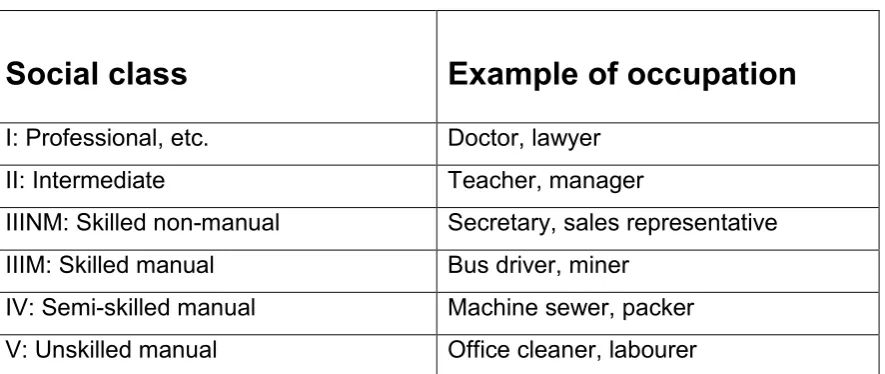
Social class is defined hierarchically by occupation in the Registrar General’s social class schema (see table 1). Children growing up in social classes V (households headed by a parent in an unskilled manual occupation) or IV (households headed by a parent in a semi-skilled manual occupation) are described as growing up in
[image:25.595.75.518.348.535.2]disadvantaged circumstances, as these are a readily available marker of social position which acts as a proxy of conferred disadvantage. It should be noted, however, that this classification scheme does not include those who are not in paid employment.
Table 1: Registrar General’s social class schema
Social class
Example of occupation
I: Professional, etc. Doctor, lawyer
II: Intermediate Teacher, manager
IIINM: Skilled non-manual Secretary, sales representative IIIM: Skilled manual Bus driver, miner
IV: Semi-skilled manual Machine sewer, packer V: Unskilled manual Office cleaner, labourer
Income
24 • Relative poverty – individuals living in households whose equivalised
income* is below 60% of UK median income† in the same year. This is a measure of whether those in the lowest income households are keeping pace with the growth of incomes in the population as a whole.
• Absolute poverty – individuals living in households whose equivalised income is below 60% of the (inflation adjusted) median income in 1998/99. This is a measure of whether those in the lowest income households are seeing their incomes rise in real terms.
Material deprivation
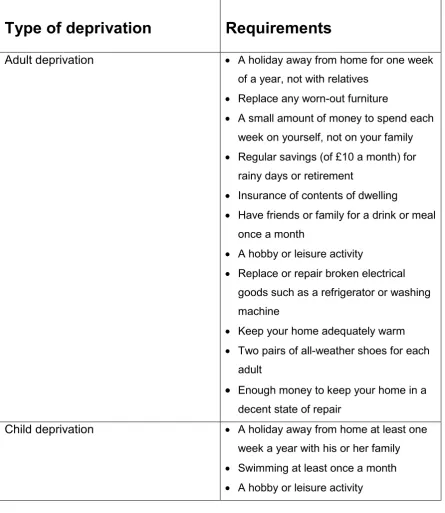
Another way of describing child poverty reflects the levels of deprivation that children experience. Child deprivation is measured using deprivation indices which lists a number of items which reflects current living conditions normally expected in society (one example can be seen in table 2 below). A household lacking on two or more of these items would be classified as a deprived household.
* Equivalised income adjusts household income to enable comparison across households of
different sizes.
† Median income divides the population equally into two, one half earns above the median
25
Table 2: Deprivation Index components*
A suite of questions designed to capture the material deprivation experienced by families with children has been included in the Family Resources Survey since 2004/05. Respondents are asked whether they have 21 goods and services, including child, adult and household items.
Type of deprivation
Requirements
Adult deprivation • A holiday away from home for one week of a year, not with relatives
• Replace any worn-out furniture
• A small amount of money to spend each week on yourself, not on your family • Regular savings (of £10 a month) for
rainy days or retirement
• Insurance of contents of dwelling
• Have friends or family for a drink or meal once a month
• A hobby or leisure activity
• Replace or repair broken electrical goods such as a refrigerator or washing machine
• Keep your home adequately warm • Two pairs of all-weather shoes for each
adult
• Enough money to keep your home in a decent state of repair
Child deprivation • A holiday away from home at least one week a year with his or her family • Swimming at least once a month • A hobby or leisure activity
* Source: Mackay & Collard (2003) Developing deprivation questions for the Family
Resources Survey. Accessed 17 September 2012,
26
Type of deprivation
Requirements
• Friends around for tea or a snack once a fortnight
• Enough bedrooms for every child over 10 of different sex to have his or her own bedroom
• Leisure equipment (e.g. sports equipment or a bicycle)
• Celebrations on special occasions such as birthdays, Christmas or other
religious festivals
• Play group/nursery/toddler group at least once a week for pre-school aged children
• ELSE: Going on a school trip at least once a term for school aged children
Debt ‘Are you behind with repayments for any of
these items?’ – then a list of bills, credit commitments, and so on.
The most common measure of deprivation used in Scotland is the Scottish Index of Multiple Deprivation (SIMD) 2009.* SIMD provides a relative measure of deprivation and allows identification of small area concentrations of multiple deprivation across all of Scotland in a fair way. This measure combines 38 indicators across seven domains, namely: income, employment, health, education, skills and training, housing, geographic access and crime.