AAEE2012CONFERENCE Melbourne, Australia www.aaee.com.au/conferences/2012/
Power of Engineering: Changing the perceptions of year 9
and 10 female school students towards an engineering
career
Felicity Briodya, Steven Gohb, and Les Dawesc. AECOMa, USQb, QUTc
Email:[email protected]
BACKGROUND
The engineering profession in Australia has failed to attract young women for the last decade or so despite all the effort that have gone into promoting engineering as a preferred career choice for girls. It is a missed opportunity for the profession to flourish as a heterogeneous team. Many traditional initiatives and programs have failed to make much impact or at best incremental improvement into attracting and retaining more women in the profession. The reasons why girls and young women in most parts of the world show little interest in engineering haven't changed, despite all the efforts to address them, the issue proposed here in this paper is with the perceptions of engineering in the community and the confidence to pursue it. This gender imbalance is detrimental for the engineering profession, and hence an action-based intervention strategy was devised by the Women in
Engineering Qld Chapter of Engineers Australia in 2012 to change the perceptions of school girls by redesigning the engagement strategy and key messages. As a result, the “Power of Engineering Inc” (PoE) was established as a not-for-profit organisation, and is a collaborative effort between
government, schools, universities, and industry. This paper examines a case study in changing the perceptions of year 9 and 10 school girls towards an engineering career.
PURPOSE
To evaluate and determine the effectiveness of an intervention in changing the perceptions of year 9 and 10 school girls about engineering career options, but specifically, “What were their perceptions of engineering before today and have those perceptions changed?”
DESIGN/METHOD
The inaugural Power of Engineering (PoE) event was held on International Women’s Day, Thursday 8 March 2012 and was attended by 131 high school female students (year 9 and 10) and their teachers. The key message of the day was “engineering gives you the power to change the world”. A
questionnaire was conducted with the participating high school female students, collecting both quantitative and qualitative data. The survey instrument has not been validated.
RESULTS
The key to the success of the event was as a result of collaboration between all participants involved and the connection created between government, schools, universities and industry. Of the returned surveys (109 of 131), 91% of girls would now consider a career in engineering and 57% who had not considered engineering before the day would now consider a career in engineering. Data collected found significant numbers of negative and varying perceptions about engineering careers prior to the intervention.
CONCLUSIONS
The evidence in this research suggests that the intervention assisted in changing the perceptions of year 9 and 10 female school students towards engineering as a career option. Whether this
intervention translates into actual career selection and study enrolment is to be determined. In saying this, the evidence suggests that there is a critical and urgent need for earlier interventions prior to students selecting their subjects for year 11 and 12. This intervention could also play its part in increasing the overall pool of students engaged in STEM education.
KEYWORDS
Introduction
Engineering has remained one of the most male dominated professions around the world with male bias in undergraduate engineering student cohorts still evidenced (UN 2010). In contrast more girls are completing year 12 than boys (Kaspura 2011). Engineers Australia suggests that women make up only 16% of commencing undergraduate students in engineering, and 9.5% of those with tertiary qualifications in engineering or related
occupations (Engineers Australia 2008a). Of these statistics, over half of the 9.5% are under 30 years of age and just 15% of women engineers over 40 remain in the engineering
profession. While women’s involvement in engineering has increased somewhat over the past three decades, beginning from an extraordinarily low base, female participation remains very low compared to overall female workforce participation rates (Engineers Australia 2008b). This gender imbalance presents a missed opportunity if we are serious about
addressing the engineering skills shortage. Systematic intervention into the education system and graduate supply is required.
Perceptions, cultural and workplace flexibility issues have caused the exodus of women from the profession. Though addressing systemic workplace and cultural issues in the engineering profession is of urgency, the profession needs to consider strategies to improve the pipeline supplying female engineering graduates. Hence the K-12 sector is critical to successful participation.
Although women make up roughly half the workforce, far fewer women than men reach senior management and leadership positions. While the business case for gender diversity at all levels is compelling, progress has been slow. The ILM report, Ambition and Gender at work (2011), suggests women’s managerial career aspirations lag behind men’s at every
stage of their working lives and that they have less clarity over traditional career direction than men. The engineering profession needs to nurture the talent of their best female employees; it needs to start challenging some of the unwritten rules of what senior engineering management roles look like. From this research, there is still a fundamental perception and confidence issue about what women think they will be able to do. One can argue that this perception and confidence issue initiates at the primary education level. Up to 40% of first year undergraduate students first consider university in primary schools, and another 23% at lower secondary schools; with 79% (of those surveyed) decided to study an area of interest (Hare 2010). The finding, as part of a large-scale survey of 55,000 students in 55 institutions, has given universities quantitative evidence for the first time that young students are highly receptive to the notion of attending university. Prof Trevor Gale, director of the National Centre for Student Equity in Higher Education, said "For some children it is a given that they will attend university. They never consider otherwise. It's part of who they are" (Hare 2010).
The evidence suggests initiatives that influence and setting career expectations in female students are not currently been successfully exploited. In the absence of inspiration, directions and role models, this perception and confidence issue becomes endemic at the primary and secondary education levels, where growing minds form and adjust their expectations for future career paths, and they become self-limiting. Even if they persist through this doubt and progress to graduation at the tertiary level, female engineers may be acculturated with this self-limiting mentality. The Power of Engineering’s team seeks to address this fundamental problem of perceptions and confidence. This is achieved by changing the discourse describing the engineering profession, having engaging engineering activities, and having role models to inspire high school girls about a career in engineering.
Power of Engineering Inc
PhD candidate at QUT. PoE seeks to inspire young people, particularly females, to consider a diverse and creative career in engineering; to quash the perception that a career in
engineering is all numbers; to prove that engineers have the power to shape the world they live in; and to show that innovation and creativity are imperative to creating solutions and ultimately changing the world. Further information is contained in Table 1 which describes the key objectives, messages and strategies of PoE.
Table 1: Key objectives, messages and strategic directions of PoE
Objectives Show high school students that engineering gives you the power to change the world;
Create new perceptions about the engineering profession;
Establish a strong connection between school students, teachers, parents, communities and universities and the engineering profession;
Link engineering projects to and engage the local community in these projects; Offer an opportunity for university students to develop their professional skills and
networks;
Provide professional development for teachers about engineering; Enable and mentor engineering ambassadors;
Creatively present engineering to the community through various media; Be a leader in the industry for the coordination of the 400+ existing programs; Develop sustainable PoE programs for Australia and around the world.
Messages Engineering is about:
People (working with people, creativity and innovation, saving lives)
Choice and Opportunity (diverse career pathways, opportunities for travel, good salary)
Influence (Opportunity to make a difference, contribute to society, turning dreams into reality)
Key descriptors of engineers and engineering: - Engineers make a world of difference. - Engineers are creative problem-solvers. - Engineers help shape the future.
- Engineering is essential to our health, happiness and safety.
Strategic directions
Deliver Power of Engineering events which comprise hands-on workshops, real-life stories from prominent engineers, hands-on activities and site tours;
Deliver a regional workshop series during Engineers Australia’s 'Year of the Regional Engineering Team 2012’ to at least 5 regional locations by end of 2012; Engage with industry, universities, schools, kindled organisations and local
communities to enable the sustainable delivery of an extensive program of events across Australia for 2013 and beyond;
Create a website to house the existing programs with a calendar of events and resources;
Team the Power of Engineering incorporated association with a full time employee to provide administrative support for program delivery;
Empower young engineers (graduates and undergraduates) to be project managers for Power of Engineering events;
Provide professional development workshops for teachers about engineering; Empower ambassadors for engineering to prepare and train them with presentation
and communication skills, awareness of audience and consistent key messages; Develop a communications strategy where non-traditional media, including public
art, will be utilised to share the Power of Engineering’s messages.
Previous Initiatives
a comprehensive literature review of the leadership topic for the K-12 as well as the tertiary sectors, where Goh (2011) argued for leadership in engineering education from K-12 to university as key to improving diversity in the engineering profession. Frid (2010) aimed to enhance the primary teacher education students’ capacities as mathematics teachers to cater for the diverse achievements and learning needs of primary school students.
Other literature have suggested Women-in-Engineering conferences, equity and outreach programs exclusively catering for female students may increase the career aspirations of girls (Fahey & Missingham 2009; Holland 2007; Cater-Steel & McDonald 2011). However, these programs would only seek to partly address some very fundamental problems in the lack of recognition of the engineering profession within the community and the perceived masculine-oriented workplace culture (Mills et al 2007; Roberts & Ayre 2002; Darby et al 2003).
Other research alluded to the need to address the perceptions of engineering profession as a career option in female students (Oware et al. 2007; Jolly 2007; Hebbani et al 2010; English et al. 2011; Darby et al. 2003). In addition, Lyons & Quinn (2011) suggested that even though students who enjoyed science education at primary and middle school did not select science in year 11, reinforcing the need to change perceptions rather than just improving engagement in the classroom. Other major overseas research has been undertaken to address the question of perceptions (Marshall et al. 2007; Intel 2011; EngineeringUK 2011; NAE 2008), and it is evidenced this fundamental problem needs addressing in Australia and around the world where there is gender imbalance in the engineering profession.
Event/Survey
The inaugural PoE event was held on International Women’s Day, Thursday 8 March 2012 and was attended by 131 high school female students from year 9 and 10 and their teachers (Lebihan 2012). The Office for Women hosted the event that included partners Engineers Australia (EA), Women in Engineering Queensland (WiEQ), National Association of Women in Construction (NAWIC), and Queensland Resources Council (QRC). “The Power of Engineering Event” that day comprised four parts:
Breakfast for teachers, educators and key influencers of high school students
Workshop for students in QUT engineering labs with four activities and a tour of the facilities
Networking lunch with high school students, QUT engineering students and industry representatives
Site tours for high school students to four different locations
The key message of the day was “engineering gives you the power to change the world”. The objectives of the event are to:
Inspire female high school students and teachers about the power of engineering;
Attract females into the engineering profession;
Inform teachers of the recourses and programs available to educate high schools students about engineering;
Ensure school students have fun and learn about a variety of engineering disciplines;
Convey the key message “engineering gives you the power to change the world”;
Create a community connecting high school teachers, high school students,
university students and the engineering industry which will contribute to a long term strategy of increasing the number of female engineers.
were year 9 and 10 students attending both private and public school systems in the
Brisbane area. The selection of the students was determined by the schools and specifically their teachers. They responded to statements about “considering a career in engineering” and “had their perception changed about what is involved in engineering”. The survey instrument has not been validated; for the purpose of this research, the emphasis is on the qualitative data collected triangulated by the quantitative data.
Results
The summarised results of the inaugural PoE event can be summarised as:
The key to the success of the event was as a result of collaboration between all participants involved and the connection created between government, schools, universities and industry;
Of the returned surveys (109 of 131), 91% of girls would consider a career in
engineering and 57% who had not considered engineering before the day would now consider a career in engineering;
Student registration for the event was so popular that bookings for the event were full in just over two days;
There are currently more than 100 students on a waiting list for the next event;
The day had a very positive impact on the students and teachers based on feedback obtained;
Students wanted more information about different disciplines of engineering;
Site tours could be run on a separate day so students can choose the discipline type;
There were significant numbers of varying but mostly negative perceptions about engineering prior to the intervention.
Table 2 indicates that 57% of participants did not consider a career in engineering before the event. Of these 91% responded positively to considering a career in engineering as a result of the event. This confirms with some qualification that the messages and strategy
[image:5.595.170.430.461.575.2]implemented have been successful in changing their perceptions of a career in engineering.
Table 2: Career in Engineering
Before today, had you considered a career in engineering?
Yes 40 37%
No 62 57%
No (including “May be”) 69 63% After today, would you considered a career in engineering?
Yes 99 91%
No 10 9%
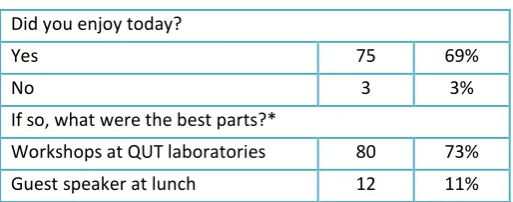
[image:5.595.170.427.667.768.2]Table 3 indicates that participants were very interested to observe and get involved in the engineering activities as part of the workshops at the QUT at 73%, and secondary to that, the site visits were also popular with the participants at 31%. The guest talks were ranked behind “hands-on” activities which indicate traditional seminar/lecture approaches may not be very effective in communicating across the desired messages.
Table 3: Engagement in Event activities
Did you enjoy today?
Yes 75 69%
No 3 3%
If so, what were the best parts?*
Hearing from Young Engineer of the year, Emma Charlton
20 18%
Site visit 34 31%
Table 4 indicates that participants were interested to find out more about the day-to-day role of the female engineers (mentors on the day) as role models, but also information relevant to their own future action regarding subject selections for year 11-12. Also of note, information on the OP score for entry into engineering programs and the details of engineering
disciplines were sought.
Table 4: Further information for engagement
Going away from today, what would you like to learn more / get more information about?
Where can I study engineering 23 21%
What OP do I need to get into engineering?
46 42%
What subjects should I study at school?
59 54%
What’s the difference between civil, mechanical, electrical and environmental engineering?
46 42%
What do engineers do in their day to day job?
67 61%
One of the survey questions asked “What were your perceptions of engineering before today and have those perceptions changed?” This question had fascinating responses and some are detailed, in no particular order below in Table 5 below. The “no and yes” after the
[image:6.595.171.430.72.114.2]statements refers to if before the day they had considered a career in engineering and if they would now consider a career in engineering.
Table 5: Perceptions of Engineering Student comments
That only girls who did very well at science opted for engineering careers [perception before]
Men building bridges [perception before changed from No to Yes]
My original perceptions were that engineering was mostly mechanically based, I have since been further educated
Lots of electronics. A wide variety of technological opportunities [perception after]
My perception on engineering has changed I never realised how many different types of engineering
My perceptions of engineering were that it was just related in terms of buildings and bridges and now I've learnt that there are many types of engineering like medical and others
Now I realise that engineering is part of everyday life
Before today, engineering was just another career path that I wasn’t very interested in. However, my perception has changed after today as I have learned how engineering can help to change the world
Conclusions
The engineering profession within Australia has failed to attract young women for the last decade despite all the effort that have gone into promoting engineering as a preferred career choice for girls. It is a missed opportunity for the profession to flourish as a heterogeneous team. Many traditional initiatives and programs have failed to make much impact or at best incremental improvement into attracting and retaining more women.
perceptions of engineering in the community and the confidence to pursue it. The Power of Engineering’s team seeks to address this fundamental problem of perceptions and
confidence.
The argument made in this paper is that perceptions of the engineering (traditionally
masculine) must be changed in order for successful engagement with female students. And that changing perception can be achieved by changing the discourse used for describing engineering careers (as part of the intervention strategies described in this paper).
The evidence in this research suggests that the intervention assisted in changing the
perceptions of year 9 and 10 female school students towards engineering as a career option. The students were eager to find out more on subject selections to have the opportunity to consider a career in engineering and the diverse choices in disciplines and industries that engineers participate in. Whether this intervention (and resultant eagerness) translates into actual career selection and study enrolment is to be determined.
In saying that, the evidence suggests that there is a critical and urgent need for earlier interventions such as PoE (and a repeated focus) before the students select their subjects for year 11 and 12. This intervention could also play its part in increasing the overall pool of students engaged in STEM education.
References
ALTC (n.a.). Australian Learning and Teaching Council: Grants and Projects, http://www.altc.edu.au/projects
ANET (n.a). Australian National Engineering Taskforce, http://www.anet.org.au/
Cater-Steel, A. & McDonald, J. (2011). Supporting women in engineering, science and technology:
The GoWest Project. In Hudbson & Chandra (Eds) STEM in Education Conference. QUT, Brisbane,
24-27 Nov 2010.
Darby, L., Hall, S., Dowling, K. & Kentish, B. (2003). Perceptions of engineering from female
secondary college students in regional Victoria. Proceedings of the 2003 AaeE conference,
Melbourne, 29 Sept – 1 Oct.
Engineers Australia (2008a). The Engineering Profession: A Statistical Overview. 5th Edition. Engineers Australia.
Engineers Australia (2008b). Valuing the difference: an update on the progress of women in
engineering profession. April 2008. Engineers Australia.
EngineeringUK (2011). 2011 Engineering and engineers brand monitor: understanding perceptions of
engineering, engineers, manufacturing and technicians. EngineeringUK.
English, L., Hudson, P.B. & Dawes, L.A. (2011) Middle school students’ perceptions of engineering. In Hudbson & Chandra (Eds) STEM in Education Conference. QUT, Brisbane, 24-27 Nov 2010.
Frid, S. (2010). Developing primary teacher education students’ professional capacities for children’s
diverse mathematics achievement and learning needs. Final report to the Australian Learning and
Teaching Council.
Fahey, E. & Missingham, D. (2009). Educating and promoting women in engineering through an
international conference for undergraduate and postgraduate engineering students. 20th AaeE
Conference, University of Adelaide, 6-9 Dec.
Goh, S. (2011). Leadership in engineering education from K-12 to university: Key to improving
diversity in the engineering profession. 15th International Conference for Women Engineers and
Scientist, Adelaide, 19-22 July.
ILM (2011). Ambition and gender at work: Research findings. Institute of Leadership and Management, UK. Retrieved Aug 1, 2012, from
http://www.redhotcurry.com/pdfs/ILM/Ambition_and_Gender_at_Work.pdf
Hare, J (2010). “University dreams start in primary school”. The Australian, Nov 24, 2010. Retrieved Aug 1, 2012, from http://www.theaustralian.com.au/higher-education/university-dreams-start-in-primary-school/story-e6frgcjx-1225959737265
Hebbani, A., Roan, A., Westwood, R. & White, C. (2010). Female careers in science and engineering. A report submitted to the University of Queensland, Dec 2010.
Holland, B. (2007). Remembering not to forget why there are so few women in engineering: the
Women in Engineering program, UTS 1981-, Proceedings of the 2007 AaeE Conference, Melbourne,
Dec.
Jolly, L. (2007). Women, Men and the practice of Engineering. Proceedings of the 2007 AaeE Conference, Melbourne, Dec.
Kaspura, A (2011). “More students attracted to engineering but still not enough”. Engineers Australia, Vol 83, No. 5, May 2011.
King, R (2008). Engineers for the future: addressing the supply and quality of Australian engineering
graduates for the 21st century. A scoping report for the Australian Learning and Teaching Council.
Retrieved Aug 1, 2012, from
http://www.engineersaustralia.org.au/shadomx/apps/fms/fmsdownload.cfm?file_uuid=424B574D-BEB5-F665-89AE-6A23B49918C6&siteName=ieaust
Lebihan, R. (2012). Engineering drive to alter the gender equation. Australian Financial Review, 28th May 2012.
Lyons, T. & Quinn, F. (2011). Looking back: students’ perceptions of the relative enjoyment of primary and secondary school science. In Hudbson & Chandra (Eds) STEM in Education Conference. QUT, Brisbane, 24-27 Nov 2010.
Marshall, H. (2007). Public attitudes to and perceptions of engineering and engineers 2007. A report for the Royal Academy of Engineering and the Engineering and Technology Board, September 2007.
Mills, J., Mehrtens, V., Smith, E. & Adams, V. (2007). Would you choose an engineering degree
course if given the choice again? Proceedings of the 2007 AaeE conference, Melbourne, Dec.
National Academy of Engineering (2008). Changing the Conversation: messages for improving public
understanding of engineering. A report published by NAE funded by National Science Foundation.
Oware, E., Capobianco, B. & Diefes-Dux, H.A. (2007). Young children’s perceptions of engineers
before and after a summer engineering outreach course. 37th FIE Conference, Milwaukee, 10-13 Oct.
Robert, P. & Ayre, M. (2002). Did she jump or was she pushed? A Study of women retention in the engineering workforce. Int Journal of Engineering Education, Vol.18, No.4, 415-421.
Southwell, D & Morgan, W (2009). Leadership and the impact of academic staff development and
leadership development on student learning outcomes in higher education: A review of the literature, a
report for the Australian Learning and Teaching Council. Retrieved Aug 1, 2012, from
http://www.altc.edu.au/resource-leadership-academic-staff-development-literature-review-qut-2009
United Nations (2010). The World's Women 2010: Trends and Statistics. Department of Economic and Social Affairs, United Nations, New York. Retrieved Oct 15, 2012 from
http://unstats.un.org/unsd/demographic/products/Worldswomen/WW_full%20report_color.pdf
Acknowledgements
The authors acknowledge the contribution of QUT, Engineers Australia, Women in
Engineering Queensland (WiEQ), National Association of Women in Construction (NAWIC), and Queensland Resources Council (QRC), the Office of Women (Qld Government) and the many volunteers supporting this PoE event on International Women’s Day, and many thanks to the students and teachers who participated.