Using Mandala Theory to explore a successful research relationship
Karen Noble & Robyn Henderson
Individuation was the central concept of Jung‟s (1965) analytical psychology,
understood as the process of integrating the conscious with the unconscious while still
maintaining conscious autonomy. Jung believed that the use of mandalas – concentric circles – had significant psychological and spiritual dimensions. Mandala Theory provides a means for centring or for inner reconciliation, bringing the often unconscious into the conscious. It is a means of examining one‟s conceptions at a particular point in time. In more recent times, notions of presence and space have been used to theorise the coupling of perception and action within particular contexts.
In this chapter, circles of collaboration – based on an interpretation of Armstrong‟s (2003) The circles (henceforth called „the circles‟) – are used as a means of
recognising constraints and enablers in the construction of a research community. Through a focused conversation, two researchers reflect on their established research relationship and how this might inform collaborative research activities more broadly. Beyond achieving above average research outputs, this exercise made it apparent that strength is recognised where the initial respect for the individual instigates a
broadening social network. Success is perceptible when each member sees her/himself as part of the sum of the whole.
Introduction
Said, 1978) that has been established in the interests of enhancing research quantum and quality.
Figure 1. Mandala 2 vector from RuthArt (Available from Flickr http://www.flickr.com/photos/ruthart/3071994492/)
Armstrong‟s (2003) The circles gave us a way of representing our collaborations pictorially as well as textually. Through these representations, we were able to investigate similar as well as contradictory ways in which we see people, places and situations that influence and impact upon the ongoing development of our established research relationship. The sharing of our circles of collaboration or mandalas led to a dialogue about the co-constructed research space that evolved for us, raising issues about the importance of place consciousness (Gruenewald, 2003) or presence (Zahorik & Jenison, 1998) for team building.
We begin this chapter by explaining Armstrong‟s (2003) circles and how we used them to map research relationships that were important to us. We then discuss the insights that we gained from using this process and insights that might be relevant to others who want to understand and/or establish effective research team relationships.
The circles explained
research relationship and our research relationships with others, in the hope that this would offer insights into what constitutes effective research relationships and ways of developing those. As outlined in the explanation that follows, the process offers a three task plan: constructing the circles, analysing reactions and examining commitment to change.
Task 1: Circle construction
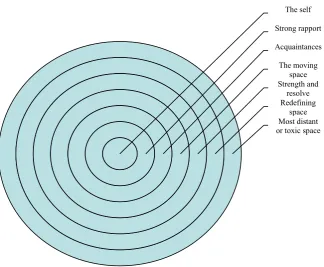
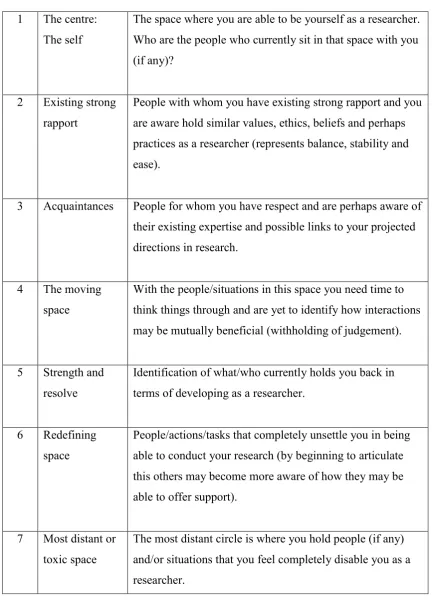
[image:3.595.124.449.407.674.2]The first task – the construction process – requires the drawing of seven circles as shown in Figure 2. Each circle represents a space – from the centre circle of the individual or self and those circles where effective and collegial relationships assist research, through to the most distant or toxic space of the outer circle. Each person considers the descriptions of what each circle represents, as shown in Table 1, and locates people, their relationships with these people, objects and tasks into particular circles. It is through this mapping process that the mandala is constructed.
Figure 2. Armstrong‟s (2003) seven circles
Most distant or toxic space
Redefining space Strength and
resolve The moving
space Acquaintances Strong rapport
Table 1. Descriptions of the seven circles, based on Armstrong (2003)
1 The centre: The self
The space where you are able to be yourself as a researcher. Who are the people who currently sit in that space with you (if any)?
2 Existing strong rapport
People with whom you have existing strong rapport and you are aware hold similar values, ethics, beliefs and perhaps practices as a researcher (represents balance, stability and ease).
3 Acquaintances People for whom you have respect and are perhaps aware of their existing expertise and possible links to your projected directions in research.
4 The moving space
With the people/situations in this space you need time to think things through and are yet to identify how interactions may be mutually beneficial (withholding of judgement).
5 Strength and resolve
Identification of what/who currently holds you back in terms of developing as a researcher.
6 Redefining space
People/actions/tasks that completely unsettle you in being able to conduct your research (by beginning to articulate this others may become more aware of how they may be able to offer support).
7 Most distant or toxic space
Task 2: Analysing reactions
Once the mandala has been constructed, a dialogue is developed with others to discuss and analyse participants‟ mapping and the related decision-making processes that were used by each individual to construct their responses. This task can lead to action planning or planning for change, at the individual level as well as more broadly across the group.
Task 3: Commitment to change
The third task – commitment to change – is where participants commit to supporting their own and others‟ positive change over time. It requires revisiting the process of mandala construction on regular occasions, by the individual as well as by the collective.
The process: Co-constructing understanding
Working together, we followed the process described above. In trying to understand our research relationship, we focused particularly on Tasks 1 and 2. Through
dialogue, we analysed our reactions and the decision-making processes we used to locate people, objects and tasks to each of the circles. This provided a basis for a deconstruction of this consciousness-raising process. Although each of us began by considering our own circles and who and what we placed into those, our reflections also provided a way of understanding the spaces that we shared. Interestingly, questions such as “What determines the success (or otherwise) of the shared space?” led to a deep ontological inquiry about the determinants of presence and how these might be measured and transferred to other contexts. Clearly, the deconstruction of our mandalas allowed us to co-construct a shared understanding.
of success for our research collaboration can be measured by the tangible or physical outputs, such as publications, it is the subjective or mental domain that provides the intrigue.
Unpacking the framework
As our dialogue progressed around who was present in each of the circles that formed the mandala, it was apparent that context plays out in particular ways as a result of the values, beliefs and understandings that are held by each of the participants. From
working collaboratively on research projects, we were aware of the effective working relationship that we had developed. However, it was through our conversation of the mandala that we began to bring our awareness of why that relationship worked from the unconscious to the conscious.
A thematic analysis of our recorded conversation revealed significant insights which we explore further in the following section of this chapter. We have, however, decided not to share the details of our circles and the representations that we
identified, as our discussion focused on the relationships we have developed (or have not developed) with other researchers in our specific work context. What we focus on here are the insights we gained as we used the circles process and the projected value of these insights to other researchers who are working, or plan to work, in teams. In particular, our insights identified three characteristics:
reflexive engagement and a sense of connectedness; agency, including independence and interdependence; high engagement and shared visioning.
In the next section, we discuss these characteristics. We have not attempted to present an exhaustive analysis or coverage of relevant literature, but instead have tried to give a sense of “what‟s in this for us” as researchers working in a team. As a result, we
Reflexive engagement and a sense of connectedness
It became apparent that the ways in which we each perceived our connection to our context was important. Connectedness is understood as an attachment or a connection to a place, person, or a group of people that promotes a sense of comfort and well-being (Beutel, 2006; Fuller, McGraw, & Goodyear, 2002; Noack & Puschner, 1999). As illustrated in the following excerpt from our conversation, the importance of the engagement and commitment of each participant is mediated by the interaction and relationship. As one of us commented:
For me it has been about being self-aware but also aware of my actions and behaviours in relation to another at the same time; having another‟s goals and needs uppermost in my mind as well. That leads me to that notion of collective mindfulness: it is about what I can do for you and how my knowledge and skills can be of benefit to you as well as what I also take away from the partnership.
While some of our previous research (e.g. Henderson, Noble & De George-Walker, 2009; Noble & Henderson, 2008) has recognised that interactions are crucial in developing effective collaborative, co-constructed learning contexts, we had not interrogated the nature of these interactions in a research team context. To better understand the dynamic and fluid nature of this partnership, the work of Soja (1996, 2003) around the concept of Thirdspace is useful. Soja‟s theory of space consists of three distinct yet interrelated conceptualisations, including Firstspace (material space), Secondspace (mental space) and finally Thirdspace, which draws upon and extends beyond the other spaces. Rather than viewing spaces as distinct from one another or as binary positions, their synthesis can have a “cumulative effect” that “is more
significant than the sum of the parts” (Danaher, Danaher & Moriarty, 2003, p.166).
So when I say collective mindfulness, it‟s also being collectively mindful of the individual spaces that we occupy, which I think is something different to what I‟ve ever had with someone else.
Importantly, it is the Thirdspace that provides the greatest capacity for reimagining or „thinking otherwise‟ with regard to exploring the shared relationship and collective
mindfulness that seemed characteristic of our research collaboration. The notion of a Thirdspace, as a space that exists philosophically and metaphorically between
practical knowledge and experience gained from engagement with others in a learning context, is helpful. Understandings like this frame how challenging traditional ways of working in a particular context can constrain and enable individuals. The privileging of the personal and emotional components of professional development highlights the way that both individual and collective meaning-making are important.
Agency: Independence and interdependence
Engaging in the process of critical reflection within the circles of collaboration helped us to realise that there was a growing sense of agency for each of us in the way that our research relationship worked. The importance of the interactions that have
developed for us as participants points to the significance of the metaphysical context that has been established. One of us explained:
There‟s a level of social connection and social responsibility that‟s developed between us that takes it from an ordinary, collaborative research relationship to a kind of … almost like a mutual responsibility or a mutual obligation, in a positive way, not mutual obligation in a negative.
We were cognisant that, while there is a collective efficacy that has been established, it is “important that the individual spaces that we occupy are also privileged.” We realised that each of us inhabited our own space, where we could work independently or with other researchers, but we worked hard to maintain our shared space. As one of us explained:
we each inhabit and maintain and we help each other to maintain those, in a sense, because you kind of, it sounds stupid, but it‟s kind of like you‟ve got permission to do that and to be, you know, when you need to be in your … space; if there‟s something that we need done for the shared space then I can pick that up or vice versa. If I need to do something in that space, you pick it up.
The advantage of sharing a research space – a Thirdspace or imagined geography
where individual and collective goals are met – was that we found that the
collaboration enabled us to do much more than either of us could do individually. The collaborative space gave us a sense of agency, because it enabled us to overcome some of the barriers that so often seemed constraining. This was particularly the case in relation to time constraints. Whilst we felt time poor, working together offered ways of working around that barrier, because we could divide to conquer or one of us could do the tasks that were necessary while the other was busy elsewhere. It was as if this space was what Chouliaraki and Fairclough (1999) describe as “a point of
connection” between social structures and individual actions, offering possibilities for
transformation and creativity.
Clearly, the quality of interactions, relationships and friendships that actually occur in collaborative endeavours is important. It is in this way that agency is best understood, as it exists within relationships and practice where there is a balancing of power relations and the recognition that presence or meta-cognitive awareness is valuable. Within this context, the notion of agency is seen as a state of mind rather than
something tangible. It is more than a place; it is an acknowledgement of involvement, of engagement as well as interdependence, and it is dependent on the individual persons. As discussed previously, this thirdspace sees the privileging of personal as well as professional meaning-making. It is not sameness, but it is an interlocking of
diversity and a respect for individual difference.
collaboratively. In particular, though, it is in the shared space that we experience the power of the collective and realise the agentic effects of our collaborations.
High engagement and shared visioning
With the tangible values of the collaborative partnership more visible through the constructing and deconstructing of the mandala, it is equally evident that such high engagement and commitment to researching collective targets is emotionally rewarding as well as professionally satisfying. It became clear that, as with any
endeavour, there will always be potential constraints and enablers that must be
recognised and shared so that strategies for moving forward are clearly articulated and committed to. It is when there is a sense of shared ownership for the journey that the shared vision is maintained and further strengthened. This space enables the
participants to engage in critical reflection and therefore enables the examination of multiple perspectives. As we discussed in our conversation:
I guess coming up with the constraints and the enablers is a good way of saying, well this is useful and these are the things that might help to move other people forward if they want to try that.
That‟s right. But equally importantly is okay and by doing this together, I guess, hopefully it leads to a raised level of consciousness of what we‟ve taken for granted almost. So it‟s really examining the taken for granted grand
narratives that we‟ve developed about ourselves.
The ongoing journey of „becoming researchers‟ cannot be underestimated in terms of necessary commitment to achieve systemic imperatives as well as personal goals. By making the unconscious elements of the social practices as well as the relationship visible, one can see that we highly value the gains that have been made in the
collective. It is evident that such insights enable us as researchers to continue to grow and support one another in ways that individually may well not be possible.
Impacts and implications
We have argued that the development and maintenance of authentic partnerships and relationships are keys to the transformative learning of the „academic as researcher‟.
Through the establishment of a supportive relationship, we found that we, as
academics, were better able to consider the multiple realities that characterise success on our learning journey (Moss, 2003; Wenger, 1998) and to ensure research quantum and quality.
As outlined in this chapter, the use of Armstrong‟s (2003) circles helped us to
examine the collaborative research relationship that we have developed. While it may not be possible to actually quantify or „make conscious all that is unconscious‟, we
have attempted to interrogate our collaborative research relationship in terms of „why it works‟ and „what happens‟. We hope that this might provide a stimulus for others to
also examine the efficacy and effectiveness of their collaborative relationships in terms of the constraints and enablers that exist within the university research culture.
For us, the process of using the circles enabled us to consider and reflect on the particular contexts and social networks that have assisted to develop and implement a working relationship within a complex university environment. We posit that this attempt to make the unconscious conscious (Jung, 1965) and to examine the private and shared spaces that exist within our partnership values openness and mutual acceptance and support. We argue, therefore, that the social and emotional aspects of our research relationship are significant determinants of the successful connectedness that has resulted in enhanced research outcomes.
In writing this reflective chapter, we drew on Armstrong‟s (2003) circles (see Figure 2) which offer a simple explanatory mandala. Whilst this mandala provided a useful framework for us to explore what we regard as a successful research relationship, we want to acknowledge that working relationships rarely have the simplicity that Armstrong‟s mandala might suggest. We would like, then, to return to Figure 1. This more multifaceted mandala implies the complexities that were inherent in our
References
Armstrong, K. (2003). The circles. Prahran, Vic: Hardie Grant Books. Beutel, D. (2006). Teachers’ understandings of pedagogic connectedness.
Unpublished doctoral thesis, Queensland University of Technology, Brisbane. Chouliaraki, L., & Fairclough, N. (1999). Discourse in late modernity: Rethinking
critical discourse analysis. Edinburgh: Edinburgh University Press.
Danaher, P. A., Danaher, G., & Moriarty, B. (2003). Space invaders and pedagogical innovators: Regional educational understandings from Australian occupational travellers. Journal of Research in Rural Education, 18(3), 1640169.
Driver, F. (1992). Geography‟s empire: Histories of geographical knowledge. Progress in Human Geography, 12(2), 208-228.
Fuller, A., McGraw, K. and Goodyear, M. (2002). Bungy jumping through life: A developmental framework for the promotion of resilience. In L. Rowling, G. Martin, and L. Walker, Mental health and young people: Concepts and practice. McGraw-Hill Australia.
Gregory, D. (1995). Imaginative geographies. Progress in Human Geography, 19, 447-85.
Gruenewald, D. (2003). Foundations of place: A multidisciplinary framework for place-conscious education. American Educational Research Journal, 40(3), 619-654.
Henderson, R., Noble, K. & De George-Walker, L. (2009). Transitioning into university: “Interrupted” first year students problem-solving their way into
study. Studies in Learning, Evaluation, Innovation and Development, 6 (1), pp. 51-65.
Jung, C. (1965). Memories, dreams, reflections. New York: Random House.
Moss, P. (2003). Getting beyond childcare: Reflections on recent policy and future possibilities. In J. Brannen & P. Moss (Eds.), Rethinking children’s care (pp. 25-44). Buckingham: University Press.
Noble, K. & Henderson, R. (2008). Engaging with images and stories: Using a
Learning Circle approach to develop agency of beginning “at-risk” pre-service teachers. Australian Journal of Teacher Education, 33 (1). Available from http://ajte.education.ecu.edu.au/issues/EarlyPub/Oct07/Noble.pdf
Said, E. (1994). Culture and imperialism. New York: Vintage Books. Soja, E. (1996). Thirdspace. Cambridge, MA: Blackwell.
Soja, E. (2003). Writing the city spatially. City: Analysis of Urban Trends, Culture, Theory,Ppolicy, Action, 7 (3), 269-281.
Wenger, E. (1998). Communities of practice: learning, meaning, and identity. New York: Cambridge University Press.
Zahorik, P. & Jenison, R. (1998). Presence as being-in-the-world. Presence, 7(1), 78-89.
Strategies for sustaining synergies
Use the process described in Armstrong‟s (2003) book, The circles, also shown in Figure 2, to map the research relationships that are part of your work as a researcher.
How might you maximise the potential of the positive relationships? What might you want to change? How might you do this?
How useful are the circles to your situation?
Further reading
Armstrong, K. (2008). The circles: A guide to mapping out your heart’s true feelings. New York: Atria Books.