Research and Information Service
Briefing Note
Paper 64/11 17th June 2011 NIAR 318-11
Caroline Perry
EU issues in education
1
Background
The Report on its Inquiry into Consideration of European Issues by the Committee for the Office of the First and deputy First Minister, published in January 2010, outlined a series of recommendations addressed to the Executive and a number of actions for the Assembly to address. One of these actions highlighted the role of departments in taking account of European policies and directives when completing business plans and strategies andthe importance of the role of statutory committees in dealing with European issues.
The House of Commons European Scrutiny Committee has discussed the EU’s role and level of influence in regard to education in the UK:1
“The EU has limited competence in the field of education and vocational training. Action at EU level is intended to "support, coordinate or supplement the actions of the Member States" and the EU has no power to harmonise national laws.[5] Article 165 of the Treaty on the Functioning of the European Union (TFEU) provides for the European Union "to contribute to the development of quality education by encouraging
cooperation between Member States and, if necessary, by supporting and
supplementing their action, while fully respecting the responsibility of the Member States for the content of teaching and the organisation of education systems and their cultural and linguistic diversity."
1
This briefing paper summarises recent developments in Europe relating to the work of the Education Committee. It is structured as follows:
Youth on the Move;
Early years education and care;
Tackling early school leaving;
Benchmarks on education and training for employability; and
Conclusion.
2
Youth on the Move
Youth on the Move is one of the flagship initiatives of the European Commission’s Europe 2020 strategy that aims to promote smart, sustainable and inclusive economic growth. The initiative proposes 28 actions at EU and national level to improve the performance of education systems across the EU, improve the quality of education and training and equip young people with the required skills for work. Its key focus is
learning mobility, together with an emphasis on ensuring that the education young people receive equips them to participate effectively in the labour market.2
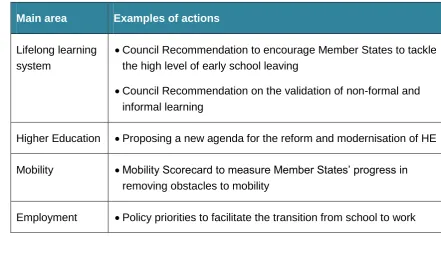
[image:2.595.83.525.475.728.2]Youth on the Move focuses on four main lines of action, as outlined in the following table.A High Level Expert Group on Literacy has also been launched aiming to identify effective practice in Member States on improving literacy.3
Table: Key areas and examples of actions as part of Youth on the Move
Main area Examples of actions
Lifelong learning system
Council Recommendation to encourage Member States to tackle the high level of early school leaving
Council Recommendation on the validation of non-formal and informal learning
Higher Education Proposing a new agenda for the reform and modernisation of HE Mobility Mobility Scorecard to measure Member States’ progress in
removing obstacles to mobility
Employment Policy priorities to facilitate the transition from school to work
2
European Parliament (2011) Report on Youth on the Move, a framework for improving Europe’s education and training
systems
3
3
Early years education and care
The European Commission places an emphasis on the importance of early years education. It released a Communication in February 2011 entitled Early Childhood Education and Care: Providing all our children with the best start for the world of tomorrow. This Communication reached council conclusion stage on 20th May 2011.4
The communication sets out the importance of improving the quality and effectiveness of education systems across the EU in order to achieve smart, sustainable and inclusive growth for Europe, and outlines the key role of Early Childhood Education and Care (ECEC) in this. The Commission's proposals are also intended to contribute to two of the headline targets of the Commission's overarching Europe 2020 strategy – to reduce the share of early school leavers to below 10% and to lift at least 20 million people out of the risk of poverty and social exclusion.5
The Communication notes that the previous focus of EU level action had been on increasing the quantity of childcare and pre-primary places to enable more parents to join the labour market. It highlights a continuing challenge in extending the coverage of pre-school
provision, but also emphasises the importance of quality in early years education and care.6 The Commission states that while ECEC is a responsibility for Member States, there is scope for the EU to add value by launching a process of cooperation on the exchange of good practice, encouraging the development of infrastructure and capacity and supporting EU-wide research. Its key proposals are as follows:7
Universal and inclusive access to high quality ECEC services;
Efficient and equitable funding;
Age-appropriate curricula with the right balance of hard and soft skills;
More focus on the professionalisation of staff with appropriate qualifications, salaries and working conditions; and
Effective governance, including strong collaboration between different policy sectors and quality assurance systems to monitor progress.
4
Tackling early school leaving
The European Commission published a Draft Council Recommendation on policies to reduce early school leaving on the 31st January 2011. Reducing the rate of early school leaving in
4
European Commission (2011) Communication from the Commission Early Childhood Education and Care: Providing all our children with the best start for the world of tomorrow Brussels
5
European Commission (2011) Communication from the Commission Early Childhood Education and Care: Providing all our children with the best start for the world of tomorrow Brussels
6
European Commission (2011) Communication from the Commission Early Childhood Education and Care: Providing all our children with the best start for the world of tomorrow Brussels
7
the EU to less than 10% by the year 2020 is one of the five headline targets of the
overarching Europe 2020 strategy which aims to support smart, sustainable and inclusive growth across Europe, and a key aspect of the Youth on the Move initiative.8
The proposal recognises the importance of increasing skill levels in contributing to the growth of the economy, and suggests that early school leaving is a ‘bottleneck’ for growth. It notes that while progress has been made across Member States in reducing rates of early leaving, the current rate of progress is insufficient to reach the 2020 target.9
The Commission states that it would be inappropriate to impose a single solution on all Member States given the diversity of education systems and the strong subsidiarity in the area of education. As such, the Commission believes that a Council Recommendation is the most effective way of providing a framework for the development of an approach in Member States to support the target set by the European Council. The Recommendation invites Member States to:10
Identify the main factors leading to early school leaving and monitor developments at national, regional and local level; and
Develop and implement comprehensive and cross-sectoral policies against early school leaving, based on their specific conditions.
It also invites the European Commission to support policies at a national level by monitoring developments across Member States; supporting peer learning and the exchange of good practice; and launching studies, research and cooperation projects.11
5
Benchmarks on education and training for employability
The European Commission released a working paper in May 2011 considering the development of European benchmarks to cover the two policy areas of the role of education and training in raising people’s employability and learning mobility, as part of the Europe 2020 strategy. Some development work has been undertaken on possible approaches to a benchmark including extensive consultation with Member States through expert working groups.12
The working paper states that the purpose of a benchmark is to stimulate policy exchange among Member States on what constitutes effective education and training policies to increase employability. It suggests that the benchmark should be framed around the duration of transition from education to employment, and take into account the quality of the first job.
8
European Commission (2011) Proposal for a Council Recommendation on policies to reduce early school leaving Brussels
9
European Commission (2011) Proposal for a Council Recommendation on policies to reduce early school leaving Brussels
10
European Commission (2011) Proposal for a Council Recommendation on policies to reduce early school leaving Brussels
11
European Commission (2011) Proposal for a Council Recommendation on policies to reduce early school leaving Brussels
12
6
Conclusion
There are a number of proposals and recommendations from the EU relating to
education that seek to contribute to the overarching aim of the Europe 2020 strategy to support smart, sustainable and inclusive growth across Europe.