“You wouldn't expect a maths teacher
to teach plastering…”
Embedding literacy, language and numeracy
in post-16 vocational programmes – the
impact on learning and achievement
Helen Casey, Olga Cara, Jan Eldred, Sue Grief, Rachel Hodge,
Roz Ivanic
v, Tom Jupp, Desiree Lopez and Bethia McNeil
This document is also available in pdf and text-only format from the NRDC's website, www.nrdc.org.uk
For information on alterative formats, please contact:
Emily Brewer
Marketing and Publications Officer Institute of Education
University of London Tel: 020 7911 5501 Email: [email protected]
We welcome feedback on the content and accessibility of this publication. This should be sent to:
Publications NRDC
Institute of Education 20 Bedford Way London WC1H 0AL.
Telephone: +44 (0)20 7612 6476 Fax: +44 (0)20 7612 6671 email: [email protected]
ISBN 1-905188-22-6
© Crown Copyright 2006
Extracts from this publication may be used or reproduced for non-commercial, research, teaching or training purposes on condition that the source is acknowledged.
NRDC is a consortium of partners led by the Institute of Education, University of London (see back cover for a list of members) and is part of the Bedford Group for Lifecourse and Statistical Studies at the IoE. www.ioe.ac.uk/bedfordgroup
Design: [email protected] Photography: iStock
numeracy in post-16 vocational
programmes – the impact on
learning and achievement
Helen Casey, Olga Cara, Jan Eldred, Sue Grief, Rachel Hodge,
Roz Ivanic
v, Tom Jupp, Desiree Lopez and Bethia McNeil
CONTENTS
EXECUTIVE SUMMARY 5
1 BACKGROUND, AIMS AND ORGANISATION OF THE RESEARCH 7
1.1 Introduction 7
1.2 Context and background 7
1.3 Definitions 8
1.4 The aims of the research 8
1.5 The research sample 9
1.6 The vocational courses 9
1.7 Terminology 11
2 RESEARCH METHODOLOGY 12
2.1 The use of mixed methods 12
2.2 Quantitative data 12
2.3 Qualitative data 13
2.4 Analysis of the data 13
3 HOW EMBEDDING AFFECTS ACHIEVEMENT, RETENTION AND SUCCESS
RATES ON VOCATIONAL PROGRAMMES 16
3.1 Introduction 16
3.2 Retention of learners on courses 16
3.3 Vocational success rates and embedded literacy, language
and numeracy (LLN) 17
3.4 Comparison between the sample and national benchmarking data 17 3.5 Learners’ achievement of LLN qualifications and embedding 18
3.6 Other important factors 21
3.7 Staffing – the effect of dual responsibility for vocational and
LLN teaching 22
3.8 How reliable are these findings? 22
3.9 Summary 23
4 WHAT DO LEARNERS THINK? 24
4.1 The value of strong LLN skills 24
4.2 Structure, delivery and a unified team 26
4.3 Learner attitudes and embeddedness 26
4.4 Learner recommendations 27
5.3 Features of teaching and learning 29
5.4 Teamwork 30
5.5 Staff understandings, values and beliefs 31
5.6 Organisational features 32
6 HOW DO EMBEDDED PROGRAMMES WORK AS A WHOLE? 33
6.1 Course A – Motor Vehicle Level 1
(Curriculum area: Engineering) 33
6.2 Course B – NVQ in Admin and IT, Entry/Level 1
(Curriculum area: Business) 35
6.3 Course C – NVQ Hairdressing, Level 1
(Curriculum area: Hair and Beauty Therapy) 37
6.4 Course D – Plastering, Level 2
(Curriculum area: Construction) 38
6.5 Course E – Certificate in Administration NVQ, Level 2
(Curriculum area: Business) 40
6.6 Key themes 42
7 CONCLUSIONS AND RECOMMENDATIONS 44
7.1 Outcomes for learners 44
7.2 Characteristics of embedding LLN into vocational programmes 44
7.3 Staffing and resources 45
7.4 Recommendations 46
APPENDIX 1 – THE ORGANISATIONS INCLUDED IN THE SAMPLE 47
APPENDIX 2 – FEATURES OF ‘EMBEDDED PROVISION’ 49
Executive Summary
This research project explored the impact of embedded approaches to literacy, language and numeracy (LLN) on 79 vocational programmes. The courses were based in 15 further education colleges and one large training provider located in five regions of England.
The 1,916 learners who took part in the research were preparing for national vocational qualifications at Levels 1 or 2 in one of five areas of learning:
■ Health and Social Care
■ Hair and Beauty Therapy
■ Construction
■ Business
■ Engineering
The sample was selected to ensure a balance of the five vocational areas, the two levels of courses, and those with and without embedded approaches. A four-point scale was developed to differentiate courses in which LLN was not embedded, through to those that were fully embedded or integrated.
Higher retention and course success rates on embedded courses
Learners on the embedded courses had better staying-on rates than those on non-embedded courses, and more positive attitudes to the value of LLN study. On the embedded courses retention was 16 per cent higher.
The embedded courses also had higher success rates than the non-embedded courses. When these data are analysed by vocational level, the increase in success rates associated with embedding is particularly strong for vocational Level 2 courses, with a 26 per cent difference between fully embedded and non-embedded courses.
Increased learner achievement in literacy/ESOL qualifications
For learners on the fully-embedded courses, 93 per cent of those with an identified literacy need achieved a literacy/ESOL qualification, compared to only 50 per cent for those on non-embedded courses. On the fully non-embedded courses, 43 per cent more learners achieved literacy qualifications.
Increased learner achievement in numeracy qualifications
Staffing
Where a single teacher was asked to take dual responsibility for teaching vocational skills and LLN, the probability of learners succeeding with literacy and numeracy qualifications was lower.
Adult LLN are complex areas to teach. Managers should not assume that the benefits of embedding can be achieved by simply adding LLN to the vocational teacher’s responsibilities. Any assumptions that adult LLN are easy to teach should be avoided. This research shows that learners benefit from being taught by teams of staff, each with their own different areas of expertise, working closely together.
Features of embedded programmes
The research team did not use fixed models of embedding; they judged courses on a range of features of embedding. Four main groups of features emerged:
■ Teamwork between LLN teachers and vocational teachers
■ Staff understandings, values and beliefs
■ Aspects of teaching and learning that connect LLN to vocational content
■ Policies and organisational features at institutional level
1 Background, aims and organisation
of the research
1.1 Introduction
This research project examined the effects on learner success of embedding the teaching of LLN in Level 1 and Level 2 vocational programmes. The project also sought to identify the key characteristics of successful embedded LLN provision.
The research examined the relationships between embedded LLN provision and:
■ the retention of learners on programmes
■ the achievement of vocational qualifications and qualifications in LLN
■ learner attitudes.
1.2 Context and background
The practice of integrating or embedding LLN into vocational study is not new, but has recently been given a renewed focus as part of the DfES Skills for Life strategy.1
Many learners are motivated to learn a set of vocational skills to access employment, but much less motivated to improve their LLN. They are often not keen to return to studying English or maths, which they may well associate with negative memories from school. Many vocational qualifications also require learners to take and pass examinations in English and maths. Learners need to develop the LLN required for the workplace and the job, for the vocational study and assessment, and also for additional LLN assessments.
Learners who do not have English as their first language, who may be more motivated to develop their language skills, are also motivated to find employment. For those with vocational skills from their country of origin, the embedding or integration of language learning within another subject area can offer an efficient route to learning the vocationally relevant language, while updating or learning new vocational skills.
Many practitioners believe that the most effective way of providing learners with effective LLN learning opportunities is to embed or integrate the LLN teaching and learning within
vocational or recreational study and practice. But this practice has not been systematically developed or supported.
This study focuses on learners in vocational courses. It does not attempt to compare more general discrete LLN provision with embedded provision. Learners who choose to attend discrete LLN classes have made a decision to improve those skills. This study concerns itself with the progress of learners whose primary motivation is vocational, and who may or may not acknowledge their LLN learning needs.
1.3 Definitions
‘Embedded’ has become a widely used term in relation to LLN but there is often uncertainty about what this means in practice. The various uses of the term always share the concept of bringing together the vocational or subject teaching with LLN teaching. This project uses a broad definition of the term, which allows for different organisational and structural features to be used to achieve the same end – an integrated holistic experience for learners.
The project developed a scale from non-embedded to fully embedded, through a complex process that is described in detail in section 2. This scale is described primarily from the learner’s perspective. At its simplest, for learners on a non-embedded course, any connection between their vocational study and their LLN learning would be made only by the learners themselves. They may, for example, take a mathematical problem from their vocational study to a numeracy or maths teacher, but the learner would be the one making the connection.
A fully embedded or integrated course may or may not include structural features that have often been associated with embedding, such as two teachers timetabled to teach together, or one teacher teaching more than one subject area. In some cases embedding was being achieved through separate LLN sessions within an integrated whole. Building on Roberts’ assertion (Roberts et al 2005) that there is ‘no one way of embedding successfully’ the research team started from the assumption that a simple definition was not possible.
Earlier work (Eldred 2005), had described different models of delivery, or ways of organising embedded provision, but had not fully captured the complexity of ways of achieving
integration. One of the findings of the research reported here is that structural features alone are unlikely to be sufficient to secure the benefits of embedding shown in this study; crucial attitudinal features were also present in the embedded courses.
The research team concluded that embeddedness requires a range of features and processes and has to be described from the perspective of both learners and teachers. This report explores the key characteristics and processes of embedding and how they work together effectively, as well as the organisational support needed for them.
1.4 The aims of the research
The project aimed:
■ to produce robust, quantifiable and qualitative evidence about embedded LLN provision and separate LLN provision from a large-scale sample of learners on a range of Level 1 and 2 vocational programmes
■ to examine whether embedded LLN provision is associated with more positive learner
attitudes, and better retention and achievement in both LLN and vocational qualifications than non-embedded LLN provision
■ to examine and describe the key characteristics of effective embedded LLN within vocational courses and the organisational arrangements that support them.
These aims can be summarised in the following research question:
embedded in a variety of ways, and learners’ retention on courses, achievement of qualifications, and attitudes?
The research set out to address this question through an examination of courses with embedded LLN provision and courses where the LLN work was separate from the vocational provision.
1.5 The research sample
The sites
Organisations volunteered to take part in the study on the basis of their having an active interest in embedded LLN provision. Introductory meetings were held to explain the project and to set out what would be required of them. Twenty-one organisations, 18 colleges and three work-based training providers, were visited by the research team during February and March 2005. Project team members met with a senior member of staff to obtain information about the delivery of LLN for learners on vocational courses at Levels 1 and 2 and to identify a balanced set of courses to be included in the study.
At this stage it became clear that, due to flexible enrolment, it would be difficult to obtain statistical data from work-based learning providers within the timescale of the project that would be comparable with that obtained from FE colleges. A decision was made to restrict the study to FE colleges with the exception of one large training provider.
A final sample of 16 organisations was selected to take part in the study. Appendix 1 summarises the background information obtained for each organisation drawn from Ofsted inspection reports and from the Index for Multiple Deprivations that provides a numerical indicator of the social and economic characteristics of the area in which the organisation is based. The colleges are based in nine local Learning and Skills Council areas, in five regions of England.
1.6 The vocational courses
The 16 organisations provided a sample of 79 courses. These courses were selected to ensure that the sample covered:
■ Five curriculum areas:
– Health and Social Care (HSC) – Construction (CON)
– Business Studies (BUS) – Engineering (ENG)
– Hair and Beauty Therapy (HBT).
■ Level 1 and Level 2 courses to enable the study to examine the impact of embedding for learners at different levels.
■ Both separate and embedded provision of LLN to provide a range of practice to compare in relation to embedding.
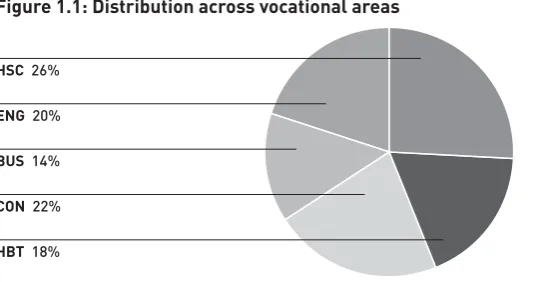
The distribution of courses across the five vocational areas is illustrated in Figure 1.1.
The number of learners on each course varied from 6 to 108. In some cases data were collected on several groups taking the same course.
The learners
[image:10.595.78.346.112.253.2]Data were collected on 1,916 learners for the academic year 2004–05. Socio-demographic data on the learners were obtained from the Individual Learner Record (ILR) assembled by each college for the Learning and Skills Council (LSC). ILR datasets were provided by the colleges and the data were checked using 2004–5 data from the LSC. Summary information on the background data on the learners participating in the study is presented below.
Table 1.1 Learners’ characteristics
percentage Number2
Gender Male 45.6 874
Female 54.4 1,042
Age 16–17 31.5 597
18–20 47.2 894
21–25 8.3 157
26–35 7.5 142
36–45 4.2 80
over 45 1.3 25
Ethnicity White British 62.3 1,159
Asian or Asian British 8.5 158
Black or Black British 17.9 333
Chinese 0.2 4
Mixed 2.9 54
White Other 5.5 102
White Irish 0.9 17
Other 1.7 32
Disability Yes 7.8 129
No 92.2 1,527
Additional Learning Support Yes 18.4 300
No 81.6 1,328
Vocational qualification Level Level 1 52.2 1,000
Level 2 47.8 916
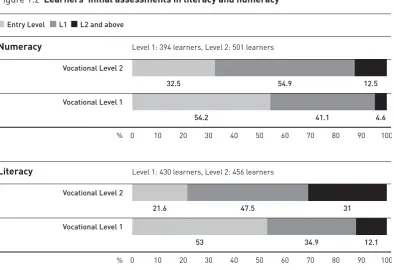
Information on learners’ initial assessments in literacy and numeracy was collected, for a total of 809 learners for numeracy and 886 for literacy/ESOL. These initial assessment data were
HSC 26%
ENG 20%
BUS 14%
CON 22%
[image:10.595.74.470.429.723.2]HBT 18%
Figure 1.1: Distribution across vocational areas
provided by the colleges. Different assessment tools were used but all were referenced to the National Standards for Adult Literacy and Numeracy.3
As Figure 1.2 below shows, for learners on vocational Level 1 courses, over 50 per cent were at Entry Level in literacy and numeracy when they started their programmes. For learners on vocational Level 2 courses, 21 per cent were starting from Entry Level in literacy and 32 per cent in numeracy.
These data demonstrate clearly the ‘spiky profiles’ of learners with different skills at varying levels. The learners represented here went on to achieve vocational qualifications at Levels 1 and 2, alongside literacy and numeracy achievements at lower levels.
1.7 Terminology
The LLN learning undertaken by learners in this study was described in various ways in the institutions in the sample. For some it was known as ‘key skills’, for others ‘essential skills’ or ‘basic skills’. For the purposes of this report all forms of literacy/language/ESOL/English/ communications learning are referred to as ‘literacy’. Similarly, maths/numeracy/application of number are referred to as ‘numeracy’.
[image:11.595.144.539.272.542.2]This report uses ‘teachers’ as a general term to refer to those who may be described as teachers/trainers/tutors lecturers in the different contexts in which they work. For ease of reference the report refers to ‘LLN and vocational’ teachers. This should not be taken to imply that the ‘LLN teacher’ is one person. The teaching of adult literacy and, numeracy and ESOL are distinct areas of expertise, usually found in separate individual teachers.
Figure 1.2 Learners’ initial assessments in literacy and numeracy
Vocational Level 2
Vocational Level 1
%
% Vocational Level 2
Vocational Level 1
32.5
0 10 20 30 40 50 60 70 80 90 100 Numeracy
■Entry Level ■L1 ■L2 and above
Level 1: 394 learners, Level 2: 501 learners
54.9 12.5
54.2 41.1 4.6
21.6
0 10 20 30 40 50 60 70 80 90 100 Literacy Level 1: 430 learners, Level 2: 456 learners
47.5 31
53 34.9 12.1
2 Research methodology
2.1 The use of mixed methods
The study set out to explore relationships between the provision of LLN in vocational
programmes and learners’ achievement, retention and attitudes to LLN. The primary focus of the study is quantitative but qualitative data is central to the methodology. Most importantly, analysis of qualitative data enabled the team to identify the features of embedded LLN against which the courses in the sample could be measured. This, in turn, provided the basis on which the degree to which LLN was embedded in vocational programmes could be quantified. It also made it possible to use quantitative methods to test the hypothesis that embedding has a positive association with learners’ retention, achievement and attitudes to LLN. The
qualitative data were also useful in checking, interpreting and, in some cases, querying the findings from the quantitative analysis. Additionally, this data provided valuable illustrations of the ways in which embedding of LLN works in practice in a range of contexts.
2.2 Quantitative data
Quantitative data were gathered in two phases. Initial data on all learners in the sample were collected in May 2005. Achievement data were then collected from October 2005.
The following data were collected for every learner:
■ Age or date of birth
■ Gender
■ Ethnic group
■ Disability
■ Whether or not in receipt of Additional Learning Support
■ The results of any initial assessment in literacy, numeracy and/or language undertaken prior to the learner starting the course.
■ Achievement of vocational qualification (qualification and level)
■ Achievement of any LLN qualification (qualification, subject and level)
■ Completion
This information was collected from sample colleges directly and then cross-checked with data received directly from the national LSC.
2.3 Qualitative data
The research team conducted:
■ in-depth semi-structured interviews
■ focus groups
■ class observations
■ document analysis
Data were gathered from:
■ LLN teachers
■ Key skills teachers
■ Vocational teachers
■ Learners
■ Programme managers
■ Curriculum managers
■ Department managers
The bulk of the qualitative data was collected between May and July 2005 and further data were followed up in September and October. In some instances, researchers spoke to the full teaching team and in other instances, only to the vocational teacher or only to the numeracy, literacy or language/ESOL teachers. Additionally, programme managers, curriculum
managers and department managers were interviewed. Where possible, researchers also conducted learner interviews, learner focus groups and class observations.
The qualitative data included information on structures, policies and practices at institutional, departmental and course level. Data were also collected to explore learners’ and teachers’ values, attitudes and opinions on the role of LLN in vocational courses and vocational identities.
2.4 Analysis of the data
The features of embedded LLN
After reviewing the initial qualitative data the research team devised a set of 30 questions in order to code aspects of the qualitative data. These questions related to the features of embedded LLN, observed by the researchers, which the team hypothesised were important to effective embedding (Appendix 2). The questions were applied to the data set for each course in the sample and responses given in a numeric form. Three questions required yes/no answers. The answers to the remaining 27 questions indicated the degree to which a particular feature was true of the observed practice on a scale of 0 = not at all to 4 = completely.
The resulting codes provided the data on embedding in a quantitative form against which data on individual learner retention, achievement and attitude could be set for analysis.
A measure of the degree of embeddedness of LLN
A four-point scale for the overall degree of embeddedness of courses was devised
characterised by the way in which learners experience the provision of LLN on their course:
4 Fully embedded or integrated Learners experience their LLN development as an integral part of their vocational studies.
3 Mostly embedded Learners mostly experience LLN development as part of their vocational studies, but some aspects of their LLN development and vocational studies remain
uncoordinated.
2 Partly embeddedLearners experience their LLN development and vocational studies as integrated to some degree / only in some aspects.
1 Non-embedded Learners experience their LLN development and vocational studies as entirely, or almost entirely, separate.
On the basis of the responses to the 30 questions, the research team allocated each course to one point on this overall scale. An exercise was then conducted to compare and moderate these decisions. The resulting scale of embeddedness was used to explore the relationships between the degree of embeddedness of courses and learner retention, achievement and attitude.
The degree of embeddedness of the LLN provision awarded to each course, as a result of the process described above, was compared with a calculation based on the scores awarded to each course on the initial 30 questions. This triangulation illustrated good agreement overall but suggested that the distinction between ‘mostly embedded’ and ‘fully embedded’ was less significant than the others.
Learner attitude
The learner questionnaires were analysed and potential relationships between the responses to some questions and the degree of embedding of the courses the learners attended were explored.
Statistical analysis
The relationships between a range of variables and three learner outcomes, retention, success in vocational qualifications and achievement of LLN qualifications, were investigated. These variables included learner and college characteristics, the level of the course and the curriculum area.
We asked the following questions in our analysis:
1. Is there a relationship between two variables? (For example, the degree of embeddedness of a course and the vocational achievement of a learner).
2. How strong is the relationship?
3. Can any particular patterns be identified in the relationship?
■ all learners on the course
■ those learners assessed as below Level 2 in literacy, language and/or numeracy at initial assessment.
For retention and achievement, the analysis was undertaken on the basis of the individual learner but for success rates it was necessary to treat the whole course as the unit of analysis.
Literacy and ESOL were grouped together for the purposes of this analysis. On the majority of vocational programmes learners undertook key or basic skills qualifications in
communication or literacy. The sample did include courses that used ESOL qualifications but these provided insufficient data for separate analysis.
The different features of embedding were also investigated. Using the 30 features of embedding, those that had the strongest association with success rates for vocational qualifications and with learners’ achievement in literacy and numeracy qualifications were identified. A factor analysis was also used to identify clusters and to explore whether any statistical relationships existed between the factors themselves.
It is important to stress that the results of this kind of analysis have limitations. Association does not equal causation. A study of this kind cannot establish direct causal connections between forms of provision and outcomes but it can support hypotheses that are valuable in their own right and as potential topics for future in-depth investigation.
Illustrative data
The researchers drew on their data from interviews and observations to create narrative reports for each course they had researched, illustrating the 30 features and the degrees of ‘embeddedness’ and providing examples and quotations. These reports included a summary of the practitioners’ own recommendations for the development of successful embedding in their own institutions.
Examples were also sought for practice that illustrated the features of embedded practice that associated most closely with success rates for vocational qualifications and with learners’ achievement in literacy and numeracy qualifications. These examples were drawn from the narrative reports for courses where these features were significant in the analysis.
The narrative reports were also used to draw together case studies of courses in which some or all of these features worked together to support the effective embedding of LLN within the vocational subject. On the basis of this analysis some general points relating to embedding were identified. In writing these case studies some of the barriers to successful embedding were also explored.
3 How embedding affects achievement, retention
and success rates in vocational qualifications
3.1 Introduction
This section reports the results of the statistical analysis that sought to identify relationships between the degree of ‘embeddedness’ of LLN within vocational courses and the retention of learners, success rates in vocational qualifications and learners’ achievement, in literacy and numeracy.
3.2 Retention of learners on courses
Using figures for all learners in the sample there was a significant positive association between whether learners completed their courses and the degree of embeddedness of LLN. This suggests that learners were less likely to drop out if LLN was embedded. Figure 3.1 illustrates the difference in retention between the courses in which the LLN provision was non-embedded on the one hand and courses in which there was some degree of embedding of LLN on the other, including those that were partly, mostly and fully embedded.
When the retention data were further analysed by the level of vocational course (Figure 3.2) the increase in retention was seen to be more marked for courses at vocational Level 2. At this level there was an increase of over 26 per cent between classes with separate LLN provision and those in which LLN was embedded. For vocational courses at L1 the increase was not statistically significant.
It is important to remember that the degree of embedding of LLN is likely to be just one of a wide range of factors that impact on the retention of learners. However, our interview data support the findings from the analysis in suggesting that, for vocational Level 2 learners, making an explicit link between LLN learning and the vocational subject can help to overcome the stigma associated with LLN classes. It can also increase the likelihood that learners benefit from this in terms of coping with their vocational course.
[image:16.595.73.470.450.515.2]At Level 1 it is possible that other factors outweighed any positive effects of embedding LLN. These vocational Level 1 learners may have been more ready to accept their literacy and numeracy learning needs, even where no links were made between LLN and vocational content.
Figure 3.1 The percentage of learners completing courses
For all learners in the sample
non embedded courses embedded courses
61.6
77.4
When analysed by vocational subject, the relationship between retention and embeddedness varied considerably between the different areas. Embedding appeared to have the most significant impact on retention in courses in engineering. However, the numbers of courses within each vocational area were too low for the findings to be statistically significant at this level of detail.
3.3 Vocational success rates and embedded LLN
The success rate of a course is the number of learners achieving a vocational qualification as a percentage of those who started the course.
The mean success rates on vocational courses were analysed to discover whether there was a relationship between these and the degree of embeddedness of the courses. The results show a statistically significant relationship between success rates and the degree of embedding of LLN (Figure 3.3).
The percentage of learners achieving their vocational qualification, as a percentage of those completing the courses, in our sample, was very high. The higher success rates for courses on which LLN teaching was embedded were therefore a result of the increase in retention described above.
3.4 Comparison between the sample and national benchmarking data
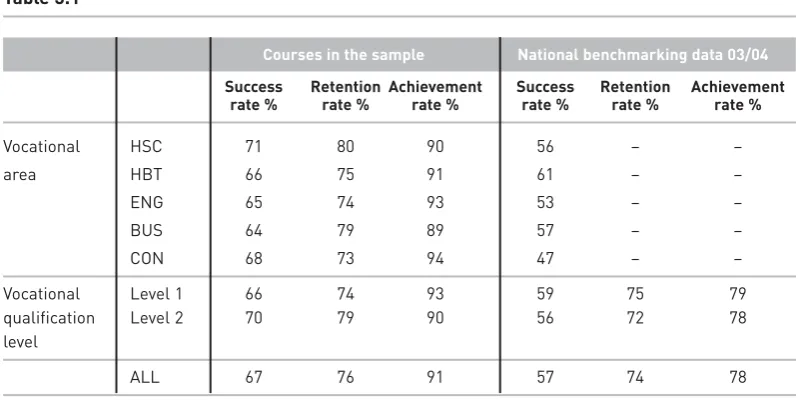
[image:17.595.143.539.549.612.2]A comparison between the success, retention and achievement rates for the courses in the sample and national benchmarking data is shown in Table 3.1. It should be noted that it was necessary to use 03/04 data for this comparison as 04/05 data were not available at the time of the analysis.
Figure 3.3 The mean vocational success rate for courses
non embedded courses embedded courses
55.5
70.5
0 10 20 30 40 50 60 70 80 90 100
Figure 3.2 The percentage of learners completing vocational courses at Levels 1 and 2
For all learners in the sample
Vocational Level 1
Vocational Level 2
66.1 73.1 53.3
81.7
0 10 20 30 40 50 60 70 80 90 100
The success rates for courses in the sample for this study are generally higher than the national average and reference to Figure 3.3 shows that only the non-embedded courses in the sample had success rates below the national average. In conjunction with the information drawn from Ofsted reports, this suggests that good teaching practice is likely to play a part in explaining the association between embedding and high success rates, or perhaps that good teachers are drawn towards embedded approaches.
[image:18.595.72.474.250.450.2]The national average success rate in 2003-04 was 57 per cent; the average success rate on non-embedded courses in our sample was 55.5 per cent, but the average success rates on embedded courses in our sample was 70.5 per cent.
Table 3.1
Courses in the sample National benchmarking data 03/04
Success Retention Achievement Success Retention Achievement
rate % rate % rate % rate % rate % rate %
Vocational HSC 71 80 90 56 – –
area HBT 66 75 91 61 – –
ENG 65 74 93 53 – –
BUS 64 79 89 57 – –
CON 68 73 94 47 – –
Vocational Level 1 66 74 93 59 75 79
qualification Level 2 70 79 90 56 72 78
level
ALL 67 76 91 57 74 78
Achievement rates show the percentage of learners passing qualifications. Retention rates show the percentage of learners staying on to completion of their courses. Success rates combine the two, and show the percentage gaining qualifications of those that started a course.
3.5 Learners’ achievement of LLN qualifications and embedding
Literacy achievements
For the analysis of the relationship between learners’ achievement of LLN qualifications and the degree of embeddedness of LLN, the data used were for those learners in the sample who were assessed at below Level 2 in literacy, language or numeracy at entry to their programmes.
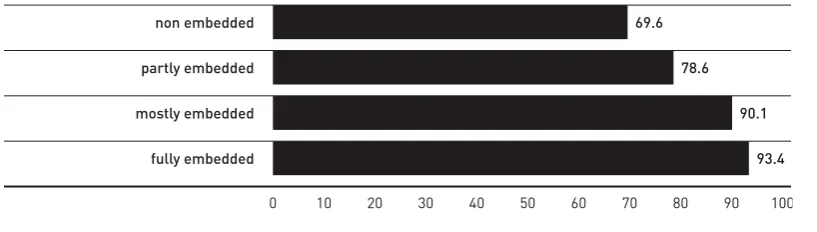
The analysis indicates a strong link between the degree of embedding of LLN and achievement of qualifications in literacy (Figure 3.4). The proportion of learners gaining a literacy qualification was more than 35 per cent higher where there was some degree of embedding as compared with provision where LLN was provided separately. Where LLN was fully integrated this difference rose to over 42 per cent. This finding appears to support the hypothesis that learners on vocational courses are more likely to engage successfully with literacy when they recognise its relevance to their vocational study and that the teaching of literacy is most successful when it is embedded into that study.
demands of the vocational subject and the professional goals of learners were as important as the specific arrangements for the teaching of LLN in terms of their motivation.
Numeracy achievements
The analysis also indicates a clear association between the degree of embedding and
achievement of qualifications in numeracy (Figure 3.5). The difference between the proportion of learners obtaining a numeracy qualification on courses with separate provision and that on fully embedded courses was over 20 per cent. This suggests that learners also engage more successfully with numeracy when it is integrated into their vocational study.
Levels of literacy and numeracy achievement
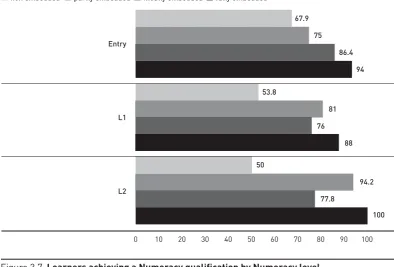
The data for learners’ literacy/ESOL or numeracy achievement were also analysed separately by the levels gained, Entry Level or Level 1 or 2. The resulting graphs indicate that embedding is associated with an increase in achievement of LLN qualifications across the range from Entry to L2 in literacy and at Entry and L1 in numeracy (Figures 3.6 and 3.7). These figures, however, need to be treated with some caution as the sample sizes in each case are small. In the case of Level 2 numeracy the number of learners was too low to include in this analysis.
non embedded
partly embedded
mostly embedded
fully embedded
69.6
78.6
90.1
93.4
[image:19.595.140.549.160.278.2]0 10 20 30 40 50 60 70 80 90 100
[image:19.595.140.549.425.541.2]Figure 3.5 Learners achieving Numeracy qualifications For learners assessed below L2 in LLN on initial assessment Figure 3.4 Learners achieving Literacy/ESOL qualifications
For learners assessed below L2 in LLN on initial assessment
non embedded partly embedded mostly embedded fully embedded
50.0
85.5 91.4
When the LLN achievement data for vocational courses at L1 and L2 were analysed separately differences emerged (Figures 3.8 and 3.9). Again, smaller sample sizes call for caution in the interpretation of these patterns. The figures suggest that for L2 courses the embedding of literacy or numeracy was associated with increased achievement of LLN qualifications.
[image:20.595.73.468.138.405.2]On L1 vocational courses there were differences between the patterns of achievement in literacy and numeracy. In literacy, separate provision appeared to be linked to low rates of achievement of literacy qualifications, whereas in numeracy, separate provision was associated with a relatively higher rate of achievement of numeracy qualifications. Possible explanations of this difference that would repay further investigation might include: Figure 3.7 Learners achieving a Numeracy qualification by Numeracy level For learners assessed below L2 in LLN on initial assessment
Entry
L1
0 10 20 30 40 50 60 70 80 90 100
83.3
84
53.1
63.6
89.7
100
65.6
91.8
[image:20.595.73.480.449.616.2]■ non embedded ■partly embedded ■ mostly embedded ■ fully embedded
Figure 3.6 Learners achieving a Literacy/ESOL qualification by Literacy/ESOL level For learners assessed below L2 in LLN on initial assessment
Entry
L1
L2
0 10 20 30 40 50 60 70 80 90 100
67.9
75
53.8
81 86.4
94
76
88
■ non embedded ■partly embedded ■ mostly embedded ■ fully embedded
50
94.2
77.8
■ a greater stigma attached to separate literacy provision
■ the importance of context in literacy learning
■ better, more responsive teaching of numeracy in separate provision.
3.6 Other important factors
Analysis was undertaken to identify which, if any, of a wide range of variables were most strongly associated with positive learner outcomes. Two points of interest arise from this. First, vocational area is a significant factor in relation to completion, vocational achievement and achievement of LLN qualifications. Data on retention and achievement were analysed by vocational area. The results indicate differences between the curriculum areas in terms of learner outcomes although the pattern of these was complex, and the sub-sample for each of the five areas was relatively small, which means that any results need to be treated with caution. These potentially important differences and their relationship to differences between vocational areas in terms of culture, language and the importance of literacy and numeracy would merit further research.
A second point of interest is that, in terms of completion, the results of this analysis indicate that learners who receive Additional Learning Support (ALS) have a higher probability of completing their course than those who do not. Learners receiving ALS were found across courses that spanned the range of ‘embeddedness’ but our analysis suggests that this can be most effective when integrated with the vocational teaching and learning.
Figure 3.9 Learners achieving a Numeracy qualification by vocational level
For learners assessed below L2 in LLN on initial assessment
78.4 82.3 59.4
93.8 0 10 20 30 40 50 60 70 80 90 100
Inon embedded Iembedded
Vocational Level 1
Vocational Level 2
Figure 3.8 Learners achieving a Literacy/ESOL qualification by vocational level
For learners assessed below L2 in LLN on initial assessment
50
87.7 50
94 0 10 20 30 40 50 60 70 80 90 100
Inon embedded Iembedded
Vocational Level 1
3.7 Staffing – dual responsibility for vocational and LLN teaching
One question concerned whether or not the LLN and vocational teaching were provided by the same teacher. A small number of teachers taking dual responsibility were dual-qualified and experienced, but most were vocational teachers taking additional responsibility for teaching LLN. The analysis of this question indicated that where one teacher was given responsibility for all the teaching of the vocational subject and LLN, the probability of learners achieving LLN qualifications was lower. Learners taught by non-specialists were twice as likely to be unsuccessful with LLN qualifications.
The qualitative research found a small number of exceptional teachers who were dual-qualified and/or highly committed to both the vocational subject and LLN, but these were outweighed in the quantitative analysis. This finding suggests that, other than in these exceptional cases, giving one teacher responsibility for both the vocational teaching and the teaching of LLN may not be a productive approach to embedding. Vocational and LLN specialists working together in teams are likely to be more effective in most contexts.
3.8 How reliable are these findings?
In any educational research carried out in real classrooms, there are always many factors in play, which cannot be controlled; for example, selection of learners, quality of teachers and resources. However, the main sample sizes in this research were large and the associations found in the analysis of literacy and numeracy achievements are strong and present a consistent picture. This, and the fact that the analysis took place on more than one level, suggest that the findings can be treated with confidence. Some reservations must be noted. Some data were missing for some learners in the sample. The conclusions that can be drawn from subsets of data, for example, learning areas by level, are based on much smaller samples and are less reliable than the main findings. These subsets suggest areas for further research.
3.9 Summary
The results of the analysis presented above provide evidence of a positive relationship between the degree of embeddedness of LLN in vocational courses and each of the three outcome measures: success rates for vocational qualifications, retention and achievement of LLN qualifications. The results indicate:
■ Learners on embedded courses had higher retention rates.
■ Embedded courses had higher success rates than non-embedded courses.
■ Learners on the embedded courses had higher levels of achievement of literacy
qualifications, with 42 per cent higher achievement on fully embedded than on non-embedded courses in the sample. There was a strong positive relationship between literacy achievement and embedding.
■ Learners on the embedded courses had higher levels of achievement of numeracy
Analysis of the data by the level of the vocational course indicates a more complex, but less statistically reliable, pattern of relationships:
■ Retention is positively associated with the degree of embeddedness on L2 courses but not for L1 courses.
■ On L2 vocational courses there is a difference between non-embedded and embedded, with the most significant difference being between separate provision for LLN and some degree of embedding in relation to both achievement of numeracy qualifications and retention.
■ On L1 vocational courses a rise in achievement in LLN qualifications is associated with LLN teaching that is mostly or fully embedded/integrated.
The results of the analysis also suggest that:
■ giving individual teachers responsibility for both the vocational subject and LLN teaching may not be the most effective approach to embedding LLN, unless the teachers are highly skilled and qualified in each area of teaching. Vocational and LLN specialists working together to embed LLN increases the probablility for learners to achieve.
4 What do learners think?
It is widely accepted that many young adults on vocational courses have largely negative attitudes towards the key skills or LLN courses that are often mandatory aspects of their overall vocational programmes. Other NRDC research studies confirm this (McNeil & Dixon 2005; Cranmer et al 2004; Roberts et al 2005).
In addition to analysis of the relationship between achievement, retention and the degree of embeddedness of LLN, this study aimed to collect insights on the attitudes and beliefs of learners regarding the LLN content in their vocational courses, embedded provision and vocational identity.
Data were collected via learner questionnaires and learner focus groups. Of the full 1,916 learner sample, 482 completed the learner questionnaire. Questionnaires were administered during the first quarter of the project, in the learners’ last terms of attendance. Questions ranged from asking learners to indicate the degree to which they valued strong LLN skills in relation to occupational identity and success, to whether or not the value they placed on strong LLN skills changed at all during the course. In addition, learners were asked a series of questions to determine the extent to which they saw links between the work of their vocational and LLN teachers. They were also asked about vocational and LLN
content/materials and how far they had anticipated LLN input on their course. A copy of the full learner questionnaire can be found at www.nrdc.org.uk
More than 25 voluntary learner focus group sessions were organised. Course teachers did not take part in these sessions, each of which involved between four and fifteen learners.
Individual learner interviews were conducted as well. Researchers asked learners a range of questions to gather insights on their motivations, attitudes and aspirations. For example, learners were asked about:
■ the factors that motivated them to select their current provider and vocational course
■ their longer-term vocational aspirations
■ the degree to which they felt their current course would assist them in reaching their longer-term vocational goals
■ their views on the role of developing LLN skills and vocational success
■ the degree to which they felt the current vocational and LLN teacher interaction was effective.
A full list of focus group questions can be found in the technical appendix on the NRDC website www.nrdc.org.uk
Three major themes arise from the analysis of learner questionnaires. The focus group quotes selected in this section complement findings from the quantative data analysis.
4.1 The value of strong LLN skills
This view was supported by focus groups in which learners described the various ways in which strong LLN was necessary for their vocational success:
“You know, I need to have strong communication skills not only to deal with
customers but also to set up my business. I need to know maths in order to set up a salon, like looking for a space, and dealing with all the orders and contracts…”
“I have worked with my dad, he has his own business, and so I have seen how strong maths skills are not only important for technical plumbing work but also for dealing with business stuff like invoices…”
Focus group respondents also supported this view, often acknowledging their participation in their vocational programme as a second chance in education, some even viewing this as a last chance for career development. They consistently mentioned the need to improve their LLN skills, which were still under-developed when they left school. A number of focus group respondents were also in employment or had been working since leaving school and starting their vocational course. These learners spoke about the challenges they had faced in gaining meaningful and sustainable employment without further qualifications. However, not all learners were as convinced of the value of LLN qualifications:
“Key skills qualifications are not what you need when you’re learning a trade.”
“Learning to be a plasterer, no one cares whether you’ve got qualifications in English and maths.”
Learners spoke about the need to develop stronger LLN skills in order to improve their lives overall, although many queried the value employers put on maths and English qualifications.
“Practical experience is more important.”
“Employers are not bothered about key skills.”
[image:25.595.140.537.105.235.2]Additionally, learners were highly sceptical about English and maths provision being related to their vocational goals if they perceived the subject as being taught in a ‘school-like’ manner.
Figure 4.1 Learners rating English/Maths as important for the job they want to do
79
94 72
85 0 10 20 30 40 50 60 70 80 90 100
I Before starting the course I After completing the course
Literacy/English
4.2 Structure, delivery and a unified team
Many focus group respondents spoke about their lack of awareness of the LLN content in their vocational programme when they enrolled. Where learners could see the connection between LLN input and the vocational programme or goals, this input was seen as positive. However, where learners perceived a disconnect between their LLN input and their vocational programme, their dissatisfaction was obvious:
“It is clear that our key skills teacher knows nothing about our (vocational) course, so then how can they help us make sure we succeed in our course? I mean, that is what we are here for. Our (vocational) teacher tries to help us with our key skills work, but it is clear they don’t work together.”
In the same institution, with a different cohort of learners, the following opinion was offered:
“It doesn’t take a lot to work out that if key skills was scheduled in between our (vocational) sessions more people would attend…now they are on days when we don’t even have to be here (in the college) for any (vocational) sessions. We pay for travel and some of us work…if it is meant to be one programme, they should structure it that way.”
Learners gave very positive feedback in another institution, where they had an explicit understanding of how their vocational and LLN tutors were working together:
“(ESOL teacher) knows what we need to deal with in our course – I mean he comes and sits in with us every week (in the vocational session) – he asks our (vocational) teacher questions, he sees what we need to know, the vocabulary and stuff…then we have our class with him, it feels like he can totally support us.”
4.3 Learner attitudes and embeddedness
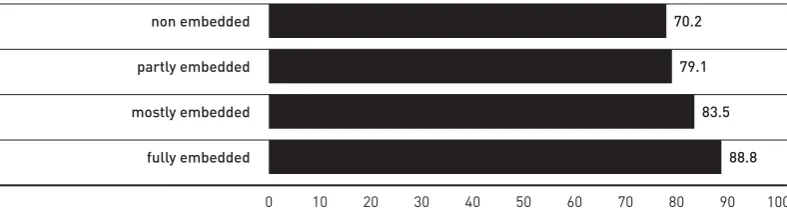
Correlating data from the learner questionnaire and the study’s four-point scale of embeddedness showed that as the degree of embeddedness increased, learners became more likely to say that the course had prepared them well for future work.
[image:26.595.74.468.630.740.2]Further research could focus on potential causal relationships between degrees of embeddedness and learner achievement, retention and shifts in attitude.
Figure 4.2 Positive learner responses to how their course has prepared them for their future work
non embedded partly embedded mostly embedded fully embedded
70.2 79.1
4.4 Learner recommendations
Learners who participated in focus groups made various recommendations in relation to embedded provision in vocational courses:
■ More coherent, seamless scheduling of vocational and LLN provision.
■ Strong working relationships between vocational and LLN teachers. Many learners felt it was important to have different specialist teachers for LLN input due in part to their own
perceived weaknesses in these areas and their need for expert teachers.
■ Better recognition by employers of their LLN qualifications. Although many learners mentioned the heavy workload related to completing both vocational and LLN qualifications, they were more concerned that their LLN qualifications should be recognised by employers than for LLN and vocational qualifications to be combined. However, better integration of qualification aims was seen as a potentially positive development.
■ Contextualisation of LLN materials was seen as positive by learners but of greater importance was that the LLN teacher should clearly understand the demands of the vocational course and the vocational goals of learners.
■ Better induction processes to prepare them for the LLN demands of vocational programmes and to begin, early on, explicitly and continually, to discuss links between LLN development and vocational success.
■ A shared professional attitude by all teachers supporting both LLN and vocational achievement. Learners felt their own negative attitudes towards LLN input were often reinforced by a lack of positive teacher attitudes.
4.5 Conclusion
Learners gave articulate and sophisticated responses in focus group sessions. In many instances researchers received the negative feedback on LLN input that is commonly associated with young adult learners. However, both data from learner focus groups and learner questionnaires would suggest that LLN that is well integrated with vocational content is highly valued by most learners, both those who are well focused on the vocational route their course supports and those for whom the course is a step on a learning journey.
For learners it is important that educators make strong connections between LLN, vocational success and personal development. Learners may be suspicious of input which is not vocationally aligned or valued, particularly those who have more clearly determined
5 The key factors in embedding LLN
This section aims to explain each of the features that were identified as making a difference between provision being embedded or not. Building on previous work, and the early stages of this research, 30 features of embedded provision were identified. There were, however, many ways in which programmes differed, from those at one end of the continuum which had no characteristics of embedding to those at the other end which had many characteristics of high quality embedded provision. The reality was that programmes had ‘spiky profiles’ as regards embedding. What these features meant in practice differed from one course to another, and courses with different configurations of features could be equally successful. There was no one set of features that formed a ‘winning profile’.
It was not just a question of whether the programme had structural features of embedding in place, for example two teachers timetabled for one class for particular sessions. There were significant differences between institutions in the degree to which they were making these features work for learners and treating LLN as integral features of the vocational area. It was important to make this distinction, because structural features of embedding may not be sufficient in themselves for achieving anticipated outcomes. Attitudinal factors were equally important.
5.1 Significant features of embedding related to LLN achievement
Of the 30 features of embedded provision that were identified in the initial analysis (Appendix 2) a number were found to have a significant statistical association with achievement in LLN. The top nine factors associated with achievement in both literacy and numeracy are listed below.
Significant features related to both numeracy and literacy/language achievement:
■ Formal shared planning (i.e. in officially allocated time) between vocational staff, LLN staff (and ALS staff where applicable) supports integration of LLN into vocational teaching.
■ Departmental and institutional management structures support embedded provision in practice.
■ The staff development policy and provision within, and available to, the college support the integration of LLN with vocational areas.
■ LLN teachers are viewed by staff and learners as contributing to learners’ vocational aspirations.
■ LLN teachers understand and engage with the vocational area as part of their work.
■ LLN teachers are willing to develop their skills in relation to the vocational area.
■ Vocational teachers are willing to develop their skills in relation to LLN.
■ Initial/diagnostic assessment is used to contribute to the integration of LLN into vocational teaching.
■ ILPs and/or other forms of on-going formative assessment contribute to the integration of LLN into vocational teaching.
Additionally, the following features were significant for numeracy and literacy/language respectively:
Numeracy:
■ Vocational staff, LLN staff, (and ALS staff where applicable) work as a team.
■ Vocational teachers understand and engage with LLN as part of their work.
Literacy/Language:
■ LLN teaching is linked to practical, vocational content and activities.
■ LLN are seen as essential in the development of learners’ professional identity and for success in their vocational area.
It is important to note that many of the features listed above represent aspects of good teaching, learning, partnership and delivery. Therefore, the research suggests a direct relationship
between effective embedding and good practice and strong teamwork more generally. In effective embedded provision, good practice, such as formative assessment and the use of ILPs, helps support the effective teaching of LLN.
5.2 Relationships between factors
A further factor analysis was conducted on the original 30 features to discover whether any statistical relationships existed between the features. This kind of analysis tests our assumptions of how features may be naturally related or grouped together. Not all features clustered together, nor were those that did limited to the top 14 features presented above. However, four broad groupings emerged:
1. Features of teaching and learning 2. Teamwork
3. Staff understanding and values 4. Organisational characteristics
The following sections illustrate these four groups of features that can enable or constrain the embedding of LLN teaching and learning.
5.3 Features of teaching and learning
This broad grouping combines the following features:
■ LLN teaching is linked to practical, vocational content and activities.
■ LLN materials are contextualised to the vocational area.
■ Initial/diagnostic assessment contributes to the integration of LLN into vocational teaching.
■ There is differentiation according to LLN needs in the way in which the vocational subject is taught.
■ LLN are seen as essential in the development of learners’ professional identity and for success in their vocational area.
■ LLN development is treated in practice as relevant to all learners, not only necessary for those who are identified with LLN needs.
What these mean in practice varies enormously from one curriculum area to another. For example, on a Level 2 Health and Social Care course, the vocational teacher uses her own experience as a nurse and quotes real life situations to demonstrate the importance of literacy and numeracy for such vocational tasks as measuring drugs and report-writing. On an
in practical sessions in an automotive engineering workshop, and differentiated to three levels. On this course, literacy and numeracy are taught by a multi-skilled vocational teacher, who has fully integrated these subjects into his vocational teaching.
In a Health and Social Care department, which integrates literacy and numeracy with vocational teaching throughout its courses, LLN is taught not by an individual but by a course team. Here, literacy, numeracy and Health and Social Care are taught in different sessions. One teacher states:
“When I look for passages [for reading] they are all health-related. I try to find magazines and newspapers that relate to the course content being covered. So this is literacy with health and care in the literacy session, and then I put it back into a health and care vocational assignment as well.”
This type of provision is driven by experience, commitment, language awareness and recognition of the holistic needs of learners.
On a Level 1 Hairdressing course, successful participation in activities that require LLN is treated as part of the vocational training, and as essential to successful achievement of the qualification, to progression into employment, and to future career development in the vocational area. A mature learner on this course said:
“At our age if you could read and write it was a bonus but now to get any kind of employment you’ve got to be computer literate and you’ve got to be able to do CVs … there is a lot of support from the teachers, the salon teacher and [the key skills teacher].”
In fully embedded provision the differing LLN needs and trajectories of all individual learners on the vocational course are taken fully into account. For example, some learners who were aiming for a GNVQ Level 2 in Construction were entered for a full Level 2 key skills accreditation, while another learner on the same course was entered for an Entry 3 Skills for Life qualification in Literacy, and a Level 1 key skills qualification in Application of Number.
5.4 Teamwork
This broad grouping included the following original features:
■ Formal shared planning (in officially allocated time) between vocational staff, LLN staff (and ALS staff where applicable) supports integration of LLN into vocational teaching.
■ Informal shared planning (without officially allocated time) between vocational staff, LLN staff (and ALS staff where applicable) supports integration of LLN into vocational teaching.
■ The vocational staff and LLN staff (and ALS staff where applicable) work as a team.
These features were illustrated in one college within both Health and Social Care and Engineering, where all but one of the five courses in the sample were graded as ‘mostly
Learners acknowledged the sense of being part of a team that existed between vocational, LLN and ALS teachers in their department. This was due in part to the highly visible collaboration between teachers, whether in shared tutorial time or informally planning and addressing learner concerns.
All teachers spoke of the need to have more time for formal shared planning. The current teaching team spoke about their long-standing relationships and commitment to their college, neighbourhood and learners as the foundation of their good will. However, they acknowledged that more formalised shared planning and development time will be needed as new members of staff join the department.
This point was clearly demonstrated by one course, non-embedded on the four-point scale, that involved ESOL and Health and Social Care. The new ESOL teacher was housed in a separate department, with little or no informal or formal planning time with the vocational teachers. The teacher did not identify herself (nor was she identified by vocational teachers) as part of the Health and Social Care team. Although she aimed to contextualise her delivery to the vocational area, she spoke about her isolation from the vocational department, content and aims. She said she struggled to support her learners in terms of questions and concerns related to vocational achievement.
5.5 Staff understandings, values and beliefs
This broad grouping was made from the following original features:
■ LLN teachers are viewed by staff and learners as contributing to learners’ vocational aspirations.
■ LLN teachers understand and engage with the vocational area as part of their work.
■ Vocational teachers understand and engage with LLN as part of their work.
■ LLN teachers are willing to develop their skills in relation to the vocational area.
■ Vocational teachers are willing to develop their skills in relation to LLN.
This set of features draws attention to the importance of teamwork which is underpinned by a level of understanding, on the part of both LLN and vocational teachers, of one another’s work. A willingness to put effort into the development of skills in areas in which they may have no previous training or experience is also important. It is not simply a matter of vocational teachers developing LLN awareness and brushing up their LLN skills. LLN teachers also need to develop an understanding of the vocational area(s) with which they work and the ways in which literacy, language and/or numeracy are used within these areas. As was pointed out in section 4.2, learners recognise and value LLN teachers’ efforts to become familiar with the vocational subject and view their contribution more positively as a result.
The vocational staff see the relevance of LLN to their work. The basic skills coordinator said: “I went around the unit two months ago to see the vocational staff about doing the basic skills awareness course and I got 20 vocational teachers who said they would be interested. The key to this success is that I’m on the shop floor daily.” A vocational teacher in the department,
recognising the value of the contribution made by the LLN colleagues in the team, said: “I have things to learn from the basic skills people…”
Working in this way requires not only the interest but also the commitment of staff and has implications in terms of time for activities such as training, classroom observation and meetings that will facilitate the development of understanding and skills and exploration of ways in which LLN can be best integrated into particular courses. The evidence of this study, however, suggests that such efforts are repaid in terms of learners’ achievements.
5.6 Organisational features
This broad grouping included the following original features:
■ Departmental and institutional managers and policies support embedded provision in principle.
■ Departmental and institutional management structures support embedded provision in practice.
■ Organisational arrangements support embedded provision.
■ Resourcing and working conditions support embedded provision.
These features underline the importance of a whole organisation approach to the embedding of LLN. The need for time for joint planning and for opportunities for training and observation, if embedding is to work effectively, have already been noted. Support for embedding from senior and middle managers through institution-wide policies makes it easier to direct resources in ways that will support embedded LLN.
Teachers engaged in working in embedded teams need time to work and plan together. Institutional policies need to cater for these priorities in timetabling.
In one college in our sample, an ad hoc group, led by the vice principal, was working towards a formal strategy to ensure the implementation of the college’s Skills for Life framework. This was seen by the staff as critical to moving towards an effective framework for embedding on both a practical and a strategic level. There is an organisational understanding of the importance of embedding LLN in relation to retention of learners.
The college embeds ESOL into childcare, business and engineering courses and the head of school for ESOL and the head of school for curriculum support and education worked closely together. The college provided extensive training for ESOL teachers, and vocational teachers were receiving a day or half-a-day of basic skills-awareness training. This was a first phase of training and more was planned.
6 How do embedded programmes
work as a whole?
This section offers five ‘pen portraits’ of ways of embedding provision of LLN in vocational courses. They reflect different curriculum areas and course levels and are taken from different parts of the country and different types of organisations. The cases, and the
contrasts between them, reveal the uniqueness of each type of provision, and give a flavour of the complex range of factors that were considered in rating the embeddedness of the LLN provision, and how they interact. In particular, they illustrate the role of the ‘top 14’ characteristics of embedded provision that were identified in the quantitative analysis as strongly associated with achievement in Communications/Literacy and/or Application of Number /Numeracy (section 5.1). They also illustrate some of the inherent tensions, and some of the obstacles to fully embedded provision.
6.1 Course A – Motor Vehicle Level 1. (Curriculum area: Engineering)
Two particular features have contributed to the successful embedding of LLN in this course. One is the belief, expressed by the course leader, that improved literacy and numeracy, together with key skills qualifications, are essential for the learners in relation to their course, their future employment and their lives more widely. The other is the in-depth knowledge and understanding of the vocational subject on the part of the key skills teacher who, in addition to being an experienced key skills specialist, has first-hand knowledge of working in the motor vehicle industry.
The key skills teacher introduces the learners to practices she knows will be required on the job.
“In number, for example, they have to learn to use a micrometer to measure in hundreds of mms, so I’ll teach the skill in the maths session then they will apply that in the workshop with the equipment.”
She explained the vocational relevance of key skills in the motor vehicle industry:
“We took our MV learners to Jaguar…robots taking human jobs and the amount of paperwork their staff have to do filling in line and bar charts, checking if mechanical parts are working, ordering parts from abroad. Whereas we used to produce parts now we import them as we need. Giving these life skills will definitely give them an advantage at interview. I think you’ve got to get out there and see what the need is. It’s quite a scary thought that in MV it was always a hands on, largely male-dominated environment where jobs were safe. Not now! So for our lads (only two are female out of 147) to continue, they need high IT skills and good literacy skills.”
Planning for learners’ LLN progress
assessment report on a continuing basis to check progression, and has devised her own ILP. She says: “It’s important that we do it ongoing, not just at the beginning and the end.” Across the whole college it is mandatory for every scheme of work and lesson plan to be profiled to show how literacy and numeracy are going to be addressed for every learner.
The key skills teacher treats LLN development as relevant to all learners. She said:
“[Level 2 learners] are working to a higher level [than Foundation] but they still need reassurance and challenge. They are using a higher level of grammar and analysing the documents they produce. You would expect them to have confidence but there is still the fear factor ‘is this right, is this the correct level for what I’m doing.?’ … They use me as a support.”
Teamwork
Formal planning is generally undertaken electronically but informal planning is responsive and face-to-face as needed. The key skills teacher is invited to the weekly department meeting. She told us:
“At first it was ‘Oh! a woman!’ but I’ve gone in and shown them what I know and I think I’ve removed a fear factor because they will come to me and say “I’m delivering this in the workshop – for example, a plan of the workshop working out area etc., and [the vocational teachers] said “If we help them to do measurements would you be able to help them in your session …could you work with us and check that what they’re actually doing is correct?”
One of the ways in which the vocational teachers and the key skills teacher work as a team is by exchanging schemes of work. The course leader said:
“We have worked with [the key skills teacher] giving her material in advance, and access to the shared area. Schemes of work are available to everybody on-line.”
The key skills teacher explained how she used the material the vocational teachers give her in order to integrate her work with theirs:
“If you look at the whole package you can identify a lot of skills that occur naturally. …For example, for one part of an assignment they have to buy parts for a motor vehicle. They might not get that part in this country, so I get them to research using the internet for car parts. We look at the price in pounds sterling, in American dollars, in Euros.”
She explained how this work is valuable for their vocational and maths qualifications but also if they go on holiday abroad.
Joint planning strengthens the team and helps the staff to provide mutual support. The key skills teacher said: