The Sc ot tish Parliament and Scottis h Parliament I nf or mation C entre l ogos .
SPICe Briefing
Teacher Numbers
31 January 2011
11/08
Camilla Kidner
CONTENTS
EXECUTIVE SUMMARY ... 3
GOVERNMENT POLICY ... 4
TRENDS IN TEACHER NUMBERS ... 4
PUPIL TEACHER RATIOS ... 6
CLAIMANT COUNT... 6
PRE-SCHOOL TEACHER EMPLOYMENT ... 7
TEACHER VACANCIES ... 8
PROBATIONER EMPLOYMENT ... 8
TESS Survey of Probationer Employment ... 10
REASONS FOR FALL IN TEACHER NUMBERS ... 10
GOVERNMENT RESPONSE ... 11
FACTORS AFFECTING DEMAND ... 12
PUPIL PROJECTIONS ... 12
TEACHER AGE PROFILE AND RETIREMENT ... 13
SPEND ON TEACHER EMPLOYMENT ... 14
TEACHER PAY AND CONDITIONS ... 15
SETTING THE SUPPLY SIDE ... 16
INTAKE TARGETS... 16
PREFERENCE WAIVER PAYMENT ... 17
SOURCES ... 18
EXECUTIVE SUMMARY
The number of teachers in primary, secondary and special schools fell from 52,452 in 2007 to 49,923 in 2010 – a drop of 4.8%1
. Over the same period the number of pupils dropped by 2.8% (Scottish Government, 2010a, 2010b).
The proportion of new teachers not employed in teaching in Scotland in the October following their probationary year rose from 5.3% to 27% between October 2005 and 2010 (GTCS, 2010a).
The Scottish Government initially had a policy to maintain teacher numbers in the face of falling schools rolls in order to support its policy on reducing class sizes. However, as teacher numbers dropped, the policy became one of matching the supply of student teachers to the demand expressed by local authorities. The Scottish Government cut teacher training places and the Cabinet Secretary was of the view that the previous administration‘s target of 53,000 had led to problems of over-supply (Scottish Parliament ELLC Committee, 2010a).
Teacher training targets were reduced from 3,857 places for 2009/10 to 2,307 places in 2010/11 and this lower level will be maintained for 2011/12 (ELLC 1 December).
The Teacher Employment Working Group reported in late 2008 (Paola, 2008). While it found that the workforce planning system at a national level was fit for purpose, it made 12 recommendations. These included:
o Improve the links between local and national teacher workforce planning o Encourage use of recent probationers for supply work
o Review winding down arrangements for teachers nearing retirement
Similarly, the Donaldson Review (2011) on teacher training recommended that the accuracy of the workforce planning model should be improved through universities and local authorities providing their latest projections on an annual basis.
In 2010, two local authorities took up a Government offer of increased borrowing consent to fund early retirement packages and teacher recruitment (Scottish Government 2010c).
As part of the negotiations on the 2011/12 budget between COSLA and the Scottish Government, it was proposed in November 2010 that councils would endeavour to reduce teacher unemployment and they would provide enough jobs for their 2011
GOVERNMENT POLICY
The previous administration had a policy to increase teacher numbers from 50,500 in 2001 to 53,000 by 2007 (Scottish Executive 2004a). The additional teachers were to be
targeted on: ‖reducing class sizes to a maximum of 20 in S1 and S2 for Maths and English, 25 in P1 and increasing the number of specialists working across the boundary between secondary and primary‖ (Scottish Labour and Scottish Liberal Democrats, 2003). It was also intended to provide the extra teachers required to enable the reduction in teachers‘ class contact time to 22.5 hours a week. This policy was supported by a ringfenced fund in the National Priorities Action Fund.
The SNP manifesto in 2007 said:
―We will maintain teacher numbers in the face of falling school rolls to cut class sizes and place greater emphasis on teacher recruitment for the early years, languages and science.‖
Shortly after the 2007 election, teacher workforce planning estimated that the commitments on class sizes would require an additional 3,300 FTE teachers (3,500 headcount). Providing these teachers would require over 4,000 extra students to enter initial teacher education (Scottish Government, 2008a). As a result, student teacher intake numbers increased and funding was provided to local authorities to employ more teachers. The Government provided £50.3m through the National Priorities Action Fund in 2007/08 for progress towards the teacher numbers target (Scottish Parliament, 2008a), and a further £9m was allocated over two years to employ an extra 300 teachers (Scottish Parliament, 2007a). After 2007-08 all money for teacher recruitment was provided through the general local government settlement and was not ringfenced for specific policies. The settlement was, however, provided within the framework of the concordat commitments including ones to make progress in reducing class sizes.
Following Local Authorities‘ decisions not to increase their teacher recruitment, training intake targets were drastically cut back. In evidence to the ELLC Committee in October 2010, Michael Russell said: ―I do not have a policy on employing an arbitrary number of teachers.‖ (Scottish Parliament ELLC Committee 2010b col 4060). In November 2010, the Scottish Government and COSLA agreed to reduce teacher unemployment and provide enough jobs for the 1,800 teachers due to complete their probationary year in June 2011 (Swinney, J, 2010).
TRENDS IN TEACHER NUMBERS
There are several measures of teacher numbers and employment including the annual teacher census, quarterly public sector employment statistics and teacher vacancies. There is also claimant count information by occupation. There have also been surveys of probationer employment by the General Teaching Council Scotland and Times Educational Supplement. The trend across all these measures is a reduction in teacher numbers over the past few years.
50,000. More recently, there was an increase from 47,761 in 1997 to 52,446 in 2007 before declining to 49,923 in 2010.
Chart 1: Teacher numbers 1967 - 2010
Source: Scottish Government 2010a, 2010b). Does not include centrally employed or pre-school teachers.
The trend in the number of teachers has generally reflected changes in pupil numbers (charts 2 and 3). However, teacher numbers increased between 2003 and 2007 despite a fall in pupil numbers over this period.
PUPIL TEACHER RATIOS
The pupil teacher ratio reduced from a high point of 16 in the late 1990‘s to 13.2 in 2007. It has since risen slightly. Pupil teacher ratios over the last 20 years are set out in the chart below.
Chart 3: Pupil teacher ratio (primary, secondary and special schools) 1990 - 2010
Scottish Government, 2009a, 2010a, Scottish Executive, 2004.
CLAIMANT COUNT
There has been an upward trend in the number of teachers claiming Job Seekers
Chart 4: Teacher claimant count January 2005 to October 2010.
Source: NOMIS
PRE-SCHOOL TEACHER EMPLOYMENT
While the headcount of teachers working in pre-school has increased, the full time
equivalent count has decreased, suggesting more part time working. In September 2010, 62% of pre-school teachers worked part time compared with 15% of primary teachers (table 2.3, Scottish Government 2010a).
Chart 5: Teachers employed by or working peripetically with pre-school, 2006 – 10
The Scottish Government had a manifesto commitment to provide access to a teacher for every child in pre-school education. Table 1 shows that more children do have access to a teacher in 2010 than in 2008. However as WTE teacher hours have not increased (chart 5), this appears to have been achieved by re-distribution of existing hours across pre-school centres rather than deployment of more teacher hours in total.
[image:8.595.58.417.449.678.2]In the guidance notes ‗access to a teacher‘ was defined as, "the teacher being present in a pre- school education setting when the child is in attendance", and it was acknowledged that systems for providing access to teachers vary. Pre-school education centres were asked whether they received occasional or ad hoc support from any external GTCS registered teachers. This could be instead of, or in addition to, any teacher(s) providing pre-school education under a regular arrangement.
Table 1: Access to a teacher in pre-school
Regular
arrangement only
Regular arrangement and ad hoc support
Ad hoc support only total
2008 48.1% 16.3% 1.8% 66.1%
2009 45.7% 22.9% 1.4% 70.0%
2010 51.2% 21.7% 0.9% 73.8%
Sources: Scottish Government 2009b table 19, 2010d table 24 and 2008 table 24.
A further survey in September 2010 found that 74.4% of pre-school pupils had access to a teacher (table 6.2, 2010 statistics).
TEACHER VACANCIES
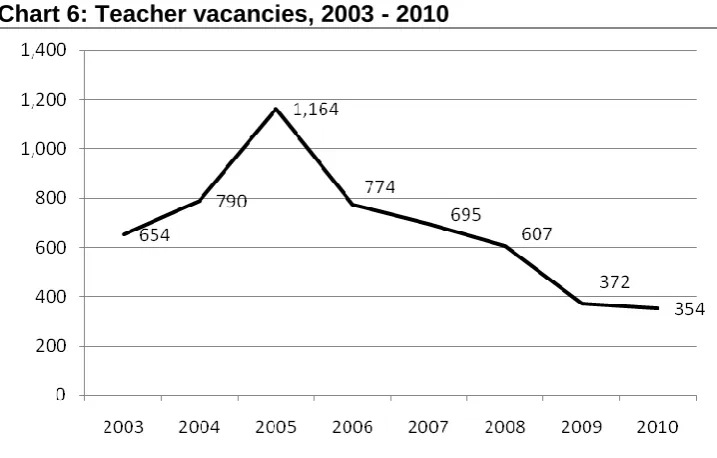
Total teacher vacancies declined from 1,164 in 2005 to 354 in 2010. Chart 6: Teacher vacancies, 2003 - 2010
Source: Scottish Government 2010e.
PROBATIONER EMPLOYMENT
October 2009. It has since fallen very slightly to 27.1%. Those in permanent teaching contracts decreased from 66% to 18% between October 2005 and 2010 (GTCS 2010b). Chart 7: Employment of Probationer Teachers, 2005 to 2010, October Survey
Follow up survey in April/May
The proportion of new teachers not employed in teaching in Scotland in the April following their probationary year rose from 7.3% to 13.5% over the last three years. Those in permanent teaching posts decreased from 51.3% to 30% over the same period. Chart 8: Employment of Probationer Teachers, 2008 – 2010, May survey
TESS Survey of Probationer Employment
The Times Educational Supplement Scotland (TESS) has been highlighting the difficulties that probationers have had finding jobs since the first cohort looked for work in August 2003. Although there was no comprehensive survey that year, the TESS reported that: ―New teachers in Scotland are struggling to find permanent jobs following their induction year.‖ The annual TESS survey has found that the proportion of teachers with a permanent job secured in the authority they trained in fell from 32% in August 2007 to 9% in August 2010. However, it is important to note that teachers would not be expected to look for work only in the authority they trained in.
Chart 9: Permanent employment of Probationer Teachers, 2007 – 2010, TESS survey
Sources: TESS 203, 2007, 2008, 2009, 2010a
Looking at both the TESS and GTCS surveys, although many probationers get permanent jobs over the course of their first year in the job market, there is still a lower proportion getting permanent jobs than in previous years.
REASONS FOR FALL IN TEACHER NUMBERS
Over the last few years, the Education, Lifelong Learning and Culture Committee has discussed both the unemployment of probationer teachers and the fall in the total number of teachers. In evidence to the Committee in December 2008, Fiona Hyslop noted that the induction scheme may have displaced rather than solved the problem of employment for new teachers:
―We have to remember where we were when the induction scheme, which is an excellent opportunity, was introduced. It was not post-probationers who could not get jobs; it was people coming out of teacher training institutions. We know the horror stories about the experience in the early 2000s. The induction scheme was introduced to try to address the problem, and it has done so, but, given the volume that we are talking about, we might just have displaced the problems that were faced by students coming out of initial teacher training to their second year.
Government guarantee someone a job? The issue is whether the Government should guarantee forever jobs for all teachers who are one, two or three years out of teacher training‖ (Scottish Parliament ELLC Committee 2008a col 1801)
In evidence to the Committee in June 2010, Michael Russell suggested that reasons for the drop in teacher numbers included both the financial crisis and the previous
administration‘s increase in training numbers:
―There are a number of reasons why teacher numbers have fallen. One is
undoubtedly the unprecedented financial pressures on local authorities; we can go through, line by line, the reasons for that. Another reason—which is controversial, Mr Macintosh, and I do not expect you to agree with it—is that we could look back and say with hindsight that the number of teachers was in fact artificially increased over a period of time, and that the number was unsustainable‖ (Scottish Parliament ELLC Committee 2010a, col 3760).
On the release of teacher statistics in 2009, Councillor Isabel Hutton referred to the financial pressures facing councils.
―Councils are under constant pressure to deliver efficiency savings and best value and it would be economic suicide to maintain teacher numbers while experiencing falling school rolls, rising salaries, and record demands on children's services.‖ (BBC, 2009)
GOVERNMENT RESPONSE
In response to the fall in demand for teachers from local authorities the Scottish
Government has cut the numbers going into teaching training (see below) and established a web site to support unemployed teachers to maintain CPD. CPD Step –in is hosted by Learning and Teaching Scotland on GLOW and includes the following features:
a discussion area with chat, forum and web meeting tools
a place to share resources and links
advice on PRD and examples of free, online CPD on Glow and beyond
a place to express views
a feed of teaching posts from MyJobsScotland.com.
In March 2010, the Cabinet Secretary was asked whether it was still government policy to maintain teacher numbers at 53,000. He said:
What we have seen is an inevitable pressure on teacher numbers, given the pressure on resources. What we now have is progress on class sizes, and I am pleased with that. There has been a reduction in teacher numbers and, as I have indicated, I think that it would be very difficult for local authorities to reverse that. Of course, were they to choose to do so, everybody would be pleased (Scottish
Parliament ELLC Committee 2010c, col 3303). And in October he said:
He predicted that, given the financial situation, further reductions in teacher numbers were likely, but recommended that local authorities replace retiring teachers with newly qualified teachers:
―We know that local authorities shed more than 2,000 teachers between 2007 and 2009, in a period when budgets were still growing. […] we are moving into a period of falling local authority budgets […] it does not take much to work out that it will be impossible to protect teacher numbers as we move forward. To avoid further shrinkage of our teacher workforce, we need local authorities to do what they can not to allow further drops in teacher numbers. […] We need local authorities not to look on each retiring teacher as an opportunity to save money, but to recruit recently qualified teachers‖ (Scottish Parliament ELLC Committee 2010 b).
In November 2010 the Scottish Government and COSLA agreed to:
ensure that are enough vacancies as there are teachers completing their probationary year in June 2011
to reduce teacher unemployment
to provide an extra £15m in the local government settlement for teacher employment (Swinney 2010)
Following the publication of the 2010 teacher census, Michael Russell said: ―with the position we have reached with COSLA, we have turned the corner and that next year teacher numbers will stabilise‖ (Scottish Parliament ELLC 2010d, col 4413). However, in a debate in January 2011 the Cabinet Secretary noted that returning teaching numbers to their 2007 levels was not realistic.
―Employing 3,000 teachers, which is roughly the number that local authorities have shed, would cost in the order of £120m. I challenge those who are so critical of the current position – which none of us wishes to be in – to point to where that funding will come from.‖ (Scottish Parliament 2011 col 32125)
FACTORS AFFECTING DEMAND
Two key trends that affect the demand for teachers are the expected number of pupils and the pattern of teachers leaving and returning to the profession. However, it is also affected by the cost of employing teachers and local authority budgets generally.
PUPIL PROJECTIONS
Chart 10: Pupil numbers and projections 2005-15, 000’s
Source: Scottish Government 2009d table 9.3
TEACHER AGE PROFILE AND RETIREMENT
Chart 11 shows that, compared with 2003, there are now around 3,000 more teachers aged over 55 but there are also over 5,000 more teachers aged under 40 and fewer teachers aged 40-54.
Source: Scottish Executive 2004, Scottish Government 2010f
In December 2008, Fiona Hyslop said that increases in teacher training targets had been needed because substantial numbers of teachers were expected to retire:
―The projection, then, was that 5,799 teachers would leave teaching between 2006 and 2007, but 5,622 actually left. […] By and large, the projections of how many would retire hit the target that we needed. We have asked local authorities to provide us with the information that we need on the actual experience of retirement this year—and, indeed, in previous years—compared with their projections. Indeed, we have asked the Scottish Public Pensions Agency to do likewise.‖ (Scottish Parliament ELLC Committee 2008a col 1810)
Reflecting on this issue, the Teacher Employment Working Group recommended in its 2008 report that there should be a review of means of early release including teacher winding down arrangements (Paola, 2008). In 2009, the Government offered extra borrowing consent of £10m for local authorities to fund early retirement packages and teacher recruitment. This was intended to free up around 500 teaching posts (Scottish Government 2009c). Full details of the scheme were issued under Finance Circular 7/2010. Borrowing consents issued under this scheme were £301,000 in total and were offered to Falkirk and West Dunbartonshire councils (Scottish Government 2010c). The low uptake might reflect the concerns expressed by some local authorities that they were being asked to fund retirement from additional borrowing (Herald, 2010a).
SPEND ON TEACHER EMPLOYMENT
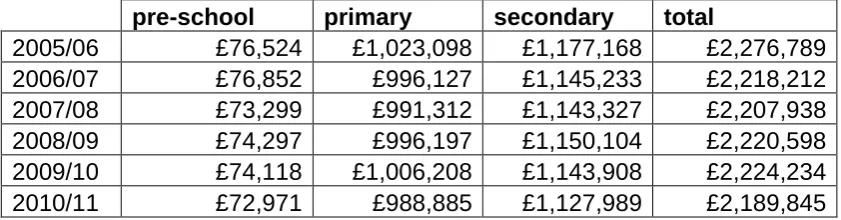
In evidence to the committee in 2008 Fiona Hyslop stated: ―Page 4 of the concordat identifies that there are sufficient resources in the local government settlement to maintain teacher numbers at 53,000.‖(Scottish Parliament ELLC Committee 2008a col 1807). Estimated spend on teacher staff costs fell by 4% in real terms between 2005/06 and 2010/11 (chart 12 and table 2).
Chart 12: Estimated teacher staff costs, 2005/06 to 2010/11. £000’s. Real terms 2009/10 prices.
Table 2: Estimated spend on teaching staff. £000’s. Real terms 2009/10 prices.
pre-school primary secondary total
2005/06 £76,524 £1,023,098 £1,177,168 £2,276,789 2006/07 £76,852 £996,127 £1,145,233 £2,218,212 2007/08 £73,299 £991,312 £1,143,327 £2,207,938 2008/09 £74,297 £996,197 £1,150,104 £2,220,598 2009/10 £74,118 £1,006,208 £1,143,908 £2,224,234 2010/11 £72,971 £988,885 £1,127,989 £2,189,845
TEACHER PAY AND CONDITIONS
A key cost pressure which can affect money available to recruit new teachers is the cost of salary increases. The teacher‘s pay agreement for 2008-11 included pay increases over three years of:
1.4.2008 2.25%
1.4.2009 2.50%
1.4.2010 2.40%
In comparison, inflation was 4% in 2008/09 and -0.5% in 2009/10 (RPI). A classroom teacher at the mid-point of the scale (point 3) would have been earning £26,829 in December 2007 rising to £28,794 in April 2010 (SNCT).
In August 2010, the Herald reported that Glasgow Council had asked the government to look again at the McCrone agreement and ask all teachers to work an extra 30 minutes a day in the class room. Glasgow estimated that this would save £15m annually. (McCrone had set class contact time at 22.5 hours which required extra teachers to be employed over all) (Herald, 2010b). The Cabinet Secretary has said that he is opposed to increasing contact time for fully qualified teachers (Scottish Parliament ELLC Committee, 2010d col 4424).
In November 2010, an agreement on the Local Authority budget (Swinney, J 2010) included:
Freezing pay for two years (in common with other public sector workers)
Increasing contact time for probationers
Removing of salary conservation
Paying all supply teachers on the lowers point of the main grade scale
Changing the leave year to 40 days per annum for calculation of family leave entitlements
Freezing entry to chartered teacher scheme
SETTING THE SUPPLY SIDE
INTAKE TARGETS
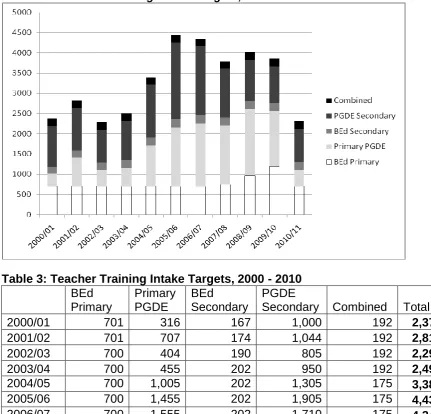
[image:16.595.55.487.267.681.2]Each year the Government undertakes a workforce planning exercise which looks at pupil projections and numbers of teachers leaving the profession in order to predict future demand for teachers. This is worked into advice to the Scottish Funding Council on the number of teacher training places needed. Decisions taken in December 2010 on ITE targets for the BEd, will affect those looking for teaching jobs in August 2016. Chart 13 and table 3 show that intake targets reached a peak in 2006/07 and in 2010/11 have fallen back to levels similar to 2002/03. The reduction this year is particularly noticeable in primary PGDE which reached a peak of 1,655 in 2008/09 but reduced to 405 in 2010/11. Chart 13: Teacher Training Intake Targets, 2000 - 2010
Table 3: Teacher Training Intake Targets, 2000 - 2010
BEd Primary
Primary PGDE
BEd
Secondary
PGDE
Secondary Combined Total
2000/01 701 316 167 1,000 192 2,376
2001/02 701 707 174 1,044 192 2,818
2002/03 700 404 190 805 192 2,291
2003/04 700 455 202 950 192 2,499
2004/05 700 1,005 202 1,305 175 3,387
2005/06 700 1,455 202 1,905 175 4,437
2006/07 700 1,555 202 1,710 175 4,342
2007/08 745 1,455 202 1,210 175 3,787
2008/09 957 1,655 202 1,005 195 4,014
2009/10 1,200 1,355 202 905 195 3,857
2010/11 700 405 202 805 195 2,307
In December 2008, Fiona Hyslop cautioned against cutting teacher training targets: ―I could make easy decisions now to ensure that we have as much employment as possible for probationers by cutting teacher training radically, but the danger would be that in four years' time we would have a teacher shortage, and any
Administration that was in place would face a big challenge.‖ Scottish Parliament ELLC Committee 2008a, col 1801).
However, in February 2010 intake targets were reduced. Michael Russell said:
"By reducing student numbers we can create more jobs for those teachers already qualified. We are working with the Initial Teacher Education providers to ensure we maintain capacity in the system to meet Scotland's future teacher training needs" (BBC 2010b).
It is expected that the lower level will be maintained in for 2011/12 (Scottish Parliament ELLC Committee 2010d col 4413).
The Donaldson review on teacher training published in January 2011 reflected on the difficulty of predicting the demand for teachers and considered that workforce planning needed mechanisms to deal with the fluctuations in demand for teachers. It recommended that:
The accuracy of the planning model should be improved by universities and local authorities providing their latest projections on an annual basis (recommendation 6).
Students should be given better information about the teaching labour market, and the BEd should be replaced by degrees that combine teacher education with other subjects. This will give students more options in job choices (recommendation 7 & 11).
Teachers employed in other occupations should retain a lower level of GTC membership with access to teaching employment information and CPD. (Recommendation 8).
PREFERENCE WAIVER PAYMENT
SOURCES
Association of Graduate Recruiters. (2010) Class of 2010 faces uphill struggle for jobs. News release 6 July 2010. Available at: http://www.agr.org.uk/content/Class-of-2010-Faces-Uphill-Struggle-for-Jobs [Accessed 10 November 2010].
BBC. (2010a) Scottish Teacher Numbers Drop Is ‘Unacceptable.’ 27 November 2009. Available at: http://news.bbc.co.uk/1/hi/scotland/8382530.stm
BBC. (2010b) Teacher training places are to be cut by 40% next year. Available at: http://news.bbc.co.uk/1/hi/scotland/8504946.stm
Cameron, D. (2010) Review of class size control mechanisms: Report of working group. Edinburgh: Scottish Government. Available at:
http://www.scotland.gov.uk/Publications/2010/09/02141620/0
CIPFA. Rating Review Estimates online. Available at:
http://www.cipfastats.net/general/ratingreviewestimates/ [Accessed October 2010]
Donaldson, G. (2011) Teaching Scotland’s Future. Edinburgh: Scottish Government. Available at: http://www.scotland.gov.uk/Publications/2011/01/13092132/0
General Teaching Council Scotland. (2009) Employment Survey 2008/09. Probationer teachers October 2009. Glasgow: GTCS. Available at:
http://www.gtcs.org.uk/web/FILES/FormUploads/employment-survey-2008-20091741_303.pdf
General Teaching Council Scotland (2010a) Teacher induction scheme employment survey –
October 2010. Available at: http://www.gtcs.org.uk/web/FILES/FormUploads/employment-survey-report-probationer-teacher-2009-10-233470_767.pdf
General Teaching Council Scotland. (2010b) Employment Follow-up Survey 2008/09. Probationer teachers May 2010. Glasgow: GTC. Available at:
http://www.gtcs.org.uk/web/FILES/FormUploads/employment-survey-2008-2009-follow-up1739_301.pdf
Herald. (2010a) Teaching jobs plan is ignored by councils. 07 June 2010. Available at: http://www.heraldscotland.com/news/education/teaching-jobs-plan-is-ignored-by-councils-1.1033259 [Accessed 10 November 2010].
Herald. (2010b) Call to make teachers spend longer in class. 30 August 2010. Available at: http://www.heraldscotland.com/news/education/call-to-make-teachers-spend-longer-in-class-1.1051292 [Accessed 10 November 2010]
Learning and Teaching Scotland. CPD Step-in. Available at:
http://ltsblogs.org.uk/cpdteam/2009/12/18/cpdstepin/ Accessed 20 December 2010.
NOMIS. Labour Market Statistics [Accessed 20 December 2010] Available at: https://www.nomisweb.co.uk/Default.asp
OECD. (2010) Education at a glance, 2010. Paris: OECD.
Scottish Executive. (2004a) Spending Review 2004 Technical Notes. Edinburgh: Scottish Executive. Available at: http://www.scotland.gov.uk/News/Releases/2011/01/28091720 Scottish Executive. (2004b) Teachers in Scotland, 2003. Edinburgh: Scottish Executive. Available at: http://www.scotland.gov.uk/Publications/2004/07/19729/40787
Scottish Funding Council. (2006) Circular 6/2006 Edinburgh: Scottish Funding Council. Available at: http://www.sfc.ac.uk/news_events_circulars/Circulars/2006/SFC0606.aspx Scottish Funding Council. (2007) Circular 13/2007 Edinburgh: Scottish Funding Council. Available at: http://www.sfc.ac.uk/news_events_circulars/Circulars/2007/SFC1307.aspx Scottish Funding Council. (2008) Circular 8/2008 Edinburgh: Scottish Funding Council. Available at: http://www.sfc.ac.uk/news_events_circulars/Circulars/2008/SFC0808.aspx Scottish Funding Council. (2009) Circular 18/2009 Edinburgh: Scottish Funding Council. Available at: http://www.sfc.ac.uk/news_events_circulars/Circulars/2009/SFC1809.aspx Scottish Funding Council. (2010) Circular 5/2010 Edinburgh: Scottish Funding Council. Available at: http://www.sfc.ac.uk/news_events_circulars/Circulars/2010/SFC0510.aspx Scottish Government. (2008a) Note of Meeting between Schools Directorate Officials and Deans of Faculties of Education, Monday 2 July 2007. Edinburgh: Scottish Government. Available at: http://www.scotland.gov.uk/About/FOI/Disclosures/2008/02/Minutes
Scottish Government. (2008b) Pre-school and childcare statistics, 2008. Edinburgh: Scottish Government. Available at: 2008, table 24
http://www.scotland.gov.uk/Publications/2008/09/12150803/29
Scottish Government. (2009a) Teachers in Scotland, 2009. Edinburgh: Scottish Government. Available at: http://www.scotland.gov.uk/Publications/2010/02/09090009/0
Scottish Government. (2009b) Pre-school and childcare statistics 2009. Edinburgh: Scottish Government. Available at: http://www.scotland.gov.uk/Publications/2009/09/22154942/0 Scottish Government (2009c) Support for teacher employment. New release 25 November 2009. Edinburgh: Scottish Government. Available at:
http://www.scotland.gov.uk/News/Releases/2009/11/25101207
Scottish Government. (2009d) Pupils in Scotland, 2009. Edinburgh: Scottish Government. Available at: http://www.scotland.gov.uk/Publications/2009/11/05112711/0
Scottish Government. (2010a) Pupil and teacher numbers. Historical data set 1966 – 2009. Edinburgh: Scottish Government. Available at:
http://www.scotland.gov.uk/Topics/Statistics/Browse/School-Education/PupilTeacherHistoric
Scottish Government (2010b) Summary statistics for schools – no. 1. Edinburgh: Scottish Government. Available at: http://www.scotland.gov.uk/Publications/2010/12/01091355/0 Scottish Government (2010c) Consents to borrow. Edinburgh: Scottish Government. Available at:
http://www.scotland.gov.uk/Topics/Government/local-government/17999/LACapital/Borrowing/CTBOther
Scottish Government. (2010e) Teacher vacancies and probationer allocations 2010. Edinburgh: Scottish Government. Available at:
http://www.scotland.gov.uk/Publications/2010/06/01120352/0
Scottish Government. (2010f) Teacher census – supplementary data. Edinburgh: Scottish Government. Available at: http://www.scotland.gov.uk/Topics/Statistics/Browse/School-Education/teachersupplementarydata
Scottish Government (2010) Estimates of employment in the public sector up to Q2 2010. Edinburgh: Scottish Government. Available at:
http://www.scotland.gov.uk/Publications/2010/09/14105157/0
Scottish Government (2010) Finance Circular 7/2010. Edinburgh: Scottish Government. Available at:
http://www.scotland.gov.uk/Topics/Government/local-government/17999/CTBTeachers
Scottish Higher Education Funding Council. (2001) Circular HE/15/01 Edinburgh: Scottish Higher Education Funding Council. Available at:
http://archive.sfc.ac.uk/information/info_circulars/shefc/2001/he1501/he1501.html
Scottish Higher Education Funding council. (2002) Circular HE/13/02 Edinburgh: Scottish Higher Education Funding Council. Available at:
http://archive.sfc.ac.uk/information/info_circulars/shefc/2002/he1302/he1302.html
Scottish Higher Education Funding Council. (2003) Circular HE/06/03 Edinburgh: Scottish Higher Education Funding Council. Available at:
http://archive.sfc.ac.uk/information/info_circulars/shefc/2003/he0603/he0603.pdf
Scottish Higher Education Funding Council. (2004) Circular HE/03/04 Edinburgh: Scottish Higher Education Funding Council. Available at:
http://archive.sfc.ac.uk/information/info_circulars/shefc/2004/he0304/he0304.html
Scottish Labour and Scottish Liberal Democrats. (2003) A Partnership for A Better Scotland. Edinburgh: Scottish Executive. Available at:
http://www.scotland.gov.uk/Publications/2003/05/17150/21955
Scottish National Party (2007) Edinburgh: SNP. SNP Manifesto 2007. Available at: http://www.snp.org/system/files/manifesto+programme.pdf
Scottish Negotiating Council for Teachers. SNCT handbook of conditions of service. Available at: http://www.snct.org.uk/
Scottish Parliament. (2007a) Official Report 20 June 2007. Col 880. Edinburgh: Scottish Parliament. Available at:
http://www.scottish.parliament.uk/business/officialReports/meetingsParliament/or-07/sor0620-02.htm#Col879
Scottish Parliament Education Lifelong Learning and Culture Committee. (2008a) Official Report 31st meeting 2008, Session 3, 17 December 2008. Edinburgh: Scottish Parliament. Available at: http://www.scottish.parliament.uk/s3/committees/ellc/or-08/ed08-3102.htm#Col1801
Scottish Parliament Education Lifelong Learning and Culture Committee. (2008b) Official Report 30th meeting 2008, Session 3, 10 December 2008. Edinburgh: Scottish Parliament. Available at: http://www.scottish.parliament.uk/s3/committees/ellc/or-08/ed08-3002.htm#Col1782
Scottish Parliament Education Lifelong Learning and Culture Committee. (2010a) Official Report 19th meeting 2010, Session 3, 16 June 2010. Edinburgh: Scottish Parliament. Available at: http://www.scottish.parliament.uk/s3/committees/ellc/or-10/ed10-1901.htm
Scottish Parliament Education Lifelong Learning and Culture Committee. (2010b) Official Report 26th meeting, 2010, Session 3, 27 October 2010. Edinburgh: Scottish Parliament. Available at:
http://www.scottish.parliament.uk/s3/committees/ellc/or-10/ed10-2602.htm#Col4048
Scottish Parliament Education Lifelong Learning and Culture Committee. (2010c) Official Report 7th meeting 2010, Session 3, 10 March 2010. Edinburgh: Scottish Parliament. Available at: http://www.scottish.parliament.uk/s3/committees/ellc/or-10/ed10-0702.htm#Col3285
Scottish Parliament Education Lifelong Learning and Culture Committee. (2010d) Official Report 32nd meeting 2010, Session 3, 1 December 2010. Edinburgh: Scottish Parliament. Available at: http://www.scottish.parliament.uk/s3/committees/ellc/or-10/ed10-3201.htm
Swinney, J. (2010) Letter from John Swinney, Cabinet Secretary for Finance and Sustainable Growth and Councillor Pat Watters, President, COSLA to leaders of all Scottish local authorities. Letter dated 17 November 2010.
Times Educational Supplement Scotland. (2003) New induction scheme fails to create jobs in Scotland. 14 November 2003. Available at:
http://www.tes.co.uk/article.aspx?storycode=386987
Times Educational Supplement Scotland. (2007) Move home to find work. 17 August 2007. Available at: http://www.tes.co.uk/article.aspx?storycode=2421693
Times Educational Supplement Scotland. (2008) Grotesque waste of talent. 29 August 2008. Available at: http://www.tes.co.uk/article.aspx?storycode=6001658
Times Educational Supplement Scotland. (2009) Probationer jobs slump.21 August 2009.
Available at: http://www.tes.co.uk/article.aspx?storycode=6021015
Times Educational Supplement Scotland. (2010a) Hard times for new teachers. 20 August 2010. Available at: http://www.tes.co.uk/article.aspx?storycode=6055216
Times Educational Supplement Scotland. (2010b) Golden hello draws more teachers to
RELATED BRIEFINGS
SB 11-09 Class Sizes (551KB pdf)
Scottish Parliament Information Centre (SPICe) Briefings are compiled for the benefit of the Members of the Parliament and their personal staff. Authors are available to discuss the contents of these papers with MSPs and their staff who should contact Camilla Kidner on extension 85376 or email [email protected]. Members of the public or external organisations may comment on this briefing by emailing us at
[email protected]. However, researchers are unable to enter into personal discussion in relation to SPICe Briefing Papers. If you have any general questions about the work of the Parliament you can email the Parliament‘s Public Information Service at
Every effort is made to ensure that the information contained in SPICe briefings is correct at the time of publication. Readers should be aware however that briefings are not necessarily updated or otherwise amended to reflect subsequent changes.