A Dissertation submitted to
THE TAMILNADU Dr. M.G.R. MEDICAL UNIVERSITY CHENNAI - 600 032
In partial fulfillment of the requirements for the award of the Degree of MASTER OF PHARMACY
IN
PHARMACEUTICS
Submitted by MANIKANDAN.R
REGISTRATION No. 261511103
Under the Guidance of
Dr. S.SUBRAMANIAN, M. Pharm., Ph.D., Department of Pharmaceutics
PSG COLLEGE OF PHARMACY PEELAMEDU
This is to certify that the dissertation entitled “SELF NANOEMULSIFYING
TABLETS OF TELMISARTAN - DEVELOPMENT, CHARACTERIZATION,
EFFECT ON DISSOLUTION” is a bonafide work submitted by Reg. No. 261511103,
to The Tamilnadu Dr. M.G.R. Medical University, Chennai in partial fulfilment for
Master of Pharmacy in Pharmaceutics and has been conducted under the guidance of
Dr. S. SUBRAMANIAN M.Pharm, Ph.D., Department of Pharmaceutics, PSG College
of Pharmacy, Peelamedu, Coimbatore in the academic year of 2016-2017.
Guide:
Dr. S.SUBRAMANIAN M.Pharm, Ph.D.,
Head of the Department:
Dr. V. Sankar M.Pharm, Ph.D.,
Principal:
PSG College of Pharmacy, Coimbatore - 641 004. (T.N)
CERTIFICATE
This is to certify that the dissertation work entitled “SELF
NANOEMULSIFYING TABLETS OF TELMISARTAN - DEVELOPMENT,
CHARACTERIZATION, EFFECT ON DISSOLUTION” submitted by University
Reg. No. 261511103 is a bonafide work carried out by the candidate under the guidance
of Dr. S.SUBRAMANIAN M.Pharm, Ph.D., and submitted to the Tamil Nadu Dr.
M.G.R. Medical University, Chennai, in partial fulfillment for the Degree of Master of
Pharmacy in Pharmaceutics, and has been conducted under the guidance of Dr.
S.SUBRAMANIAN M.Pharm, Ph.D., Department of Pharmaceutics, PSG College of
Pharmacy, Coimbatore, during the academic year 2016-2017.
PSG College of Pharmacy, Coimbatore - 641 004. (T.N)
CERTIFICATE
This is to certify that the dissertation work entitled “SELF
NANOEMULSIFYING TABLETS OF TELMISARTAN - DEVELOPMENT,
CHARACTERIZATION, EFFECT ON DISSOLUTION” submitted by University
Reg. No. 261511103 to the Tamil Nadu Dr. M.G.R. Medical University, Chennai, in
partial fulfillment for the Degree of Master of Pharmacy in Pharmaceutics and has
been conducted under the guidance of Dr. S.SUBRAMANIAN M.Pharm, Ph.D.,
Department of Pharmaceutics, PSG College of Pharmacy, Coimbatore, during the
academic year 2016-2017
Place: Coimbatore Dr. V. Sankar, M.Pharm, Ph.D.,
Date: Head of the Department
PSG College of Pharmacy, Coimbatore - 641 004. (T.N)
CERTIFICATE
This is to certify that the dissertation work entitled “SELF
NANOEMULSIFYING TABLETS OF TELMISARTAN - DEVELOPMENT,
CHARACTERIZATION, EFFECT ON DISSOLUTION” submitted by University
Reg. No. 261511103 to the Tamil Nadu Dr. M.G.R. Medical University, Chennai, in
partial fulfillment for the Degree of Master of Pharmacy in Pharmaceutics and has
been conducted under the guidance of Dr. S.SUBRAMANIAN M.Pharm, Ph.D.,
Department of Pharmaceutics, PSG College of Pharmacy, Coimbatore, during the
academic year 2016-2017
Place: Coimbatore Dr. S. Subramanian, M.Pharm, Ph.D.,
I do hereby declare that the dissertation work entitled “SELF
NANOEMULSIFYING TABLETS OF TELMISARTAN - DEVELOPMENT,
CHARACTERIZATION, EFFECT ON DISSOLUTION” submitted to The Tamil
Nadu Dr. M.G.R. Medical University, Chennai, in partial fulfillment for the
Degree of Master of Pharmacy in Pharmaceutics, was done by me under the
guidance of Dr. S.SUBRAMANIAN M.Pharm, Ph.D., Department of Pharmaceutics,
PSG College of Pharmacy, Coimbatore,during the academic year 2016-2017.
Reg. No. 261511103
This is to certify that the dissertation work entitled “SELF
NANOEMULSIFYING TABLETS OF TELMISARTAN - DEVELOPMENT,
CHARACTERIZATION, EFFECT ON DISSOLUTION” submitted by University
Reg. No. 261511103 to The Tamil Nadu Dr. M.G.R. Medical University, Chennai in
partial fulfillment for the Degree of Master of Pharmacy in Pharmaceutics is a
bonafide work carried out by the candidate at the Department of Pharmaceutics, PSG
College of Pharmacy, Coimbatore and was evaluated by us during the academic year
2016-2017.
Examination Center: PSG College of Pharmacy, Coimbatore.
Date:
Internal Examiner External Examiner
Behind every achievement there are many helping hands, my work would be incomplete
unless I mention the names of people those made it possible, whose constant guidance and
encouragement served as a source of inspiration and energy made this success.
It is an honour to express my sincere thanks and gratitude to Head of the Department Dr. V. Sankar, M.Pharm, Ph.D., Associate Professor for guiding me at every stage of the project and his absolute patience has inspired me a lot to venture towards the completion of my
dissertation work.
It is an honour to express my sincere thanks and gratitude to my guide Dr. S. Subramanian, M.Pharm, Ph.D., Associate Professor for guiding me at every stage of the project and his absolute patience has inspired me a lot to venture towards the completion of my dissertation
work.
It is my privilege to acknowledge Dr. M. Ramanathan, M.Pharm, Ph.D., principal, for providing the necessary facilities for carrying out this work.
Friends are treasures to me very time.it is very difficult to overstate my thanks to all my
friends apparently Jayakumar, Manivaasagam, Saravana bharath, Renuka Devi, Vijiyalakshmi, Senith. It has been my happiest time to study with them all.
Also I would like to thank PSG Institutions-management for providing a nice environment for learning. I felt delighted to express my whole hearted gratitude to all those who gave their
CHAPTER NO CONTENTS PAGE NO
1. Introduction 1
2. Literature Review 23
3. Drug Profile 28
4. Excipients Profile 31
5. Objective 40
6. Plan of Work 41
7. Materials and Instruments 42
8. Preformulation Studies 44
9. Experimental Methodology 46
10. Results and Discussions 54
11. Summary and Conclusion 82
TABLE NO PARTICULARS PAGE NO
1. Components of SNEDDS 19
2. Calibration curve of Telmisartan 45
3. Composition of Telmisartan SNEDDS
formulation
47
4. Grades for the visual assessment of self nano
emulsifying formulation
49
5. IP limits for weight variation 51
6. FT- IR data of Telmisartan 55
7. FT- IR data of Pluronic F 127 56
8. FT- IR data of microcrystalline cellulose 57
9. FT- IR data of span 60 58
10. FT- IR data of Drug+excipients 59
11. Calibration curve of Telmisartan 60
12. Solubility studies in oil 61
13. Percentage transmittance of surfactants 63
14. Visual assessment and self emulsification
time of SNEDDS and S-SNEDDS
Formulations
65
15. Characterzation of S-SNEDDS formulations 66
16. Micromeritics properties of SNE powder
formulation
(Before adding glidant)
72
17. Micromeritics properties of SNE powder
formulation
(After adding Talc 2%)
72
18. Compression of telmisartan SNE tablet 73
19. Weight variation test 76
23. Dissolution data of FT11 telmisartan SNE
tablet
78
24. Dissolution data of FT12 Telmisartan SNE
tablets
79
25. Dissolution data of FT13 Telmisartan SNE
tablet
80
26. Dissolution data of Telmisartan tablet-
marketed formlation
FIGURE NO
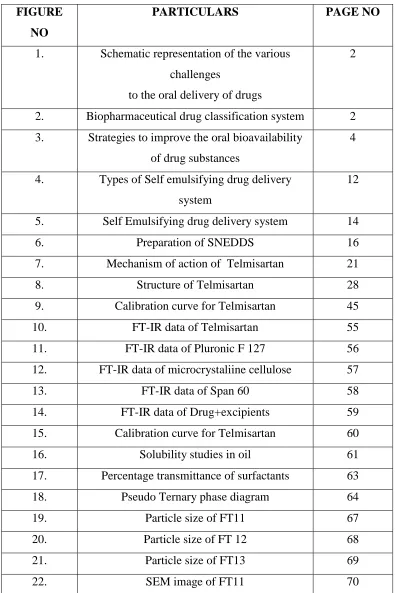
PARTICULARS PAGE NO
1. Schematic representation of the various
challenges
to the oral delivery of drugs
2
2. Biopharmaceutical drug classification system 2
3. Strategies to improve the oral bioavailability
of drug substances
4
4. Types of Self emulsifying drug delivery
system
12
5. Self Emulsifying drug delivery system 14
6. Preparation of SNEDDS 16
7. Mechanism of action of Telmisartan 21
8. Structure of Telmisartan 28
9. Calibration curve for Telmisartan 45
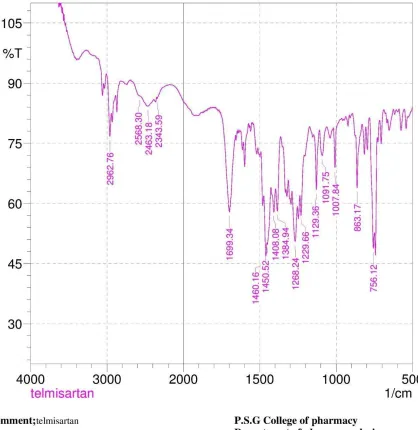
10. FT-IR data of Telmisartan 55
11. FT-IR data of Pluronic F 127 56
12. FT-IR data of microcrystaliine cellulose 57
13. FT-IR data of Span 60 58
14. FT-IR data of Drug+excipients 59
15. Calibration curve for Telmisartan 60
16. Solubility studies in oil 61
17. Percentage transmittance of surfactants 63
18. Pseudo Ternary phase diagram 64
19. Particle size of FT11 67
20. Particle size of FT 12 68
21. Particle size of FT13 69
24. SEM image of FT13 70
25. FT11 Telmisartan SNE tablets 74
26. FT12 Telmisartan SNE tablets 74
27. FT13 telmisartan SNE tablets 74
28. Formulation of Telmisartan Liquid SNEDDS 75
29. Dissolution profile of FT11 SNE Telmisartan
tablet
78
30. Dissolution study of FT12 SNE Telmisartan
tablets
79
31. Dissolution profile of FT13 SNE Telmisartan
tablets
80
32. Dissolution profile of Telmisartan marketed
tablets
Department of Pharmaceutics, PSG College of Pharmacy, Coimbatore.
LIST OF ABBREVATION
UV - Ultra violet
FT-IR - Fourier Transform Infrared
PEG 400 - Polyethylene glycol 400
PG - Propylene glycol
SNEDDS - Self nanoemulsifying drug delivery system
SNET - Self nanoemulsifying Therapeutic system
SEDDS - Self emulsifying drug delivery system
SEM - Scanning electron microscopy
Department of Pharmaceutics, PSG College of Pharmacy Page 1
INTRODUCTION
Around fourty percent of new chemical entities developed by the pharmaceutical
industry are poorly soluble or lipophilic compounds, which result poor oral bioavailability,
high intra and inter subject variability and lack of dose proportionality.
Oral delivery route is the most convenient route for drug administration to achieve
desired therapeutic effects and the greatest degree of patient compliance, especially for chronic
condition diseases. Despite some clinical oral formulations have been developed, their low oral
bioavailability is still a major hurdle, leading to challenges for pharmaceutical manufacturers
to design delivery systems that can provide improved pharmacokinetic profiles and therapeutic
responses. Currently, many efforts such as efflux pump inhibitors, permeation enhancers and
drug nanonization, have been made to overcome the challenges of low oral bioavailability
resulting from low drug solubility, poor permeation and enzymatic degradation, which limiting
drug effective delivery.
Advantages of oral delivery systems
Oral administration is the most widely accepted and preferred route for
pharmaceuticals, due to its high convenience and better patient compliance. Oral
administration of drugs can avoid hospitalization, sterile manufacturing and trained personnel
assistance, so reducing the cost of the health treatment. Pharmaco-economic analyses were
performed in clinical trials to evaluate the economic effectiveness of various oral drugs and to
make a contrast with the cost of infusion administration.
Challenges in the oral drug delivery
Regardless of many advantages, the development of oral delivery route still represents
a great challenge owing to peculiar physicochemical properties of lipophilic drug candidates,
and physiological barriers such as gastrointestinal instability, pre-systemic metabolism and
efflux pump. Upon oral administration, lipophilic drug in a dosage form is easily ingested by
patients, travels in the GIT passing through an extremely various environment. When drug
transits from a strong acidic pH in stomach to basic environment of the intestine, it encounters
harsh pH changes, but also different digestive enzymes and the resident micro flora.
After the digestive journey, only a fraction of dose is available to systemic circulation for the
Department of Pharmaceutics, PSG College of Pharmacy Page 2 are classified into physicochemical properties of drugs and physiological barriers posed by
[image:16.595.127.448.360.575.2]human body (Figure 1).
Figure 1: Schematic representation of the various challenges
to the oral delivery of drugs.
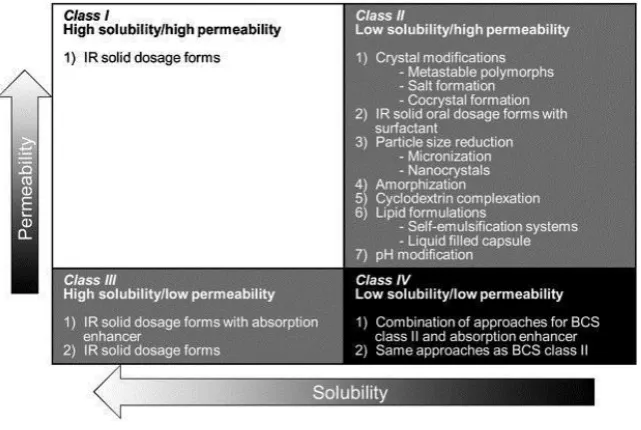
Biopharmaceutical drug classification system
Figure 2: Biopharmaceutical drug classification system
Class I includes drugs that are water soluble and gastrointestinal tract permeable. This class
does not suffer from absorption or permeation problems that may affect oral drug
bioavailability. While classes II, III and IV contain drugs having problems in solubility and/or
Permeability that may reflect on their bioavailability in the blood after the drug is taken orally.
Department of Pharmaceutics, PSG College of Pharmacy Page 3
Solubility of drug substances
A plenty of organic materials are poorly soluble in water. The poorly water-soluble
drugs are typical examples. Poor solubility of a drug is in most cases associated with poor
bioavailability. Furthermore, in drug discovery, about 40% of new drug candidates display
poor solubility in water, which leads to low bioavailability, erratic absorption, high
intra-subject and inter-intra-subject variability and lack of dose proportionality. From a physicochemical
point of view, poor aqueous solubility and low dissolution rate are the major factors that affect
oral delivery of many existing lipophilic drugs. Improving the drug solubility might only solve
one aspect of the problem but it is a starting point to design efficient pharmaceutical
formulations.
Gastrointestinal transit
Human digestive system is complicatedly designed to safely, selectively, and
effectively absorb as many nutrients as possible from our diet. In the case of drug delivery,
after the oral administration, drug candidates have to reach final absorption site – intestine.
However, the gastrointestinal tract (GIT) presents various chemical and enzymatic barriers that
affect delivery of drugs. During the drug transit, the pH of the GI tract lumen rises from the
strongly acidic (pH 1.0–2.0) in the stomach, to 5.0–6.0 in the duodenum, to basic (pH 7.0-9.0)
in the jejunum. On the other hand, variety of enzymes that include lipases and proteases also
function to initiate foodstuff digestion and destroy unwanted pathogens and toxins.
Furthermore, the gastrointestinal transit time is another factor that significantly affects oral
bioavailability and efficacy of many drugs.
Many efforts have been done to enhance the duration for absorption, like the dosage form
mucoadhesive. The use of mucoadhesives can increase local drug concentrations for absorption
enhancement, improve the efficiency for prolonging drug resistance time, and in some cases
restrict absorption to a specific site in the intestine. So far, various types of approaches have
been successfully developed to extend the gastrointestinal transit time, further to improve the
intestinal permeability and to enhance the oral bioavailability.
Approaches for enhancement of oral bioavailability
The common approaches to improve the systemic bioavailability of drugs are to deliver
Department of Pharmaceutics, PSG College of Pharmacy Page 4 Among these routes, oral administration is the most convenient way to achieve the desired
therapeutic effects.
Numerous pharmaceutical scientists have logically focused on oral administration route to
effectively enhance the bioavailability of the drug substances. The key approaches to
maximize oral drug absorption are described as follows:
By using efflux pump inhibitors to improve the efficiency of drug transport;
By using permeation enhancers to inhibit drug degradation and improve permeability; Modifying the physicochemical properties of drugs for improving drug solubility,
stability and dissolution rate;
Designing the specialized formulation such as nanoparticles, micro-particles and
liposomes that improve the drug solubility and protect drugs from harsh environment
of the gastrointestinal tract;
Developing stimuli-responsive systems for controlled drug delivery summarizes the
various strategies that have been investigated and proposed to improve the oral
[image:18.595.85.514.383.706.2]bioavailability of drug substances.
Department of Pharmaceutics, PSG College of Pharmacy Page 5
LIPID BASED DRUG DELIVERY SYSTEMS
Drugs which are poorly water solubility are made well suitable for lipid-based
formulation. Water insoluble and weakly basic drugs require special care in the design and
development of lipid based formulation. These drugs administered in the solubilized form in
the lipid vehicle may come out of the formulation due to solubilisation in the gastric fluid and
may precipitate in the intestinal fluid on gastric emptying. The bioavailability of this system
would depend on how rapidly the precipitates can be resolubilized by the formulation.
The percentage of new chemical entities synthesized with low aqueous solubility and high
therapeutic efficacy is growing, this presents a major challenge for the drug delivery. To
overcome the above challenge different methods were developed for the enhancement of
bioavailability.
Lipid based formulations are more effective delivery system for oral route and improve
bioavailability because of its proven safety and efficacy. Lipid Formulation Classification
System was established by Pouton et al., It aims to enable in vivo studies for interpreting and for the identification of the most appropriate formulations for specific drugs, their
physiochemical properties are taken into consideration.
Lipid-drug conjugates
To overcome the limitation of limited loading capacity for highly potent hydrophilic
drugs and drug expulsion during storage, lipid-drug conjugates have been made. Lipid-drug
conjugates nanoparticle are prepared either by formation of a salt with a fatty acid or
alternatively by covalent linkage (e.g. to ester or ethers). Further process is perform an aqueous
surfactant solution to a nanoparticle formulation using high pressure homogenization. The
lipids that can be used for formulation of lipid–drug conjugates include phospholipids, fatty
acids such as stearic acid, oleic acid, docosahexaenoic acid, etc. and lipoamino acids.
Solid lipid nanoparticles (SLNs)
Solid lipid nanoparticles (SLNs) are composed of melt-emulsified solid lipids like
highly purified triglycerides, monoglycerides, hard fats, complex glyceride mixtures as matrix
materials. As they are derived from biodegradable and compatible lipids, SLN represents a
comparatively stable system with protective effects against serious drug toxicity and harsh
Department of Pharmaceutics, PSG College of Pharmacy Page 6 offer the advantages of avoidance of organic solvents in their preparation, controlled release of
drugs and excellent tolerability.
Of the available methods for preparation, cold high-pressure homogenisation process,
hot homogenization of melted lipids at elevated temperatures and microemulsion technology
are considered as the most feasible methods for large scale production of SLNs. Although solid
lipid nanoparticles (SLNs) have attracted increasing attention due to its advantages, SLNs have
several limitations, for example, low loading efficiency for some drugs which owing to the
densely packed lipid crystal network. Furthermore, SLNs also show considerable expulsion of
the drug during storage.
Lipid nanocapsules (LNCs)
Lipid nanocapsules (LNCs) provide a new nanotechnology which contributes to oral
drug delivery development. LNCs are another kind of lipid nanoparticles, composed of an
internal liquid or semi-liquid oil core and an external lipid layer solid as a core-shell structure.
LNCs with the unique properties such as controlled release profiles and high bioavailability,
represent a promising biocompatible drug delivery platform in nanometer range with narrow
size distribution. The phase inversion temperature (PIT) method proposed by Shinoda and Saito
led to lipid nanocapsules preparation with good mono-dispersion. LNCs prepared by PIT
method is based on three main components: an oil phase, an aqueous phase and a non-ionic
surfactant.
Furthermore, the temperature cycling process crossing the phase-inversion zone (PIZ)
plays another role on LNCs formulation. Increasing the number of cycles promotes LNC
formation and improves the quality of LNC dispersion. Recently, many lipophilic drugs have
been developed in LNCs form for instance, ibuprofen loaded LNCs for pain treatment;
indinavir, an inhibitor of HIV1 protease; various hydrophobic anticancer agents. Consequently,
LNCs provide an attractive drug delivery approach for highly lipophilicity drug substances that
are usually unsuitable for oral use.
Nanosuspensions
Nanosuspensions are nanoscale colloidal dispersion of solid drug particles which are
stabilized by surfactants, polymers or a combination of both. The key difference from
conventional suspensions is that the particle size distribution of the solid particles in
Department of Pharmaceutics, PSG College of Pharmacy Page 7 media milling, high pressure homogenization, microprecipitation-high pressure
homogenization, emulsion diffusion method and melt emulsification method. Owing to the
enhanced drug solubility, increased surface-volume ratio of the nanocrystals, and improved
dissolution rate, oral nanosuspensions have been specifically used. Furthermore,
nanosuspensions are available in various dosage formats such as tablets, pellets, and capsules
following different manufacturing techniques. Nevertheless, the major challenges in
nanosuspensions preparation are maintaining colloidal stability and particle size of the
nanosuspensions during storage. The appropriate selection of the surfactants and/or steric
stabilizers and the method of fabrication have been sought to prevent the nanocrystal
aggregation to achieve the nanosuspensions with long-term storage and physiological stability.
Liposomes
Liposomes are a form of self-assembled lipid bilayer vesicles which composed of one
or more aqueous compartments are completely enclosed by hydrophilic and/or hydrophobic
molecules. Due to the core (aqueous)-shell (lipidic) structure, liposomes are available for
encapsulating hydrophilic drugs in the aqueous core, hydrophobic agents in the lipidic shell,
meanwhile, amphiphilic molecules distributed through the hydrophobic-hydrophilic layers. In
addition, using biologically and natural lipids makes liposomes highly biocompatible and
suitable for in vivo use.
Recently, research on liposomes technology has been extensively investigated for the delivery
of various therapeutic and bioactive agents, decreasing toxicity and increasing their
accumulation at target sites. Nitesh Kumar et al developed lecithin-based silymarin liposomes. The results showed that incorporating phytosomal form of silymarin in liposomes had better in vitro and in vivo hepatoprotection and better anti-inflammatory effects in histopathological changes. Therefore, liposomes can be used in the oral delivery of lipophilic drugs to increase
its oral bioavailability.
Liquid crystalline nanoparticles (LCNPs)
Liquid crystalline nanoparticles (LCNPs), which combine the properties of both liquid
and solid states, are self-assembled from polar amphiphilic lipids in the presence of excess
water. LCNPs are generally prepared by dispersing the liquid crystalline matrix formed into
water phase using high-energy fragmentation, such as ultrasonication, microfluidization, or
Department of Pharmaceutics, PSG College of Pharmacy Page 8 improvement of bioadhesiveness, membrane fusing properties, superior encapsulation,
solubilization, etc. Ni Zeng et al developed self-assembled LCNPs consisting of soy phosphatidylcholine and glycerol dioleate for oral delivery of paclitaxel. The results of this
study suggest that LCNPs could be a promising approach for enhancing the oral bioavailability
of lipophilic drugs and agents.
Self-Nanoemulsifying drug delivery system (SNEDDS)
Self-nanoemulsifying drug delivery systems (SNEDDS) are isotropic mixtures of oil,
surfactant, co-surfactant and drug that rapidly form fine oil-in-water (o/w) nanoemulsions
when introduced into aqueous medium under mild agitation. In the human body, the agitation
required for formation of nanoemulsions is provided by digestive motility of the
gastrointestinal tract. In comparison with the ready to use nanoemulsions or nanosuspensions,
SNEDDS have shown many advantages such as: physical or chemical stability profile
improvement in long term storage; possibility of filling into soft/hard gelatin capsules, which
results in attractive commercial viability and patient acceptability; no palatability-related
issues.In recent years, Self-emulsifying drug delivery systems (SNEDDS) is used to improve
the oral bioavailability of poorly water-soluble drugs.
Polymer based nanocarriers
Polymeric nanoparticles
Polymeric nanoparticles are submicronic solid particles where drug is encapsulated or
adsorbed onto particles. With the increasing study on polymers, polymeric nanoparticles have
emerged as a promising approach in oral drug delivery field due to their unique properties such
as improved drug stability, the duration of the therapeutic effect and to minimize drug
degradation and metabolism etc. A variety of biodegradable and biocompatible polymers have
been used in the research of polymeric nanoparticle preparation include starch, chitosan,
poly(lactic acid) (PLA), poly(lactic-co-glycolic acid) (PLGA), poly(ε-caprolactone) (PCL),
etc. These polymers can be used either separately or combined with each other. The advantages
of polymeric nanoparticles can be their high stability in the gastrointestinal tract, protection
and controlled release of the incorporated drugs, flexibly modulating, and offering targeting
with improved cellular uptake. However, the potential challenge for polymeric nanoparticles
is associated with the polymer toxicity and the residues of organic solvents during the
Department of Pharmaceutics, PSG College of Pharmacy Page 9 friendly to hydrophilic drugs. These limitations of polymeric nanoparticles should be addressed
in the future studies.
Polymeric micelles
Polymeric micelles are nanosized supramolecular constructs formed by amphiphilic
molecules consisting of an inner hydrophobic core and an outer hydrophilic entity. As a
core-shell structure, the hydrophobic core acts a reservoir for lipophilic drugs whereas the
hydrophilic shell protects the drugs to avoid the inactivation and increase the bioavailability
and retention.
Two main methods have been commonly used to produce drug-loaded polymeric micelles.
Direct dissolution involves dissolving both polymer and drug in an aqueous solvent.
Alternatively, organic solvents are employed when both polymer and drugs are highly
hydrophobic. As reported by literatures, polymeric micelles are stable in terms of both
thermodynamic and kinetics, imparting overall structural stability. Moreover, polymeric
micelles allow a multifunctional design to achieve integrated diagnostic and therapeutic
functions and molecular targeting capabilities. Nevertheless, more efforts are still required in
order to overcome the challenges, for examples, low drug loading, low permeability in
transport through intestinal membrane.
Polymer-drug conjugates
By definition, polymer-drug conjugates are formed by the conjugation of a
biocompatible polymeric carrier and low-molecular weight biologically active molecule(s)
through a biodegradable linker. One of the major differences between polymer–drug
conjugates and other nanocarriers that contain physically entrapped drugs is that the drug
molecules are covalently bound to the polymers. Mostly, the presence of polymers increases
the solubility of hydrophobic drugs, modifies drug dispersion profile, extends plasma
circulation half-life, and improves its pharmacokinetic profile, in turn, enhancing the oral
bioavailability of the drugs. On the other hand, the biodegradable linker can also become active
by triggering drug release under certain conditions, such as a change in pH or in the presence
of enzymes, such as esterases, lipases or proteases. A pH-sensitive amphiphilic dendritic
polyrotaxane drug-polymer conjugate by covalently linked doxorubicin (DOX) and dendritic
Department of Pharmaceutics, PSG College of Pharmacy Page 10 condition while without burst release in aqueous at a physiological pH of 7.4. The results
proved that this conjugate has tremendous potentials for targeted cancer therapy.
Drug nanocrystals
Besides liposomes, nanocrystals are the most successful nanocarriers when considering
the first marketed products as well as the total number of commercial products and in clinical
phases. Nanocrystals are nanosized crystals of pure drug particles with the surfactants or
polymeric steric stabiliser absorbed onto the surface of drugs. Thus, drug nanocrystals possess
a 100% drug loading in contrast to polymer or lipid-based nanoparticles. As we known,
decrease in particle size provides a greater surface area in the diffusion layer and leads increase
of the drug dissolution rate, furthermore, enhancing the absorption . Industrially, the drug
nanocrystals are produced with four main technologies, including top-down (e.g. pearl milling,
high pressure homogenisation), bottom-up (e.g. precipitation) and combination (sonication–
precipitation) and chemical approaches.
Dendrimers
Dendrimers are the new artificial well-defined polymeric nanostructures exhibiting
tree-like architecture that consist of a hydrophobic central core, branching units and terminal
functional groups. Dendrimers possess definite molecular weight, shape, size and specific
physicochemical properties including host–guest entrapment properties. Unlike many
traditional polymeric nanocarriers, dendrimers can be manufactured in almost any size whereas
the diameters are commonly 10-20 nm. In addition, dendrimers also have a narrow
polydispersity and well defined spherical shape with a variety of terminal functional groups.
These unique structural nanosized macromolecules offer multiple ways for incorporation of
plenty of drugs which pose oral delivery challenges.
First, drug molecules can be physically encapsulated in the core of the dendrimers.
Second, drug molecules can be chemically conjugated to the functional end groups on the
dendrimer surface during or after synthesis. Third, dendrimer drug networks can be formed.
As an approach for the oral bioavailability enhancement, dendrimers provide many potential
mechanisms. First, the dendrimers entrap the drugs to prevent the drug degradation from harsh
gastrointestinal tract. Next, dendrimers may act as permeability enhancers and alter the barrier
of the intestinal epithelium, thereby improve the drug absorption. Last, the dendrimer-drug
Department of Pharmaceutics, PSG College of Pharmacy Page 11 dendrimers such as size, surface charge and conformation significantly affect the drug delivery
and absorption in the GIT. Moreover, larger dendrimers have been found be more toxic, in
comparison with the smaller ones. Conclusively, dendrimers are promising delivery system,
but more efforts should be required to overcome challenging biological barriers.
Others
Except the above mentioned strategies, many other nanotechnologies are also employed
in the oral drug delivery, for example, carbon nanotubes, silica and silicon nanoparticles,
nanogels and so on. Carbon nanotubes possess unique hollow cylindrical structures, high
surface area, conductivity, optical and potential higher absorption capabilities, allow the
incorporation of drug molecules for controlled and site-specific delivery. Silica/silicon
nanoparticles offer a high absorption capacity, mesoporous channel to change the crystalline
state of the drugs and the possibility to tailor the physicochemical properties. The
biocompatibility, chemical properties and mesoporous structure make silica/silicon
nanoparticles an excellent alternative for drug delivery application. Nanogels are commonly
used for oral controlled drug delivery with the advantages such as thermodynamic
compatibility with water, enviro-intelligent, stimuli-sensitive and sustained release.
In recent years, SNEDDS have attracted more and more attention as the mean to
enhance the oral bioavailability of poorly soluble and highly metabolized drugs. Nevertheless,
conventional SNEDDS also require a relatively large amount of surfactants, which may induce
GI irritation and side-effects. In order to achieve a safe and efficient delivery system for the
poor oral bioavailability drugs, we have designed a novel self-nanoemulsifying drug delivery
system with high proportion lemon essential oil as carrier for lipophilic drugs.
Self-emulsifying drug delivery systems (SEDDS)
Self-emulsifying drug delivery systems (SEDDS) are emulsion pre-concentrates or
anhydrous forms of emulsion. These systems (SEDDS) are ideally isotropic mixtures of drugs,
oils and surfactants, sometimes containing co-surfactant or co-solvents. Upon mild agitation
followed by dilution with aqueous media, SEDDS can form fine oil-in-water emulsions
spontaneously. In gastrointestinal tract of human body, the agitation required for formation of
emulsions is provided by gastric mobility, the aqueous media are gastrointestinal fluids. In
comparison with ready-to-use emulsions, which are metastable dispersed forms, SEDDS
Department of Pharmaceutics, PSG College of Pharmacy Page 12 easy manufacture property. Thus, for the lipophilic drugs that exhibit poor water solubility and
rate−limited dissolution, SEDDS may offer an improvement in the rate and extent of absorption
and result in more reproducible blood−time profiles.
Types of SEDDS
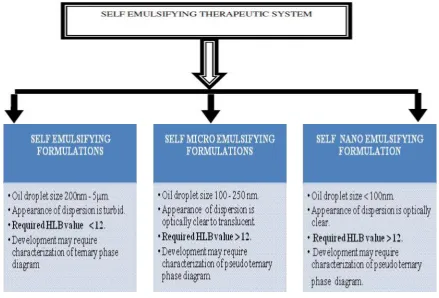
SEDDS include both self-microemulsifying drug delivery systems (SMEDDS) and
[image:26.595.94.534.205.503.2]self-nanoemulsifying drug delivery systems (SNEDDS).
Figure 4: Types of Self emulsifying drug delivery system
SMEDDS indicate the formulations producing transparent microemulsions with
droplets size range between 100 and 250 nm while SNEDDS form emulsions with the globule
size range lower than 100 nm. The term ‘droplet’ is used to describe micelles, mixed micelles
which exist in the emulsions. In details, the microemulsion is a thermodynamically stable
colloidal dispersion consisting of small spheroid particles (comprised of oil, surfactant, and
possibly co-surfactant) dispersed within an aqueous medium and thus in equilibrium. In
contrast, the nanoemulsion is non-equilibrium colloidal dispersion system that over time
Department of Pharmaceutics, PSG College of Pharmacy Page 13 However, nanoemulsions can have a relatively high kinetic stability, and in this case it
will be difficult to distinguish on the previous basis micro and nano-emulsions. Actually, the
structure of the droplet in both nanoemulsion and microemulsion are very similar: the
non-polar tails of surfactant molecules protrude into the lipophilic core formed by the oil, while the
polar head groups protrude into the surrounding aqueous phase
Nanoemulsions
Nano-emulsions are a new class of emulsion which can be defined as an emulsion with uniform
and extremely small droplet sizes, typically in the range of 20–200 nm. The physical
appearance of nano-emulsion is transparent or translucent because of their small droplets size.
Their small droplets size makes it kinetically stable against sedimentation or creaming for a
long period of time. The use of nano-emulsions in oral dosage forms, achieve promising results
in increasing the effectiveness of the drug at the target site, as well as can increase drug
bioavailability, enhanced permeability and therapeutic functions. Efforts are madewith
SNEDDS to enhance the oral bioavailability of lipophilic drugs in order to increase their
pharmacological efficacy.
Nanoemulsions are non-equilibrium, heterogeneous systems composed of oil droplets
dispersed in an aqueous medium and stabilized by surfactant molecules. In a nanoemulsion,
the oil droplets serve as the reservoir for hydrophobic drugs. Moreover, nanoemulsions are
regarded as kinetically stable, isotropic and transparent without any apparent coalescence
during the long time storage.
The nanoemulsions are usually stabilized by large amount of surfactants, which can
improve drug solubilisation, protect active compound against physicochemical and enzymatic
degradation and modify the permeability of the GIT membrane. Non-ionic surfactants are
commonly preferred due to their less toxicity, less affected by pH and ions than ionic and
amphiphilic surfactants, and better compatibility with biological systems. Combinations of
different surfactants have also been employed to decrease the droplet size and improve the
stability of nanoemulsions. Methods used for the production of nanoemulsions include
high-pressure homogenization, microfluidization, ultrasonication, spontaneous emulsification and
so on. The advantages of nanoemulsions are increased drug loading, tissue targeting and
Department of Pharmaceutics, PSG College of Pharmacy Page 14
SELF NANO EMULSIFIED DELIVERY SYSTEMS
Lipid based formulations such as self nano emulsified delivery systems (SNEDDS) are
said to increase the absorption of the lipophilic drugs. SNEDDS are isotropic mixtures of oil,
surfactant, co-surfactant and drug that form oil in water emulsion in aqueous environment
under gentle agitation. This forms a good mode for delivering poorly soluble drugs orally by
increasing their bioavailability and stability. They offer large interfacial area between the oil
and GIT fluids and enhance the rate of absorption of the drugs
Self-nanoemulsifying Drug Delivery system (SNEDDS) is isotropic mixture of natural
or synthetic oil, surfactants and co-surfactants that havea unique ability of forming fine
oil-in-water (O/W) nano-emulsions under mild Agitation followedaqueous media. Self-Nano
emulsifying Drug Delivery System having size range of globules is less than 100nm under
dispersion of water.
Figure 5: Self Emulsifing drug delivery system
SNEDDS spread readily in the gastrointestinal tract, and the digestive motility of the
stomach and the intestine provide the agitation necessary for self-emulsification. Spontaneous
emulsification to produce fine oil-in-water emulsion under gentle agitation followed by
dilution in aqueous media can occur in oil and surfactants mixture. The production of
self-emulsifying formulation involves several combinations of oil and surfactants, also the
efficiency of self-emulsifying formulation can be influenced by several factors such as HLB
value of the surfactant and surfactant concentration. The components used must be suitable for
Department of Pharmaceutics, PSG College of Pharmacy Page 15 These SNEDDS are given in the form of soft or hard gelatin capsules or in the form of
Tablets. They reach the gastro intestinal tract and the GI motility of the stomach provides the
agitation for self-emulsification. Because of this self-emulsification the drug is given as small
droplets with size less than 5μm for improved solubility. After administering orally, lingual
and pancreatic lipases act on the oily phase of the SNEDDS that result in the formation of
emulsified mono-glycerides, di-glycerides and fatty acids. This in the presence of bile acids
leads to the formation of intestinal mixed micelles. When these mixed micelles pass through
the enterocytes, it leads to the formation of chylomicrons. These drain the drug into the
lymphatic vessels and not in the blood vessels thus bypassing the first pass effect. Thus the oral
bioavailability gets increased.
These study shows preparation of various kind of SNEDDS formulation by performing trial
batches of various oils (sunflower oil, soyabean oil, olive oil), surfactants (Acrysol derivatives
and other Gattefosse surfactants, Tween 80, Tween 20), cosurfactants (captex 200,captex
300,labrafil M 2125) and cosolvents (PEG 400,Propylene Glycol, ethanol) with drug to assess
the ability of drug in solubilized form and to form a transparent solution for better
emulsification ratio of Surfactant: Cosurfactant: Cosolvents remains same. Nonionic
surfactants with high HLB (HLB = 10) and subsequent hydrophilicity is necessary for the
instant creation of oil in water droplets and/or rapid spreading of the formulation in the aqueous
environment providing a good dispersing/self-emulsifying performance. The surfactants are
amphiphilic in nature have ability to dissolve and solubilize to some extent high quantities of
the hydrophobic drug. In SNEDDS generally surfactant of HLB value 8-16 is used.
Self nanoemulsifying drug delivery system (SNEDDS) has received particular attention as a
means of improvement of oral bioavailability poorly soluble and absorbed drugs. SEDDS are
the mixture of oils, surfactants, and co-surfactants. This becomes emulsify when come in
contact with aqueous solution of GIT under the condition of gentle stirring and digestive
motility. SNEDDS includes various dosage forms like capsule, tablets, beads, microspheres,
nanospheres, etc. thus SNEDDS could efficiently improve oral absorption of the sparingly
soluble drugs by self-emulsification. For the improvement of bio-availability of drugs with
Department of Pharmaceutics, PSG College of Pharmacy Page 16
Figure 6: Preparation of SNEDDS
The bioavailability enhancing property has been associated with a number of in-vivo properties of lipidic formulation including:
The formation of fine dispersions and micellar suspensions to prevent precipitation and recrystallization of the drug compound.
The ability of certain lipid compounds and their metabolites to initiate changes in the
gastrointestinal fluid to favor improved drug absorption.
The inhibition of cellular efflux mechanisms and pre-absorptive metabolism by gut
membrane-bound cytochrome enzymes, further augmenting the absorption enhancing
properties of these formulations.
Certain lipidic excipients are associated with selective drug uptake into the lymphatic
transport system, thereby reducing the effect of first-pass drug metabolism in the liver.
SNEDDS are particularly useful when the poorly water soluble compounds are to be
pre-dissolved in a suitable solvent and filled into capsules. The main benefit of this approach is that
pre-dissolving the compound overcomes the initial rate limiting step of particulate dissolution
in the aqueous environment within the GI tract. However, a potential problem with this system
is that the drug may precipitate out of solution when the formulation disperses in the GI tract,
particularly if a hydrophilic solvent is used (e.g. polyethylene glycol). But alternatively, if the
drug can be dissolved in a lipid vehicle there is less potential for precipitation on dilution in
Department of Pharmaceutics, PSG College of Pharmacy Page 17 Some of the potential advantages of self-emulsifying lipid formulations include
physicochemical stability, enhanced oral bioavailability enabling reduction in dose, consistent
temporal profiles of drug absorption, selective targeting of drug towards specific absorption
window in GIT, control of drug delivery profiles, ability to increase Cmax, AUC, and reduced
tmax, linear AUC-dose relationship, reduced variability including effect of food, protection of
sensitive drug substances, high drug payloads and flexibility of designing liquid or solid dosage
forms.
Advantage of SNEDDS
1. Enhanced oral bioavailability enabling reduction in dose.
2. Selective targeting of drugs toward specific absorption window in GIT.
3. High drug payloads.
4. Control of delivery profiles.
5. Emulsion is sensitive and metastable dispersed forms while S(M)EDDS are physically stable
formulation that are easy to manufacture.
6. As compared with oily solutions, they provide a large interfacial area for partitioning of the
drug between oil and water.
7. SEDDS help to wide distribution of the drug throughout the stomach and promote wide
distribution of the drug throughout the GI tract, thereby minimizing the irritation frequently
encountered during extended contact between bulk drug substance and the gut wall.
Potential advantages of these systems include enhanced oral bioavailability, more consistent
temporal profiles of drug absorption, selective drug targeting toward a specific absorption
window in the GI tract, and drug protection from the hostile environment in the gut. Thus
for lipophillic drug compounds that exhibit dissolution rate limited absorption, these system
may offer an improvement in the rate and extent of absorption.
Disadvantages of SNEDDS
1. Traditional dissolution methods do not work, because these formulations potencially are
dependent on digestion prior to release of the drug.
2. This in vitro models needs further development and validation before its strength can be
Department of Pharmaceutics, PSG College of Pharmacy Page 18 Further development will be based on in vitro - in vivo correlations and therefore different
prototype lipid based formulations needs to be developed and tested in vivo in a suitable
animal model.
The drawbacks of this system include chemical instabilities of drugs and high surfactant
concentrations in formulations (approximately 30-60%) which GIT.
Limitation of SNEDDS
conventional SEDDS, which are mostly prepared in a liquid form and orally administered in
soft or hard gelatin capsules, can make some disadvantages such as high production costs, low
drug incompatibility and stability, drugs leakage and precipitation, capsule ageing. Then
incorporation of liquid SEDDS into a solid dosage form is compelling and desirable. Recentl
y, a new drug delivery technology-solid SEDDS (S-SEDDS) which combine the advantages of
SEDDS and those of solid dosage forms, have been investigated.
Factors affecting SNEDDS
Drugs which are administered at very high dose are notsuitable for SNEDDS, unless they
exhibit extremely good solubility in at least one of the components of SNEDDS, preferably
lipophillic phase. The drugs exhibit limited solubility in water and lipids are most difficult to
deliver by SNEDDS.
The ability of SNEDDS to maintain the drug in solubilized form is greatly influenced by the
solubility of the drug in oily phase. If the surfactant or co-surfactant is contributing to a greater
extent for drug solubilization, then there could be a risk of precipitation, as dilution of
SNEDDS will lead to lowering of solvent capacity of surfactant or co-surfactant.
Components of SNEDDS
It is very important to select and optimize the quantities of the SNEDDS components. Because
the components of SNEDDS and their concentrations will influence the various characteristics
of nano emulsions, such as droplet size, polydispersity index, self-nano emulsification time and
in vitro drug release. In general, the selection of the components based on their ability to solubilize the drug of interest and also on their ability to form spontaneous
Department of Pharmaceutics, PSG College of Pharmacy Page 19
Oils: Long and medium-chain triglyceride oils with different degrees of saturation have been used for the design of SEDDS. Oil can facilitate self-emulsification and increase the fraction
of lipophilic drug transportation via the intestinal lymphatic system, thereby increasing
absorption from the GI tract. Modified or hydrolyzed vegetable oils have contributed widely
to the success of SEDDSs owing to their formulation and physiological advantages. Novel
semi-synthetic medium-chain triglyceride oils have surfactant properties and are widely
replacing the regular medium- chain 12-14 triglyceride.
Surfactant: Non-ionic surfactants are used in formulation of SNEDDSs. The usual surfactant concentration is between the ranges of 30–60% w/w of the formulation in order to form a stable
SNEDDS. Surfactant having a high hydrophilic lipophilic balance (HLB) and hydrophilicity
assists the immediate formation of o/w droplets and/or rapid spreading of the formulation in
the aqueous media. Surfactants are amphiphilic in nature and they can dissolve or solubilize
relatively high amounts of hydrophobic drug compounds. This can prevent precipitation of the
drug within the GI lumen.
[image:33.595.72.554.531.768.2]Co-solvents: Co-solvents used in SEDDS helps to dissolve large amounts of hydrophilic surfactants or the hydrophobic drug in the lipid base.
Table 1: Components of SNEDDS
Component Examples
Fatty acids Palmitic acid, Stearic acid, Oleic acid
Fatty acid esters Glyceryl monooleate [Capmul1 GMO,Imwitor1
948, Peceol1], Glyceryl monostearate [Capmul1
GMS-50, Imwitor1 191], Glyceryl monolinoleate
[MaisineTM 35-1], Glyceryl palmito stearate
[Precirol1 ATO 5], Glyceryl behenate [Compritol1
Department of Pharmaceutics, PSG College of Pharmacy Page 20 mono- and diglycerides [Capmul1 MCM], Medium
chain triglycerides [Labrafac1 CC Miglyol1 810
and 812], Glyceryl dilaurate, Propyleneglycol
monolaurate [Lauroglycol1 FCC, Capmul1 PG-12]
Propyleneglycol esters Propyleneglycol monolcaprylate [Capryol1 90,
Capmul1 PG-8], Propylene glycol dicaprylocaprate
[Labrafac1 PG]
Lipids and oils
Miscellaneous Stearyl alcohol,Phospholipids, Bees Wax,Vitamin E
Surfactants/ stabilizers Caprylocaproyl polyoxyl-8-glycerides [Labrasol1],
Polyoxyethylene sorbitan fatty acid esters
[Tween1], Polyoxyethylene castor oil derivatives
[Cremophor1, Lipocol1], Polyvinyl alcohol,
Sorbitan esters [Span1], Tocopherol polyethylene
glycol, succinate (TPGS)Macrogol fatty acid
glycerides [Gelucire1 44/ 14, Gelucire1 50/13],
Co-surfactants Hydroxyl propyl methyl cellulose, Poloxamer,
Phospholipids and PEGylated phospholipids,
co-solubilizers Polyvinyl pyrrolidone, Bile acids (sodium
deoxycholate), Cellulose derivatives, Polyglyceryl-
co-stabilizers
3 dioleate [Plurol1, Oleique1 CC497]
Propylene glycol, Glycofurol, Phospholipids, Oleoyl/
linoleoyl polyoxyl-6-glycerides [Labrafil1],
Polyethylene glycol, Triacetin, Ethanol, Diethylene
Department of Pharmaceutics, PSG College of Pharmacy Page 21
Telmisartan
Telmisartan is Angiotensin II Receptor Antagonist, which is used in the prevention and
treatment of Hypertension.Telmisartan belongs to class II drug in BCS classification i.e. low
solubility and high permeability.One of the major problems with this drug is its low solubility
in biological fluids, which results into poor bioavailability after oral administration.The
solubility of Telmisartan in aqueous medium was very low i.e. 0.078 mg/ml in water. Absolute
bioavailability of the Telmisartan was 42-58% and biological half-life is only 24 hours that
[image:35.595.83.525.270.562.2]results into poor bioavailability after oral administration.
Figure 7: Mechanism of action of Telmisartan
Poor solubility of Telmisartan leads to poor dissolution and hence variation in bioavailability.
Thus increasing aqueous solubility and dissolution of Telmisartan is of therapeutic importance.
A many number of approaches have been developed to improve the drug solubility and
dissolution of drugs. The solid dispersion is a technique to achieve this goal particularly the
poor aqueous soluble drugs in which the drug is incorporated in to water soluble polymeric
matrix . In this research the solubility and bioavailability of telmisartan in conjugation with
Department of Pharmaceutics, PSG College of Pharmacy Page 22 study, the various evaluation methods were carried out to determine the physico chemical
properties of physical mixture and solid dispersions in comparison to pure drug.
Previous researchers have made attempts to improve the aqueous solubility of telmisartan by
preparing solid dispersion and solid lipid nanoparticles. The preparation of solid dispersion is
easy, but its limitations include stability of the drug and the difficulty of incorporating into
solid dispersion in suitable dosage forms. For solid dispersion, the amount of carriers used is
often large, and thus if the dose of the active ingredient is high, the tablets or capsules formed
will be large in volume and difficult to swallow.
Moreover, the carriers used are usually expensive and the freeze-drying or spray-drying method
requires particular facilities and processes, leading to a high production cost. Though a
traditional solvent method can be adopted instead, it is difficult to deal with co-precipitates
with a high viscosity. One potential problem with solid lipid nanoparticles formulation is that
the drug may favor a more thermodynamically stable state, which can result in the compound
crystallizing in the polymer matrix.
There is a necessity to develop a formulation that would offer rapid dissolution of temisartan
and improve its bioavailability and finally therapeutic efficacy. Lipid-based formulation
approaches, predominantly the self-emulsifying drug delivery system (SEDDS), illustrate their
potential as alternative approaches for the delivery of hydrophobic drugs. Dosing of drug
substances that exhibit poor water solubility, but sufficient lipophilic properties in a
predissolved state are advantageous in view of the fact that the energy input allied with a
solid-liquid phase transition is circumvented, thus overcoming the slow dissolution process after oral
Department of Pharmaceutics, PSG College of Pharmacy Page 23
LITERATURE REVIEW
Hyma .P1, Anusha Chandra, Abbulu K et al., (2014) Telmisartan SMEDDS were
prepared as a novel technique to improve the solubility of poorly soluble drug. The
preformulation studies done clearly indicate good compatibility of the drug with the
various excipients used. The reduction of particle size was clearly depicted in the
droplet size measurements where the size is reduced to nanometer range, which has led
to increase in dissolution rates as shown in the dissolution studies and graph.. Thus it
can be concluded that micro emulsion formulation can be used as a successful tool to
enhance the bioavailability of the drug, and there formulations can be further tested in
vivo by using animal models.
Mr. Girish C. Soni, S.K. Prajapati, Nirvesh Chaudhri et al.,(2014) Ease of
manufacture and scale-up is one of the most important advantages that make SNEDDS
unique when compared with other novel drug delivery systems, such as solid
dispersions, liposomes and nanoparticles. SNEDDS require very simple and
economical manufacturing facilities, such as simple mixer with an agitator and
volumetric liquid filling equipment for large-scale manufacturing. These SNEDDS are
better formulation for drugs with poor solubility. This gives good absorption profiles
thus offering high bioavailability for such drugs when administered orally. However
the role of nanoscale in improving the transport of drug across biological membranes
and therapeutic efficacy is debatable in the case of nanoemulsions. The amenability of
converting SNEDDS into solid self-nanoemulsifying systems enables development into
solid dosage form. Thus, the solid self-nanoemulsifying system can serve as platform
technology for delivering poorly soluble drugs. Although a lot of research is being
carried out in this area, other aspects, such as in vito /in vivo correlation, need to be
Department of Pharmaceutics, PSG College of Pharmacy Page 24 Parul Jaiswal, Geeta Aggarwal, Sasidharan Leelakumari Harikumar, and
Kashmir Singh et al., (2014) Self-microemulsifying drug delivery system is a vital tool in overcoming the formulation difficulties and improving the oral bioavailability
of hydrophobic/lipophilic drugs. In this study, SMEDDS and solid-SMEDDS
formulations of poorly water-soluble drug, telmisartan were successfully prepared by
the ultrasonication method and adsorbent technique respectively for oral
administration. Further, they were assessed for in vitro performances. Among various
formulations, F3 in SMEDDS and SF3 in solid-SMEDDS showed promising results in
the terms of globule size analysis, self-emulsification time, zeta potential, drug loading
efficiency and in vitro drug release. It could be summarized that SMEDDS formed from
castor oil, tween 20 and propylene glycol as oil, surfactant and co-surfactant is a
promising approach to improve the solubility, dissolution rate and hence bioavailability
of telmisartan. The optimized formulations showed significantly improved drug release
as compared to pure drug. Solid-SMEDDS were preferred over SMEDDS in terms of
stable dosage form. It can be concluded that telmisartan solid-SMEDDS offer more
predictable and more extensive drug release/absorption than the corresponding
conventional formulations. The results from the study showed the utility of
solid-SMEDDS to enhance solubility and bioavailability of sparingly soluble compounds like
telmisartan, which can be helpful to reduce dose and related side effects of the drug.
The present exploratory work successfully illustrates the potential utility of
solid-SMEDDS for the delivery of poor water-soluble compounds.
Sindhu Raavi*, Subramanian S, Surya Kiran Vuddisa et al., (2014) It can be
concluded from the experimental study carried out that the formulation of a poorly
water soluble drug, Atorvastatin calcium , into a Supersaturated Self Nanoemulsifying
Drug Delivery System yields a formulation with the droplets in the nano size range with
good zeta potential. The in vitro study of the best formulation AS- 3s SNE tablet with
2% starch as binder showed a 2.5 fold increase in the bioavailability when compared to
Department of Pharmaceutics, PSG College of Pharmacy Page 25 Ali M. Nasr *, Ahmed R. Gardouh , Hassan M. Ghonaim and Mamdouh M.
Ghorab et al., (2016) In this study, a novel liquid SNEDDS consisting of Capryol 90, Cremophor RH40 and Transcutol HP as an oil phase, surfactant and co-surfactant,
respectively, was formulated and further developed into a solid SNEDDS by a
spray-drying technique using Aerosil 200 as the solid carrier. From this study it was concluded
that the prepared liquid SNEDDS was thermodynamically stable with good self
emulsification efficiency and having globule size in nanometric range which may be
physiologically stable. Study also concluded that S-SNEDDS of IRB prepared by a
spray-drying technique using Aerosil 200 as the solid carrier have good flow properties
and drug content. This solid SNEDDS preserved the self-emulsification performance
of the liquid SNEDDS and gave a faster in-vitro dissolution rate than the crude powder
and marketed product. Results of SEM demonstrate that spherical particles of
S-SNEDDS can be obtained without agglomeration. Considering the limitations
associated with liquid SNEDDS, a solid powder formulation should be a more
acceptable form. Furthermore, our results suggest that the S-SNEDDS could be
considered and further evaluated for the oral delivery of lipophilic poorly soluble drugs
for which an oral route of administration is desirable. In conclusion, Self emulsifying
drug delivery systems were a promising approach for the formulation of IRB.
S-SNEDDS appeared to be an interesting approach to improve problems associated with
oral delivery of IRB. Thus S-SNEDDS can be considered as novel and commercially
feasible alternative to current marketed IRB. Finally, the oral delivery of hydrophobic
drugs can be made possible by SSNEDDS, which have been shown to substantially
improve the oral bioavailability
NiraliPadia, Arunkumar Shukla, PragnaShelat et al .,(2015) In this study,
SMEDDS of Telmisartan were prepared and evaluated for their in vitro and in vivo
behavior. Prepared liquid SMEDDS was thermodynamically stable with good self
emulsification efficiency and having globule size in nanometric range which may be
physiologically stable. The optimized formulation consisting of Telmisartan (20mg),
Capmul MCM (14.40%w/w), Tween 80 (27.20% w/w) and Propylene glycol (54.40%
w/w) exhibited faster release profiles with a rapid rate of emulsification. The optimized
SMEDDS formulation of Telmisartan showed a significant increase in oral absorption
Department of Pharmaceutics, PSG College of Pharmacy Page 26 SMEDDS was found to be comparatively higher (1.54 fold) than reference marketed
product indicating better rate and extent of absorption than reference formulation. Thus,
SMEDDS can be regarded as a novel and commercially feasible alternative to current
Telmisartan formulations. However, further studies in the higher animals and human
beings need to be performed before this formulation can be commercially exploited.
Rahul S. Narkhede, Kishor N. Gujar, Vaishali M. Gambhire* et al ., (2013) The
present study has clearly showed the potential utilization of S-SNEDDS for formulating
NEB with improved aqueous solubility, stability and in-vitro drug release. The
S-SNEDDS with relatively high cryoprotectant effect was prepared which self-emulsified
easily with mean emulsion droplet size of 156.34 nm. Stability study and cloud point
study confirmed that the S-SNEDDS had no dilution effect and was stable at 0.1 N HCl
and phosphate buffer 6.8 without any change in emulsion droplet size.
Ali Nasr*, Ahmed Gardouh , and Mamdouh Ghorab , et al ., (2016) In this study,
liquid SNEDDS was formulated and further developed into solid SNEDDS by a
spray-drying technique using Aerosil 200 as the solid carrier. From this study, it was
concluded that the prepared liquid SNEDDS was thermodynamically stable with good
self-emulsification efficiency and having globule size in the nanometric range which
may be physiologically stable. It was also concluded that S-SNEDDS preserved the
self-emulsification performance of the liquid SNEDDS and gave a faster in vitro
dissolution rate than the crude powder and marketed product. Furthermore, our results
suggest that S-SNEDDS could be considered and further evaluated for the oral delivery
of lipophilic poor soluble drugs for which an oral route of administration is desirable.
In conclusion, self-emulsifying drug delivery systems represented a promising
approach for the formulation of OLM. S-SNEDDS appeared to be an interesting
approach to improving problems associated with oral delivery of OLM. Thus,
S-SNEDDS can be considered as a new and commercially feasible alternative to current
marketed OLM. Finally, the oral delivery of hydrophobic drugs can be made possible
by S-SNEDDS, which have been shown to substantially improve the oral
Department of Pharmaceutics, PSG College of Pharmacy Page 27 Payal Gupta, Pramod Kumar Sharma, Nitin Kumar, Yogesh Pawar, Jitendra
Guptaet al., (2014) SNEDDS is a promising approach for BCS class II or IV and drug compounds with poor aqueous solubility. The method used for lipophilic drugs where
resulting emulsification gives faster dissolution rates. The oral delivery of hydrophobic
drugs can be made possible by SNEDDS which have been shown to substantially
improve oral bioavailability with future development of this technology. SNEDDS will
continue to enable novel applications in drug delivery and solve problems associated
Department of Pharmaceutics, PSG College of Pharmacy Page 40
OBJECTIVE
To prepare SNEDDS of Telmisartan
To convert Liquid SNEDDS to Solid – SNEDDS form
To characterize the prepared SNEDDS for the size, self emulsification time, drug
content
Department of Pharmaceutics, PSG College of Pharmacy Page 41
PLAN OF WORK
PHASE – I
Drug profile
Polymer and excipient profile
PHASE- II
Preformulation studies
a. Identification of drug
1. Melting point determination
2. Infrared studies
b. Solubility studies
c. Calibration curve
PHASE - III
Preparation of liquid SNEDDS
Conversion of liquid SNEDDS to solid SNEDDS
PHASE- IV
Characterization of nano particle formulation
Particle size determination Zeta potential
SEM analysis
Self-emulsification time
PHASE- V