ICT
3107
– Microprocessors
and
I
nterfacing
Lecture Notes # 2 Outline of the Lecture
Brief History of 80x86 Family of Microprocessors Pipelining and Registers
Introduction to Assembly Programming
BRIEF HISTORY OF 80X86FAMILY OF MICROPROCESSORS Evolution from 8080/8085 to 8086
¾ Intel introduced 8086 microprocessor in 1978. This 16-bit microprocessor was a major improvement over the previous generation of 8080/8085 series of microprocessors.
8086 8080/8085 1 megabyte
(20-bit add. bus) Memory of 64 kilobyte (16-bit add. bus)
16-bit Data bus 8-bit data bus
Pipelined processor
(first single-chip
µ
pr.) Non-pipelinedµ
pr¾ In a system with pipelining, the data and the address bus are busy transferring data while the CPU is processing information.
Evolution from 8086 to 8088
¾ 8086 was with 16-bit data bus internally and externally. All registers and the data bus carrying data in/out of the CPU were 16-bit.
• That time all the peripherals were designed around 8-bit microprocessor. • It was expensive to built PCB with 16-bit data bus.
¾ So Intel introduced 8088 which was;
• Identical to 8086 internally, but externally 8-bit data bus instead of 16-bit. • It had 1 megabyte of memory like 8086.
¾ IBMs decision to pick up 8088 as their choice of microprocessor in designing the IBM PC. • 8088-based IBM PC was enormous success, because IBM and Microsoft made it an open
system.
• This enabled the cloning of this system and resulted a huge growth in both hardware and software designs based on IBM PC.
• In contrast IBMs main competitor Apple computer introduced a closed system and blocked all attempts of cloning.
Other microprocessors: the 80286, 80386, and 80486
¾ 80286: Intel introduced 80286 in 1982.
• With 16-bit internal and external data bus. • 24-bit address bus (224 = 16 megabyte)
• virtual memory: a way of fooling the microprocessor into thinking that it has access to unlimited memory by swapping data between disk storage and RAM.
• Real mode (faster operation with maximum of 1 Mbytes of memory) vs. Protected mode
¾ 80386: introduced in 1985 also known as (80386DX)
• With 32-bit internal and external data bus.
• 32-bit address bus (232 = 4 gigabyte-physical memory). With virtual memory 64 terabytes(246).
• 80386SX was later introduced with the same internal structure with 16-bit external data bus and
24-bit address bus. 80386SX was much cheaper.
¾ All microprocessors discussed so far were general-purpose microprocessors and could not handle mathematical operations rapidly. For this reason, 8087, 80287, 80387 numeric data processing chips called math co-processors were used.
¾ 80486: introduced in 1989 with 32-bit internal-external data bus and 32-bit address bus.
• built in math co-processor in a single chip.
[image:2.612.101.509.413.678.2]• Introduction of cache memory ( Static RAM with very fast access time)
Table 1: Evolution of Intel's Microprocessors
Product 8080 8085 8086 8088 80286 80386 80486
Year Introduced 1974 1976 1978 1979 1982 1985 1989 Clock rate (MHz) 2-3 3-8 5-10 5-8 6-16 16-33 25-50 No. transistors 4500 6500 29,000 29,000 130,000 275,000 1.2 million Physical memory 64K 64K 1M 1M 16M 4G 4G Internal data bus 8 8 16 16 16 32 32 External data bus 8 8 16 8 16 32 32 Address bus 16 16 20 20 24 32 32 Data type (bits) 8 8 8,16 8,16 8,16 8,16,32 8,16,32
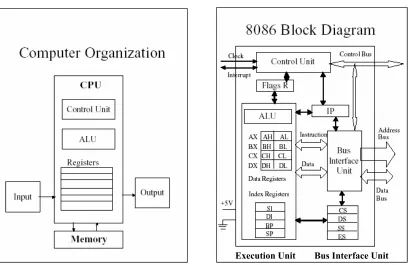
THE 8086INTERNAL ORGANIZATION,PIPELINING AND REGISTERS
Pipelining
¾ In the 8085 microprocessor, the CPU could either fetch or execute at a given time. CPU had to fetch an instruction from the memory, then execute it, then fetch again and execute it and so on..
¾ Pipelining is the simplest form to allow the CPU to fetch and execute at the same time. Note that the fetch and execute times can be different.
Pipelined vs. Nonpipelined Execution
¾ Intel implemented the concept of pipelining by splitting the internal structure of 8088/86 into two sections.
• the execution unit (EU)
• the bus interface unit (BIU)
• These two sections work simultaneously. BIU accesses memory and peripherals while the EU executes the instructions previously fetched.
• It only works if BIU keeps ahead of EU. Thus BIU has a buffer of queue. (8088 has 4 byte, and 8088 has 6 bytes).
• If the execution of any instruction takes to long, the BIU is filled to its maximum capacity and busses will stay idle. It starts to fetch again whenever there is 2-byte room in the queue.
• When there is a jump instruction, the microprocessor must flush out the queue. When a jump instruction is executed BIU starts to fetch information from the new location in the memory. In this situation EU must wait until the BIU starts to fetch the new instruction. This is known as
branch penalty.
nonpipelined fetch 1 exec 1 fetch 2 exec 2 (e.g.. 8085)
pipelined fetch 1 exec 1 (e.g. 8086)
fetch 2 exec 2
Registers of 8086 Microprocessor
¾ In the CPU, registers are used store information temporarily. The information can be one or two bytes of data, or the address of data.
¾ In 8088/8086 general-purpose registers can be accessed as either16-bit or 8-bit registers. All other registers can be accessed as full 16-bit registers.
¾ The bits of the registers are numbered in descending order:
8-bit register:
D7 D6 D5 D4 D3 D2 D1 D0
16-bit register:
D15 D14 D13 D12 D11 D10 D9 D8 D7 D6 D5 D4 D3 D2 D1 D0
¾ Different registers are used for different functions. Registers will be explained later within the context of instructions and their applications.
¾ The first letter of each general register indicates its use. • AX is used for the accumulator.
• BX is used forbase addressing register. • CX is used for counter loop operations.
• DX is used to point out data in I/O operations.
Registers of 8086
Category Bits Register Names
16 AX, BX, CX, DX
General
8 AH, AL, BH, BL, CH, CL, DH, DL
Pointer 16 SP (stack pointer), BP(base pointer) Index 16 SI (source index), DI(destination index) Segment 16 CS (code segment), DS(data segment)
SS (stack segment), ES(extra segment) Instruction 16 IP (instruction pointer)
Flag 16 FR (flag register)
¾ Note: the general registers can be accessed as full 16 bits (such as AX), or as the high byte only (AH) or low byte only (AL). The others are not!!
AX 16-bit register
AH AL
INTRODUCTION TO ASSEMBLY PROGRAMMING Machine Language:
¾ Programs consist of 0s and 1s are called machine language.
¾ Assembly Languages provided mnemonics for machine code instructions.
¾ Mnemonics refer to codes and abbreviations to make it easier for the users to remember.
Low / High level languages:
¾ Assembly Language is a low-level language. Deals directly with the internal structure of CPU.
Assembler translates Assembly language program into machine code.
¾ In high-level languages, Pascal, Basic, C; the programmer does not have to be concerned with internal details of the CPU. Compilers translate the program into machine code.
Assembly Language programming:
¾ Assembly Language program consists of series of lines of Assembly language instructions. ¾ Instruction consists of a mnemonic and two operands.
MOV instruction
MOV destination, source; copy source operand to destination
mnemonic operands
Example: (8-bit )
MOV CL,55H ;move 55H into register CL
MOV DL,CL ;move/copy the contents of CL into DL (now DL=CL=55H) MOV BH,DL ;move/copy the contents of DL into BH (now DL=BH=55H) MOV AH,BH ;move/copy the contents of BH into AH (now AH=BH=55H)
Example: (16-bit)
MOV CX,468FH ;move 468FH into CX (now CH =46 , CL=8F)
MOV AX,CX ;move/copy the contents of CX into AX (now AX=CX=468FH) MOV BX,AX ;now BX=AX=468FH
MOV DX,BX ;now DX=BX=468FH MOV DI,AX ;now DI=AX=468FH
MOV SI,DI ;now SI=DI=468FH MOV DS,SI ;now DS=SI=468FH MOV BP,DS ;now BP=DS=468FH
¾ Data can be moved among all registers except the flag register. There are other ways to load the flag
registers. To be studied later.
¾ Source and destination registers have to match in size.
¾ Data can be moved among all registers (except flag reg.) but data can be moved directly into
nonsegment registers only. You can’t move data segment registers directly.
Examples:
¾ Important points:
• Values cannot be loaded directly into (CS,DS,SS and ES)
MOV AX,1234H ; load 1234H into AX
MOV SS,AX ;load the value in AX into SS
• Sizes of the values:
MOV BX,2H ; BX=0002H, BL:02H, BH:00H