ScienceDirect
Available online at Available online at www.sciencedirect.comwww.sciencedirect.com
ScienceDirect
Energy Procedia 00 (2017) 000–000www.elsevier.com/locate/procedia
1876-6102 © 2017 The Authors. Published by Elsevier Ltd.
Peer-review under responsibility of the Scientific Committee of The 15th International Symposium on District Heating and Cooling.
The 15th International Symposium on District Heating and Cooling
Assessing the feasibility of using the heat demand-outdoor
temperature function for a long-term district heat demand forecast
I. Andri
ć
a,b,c*, A. Pina
a, P. Ferrão
a, J. Fournier
b., B. Lacarrière
c, O. Le Corre
caIN+ Center for Innovation, Technology and Policy Research - Instituto Superior Técnico, Av. Rovisco Pais 1, 1049-001 Lisbon, Portugal bVeolia Recherche & Innovation, 291 Avenue Dreyfous Daniel, 78520 Limay, France
cDépartement Systèmes Énergétiques et Environnement - IMT Atlantique, 4 rue Alfred Kastler, 44300 Nantes, France
Abstract
District heating networks are commonly addressed in the literature as one of the most effective solutions for decreasing the greenhouse gas emissions from the building sector. These systems require high investments which are returned through the heat sales. Due to the changed climate conditions and building renovation policies, heat demand in the future could decrease, prolonging the investment return period.
The main scope of this paper is to assess the feasibility of using the heat demand – outdoor temperature function for heat demand forecast. The district of Alvalade, located in Lisbon (Portugal), was used as a case study. The district is consisted of 665 buildings that vary in both construction period and typology. Three weather scenarios (low, medium, high) and three district renovation scenarios were developed (shallow, intermediate, deep). To estimate the error, obtained heat demand values were compared with results from a dynamic heat demand model, previously developed and validated by the authors.
The results showed that when only weather change is considered, the margin of error could be acceptable for some applications (the error in annual demand was lower than 20% for all weather scenarios considered). However, after introducing renovation scenarios, the error value increased up to 59.5% (depending on the weather and renovation scenarios combination considered). The value of slope coefficient increased on average within the range of 3.8% up to 8% per decade, that corresponds to the decrease in the number of heating hours of 22-139h during the heating season (depending on the combination of weather and renovation scenarios considered). On the other hand, function intercept increased for 7.8-12.7% per decade (depending on the coupled scenarios). The values suggested could be used to modify the function parameters for the scenarios considered, and improve the accuracy of heat demand estimations.
© 2017 The Authors. Published by Elsevier Ltd.
Peer-review under responsibility of the Scientific Committee of The 15th International Symposium on District Heating and Cooling.
Keywords:Heat demand; Forecast; Climate change
Energy Procedia 158 (2019) 4447–4452
1876-6102 © 2019 The Authors. Published by Elsevier Ltd.
This is an open access article under the CC BY-NC-ND license (http://creativecommons.org/licenses/by-nc-nd/4.0/)
Peer-review under responsibility of the scientific committee of ICAE2018 – The 10th International Conference on Applied Energy. 10.1016/j.egypro.2019.01.770
10.1016/j.egypro.2019.01.770
© 2019 The Authors. Published by Elsevier Ltd.
This is an open access article under the CC BY-NC-ND license (http://creativecommons.org/licenses/by-nc-nd/4.0/)
Peer-review under responsibility of the scientific committee of ICAE2018 – The 10th International Conference on Applied Energy.
1876-6102 Available online at www.sciencedirect.com
ScienceDirect
Energy Procedia 00 (2018) 000–000www.elsevier.com/locate/procedia
1876-6102 Copyright © 2018 Elsevier Ltd. All rights reserved.
Selection and peer-review under responsibility of the scientific committee of the 10th International Conference on Applied Energy (ICAE2018).
10
thInternational Conference on Applied Energy (ICAE2018), 22-25 August 2018, Hong Kong,
China
Computational study of NO
x
reduction on a marine diesel engine by
application of different technologies
Xiuxiu Sun
a, Xingyu Liang
a*, Peilin Zhou
b, Hanzhengnan Yu
c,
Xinyi Cao
aaState key Laboratory of Engines, Tianjin University, Tianjin 300072, China
bNaval Architecture, Ocean &Marine Engineering, University of Strathclyde, Glasgow G4 0LZ, UK c China Automotive Technology & Research Center, Tianjin, China, 300300
Abstract
The simulation model of two-stroke heave fuel oil marine diesel engine was developed in this paper. The model was validated with the experimental data. The ability of NOx reduction was researched for exhaust gas recirculation, humid air motor and miller cycle based on the simulation model. The results show that the EGR has the most potential to reduce the NOx emission. It can make the quantity of NOx meet the requirement of Tier Ⅲ. The reduction value of NOx was less for miller cycle. The HAM can be reduced the NOx. However, the depth of HAM was limited.
Copyright © 2018 Elsevier Ltd. All rights reserved.
Selection and peer-review under responsibility of the scientific committee of the 10th International Conference on Applied Energy (ICAE2018).
Keywords: heavy fuel oil; marine diesel engine; EGR; HAM; miller cycle
1. Introduction
The two-stroke marine diesel engine has been widely used in the marine transport, due to the high thermal efficiency and lower cost. However, it also produces more pollutants than the vehicles. The international maritime
organization (IMO) require the NOx of marine engine reduce to 3.4 g/kWh in environment control area (ECA),
which was applied in 2006 [1]. All kinds of methods were researched to reduce the emissions of the marine diesel engine, such as exhaust gas recirculation (EGR), humid air motor (HAM), miller cycle, injection strategies and so on [2].
* Corresponding author. Tel.: +86-022-2789 1285; fax: +86-022-2789 1285 E-mail address: [email protected]
Available online at www.sciencedirect.com
ScienceDirect
Energy Procedia 00 (2018) 000–000
www.elsevier.com/locate/procedia
1876-6102 Copyright © 2018 Elsevier Ltd. All rights reserved.
Selection and peer-review under responsibility of the scientific committee of the 10th International Conference on Applied Energy (ICAE2018).
10
thInternational Conference on Applied Energy (ICAE2018), 22-25 August 2018, Hong Kong,
China
Computational study of NO
x
reduction on a marine diesel engine by
application of different technologies
Xiuxiu Sun
a, Xingyu Liang
a*, Peilin Zhou
b, Hanzhengnan Yu
c,
Xinyi Cao
aaState key Laboratory of Engines, Tianjin University, Tianjin 300072, China
bNaval Architecture, Ocean &Marine Engineering, University of Strathclyde, Glasgow G4 0LZ, UK c China Automotive Technology & Research Center, Tianjin, China, 300300
Abstract
The simulation model of two-stroke heave fuel oil marine diesel engine was developed in this paper. The model was validated with the experimental data. The ability of NOx reduction was researched for exhaust gas recirculation, humid air motor and miller cycle based on the simulation model. The results show that the EGR has the most potential to reduce the NOx emission. It can make the quantity of NOx meet the requirement of Tier Ⅲ. The reduction value of NOx was less for miller cycle. The HAM can be reduced the NOx. However, the depth of HAM was limited.
Copyright © 2018 Elsevier Ltd. All rights reserved.
Selection and peer-review under responsibility of the scientific committee of the 10th International Conference on Applied Energy (ICAE2018).
Keywords: heavy fuel oil; marine diesel engine; EGR; HAM; miller cycle
1. Introduction
The two-stroke marine diesel engine has been widely used in the marine transport, due to the high thermal efficiency and lower cost. However, it also produces more pollutants than the vehicles. The international maritime
organization (IMO) require the NOx of marine engine reduce to 3.4 g/kWh in environment control area (ECA),
which was applied in 2006 [1]. All kinds of methods were researched to reduce the emissions of the marine diesel engine, such as exhaust gas recirculation (EGR), humid air motor (HAM), miller cycle, injection strategies and so on [2].
2 Author name / Energy Procedia 00 (2018) 000–000
Verschaeren et al. [3] researched the EGR and miller timing to reduce the NOx on a medium speed heavy duty
diesel engine. The results showed that the EGR system is an essential part of an engine concept in order to fulfill
IMO Tier III NOx requirements. However, further investigation was needed to address its inherent drawbacks. Zhou
et al.[4] researched the miller cycle and fuel injection direction strategies for low NOx emission in the marine
two-stroke engine. To improve fuel consumption, the injection direction must be carefully adjusted within certain limits.
With optimized exhaust valve closed timing and injection direction, lower NOx emission can be realized with no
penalty of fuel consumption. Raptotasios et al.[5] researched the effect of EGR on the in-cylinder combustion and
NOx formation using a multi-zone combustion model of two-stroke marine diesel engine. The results showed that
the NOx can meet the requirements of Tier Ⅲ when the EGR rate close to 40 % at 75 % load.
The reduction of NOx was researched using EGR, HAM and miller cycle on the marine diesel engine using heavy
fuel oil (HFO). The simulation model was validated with the experimental data. The in-cylinder pressure, NOx
emission and indicated specified fuel consumption (ISFC) were compared using different methods. The technology
lines were provided for the marine diesel engine to meet the requirement of Tier Ⅲ.
2. Model Validation
The simulation model was based on a marine diesel engine (6S35ME-B9). The structure of marine diesel engine has been introduced in published paper [6]. The experimental data were obtained when the engine speed was 142 r/min using HFO. The spray model and combustion model were validated with experimental data due to the different physical properties of diesel and heavy fuel oil [7]. The physical properties of HFO were obtained from the
Kyriakides’s model, which includes the dynamic viscosity, surface tension, vapor pressure, heat of evaporation and
specific enthalpy [8]. The spray model was validated with the experimental data in a rotational flow constant volume combustion chamber [9, 10].
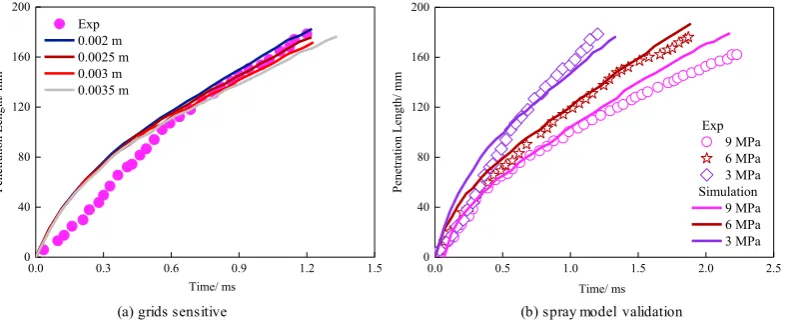
The validation of HFO spray model is shown in Fig.1. The effect of grids was shown in Fig.1(a) on the penetration length of HFO spray. The penetration length was close to the experimental data when the grids set to less 2.5 mm. The base grids set to 2 mm in a simulation model. The penetration lengths of HFO were compared with the experimental data at different environment pressure, 9 MPa, 6MPa, and 3MPa. The results are shown in Fig.1 (b). The penetration length increases with increasing the environment pressure. It can be seen that the simulation results are in good agreement with the experimental data. The spray model of constant volume combustion chamber will be used in the simulation model of the marine diesel engine.
0.0 0.3 0.6 0.9 1.2 1.5
0 40 80 120 160 200
Pen
etrat
io
n Len
gt
h/
mm
Time/ ms
Exp 0.002 m 0.0025 m 0.003 m 0.0035 m
0.0 0.5 1.0 1.5 2.0 2.5
0 40 80 120 160 200
Pen
etrat
io
n Len
gt
h/
mm
Time/ ms
Exp 9 MPa 6 MPa 3 MPa Simulation
9 MPa 6 MPa 3 MPa
[image:2.544.77.470.447.607.2](a) grids sensitive (b) spray model validation
Fig. 1. The validation of spray model for the HFO
Author name / Energy Procedia 00 (2018) 000–000 3
experimental data, due to the lack of experimental data. The trend of in-cylinder pressure was in good agreement with the experimental data. The errors of maximum compress and combustion pressure were less 1 % compared with the experimental data. The simulation model can be used to research the EGR, HAM and miller cycle.
150 200 250 300 350 400 450 0
4 8 12 16 20
Experiment Simulation
Pres
su
re/ MPa
[image:3.544.175.370.120.266.2]Crank angle/ oCA
Fig. 2. The validation of simulation model with the experimental data in HFO marine diesel engine
3.Results and Discussion
3.1.Exhaust Gas Recirculation
The effect of EGR rate has been researched to reduce the NOx emission. The boundary conditions were obtained
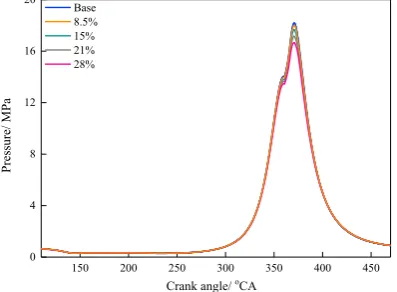
from the calculated results of GT-power. The comparisons of in-cylinder pressure are shown in Fig.3 using different EGR rate. It can be seen that the in-cylinder pressure decreases with increasing EGR rate. It causes the ISFC increases. The maximum combustion pressure was lower 0.15 MPa than the result of original engine when the EGR rate set to 28%. The ISFC increases 5.8 g/kWh compared with the value of original engine.
The comparisons of NOx emissions are shown in Fig.4. The quantity of NOx emissions decreases with increasing
EGR rate. It can be seen that the quantity of NOx can meet the requirements of Tier Ⅲ when the 28 % EGR rate was
used in the marine diesel engine. The EGR technology is the useful method to reduce the NOx emissions. However,
the increased ISFC is the disadvantage for using the EGR to reduce the NOx emissions. The EGR technology can be
coupled with others methods to resolve the problem.
150 200 250 300 350 400 450 0
4 8 12 16 20
Pres
su
re/ MPa
Base 8.5% 15% 21% 28%
Crank angle/ oCA
[image:3.544.180.379.474.620.2]4 Author name / Energy Procedia 00 (2018) 000–000
0 4 8 12 16
Tier III
NO
x
/ g/
kWh
EGR rate
[image:4.544.184.376.71.211.2]0 8.5% 15% 21% 28%
Fig. 4. The comparisons of NOx emissions using different EGR rate
3.2.Humid Air Motor
The air contains more H2O in the operation environment of ships, which has a large effect on the performance of
marine diesel engine. The HAM is a useful method to reduce the NOx for the marine diesel engine. However, the
quantity of HAM depends on the pressure and temperature of inlet gas. The quantity of HAM (W/F) can be defined as:
fuel O H
m
m
F
W
/
2It is important to ensure the vapor water into the cylinder instead of liquid water. So, the maximum value of W/F
was set to 2 in this paper. The potential of HAM was researched on the reduction NOx of the marine diesel engine.
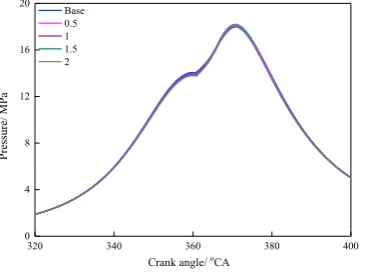
The simulation results of in-cylinder pressure are shown in Fig.5. The maximum compress pressure is lower 0.26 MPa than the results of without HAM when the W/F set to 2. It decreases with the increasing depth of HAM. The reduced value of maximum combustion pressure is lower than that of the maximum compress pressure. That is to say: the HAM has little effect on the in-cylinder pressure. The power and fuel consumption has a relationship with the pressure. The HAM technology will not cause a reduction of power compared with the results using EGR.
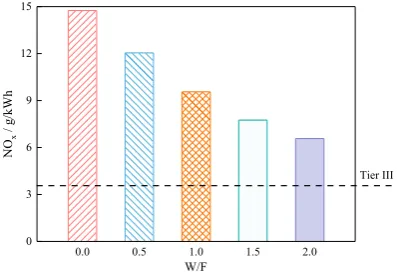
The comparisons of NOx are shown in Fig.6 using different HAM. It can be shown that the quantity of NOx has
large decrease with the increasing depth of HAM. The quantity of NOx can reduce to 6.57 g/kWh when the W/F set
to 2. The HAM makes the content of vapor water increasing. The content of oxygen decreases 1.31% compared with the value of oxygen content without HAM when the W/F set to 2. The specific heat capacity of mixture gas increase, which makes the increasing of absorbs heat. The in-cylinder temperature decreases. The region of higher temperature and rich oxygen become reduction with the increasing depth of HAM. It is a good method to reduce the
NOx for the marine diesel engine.
320 340 360 380 400
0 4 8 12 16 20
Pres
su
re/ MPa
Base 0.5 1 1.5 2
Crank angle/ oCA
[image:4.544.189.373.522.659.2]Author name / Energy Procedia 00 (2018) 000–000 5
0.0 0.5 1.0 1.5 2.0
0 3 6 9 12 15
NO
x
/ g/
kWh
W/F
[image:5.544.182.381.71.207.2]Tier III
Fig. 6. The comparisons of NOx emissions using different HAM
3.3.Miller cycle
The miller cycle has been widely researched to reduce the quantity of NOx. The case is name M10 when the
exhaust valve delay 10 °CA to close. The inlet pressure increase to make up the loss of fresh charge due to the delay close time of exhaust valve.
150 200 250 300 350 400 450 0
4 8 12 16 20
Pres
su
re/ MPa
Base M10 M15 M20 M25
[image:5.544.179.379.302.452.2]Crank angle/ oCA
Fig. 7. The comparisons of in-cylinder pressure using different miller cycle
0 4 8 12 16
Tier III
NO
x
/ g/kW
h
base M10 M15 M20 M25
Fig. 8. The comparisons of NOx emissions using different miller cycle
[image:5.544.182.387.483.615.2]6 Author name / Energy Procedia 00 (2018) 000–000
4.6 MPa compared with the result of the original engine when the exhaust valve delay 25 °CA to close. The maximum combustion pressure also has a large decrease, which is about 2.83 MPa. The in-cylinder pressure is an index to evaluate the performance of engines. The in-cylinder pressure becomes worse than the results of using EGR and HAM.
The reductions of NOx are shown in Fig.8 with the increasing depth of miller cycle. It can be seen that the
quantity of NOx has small decrease with the increasing depth of miller cycle. The quantity of NOx emissions was
11.2 g/kWh when the M25 was used in the marine diesel engine. The value has a large difference with the
requirements of Tier Ⅲ. The effect of reducing NOx is not obvious using miller cycle in the marine diesel engine.
4. Conclusions
The simulation model of the marine diesel engine was established in this paper. The model was validated with the experimental data. Then, the effect of EGR, HAM and miller cycle were investigated on the combustion and emission of the marine diesel engine. The results as follows:
1) The NOx emissions have large improved when the EGR was used in the marine diesel engine. The
quantity of NOx can meet the requirement of Tier Ⅲ when the EFR rate close to 30 %. However, the
power of engine decreases.
2) The NOx reduction using HAM is less than the results of using EGR. The power has less effect for the
HAM method. The HAM is an effective method to reduce the NOx. However, the depth of HAM is
limited by the vapor water.
3) The decreasing of NOx is limited using miller cycle. And, it decreases the in-cylinder pressure largely.
The miller cycle cannot reduce the NOx to meet the requirement of Tier Ⅲ.
4) The EGR coupling with HAM is an optimal technology to reduce the NOx. It is not only reducing the
NOx, but also keeping the power. The results improve a direction for marine diesel engine to reduce the
NOx.
Acknowledgements
This work was supported by National Natural Science Foundation of China (No. 51376136 and No. 91641111) and National Sci-Tech Support of China (2016YFC0205304). The author also wants to appreciate the support of high-tech Ship Research Program of MIIT.
References
[1] Report of the marine environment protection committee on its’ fifty-eighth session – revised MARPOL annex VI. Tech report, International Maritime Organization, (17/10/2018).
[2] I.D. Er, Overview of NOx Emission Controls in Marine Diesel Engines, Energy Sources, 24 (2002) 319-327.
[3] R. Verschaeren, W. Schaepdryver, T. Serruys, M. Bastiaen, L. Vervaeke, S. Verhelst, Experimental study of NO x reduction on a medium speed heavy duty diesel engine by the application of EGR (exhaust gas recirculation) and Miller timing, Energy, 76 (2014) 614-621. [4] S. Zhou, R. Gao, Y. Feng, Y. Zhu, Evaluation of Miller cycle and fuel injection direction strategies for low NOx emission in marine two-stroke engine, International Journal of Hydrogen Energy, 42 (2017) 20351-20360.
[5] S.I. Raptotasios, N.F. Sakellaridis, R.G. Papagiannakis, D.T. Hountalas, Application of a multi-zone combustion model to investigate the NOx reduction potential of two-stroke marine diesel engines using EGR, Applied Energy, 157 (2015) 814-823.
[6] X. Sun, X. Liang, G. Shu, Y. Wang, Y. Wang, H. Yu, Effect of different combustion models and alternative fuels on two-stroke marine diesel engine performance, Applied Thermal Engineering, 115 (2017) 597-606.
[7] C.C. Konstantinos Pantazis, Lambros Kaiktsis, Development and Validation of a CFD Heavy Fuel Oil Model, (2010).
[8] N. Kyriakides, C. Chryssakis, L. Kaiktsis, Influence of Heavy Fuel Properties on Spray Atomization for Marine Diesel Engine Applications, SAE International, 2009.
[9] B.v.R. K. Herrmann, R. Schulz, G. Weisser, K. Boulouchos , B. Schneider, Reference Data Generation of Spray Characteristics in Relation to Large 2-Stroke Marine Diesel Engines Using a Novel Spray Combustion Chamber Concept, ILASS – Europe 2010, 23rd Annual Conference on Liquid Atomization and Spray Systems, Brno, Czech Republic, September 2010.