
0022-538X/84/010035-15$02.00/0
Copyright © 1984,American SocietyforMicrobiology
The
Function(s)
Provided
by
the
Adenovirus-Specified,
DNA-Binding
Protein
Required
for Viral Late
Gene
Expression
Is
Independent
of
the Role of the Protein
in Viral
DNA
Replication
STEPHEN A. RICE AND DANIEL F. KLESSIG*
DepartmentofCellular, Viral and MolecularBiology, SchoolofMedicine, University ofUtah, Salt LakeCity, Utah84132
Received20June 1983/Accepted 16September 1983
The adenovirus type 2(Ad2) host range mutant Ad2hr400grows efficiently in cultured monkey cells at 37°C, but is cold sensitive for plaque formation and late gene expression at 32.5°C. After nitrous acid mutagenesis ofanAd2hr400stock,cold-resistant variantswereselectedinCV1 monkeycellsat32.5°C. One suchvariant,Ad2ts400, wasalsotemperature sensitive(ts)forgrowthin bothCV,and HeLacells. Marker rescueanalysis has been usedto show that the two phenotypes, cold resistant and temperature sensitive, aredueto twoindependent mutations, eachof whichresidesin adifferentsegmentof the geneencoding the 72-kilodalton DNAbinding protein (DBP).The cold-resistantmutation(mapcoordinates 63.6 to66)isahost
rangealteration that enhancestheabilityof the virustoexpresslategenesandgrowproductivelyinmonkey cellsat 32.5°C.Thetemperature-sensitive mutationis in the samecomplementationgroup andmaps tothe same segment ofthe DBP gene (map coordinates 61.3 to 63.6) as the well-characterized DBP mutant Ad5tsl25. Like Ad5tsl25, Ad2ts400 is unable to replicate viral DNA orto properly shut offearly mRNA expression at the nonpermissive temperature. Two sets ofexperiments with Ad2ts400 suggest that DBP contains separatefunctionaldomains. First, when CV1 cellsare coinfected at the nonpermissive tempera-ture with Ad2 plus Ad2ts400 (Ad2 allows DNAreplicationand entry into, but notcompletion of, the late phase ofinfection), normal late gene expression and productive growth occur. Second, temperature shift experiments showthat,althoughDNAreplicationisseverelyrestrictedatthenonpermissive temperaturein ts400-infected monkey cells, late gene expression occurs normally. These results indicate that the DBP activity required fornormal lategeneexpressioninmonkeycellsisfunctionalevenwhenthe DBP'sDNA replication activity is disrupted.
The72-kilodalton DNA-binding protein (DBP),encoded in earlyregion 2Aoftheadenovirus genome, is a
phosphopro-tein with an avid affinity for single-stranded DNA (66).
Unlikemostotheradenovirusproteins, DBPis expressedat
substantial levels both early and late during the viral life
cycle (23).
Analysis of two general classes of DBP mutants has
indicated that DBP performs several seemingly diverse
functions in the infected cell. The first class of mutants is
typified by the temperature-sensitive adenovirus type 5
(AdS) mutant Ad5tsl25 (18) and suggests a role for DBP in
viral DNA replication, early gene expression, and cellular
transformation. Ad5tsl25 synthesizesa DBP that is
thermo-labile in its capacitytobindtosingle-stranded DNA in vitro
(67). At thenonpermissive temperature,Ad5tsl25 is unable to replicate viral DNA both in vivo (18) and in an in vitro system (36). In vivo thets125 defect appears to affect both theinitiation(68) and chain elongation(36, 69)steps of viral DNA synthesis, although more recent studies have shown that in vitro DBP is only required for chain elongation(14,
25). Inaddition, the normal turnoff of early mRNA
expres-sion does not occur at the nonpermissive temperature in cellsinfected withAd5ts125(10, 11). This is not simply due to the inhibition of viral DNA synthesis, since inhibition of DNA synthesis by drugs or byinfectionwithDNA-negative
mutants in other early genes does not have the same effect. Thenegative regulation of early mRNA expression mediated
by the wild-type (WT) DBP appears to act at the level of
transcription for early region 4 (33, 50) and at the level of mRNA turnover for early regions 1A and 1B (7).
Further-*Corresponding author.
more, Ad5ts125 transforms cultured rat cells with greater
efficiency
than WT virus, even atpermissive temperatures
(28,
70).
Asecondclass of DBPmutantsthat growproductivelyin
monkey
cells(2, 40, 43)
suggeststhat DBP alsoplays arole in late gene expression. WT adenovirus does not grow in cultured monkey cells even though virus adsorption(20),
early
geneexpression
(4, 20, 24),
andDNA replication(24,
34, 57)
all appear normal. Synthesis ofmostof the late viralproteins, however, is greatly diminished (8, 24, 41). This reductioncanin mostcasesbe accounted for
by
areduction in thesteady-state
levels ofencoding mRNAs(19, 41). This is not the case for the capsid proteinfiber, however. Fiberprotein synthesis isreduced more than 100-fold relative toa
productive infection,
whereas fiber mRNA levels are re-ducedonly
5- to 10-fold (5, 41, 42). The block to fiberexpression may involve both abberant processing (42) and translation(5)of thefiber mRNA. Host range(hr) mutants of adenovirus (Ad2hr400 to 403, Ad5hr4O4, and
Ad2+ND3hr600to603)have beenselectedby their abilityto
grow in monkey cells, and the mutations responsible have been localizedto the DBP gene (3,43, 44). Thus, an altered DBP can in some way allow the normal expression oflate
genes in monkey cells. A similar function is carried by the
carboxyl-terminal portion ofsimian virus 40(SV40) large T
antigen, sincecoinfection of monkey cells with WT
adenovi-rus plus SV40 allows normal late gene expression (56), as
does infection with Ad2-SV40 hybrid viruses that contain
only
the SV40 sequences encoding the C-terminal segment ofTantigen (21, 31, 47).Physical mapping of the two classes of DBP mutations suggests that the protein contains functionally distinct
do-35
on November 10, 2019 by guest
http://jvi.asm.org/
mains (44). Both
AdStsl25
and the phenotypically similar mutantAdStslO7
map to the carboxyl-terminal half of the DBP gene (coordinates 60.2 to 63.6 on the adenovirus map), whereas the hr mutants map to the amino-terminal portion of the gene (coordinates 63.6 to 66.0). Biochemical studies also suggest the existence of two domains. Mild treatment of purified DBP with chymotrypsin generates two products: a carboxyl-terminal 44-kd fragment and a 26-kd amino-termi-nal fragment (39, 60). The 44-kd polypeptide is similar in size to the C-terminal breakdown product of DBP often observed in extracts from infected cells (59, 66). The purified 44-kd fragment retains the DNA binding activity of DBP (39) and can complement an in vitro DNA-synthesizing system that is dependent upon exogenous DBP (6). The 26-kd N-terminal polypeptide has no DNA binding activity, but contains most ofDBP's
9 to 11 phosphate residues (39).Here we describe a novel adenovirus mutant, Ad2ts400,
which contains DBP mutations of both types. As expected, the temperature-sensitive mutation that affects DNA replica-tion and early gene expression maps in the C-terminal portion of the gene, whereas the host range alterations map in the N-terminal portion. Analysis of Ad2ts400 provides further evidence that the adenovirus DBP contains separate functional domains.
MATERIALS AND METHODS
Cells, viruses, and infections. CV1 and CVc cells, estab-lished lines of African green monkey kidney cells, were obtained from J. Mertz and P. Tegtmeyer, respectively. The human 293 and HeLa cell lines were obtained from J. F. Williams. Monolayer cultures ofCVc, 293, and HeLa cells were cultivated in Dulbecco modified Eagle medium (GIBCO Laboratories) supplemented with 10% calf serum (Irvine Scientific), 100
F.g
of streptomycin per ml, and 100pLgof penicillin per ml. For CV1 cultivation, 5% calf serum and 2% fetal calf serum (Flow Laboratories, Inc.) were used instead of 10% calf serum. Suspension cultures of HeLa cells were grown in Eagle F13 medium (GIBCO).
Ad2 and
AdS
were originally obtained from U. Pettersson and J. F. Williams, respectively. Ad2hr400 and Ad2hr4O3 were isolated by D. F. Klessig (40, 43). All of the above virus were propagated in suspension cultures of HeLa cells.AdStsl25, AdSts107,
andAd5dl434
were obtained from J. F. Williams, C. S. H. Young, and D. Solnick, respectively.Ad5ts125
andAd5ts107
were propagated in monolayers of HeLa cells at32.5°C,
andAd5dl434
was propagated in 293 monolayers at37°C.
SV40 strain 776 was obtained from J. Sambrook and prepared as previously described (61). Plaque assays were performed as described previously (31), except thatMgCl2
was omitted from titrations on 293and CV1 cells. Confluent monolayers of CV1, CVc, or HeLa cells were infected at a multiplicity of 20 PFU per cell unless otherwise indicated. After adsorption for 75min at37°C
in phosphate-buffered saline, the cells were washed, overlaid with medi-um, and incubated at the appropriate temperature.Analysis of viral protein synthesis. The synthesis of viral proteins in vivo was assayed by labeling cell monolayers with 40
,uCi
of [35S]methionine per ml and analyzing the products by sodium dodecyl sulfate (SDS)-polyacrylamide gel electrophoresis (41). Immunoprecipitation of the fiber protein from infected cell lysates was performed as previous-ly described (5).Analysis of viral DNA synthesis. Viral DNA synthesis was
analyzed by labeling cell monolayers (60 mm) with 50puCi of
[3H]thymidine
(Amersham Corp.) per ml for 1 or 2.5 h. Viral DNA was extracted by a modified Hirt extraction (35). Thelabeled cell monolayers were washed once with phosphate-buffered saline and 3.2 ml of 10 mM Tris (pH 7.9)-10
roM
EDTA-0.6% SDS-0.5 mg of pronase per ml was added to
each. After incubation for 2 h at 37°C,0.8 ml of 5 M NaCl was added dropwise to each plate. The viscous cell lysates were carefully poured intoSW60 centrifuge tubes,incubated for 4 to 16 h at
4°C,
and spun at 25,000 rpm,4°C, for 1 h in anSW60 rotor. The supernatants were extracted once with phenol and once with chloroform-isoamyl alcohol (24:1) and precipitated with 2.5 volumes of ethanol.
[3H]thymidine
incorporation into adenovirus DNA was assayed in two ways. In the first method, equal fractions of each DNA preparation were digested with a restriction enzyme and fractionated by electrophoresis on a horizontal 1.2% agarose gel in 36 mM Tris-30 mM NaH2PO4-1 mM EDTA. After staining of the gel with 1 pLg of ethidium bromide per ml and photography under UVillumination, the gel was soaked inEn3Hance
(New England Nuclear Corp.) for 12 h and thenin 5% trichloroacetic acid for 12 h. The gel was dried and exposed to XR-1 film with intensifying screens. In the second method, viral DNA synthesis was assayed by hybridizing equal fractions of each DNA prepa-ration to Ad2 DNA immobilized onnitrocellulose filters (17). Before hybridization, the DNA samples were boiled for 5min in 200 mM NaOH to denature DNA and degrade contaminating RNA. After hybridization at 42°C for 72 h in
50%formamide-0.4 MNaCl-0.1 M N-2-hydroxyethylpiper-azine-N'-2-ethanesulfonic acid (pH 8.0)-5 mM EDTA-0.2% SDS-5 x Denhardt solution (lx Denhardt solution is 0.2% [wt/vol] bovine serum albumin, Ficoll [molecular weight, 400,000], and polyvinyl pyrrolidone)-100 pg of denatured salmon sperm DNA per ml, the filterswere washed twice in 2x SSC(lx SSC is 0.15 M NaCl, 0.015 M sodium
citrate)-0.1% SDS at room temperature, once in lx SSC-0.1%SDS at
52°C,
and twice in 0.1x SSC-0.1% SDS at52°C. The dried filters were counted in 3 ml of Econofluor (New England Nuclear) in a liquid scintillation counter. The supernatants from the first hybridization were boiled for 5 min and hybridized to new filters. The amount ofhybridization inthe second round was less than50O% of the amount obtained in the first. [3H]thymidine-labeled DNA from mock-infectedcells was used to determine the background level of
hybrid-ization. The values given below (see Fig. 8a) arethe sums of both hybridizations after subtraction of the backgrounds.
Physical mapping of temperature-sensitive and cold-resis-tant mutations. The DNA-terminal protein complex was
prepared from Ad2 and Ad2ts400 by the method of Chinna-durai et al. (15), dialyzed extensively in 10 mM Tris
(pH
7.8)-l mM EDTA-1 mMP-mercaptoethanol,
and stored at4°C. Adenovirus genomicDNA waspreparedbythe method of Pettersson and Sambrook (54). Restriction enzyme-gener-ated fragments of genomicDNA were fractionated on40- by
20- by 0.6-cm horizontal 1% agarose gels in TBE buffer
(90
mM Tris-borate, 2.5 mM EDTA, pH8.3)by
electrophoresis
at a potential of 1 to1.5 V/cm for 36 to 48 h. The separated
fragments were eluted from the gel by
electrophoresis
as previouslydescribed (43). Thepositions atwhich restriction enzymes cleave the DNA of Ad2 have been taken from Tooze (65).DNA infections (transfections) into 293 cells were per-formed by the method ofGraham and van der Eb
(30)
and Stow et al. (63) and have beendescribedpreviously (43,
44).
The transfected 293 cells were incubated at 37°Cfor 4to5 h before glycerol treatment to boost transfection
efficiency
(26, 43).
For mapping of the Ad2ts400 temperature-sensitive
on November 10, 2019 by guest
http://jvi.asm.org/
tion, 293 cells were transfected with 0.5 [Lg of Ad2ts400
DNA-terminal protein complex per plate plus 4 or 8molar equivalents of an individual restriction fragment derived from non-temperature-sensitive virus (Ad2, Ad2hr400, or
Ad2hr4O3). After the glycerol treatment, the cells were incubated at 32.5°C. Progeny virus were released from the
cells 4 days after transfection by freeze-thawing and sonica-tion. One-tenth of each cell lysate was used to infect fresh monolayers of HeLa cells. After 72 h at 39.5°C, progeny virus were titrated onHeLacells at 39.5°C todetermine for
each cross the number of virus that had acquired the ability to form plaques at 39.5°C. In one experiment, a second passage in HeLa cellsat 39.5°C wasdone before titration.
For mapping of the Ad2ts400 cold-resistant mutation, 293
cells were transfected with 0.5 [Lg of Ad2 DNA-terminal
protein complex per plate plus 10 or 20 molar equivalents of an individual restriction fragment derived from Ad2ts400
or 5 molar equivalents of unfractionated fragments
de-rived fromAd2hr400 orAd2ts400. Thetransfected cellswere
incubated at 32.5°C for 4 days. After release of progeny virus, 0.1of the celllysate wasusedtoinfect fresh monolay-ers of CVc cells. After 4 days at32.5°C,progeny virus were titrated on
CV,
cellsat32.5°C. Plaqueswerecountedonday 18 to ensure that only virus with the cold-resistantpheno-type were scored.
RNA preparation and analysis. Suspension cultures of HeLa cells (5 x 10⁵ cellsperml)wereinfected with virusata
multiplicity of 100 at 41°C in the presence of 25 iLg of cytosine arabinoside (araC) per ml to block DNA replica-tion. araC was supplementedat9hpostinfection (p.i.).At 6, 12, and 18 h p.i., approximately 2.5 x 10⁷ cells were
removedfromeach culture.Cytoplasmic RNAwasprepared
fromthese cellsby phenol and chloroform extraction of the
0.5%NonidetP-40supernatantfractionsfollowed by ethanol precipitation (41). Polyadenylated RNA was selected by
passage over oligodeoxythymidylic acid-cellulose (type 3; Collaborative Research Inc.).
Polyadenylated RNA selected from 100
pLg
of each cyto-plasmicRNApreparationwasfractionated for5 hat70 V ona 14- by 16- by 0.4-cm 1.2% agarose gel containing 10 mM methyl mercury hydroxide.
HinzdIII
restriction fragments of Ad2DNAwere coelectrophoresedassize standards. The gelwas stained with 0.5 p.g of ethidium bromide per ml and
examined under UV illumination to ensure that
approxi-matelyequalamounts of RNA had been loaded ineach lane. The RNA was transferred to
diazobenzyloxymethyl-cellu-lose paper, and thediazobenzyloxymethyl paper was
subse-quently hybridizedwith radioactively labeled probes specific for each adenovirusearly regionaspreviously described (5).
All of theAd2-specific probes used for hybridization were
cloned fragments of Ad2 DNA inserted into a pBR322
plasmid. The HindIII-F (coordinates 89.5 to 97.1; early region 4) and HindIII-I (coordinates 31.5 to37.3;late family 1) clones wereobtained from S. L.Hu, and theBalI-Lclone
(coordinates 6.0 to 7.7; early region iB) was obtained from S. Berget. HEB4(coordinates 0.8to 4.5), aclone ofa
BaI-HpaI double digestfragment, wasobtained fromD. Solnick
and was used as the probe for early region IA. EcoRI-B
(coordinates 58.5 to70.7)and EcoRI-D(coordinates 75.9to
84.0) cloneswere usedasprobes for early regions 2A and 3, respectively. Purified AdS EcoRI fragment C (coordinates
75.9 to 84.0) was used as the AdS-specific probe for early
region 3. The DNA used for probes was labeled by nick
translationwith[32P]dCTP to aspecific activity of 1 x 10⁸ to
3 x 10⁸ cpm/pLg.
The autoradiographs shown in the textand those used for
densitometry wereobtained without intensifying screens so
that bandintensitywould beproportionalto the
radioactivity
on the blot. Densitometer tracings of the
autoradiographs
were performed with aJoyce-Loebl model3CS
microdensi-tometer, and areas under the peaks weredetermined with a
Numonic Corp. model 1224 electronic graphics calculator.
RESULTS
Derivation ofAd2ts400. Ad2hr400 is a host range
deriva-tive of adenovirus that has acquired the ability to grow in
CVl
cells, an established line of African greenmonkey
kidney cells, at
37°C
(40). The mutation responsible for this phenotype is located in the gene encoding the 72-kd DBP (43). Ad2hr400, however, is partially cold sensitive for growth inCV,
cells at 32.5°C. Although Ad2hir400 formsplaques on CV, cells with approximately equal
efficiency
at32.5 and 370C, the plaques at 32.5°C appear only after very
long incubation and are minute in comparisons to those
produced by the Ad2-SV40 hybrid virus Ad2 ND1. We suspected that the cold-sensitive phenotype of Ad2hr400
was related to the monkey cell block tolate gene
expression
sinceAd2hir400 was not cold sensitive forplaque formation
on human (HeLa) cells. If this is true, then selection of
cold-resistant variants might uncover new alterations in the DBP
gene or in other genes whose productsinteract with
monkey
cell components to allow late gene expression. Furthermore.
we anticipated that somecold-resistant variants selected for
better growth in monkey cells at low temperature
might
simultaneously acquire a temperature-sensitive
phenotype.
Jarvik and Botstein (38) have observedthis type of
simulta-neous switch from cold sensitivity to cold resistance and
temperature sensitivity in bacteriophage P22.
A high-titer stock of Ad2h/r400 was mutagenized with
nitrous acid for 2 min as described previously (40). Portions
of this mutagenized stock were usedtoinfect CV1
monolay-ers, and the infections were allowed toproceedat
32.5°C
for68 to 72 h before harvesting. The cell lysates were
passaged
twice more on
CV,
cells for 68 to 72 hat 32.5°C. Since 68to72 h approximates the minimumtime requiredfor WT Ad2to
complete an infectious cycle at thistemperature, variantsof
Ad2hr400
that grow faster or withhigherburst sizes (orboth)
are enriched in this scheme. Afterthe third passage the cell
lysates were titrated on CVl cells at 32.5 and
39.5°C,
monitoring the total number of plaques appearing at the
different temperatures as well as the rate of appearance of
plaques at
32.5°C.
Several of theindependently passaged
lysates yielded plaques thatappeared sooner at 32.5°C than
did
Ad2hir400
plaques and were substantially larger. Onesuch lysate also appeared to harbora temperature-sensitive
virus since the titer at 39.5°C was
significantly
less than thetiter at
32.5°C.
A virus from this stock was plaque purifiedthree times on CV, cells at 32.5°C. High-titer stocks ofthis
variant, Ad2ts400, were prepared by growth of the virus on either HeLa or CV1 monolayers at 32.5°C.
Growth properties ofAd2ts400. The plaque-purified stock
ofAd2ts400 was initially characterized by plaque assay on both HeLa and CV, cells at 32.5 and 39.5°C. As expected,
Ad2ts400
plaques appeared sooner than did Ad2hir400plaques at
32.5°C
on CV1 cells. In Ad2ts400 titrations, 50%of the plaques that eventually appeared on
CV,
cells at32.5°C
were visible by day19,
whereas inAd2h/i400
titra-tions 30 days were required to reach the 50% level. Further-more, Ad2ts400 formed plaques on
CV,
monolayers at32.5°C
that were substantially larger than Ad2hir400 plaques(Fig. 1). Both viruses, however, formedplaqueswith similar
on November 10, 2019 by guest
http://jvi.asm.org/
hr
4C)0
FIG. 1. Viral plaque assay on CV1 monolayers at 32.5°C. Virus stocks were titrated as described by Grodzickeret al. (31). The cell monolayerswerestainedonday 18 with0.01% neutral red,and the photograph shownwastakenonday 25.
kinetics and morphology when titrated on HeLa cells at 32.5°C. Inadditiontoitscold-resistantphenotype, Ad2ts400
appeared to be temperature sensitive, since it did notform plaques oneitherHeLaorCV, cellsat39.5°C, althoughthe
monolayers were killed at verylow dilutions of virus. To define more carefully the difference in growth
proper-ties between Ad2ts400 and its parent, burst size and the kinetics of virusreplicationwerenextdetermined. Confluent cell monolayers were infected with virus and allowed to undergo one infectious cycle. Virus yield was assayed by titration of thecelllysatesonHeLacellsat32.5°C (Table 1).
Note that the growth of Ad2ts400 is indeed temperature sensitive in both HeLaand
CV,
cells. TheyieldsofAd2ts400 areless than1PFUperinfected cellat39.5°C,areduction of103
to 104-fold compared with growth at 32.5°C. Somewhatsurprisingly, Ad2hr400 produced quite normal levels of
infectious virus in
CVI
cells at 32.5°C (360 PFU percell), even though it is cold sensitive for plaque formation. Incomparison, Ad2ts400 produced nearly four times more virus(1,300 PFUpercell) underthe same conditions in this experiment. Ad2hr400 and Ad2ts400 showed similaryields
in HeLa cellsat 32.5°C (440and 240 PFU percell,
respec-tively).
Thekinetics ofgrowthof these twoviruses at32.5°Cwas
next compared. At the completion ofone infectious cycle, Ad2ts400-infected CV1 cellsyielded three toeightfoldmore infectious virus than did Ad2hr400-infected CV1 cells (Fig. 2a). Both viruses, however, grew with similar kinetics. In contrast, Ad2ts400 and Ad2hr400 grewwith similar kinetics andyieldinHeLacellsat 32.5°C (Fig. 2b).This experiment was repeated twice more, and very similar results were obtained (datanotshown). These resultsare alsoconsistent with the virus yields shown in Table 1. We conclude that Ad2ts400 contains a mutation that allows the virus to pro-ducehigher yieldsinCV, cellsat32.5°C,but has little ifany effecton the kinetics of viral growth. This mutation has no apparent effect on growth in HeLa cells at 32.5°C. Since several rounds of viral growth are required to produce a
visible plaque, the three- to eightfold difference in virus yield is probably responsible for the different plaquing characteris-ticsofAd2ts400 and Ad2hr400 on
CV,
cells at 32.5°C.As can be seenin Table 1and Fig. 2a, Ad2hr400 produces
quitenormal levels of progeny virusin CV1 cells at 32.5°C.
Therefore, itmay notbeaccurate tocharacterizeitsgrowth in CV1 cellsascold sensitive. PlaqueformationbyAd2hr400
onCV1cells, however,iscoldsensitive relativetoAd2ts400. Thus, for the sake of consistency and clarity, we will
continuetorefertothegrowth of Ad2hr400 and Ad2ts400 in CV1 cellsascold sensitiveandcold resistant, respectively.
Late protein synthesis inAd2ts400-infectedcells. Basedon
ourselectionrationale,weanticipatedthatthe cold-resistant temperature-sensitive mutation(s) ofAd2ts400resided in the
DBP gene.BecauseaDBPmutation might directly (i.e.,host range) or indirectly (i.e., DNA replication negative) affect
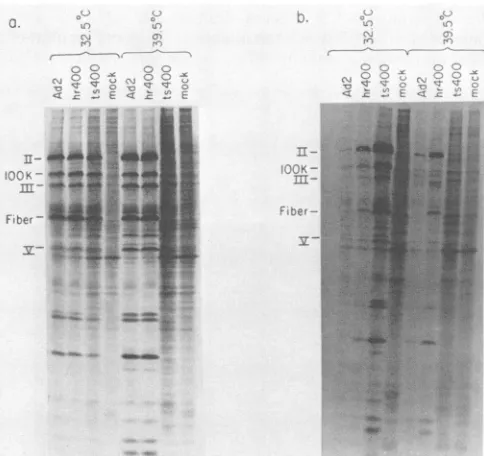
late gene expression, we compared the patterns of late protein synthesis in Ad2-, Ad2hr400-,andAd2ts400-infected cells.HeLaorCV1 monolayerswereinfectedwithvirus and incubated at 32.5 or 39.5°C until late times after infection.
[image:4.612.117.498.79.306.2]Thecellswere thenpulse-labeled with
[35S]methionine,
andTABLE 1. Yieldsof virus in HeLa andCV1 cellsat32.5and 39.50C
Virus" Cell PFU/cellb
line 32.5°C 39.5°C
Ad2 HeLa 770 430
Ad2hr400 HeLa 440 310
Ad2ts400 HeLa 240 0.17
Ad2 CVl 10 20
Ad2hr400 CV1 360 400
Ad2ts400 CVl 1,300 0.03
"Confluentmonolayerswereinfectedatamultiplicityof 20 PFU percell.
hProgenyviruswereharvested after4and 2daysofincubationat 32.5 and 39.50C, respectively, and then titratedon HeLa cells at 32.50C.
on November 10, 2019 by guest
http://jvi.asm.org/
[image:4.612.316.556.602.685.2]C. b
1000
100,
1.0'
0.1'
20 40 60 80 100 20 40 60 80 t00
HOURSPOSTINFECTION HOURSPOST INFECTION
FIG. 2. Growth ofAd2hr400 (0) and Ad2ts400 (A) at 32.50C. Confluent monolayers of
CV,
(a)or HeLa(b) cells were infected with virusat 20 PFU percell.Aftera70-minadsorptionat370C,the infected cells were incubated at 32.50C. At various times after infection, cultures were frozen at -200C. Virus yield was deter-mined by titrationof the celllysatesonHeLamonolayersat32.50C and isexpressed asPFUpercell.the totalcellextracts wereanalyzedbySDS-polyacrylamide gel electrophoresis. All three viruses showed similar pat-ternsof late viral proteinsynthesis in HeLa cellsat 32.50C
(Fig. 3a).At39.50C, incontrast,whereasAd2 and Ad2hr400 both showed anormal pattern ofprotein synthesis inHeLa
cells, Ad2ts400 failed to synthesizeany late viral proteins. CV1 cells infectedwithAd2, bothat32.5and
39.50C,
showed the typical abortive pattern of protein synthesis (Fig. 3b), i.e., some late adenovirus proteins were made in nearlynormal amounts (1OOK protein), whereas the synthesis of otherswasreducedmoderately(protein II)orseverely(fiber protein)(31, 41). Ad2hr400- andAd2ts400-infected CV1 cells incubated at 32.50C and Ad2hr400-infected
CV,
cells incu-batedat 39.50C all showed normal synthesis ofthe late viral proteins, including fiber.CV,
cells infected withAd2ts400at39.50C, however, failedtosynthesizeanylateviralproteins.
Thetemperature-sensitive mutationofts400 thus appearsto
restrictthevirus from entering the late phase of infectionat
39.50C in either humanor monkeycells.
Incontrast tothesituation at
39.50C,
at32.50CAd2ts400-infected
CV,
cellsincorporated more radioactivity intolateviral proteins during the pulse-label than did Ad2hr400-infected
CV,
cells(Fig. 3b). This resulthasbeenobserved in several otherexperiments andis consistent with theobser-vationthat Ad2ts400 produces a larger burst size than does Ad2hr400 in
CV1
cells at32.50C.Topursue this observation in more depth we employed another established line ofAfrican green monkey kidney cells, called
CVc,
in which adenovirus replication is even more restricted. At 32.50C, virtually no late viral proteins were synthesized inAd2-infected
CVc
cells, irrespective of multiplicity of infection(Fig. 4). Coinfection with Ad2 plus SV40, as expected, allowed normal late gene expression. Both Ad2hr400- and
Ad2ts400-infected
CV,
cells produced late viral proteins at32.50C,
but, as inCV1
cells, the rate of late viral proteinsynthesis appeared greater in Ad2ts400-infected cells. This difference was most striking for the fiber protein. Cells infected with Ad2ts400 appeared to synthesize at least 10-fold more fiber during the pulse-label than did Ad2hr400-infectedcells, althoughboth viruses made nearlyequivalent
amountsof the 100Kprotein. These results suggest that the cold sensitivity of Ad2hr400 in monkey cells is due to a
specific defect in late gene expression that is related to that observed in WT Ad2 infection ofmonkey cells,whereagain
the synthesis of the fiber protein is most dramatically
affected.
Ad2ts400 is temperature sensitive for DNA replication. The observation that no late viral proteins were synthesized in Ad2ts400-infected cells at 39.5°C suggested that the virus was temperature sensitive for DNA replication since the viral genome must be replicated before it can serve as a template for late gene expression (64). To verify this suppo-sition, viral DNA replication was analyzed. Duplicateplates ofeither HeLa or
CV,
cells were infected with Ad2hr400,Ad2ts400,orthe knownDNA-negativemutantAd5tsl25 and incubatedat32.5°C until well into the DNAreplicationphase (29 h p.i.). At this point, one plate from each duplicate infection was shifted to 39.5°C, and after 4 h, allplateswere
labeled with [3Hlthymidine for 2.5 h. The cells were then harvested, andlow-molecular-weightDNA wasprepared by a modified Hirt extraction procedure (35). Each DNA sam-ple was digested with the restriction enzyme HindIll and electrophoresed on a 1.2% agarose gel. Ethidium bromide staining of the gel showed thatroughly equivalent amounts of viral DNA were present in each preparation (Fig. 5a). Because alarge amount of viral DNA had been synthesized
.. .
LU
r'l.". ".
-.j -;,:- .,: T' .- Z.. -L a
N,
.:.
a
'.-Z
e
-F,ter
-
:-FIG. 3. In vivosynthesisofviralproteins in HeLa andCV1cells
at32.5 and39.5°C. Monolayercultures of HeLa (a) orCV, (b) cells were infected with virus andincubatedat thetemperatureindicated. Atlate timesafter infection(24 and 47 h for HeLa cells at 39.5 and 32.50C, respectively; 29 and67 h forCV1 cells at 39.5 and 32.5°C, respectively), the monolayers were labeled with 40
pRCi
of[355]methioninepermlfor1h at39.5°C and 2 h at 32.5°C. An equal fraction ofeach labeledcell lysate was electrophoresed on a 15% SDS-polyacrylamide gel. The labeled proteins were visualized by autoradiography of the dried gel. The positions of several late adenovirusproteinsareindicated.
v
-i
z-
4446
.0C)K -Wgo
= 4040
=....i ...
on November 10, 2019 by guest
http://jvi.asm.org/
[image:5.612.61.292.74.304.2] [image:5.612.310.552.403.631.2]i'
FIG. 4. Invivo synthesis ofviral proteinsinCV,,cells at 32.5°C. Cell monolayers were labeled, andprotein synthesis wasanalyzed as inFig. 3, exceptthat labeling wasfor2h at 48 h p.i. Infections weredone at a multiplicity of 20 PFU per cell, except in two Ad2 infections, where themultiplicity of infectionwasraisedto200and 2,000 PFU per cell (indicated by numbers in parentheses). In the Ad2-SV40 coinfection, SV40wasused at amultiplicity of infection of100 PFU percell.
before the shift-up, the additional DNA synthesized during the subsequent 6.5 h did not
dramatically
alter the totalamountof viral DNA in each infection. Thus theamount of
ethidium bromide staining serves as an internal control to
show that viral DNA was extracted with approximately equal efficiency (factor of 2) from each infection.
Analysis of the fluorograph of the same gel (Fig. 5b) indicated that little 13H]thymidine was incorporated into Ad5tsl25 DNA after shift-up to 39.5°C in both HeLa and CV1 cells, as expected. Similar results were observed in Ad2ts400-infected HeLa or CV1 cells after shift-up. In contrast, Ad2hr400 incorporated more rather than less [3H]thymidine into viral DNAafter shift-up to 39.5°C, proba-bly due to a generalized increase in the rate of metabolism at the higher temperature. Thus Ad2ts400, like Ad5tsl25, is temperature sensitive for viral DNA replication.
Ad2ts400 is inthe same temperature-sensitive
complementa-tion group as Ad5ts125 and AdSts107. The phenotype of
Ad2ts400 and the rationale for its selection suggested that thetemperature-sensitive lesion probably resided in the DBP gene. Complementation analysis with the known DBP
mu-tantsAd5tsl25 and Ad5tslO7, and Ad5dl434, an AdS deletion
mutant(coordinates 2.6 to 8.7) lacking parts of early regions
IA and 1B (D. Solnick, unpublished data), confirmed this suspicion. HeLa cells were infected either singly or in pairwise combinations with these mutants and incubated at
39.5°C for 3 days. The cell lysates were titrated on 293 cells
at 32.5°C to determine virus yield (Table 2). As expected,
coinfections withAd5d1434 plusAdStsl25orAdStslO7
yield-edlarge numbers of progeny virus, whereas coinfection with AdStsl25 plus Ad5tslO7 did not. Mixed infection with Ad5dl434plus Ad2ts400 yielded large numbers of progeny, but the Ad2ts400plusAdStsl25orAd5tslO7 coinfections did not. Ad2ts400, AdStsl25, and AdSts107are therefore mem-bers of the same temperature-sensitive complementation
group.
Physical mapping of the Ad2ts400 temperature sensitivity mutation. The temperature-sensitive mutation ofAd2ts400
was physically localized on the adenovirus genome by marker rescue analysis (26, 43, 63). 293cells were
cotrans--.*, _ MWS_ _ -_ _ __e
_
_m-"
--FIG. 5. Analysisof viral DNAreplicationafter temperatureshift-up.Duplicateplatesofconfluent HeLaor
CV,
monolayerswereinfected withAd2hr400, Ad2ts400,orAd5tsl25andincubatedat32.5°Cuntil 29 hp.i.Atthistime,oneplate (indicatedbyarrowinfigure)from each duplicateinfectionwasshiftedto39.5°C.After4moreh,allplateswerelabeledwith 50pCi of[3H]thymidineper ml for 2.5 h. Low-molecular-weight DNA was extracted from each infection, and an equal fraction of each DNA preparation was digested with HindIll and electrophoresedon a1.2%agarosegel. (a)Ethidium bromide stainof thegel;(b)Autoradiogramof thegelaftertreatmentforfluorography. The majorDNA bands correspondto expected adenovirus Hindlll restriction fragments forserotypes 2 (Ad2ts400 and Ad2hr400) and 5 (AdStsl25).72
.1
..Z'
Al ...
Zif .1.- ".
V, (;,
... L
-L
." ,%
,7", -,
on November 10, 2019 by guest
http://jvi.asm.org/
[image:6.612.138.233.77.301.2] [image:6.612.149.479.444.666.2]TABLE 2. Complementationbetweenadenovirusmutantsin HeLacellsat39.5°C
Virusa PFU/cellb
Ad2hr400... 200
Ad5tsl25... 0.03
AdStslO7... ... 0.38
Ad5d1434... 0.16 Ad2ts400... 0.13 Ad5ts125 + Ad5ts107... 0.10
Ad5tsl25 + Ad5dl434... 420
Ad5ts1O7 + Ad5dl434... 23
Ad2ts400 + AdStsl25... 0.07
Ad2ts400 + AdStslO7... 0.10
Ad2ts400 + Ad5dl434... 250
a ConfluentHeLamonolayers wereinfectedatmultiplicity of20 for single virus infections or 10 each for the coinfections. The infected cells were incubated for 68 h at 39.5°C before being harvested.
b The cell lysates were titratedon293 cells at 32.5°C;293 cells contain andexpress adenovirus early regions 1Aand 1Band thus supportthegrowthofAd5d1434.
fected withfull-lengthAd2ts400DNA-terminalprotein
com-plex plus purified DNA restriction fragments derived from
nontemperature-sensitive virus (Ad2, Ad2hr400,Ad2hr4O3).
The transfections were allowed to
proceed
through oneinfectious cycle at 32.5°C, and the cell lysates were then
passagedonce ortwiceonHeLacellsat39.5°Ctoenrichfor
nontemperature-sensitive recombinants. The final yield of
nontemperature-sensitive virus was determined by titration onHeLacells at39.5°C(Table 3).EcoRIfragments
spanning
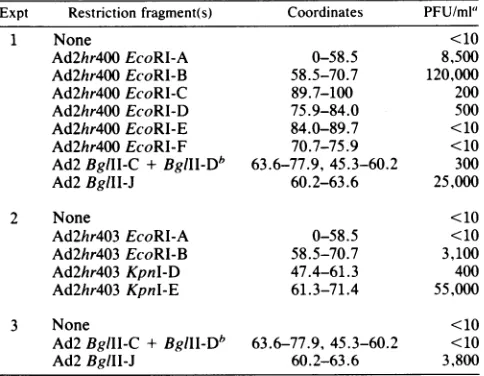
the entire genome were tested for their ability to rescue.Only the EcoRI B fragment (coordinates 58.5 to 70.7) efficiently rescued the
temperature-sensitive
lesion.BglII
andKpnI fragments were used to further localize thetem-perature-sensitive
mutation withinthis area of the genome.Both theBglII Jfragment(coordinates 60.2to63.6) and the
KpnI
E fragment (coordinates 61.3 to 71.4) were able to rescue. The temperature-sensitive mutation of Ad2ts400 thereforemapsbetweencoordinates61.3 and 63.6ofthe Ad2 genome,placing it in the C-terminalhalf of the DBP gene ataposition analogoustothatoftheAd5DBP mutantsAd5ts125
andAd5ts107 (44-46).
Ad2ts400is adoublemutant.Ad2ts400has twophenotypes
thatdistinguish it from itsprogenitor, Ad2hr400. First, it is
fully cold resistant for late gene expression and growth in
monkey cells. Second, Ad2ts400 is temperature sensitive for
DNA replication and growth in both monkey and human
cells. The rationale behind our selection scheme was to create bothcold-resistant and
temperature-sensitive
pheno-types in one mutational step. If such were the case, we
would expect that the nontemperature-sensitive
recombi-nants derived in the marker rescue experiments would
concommitantly have losttheircold-resistant phenotype.
To testthis, virus from plaquesresulting from the various
crossesdescribed above wereisolatedandtitratedon HeLa andCV1 monolayers at both 39.5 and 32.5°C. As expected, none of the rescued virus exhibited the
temperature-sensi-tive phenotype. All of the recombinants were also able to grow efficiently on monkey cells. This was also expected, since theEcoRIB and
KpnI
Efragments were derived from hostrangevirus, whereas theBglIIJfragment, derived from WT Ad2, does not include the site of the host rangemutation. Surprisingly, however, the rescued virus stocks fell into two classes with respect to theirplaquing
character-istics on
CV1
cells at 32.5°C. Both viruses that had beenrescuedwiththe Ad2BglII Jfragmentretained theabilityto
form large, rapidly appearing plaques. In contrast, both virusesrescued with the Ad2hr4O3KpnIEfragmentreverted tothe small-plaquing phenotype characteristic of Ad2hr400
(Ad2hr4O3, like Ad2hr400, produces small plaques on CV1 cells at32.5°C). Viruses rescued with the EcoRI Bfragment
fellinto bothclasses.
These results indicate that Ad2ts400 is a double mutant, because physical rescue of the temperature-sensitive
muta-tion does not necessarily convert thecold-resistant pheno-type to cold sensitivity. However, in some cases, purified restriction fragments were simultaneously able to convert both phenotypes. TheEcoRIBfragment (coordinates 58.5 to
70.7)andKpnIEfragment(coordinates 61.3 to 71.4) hadthis ability and must presumably cover the cold-resistant muta-tion. The cold-resistant mutation thus lies between coordi-nates 61.3 and 70.7 on theadenovirus genome.
Physical mapping of the Ad2ts400 cold-resistant mutation. Initial attempts were made to physically map the Ad2ts400 cold-resistant mutation by a modified marker rescue tech-nique. Genomic DNA fromAd2hr400plusindividual
restric-tion fragments derived from Ad2ts400 were cotransfected into 293 cells. After completion of one infectious cycle at 32.5°C, the cell lysateswere passaged on either
CV1
orCVc
cells at 32.5°C to enrich forcold-resistant recombinants. The results of these experiments were equivocal due to high background levels of unrescuedAd2hr400virus. Presumably the selection for cold resistance in monkey cells was not strongenough togive unambiguous results.
To increase the selection pressure the above experiment was repeated with WT Ad2 as the genomic background rather than Ad2hr400. There existed two problems to this approach. First, weneeded to ensure that we were mapping the Ad2ts400 cold-resistant mutation and not simply
remap-TABLE 3. Physicalmapping of the Ad2ts400 temperature-sensitive mutation by markerrescue
Expt Restriction fragment(s) Coordinates PFU/ml'
1 None <10
Ad2hr400EcoRl-A 0-58.5 8,500
Ad2hr400EcoRl-B 58.5-70.7 120,000
Ad2hr400 EcoRl-C 89.7-100 200
Ad2hr400EcoRl-D 75.9-84.0 500
Ad2hr400 EcoRI-E 84.0-89.7 <10
Ad2hr400EcoRI-F 70.7-75.9 <10
Ad2BglII-C + BgIIl-Db 63.6-77.9,45.3-60.2 300
Ad2BglII-J 60.2-63.6 25,000
2 None <10
Ad2hr4O3EcoRl-A 0-58.5 <10
Ad2hr4O3 EcoRI-B 58.5-70.7 3,100
Ad2hr4O3 KpnI-D 47.4-61.3 400
Ad2hr4O3 Kpnl-E 61.3-71.4 55,000
3 None <10
Ad2BgllI-C+ BgIIl-Db 63.6-77.9, 45.3-60.2 <10
Ad2BgIII-J 60.2-63.6 3,800
a Intact
Ad2ts400
DNA-terminalprotein complexwasmixed with the restriction fragments indicated and transfected into 293 cells. The progeny resulting from such crosses were passaged once(experiments 1 and 3) or twice (experiment 2) in HeLa cells at
39.5°C, and the resulting progeny were titrated on HeLa cell monolayersat 39.5°C. The numbers given are the averages of two independentcrosses.
bTheBgIIlfragments Cand D cannotbeseparatedby electropho-resisonagarosegels.
on November 10, 2019 by guest
http://jvi.asm.org/
[image:7.612.318.560.463.651.2]ping the original host range mutation. Growth in monkey cellsat32.5°C should select forthecold-resistantphenotype
of Ad2ts400, although as just noted this selection is not
strong. Inaddition, rescued virus thataretruly cold resistant should form large, rapidly appearing plaques on CV1 cells and thus should be distinguishable from virus that have acquired only the Ad2hr400 mutation. The second problem
concerns whether the cold-resistant mutation would mani-fest itself in a wild-type genetic background. The cold-resistantphenotypemight require boththeoriginalAd2hr400
mutation plus the cold-resistant mutation. A restriction fragment that carries only the latter mutation may not be ableto bestowa cold-resistantor evena hostrange pheno-type. However, from the earlier analysis of
non-tempera-ture-sensitive rescuedvirus,weknewthat thecold-resistant
mutation mapped relativelyclosetothe Ad2hr400 mutation.
Thus we suspected that both mutations would often be present onthe sameAd2ts400 restrictionfragment.
WT Ad2 DNA-terminal protein complex plus Ad2ts400 restriction fragments were cotransfected into 293 cells at 32.5°C. The lysates of the transfected cells were passaged one timeon
CVc
cells at 32.5°C to enrich for cold-resistant recombinants, and final virus yield was determined by titration on CV1 cells at 32.5°C (Table 4).Plaques
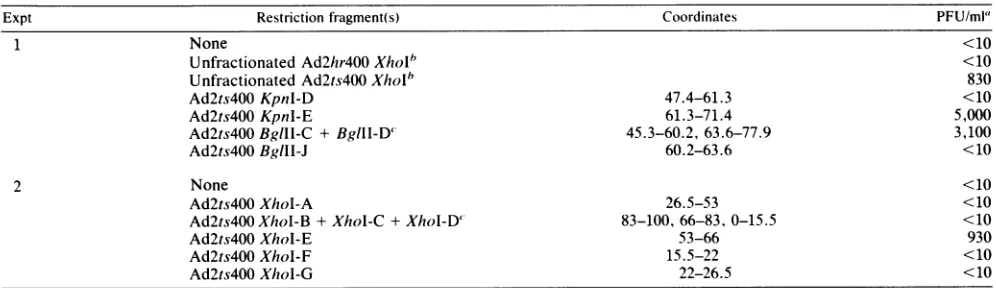
were countedafter 18 days. Since Ad2hr400 plaques donotappear until approximately day 21, all virus plaquing at this point presumably carrythe cold-resistant mutation. As expected, Ad2ts400 but not Ad2hr400, unfractionated XhoI fragments were able to confer the cold-resistant phenotype on WT Ad2. Among the crosses performed with purified XhoI fragments, only XhoI-E (coordinates 53 to66) crosses were able toyield cold-resistant virus. BglII and KpnI fragments were used tofurther localize the cold-resistant mutation on the adenovirus genome. BothBgIII-C-BgIII-D and KpnI E fragments were able to efficiently confer the cold-resistant phenotype. This places the cold-resistant mutation between coordinates 63.6 and 66.The cold-resistant mutation thus maps in the N-terminal segment ofthe DBP gene, as does the original Ad2hr400 mutation (44). We are confident that the marker rescue experiments mapthe cold-resistant mutation andnotsimply remapthe original Ad2hr400 mutation fortworeasons. First,
crossesperformed with unfractionated XhoI restriction
frag-ments derived from Ad2hr400 yielded no progeny virus. Second, progeny virus obtained in successfulcrosses yield-edlarge, rapidly forming plaquesthatwerevisible by day 18. Since both the Ad2hr400 and cold-resistant mutationsmapto thesamerestriction fragments, wedonotknow whether the cold-resistant mutation alone can confer the cold-resistant phenotype or whether both mutationsare necessary.
Cold-resistant recombinants obtained inthe crosses were examinedto seewhether they had simultaneously acquired the temperature-sensitive phenotype. The resultswere
con-sistent with the earlier mapping data, which localized the temperature-sensitive mutation tocoordinates 61.3 to63.6. Two oftwo recombinants obtained in the XhoI-E (coordi-nates 53 to 66) cross acquired the temperature-sensitive phenotype, whereasoneoftworecombinants obtained in the KpnI-E (coordinates 61.3 to 71.4) cross was temperature sensitive. As expected, neither of the two recombinants derived in the BglII-C-BglII-D cross (coordinates 63.6 to
77.9 and45.3to60.2) hadacquired the temperature-sensitive phenotype.
EarlymRNA accumulation inAd2ts400-infectedcellsatthe
nonpermissivetemperature. Experimentswereperformed to determine whether Ad2ts400, like Ad5tsl25, accumulated early viral mRNA at thenonpermissive temperature (7, 10, 11, 50). Suspension cultures of HeLa cells wereinfected at high multiplicity with Ad2orAd2ts400 and incubatedat41°C
in thepresenceof araCtoinhibit DNA replication. At6,12, and 18 hp.i., samples of cells weretaken, and cytoplasmic RNAwasextracted. Polyadenylated RNA selected from 100 ,ug of each RNA preparation was electrophoresed on a denaturingagarosegel, transferredtodiazobenzyloxymethyl paper, andprobed withradioactively labeled, cloned DNAs specific for each early region. Differences in early mRNA
accumulation between Ad2 and Ad2ts400 were not readily apparent at6 hp.i. (Fig. 6). This wasconfirmed by densito-metrictracingsof theautoradiograms, which showed thatat 6 hp.i.the steady-statelevelsofearlymRNAsproduced by
thetwoviruses werewithinafactor oftwo. By 12and 18h, however, Ad2ts400 had accumulated higher steady-state
levels ofearlyviral mRNAs thanhad Ad2. At 18 hp.i., the amount of accumulation relative to the WT infection as assessed by densitometry was greatest forearly region 1B
[image:8.612.62.560.534.678.2]mRNAs(eightfold),whereas theotherearly regions(1A, 2A,
TABLE 4. Physical mapping of the Ad2ts400 cold-resistant mutationby markerrescue
Expt Restrictionfragment(s) Coordinates PFU/ml'
1 None <10
UnfractionatedAd2hr400Xholb <10
Unfractionated Ad2ts400XhoI* 830
Ad2ts400 Kpnl-D 47.4-61.3 <10
Ad2ts400Kpnl-E 61.3-71.4 5,000
Ad2ts400BglIl-C + BglIl-D' 45.3-60.2,63.6-77.9 3,100
Ad2ts400BgIII-J 60.2-63.6 <10
2 None <10
Ad2ts400 XhoI-A 26.5-53 <10
Ad2ts400 XhoI-B +XhoI-C+XhoI-D' 83-100, 66-83, 0-15.5 <10
Ad2ts400 XhoI-E 53-66 930
Ad2ts400 XhoI-F 15.5-22 <10
Ad2ts400 Xhol-G 22-26.5 <10
"IntactAd2 DNA-terminalprotein complexwasmixed with the restrictionfragmentsindicated andtransfectedinto 293cells. The progeny resulting fromsuch crosses werepassagedonceinCVccellsat32.5°C,and titersoftheresultingprogenyweredeterminedon
CVI
monolayersat32.5°C. Thenumbersgivenarethe averagesoftwo independentcrosses.
bNeither
Ad2hr400
orAd2ts400
unfractionated Xholfragments were infectious in the absence of Ad2 DNA-terminalprotein complex.'TheBglll-C and
BgllI-D
and theXhoI-B, XhoI-C,
andXhoI-D
restrictionfragmentscannotbeseparated byelectrophoresisonagarose gels.on November 10, 2019 by guest
http://jvi.asm.org/
SEPARATE DOMAINS OF Ad2 DNA-BINDING PROTEIN 43 E A
Ad? tI4:^'
6 6 :
12l 14, 6 .Z2 is
_ _ 1 |
- -1175
.r,P
b..
s--*!050ElB Aid2 R4Dm.l... 6 12 j8 6 ?1)is...
_1-2350
-1150
E2A Ae2 t s42.V
....
... ....I ..-.6 12 18 '12 '8
U"
_=i825E4 Ad2 ts430
----6- 2
6 :, i 6 12 18
.f.
* 2 f;-~
_1850
-1575
LI Ad2 ts400
,-- ,---;
6 12 18 6 12 18
.::..':
E3
Ad2 ts4O0 Ad5 ts125
6 12 18 6 12 18 6 12 18 6 12 18
*.''.'
E 3(Ad5 probe) Ad2 ts400 Ad5 ts125 6 12 18 6 1? 18 6 12 18 6 12 18
<;r n
-3500 3450 2950-2250
-
1825-
1075-,345"
---3000
----2250 2000
-3450
-3000
-1075
1825-FIG. 6. Earlyviral mRNAaccumulation in HeLacellsat39.5°C. SuspensionculturesofHeLacells wereinfected withAd2,Ad2ts400, Ad5, or Ad5tsl25 and incubated at 41°C in the presence of araC to inhibit DNA replication. Cytoplasmic RNA was extracted from approximately equal numbers of cells at 6, 12, and 18 h p.i. Samples (100 ,ug) of each RNA preparation were fractionated on oligodeoxythymidylic acid-cellulosecolumns,and thepolyadenylatedfractionswereelectrophoresedthroughadenaturing 1.2%agarosegel
containing 10 mM methyl mercury hydroxide. The RNA was blotted onto diazobenzyloxymethyl paper and probed with nick-translated DNAsspecific foreach adenovirusearlyregion (indicatedabove eachpanel).Theprobes usedwereplasmidclonesof Ad2DNA, except the
oneearly region3blotindicated, whichwasprobedwithapurifiedAd5 restrictionfragment specificfor E3. The numbers above each track in-dicate the hours afterinfection thatthe RNA was isolated, and the brackets indicate theinfecting virus. The numbersbeside each panel
indicatethe approximatesize in nucleotides of the mRNAspecies. 3, and 4) were overproduced to lesser extents (two- to threefold). The mRNA speciesmadein both infections were ingeneralsimilar and similar in size and relative abundance
to the species previously reported in Ad2-infected cells treated with araC (4, 9, 16).
The late Li mRNA family, which has previously been reported tobeexpressed duringthe early phase of infection (1, 16, 51, 62), was also analyzed (Fig. 6). A single 3.500-nucleotide mRNA was present at 18 h inAd2ts400-infected
cells, but was not detectable in the WT infection. Other
groups have reported the presenceofa single Li
cytoplas-mic RNA during the earlyphase, although its size has been
reported as 4,000(51) and2,900 (1) nucleotides.
Early mRNA accumulation was also examined in Ad5-and Ad5t.s125-infected cells. In general, theoverproduction ofearly messages relative to the WT in Ad5ts125-infected cellswassimilartothatobserved inAd2ts400-infected cells, although the kinetics of earlymRNAaccumulationappeared
todiffer between thetwoviral serotypes(datanotshown). A
striking serotypic difference was noted, however, in the earlyregion3 mRNAspecies hybridizingtotheAd2-specific
probe (Fig. 6). To see whether this result was due to sequence heterology or serotypic differences in the pattern
of early region 3 mRNA expression (or to both), an
AdS-specific probe covering the same viral coordinates was
hybridized to a similar Northern blot of the same RNA preparation. Analysis of this blot (Fig. 6) showed that both
the above explanations were correct. This region of the adenovirusgenome shows large serotypic sequence
heterol-ogy, since the patterns of hybridization by the two probes
were quite dissimilar. In addition, early region 3 shows
serotypicdifferencesinthe pattern of mRNAexpression. In particular, the major 1,825-nucleotide Ad2 species was not
detected ineitherthe AdS orAd5t125 infections. Evidence forextensive sequencedifferences between serotypes2 and
5 in this region of the adenovirusgenome hasbcen reported previously (27). Furthermore, Flintet al. (22), using satura-tion hybridization techniques, concluded that AdS early region3 mRNAcorrespondedinpositiontoAd2mRNA,but
also contained some additional adjacent sequences. Since
the closely related Ad2 and AdS areoften used interchange-ably, these differences in nucleotide sequence and mRNA VOL.49, 1984
on November 10, 2019 by guest
http://jvi.asm.org/
[image:9.612.60.555.79.423.2]expression are noteworthy. It should be pointed out, howev-er,that early region 3isoneregion of the adenovirus genome that is nonessential for growth of the virus in tissue culture. Complementation between Ad2 and Ad2ts400 in monkey cells at the nonpermissive temperature. The DBP gene of
Ad2ts400 has three mutations compared with the WT gene. The N-terminal portion contains two mutations that extend the host range of the virus by allowing late gene expression and growth in monkey cells. The C-terminal portion contains athird mutation that makes the virus temperature sensitive for DNA replication and proper early gene expression. If the DBP contains separate functional domains, one might expect that mutations in one domain would not affect the activities
ofthe other.
To test this idea we asked whether Ad2ts400was able to express its late genes in monkey cells at the nonpermissive temperature, when the DNA replication function of DBP was disrupted. However, since only replicated viral DNA can serve as a template for late gene expression (64), cells infected with a DNA-negative mutant such as Ad2ts400 at the nonpermissive temperature would not be expected to
synthesize late viral proteins irrespective of whether the late gene expression and DNA replication functions ofDBP are
functionally independent. To circumvent this problem, CV1 cells were coinfected with Ad2ts400 plus WT Ad2 at 39.5°C. Under these conditions the WT DBP should complement the DNA replication defect of the Ad2ts400 DBP and allow the infection to proceed into the late phase. If the Ad2ts400 DBP activity that allows late gene expression in monkey cells is
functional at the nonpermissive temperature, then the
Ad2ts400 DBP should complement the late gene expression defect of the WT DBP and allow normal lateprotein synthe-sis and viral growth.
CV1 cells infected at 39.5°C with Ad2 alone showed the
typical abortive pattern of protein synthesis, whereas Ad2ts400-infected cells, as expected, are restricted to the
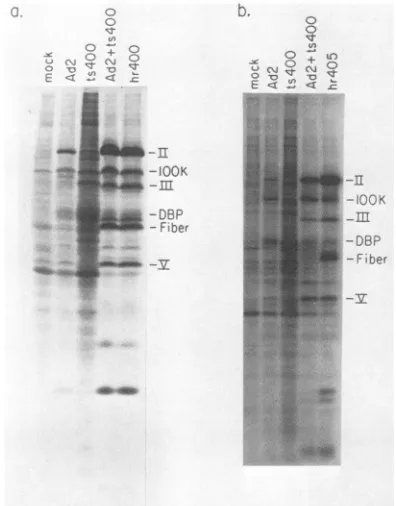
early phase of infection (Fig. 7a). Cells coinfected with Ad2
plus Ad2ts400, on the other hand, showed a productive
pattern of late protein synthesis, with all late proteins, including fiber, being made in normal amounts. Virus yield was also greatly enhanced in the mixed infections (Table 5). Low levels ofprogeny virus wereproduced in cells infected with Ad2 or Ad2ts400 alone (9.0 and 1.3 PFU per cell,
respectively), but coinfection yielded normal levels of infec-tious virus (450 PFU per cell). The yields of both Ad2 and Ad2ts400 were enhanced to similar extents in the mixed infection.
The results of this experiment suggest that the ability of Ad2ts400 to express its late genes in monkey cells is not temperature sensitive. A repeat of this experiment in
CVC
cells, where the block to adenovirus growth is more strin-gent, showed that although complementation between Ad2 and Ad2ts400 occurred, it was not as complete as in CV1
cells (Fig. 7b; see below).
Ad2ts400 late gene expression in monkey cells after
tem-perature shift-up.Although theprevioussetofresultsargues
that the late gene expression activity of DBP functions
independentlyof its DNAreplication activity, thepossibility
exists that these activities are not independent and that the
observed complementation was simply due to the WT DBP
protecting the mutant DBP against heat inactivation,
possi-bly as part of a multimeric complex. To rule out this
possibility temperature shift experiments were performed
with Ad2ts400 in the absence ofcomplementing virus.
CVc
cells were infected with Ad2, Ad2ts400, or anon-temperature-sensitive derivative of Ad2ts400 called
b. C)
c1;3)
Ej (I 0 c
-IOOK
,-II
-DBP
-Fiber
010
C)
+4
0
h-T
_-100K
-m
-DBP
-FXber
FIG. 7. Complementationbetween Ad2 andAd2ts400 in
monkey
cells at the nonpermissive temperature. CV1 (a) or
CVc
(b) cells wereinfectedat amultiplicityof40 PFUper cell forsingleinfections and 20 PFU per cellof eachinfectingvirus for thecoinfections. The infectedmonolayerswereincubatedat39.5°C.At30 hp.i.,
thecells were labeled with40p.Ci
of[35S]methionine
permlfor1 h,and in vivo protein synthesis was analyzed by SDS-polyacrylamide gelelectrophoresis. Ad2hr4O5 isanon-temperature-sensitivederivative of Ad2ts400 (see text) and serves as the
positive
control forproductiveinfection inCVc cells.
Ad2hr4O5. Ad2hr4O5 was derived
during
the markerrescueexperiments
from a cross between the intact Ad2ts400genome and a
purified BgII
J restrictionfragment
(coordi-nates 60.2 to
63.6)
ofWT Ad2.Thus,
Ad2hr4O5 ispresum-ably
genetically
identicaltoAd2ts400, except
forlacking
thetemperature-sensitive
mutation between coordinates 61.3 and 63.6. The infections were maintained at32.5°C
for 29 htoallow themto
proceed
into thebeginning
of thelatephase.
Atthis
time,
oneofaseries ofreplicate
infectionswas pulse-labeled with either[3H]thymidine
or[35S]methionine,
andthe
remaining
infections were transferred to39.5°C.
As acontrol,
the DNAsynthesis
inhibitoraraC wasaddedtoone set ofAd2hr405-infected
cells incubated at39.5°C.
At4,
8,and 12 h after the temperature
shift-up, plates
from each infection(Ad2,
Ad2hr4O5,
Ad2hr405
plus
araC,
andAd2t.s400) were
pulse-labeled
with either[3HJthymidine
or[35S]methionine.
One set ofplates
waspulse-labeled
with[35S]methionine immediately
after incubation at39.5°C.
Low-molecular-weight
DNA was extracted from cellslabeled with
[3HJthymidine,
and anequal sample
from eachpreparation
washybridized
to Ad2 DNA immobilized on nitrocellulose filters. The rate of DNAsynthesis
in eitherAd2- orAd2hr405-infected
CVc
cellsincreasedduring
the 12h after the temperature
shift-up
(Fig.
8a).
When araC was added tothe Ad2hr405 infections at the time oftheshift-up,
however, DNAsynthesis
wasmarkedly
reduced.Ad2ts400
DNA
synthesis,
which at the time of theshift-up
wasoccuring
at aslightly
faster rate than that ofAd2hr405,
waspractically undetectable at 4,
8,
and 12 h after theshift-up.
L.,
4W.-.4
on November 10, 2019 by guest
http://jvi.asm.org/
[image:10.612.340.538.79.332.2]SEPARATE DOMAINS OF Ad2 DNA-BINDING PROTEIN 45 TABLE 5. Complementation between Ad2 and Ad2ts400 inCVI
cellsat39.5°C
Virus' PFU/cell
Ad2... 9.0*
Ad2ts400... 1.3'
Ad2hr400...
950b
Ad2 + Ad2ts400... 170" + 280'
c
CV1
cellswereinfectedat amultiplicityof40,or20each for the Ad2plusAd2ts400coinfection. The infected cellswereincubatedat39.5°C for 48 h.
bYieldwasdeterminedby titrationonHeLa cells at39.5°C. ' Yieldwasdetermined bytitration onCV1 cellsat 32.5°C.
The result is consistent with our earlier observation that
Ad2ts400 is temperature sensitive for DNA replication. The critical question is whether Ad2ts400 late gene
expression is also temperature sensitive. Since
ongoing
DNAsynthesis is not required for late gene expression(12),
viral DNA replicated beforetheshift-upshould continue to act as a template for late gene expression. We purposely
chosetoshift the temperature atatimeearly
during
thelate phase, hoping to catch the infections at a point beforesteady-state levels of the late mRNAs had been reached.
Thus, if Ad2ts400 late gene expression is not temperature
sensitive, the rate of late viral protein
synthesis
should remain constant andperhapsevenincreaseafter theshift-up.
Ifthe late gene expression activity oftheAd2ts400 DBP is temperaturesensitive, then,dependingonthe level atwhich
E
a) 0
irJ
the block to late protein synthesis occurs in monkey cells, viral protein synthesis may drop immediately (translational defect)or after some lag(transcriptional or RNA processing defect)after the shift-up. If viral mRNAsynthesis is defec-tive in monkey cells, then the length of this lag will depend on the stability of the preexisting viral mRNAs. Because fiber protein synthesis is most dramatically affected in monkey cells, alterations in its production are most easily
followed after the shift-up.Since the half-life of fiber mRNA is approximately 2 h in CV1 cells (K. P. Anderson and D. F.
Klessig, unpublished data)andpresumablyalso in
CV,
cells, asignificant drop in fiber proteinsynthesis should be appar-ent by 4 and certainly 8 h after the shift-up if no new functional fiber mRNA isbeing produceddue to the inactiva-tionof DBP's late gene expression function.As expected, Ad2-infected
CVc
cells showed no detect-able fiber synthesis either beforeor 12 h after the tempera-ture shift-up (Fig. 8b). In contrast, fiber expression was evident inAd2hr405-infectedcells and increasedsubstantial-lyduring theshift-up period. When Ad2hr405-infected cells were treated with araC to block DNA
replication,
fibersynthesis increased between 0 and 4 h after the shift-up,
appeared to level off, and then dropped somewhat at 12 h after the shift-up. A very similarpattern of fiber synthesis
was seen in theAd2ts400 infections. Although araC-treated
Ad2hr405 infections showed slightly more fiber synthesis
thandidAd2ts400infections aftertheshift-up,this is
proba-bly the resultof a greaternumber ofDNAtemplatesin these cellsdue to a lessstringent block ofDNA
replication
by araCb
Ad2;."
C 0
f0N
_l- E
r ' 1', ^ rC\S7 (M
m~
"~*4.UbIFim
nil-|
l il __Fe
..e-*.f
_lb^.
4 8
HOURS PST SHIFT-UP
FIG. 8. DNAsynthesisand late geneexpressioninAd2ts400-infectedmonkey cells after temperature shift-up. Replicate cultures ofCVc
monolayers were mock infectedorinfected withAd2 (0), Ad2hr4O5
(U),
orAdts400 (0)and incubated at32.5°C for 29 h. At this time, infectedmonolayers from two plates of each infection were labeled at 32.5°C for 1 h with either 50,uCiof[3H]thymidine per ml or 40,uCiof[35S]methionineper ml.araCwasadded to one group ofAd2hr4O5-infectedcells(A).These andall of the remaining infections were shifted to 39.5°C.At0, 4, 8, and 12 h aftershift-up, infectedmonolayerswere labeled with either[3H]thymidineor[35S]methioninefor 1 hat 39.5°C. (a) DNA synthesis aftertemperature shift-up. Low-molecular-weightDNA was prepared from[3H]thymidine-labeled cells by amodified Hirt extraction. Equalfractions of each preparation were boiled in alkali and hybridized to Ad2 DNA immobilized on nitrocellulose filters. The
zerotime point represents cells labeled for1 hat 32.5°C, and all other points represent cells labeled for 1 h at 39.5°C. (b) Fiber protein synthesis aftertemperatureshift-up. Equalfractions of each[35S]methionine-labeledproteinextract were immunoprecipitated with polyclonal antibodies raised against native fiber protein, and the precipitated polypeptides were analyzed by electrophoresis on a 15% SDS-polyacrylamide gel.The numbers aboveeachtrack denote the time after shift-up when the cells were labeled. The parentheses above some numbers indicatelabelingwasfor1h at 32.5°C. Otherwise, labeling was at 39.5°C for 1 h. The position of the fiber and other late adenovirus proteinsareindicatedtothe leftofthe panel.
VOL. 49, 1984
on November 10, 2019 by guest
http://jvi.asm.org/
[image:11.612.79.526.385.613.2]than by the temperature-sensitive mutation (Fig. 8a). Since the actual amount of functional fiber mRNA or the efficiency of its translation actually increased after the shift-up, the late gene expression function of DBP must remain active even though its DNA replication function is disrupted.
DISCUSSION
Few multifunctional eucaryotic proteins have been stud-ied in great detail, in part due to the great difficulty, at least until recently, of obtaining large numbers of mutants for genetic and biochemical analyses. One exception is theSV40
large T antigen. A variety of genetic and biochemical studies indicate that T antigen is a multifunctional protein containing separate functional domains (for review, see reference 32). A large body of evidence suggests that the
adenovirus-speci-fied, 72-kd DBP is another eucaryotic protein that is multi-functional. The similarities between DBP and T antigen are striking. Both are phosphorylated, early viral gene products that are necessary for viral DNA replication and the repres-sion of early gene expresrepres-sion during the late phase of infection. Both are DBPs; T antigen binds specifically to the
SV40 origin of replication, whereas DBP binds non-specifi-cally to single-stranded DNA. In addition, the two proteins can complement one another for function. Both T antigen and the host range mutant DBP have the ability to enhance adenovirus late gene expression in monkey cells. Further-more, the defect in the DNA replication of the adenovirus DBP mutant
Ad5tsl25
at the nonpermissive temperature can be partially overcome by coinfection with WT, but not a T antigen tsA mutant ofSV40. In return, coinfection with Ad2 helps SV40 tsA down-regulate the expression of its early genes (29, 55).Genetic data suggest that, like SV40 T antigen, DBP contains separate functional
domains,
since there exist two classes of DBP mutations (temperature sensitive and host range), each of which affects very different activities and maps in a distinct region of the gene (3, 44-46). Analysis ofAd2ts400,the DBP mutant described in this paper, provides additional genetic and biochemical evidence that DBP con-tains separate functional domains. Ad2ts400,compared with WT Ad2, is a triple DBP mutant. It contains two host range alterations in the amino-terminal portion of the gene (the
Ad2hr400 mutation and the cold-resistant mutation) that allow the virus to overcome the normal block to late gene expression in monkey cells, even at low temperature. In addition, Ad2ts400 contains a temperature sensitivity muta-tion in the carboxyl-terminal pormuta-tion of the gene. The temperature-sensitive mutation causes a phenotype similar to that of the well-characterized DBP mutantAd5tsl25. Like
Ad5tsl25,
Ad2ts400 is unable to replicate viral DNA or properly shut off early viral mRNA expression at thenonper-missive temperature.
Two sets of experiments suggest that the ability of the
Ad2ts400 DBP to overcome the block to late geneexpression in monkey cells is independent of its function in DNA replication.
First,
Ad2ts400 and Ad2 complement one anoth-er for growth in monkeyCV,
cells at the nonpermissive temperature. Presumably the Ad2 DBP supplies the DNA replication function, whereas the Ad2ts400 DBP allows normal late gene expression to occur. The simplest interpre-tation is that the ability of the Ad2ts400 DBP to allow late gene expression in monkey cells is not temperature sensi-tive. An alternative, although less attractive, explanation is that whereas this function is temperature sensitive, theAd2ts400 DBP is stabilized in the mixed infection by interac-tion with WT DBP.
When this experimentwas repeated in
CV,
cells, a mon-key cell line where the block to adenovirus late gene expression is more stringent, onlypartial complementationwas observed. Incomplete complementation maybe due to the WT DBP negatively interfering with late gene
expres-sion,althoughitisnotclearwhy this does not occurin
CV1
cells. Perhaps mixedmultimericcomplexesconsisting ofWT and mutant DBP molecules are active in the CV1 cellular environment, but are nonfunctional in the more restrictive
CVc
cell.To avoid problems inherent in the interpretation of such complementation experiments, temperature shift
experi-ments wereperformedinwhich
CVc
cellswereinfected withAd2ts400 alone. Temperature shift-up during the beginning
of the latephaseofinfectionresulted inarapidanddramatic
inhibitionof viral DNAreplication, whereasthesynthesis of
the viral fiber protein (the expression of which is most dramaticallyaffectedinmonkey cells) actually increased and
thencontinuedforat least 8 h. Themost plausible
interpreta-tionofthis result isthatthe lategeneexpressionfunction of
DBP isnotdisruptedat thenonpermissive temperature even though the DNA replication activity of this protein is de-stroyed. This interpretation, however, issomewhat clouded byourlackofunderstandingof the mechanismby whichthe altered DBP overcomes the monkey cell block to fiber
synthesis. The DBP could presumably be acting at one or morelevels ofgeneexpression includingtranscription, RNA processing, RNAtransport, and translation. Ifthe late gene expression function of the Ad2ts400 DBP was in fact
temperature sensitive, and the protein was acting
primarily
at the level of translation, we would expect to see an
inhibition offiber synthesis soon after repression of DNA synthesis occurred. This was not the case.
If,
on the otherhand, the Ad2ts400 DBP was temperature sensitive forlate geneexpression, but wasactingat thelevel of
transcription,
processing, or transport, we would expect alag
before inhibition of fiber synthesis occurred, since functional fibermRNA made before the shift-up could continue to direct
fiber protein synthesis. Nevertheless, a dramatic inhibition
wouldbe expected8 to12 h after theshift-updueto turnover
of preexisting fiber messages, which have half-lives of approximately 2 h (K. P. Anderson and D. F.
Klessig,
unpublished data).This was not thecase; thekinetics of fiber synthesis appeared identical to a control infection withAd2hr4O5 (a non-temperature-sensitive derivative of Ad2ts400)inwhich DNAreplicationwas
prevented
by
araC treatment. Furthermore, fiberprotein
synthesis
actually
increased up to 8 h after the temperature
shift-up.
Such aresult would not be expected if the cells were
simply
translating message made before the
shift-up.
Theresults of the two sets of
experiments
takentogether
strongly suggest (i) that the DBP contains at least twofunctional domains, and (ii) that thedomain that allows late geneexpression inmonkeycellscan function
independently
of thedomaininvolved in DNA
replication.
These functionaldomainsmaycorrespond tothe two
physical
domainsprevi-ously described (39, 60). The
large
C-terminal domain isknown to possess the DNA
binding
and DNAreplication
activities of DBP (6, 39) and
presumably
also carries theactivities thataffect early gene shutoffand the
efficiency
of cellular transformation. Recent studies of revertants ofAd5tsl25 andAd5ts107suggest that these C-terminal
activi-ties (DNA replication, shutoff of
early
genes, and modula-tion ofcellular transformation) are themselvesfunctionally
distinct (13, 45, 48, 52, 53). Incontrast, the
smaller,
heavily
phosphorylated N-terminal domain



![FIG. otherantibodiesextraction.proteinszeronumberspolyacrylamideDNAsynthesis39.5°C.infectedmonolayers[35S]methionine after time synthesis Replicate At are monolayers indicate after point CVc raised 0, Equal were indicated 4, temperature 8, gel](https://thumb-us.123doks.com/thumbv2/123dok_us/1438195.96239/11.612.79.526.385.613/otherantibodiesextraction-proteinszeronumberspolyacrylamidednasynthesis-infectedmonolayers-methionine-replicate-monolayers-indicated-temperature.webp)