JOURNAL OFVIROLOGY, Mar. 1991, p.1082-1089 0022-538X/91/031082-08$02.00/0
Copyright © 1991, AmericanSocietyforMicrobiology
Correct
Intranuclear Localization
of
Herpes Simplex
Virus
DNA
Polymerase Requires the Viral ICP8
DNA-Binding Protein
MELISSA BUSH,' DORNE R. YAGER,2t MINGAO,' KLAUS WEISSHART,2ALICE I. MARCY,2t
DONALD M. COEN,2AND DAVIDM.
KNIPE'*
Department of Microbiology and Molecular Genetics'andDepartment ofBiologicalChemistry andMolecular
Pharmacology,
HarvardMedicalSchool,
200Longwood
Avenue, Boston, Massachusetts 02115 Received 20 August1990/Accepted 19 November 1990We usedindirectimmunofluorescence to examine the factorsdeterminingtheintranuclear location ofherpes simplex virus(HSV) DNA polymerase (Pol)ininfectedcells. In the absence of viral DNAreplication,HSVPol colocalized with the HSV DNA-binding protein ICP8 in nuclear framework-associated structures called prereplicative sites. In the presence ofviral DNA replication, HSV Pol colocalized with ICP8 in globular intranuclear structures called replication compartments. In cells infected with mutant viruses encoding defective ICP8 molecules, Pol localized within the cell nucleus but showed a general diffuse intranuclear
distribution. In uninfected cells transfected with a plasmid expressing Pol, Pol similarly showed a diffuse
intranuclear distribution. Therefore, Pol can localize to the cell nucleus without other viral proteins, but functional ICP8is required for Pol to localize to prereplicative sites. In cells infected with mutant viruses encoding defective Polmolecules, ICP8 localizedtoprereplicative sites. Thus, Polortheportionsof Pol not expressed by themutantvirusesarenotessential fortheformationofprereplicative sitesorthe localizationof
ICP8 to these structures. These results demonstrate that a specific nuclear protein can influence the
intranuclear location ofanothernuclear protein.
Herpes simplex virus (HSV)DNAreplication takes place within defined regions of the infected cell nucleus called replicationcompartments (3, 18). Studieswith viralmutants andtransfected viralgeneshave shown thatsevenviralgene
products arerequired forviral DNA synthesis (reviewed in
references 1 and 6). The major DNA-binding protein, or
infected-cell protein 8 (ICP8), is one ofthe HSV proteins
required forviralDNAsynthesisandwasusedtodefine the replication compartment structures (16).
Immunofluores-cenceexperiments also showed that viralDNA polymerase (Pol) (15, 17, 22), the UL42geneproduct (15), andthe UL9
geneproduct(15)arealso localizedwithinstructuressimilar toreplicationcompartments. Nuclear stainingwasobserved
for the three other viral proteins required for viral DNA synthesis, UL8, UL5, and UL52 (15), but the staining was
toofaintto determine precise sites of intranuclear localiza-tion.
In theabsence ofviral DNA replication, ICP8 assumes a
punctate distribution within the nuclei of infected cells, at sites called prereplicative sites (16). We have hypothesized that these infected-cell-specific structures arecomplexes of
viral and cellular proteins poised to initiate viral DNA synthesis andthat, when viral DNA replicationcanproceed,
progeny viralDNA-protein complexes and additional repli-cationcomplexes accumulate inoneareaoftheinfected-cell
nucleus, leading to globular intranuclear structures called replication compartments (3). Atleast aportion of the host
DNA replication apparatus is localized to prereplicative sites, and ICP8 is required for this reorganization of the location ofcellular DNAsynthesis (3). We have investigated whether viral DNA polymerase is localized to the same
* Correspondingauthor.
t Present address: Department ofSurgery, Medical College of Virginia, Richmond, VA23298.
tPresentaddress: DepartmentofBiophysicalChemistry, Merck Sharp and Dohme ResearchLaboratories, Rahway,NJ07065.
intranuclear structures as is ICP8 and, by the use of viral mutants with specific alterations in the ICP8 or pol gene
products,examined the interrelationshipbetween thesetwo viralgene
products
forlocalization within the cell nucleus.MATERIALS AND METHODS
Cells and viruses. Monkey CV-1 cells (American
Type
Culture Collection)werechosen forthis study becausethey gavelowerbackground levels of staining than did Vero cells withthe rabbitseraused. These cellswere platedontoglass
coverslips as described previously for Vero cells (8) and infected the next day. The cultures were mock infected or
infected at a multiplicity of infection of 20. The KOS1.1
wild-type(wt) virus; thepolgenemutantsAX17, AX14, and AS1(12) (Fig. 1); and the ICP8genemutantsd301,nlO, and
n102 (4) (Fig. 2) were described previously. Mutant HP54 (Fig. 1)was constructed asdescribed for mutantHP66(13)
tohave2,253 bp of Pol-coding sequences replaced with the Escherichia colilacZgene linkedtothe tkpromoter. HP54 hasan additional deletionofthepol locusrelative to HP66 (12). The AX14 and AX17 mutant viruses (Fig. 1) each containa1,165-bp deletionthat shouldcause aframeshiftin
thePol-codingsequences.Onthe basis of this deletion, these
mutants were predictedtoencode aPol protein of 65 kDa.
NoPolproteinwasdetectedincellsinfectedwithAX17, and
AX14-infected cells expresseda96-kDaPol protein,
consis-tent with an additional frameshift mutation restoring the expression ofanadditionalpartof thePol-codingsequences.
The AS1 mutant virus(Fig. 1) contains a2,253-bp deletion
within thePol-codingsequencesandexpresses a57-kDaPol
geneproduct(26). Propagation and determination of titers of thepolmutantswere doneon DP6 cells, which contain the polgeneandarecapableofcomplementing the growthofpol mutants (13).
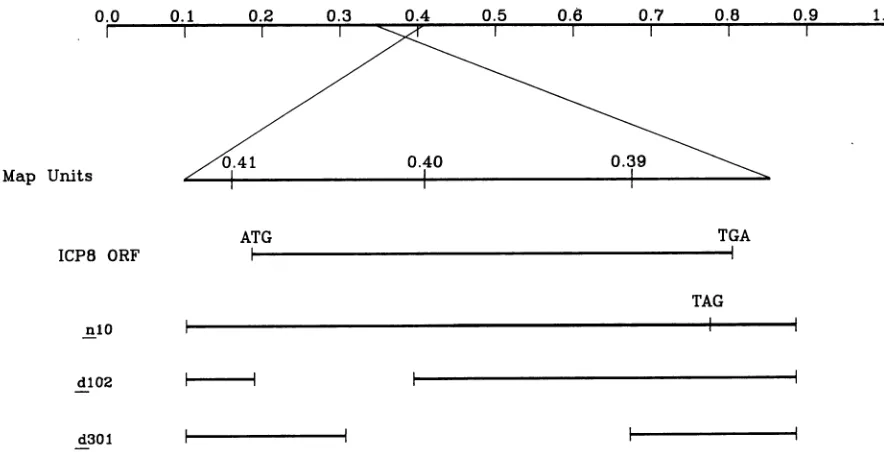
The ICP8 gene mutant d301 (Fig. 2) contains a 2,001-bp
deletion within the ICP8-codingsequences and expressesa
1082
Vol. 65, No. 3
on November 10, 2019 by guest
http://jvi.asm.org/
POL ORF
ATG TGA
_
tk PROMOTER
-
--, -galactosidase
FIG. 1. Structures of viral DNA Polgenesinviralmutantsused in this study. Thelocation of the Polopenreading frame(ORF) in theviral
genomeis shown inthetophalf of the figure. The bottom lines show the locations of the deletions in AX14, AX17, andAS1 and thelocation ofthe tk-lacZ insertion in HP54.
53-kDa ICP8geneproduct which localizestothe cellnucleus (4). The mutant nlO genome (Fig. 2) contains a nonsense
codon after codon 1160 of the ICP8-coding sequences, and
thismutantvirusexpresses anICP8geneproduct of
approx-imately 120,000 kDawhich failstolocalizetothecellnucleus (4).TheICP8gene mutantd102 (Fig. 2) contains a1,188-bp
deletion in the ICP8-coding sequences and expresses an
ICP8gene product of 80,000 kDa which fails to localize to the cell nucleus(4). Propagation and determination of titers of theICP8mutantvirusesweredoneonS-2 cells, whichare
derived by introduction of the ICP8geneandarecapable of
complementing the growth of ICP8mutants (4).
To block viralDNA synthesis in wtvirus-infected cells,
weadded 400 ,ug of sodium phosphonoacetate (PAA)perml
0
Map Units
ICP8
nl
of culture medium. Under these conditions, 20 mM N-2-hydroxyethylpiperazine-N'-2-ethanesulfonic acid (HEPES) buffer(pH 7.6)wasaddedtothe medium.
Plasmids. pCIE-Pol contains the HSV Pol major open
reading frameunder the control of the human cytomegalo-virus immediate-early enhancer-promoter and was
con-structedasfollows. A1.1-kbpXbaIfragment containing the
cytomegaloviruscontrolregionwasisolated from pEQ176 (a generousgiftfrom A. Geballe)and treatedwith theKlenow fragment and deoxynucleoside triphosphates to fill in the ends. The treated fragment was inserted into similarly
treatedHindIII-cleaved pT7Pol-01. pT7Pol-01 (24) consists ofa pGEM4 backbone and HSV sequences starting 6 bp
upstreamof the start site of transcription of the major Pol
.0 0.1 0.2 0.3 0.4 0.5 0.6 0.7 0.8 0.9 1.0
0.41 0.40 0.39
r
lllll
ATG TGA
ORF
TAG 0
dlO2
d301
FIG. 2. Structures of ICP8genesin viralmutantsusedinthisstudy.The location of the ICP8openreadingframe(ORF)inthe viralgenome
is shown in thetophalf ofthefigure. The bottom lines showthe location of thenonsensecodon in nlOand the locations of the deletionsin d102 and d301.
Ax14,17
ASi HP54
on November 10, 2019 by guest
http://jvi.asm.org/
[image:2.612.70.551.69.255.2] [image:2.612.87.529.468.694.2]1084 BUSH ET AL.
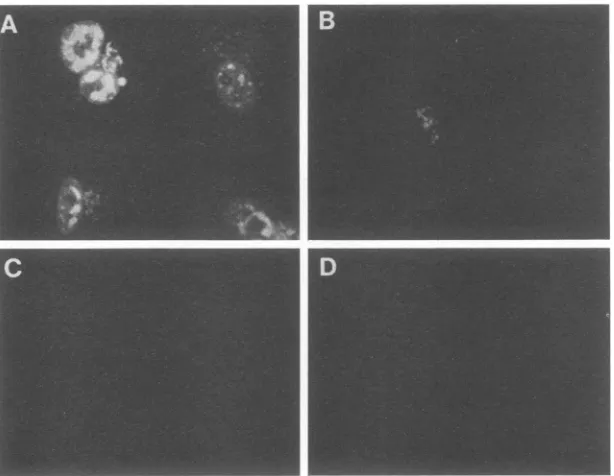
FIG. 3. Specificity of anti-Pol serum PP5for immunofluorescence. CV-1 cellswereinfected withKOS1.1wtvirusormockinfected. At 5hpostinfection, thecells werefixedandreactedwithanti-Polserum PP5 orpreimmune serumand then withfluorescein-conjugatedgoat antirabbit immunoglobulinantibody. (A)Infected cells reactedwithanti-Pol serum.(B) Infected cells reacted with preimmune serum.(C) Mock-infected cells reacted with anti-Polserum. (D) Mock-infectedcells reactedwithpreimmuneserum.
transcript (the location of the HindIll site into which the
cytomegaloviruscontrolregionwasinserted)andcontinuing
to a KpnI sitejust downstream ofthe Poladenylation site
(25).
Indirect immunofluorescence. Mock-infected or infected cells were fixed and permeabilized as describedpreviously (16)at5 hpostinfection. The cellswereincubatedwitha1:10
dilution ofanti-Pol serumPP5 (26) and/ora1:10dilution of mousemonoclonalantibody39S (20), witha1:50dilution of
fluorescein-conjugated goat antirabbit immunoglobulin
anti-body,andwitha1:30dilution ofrhodamine-conjugatedgoat antimouse immunoglobulin antibody. The last two antibod-ieswerediluted in phosphate-buffered saline (PBS)
contain-ing 10%normal goat serum tolowernonspecificstaining by the fluorochrome-conjugated antibodies. For double-label
immunofluorescence, the cells were photographed as de-scribedpreviously (7, 8).
Transfectedcells werefixed andpermeabilized 48 h post-transfection by incubationfor 10 min in methanol and for 5 minin acetoneat -20°C. Thecoverslips were air dried and stored at -20°C. Prior to reaction with antibodies, the
coverslips
werethawed and washedtwiceinPBS, incubatedfor 20 min at 37°C in 10% fetal calf serum in PBS, and reacted for 20 min at 37°C with a 1:20 dilution in PBS of either preimmune serum or EX6 anti-Pol rabbit antiserum (23). The coverslips were washed and incubated for 20min with fluorescein-conjugated goat antirabbit immunoglobulin
antibodydiluted 1:50 in 2% calf serum in PBS.
RESULTS
We used indirect immunofluorescence to examine the
localizationof HSVDNAPol undervarious conditions. For
analysis of infected cells, we used anti-Pol serum PP5,
prepared by immunizing rabbits with a lacZ-pol fusion
proteinandpreviously shown to be specific for Pol (26). On
HSV-infectedcells, the antiserum stained intranuclear glob-ularstructures (Fig. 3A),as reportedfor other Pol antisera
(15, 17, 22). No staining was seen with the PP5 antiserum (Fig. 3C) or preimmune serum (Fig. 3D) on mock-infected cells. Preimmune serum did react with some perinuclear structuresininfected cells(Fig. 3B).This reactionappeared tobe duetononspecific binding of rabbit immunoglobulin G to some componentof the Golgi apparatusin infected cells (resultsnotshown), possibly the virus-encoded Fc receptor (21). We have notbeen abletoblock this apparent nonspe-cific bindingbut have focused on the specific nuclear
reac-tivity of the Pol antiserum.
Localization ofPol to prereplicative sites and replication compartments.The intranucleardistribution of Pol shown in Fig. 3 was very similar to thatpreviously observed for the virus-encodedmajorDNA-binding protein ICP8 (16)and for the viral transactivator ICP4(7, 17). We performed double-label immunofluorescence with rabbit anti-Pol serum PP5 (26) and mouseanti-ICP8 monoclonal antibody 39S (20). A
major portion of Polwascodistributedwith ICP8 in
replica-tion compartments(Fig.4AandB).Single-antibody staining
did not reveal a spillover of the two fluorescent images
between thetwofilters (7; results not shown).
Wealsoexamined the distribution of Pol in cells infected in the presence of PAA, a specific inhibitor of viral DNA
polymerase (9, 11), to determine the site of localization of Pol in the absence of viral DNA synthesis. Under these
conditions, a major portion of Pol showed an intranuclear punctatedistributionthatcorrespondedtotheprereplicative sitesatwhichICP8waslocalized(Fig.4C andD).Thus,Pol was codistributed with ICP8 in prereplicative sites in the absence of viral DNAreplicationandinreplication compart-mentsin the presenceof viral DNAreplication.
Requirement for functionalICP8 for correct nuclear local-ization of Pol. Wehadpreviouslyshown thatfunctionalICP8 J. VIROL.
on November 10, 2019 by guest
http://jvi.asm.org/
[image:3.612.154.461.71.309.2]FIG. 4. Codistributionof ICP8 and Pol in thepresence or absenceof viralDNAreplication. CV-1 cellswereinfected with wtvirus inthe absence orpresence of 400p.gofPAA perml toinhibit viralDNAreplication. AtShpostinfection,thecells were fixed and reacted with anti-Pol serum PP5 and/oranti-ICP8 monoclonal antibody39S,with fluorescein-conjugated goat antirabbit immunoglobulin antibody, and with rhodamine-conjugatedgoat antimouseimmunoglobulinantibody.(A)Cells infected in the absence of PAA and reacted with Pol antiserum. (B)Same field ofcells asin panel A; thefluorescence image is due to the reaction withICP8antibody. (C) Cells infected in the presence of PAA; thefluorescenceimageis duetothe reactionwith Polantiserum. (D)Same field of cellsas inpanel C; the fluorescence image is due tothe reaction withICP8 antibody.
isneeded for the localization of at least a portion of the host DNA replication apparatus to prereplicative sites (3). To
determine whether functional ICP8 was needed for the
localization of Pol to prereplicative sites, we examined the
localization ofPol in cellsinfected with variousviral mutants
(Fig. 2) expressing defective ICP8molecules (4). Allof these
ICP8 mutants are defective forDNA replication (4), so wt
virus infection was carried out in the presence of PAA to inhibit viral DNA replication. Under these infection
condi-tions,wtPol andICP8localizedtoprereplicativesite struc-tures(Fig. 5CandD). In cellsinfectedwith the d301 mutant, monoclonal antibody 39S did not recognize the truncated ICP8 molecule expressed (Fig. 5E), but the Pol antiserum showed diffuse nuclear staining (Fig. 5F). In cells infected withthenlO mutant,ICP8 showed acytoplasmic distribution
with some perinuclear accumulation (Fig. 5G), while Pol showed adiffuse distribution throughout the nucleus (Fig. 5H). In cells infected with the n102 mutant, ICP8 reacted
poorly with monoclonal antibody 39S but appeared to be distributedthroughout the cell(Fig. 5I), andPol exhibiteda
diffusedistributionthroughout thenucleus(Fig. 5J). On the basisof theseresults,weconclude thatthe nuclear
localiza-tion of Pol isindependentof the nuclearuptake ofICP8 but thatfunctional ICP8 is needed for the correct intranuclear localizationofPoltoprereplicative sites.
Localization ofPol in transfected cells. To determine the
intracellular distribution ofPol in the absence of any other
viralproteins,wetransfected cells with pCIE-Pol, aplasmid
that contains the pol gene under the control of the strong
immediate-early enhancer-promoter of cytomegalovirus,
and analyzed the cells for Pol expression and intracellular
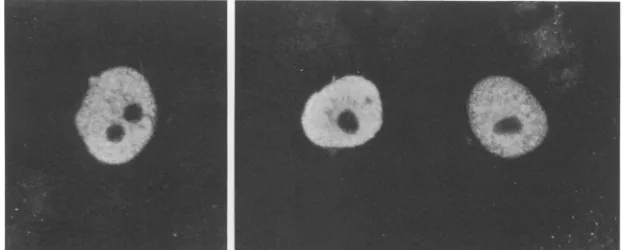
distributionby immunofluorescence. Approximately 5% of
the cells exhibited fluorescence staining, which was almost
exclusively nuclear (Fig. 6). The intranuclear fluorescence showedadiffuse, slightly granularnucleardistribution, with theexclusionof nucleoli. Nostainingabove the
background
was observed with preimmune sera againstpCIE-Pol plas-mid-transfected cells or with anti-Pol serum or preimmune
serum against cells transfected with a control
plasmid
(pGEM4) lacking the pol open reading frame (results not
shown).Weconcludefromthese results that Polcanlocalize tothenucleus in the absenceofother viral
proteins
butcan notlocalizetoprereplicative sitesby itself.Localization ofICP8incells infected withpolmutants. To determine whether therewas arolefor Pol in the
assembly
ofprereplicative sites and in thelocalization of ICP8 tothese structures, we examined the localization of ICP8 in cells infected with viralmutants
containing
lethalmutations in the pol gene (13). Previous work withpol ts mutants and Pol inhibitors had indicated that Polmight
not be needed foron November 10, 2019 by guest
http://jvi.asm.org/
[image:4.612.120.502.72.395.2]1086 BUSH ET AL. J.VIROL.
on November 10, 2019 by guest
http://jvi.asm.org/
FIG. 6. Nuclear localizationofPolexpressed in transfected cells. Vero cells transfected with pCIE-Pol were fixed at 48 h posttransfection andprocessed as described in Materials and Methods to detect Pol by immunofluorescence. Immunofluorescence images of fields are shown.
these assembly processes (3, 16, 17), but the possibility remained that some Pol function was still expressed by Pol proteins to promote assembly of the prereplicative sites. We
used various replication-defective Pol mutants (Fig. 1) to
determinewhether there was any role for Pol in the assembly ofprereplicative sites. In cells infected with mutant HP54 containingadeletion in thepol coding sequences and a lacZ
insertion,ICP8localized to prereplicative sites (Fig. 7A), but no Pol was detected by immunofluorescence (Fig. 7B).
Similarly, in cells infected with AX17 or AX14, viruses
containing 1.2-kbdeletions in the pol gene, ICP8 localized to
prereplicative sites (Fig. 7C and E), but little Pol could be
detected(Fig. 7D and F). In cells infected with mutant AS1,
containinga2-kb deletion in the Pol-coding sequences, ICP8 localized to prereplicative sites (Fig. 7G). Pol staining was faint but appeared to coincide with prereplicative sites
containingICP8 (Fig. 7H). Thus, Pol or at least the regions
missing fromthese mutant proteins are not essential for the assemblyofprereplicative sites or the localization of ICP8 to these structures.
DISCUSSION
The eucaryotic cell nucleus is organized structurally so thatatleastcertainfunctions are compartmentalized within specific regions of the organelle. In a similar fashion, viral DNA synthesis in cells infected with HSV is organized
within globular structures called replication compartments. Wehavehypothesized that viral DNA replication is initiated atcomplexes of viralDNAreplication proteins similar to the
prereplicativesites at which viralproteins accumulate in the
absence of viral DNA synthesis (3). The accumulation of
viral progeny DNA and additional replication complexes
would then lead to the formation of larger intranuclear structures called replication compartments. In this report, we show that HSV Pol is localized to both prereplicative
sites and replication compartments and is colocalized with
ICP8 in these structures. The localization of Pol to the cell nucleus is independent of ICP8 but, in the absence of ICP8, Pol remainsdiffusely distributed throughoutthecellnucleus. Thus, Pol is dependent on ICP8 to promote the formation of prereplicative site structures (3) or to directly interact withit inthese structures.
Previously reportedresults support a possible direct inter-action between Pol and ICP8. First, ICP8 was reportedto stimulate Polactivityinvitro,although one report described thestimulation of Polactivity on an activated DNA template (19), a second report described inhibition by ICP8 on a
primed single-stranded DNA template but stimulationon a
double-stranded DNA template and stimulation of 3'-5' exonuclease(14), andathird report described stimulation by ICP8 on a primed single-stranded DNA template (5).
Sec-ond,Polactivitywasreduced inextractsfrom cells infected with HSV type 2 ICP8 ts mutants at the nonpermissive
temperature (10). Finally, some viral mutations altering
sensitivitytoPol inhibitorsmapped within the ICP8 gene (2).
However, nodirectbiochemicalevidence foraninteraction between Pol and ICP8 has been reported.
Althoughit isknownthatcertainmoleculesarelocatedat
specificsites within the cellnucleus, little is known about the
mechanisms localizing them to these sites. This report
provides one of the first demonstrations that a specific
protein molecule can influence the intranuclearlocation of anotherproteinmolecule. The HSV DNAreplicationsystem
provides a unique situation for studying the assembly of nuclearstructures becauseit encodes sevengene products
involved in DNA synthesis, and it is likely that several of these molecules interact within the nucleus. Furthermore, the viral genes can beindividually mutated, and the
muta-tions can be incorporated easily into the viral genome to
investigatethe result ofalteringoreliminatinga
specific
geneproduct. Thus, this systemprovidesthe abilitytoperforma
genetic analysis of the role of individual gene products in
FIG. 5. Requirement for functional ICP8 for intranuclear localizationof Pol. CV-1 cellswereinfectedwithwtorICP8mutantviruses, fixed for immunofluorescenceat 5 hpostinfection,andreactedwithantibodiesasdescribedin thelegendtoFig.3.(A) Mock-infectedcells; thefluorescence imageis due to thereactionwith ICP8antibody. (B) Mock-infectedcells;thefluorescenceimageis duetothereactionwith anti-Polserum. (C) Cellsinfected with wtvirus inthepresenceof PAA;the fluorescenceimageis duetothereactionwithICP8antibody. (D)Samefieldof cells as inpanelC;thefluorescenceimageis duetothereactionwith anti-Polserum. (E) Cellsinfected with d301mutant virus; the fluorescence image isdue to the reaction withICP8antibody. (F) Samefieldof cellsasinpanel E;thefluorescenceimageis due tothe reactionwith anti-Pol serum.(G) CellsinfectedwithmutantnlO;thefluorescenceimageis duetothereactionwithICP8antibody. (H) Same field ofcells as in panel G; the fluorescence image is due to the reaction with anti-Pol serum. (I) Cells infected with d102; the fluorescence imageis due to the reaction withICP8antibody. (J) Samefield of cellsasinpanelI;thefluorescenceimageisduetothereaction withanti-Polserum.
on November 10, 2019 by guest
http://jvi.asm.org/
[image:6.612.155.466.76.201.2]1088 BUSH ET AL. J. VIROL.
on November 10, 2019 by guest
http://jvi.asm.org/
nucleus.
Itis not known whether ICP8 acts as a carrier protein to direct Pol to the prereplicative sites or whether ICP8 pro-motes the assembly of prereplicative sites and Pol then binds to orinteracts with these structures. The results presented in this report indicate that Pol can localize into the nucleus even when ICP8 remains within the cytoplasm or in cells transfected with only the pol gene. Therefore, Pol has its own nuclear localization signal and can localize into the nucleus independently of other viral proteins. Elucidation of the events involved in the localization of Pol to the prerep-licative sites islikely to provide basic information about the mechanisms controlling the intranuclear location of proteins. Itwill be of interest to map the portion(s) of Pol needed for its localization into the nucleus and for its association with prereplicative site structures. Additional antibodies specific for Pol will be necessary, because several of the mutant proteins react poorly with the PP5 antiserum used in this
study. Identification of the site on Pol involved in the interaction with other viral or cellular proteins may allow the design of antiviral agents that block this interaction, which is likely to be essential forproductive infection by HSV.
ACKNOWLEDGMENTS
WethankPhon Tooforassistance withsomeofthe
photomicros-copy.
D.R.Y. was the recipientofapostdoctoral fellowship from the National Institutes ofHealth, and A.I.M. was the recipient of a postdoctoral fellowship from the American Cancer Society. This work was supported by Public Health Service grants A119838, BRSGS07, andRR05381(D.M.C.) and CA26345 (D.M.K.).
REFERENCES
1. Challberg, M. D., and T. J. Kelly. 1989. Animal virus DNA replication. Annu. Rev. Biochem. 58:671-717.
2. Chiou, H. C., S. K.Weller, and D. M. Coen. 1985. Mutations in the herpes simplex virus major DNA-binding protein gene leading to altered sensitivity to DNA polymerase inhibitors. Virology 145:213-226.
3. deBruyn Kops, A., and D. M. Knipe. 1988.Formation ofDNA replication structures inherpes virus-infected cells requires a viral DNA-bindingprotein. Cell 55:857-868.
4. Gao, M.,and D. M.Knipe. 1989.Geneticevidence formultiple nuclear functions of the herpes simplex virus ICP8 DNA-binding protein. J.Virol. 63:5258-5267.
5. Hernandez, T. R., andI.R.Lehman.1990. Functional interac-tion between theherpessimplex-1DNApolymeraseand UL42 protein. J. Biol. Chem.265:11227-11232.
6. Knipe, D. M. 1989. The roleofviralandcellularnuclearproteins inherpessimplexvirusreplication. Adv. Virus Res. 37:85-123. 7. Knipe, D. M., D. Senechek,S. A.Rice,andJ. L.Smith. 1987. Stages in the nuclear association of the herpes simplex virus transcriptional activator protein ICP4. J.Virol.61:276-284. 8. Knipe, D. M., and J. L. Smith. 1986. A mutant herpesvirus
protein leads to a block in nuclear localization of other viral proteins.Mol. Cell. Biol.6:2371-2381.
pesvirus-inducedDNApolymerase. Biochemistry 15:426-430. 10. Littler, E., D. Purifoy, A. Minson, and K. L. Powell. 1983.
Herpes simplex virus nonstructural proteins. III. Functionsof themajorDNA-binding protein.J.Gen. Virol. 64:983-995. 11. Mao,J. G.-H., and E. E. Robishaw. 1975. Mode of inhibition of
herpes simplex virus DNA polymerase by phosphonoacetate. Biochemistry 14:5475-5479.
12. Marcy, A. I., and D. M. Coen.Unpublished results.
13. Marcy, A. I., D. R. Yager, and D. M. Coen. 1990.Isolationand characterization of herpes simplex virus mutants containing engineered mutations at the DNA polymeraselocus. J. Virol. 64:2208-2216.
14. O'Donnell, M. E., P. Elias, B. E. Funnell, and I. R. Lehman. 1987. Interaction between the DNA polymerase and single-strandedDNA-binding protein (infectedcellprotein 8) of herpes simplexvirus1.J. Biol. Chem. 262:4260-4266.
15. Olivo, P. D., N. J. Nelson, and M. D. Challberg. 1989.Herpes simplexvirus type 1 geneproducts requiredfor DNA replica-tion: identification and overexpression. J.Virol. 63:196-204. 16. Quinlan, M. P., L. B. Chen, and D. M. Knipe. 1984. The
intranuclear location ofa herpes simplex virus DNA-binding protein is determined by thestatus of viral DNA replication. Cell36:857-868.
17. Randall, R. E., and N. Dinwoodie. 1986. Intranuclear localiza-tion ofherpes simplexvirusimmediate-earlyand delayed-early proteins: evidence thatICP4 is associated with progeny virus DNA.J.Gen. Virol. 67:2163-2177.
18. Rixon,F. J., M. A. Atkinson, and J. Hay. 1983. Intranuclear distribution of herpes simplex virus type 2 DNA synthesis: examination by light and electron microscopy. J. Gen. Virol. 64:2087-2092.
19. Ruyechan, W. T., and A. C. Weir. 1984.Interaction withnucleic acids and stimulation of the viral DNA polymerase by the herpes simplex virus type 1 major DNA-binding protein. J. Virol.52:727-733.
20. Showalter, S. D., M. Zweig, and B. Hampar. 1981.Monoclonal antibodiestoherpes simplex virustype 1proteins,includingthe immediate-early protein ICP4.Infect. Immun.34:684-692. 21. Spear,P. G. 1984. Glycoproteins specified by herpes simplex
virus, p. 315. In B. Roizman(ed.), Theherpesviruses, vol. 3. PlenumPress,NewYork.
22. Thomas, M.S., L. M. Banks, D. J. Purifoy, and K. L.Purifoy. 1988. Production of antibodies of predetermined specificity againstherpes simplexvirus DNApolymerase and theirusein characterization of the enzyme. J.Virol.62:1550-1557. 23. Weisshart, K.,and C. W.Knopf.1988. Theherpessimplexvirus
type 1 polymerase: polypeptide structure and antigenic do-mains.Eur. J.Biochem. 174:707-716.
24. Yager,D.,andD.M.Coen.Unpublishedresults.
25. Yager,D.R.,and D. M.Coen. 1988.Analysisof thetranscript ofthe herpes simplex virus DNA polymerase gene provides evidence thatpolymeraseexpressionisinefficientatthe level of translation.J. Virol. 64:2007-2015.
26. Yager, D.R.,A.I.Marcy,and D.M. Coen.1990. Translational regulation ofherpes simplex virus DNApolymerase. J. Virol. 64:2217-2225.