JOURNALOFVIROLOGY, Dec. 1988, p.4510-4522
Vol.
62, No. 12 0022-538X/88/124510-13$02.00/0Copyright© 1988,American Society forMicrobiology
The Herpes
Simplex
Virus
Type
1
ot
Protein ICP27 Can Act
as
a
trans-Repressor
or a
trans-Activator in Combination
with
ICP4
and ICPO
ROSE E. SEKULOVICH, KATHRYN LEARY,t ANDROZANNE M. SANDRI GOLDIN* DepartmentofMicrobiology andMolecular
Genetics, College
ofMedicine,
University of
California,Irvine,
California
92717Received31May1988/Accepted12August 1988
Theherpessimplex virus type 1(HSV-1)aproteinsICP4, ICPO,andICP27are
trans-acting proteins
which affect HSV-1geneexpression.Toinvestigate potentialinteractions between theseaproductsand to determine the specificity of action of the a proteins in combination with each other compared with their activities individually,weperformedaseriesoftransient-expressionassays.Intheseassaysweusedplasmidscontaining thea genesencodingICP4,ICPO, andICP27 eithersinglyorincombinationaseffectorsand HSV-1 genes of differentkineticclasses andheterologousgenesastargets. The HSV-1targetsconsisted ofpromoter-regulatory domains from a (ICPO and ICP27),0
(thymidine kinase and alkaline exonuclease),P--y
(glycoprotein D, glycoproteinB, andVP5),and y (glycoproteinC)genes, eachfusedtothechloramphenicol
acetyltransferase (CAT)gene. Theheterologous target genesconsistedof the simian virus 40earlypromoterwith enhancer and the Roussarcoma virus long terminal repeat promoter and enhancer each fused to theCAT gene. Target promoteractivitywasmeasuredbythe assayofCATactivity inextractsoftransfectedcellsand byNorthern (RNA) blot hybridization of CAT mRNA. Theresultsof these experimentsshowed thatICP4 activatedonly HSV-1target genes,whereasICPO activatedallof thetargetsandICP27 had little effectonanyofthetargets. ICP4 and ICPO hadasynergistic effect wheninducing HSV-1 targets, buttheydidnothave thiseffectonthe heterologoustargets pSV2-CATor pRSV-CAT. Infact, lowerlevelsof CATactivity and CAT mRNAwere foundin the presenceof both effectorsthan withICPO alone. Mostinterestingly,
althoughtheeffector plasmid containing the ICP27genehadlittleeffectonitsown, twodifferent and marked effectsdependingonthe target wereobservedwhenICP27wascombined with ICP4orICPOorboth. Atrans-repressionof the inductionseen with ICP4and ICPOwas found when ICP27was presentinthetransfections with pSV2-CAT, pRSV-CAT, pICPO-CAT, pICP27-CAT, pTK-CAT, pgD-CAT, pgB-CAT, and pgC-CAT. This resulted in CAT activity levels which were similarto or lower than the basal level of expression ofthe target genesin the absenceof effector plasmids.Thistrans-repression occurredover awiderangeof concentrations ofinputICP27plasmid. In contrast tothisrepressiveeffectofICP27,atrans-activationwasseenwhenICP4,ICPO,andICP27 plasmids werecombined intransfections with pAE-CAT and pVP5-CATastargets.Thistrans-activation also occurred over a 10-fold range of input ICP27 plasmid. These results suggest that ICP27 can facilitate both down regulationand induction of HSV-1 geneexpression.Theregulated expressionof mRNA ineucaryotic cells by RNA polymerase II involves promoter selectivity which is
mediatedinpart by cellulartranscriptionfactors interacting
with cis-acting DNA sequences (6, 14, 48, 49, 59, 81). A number ofvirally encoded trans-acting proteins have been
shownto beinvolvedin theselective expressionof different
classes of viral genes in virus-infected cells. The large T
antigen of simian virus 40 (SV40), for example, has been
shown to be both a negative regulator ofSV40 early gene
transcription(33, 46, 67, 77, 78, 87) and apositiveactivator of late geneexpression(4, 44, 45).SpecificT-antigen-binding
sites have been identifiedinthe early promoterregion (87), andsitesnecessaryforT-antigen activationhave been found inthelatepromoter(45). Inadenovirus,theimmediateearly proteinElA stimulates early-gene expression.Incontrastto the situation found with large T antigen, no unique sites appear to berequiredforElA stimulation, only afunctional
promoter (22, 27, 34, 40, 47, 52, 66). Thus, ElA has been
shown to induce heterologous promoters (31, 39, 43) and,
*Correspondingauthor.
tPresentaddress:DepartmentofMicrobiologyandImmunology, theMedicalCollegeofPennsylvania, Philadelphia, PA19129.
furthermore,tonegatively regulateenhanceractivity (3,
35,
88, 89).
Recent studies have shown thatElAmaystimulatetranscription ofearly genes by increasing the amount ofa cellular transcription factor orby altering or activating this factor(48, 49, 53,
84).
Unlike SV40 or adenovirus, which have onlyone
major
trans-regulatory protein, herpes simplex virus type 1
(HSV-1)
encodes four immediate early or a proteins which have been shown to affect the expression of HSV-1 genes (37,38).These proteins are termed ICP4 (Vmw 175), ICPO (Vmw
110), ICP27 (Vmw 63), and ICP22 (Vmw 68). There is an additional a protein, ICP47 (Vmw 12), which does not appear to affect HSV-1 gene expression (54, 57). ICP4 has been shown through the analysis of temperature-sensitive
anddeletion mutants to beessential for early
(3),
leaky late(13-y),
and late(y)
geneexpression
in HSV-1-infected cells (10, 12, 74, 75, 90, 91). ICP4 has also been shown to autoregulate its own expression and that of other a genes (11, 12, 24, 25, 65, 69, 70, 91). ICP0 has been shown to have strong trans-inducing activity on HSV-1 immediate early, early, and latepromoters intransfection assays (15, 18, 23, 58, 68, 76, 83). ICP27 and ICP22 appear to be involved in late-gene expression, since late-gene products are severely4510
on November 10, 2019 by guest
http://jvi.asm.org/
HERPES SIMPLEX VIRUS TYPE 1 a PROTEIN ICP27 diminished in infections with mutants defective inICP27or
ICP22
(79, 82), although a host cell factor can apparently substitute for the function ofICP22
in some cell lines (82).The mechanism by which the a products modulate HSV-1 gene expression has not been elucidated. ICP4 is the best characterized a gene product. It binds to sequences in the promoter regions and transcribed noncoding regions of var-ious HSV-1 genes as part of a protein complex (1, 20, 21, 50, 51, 65), and recent evidence suggests that it may bind directly to DNA on its own (64). Partly purified preparations of ICP4 have also been found to stimulate transcription of HSV-1 early and late genes in vitro (1, 73). However, it is not known whether direct binding of ICP4 is necessary for this transcriptional stimulation to occur. In addition, it has not been demonstrated whether the other a proteins interact with specific sequences or whether they increase or modify cellular factors.
It is also possible thata products interact with each other to perform their regulatory functions. It has been demon-strated that ICP4 and
ICP0
act synergistically to induce early-gene expression in transfection assays (15, 18, 23, 58, 68, 76), suggesting an interaction between these proteins. Furthermore, Everett (17) has shown thatICP27 enhances the expression of a 3--y gene when ICP4 andICPO are also present in the transfections. To investigate interactions between a proteins and to determine the specificity of action of the a proteins in combination with each other compared with their individual activities, we performed a series of transient-expression assays with plasmids containing the a genes for ICP4, ICPO, andICP27 either singly or in nation with the others. The effects of each of these combi-nations of effector plasmids were measured by the expres-sion of heterologous genes and HSV-1 genes of different kinetic classes. The results of these experiments show thatICP27
alone had little or no effect on the expression of any of the target genes. However, in combination with ICP4 and/orICPO, either a marked repression or a stimulation was observed depending on the target gene. Therefore, ICP27 functions as both a trans-repressor and a trans-activator in the presence of ICP4 and/orICPO, depending on the target. This suggests thatICP27 interacts with ICP4 andICP0 and that this interaction can result in transcriptional activation or repression.
MATERIALS AND METHODS
Bacteria and cells. Escherichia coli K-12 strain 1100 deriv-ative DH-1 (recAl
hsdM+
nalA96 thi-J endA supE44 [32]) was used as the host for the propagation of all chimeric plasmids. Rabbit skin fibroblasts (RSF), obtained from the American Type Culture Collection, were grown in Eagle minimal essential medium supplemented with nonessential amino acids, 100jig
of streptomycin per ml, 100 U of penicillin per ml, and 10%fetal calf serum (GIBCO Labora-tories).Plasmids. The effector plasmids containing a genes were constructed as follows. The plasmid pSG28 K/B consists of a 9.0-kilobase (kb) BglI-KpnI fragment (coordinates 0.79 to 0.86) containing the ICP4 gene cloned into the vector pUC18. It was constructed by first cloning an8.4-kb EcoRI-KpnI fragment into pUC18. The EcoRI site occurs 110 base pairs (bp) upstream from the start site oftranscription for the ICP4 gene, and so this fragment contained the ICP4 pro-moter but not the upstream regulatory sequences (8, 55,56). A 550-bp
EcoRI-BglI
fragment containing the additional regulatory sequences was ligated to the EcoRI-KpnIfrag-ment. pRS1 consists of the 4.8-kbSstI-HpaIfragment (co-ordinates 0.77 to 0.80) containing the ICPO geneclonedinto
pUC18. pSG130 B/S contains the ICP27 gene as a 2.4-kb
BamHI-SstI fragment from coordinates 0.745 to 0.762. pBOC2 contains theICP27 gene with anin-frame stop codon at amino acid 36. Thisplasmid wasconstructed byfillingin aHinflsitewhich occurs 105 bpdownstreamfromtheICP27
transcriptional start andinserting a 10-bpBglII linker. The target plasmids were as follows. The plasmids pSV2-CAT,
containing the SV40 early promoter and enhancer, and pRSV-CAT,containing the longterminal repeatfrom Rous sarcoma virus (RSV) fused to the chloramphenicol
acetyl-transferase(CAT) gene, wereobtainedfrom Bruce Howard
(29, 30). The HSV-1 target plasmids were constructed
by
fusing promoter-regulatory sequences from each HSV-1
gene analyzed to the promoterless construct
pSVO-CAT,
which was obtained from Bruce Howard (30). Plasmid pICPO-CATconsists of a900-bpSstI-NcoIfragment
contain-ing theICPOpromoter and upstreamregulatorysequencesas well as the 5' untranslated leader region (72).This fragment
wasappropriately modified and inserted intotheHindIII site
ofpSVO-CAT. pICP27-CAT containsa325-bp
BamHI-HinfI
fragmentencompassingtheICP27regulatory
region
(56)
and55 bp ofuntranslated leader sequences inserted into
pSVO-CAT. Plasmid pTK-CAT consists of the
promoter-regula-tory sequences of the HSV-1 thymidine kinase
(tk)
gene fused toCAT. It wasconstructed byinserting
aKpnI-BglII
fragment of the tkgenefrom
approximately
-650to +50(61)
into the HindIII site ofpSVO-CAT. The
plasmid
pgB-CAT
contains the promoter-regulatory
region
of the HSV-1gly-coprotein B (gB) gene fromanXhoI siteat -510 to anXhoI
site at +40 (5, 71) in the HindIII site of
pSVO-CAT.
pgD-CATconsists of the promoter
region
of theglycoprotein
D (gD) gene fused to CAT. Afragment
from an SstI site at about -400 to a HindIII site at +1 (92) was inserted into pSVO-CAT. Plasmid pgC-CAT,containing
theregulatory
sequences of theglycoproteinC(gC) gene,was
provided
by
FredHoma (36). PlasmidspAE-CAT,
containing
thealkalineexonuclease gene promoter(AE), and
pVP5-CAT,
contain-ing the promoter from the major
capsid
geneVP5,
wereobtained from E. K. Wagner(9).
Transfection. For
transient-expression
assays in which CAT activity wasassayed,
subconfluentmonolayers
in 35-mm six-wellclusterdishesweretransfected with 20 ,ugof target plasmid per ml. Effectorplasmids
were added at various concentrations in theseexperiments,
and the amounts added aredescribed for eachexperiment.
The total amount of DNAin each transfectionwasadjusted
to30,ug/
ml by the additionofpUC18 DNA, and 1 ml oftransfection solution containing the
appropriate
amount of DNA wasadded to each well. Transfections were
performed
asde-scribedpreviously (28),and thecellswereshocked with 15% glycerol inminimal essential medium5 h after the addition of DNA. Cells were harvested 48 h after transfection. CAT activity wasassayed asdescribed
by
Gorman et al.(30).
To ensure that measurementsweremadeinthe linearrange, weuseddifferentvolumesofextractin the assays for each of the target genes. CATactivitywas
quantitated
by
cutting
outthe spots from thethin-layerchromatograms
afterautoradiogra-phy and thencountingthemina
liquid
scintillation counter. For measurement of theexpression
ofmRNA,
subcon-fluent monolayers of RSF cellsin 75-cm2 flasks were trans-fected with 20 ,ug of targetplasmid
per ml. Each effector plasmid wasaddedat the concentrations described for each experiment in the figurelegends.
A total volume of 5 ml of transfection solution was added to eachflask,
and fourVOL.62, 1988 4511
on November 10, 2019 by guest
http://jvi.asm.org/
4512 SEKULOVICH ET AL.
identical flaskswere used for each transfection. Cellswere shocked with
glycerol
5 h after transfection as describedabove.
They
were harvested 24 h later.Northern
(RNA)
hybridizations.
Total RNAwasextractedby
theguanidium thiocyanate
method(7). Poly(A)+
RNA was selectedby using
oligo(dT)-cellulose
(Collaborative
Research, Inc.).
RNAsamples
were denatured inglyoxal
(63)
andfractionated in 1% agarosegels.
Transfer to Gene-Screen(Du Pont,
NEN ResearchProducts)
wasperformed
asspecified by
thesuppliers.
Blotswereprehybridized
andhybridized
for
18h inabuffercontaining
5x SSC(1
x SSC is0.15 M NaCl
plus
0.015 M sodiumcitrate)
and 50%formam-ide as described
by
Thomas(86).
When thehybridizations
wereperformed
with aprobe
specific
for CATmRNA,
theblotswereincubatedat
42°C.
Whenprobes specific
for ICPO andICP27
mRNA wereused,
hybridizations
wereper-formed at
50°C.
Dextran sulfate(10%)
was included in theprehybridization
treatmentsolution andin thehybridization
solution.
32P-labeled
probes
were nick translated anddena-tured as described
previously (80).
The RNA blots were washed once in 2x SSC-0.1% sodiumdodecyl
sulfate at roomtemperature and then twice for 30 min each in0.1x
SSC-0.1% sodium
dodecyl
sulfateat65°C. Hybridized
probe
wasremovedbeforerehybridization
with differentprobes by
twosuccessive washes in0.05x washbuffer
(1
xwashbuffer contains50 mM Tris[pH 8.0],
2 mMEDTA,
0.5%PP1,
and0.02%each bovineserum
albumin, Ficoll,
andpolyvinylpyr-rolidone
[86])-50%
formamide for90 mineach at80°C
with constantagitation.
RESULTS
trans-Regulation
ofheterologous
andHSV-1target genesbya gene
products.
It has beenreported
thatsuperinfection
with HSV-1results ininduction of
heterologous
promotersas well as HSV-1 promoters
(16, 19, 22).
As a first step inanalyzing potential
interactions betweenthe HSV-1 ageneproducts ICP4, ICPO,
andICP27
and thespecificity
of thoseinteractions,
we studiedtheeffects of theseageneproducts
on two
heterologous
promoters, theearly
promoter with enhancerfrom SV40and the promoter and enhancerin thelong
terminalrepeatofRous sarcomavirus, compared
withtheireffects on an HSV-1 ,B promoter
(tk),
twoHSV-1r--y
promoters
(gD
andgB),
andanHSV-1 ypromoter(gC).
Allpromoters were fused to the CAT gene
(see
Materials andMethods).
A series of transfectionexperiments
wasper-formed with each of these target genes and with
plasmids
encoding ICP4, ICPO,
and ICP27. The effector plasmidswere added in
equimolar
ratios eithersingly
orin combina-tion.Figure
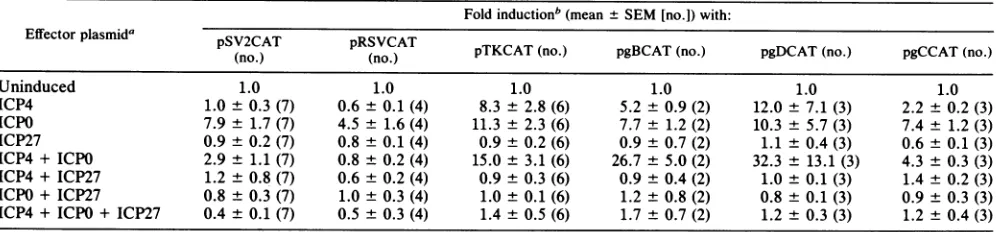
1 shows the results of theseexperiments,
and thequantitation
ofthe CATassays is shown in Table 1. Inthese and all of the
following
experiments,
the results arepresented
asfoldinductionovertheactivity (percentacety-lation)
seenwith the targetplasmid
in the presence ofpUC18 alone with no effector added. This uninduced value wasalways
derived fromfour separatetransfectionsin each setofassays andwas
arbitrarily
set at1.0.Thefoldinductionfortransfections with effector
plasmids
wascalculated relative to this value. To control for variations in the transfectionefficiency,
weperformed
theexperimentsanumberof times,and themeansand standard errors aregiven.
ICP4 induced the HSV-1 target genes, as expected, but hadnoeffecton
pSV2-CAT (Fig.
1). This result is in accordwiththe dataofO'HareandHayward(70), who showed that ICP4 does not affect
expression
from the SV40 early pro-moter and enhancer.ICPO
induced all ofthe target genes,z 0
U D 0
z
C 0
Ui-FIG. 1. Effects ofequimolar ratios of plasmids encoding ICP4, ICPO, and ICP27 on the expression of heterologous and HSV-1 target genes.Subconfluentmonolayers of RSF cells were transfec-tedwithheterologous and HSV-1 targetsplasmidsata concentra-tion of 20 ,ug/ml with either pUC18 (UN; 10 ,ug/ml), pSG28 K/B (ICP4;4,ug/ml), pRS1 (ICPO;2.5
jig/ml),
orpSG130 B/S (ICP27; 1.5 p.g/ml) orwith combinations ofpSG28 K/B (ICP4), pRSI (ICPO), andpSG130B/S(ICP27)asindicated. Cells with harvested 48 h after transfection,and CATactivitywasmeasured(30). The uninducedor basal level ofexpression for each target was determined in each experimentasthemeanlevel of CATactivity found in four separate transfections with each targetplasmid in the presence of 10 ,ug of pUC18perml. The fold induction of CATactivityseenin transfec-tions with effector plasmids was calculated relative to this unin-duced level. In this experimentand in all of thefollowing experi-ments, this uninduced value was set equal to 1.0, and the fold induction relative tothe uninduced value is presented. The mean fold induction is presented here. Table 1 shows the number of experiments performedfor each target, and the standard errors of the meanaregiven. (A) Symbols: 0,pSV2-CAT; A, pRSV-CAT. (B) Symbols: 0, pTK-CAT; A,pgB-CAT; 0, pgD-CAT; *, pgC-CAT.and ICP27 had no substantial effect on any ofthe targets. The mostinterestingandunexpected findingwasthatICP27 in combination with ICP4 or ICPO, or both, significantly
repressed the induction found with these effectors when ICP27 was not present. When ICP27 was present, the
expression ofeach of the targets wasreduced to the basal levelseenintheabsence ofICP4 or ICPO or both. Another
unexpectedresult wasthatthesynergism normally seen with ICP4 and ICPO, which results in greater stimulation of HSV-1earlygenes(15,18, 23, 58, 68, 76), did not occur with
pSV2-CAT
orpRSV-CAT (Fig. 1A,Table 1). In fact, a 2.5-to5-fold-lowerlevelofexpressionwasfoundwhenICP4 and ICPOwere presenttogether in the transfections with theseheterologoustargetplasmids comparedwithtransfectionsin whichICPOwastheonlyeffector. These results suggest that theHSV-1 aproducts ICP4, ICPO,andICP27 can interactto J. VIROL.
on November 10, 2019 by guest
http://jvi.asm.org/
[image:3.612.337.532.72.342.2]HERPES SIMPLEX VIRUS TYPE 1 a PROTEIN ICP27 TABLE 1. Effects ofequimolar ratios of effectorplasmidsonheterologousand HSV-1 targetgenes
Foldinductionb(mean±SEM[no.])with:
Effector plasmida pSV2CAT pRSVCAT
(no.) (no.) pTKCAT(no.) pgBCAT (no.) pgDCAT (no.) pgCCAT(no.)
Uninduced 1.0 1.0 1.0 1.0 1.0 1.0
ICP4 1.0 ±0.3 (7) 0.6± 0.1 (4) 8.3± 2.8 (6) 5.2 ±0.9 (2) 12.0± 7.1 (3) 2.2± 0.2 (3) ICPO 7.9± 1.7 (7) 4.5 ± 1.6 (4) 11.3 ± 2.3 (6) 7.7 ± 1.2 (2) 10.3 ± 5.7 (3) 7.4± 1.2 (3)
ICP27 0.9± 0.2 (7) 0.8 ± 0.1 (4) 0.9± 0.2 (6) 0.9 ±0.7 (2) 1.1 ± 0.4 (3) 0.6± 0.1(3)
ICP4+ ICPO 2.9± 1.1 (7) 0.8 ± 0.2 (4) 15.0± 3.1 (6) 26.7± 5.0 (2) 32.3 ± 13.1 (3) 4.3 ± 0.3 (3) ICP4+ ICP27 1.2 ± 0.8(7) 0.6± 0.2 (4) 0.9± 0.3 (6) 0.9± 0.4 (2) 1.0± 0.1 (3) 1.4± 0.2 (3) ICPO+ ICP27 0.8 ± 0.3 (7) 1.0± 0.3 (4) 1.0± 0.1 (6) 1.2 ± 0.8 (2) 0.8± 0.1 (3) 0.9± 0.3 (3) ICP4+ ICPO+ ICP27 0.4 ± 0.1 (7) 0.5 ± 0.3 (4) 1.4 ± 0.5 (6) 1.7 ± 0.7 (2) 1.2 ± 0.3 (3) 1.2± 0.4 (3)
aEffector plasmids used are described in the Materials and Methods and are as follows: ICP4, pSG28 K/B (4
pg/ml);
ICPO,pRS1(2.5 ,g/mI); ICP27,pSG130B/S (1.5pLg/ml).The effector plasmids were added to the transfections at equal molar geneequivalents.
bMean values of induction from the stated number of experiments are presented as fold induction relative to the percent acetylation obtained with the target plasmid in the presence of 10 ,ug of pUC18 per ml (uninduced level). This level was set at 1.0. The actual uninduced level of acetylation was obtained in each experiment from four separate transfections with each target plasmid. Different amounts of lysates were assayed to ensure that the CAT assays were in the linear range. The average uninduced level ofacetylation in these experiments was about 5% for pSV2CAT and pRSVCAT and from 0.4 to 1% for the HSV-1 target plasmids.
negatively regulate gene expression in addition to their previously reported activation functions.
We nextwishedtoascertainwhether the down-regulation seen in thepresence of the plasmidpSG130 B/S containing
the ICP27 gene was in fact due to the action of the ICP27 proteinand not to some other effect such as competition for
transcription factors by the ICP27 promoter. Therefore,
transfection experiments were performed again with the same HSV-1 target and effector plasmids but with the
addition ofthe plasmid pBOC2, which encodes a truncated
ICP27protein. This plasmid was constructed by inserting an
in-frame stop codon at amino acid 36. As in the previous
experiment, effector plasmids were added either singly or in
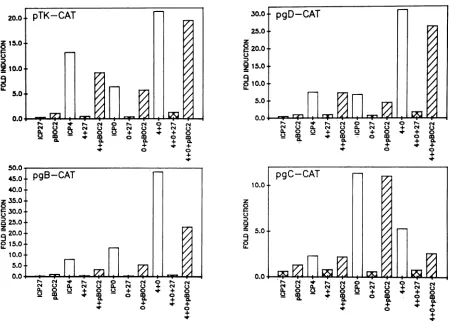
combination in equimolarratios. Addition of plasmid pBOC2
along with the ICP4 andICPO plasmids did not result in a
significantdown-regulation of induction, as is seen with the
ICP27 plasmid (Fig. 2). In mostinstances, the presence of
pBOC2had no effect on the induction of the target plasmid
by ICP4orICPO orboth,andwhenareductionwas seenit was on the order of two- to fourfold. In contrast, the presence ofthe ICP27 plasmid resulted in a 10- to 50-fold reduction in stimulation of expression by ICP4 or ICPO or
both.
The slight level of down-regulation seen with pBOC2 in someofthetransfections may have been due tocompetition fortranscription factors bytheICP27promoter. To test this
possibility,weperformedasimilarsetofexperimentswitha
plasmid containing only the promoter-regulatory region of
the ICP27 gene. A BamHI
(-275)-Hinfi
(+55) fragment which includes the ICP27 promoter, upstream sequences,and55bp of untranslatedleader wasclonedinpUC18.When
thisplasmid wasaddedinanequimolar ratio alongwith the
ICP4orICPO plasmid orboth,atwo- tothreefold decrease
inthe induction of the target gene was seen in someofthe
transfections (data not shown). Therefore, it is likely that any small decreases seen with
pBOC2
were also due to promotercompetition fortranscription factorsor to variabil-ity in transfection efficiencies. On the other hand, the substantial decreases seen with theICP27plasmidweredue to theexpression ofthe ICP27protein.
In the experiment shown in
Fig.
1,itwasalsonoted that thesynergistic effectseenwith ICP4 andICPO,
which results in enhancedstimulation ofHSV-1targets,was not seenwithpSV2-CAT or
pRSV-CAT.
Infact,
a lowerlevelof expres-sion wasfoundwhenICP4 andICPOwerebothpresent than was found withICPO
as the only effector. To determinewhetherthis effect may have involved competition for
tran-scription factors orwhether the ICP4 protein was required, weperformeda set of transfections with increasing amounts
oftheICP4plasmidorthe samemolar gene equivalents of a
plasmid containing only the ICP4 promoter (pICP4 pro-moter). Thisplasmid contains 660 bp upstream of the ICP4
transcriptional start site, as well as 150 bp ofuntranslated leaderregion. Addition ofICP4 along with ICPOresulted in a 2- to 2.5-fold decrease in the induction seen with ICPO alone (Table 2). Although this effect is not large, it is reproducible (Table 1, pSV2-CAT), and a similar reduction was not seen with pICP4 promoter. The results with the
pTK-CAT target illustrate the effects seen with ICP4 and
ICPO on an HSV-1 early gene, when the trans-activating synergism of ICP4and ICPO isclearly evident.
The resultsfromthese experimentsshow that the a gene
products ICP4, ICPO, and ICP27can interact to negatively effect theexpression oftarget genes. This trans-repression requiresthe expression ofthe a proteins and is not due to
nonspecific effects such as competition for transcription
factors or the presence of some putative plasmid poison
sequences.
The a protein ICP27 can act as either a trans-repressoror trans-activator with differenttargets. Everett(17)has shown thatICP27incombinationwith ICP4 andICPOaugmentsthe
induction of a
P--y
target (VP5-CAT) compared with theinduction seen with ICP4 and ICPO alone. Furthermore, in
transfections with pTK-CAT and pgD-CAT, he did not
observe any
repression
when ICP27 was added. We haveexaminedanumberofparameters to
identify
thereasonsfor thedifferences inourresults and those of Everett(17).
Thefirstpossibility weinvestigatedwasthe
input
concen-tration of the effector
plasmids.
This was because theconcentrations of
transcriptional
activators or repressors have been shown to be critical to their action(85).
Forexample, thelac repressor acts as arepressoratnormal or
high concentrationsbut can alsoact as an activator atlow
concentrations by
stabilizing
RNApolymerase
(85).
It ispossiblethattheeffectiveconcentration ofICP27
expressed
in the transfections
performed
by
Everett(17)
wassignifi-cantlylower than in our
experiments
because Everett used HeLa cellsandICP27isregulated
likea 3gene in HeLa cells (25). Toinvestigatethispossibility,
weusedpTK-CAT
asa target and addedincreasing
amountsofICP27plasmid
tothetransfections over a10-fold range. The smallest amount of
ICP27
plasmid
addedwas0.25 ,ug,which is sixfold less thanVOL.62,1988 4513
on November 10, 2019 by guest
http://jvi.asm.org/
[image:4.612.61.562.85.201.2]4514 SEKULOVICH ET AL.
2o.o0
pTK-CAT
:15.0-tio.o
.15.0T
0.0 .. CZ
NC44
~
N 0C.
N00+ + 0
~~*+.
* 0to 0
+
50.0-4.
pgB-CAT
40.0-
-35.0-
125.0-
'20.0-I15.
05.0-
10.0-50'OL
. N: 4.2.
N 0 N
- a.
N I cN f CN
N OC. + NO
0 + 0 * + 0
o m 0
*0
o~~~
z
0.
Z
01I
to..
z
0 0 z
9
'A.
S.0o
pgD-CAT
L5.0
-20.0
i5.0-I10.0
5.0
-0.0.T'T T
? NCM P N 0 b CM o t. N N 0 X.N a. N 0 + N 0
. 0 + 0 C.) + 0 + 0
0 * 0 0 0 0 0i
0. a. + o.
+ +o +
F o ~~~+
pg C-CAT
10.0-5.0
0.0
C,C)L 14oa. NO + N- 0
IL0 0 00 0
m * m a 0 0
[image:5.612.84.535.72.394.2]CL CL ~~~~~+
FIG. 2. RequirementofICP27 proteinfordown-regulationof inductionseenwith HSV-1target plasmidsin thepresenceofICP4andICPO.
Four different HSV-1 targetp!asmids (20,ug/ml)werecotransfectedwith pSG28K/B (ICP4;4 ,ug/ml),pRS1(ICPO;2.5 ,ug/ml),orpSG130 B/S(ICP27;1.5 ,ug/ml).The effectorplasmidswereaddedseparatelyorin combinationasindicated in eachpanel.TheplasmidpBOC2was
included in theseexperimentstodeterminewhether theICP27 proteinwasrequiredfor thedown-regulationobserved withplasmidpSG130 B/S. pBOC2containsanin-frame stopcodonatamino acid 36 and thereforeproduces atruncatedICP27protein.The uninducedlevelof
expressionfor eachtargetplasmidwasagaincalculated from fourseparate transfections, and the foldinductionin thepresenceofeffector
plasmidswascalculated relativetothis value. Thetargetplasmidsareshownineachpanel. theamountaddedintheexperiments performedat
equimo-larconcentrations. The ICP4 and ICPO plasmidswereadded atthe same concentrations as inthe previous experiments. pBOC2 was also included in these experiments, and the concentrationwasvariedoverthesamerangeasforpSG130
B/S(ICP27)tobesurethatanyeffects observedwerereally
due to the presence of the ICP27 protein. The additionof
ICP27 along with ICP4 or ICPO or both resulted in a
significant decrease in the fold induction found in the
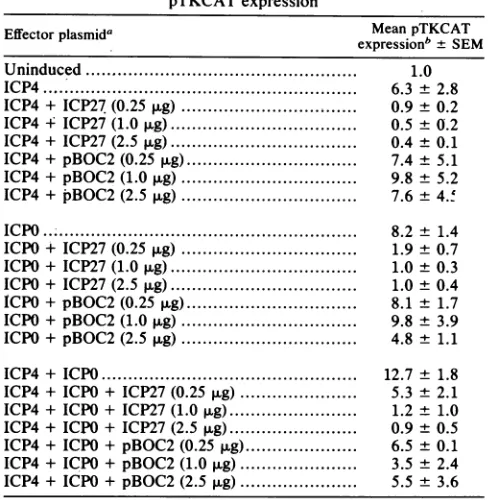
ab-senceofICP27, regardless of the input concentration ofthe plasmid (Table 3). A similar reductionwasnotobserved with pBOC2, confirming that the ICP27 protein is responsible for thedown-regulatory effect. Therefore, evenatlow
concen-trations, ICP27 acted as a repressor, with pTK-CAT as a
target.
Anotherpossibility for the discrepancy between our
re-sultsandthose of Everett(17)wasthat theICP27genewhich
wehadclonedfrom HSV-1 strain KOS 1.1 differed insome
way from the strain 17-derived clone. To check this, the ICP27 locus from strain 17 was cloned as a BamHI-SstI
fragment in pUC18, and an identical set ofexperiments to thosepresented in Fig. 2wasperformed. Both of the cloned
ICP27genes down-regulated theinduction of four different targetgenestothesame extent(datanotshown),indicating thatthere is nodifference between the ICP27 genescloned
fromKOS 1.1 and strain 17.
A third possibility for the discrepancy is that ICP27 interactswithsomecellulartranscriptionfactorwhichdiffers betweenHeLa cells and the RSF cells usedin these exper-iments. This was not tested directly, because weroutinely
observemuch lower transfection efficiencies in HeLa cells. However, a series of transfection experiments was
per-formedwith Vero cells and Ltk- cells withpTK-CATasthe target. The results wereidentical tothose found with pTK-CAT in RSF cells, meaning that ICP27 acted as a
trans-repressorin all three cell types(datanotshown). Although these results do notexclude thepossibilityofdifferences in cellular transcriptionfactors which modulate the activityof ICP27, theydo indicate thatICP27actsas atrans-repressor in these three different cell lines derived from monkeys, mice, and rabbits.
The fourthpossibilityweinvestigatedwasthatICP27has differentspecificitiesondifferenttargetgenes.Allthetargets which we tested up to this point were down-regulated by
ICP27, suggestingthat there isno specificityin theaction of ICP27. This result was surprising, becauseinvivoanalysis
of the phenotypes ofICP27 temperature-sensitive mutants has shown that ICP27is required both for efficient
expres-sion oflate-gene products and for the turnoffofimmediate earlygeneproducts(79). Although trans-repressionof
early-gene targets was consistent with the in vivo phenotype
observed with ICP27 mutants, trans-repression of 3--y (gD-z
0
UO
z
C
P
C)
C
'I.
J. VIROL.
on November 10, 2019 by guest
http://jvi.asm.org/
HERPES SIMPLEX VIRUS TYPE 1 a PROTEIN ICP27 TABLE 2. Effects ofincreasing amounts of plasmids containing
the ICP4 gene or ICP4 promoter on pSV2CAT and pTKCAT
Foldinductionbwith: Effector plasmida
pSV2CAT pTKCAT
Uninduced
i.0
1.0ICP4(0.25 ,ug) 1.0 3.0
ICP4(1.0 ,ug) 1.1 5.6
ICP4 (5.0
R.g)
0.5 7.6ICP4 promoter (0.25 ,ug) 1.2 0.6
ICP4 promoter (1.0 ,ug) 1.6 1.0
ICP4 promoter (5.0 ,ug) 1.0 0.9
ICPO 5.1 5.6
ICPO +ICP4(0.25 ,ug) 2.6 15.2
ICPO+ ICP4 (1.0 ,g) 2.0 22.8
ICPO+ ICP4 (5.0,ug) 1.9 27.6
ICPO+ICP4promoter (0.25 ,ug) 3.9 5.0
ICPO+ ICP4promoter (1.0
Rg)
3.5 3.8 ICPO+ ICP4 promoter (5.0 ,ug) 4.9 4.6a The plasmid pSG28 K/B containing the ICP4 gene was added to each transfection at the concentrations stated. The plasmid pICP4 promoter containing the ICP4 promoter-regulatory sequences and 150bpof untrans-lated leader region was added at equal gene equivilent amounts to those statedfor pSG28 K/B. The plasmid pRS1 containing theICPOgene wasadded tothe transfections at 2.5 ,ug/ml.
bValues are presented as fold induction overtheuriinducedlevel obtained withthe target plasmid in the presence of 10 ,ug of pUC18 per ml. The uninduced level was set at 1.0. The actual percent acetylation obtained for pSV2CAT in this experiment was 4.6%, and for pTKCAT, the percent acetylation was0.5%.
CAT and gB-CAT) and y (gC-CAT) target genes was not.
Therefore,weperformedaseries oftransfectionswithtarget geneswhichcontained promoters
representing
three kinetic classes.The new targets werepICPO-CAT and pICP27-CAT (a), pAE-CAT(p),
andpVP5-CAT(P3-y),
and thepreviouslyused targetspgB-CAT
(P--y)
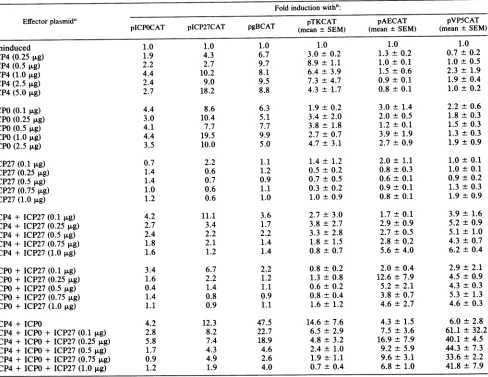
andpTK-CAT(,B) wereincluded forcomparison. In theseexperiments, the inputconcentra-tions oftheeffector plasmidswhenaddedsinglywerevaried
over a 10- to25-fold range (Table 4) toobserve any
differ-ences which could be attributed to concentrations of the
effector proteins. When ICP27 was
added
in combination with the ICP4orICPOplasmids, theinput concentrations oftheICP27 plasmid varied from0.1 to 1.0
,ug/ml,
whereas the concentration of ICP4plasmid
was always5,ug/ml
and the [image:6.612.318.560.88.337.2]concentration of the ICPO
plasmid
wasalways
2.5p.g/ml
(Table 4).
Theresults of these experiments
(Table 4)
confirmed that ICP27 alone hadnosignificant effectonanyofthetargets but thatICP27 in combination with ICP4 or ICPO orboth haddifferent effects
depending
on the target gene. Thetrans-repression previously seen with pTK-CAT and
pgB-CAT
was also observed with the atarget genes pICPO-CATand
pICP27-CAT. However, the opposite
effect,
trans-induc-tion,
was seenwiththeP
targetpAE-CAT
and theP--y
targetpVP5-CAT.Thestimulationwasgreatestin thepresenceof all threeeffectorgenes. It canalso beseenthatthesetargets werenotstimulatedtolevelsof
expression
ashigh
asfor the other targets withICP4
orICPO,
regardless
of theinput
effector plasmid concentration. In
fact,
no induction ofVP5-CAT
was observed,except whenICP27waspresentin
the transfection.These resultsaresimilartothoseofEverett
(17) fortheVP5promoter.Thissuggeststhat ICP27 interacts
withICP4and ICPO tomodulatetheir
activity
such that theprotein(s)
acts as an inducerorrepressordepending
on the target sequences.TABLE 3. Effect of different amounts ofICP27plasmid on pTKCAT expression
Effectorplasmida Mean pTKCAT
expressionb + SEM
Uninduced... 1.0
ICP4... 6.3 +2.8
ICP4+ ICP27 (0.25 ,ug) ... i... 0.9± 0.2
ICP4 + ICP27(1.0
,ug)
... 0.5 ± 0.2ICP4+ ICP27 (2.5
,ug)
... 0.4 ± 0.1ICP4 +pBOC2 (0.25
,ug)
... 7.4 ± 5.1ICP4+ pBOC2 (1.0 ,g) ... 9.8 ± 5.2 ICP4+ pBOC2 (2.5 ,ug) ... 7.6± 4.' ICPIO..
IC0...8.2
-8.2..4... ±1.4 ICPO+ ICP27 (0.25 ug) ... 1.9± 0.7 ICPO+ ICP27 (1.0,ug)
... 1.0 ± 0.3 ICPO+ ICP27 (2.5,ug)
... 1.0 ± 0.4 ICPO+ pBOC2 (0.25,ug)
... 8.1 ± 1.7 ICPO+ pBOC2 (1.0,ug) ... 9.8 ± 3.9 ICPO+ pBOC2 (2.5 ug)... 4.8 ± 1.1 ICP4+ ICPO... 12.7 ± 1.8 ICP4+ ICPO + ICP27(0.25 ug)... 5.3 ± 2.1 ICP4+ ICPO + ICP27(1.0,.g)... 1.2 ± 1.0 ICP4 +ICPO + ICP27(2.5ug)
... 0.9 ± 0.5 ICP4 +ICPO + pBOC2 (0.25 .g)... 6.5 ± 0.1ICP4 +ICPO + pBOC2 (1.0 ,g)... 3.5 ± 2.4 ICP4+ICPO+pBOC2 (2.5
,ug)
... 5.5 ±3.6a The plasmid pSG28 K/G containing the ICP4 gene was added at 5 ,ug/ml tothe transfections. The plasmidpSG130 B/S containing the ICP27 gene was added at the concentrations indicated. The plasmid pBOC2, which contains theICP27 geneandhas anin-frame stop codon at amino acid 36, was added at the concentrations indicated. The plasmid pRS1 containing the ICPO gene was added at 2.5,g/ml.
bMean values and standard errors of the mean fromthree experiments are
presented asfold inductionover theuninduced levelobtained with pTKCAT andpUC18 (10 ,ug/ml). This value (0.7%)was setequalto1.0.
Measurement of the expression of the a genes in the presence of other aproducts. The data shown in Table 4 also demonstrated that the a effector plasmids modulated the expression of CAT when driven by the promoters from the ICPO or ICP27 genes. Both the ICP4 plasmid (pSG28 K/B) and the ICPO plasmid (pRS1) stimulated the expression of pICPO-CAT and pICP27-CAT. ICP27 alone had no signifi-cant (less than twofold) effect on the expression of pICPOCAT or pICP27CAT. However, in combination with ICP4 or ICPO,down-regulationof induction was seen. It has been demonstrated previously that ICP4 canautoregulate its ownexpression and that of the other a genes(11, 12,24,25, 65, 69, 70, 91). Therefore, as levels of ICP4 increase, expression from a promoters decreases.However,wefound that this autoregulation requires higher input levels of the ICP4 plasmid than were used in the transfections shown in Table 4. It has also been shown that ICPO can induce a
promoters (24, 70). Because multiple a effector plasmids
were cotransfected with the target plasmids in our
experi-ments, some of the regulatory effects which we observed could be theresultof achangein the level ofanaproductin the presence of anotheraprotein. Forexample, ICP27 could have anegativeeffect on theexpression of ICP4 and ICPOas well as on the targetplasmid.To
investigate
theseeffects,
we measured thelevel ofexpression
of ICPO andICP27 mRNA in transfection experiments with different target genes and different amounts ofinputeffector plasmids.In the firstexperiment,the
heterologous
targetpSV2-CATwas used and the a effector plasmids pSG28 K/B (ICP4),
pRS1 (ICPO), and pSG130 B/S (ICP27) were added singly
VOL.62, 1988 4515
on November 10, 2019 by guest
http://jvi.asm.org/
J.VIROL.
[image:7.612.67.555.87.464.2]4516 SEKULOVICH ET AL.
TABLE 4. Effect ofincreasing concentrations of effectorplasmidsonHSV-1targetgenes
Foldinductionwithb:
Effectorplasmida pTKCAT pAECAT pVP5CAT
pICPOCAT
pICP27CAT
pgBCAT (mean + SEM) (meantSEM) (meant SEM)Uninduced 1.0 1.0 1.0 1.0 1.0 1.0
ICP4(0.25 p.g) 1.9 4.3 6.7 3.0 ± 0.2 1.3 0.2 0.7
±0.2
ICP4(0.5
jig)
2.2 2.7 9.7 8.9 ± 1.1 1.0±0.1 1.0±0.5
ICP4(1.0p.g) 4.4 10.2 8.1 6.4 ±3.9 1.5 ±0.6 2.3
±1.9
ICP4(2.5p.g) 2.4 9.0 9.5 7.3 ±4.7 0.9 ±0.1 1.9
±0.4
ICP4(5.0 ,ug) 2.7 18.2 8.8 4.3 ± 1.7 0.8 ± 0.1 1.0 ± 0.2
ICPO(0.1 ,ug) 4.4 8.6 6.3 1.9± 0.2 3.0 ± 1.4 2.2 ± 0.6
ICPO (0.25 ,ug) 3.0 10.4 5.1 3.4 ± 2.0 2.0 ± 0.5 1.8 ± 0.3
ICPO(0.5 p.g) 4.1 7.7 7.7 3.8 ± 1.8 1.2 t 0.1 1.5 ± 0.3
ICPO(1.0 ,ug) 4.4 19.5 9.9 2.7 ±0.7 3.9± 1.9 1.3 ±0.3
ICPO (2.5
jig)
3.5 10.0 5.0 4.7 ± 3.1 2.7 ± 0.9 1.9 + 0.9ICP27 (0.1 ,ug) 0.7 2.2 1.1 1.4± 1.2 2.0± 1.1 1.0± 0.1
ICP27 (0.25 ,ug) 1.4 0.6 1.2 0.5 ± 0.2 0.8± 0.3 1.0 ± 0.1
ICP27(0.5
tLg)
1.4 0.7 0.9 0.7 ± 0.5 0.6 + 0.1 0.9 ± 0.2ICP27 (0.75 ,ug) 1.0 0.6 1.1 0.3 ± 0.2 0.9± 0.1 1.3 t 0.3
ICP27 (1.0,ug) 1.2 0.6 1.0 1.0± 0.9 0.8 + 0.1 1.9± 0.9
ICP4+ ICP27(0.1 jig) 4.2 11.1 3.6 2.7 ± 3.0 1.7 ± 0.1 3.9 ± 1.6
ICP4+ ICP27 (0.25 ,ug) 2.7 3.4 1.7 3.8 ± 2.7 2.9 ± 0.9 5.2 ± 0.9
ICP4+ ICP27(0.5 ,ug) 2.4 2.2 2.2 3.3 ± 2.8 2.7 ± 0.5 5.1 ± 1.0
ICP4+ ICP27 (0.75 ,ug) 1.8 2.1 1.4 1.8 ± 1.5 2.8 ± 0.2 4.3 ± 0.7
ICP4+ ICP27(1.0,ug) 1.6 1.2 1.4 0.8 ± 0.7 5.6 t 4.0 6.2 t 0.4
ICPO+ ICP27(0.1 jig) 3.4 6.7 2.2 0.8 ± 0.2 2.0 ±0.4 2.9 ± 2.1
ICPO+ ICP27(0.25 ,ug) 1.6 2.2 1.2 1.3 ± 0.8 12.6 ± 7.9 4.5 ± 0.9
ICPO + ICP27(0.5 ,ug) 0.4 1.4 1.1 0.6 ± 0.2 5.2 ± 2.1 4.3 + 0.3
ICPO+ ICP27(0.75 ,ug) 1.4 0.8 0.9 0.8 ± 0.4 3.8 ± 0.7 5.3 ± 1.3
ICPO+ ICP27 (1.0,ug) 1.1 0.9 1.1 1.6 ± 1.2 4.6 t 2.7 4.6± 0.3
ICP4+ ICPO 4.2 12.3 47.5 14.6 + 7.6 4.3 ± 1.5 6.0 ± 2.8
ICP4+ ICPO+ ICP27 (0.1 jg) 2.8 8.2 22.7 6.5 ± 2.9 7.5 ± 3.6 61.1 t 32.2
ICP4 + ICPO + ICP27 (0.25 ,ug) 5.8 7.4 18.9 4.8 ± 3.2 16.9± 7.9 40.1 ± 4.5
ICP4+ ICPO+ ICP27 (0.5 ,ug) 1.7 4.3 4.6 2.4 ± 1.0 9.2 ± 5.9 44.3 + 7.3
ICP4+ ICPO+ ICP27 (0.75 ,ug) 0.9 4.9 2.6 1.9 ± 1.1 9.6 ± 3.1 33.6 ± 2.2
ICP4+ ICPO+ ICP27 (1.0 p.g) 1.2 1.9 4.0 0.7 ± 0.4 6.8 ± 1.0 41.8 ± 7.9
a The plasmid pSG28 K/B (ICP4) was added at the concentrations indicated, except where pSG130 B/S and pRS1 were also added. In these transfections, pSG28 K/B was added at5,ig/ml. The plasmid pRS1(ICPO)was added at theconcentrations shown, except where pSG130 B/S and pSG28 K/B were also added.pRS1
wasadded at aconcentration of 2.5 ,ug/ml to thesetransfections. The plasmid pSG130 B/S (ICP27) was added at the concentration indicated whether transfected aloneorincombination with pSG28 K/B or pRS1.
bValuesarepresentedasfoldinduction over the uninduced level of acetylation obtained with the target plasmids and pUC18 (10,ug/ml). Thevalues shown forpTKCAT, pAECAT, andpVP5CATare mean values fromthreeexperiments, and standard errors of the mean are given.
and in combination in equimolar ratios. Total RNA was
extracted 30 h after transfection, and poly(A)+ RNA was
selected by oligo(dT) column purification. The Northern (RNA) blot shown in Fig. 3 was hybridized with a probe
specific for CAT mRNA and then stripped and rehybridized with a probe specific for ICPO mRNA. Appropriate
expo-sures of the autoradiograms were scanned with a laser
densitometer, and relative peak areas are given. For CAT
mRNA, the value obtained with pSV2-CAT alone in the absence of effectorplasmids (lane 1)was set equal to 100, andallother valueswerecalculated relativetothis value. In theautoradiogram showingICPO mRNA, the value obtained withpSV2-CATand the ICPO plasmidandnoother effectors
was set equal to 100, and, again, other values were
calcu-latedrelativeto thisvalue. Figure 3 shows thatthelevel of CAT mRNA expressed in the presence of ICP4 (lane 2),
ICPO (lane 3), or ICP27 (lane 4) alone correlated well with the levels of activity measured in the CAT assays (Fig. 1; Table 1).Thiswasalsotruewhenthe effector plasmidswere
added in combination (Fig. 3, lanes 5to 7). Therefore, the
level of CATactivityaccurately represents the level of CAT mRNA. In addition, it can be seen that the level ofICPO
mRNA was notsubstantially altered by the presence of
ICP4
(lane
5)
or ICP27 (lane 7) in this experiment. Therefore, down-regulation of CAT mRNA levels seen in combinations ofICPO
and ICP4 (lane 5) or ICPO and ICP27 (lane 7) compared with the level expressed withICPO alone (lane 3) was not due tolowered expression ofICPO mRNA.We next studied mRNA levels from transfections with HSV-1 target genes (Fig. 4). The targets were
pICPO-CAT
(a), pTK-CAT (,B), and pgC-CAT (-y). ICPOandICP27were the effectors added, and the input concentrations were varied and are described for each experiment. In Fig. 4A,
pICPO-CAT
was transfected alone (lane 1) or with 0.25 ,ug (lane 2) or 2.5 ,ug (lane 3) ofpRS1
per ml. First, it can be seen that the level ofICPO
mRNA was much lower than the level of CAT mRNA (theautoradiogram in which the CAT probe was used wasexposed for 3 dayscompared with 18 days for theICPO
mRNA). A possible explanation for this finding is competition fortranscription factors between theICPOon November 10, 2019 by guest
http://jvi.asm.org/
HERPES SIMPLEX VIRUS TYPE 1 a PROTEIN ICP27
ICPO-
CAT--1 2 3 4 5 6 7
A-ICPO CAT
ICPO-
CAT-RelativePeak Area
1 2 3 4
B-TK CAT
Lane 1 2 3 4 5 6 7
ICPO 100 90 8 5
CAT 100 112 400 28 148 8 64
FIG. 3. Expression of ICPO mRNA in transfectionswith
pSV2-CAT and a effector plasmids. RSF cells were transfected with
pSV2-CAT(20,ug/ml)andeffectorplasmids containingtheagenes
forICP4 (pSG28 K/B;4,ug/ml),ICP0(pRS1;2.5,ug/ml),andICP27 (pSG130 B/S; 1.5 ,ug/ml) as described in Materials and Methods.
Transfection buffer (5 ml) containing the appropriate amounts of
DNA wasaddedto each flask. The total DNAconcentration was
adjusted to 150 ,ug/75-cm2 flask by adding pUC18 DNA when
necessary. Four identical flasks were set up and used for each
transfection. Transfections shown in eachlaneare asfollows: lane
1, uninducedpSV2-CAT; lane 2, pSV2-CAT and pSG28 K/B (ICP4 gene);lane3,pSV2-CAT and pRS-1 (ICPOgene);lane 4, pSV2-CAT andpSG130 B/S (ICP27gene);lane 5, pSV2-CAT with pSG28 K/B and pRS-1; lane 6, pSV2-CAT with pSG28 K/Band pSG130 B/S; lane7,pSV2-CATwithpRS-1 and pSG130 B/S.Poly(A)+RNAwas
denaturedin glyoxal(63)andfractionatedon a1%agarosegel. RNA was transferred to GeneScreen. Inthe upper panel, the blotwas
hybridizedwitha1.3-kbNruI-SalI fragment from withinexon3of
theICP0gene(72). Thefragmentwaslabeled by nick translationas
described previously (28, 80). In the lower panel, the blot was
hybridized with a 1.6-kb HindIII-BamHI fragment encompassing
the CAT gene (30). Hybridization with the CAT probe was
per-formed first at42°C as described inMaterials and Methods. After
autoradiography, the blot was then stripped and rehybridized at
50°C withthe probe specific for ICPO mRNA. Appropriate expo-suresof theautoradiographs werescanned withanLKB
densitom-eter.Thelevel ofICPOmRNAseeninlane 3 in the absence of other
aeffector plasmidswasset at100%. The remainingvalues, where the otheragenes werealsopresent(lanes 5 and7),werecalculated
relative to this level. For CAT mRNA, the level seen in lane 1,
wherenoaplasmidswerepresent, wasset at 100%,and all other valueswerecalculated relative tothis level.
moterfusedtothe CATgeneandthe ICP0plasmid.
pICP0-CAT was added at the target concentration of 20 ,ug/ml, whereas the ICP0 plasmid (pRS1) was added atlevels that
were 8- (lane 3) to 80-fold (lane 2) lower. Second, itcan be
seenthat the amount of stimulation found wasnot directly proportional tothe input effector plasmidconcentration. A 1.5-fold increase inCAT mRNA was seen when the ICP0 plasmid (pRS1) was added at 0.25 jig/ml (lane 2), but additionof 10 timesmoreeffectorplasmid (lane 3)resulted in only a 2.5-fold-higher CAT mRNA level. Addition of the ICP27 plasmid (pSG130 B/S)at0.25,ug/ml (lane 4),1.0,ug/ml (lane 5),or2.5 ,ug/ml (lane 6)resulted inalowerexpression of ICPO mRNA as well as of CAT mRNA. In fact, ICPO mRNA could barely be detected on the autoradiograms in the lanes in whichICP27waspresent(lanes4 to6),and CAT mRNAcouldnotbe detectedatall. Incontrast tothe results shown inFig. 3, in which ICP27did notsignificantly lower
ICPO- 0
ICP27-
pa
V
1 2 3 4
.96
_ _
5 6 7 8
C-gC CAT
iCPO-
ICP27-
[image:8.612.86.274.69.252.2]CAT-1 2 3 4 5
FIG. 4. Northern hybridization analysis of the expression of CATmRNA andaeffector RNA intransfectionswiththree different
HSV-1 target genes representing three different kinetic classes. Total RNA was isolated from transfections with HSV-1 target
plasmidsaddedat20 ,ug/mland different concentrations of effector plasmids. (A) pICPO-CATwasthetarget,andhybridizationtoICPO mRNA and CAT mRNA is shown. In lane 1, pICPO-CAT was
presentalong with 10 jg ofpUC18perml;inlane2,0.25 p.gofpRSl (ICPO)permlwasadded;and in lane3, 2.5,ugofpRS1permlwas
added. In lanes 4to6,2.5 ,gofpRS1permlwasaddedalongwith
0.25 ,ug (lane 4), 1.0 ,ug (lane 5)or 2.5 ,ugofpSG130 B/S (ICP27) (lane 6) per ml. (B) pTK-CAT was added at20 ,ug/ml along with
pUC18at10,ug/ml (lane 1)orpRS1at0.25,ug/ml (lane 2)or2.5,ug/ ml(lanes3to8). pSG130B/Swasaddedtothetransfectionsat0.25
jig/ml
(lane 4),1.0,ug/ml (lane 5),or2.5,ug/ml (lane6).pBOC2wasaddedtothe transfections showninlane7 (0.25 ,ug/ml) andlane 8
(1.0 ,ug/ml). (C) Transfections with pgC-CAT are shown. Lane 1
shows thehybridizationtoRNA fromtransfectionswithpgC-CAT andpUC18,whereaspRS1wasaddedat2.5 ,ug/mltothe
transfec-tions shown in lanes 2 to6. The ICP27 plasmidpSG130 B/S was
addedat0.25 p.g/ml (lane 3)and 1.0 ,ug/ml (lane 4)to the
transfec-tions shown in lanes 3 and4,whereaspBOC2,theplasmid encoding
atruncatedICP27protein,waspresentat0.25jig/ml(lane 5)or1.0
,ug/ml (lane 6). The blots were first hybridized with a 1.6-kb
HindIII-BamHI probe specific for CAT mRNA. After autoradiog-raphy, the blots were stripped and rehybridized with a 1.3-kb
NruI-SalIprobefromexon3 of the ICPOgene(panelsAandC)or a mixture of the probe specific for ICPO mRNA and a 1.2-kb
BamHI-SaIl probe specificforICP27mRNA(panel B). Following autoradiography, the blot inpanelCwasagain strippedand rehy-bridized withtheICP27probe.
5 6
VOL.62, 1988 4517
on November 10, 2019 by guest
http://jvi.asm.org/
[image:8.612.326.557.91.422.2]4518 SEKULOVICH ET AL.
the ICP0 mRNA levels, in this
experiment
ICP27down-regulated bothCAT mRNA and ICPO mRNA
levels,
regard-less of the inputconcentration of ICP27 plasmid.
Figure4Bshows theNorthern blot
hybridizations
of RNAisolated from transfectionswith
pTK-CAT
as atarget. TheICPO
plasmid (pRSl)
wasaddedat0.25jxg/ml (lane 2)or2.5jig/ml
(lanes
3 to8),
whereas the ICP27plasmid
(pSG130B/S)
wasaddedat0.25,ug/ml (lane 4),
1.0,g/ml (lane 5),
or 2.5,ug/ml (lane 6). Also, pBOC2,
theplasmid
which encodes atruncated ICP27protein,
wasaddedat1.0,ug/ml (lane 7)or 2.5,ug/ml
(lane 8). Theblots werehybridized
witha probespecific
for CATmRNAandthenstripped
andrehybridized
with two probes, one
specific
for ICP0 mRNA and onespecific
for ICP27 mRNA. Several observations should be noted.First,
as seen in theprevious
experiment,
a 10-foldincrease in the
input
ICPOplasmid
concentration does not resultinaproportional
increase inthelevel ofCATexpres-sion
(lanes
2and3),although
theexpression
of ICPO mRNAin lane 3 was morethan 10-fold
higher. Second,
theexpres-sion ofICP27 RNA was
proportional
to the level ofinput
plasmid (lanes
4 to 6), whereas theexpression
ofpBOC2RNA was much
higher (lanes
7 and8).
Measurements ofplasmid
DNAcopy number showed thatbothplasmids
weretaken upin the transfections with
equal efficiency (data
notshown).
This enhancedexpression
ofpBOC2
mRNA wasprobably caused by the presence in these transfections of
ICPO,
which induced the level ofexpression
ofpBOC2.
A similar result was not seen in transfections with the wild-type ICP27plasmid,
because of therepressive
action of ICP27.Third,
ICP27down-regulatedtheexpression
ofCAT mRNAand ICPO mRNA. pBOC2 also reduced theamountof ICPO mRNA, butthis was
probably
aresult ofcompeti-tion for
transcription factors,
since theexpression
ofthepBOC2
mRNAwas sohigh.
Aswaspreviously
thecase inthe CATassayswith
pBOC2 (Fig. 2;
Table2),
nosignificant
effecton CAT
expression
was seen(Fig.
4, lanes 7 and8).
In the
experiment
shown inFig. 4C, pgC-CAT
was the targetandtheICPOplasmid
wasaddedat2.5p.g/ml
inlanes2to6, whereas the ICP27plasmidwasadded at 0.25 ,ug/ml
(lane 3)
and 1.0,ug/ml
(lane 4)andpBOC2wasaddedat0.25jig/ml
(lane
5) and 1.0,ug/ml
(lane 6). The blot was hybrid-ized first with the CAT probe, then stripped and rehybri-dized withtheprobe
forICPO mRNA, andthenstrippedandrehybridized
with the ICP27 probe. As in the previousexperiment,
the levelofpBOC2mRNA was higherthanfor theICP27 mRNA,although both plasmidswereadded at the same concentrations. This again suggests thatICPO
stimu-lated the expression of pBOC2. The presence of ICP27 resulted in adecrease ofCAT mRNA (lanes 3 and 4), butalthough ICPO
mRNA levels were decreased, the reduction was less than was seen intheexperimentwith pTK-CAT.Three conclusionscanbedrawnfromthese experiments.
First,
the level of CAT mRNA correlated with the level of CATactivity
seenpreviously. Second,theamount ofinduc-tionfound withICPOwas notproportional to the inputICPO
plasmid
concentrationor to thelevel of expression ofICPO mRNA, suggestingthatICPO
may be acting catalytically to enhance transcription. Third, ICP27 had a negative regula-toryeffectonICPOexpression, as well as on the expression of the target plasmid. The extent of this down-regulationvariedindifferent experiments.
The level ofinduction by ICPO isnot directly proportional to the amount of input plasmid added. To investigate the
relationship
between the relative amount ofICPO plasmidadded to the transfections and the fold induction of CAT
expression,
weperformed aset of transfection experiments60.0 z 50.0 1- 40.0 o 30.0
z
o 20.0 0 z
0
C)
D
0
z
0
0 ILL
0 0.1 0.25 0.5 1.0 2.5 5.0 10.0
CONCENTRATION OF ICPO PLASMID(jsg)
5.0 .
0.0
0 0.1 0.25 0.5 1.0 2.5 5.0 10.0
CONCENTRAnON OF ICPO PLASMID(pg)
FIG. 5. The levelof inductionbyICPOisnotproportionaltothe input ICPO plasmid concentration. Transfections with pgC-CAT (upper panel) and pgB-CAT (lower panel)were performedin the
presenceofincreasingamountsof the ICPOplasmid pRS1. Inthe
upperpanel,results withpgC-CATandpRS1 (0)aregivenasthe
mean offour separate transfections, and errorbars showing the standarderrorsof themean areindicated. Thelowerpanel shows the results with pgB-CAT andincreasing concentrations ofpRS1 (0). Theplasmid encoding ICP27 (pSG130 B/S)was added tothe
transfections withpgC-CAT (upper panel)andincreasingamounts ofpRS1 at 1.0 ,ug/ml (A) andto transfections withpgB-CATand pRS1 (lower panel)at0.25 ,ug/ml (A)or1.0 ,ug/ml (-). Valuesare
presentedasfold inductionoverthe induced level of CATactivity found with the targetplasmids in the presence ofpUC18 andno
effectorplasmids.
in which theinputconcentration ofpRSlwasvariedover a
100-fold range from 0.1 to 10.0 ,ug/ml. Figure 5 shows the
results obtained withpgC-CATorpgB-CATastargets. For pgC-CAT,themeanof four separateexperimentsisplotted, and error bars indicating standard errors of the mean are
shown. Inboth cases, itcanbeseenthat thefold induction
of CATactivitywasnotdirectly proportionaltotheamount ofinput plasmid. Even atvery low concentrations (0.1 to 0.25 ,ug), substantial levelsofinductionwereobserved, and these levels werenearly equivalenttolevelsseenwhen
20-to 50-fold-larger amounts of ICPO plasmid were added.
These resultsaresimilartothoseseeninTable 4 andtothe Northernhybridization experiments,inwhich levels of CAT mRNA did not increase proportionally to the increase in ICPO mRNAexpression (Fig. 4A andB). Thissuggeststhat the down-regulation of target expression seen when ICPO
and ICP27 are both present is not solely due to a
down-regulationofICPO,becauseverylow levels of ICPO
expres-sion still result in substantial induction of CAT activity. Furthermore, when the ICP27 plasmid was added to the transfections, eitherat0.25 ,ug/mlorat 1.0 ,ug/ml,a similar
level ofdown-regulationwas seen, regardless of the input
level of the ICPO plasmid. Interestingly, a 2.5-fold-higher
gB-CAT
A~~~~~-A
J. VIROL.
gC-CAT
U.U
on November 10, 2019 by guest
http://jvi.asm.org/
[image:9.612.341.535.69.339.2]HERPES SIMPLEX VIRUS TYPE 1 a PROTEIN ICP27 levelof induction of CAT activitywithpgC-CATwasseenin
the presence of ICP27 at the lowest concentrations ofthe ICP0plasmid (0.1 and 0.25 ,ug) than was seen when pRS1
was present at 10- to 100-fold-higher concentrations. This result suggests that some minimal amount of ICPO protein must be present to interact with ICP27 for repression to
occur.
DISCUSSION
To investigate the specificity of action of the HSV-1 a
proteins ICP4, ICP0, and ICP27, we performed a series of transfection experiments in which plasmids containingeach ofthese geneswere transfectedeithersinglyorin
combina-tion with each otherwithabattery ofHSV-1 and
heterolo-gous target plasmids. These experiments showedthat ICP4
had specificity for HSV-1 promoters, whereas ICP0 was
capable of inducing the SV40 early promoter or the RSV
long terminal repeat as efficiently as HSV-1 promoters, consistentwith the results of O'Hare and Hayward (70). In
accord with previous findings, ICP27 on its own had little
effect on HSV-1 promoters (11, 17, 25), nor did it have a
substantial effect on heterologous promoters. The most
interesting finding of these studieswas thatwhenaplasmid
encoding ICP27 was added to transfections in combination
with plasmids encoding ICP4 orICPO orboth, a significant
trans-repression or trans-activation of target gene activity occurred. Whether repression or activation occurred
de-pendedon the targetpromoter.
Several possible methods of action for ICP27 can be
postulated from these results. Considering the
trans-re-pressoractivity, down-regulation of ICPO mRNA levels by ICP27 (Fig. 4) suggests that ICP27 could be acting specifi-cally on the promoter-regulatory region ofthe ICPO gene, resultinginrepression, similar tothe autoregulatoryactivity of ICP4(11, 24, 25, 65, 69, 70). The consequentlowerlevel
of ICPO expression could result in decreased induction of
target plasmids. This is unlikely to be the sole explanation for the trans-repressive effect ofICP27 observed, however, becauseevenverylow levelsofinputICPOplasmid(Table4; Fig. 5) or low levels of ICPO mRNA (Fig. 4) resulted in
significant induction of target plasmids. Furthermore, the
extent of down-regulation of ICPO mRNA levels varied in
differentexperiments,fromlittle discernibleeffect(Fig. 3)to a significant effect (Fig. 4B), yet down-regulation of CAT
expressionwasseenin allcases.Inaddition, ICP27does not
appear to show specificity for the ICPOpromoter, because
when the ICP27 plasmid
pSG130
B/S was added over a10-fold concentration range to transfections with
pICPO-CATasthe target, no significant effect on CAT expression
was seen (Table 4). A similarresultwas found with pICP4-CAT,whichcontainsthepromoterfrom the ICP4genefused
to CAT (datanotshown). Furthermore, some down-regula-tion of othertargetswasseenwithICP27,althoughtheeffect
was small, indicatingthat ICP27does notspecifically recog-nize theregulatory regions of ICPO and ICP4. Forexample, down-regulation of CAT activity by ICP27 alone was seen
withpICP27-CAT, pTK-CAT, andpAE-CAT(Table4), and
approximately threefold-lower levels of CAT mRNA were
seen in the presence ofICP27 with pSV2-CATas a target (Fig. 3). Finally, in transfections with pAE-CAT or pVP5-CAT as targets, a stimulation of CAT activity occurred
beyond that seen with ICP4 or ICPO as the only effector.
Therefore, ifICP27 acted specifically to repress ICP4 and
ICPO expression, resulting in lower induction of target
activity, it would be expected that this repression would
occur
regardless
of thetarget, yet
stimulation of CATactivity
was seen withpAE-CAT
andpVP5-CAT
in thepresenceof
ICP27, ICP4,
andICPO.
Forthesereasons,other modes ofaction forICP27
besidesspecificity
for ICP4 orICP0
promoter
sequences shouldbeconsidered.During infection, ICP27
isclearly
involved in the switchfrom
early
to late geneexpression,
because atthenonper-missive
temperature,
ICP27
temperature-sensitive
mutantsoverproduce
someimmediateearly
andearly
geneproducts,
whereas late geneproducts
areunderproduced
(79;
I. L.Smith andR. M.
Sandri-Goldin,
unpublished
observations).
The two activities of
ICP27
found in the studiesreported
here,
namely,
arepressorfunction andanactivatorfunction,
areconsistent withthe invivo role of
ICP27.
Furthermore,
these two activities involve different
regions
oftheICP27
protein.
We haveconstructed andanalyzed
a seriesICP27
mutants
containing
in-frameinsertionsordeletions. Severalmutants havebeen identified which cannot activate
pVP5-CATin the presence of ICP4 andICPO
but whichcan stillrepress
pTK-CAT activity.
Other mutants have beenfound which fail to represspTK-CAT
(M.
A.Hardwicke,
P. J.Vaughan,
R. E.Sekulovich,
B.O'Conner,
andR. M.San-dri-Goldin,
submitted forpublication). ICP27
couldperform
thesedifferent functionsinanumberofways.
First,
itcouldbind to
specific regulatory
sequences and thusprevent
progression
ofthetranscription complex,
resulting
inrepres-sion. The
recognized
sequences could beregulatory
se-quenceslike
SP1
sites(13,
42)
orCAATboxes(60,
62)
foundon HSV-1 immediate
early
andearly
genes, as well asheterologous
genes, butnot onHSV-1fy
genes(36, 41, 83).
Second,
ICP27
couldactby
protein-protein
interactionswithICP4and
ICPO,
altering
theirspecificities
ormodifying
theminsomeway.
Third,
ICP27
couldinteractwithsomecellulartranscription
factor,
altering
ormodifying
it.Finally,
acombination
of mechanisms may occur such thatICP27
could bind to DNA in its role as a repressor and could
interact with ICP4 and
ICP0
tofacilitate activation.Although
thedatareported
heresuggest
thatICP27
inter-acts with ICP4 and
ICP0,
biochemical evidence must beobtainedto substantiate this
hypothesis.
Furthermore,
stud-iesmustbeperformed
toanalyze
thespecificity
oftheICP27
repressor function versus the activation function. In theseexperiments,
theB--y
target
pVP5-CAT
wasactivated,
whereas the
P
target
pTK-CAT
wasrepressed.
Theseresults areconsistentwithaproposed
in vivo roleforICP27
in theshutoff of
early
functionsand theactivation oflatefunctions.
However,
the3--y
targets
pgD-CAT
andpgB-CAT
andthe-ytarget
pgC-CAT
were alsorepressed,
whereas the1P
target
pAE-CAT
was activated. Apossible
explanation
for thesefindings
is that thesetarget
genescontain differentextentsofupstream
sequences. Forexample,
thepgC-CAT
constructcontains
approximately
1,100
bp
upstream
ofthegC
tran-scriptional
startsite,
whereasonly
about 35bp
upstream
from thecapsite isnecessaryfor full
expression
as a-ygene(83).
Gelman and Silverstein(25, 26)
and Blair andWagner
(2)
havedemonstrated
that differentlengths
ofupstream
sequences have
significant
effects onthe response oftarget
genes to
trans-acting
factors.Therefore,
it is necessary toidentify
thecoresequenceswhichareresponding
in eachofthese
target
plasmids.
We havebegun
todothis with the VP5and
gC
promoters.
A nested set ofpromoter
deletions arebeing
analyzed
fortheirability
torespond
toICP27.
ACKNOWLEDGMENTS
Wethank BobO'Conner for excellenttechnical assistance andAl Goldin forcritical
reading
of themanuscript.
Wearegrateful
toEdVOL.62, 1988 4519