City, University of London Institutional Repository
Citation:
Argasinski, K. & Broom, M. (2018). Interaction rates, vital rates, background
fitness and replicator dynamics: how to embed evolutionary game structure into realistic
population dynamics. Theory in Biosciences - Theorie in den Biowissenschaften, 137(1), pp.
33-50. doi: 10.1007/s12064-017-0257-y
This is the published version of the paper.
This version of the publication may differ from the final published
version.
Permanent repository link:
http://openaccess.city.ac.uk/19597/
Link to published version:
http://dx.doi.org/10.1007/s12064-017-0257-y
Copyright and reuse: City Research Online aims to make research
outputs of City, University of London available to a wider audience.
Copyright and Moral Rights remain with the author(s) and/or copyright
holders. URLs from City Research Online may be freely distributed and
linked to.
City Research Online:
http://openaccess.city.ac.uk/
[email protected]
O R I G I N A L A R T I C L E
Interaction rates, vital rates, background fitness and replicator
dynamics: how to embed evolutionary game structure
into realistic population dynamics
K. Argasinski1• M. Broom2
Received: 3 September 2016 / Accepted: 16 October 2017 / Published online: 20 November 2017 ÓThe Author(s) 2017. This article is an open access publication
Abstract In this paper we are concerned with how aggre-gated outcomes of individual behaviours, during interactions with other individuals (games) or with environmental fac-tors, determine the vital rates constituting the growth rate of the population. This approach needs additional elements, namely the rates of event occurrence (interaction rates). Interaction rates describe the distribution of the interaction events in time, which seriously affects the population dynamics, as is shown in this paper. This leads to the model of a population of individuals playing different games, where focal game affected by the considered trait can be extracted from the general model, and the impact on the dynamics of other events (which is not neutral) can be described by an average background fertility and mortality. This leads to a distinction between two types of background fitness, strate-gically neutral elements of the focal games (correlated with the focal game events) and the aggregated outcomes of other interactions (independent of the focal game). The new approach is useful for clarification of the biological meaning of concepts such as weak selection. Results are illustrated by a Hawk–Dove example.
Keywords Replicator dynamicsEvolutionary game
Density dependenceInteraction rateEco evolutionary feedbackBackground fitness
Mathematics Subject Classification 91A22 92D15
37C10
Introduction
The cornerstone of building scientific theories is the proper choice of underlying terminology describing the objects and processes of interest; the mathematical structures used in the formalization of the theory can influence the underlying language. A good example is the impact of game theory on evolutionary theory, which has meant that strategic reasoning is common in works related to evolu-tion, even if they are not supported by mathematical notions (Dawkins 1976; Williams 1996). However, the basic evolutionary game theoretic framework is described by abstract mathematical terms whose relations with observable biological processes is often unclear. The most influential concept, which is foundational for game theo-retic methods in biology, is the game as a metaphor for the individual interactions. In this paper we will investigate how this aspect should be expressed in the context of the ecological population dynamics.
The modern approaches to evolutionary game mod-elling can essentially be divided into two classes. The first contains static models (see e.g. Maynard Smith 1982; Broom and Rychtar 2013), based on potentially compli-cated payoff functions describing some abstract parameter called ‘‘fitness’’, while the second contains dynamic models based on replicator dynamics and simplified (mostly matrix) payoff functions (Maynard Smith 1982; Cressman et al.1986; Hofbauer and Sigmund1988,1998). The first type is focused on the details of the interaction, while population dynamics aspects are lacking. There are no evolutionary processes in time, only causal outcomes of & K. Argasinski
M. Broom
1 Institute of Mathematics of Polish Academy of Sciences, ul.
S´niadeckich 8, 00-956 Warszawa 10, Poland
2 Department of Mathematics, City, University of London,
the particular interaction. Thus, while payoffs quantified by obtained resources or energetic gain have a clear bio-logical interpretation, the impact of the game outcomes on the population state is not fully explained. In the second case, the situation is the opposite: the interactions are not explicitly depicted in the model but their outcomes are phenomenologically described by the excess from the average growth rate, and the dynamics of the selection process is explicitly analysed. In addition, from game theoretic methods have grown the field of adaptive dynamics (Dieckmann and Law 1996; Metz et al. 1996; Geritz et al.1998; Dercole and Rinaldi2008), focused on the long-term evolution of continuous traits, driven by mutations. This approach emphasises the importance of ecological context.
To fill the gap between the two approaches to games and investigate the ecological meaning of individual interactions we should answer the question: How do the outcomes of particular interactions affect the growth rates of the respec-tive strategies? The methods related to game theory are also used in life history theory (Caswell2001) to describe the competition between different life history strategies, but this framework does not assume interactions between individu-als. In this approach fitness components are described as the vital rates (birth and death rates of the respective age or stage classes). We can use this approach to solve the posed prob-lem and establish the link between interaction rates, describing the occurrence of the interaction events in time, and resulting vital rates of respective types of interactions, describing the changes of the population state. This question is important not only for game theoretic models. It is related to the problem of the general mathematical representation of fitness (Metz2008; Roff2008; Orr2009) and the method-ological interpretation of this term, discussed by biologists and philosophers of science (Mills and Beatty 1979; Rosenberg and Williams1986; Horan 1994; Matthen and Ariew2002; Brandon and Ramsey2007; Matthen and Ariew
2009; Walsh2010; Ramsey2013).
State of the art. An event-based approach
This paper extends a novel approach to evolutionary games from Argasinski and Broom (2012). This approach is focused on ecological realism, falsifiability and a mecha-nistic interpretation of the results obtained. The main goal was to express individual fitness in terms of demographic parameters. This allows us to describe the terms, such as ‘‘costs’’ and ‘‘benefits’’, by measurable parameters (mortal-ity interpreted as the probabil(mortal-ity of death and fecund(mortal-ity interpreted as the number of newborns obtained in effect through an interaction) instead of an abstract, undefined ‘‘fitness’’ described by an infinitesimal rate of increase of the population (or single component of fitness such as fecundity
as in Chakra et al. (2014), where the number of eggs laid constitutes fitness). This is realized by the explicit applica-tion of two payoff funcapplica-tions describing mortality and fecundity counted in the currencies of births and deaths, instead of one fitness function describing excess from the mean Malthusian growth rate. This new approach can be described as event-based because it describes cause and effect chains of underlying interaction events. For example mortality can act on adult individuals before or after repro-duction, or the description of the structure of the interaction event can be more complex.
In addition, this approach emphasises the role of density dependence. The fertility payoff functions are not constant in time but can be affected by selectively neutral juvenile mortality leading to a more complex selection mechanism induced by eco-evolutionary feedback (Hauert et al.
2006, 2008; Argasinski and Kozłowski 2008; Zhang and Hui2011; Argasinski and Broom2012; Huang et al.2015; Gokhale and Hauert 2016). Thus the fertility reward can decrease, due to the increase of the juvenile mortality, below the adult mortality costs. Population size does not converge to an arbitrary phenomenological carrying capacity (constant, as in for example Cressman and Krˇivan
2010; Krˇivan 2013, or affected by payoffs, as in Novak et al. 2013) as in many models, exploiting the classical logistic growth, but to a dynamic equilibrium between all mortality and fertility factors. A similar approach that can be found in epidemiological models is called the emergent carrying capacity (Bowers et al.2003; Sieber et al.2014). This is more realistic and provides a mechanistic inter-pretation in terms of demographic factors. The properties of the selection mechanism, induced by strategically neu-tral growth limitation, were analysed in Argasinski and Broom (2013). Here at the population size equilibrium, newborns form a pool of candidates from which survivors which will replace dead adults at their nest sites will be drawn; this was termed the nest site lottery.
Two research goals of the paper
to extract those focal interaction from our more complex general model, with the remaining events generating the corresponding background fitness. The application of event occurrence rates (or interaction rates) for evolutionary games was originated in Taylor and Nowak (2006). In their paper different strategy carriers can interact at different rates and thus can play different numbers of game rounds (the differences with our approach, related to the definition of fitness, are discussed in section ‘‘The event-based approach and rates of event occurrence’’ in the Discussion. (b) Classification of the types of background fitness: Traditionally, background fitness has been modelled by a phenomenological additive element of the payoff function that vanishes under the replicator dynamics, with the associ-ated dynamics being very simple. The growth rate is described by a single payoff function and it is not clear whether back-ground fitness is a neutral element of the payoff or a separate factor acting at a different occurrence rate. Within classical evolutionary game theory, which is density independent, both approaches are equivalent and distinction between them is not necessary. In addition there is no clear biological interpreta-tion of this factor and it has rather been interpreted as a technical element of mathematical notation. As was shown in Argasinski and Broom (2012), background fitness compo-nents can seriously affect the dynamics. However, the natural interpretation of those factors can be provided by the approach from point a). Thus, can we derive phenomenological neutral elements as the aggregated outcomes of background events?
Results
In the coming sections we will introduce a number of important terms used in our paper; a summary of these is presented in Table1.
The general model
Introduction of the rates of event occurrence and derivation of the vital rates
Firstly, let us derive the general growth equation according to the framework proposed in point (a) from ‘‘Two research goals of the paper’’. We can consider multiple event types which occur as independent Poisson processes. Then, during a short time interval some number of events occur and their outcomes change the state of the population (newborns are introduced to the population and dead individuals are removed, see Fig.1).
The events of thei-th type occur at rate si (the super-script describes the event type since later the subsuper-script will describe the strategy), where its outcomes are described by
respective fertility and mortality payoff functions Wi and
di, whereWiis the average number of newborns produced and di is the probability of death during this type of interaction event. If the i-th event type is a safe mating opportunity then the respective death probabilitydiequals zero. On the other hand, if the event is not related to mating or reproduction but is dangerous, thenWi¼0. The general growth equation thus has the following form:
_
n¼X
i
nsiWidi: ð1Þ
Note that the parameterssido not have to be just technical constants but can be functions of the population size or strategic composition, as for example in the dynamic sex ratio model as we discuss in ‘‘The event-based approach and rates of event occurrence’’ in the Discussion (see Argasinski 2012, 2013, 2017) or models of upstream reciprocity (Nowak and Roch2007; Pena et al.2011). Thus we can derive the per capita vital rates as products of the event occurrence rates and the demographic outcomes of events. ThensiWiwill be the fertility rate andsidiwill be the mortality rate for thei-th type of event. The sum of the respective vital rates over all types of events will constitute the crude mortality and fertility rates (Caswell2001).
We will next apply the approach presented in this section and summarized by Eq. (1) to obtain the evolutionary dynamics framework centred on a particular focal game. We will extract one particular type of event from our general model to analyse the selection of individual strategies rela-ted to that game. The aggregarela-ted impact of all other types of events will constitute the background fitness.
Background fitness as the aggregated outcomes of background events
Individuals enter an arbitrarily chosen focal game (with payoffs WF and dF where auxiliary lower index F means ‘‘focal event’’) at ratesF as in Eq. (1), and engage in other activities at rates described bysi
B; we can consider a single class of all such activities, as we show below.
Each of the background events can be characterised by outcomes which include a fertility Wi
B and mortality dBi component (lower index B means ‘‘background event’’). We can calculate the outcomes of the average background event.WB¼Pis
i BW
i
B=sB is the average fertility per event (where sB¼Pis
i
B) and dB ¼Pis i Bd
i
B=sB is the average death probability per event.
In effect ‘‘background events’’ occur at intensitysB and individuals involved in those events obtain fertilityWB on average and survive with probability sB¼1dB. Then Eq. (1) can be presented in the following form:
_
Note that, since the focal game depends on the analysed traits then the respective focal game payoffs will depend on the strategic composition of the population. However, for simplicity, the argument term (q) will not be included in the numbered equations. Then the interaction rates multiplied by demographic payoffs will constitute the ‘‘vital rates’’ (per capita rates of change of the population state, see Caswell
[image:5.595.167.547.57.618.2]2001). Now we can extend our model to the detailed description of the evolutionary game including the different strategies. Each strategy should be represented by its respective equation of type (2) and assigned demographic payoff functionsWFðqÞanddFðqÞ. We can use the structure of the demographic payoff functions from Argasinski and Broom (2012) (see ‘‘Appendix 1’’ for the necessary details)
Table 1 A list of important
symbols Symbol Description
n Population size
Wi Fertility payoff function of thei-th type event di Mortality payoff function of thei-th type event K Carrying capacity (maximal environmental load)
qi Frequency of thei-th strategy
WiðqÞ Fertility payoff of thei-th strategy
siðqÞ Pre-reproductive survival payoff function of thei-th strategy ViðqÞ Mortality-fertility trade-off function for thei-th strategy
si Rate of occurrence (intensity) of thei-th type event
sF Rate of occurrence (intensity) of the focal game event
sB Rate of occurrence of the background event
s Interaction rate from Argasinski and Broom (2012)—see ‘‘Appendix 1’’ h¼sB=sF Average number of background events between two focal events Wb Focal game background fertility (payoff based approach)
db¼1sb focal game background post-reproductive mortality (payoff-based approach) WB Average background event fertility (dynamics-based approach)
dB¼1sB Average background event mortality (dynamics-based approach)
U¼hWB Rate of the average background fertility
W¼hð1sBÞ Rate of the average background mortality
S Hawk–Dove example survival payoff matrix
F¼WP Hawk–Dove example fertility payoff matrix d¼1s Probability of death during a Hawk–Dove contest ~
qhðnÞ Frequency nullcline describing the Nash equilibria ~
nðqhÞ Density nullcline describing the ecological equilibria
Fig. 1 Schematic presentation of the idea underlying the proposed framework.
[image:5.595.178.547.61.399.2]allowing us to describe the mortality and fertility outcomes of the elements of the causal chain underlying the single interaction event. We limit ourselves to the simple trade-off between a single pre-reproductive mortality stage and a single fertility stage (this happens for example in mating conflicts when males fight and the surviving winners can mate; thus mortality acts before reproduction). For each strategy WFðqÞwill be the mortality–fertility trade-off function ViðqÞ ¼PjqjsiðejÞWiðejÞ describing the repro-ductive success of the survivors of the mortality stage described by survival payoffsiðqÞ ¼1diðqÞ(where index
i describes the strategy number) acting as 1dFðqÞ. In addition, we will include the density dependent juvenile survival functionð1n=KÞto introduce the nest site lottery mechanism (Argasinski and Broom2013). Thus the general growth equation for thei-th strategy will be as follows:
_
ni¼nisFVi 1
n K
nisFð1siÞ
þnisBWB 1
n K
nisBdB:
ð3Þ
We can adjust the timescale to make the focal game’s vital rates equal to their demographic payoffs. This will keep the mechanistic interpretation of the payoffs as the number of offspring and the survival probability during the interaction event. It is clear that only the ratio of our two interaction rates is important for the evolution of the population. After a change of timescale ~t¼tsF, sF vanishes and sB trans-forms into h¼sB
sF
. Note that letting sF tend to zero, i.e.
lettinghtend to1, implies the weak selection limit where the impact of the focal game on the ecological dynamics vanishes; thus the eco-evolutionary feedback is broken (see ‘‘Formulation of a Hawk-Dove game as an example’’. The parameter h can be interpreted as the average number of background events between two focal interactions. Then the growth equation will be:
_
ni¼ni Vi 1
n K
ð1siÞ þh WB 1
n K dB h i ;
ð4Þ
leading to the following equation for the population size:
_
n¼X
i
_
ni¼n X
i
qiVi 1
n K
1X
i
qisi ! "
þh WB 1
n K dB i :
ð5Þ
ParameterssB,WB anddB can be biologically justified and can even be functions of other parameters (for example from other types of game). However, if we need only some background ‘‘noise’’ without particular justification, to add realism to our model, we can simplify the notation. Since demographic parameters WB and dB never occur without
the ratio between intensities h, we can simplify this by substitutions U¼hWB and W¼hdB, constituting the background vital rates. Letting qi¼ni=n, we obtain the following system of replicator equations:
_
qi¼qi Vi X
j
qjVj !
1n K
þ si X
j
qjsj !
" #
;
ð6Þ
_
n¼n UþX
i
qiVi !
1n K
þX
i
qisi1W
" #
;
ð7Þ
where Eq. (7) follows directly from Eq. (5), and Eq. (6) is obtained using Eqs. (4) and (5). The attractor of the pop-ulation size is given by the nontrivial zero of the right-hand side of Eq. (7), constituting the density nullcline:
~
n¼ 1Wþ1
P iqisi
UþPiqiVi
K: ð8Þ
This approach to the background fitness can be termed the
dynamics based approachsince it is not related to the game theoretic structure. Note that this approach is related to the methodology used for the separation of ecological equa-tions from selection dynamics (Cressman and Garay
2003a,b; Cressman et al.2001). However, here we do not want to separate the ecological dynamics from the selection dynamics, since we believe that the relationship between ecology and selection is extremely important.
Two distinct approaches to background fitness
The background fitness vital rates, representing the impact of other games played by individuals, appear as the addi-tive elementsU 1n
K
andW in Eq. (7). However, tradi-tionally in evolutionary games, a background fitness is represented by a background payoff which is the strategi-cally neutral element of the payoff function (such as a constant added to all entries of the payoff matrix). But in our case, we have two separate payoffs described in distinct units (numbers of births and probability of survival). The question of whether the game theoretic background payoff concept and the background fitness describing the impact of the other games are equivalent arises. The impact on the dynamics of the neutral elements of both payoff functions is analysed in ‘‘Appendix 2’’. It is shown there that only multiplicative pre-reproductive survival will be selectively neutral and will affect only the pace of convergence. Additive background fertility Wb and multiplicative post-reproductive background survivalsb (which was described bymin Argasinski and Broom2012) will appear together in the multiplicative factor Wb 1Kn
þsb
Broom2012). Note that here we use the lower case sub-script b for the neutral elements of the payoff functions (that can be termed thepayoff-based approach), to distin-guish them from the payoffs from the alternative approach, where we useB. The replicator dynamics will be
_
qi¼qi Vi X
j
qjVj !
1n K
"
þ Wb 1
n K
þsb
h i
si X
j
qjsj !#
;
ð9Þ
_
n¼n X
i
qiVi 1
n K
þ Wb 1
n K
þsb
h i X
i
qisi1
" #
;
ð10Þ
and then the manifold representing the population size equilibria (then-nullcline, which is the attractor in then -subspace) is
~
n¼K 1 1sb
P iqisi
WbPiqisiþPiqiVi
: ð11Þ
The above equations show that the neutral elements of the payoff functions produce different outcomes than the dynamics-based background fitnessUandW. However, the payoff-based approach can be a valuable element of the the-oretical framework. In particular, it can be used to describe the selectively neutral elements linked with the game interaction such as juvenile mortality (responsible for the nest site lottery mechanism, Argasinski and Kozłowski2008; Zhang and Hui
2011; Argasinski and Broom 2012, 2013). But it can be problematic, if we want to use it when describing the impact of other games, since it is an element of the causal chain of the focal game. This can be done only in the case of the back-ground post-reproductive mortalitydb¼1sb, which can be linked with background mortality W by the relationship described by Theorem 1 in ‘‘Appendix 2’’.
The difference between the two approaches relies on the different distributions of events in time. In the dynamics-based background fitnessW all background deaths gradu-ally aggregate according to the intensities of all other games. In the payoff-based approach, all background deaths occur at the same time with the focal interaction as the last element of the causal chain (some survivors of the game are killed). Theorem 1 (see ‘‘Appendix 2’’) shows that this mortality can be interpreted as the aggregated mortality between two focal game events.
If we limit analysis to the static case, then the interpretation of the background fitness as the mortality between two focal games is more natural and allows us to get rid of the instanta-neous rates of occurrence from our reasoning. In addition this allows us to remove the abstract terminology of differential equations. In effect, the static reasoning can be expressed in
clear, intuitive and empirically measurable terms, describing the respective causal stages of the interaction.
However, if we are interested in the dynamics, the dif-ferences related to the different distribution of deaths in time can seriously affect the predictions. This will be illustrated in the next section.
Formulation of a Hawk–Dove game as an example
We will illustrate the results from ‘‘The general model’’ by use of a Hawk–Dove example. Argasinski and Broom (2012) considered the payoff matrices S (survival proba-bility) andP, where the fertility matrix isF¼WP, below:
S= ⎛ ⎜ ⎜ ⎜ ⎜ ⎜ ⎜ ⎝ H D
H s 1
D 1 1
⎞ ⎟ ⎟ ⎟ ⎟ ⎟ ⎟ ⎠
, P = ⎛ ⎜ ⎜ ⎜ ⎜ ⎜ ⎜ ⎝ H D
H 0.5 1
D 0 0.5 ⎞ ⎟ ⎟ ⎟ ⎟ ⎟ ⎟ ⎠ .
Here s¼1d\1 is the survival probability of a fight between Hawks, and the fertility matrix contains the expected number of newborns W produced from the interaction. This leads to the following set of replicator equations (see ‘‘Appendix 3’’ for a detailed derivation):
_
qh¼qhð1qhÞ 1
2Wð1qhdÞ 1
n K
qhd
; ð12Þ
_
n¼n Uþ1
2W 1q
2
hd
1n K
q2hdW
;
ð13Þ
describes the Hawk frequencies and total population size. The zeros of the right-hand sides of the above equations will give nullclines constituting the equilibria of selection and ecological subsystems. Two rest points of this system are qh¼0 and 1. A nontrivial rest point, which becomes the attracting nullcline describing the manifold represent-ing the strategic equilibria, is given by
~
qhðnÞ ¼
1 2W 1
n K
d 12W 1n K
þ1
: ð14Þ
There is a stable population size at either n~¼0 or at the positive restpoint, which is conditional on the Hawk strategy frequency (describing the nullcline constituting the population size equilibrium manifold parametrized byqh),
~
nðqhÞ ¼K 1
q2hdþW
1
2W 1q 2
hd
þU
!
: ð15Þ
Note that background fitness factors W 1n K
and U
simulations show that this impact can be significant. This is illustrated by examples in Figs.2,3,4, which differ only by parametersUandW.
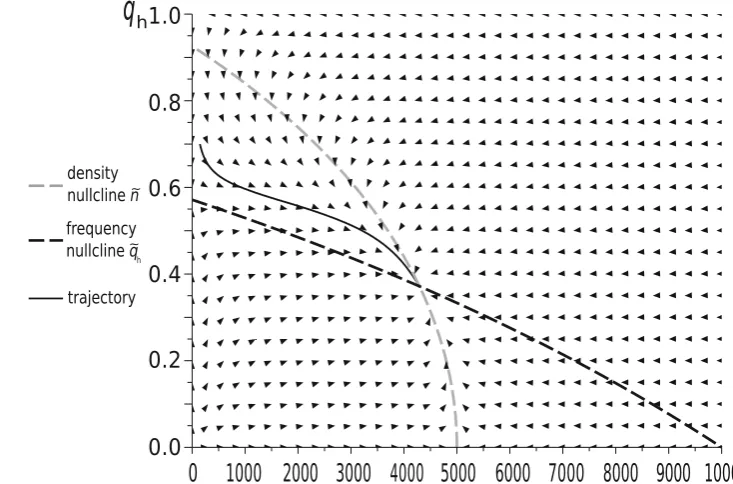
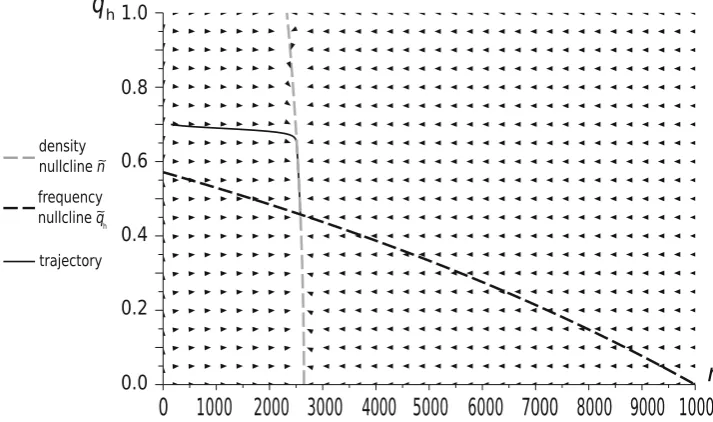
We see that whenUandWare small as in Fig.2, and to a lesser extent in Fig.3, the trajectory is clearly distinct from the density nullclinen~ðqÞ, whereas for largeUandW, as in Fig.4, the trajectory converges quickly to this null-cline, and then follows it to the equilibrium point. Thus,
only for largeUandW, i.e. in the weak selection limit, can we obtain a separation of timescales for slow frequency and fast size dynamics, which can be described by its equilibrium value.
The shape of the density nullcline shows the strength of the impact of the focal game, via eco-evolutionary feed-back, on the ecology of the population. In Figs. 2 and3, where the focal game is quite a frequent event (since
Fig. 2 The dynamics of a Hawk–Dove population in our new model with initial conditionsqhð0Þ ¼0:7 andnð0Þ ¼147. Model
parame-ters: W¼0:8, d¼0:5, W¼0:006, U¼0:008. In this case the impact of the background fitness components is very weak. The vector field indicated by the arrows shows that the force of attraction towards the density nullcline increases with population size.
However, the dynamics does not converge quickly to the nullcline, and this case is far from timescale separation. Note that, the shape of the density nullcline highly depends on the strategic composition of the population. Thus the impact of the focal game on the population size is strong
[image:8.595.115.474.179.378.2] [image:8.595.170.537.468.710.2]background fitness is relatively low), the density nullcline (as a function of qh) depends strongly on the strategic composition. On the other hand, in the case when the focal game is rare (as in Fig.4), and so its impact is weak, the density nullcline is nearly flat.
Impact of the distribution of interaction events in time on the dynamics
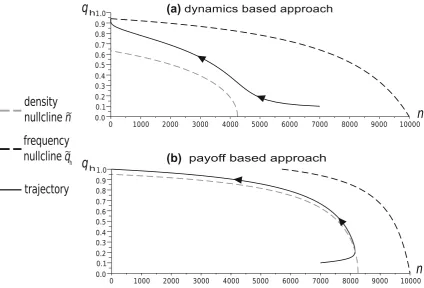
In this section we will illustrate the relationships between the dynamics-based and payoff-based approaches to the background mortality analysed in ‘‘Two distinct approaches to background fitness’’ and summarized by Theorem 1 in ‘‘Appendix 2’’. This will show the importance of the impact of the distribution of events in time. In the payoff-based approach, background deaths occur simultaneously with the focal game event while in the dynamics-based approach they gradually aggregate independently of the focal interactions. We can observe this comparing the numerical simulations of the system (12,13) with the system (55,56), which is the Hawk–Dove game model derived according to (9,10). For simplicity we remove the background fertility from both systems by settingWandWb equal to zero.
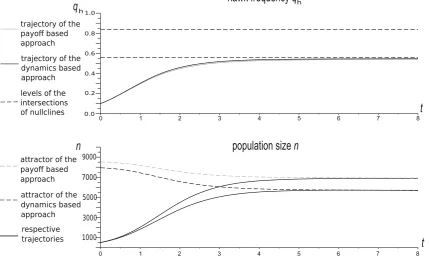
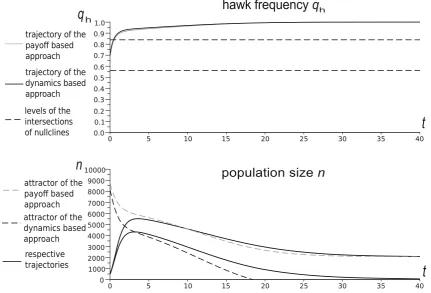
Numerical simulations show that for small background mortalities the two approaches produce similar trajectories of strategy frequencies, but ecological predictions differ significantly (see Figs. 5 and 6). The dynamics-based model can predict extinction in the case when the payoff-based model shows a positive stable population size (Fig. 6). These numerical results support the analytical
results from Theorem 1 in ‘‘Appendix 2’’, which shows that the stable sizes predicted by the model of Argasinski and Broom (2012) are biased, while the frequency levels of the intersections are the same for both approaches. With an increase of the background mortality, the differences between the models also increase and can affect frequency trajectories and phase portraits (Fig. 7). Thus the above example supports the claims that background fitness and the background payoff are distinct, although related, concepts.
Discussion
Two types of background fitness
Background fitness is traditionally interpreted as some phenomenological constant (or function) added to the payoffs of all strategies which vanishes from the continu-ous replicator equations. This concept can be found in many papers (for example see Cressman et al. 1986; Houston and McNamara 1991; Claussen and Traulsen
2005), but it is treated as a technical element of the mathematical notation and these works are not primarily focused on the biological meaning of it. Background fitness can be interpreted in two ways: First, as an element of the game theoretic structure (a generalization of the back-ground payoff from classical game theory). Second, as an element of the dynamics occurring independently from the focal game at a separate rate of occurrence. In the basic
Fig. 4 The dynamics of a Hawk–Dove population in our new model with initial conditionsqhð0Þ ¼0:7 andnð0Þ ¼147. Model
parame-ters:W¼0:8,d¼0:5,W¼15,U¼20. In this case the impact of the background fitness components is very strong and the system is close to the weak selection limit. The stable restpoint is different to
[image:9.595.116.473.61.272.2]approach to evolutionary game theory, the two approaches are indistinguishable. Some researchers, for instance those working explicitly using discrete dynamics or weak selection models, interpret the classical background fitness in rather a similar way to the first approach (Broom and Rychtar2013; Taylor and Nowak 2006; Wu et al.2010), while for others, for instance in optimal foraging/ diet choices models, the underlying logic involves the second approach (Krˇivan1998,2003; Cressman and Krˇivan2010). However there was no rigorous formalization of this aspect and it is rather an example of ‘‘folk’’ knowledge.
Our work shows that there are essentially two types of background fitness (or more precisely, of background mor-tality and fertility), the payoff-based and the dynamics-based approaches. The dynamics-based approach that we focus on in this paper acts as the classical background fitness and is derived from the general ecological model, not phe-nomenologically postulated. While the payoff-based approach is a good tool to describe the selectively neutral factors related to the game interaction, which is clearly shown by the example of density dependent juvenile mor-tality (Argasinski and Kozłowski 2008; Zhang and Hui
2011; Argasinski and Broom2012,2013), we have shown here that such an application to the factors not related to the focal game can be problematic. The payoff-based approach does not take into account the distribution of the background
events in time. The outcomes of all background events which occurred between two focal events affect the popu-lation state simultaneously when a single focal event occurs, since they are the final element of the focal game’s causal chain. The dynamics-based background fitness is free from this disadvantage. Note that both types of background fitness are not selectively neutral and affect the dynamics of the system via strategically neutral juvenile mortality (as is shown by a Hawk-Dove example). This impact is nontrivial and will probably affect the general stability conditions. This is a question which is analysed in a subsequent paper (Ar-gasinski and Broom2017).
The event-based approach and rates of event occurrence
The most general and important claim resulting from our approach is that the payoff is not equivalent to the popu-lation growth rate. Game-theoretic notions describe the causal structure and the resulting outcomes of the specific single interaction. The interactions aggregate with some rate and the product of this rate with demographic out-comes constitute the vital rates. This is different to the approach from Taylor and Nowak (2006), where the fitness is expressed as the outcome of the average interaction (the sum of payoffs from interactions divided by the number of
Fig. 5 Time evolution of the Hawk frequency and population size for the payoff-based and dynamics-based models for the parameters: W¼4, d¼0:85, W¼0:4. Levels of intersections indicate the frequency coordinates of the intersections of frequency and density
nullclines q~hðnÞ and nðq~ hÞ, constituting the rest points of the
[image:10.595.85.515.67.327.2]those interactions). This assumption does not take into account the impact of the different numbers of interactions on the fitness of the particular strategy. We can imagine an example when one strategy will obtain on average lower reproductive success per interaction than a competitor, but will participate in more interactions, so that its aggregated reproductive success is larger. The approach proposed here explicitly takes this into account. We thus believe that the number of games played should be explicitly considered. Then the demographic payoffs will describe the outcomes of the average interaction event (similarly to the stoichio-metric coefficients in chemical kinetics, Upadhyay 2006) not the growth rates as in traditional evolutionary games.
In static models there is no time but causal conse-quences of the strategic ‘‘decisions’’ of individuals described by their reproductive success. Thus, the rigorous derivation of the population growth rate as an aggregated outcome of individual interactions needs rates of occur-rence as the necessary element to make the framework consistent (the problem of the consistency and realism of modelling frameworks was discussed in Houston and McNamara 2005; McNamara 2013). Traditionally, inter-action rates are not explicitly analysed in game-theoretic selection models (some exceptions will be discussed later).
However, they can be a practical analytic tool. We can imagine a population of individuals where the type of games played depends upon their situation. Then the probabilities of finding particular situations associated with the respective type of game can be described by different rates of occurrence. The new approach corrects intuitions inspired by classical birth and death processes (see e.g. Haigh2002) where birth and death events are described by different intensities, which implies statistical independence of births and deaths. In this case trade-offs between mor-tality and fertility are impossible. In evolutionary theory benefit is linked to reproductive success while expected cost is related to the associated mortality risk. The approach from this paper can be used to describe the cor-relations between mortality and fertility factors associated with particular activities.
In addition, rates of occurrence are not necessarily constants. For example they can be functions of the pop-ulation size (more individuals implies potentially more interactions per unit time) or population state. A good example of this is the battle of the sexes with the problem of pair formation (Mylius1999) or dynamic model of sex ratio evolution (see Argasinski 2012, 2013 and 2017). There an elementary event (a Bernoulli trial) is the
Fig. 6 Time evolution of the Hawk frequency and population size for the payoff-based and dynamics-based models for the parameters: W¼15,d¼0:85,W¼0:4. As in Fig.5, the frequency trajectories are similar but the predicted population sizes differ dramatically. The
[image:11.595.83.515.60.353.2]production of a single offspring with a randomly chosen partner. Then females interact at a constant rate, while males interact proportionally to the number of available females described by the actual sex ratio (female to male). Thus interaction rates constitute a crucial element of the strategy selection mechanism. We can also imagine the situation when interaction rates can depend on an indi-vidual’s strategy. This can be illustrated by the example of non-uniform interaction rates in the models of social dilemmas, such as the models of upstream reciprocity (Nowak and Roch 2007; Pena et al. 2011). In this case there are different interaction rates for different individual strategies within the single game.
There is also an interesting relationship between the so-called weak selection concept and our eco-evolutionary feedback. Traditionally, in population genetics and models based on continuous traits, the weak selection limit assumes very small differences between strategic agents or alleles resulting in small selective advantage (Kimura
1968; Ohta2002). This assumption was also used in matrix game models, where assumption of small differences is not necessarily applicable (for example in models with con-trasting strategies such as Hawks and Doves which by
definition will obtain different demographic payoffs). Then, the weak selection limit is introduced via a selection constant (see Wild and Traulsen2007 for the comparison of both approaches). Note that the selection constant (Nowak et al.2004; Antal et al. 2009; Taylor et al.2004; Ohtsuki et al. 2006; Taylor et al. 2007; Fu et al. 2009; Tarnita et al. 2009a; Wild and Traulsen 2007) can be interpreted as the rate of the focal game’s occurrence. Under weak selection, a focal game described by relatively high demographic parameters will be a rare event, and its impact on the population dynamics will be small. Our interpretation embeds this concept in a clear biological context. The weak selection limit can be applied only in the case that the focal events are really rare. Thus it cannot be applied in common types of interactions such as mating conflicts or resource conflicts during foraging. Note that, in the weak selection limit, where our parameter h tends to infinity, the impact of the frequency dynamics on the population size vanishes, but the second element of the eco-evolutionary feedback is still present. The frequency dynamics is affected by population size via juvenile sur-vival inducing the nest site lottery mechanism on the density nullcline (Argasinski and Broom2013).
(a)
(b)
Fig. 7 Phase diagrams following the evolution of the Hawk frequency and population size for the payoff-based and dynamics-based models for the parameters:W¼8,d¼0:85, W¼2:3. The
[image:12.595.86.511.57.345.2]General discussion
The event-based approach constitutes a clearly defined area of application of game-theoretic notions within the evolutionary dynamics framework. The mathematical structure describing the focal interaction can be very complex (e.g. see Broom and Ruxton 1998; Gokhale and Traulsen 2010; Broom 2002; Broom and Cannings2002, and in general the book Broom and Rychtar2013) and a clear methodology how to incor-porate the game into a population dynamic model can be important. The approach proposed in this paper shows that evolutionary dynamics under growth, limited by nest site availability, is a synergistic product of different games played by individuals, not only a simple aggregated sum of the outcomes of those games. Thus, the dynamical approach is more than an extension of the static game structure, as in classical theory. An important aspect of this approach is that it can be easily interpreted, which is a significant advantage over abstract simplified models , as argued Geritz and Kisdi (2012). Further, the proposed approach allows for more pre-cise modelling of the outcomes of selection dynamics on ecological parameters such as population size. This is very important, because the relationship between ecological mechanisms (regulation of the population size) and the pro-cess of natural selection is one of the major problems of modern evolutionary biology (Birch1960; Hutchinson1965; Ginzburg1983) and is still at the centre of debate (Pelletier et al.2009; Morris2011; Post and Palkovacs2009; Schoener
2011). We note that aspects discussed above are important from the point of view of the general definition of fitness (see Metz2008; Roff2008; Orr2009) and its interpretation within evolutionary theory (Mills and Beaty1979; Rosenberg and Williams 1986; Horan 1994; Matthen and Ariew 2002; Brandon and Ramsey2007; Matthen and Ariew2009; Walsh
2010; Ramsey2013).
The proposed approach shows how the game theoretic notions, causal structure underlying the interactions that shape the population dynamics, can be used within many theoretical frameworks. It can be easily extended to Adaptive Dynamics (Dercole and Rinaldi2008) due to its clear description of the underlying ecology. On the other hand, decomposition of fitness into separate demographic payoffs creates the possibility of incorporating more detailed population genetic mechanisms (Crow and Kimura
1970; Hartl and Clark 1997; Bu¨rger 2000), which will affect the fertility payoffs. Then the fertility payoff will describe the number of mating attempts which can be weighted by the probability of gene transfer determined by the underlying genetic system.
In addition the impact of the proposed methodology can be broader and more general. Note that in the case of abstract model parameters, that are ‘‘fitted’’ to data, it can be hard to falsify the obtained outcomes, if the model is
‘‘flexible’’ enough with respect to the ‘‘fitted’’ parameters, to cover different types of datasets. The clear demographic meaning of our model parameters can allow for easy falsi-fication according to empirical data or the outcomes of individual-based simulations (which will have the status of in-silico experiments, see Uchman´ski and Grimm 1996; Grimm and Railsback 2005) parameterized by the same values. The predictions of the analytical model can be helpful in a mechanistic explanation of the patterns pro-duced by the simulation (see, for example, Gerlee and Lundh2010) or observed empirical data. This will constitute important progression in the direction of the development of theoretical notions related to the individual level, originated by Łomnicki (1988), and in particular related to research on animal personalities (Dall et al. 2004; Wolf et al. 2007; Wolf and Weissing2010,2012; Wolf and McNamara2012). Thus, the event-based terminology not only extends the mathematical notions, but also influences the general theory and contributes to the understanding of the causal structure of the evolutionary process.
Acknowledgements In memory of Krzysztof Chodasewicz. We want to thank Jan Kozłowski, John McNamara and Ryszard Rudnicki for their support of the project and helpful suggestions. K. Argasinski was supported by Grant 2013/08/S/NZ8/00821 FUGA 2 by the Polish National Science Centre.
Open Access This article is distributed under the terms of the Creative Commons Attribution 4.0 International License (http://crea tivecommons.org/licenses/by/4.0/), which permits unrestricted use, distribution, and reproduction in any medium, provided you give appropriate credit to the original author(s) and the source, provide a link to the Creative Commons license, and indicate if changes were made.
Appendix 1: The details of the general model
from Argasinski and Broom (
2012
)
We now briefly consider some important ideas and termi-nology from Argasinski and Broom (2012). The main idea underlying the modelling approach of Argasinski and Broom (2012) is that all interactions between individuals occur with single intensity s (there are no distinction between different games played by the individuals) and their outcomes are described by demographic payoff functions, fertility W (interpreted as the number of off-spring produced during an interaction) and mortality d
(interpreted as the probability of death during an interac-tion). This leads the following growth equation:
_
ni¼nisðWidiÞ: ð16Þ
current paper, we do not need a complex causal structure for our focal interaction. We will limit ourselves to a single pre-reproductive mortality stage. Assume that it is descri-bed for thei-th strategy by payoff functionssi and single fertility stage (when survivors reproduce) described by payoff functions Wi. For our population, qi¼ni=n is the frequency of strategyi,n¼Pnithe population size,Kthe carrying capacity (maximum environmental load, Hui
2006). Since we assumed the pre-reproductive survival stage, which implies that only survivors can reproduce, this leads to a mortality–fertility tradeoff. Sincesi andWiwill be functions of vector q (frequency dependent, as in Framework II in Argasinski and Broom2012) the mortal-ity–fertility trade-off function ViðqÞ ¼PjqjsiðejÞWiðejÞ should be introduced. Finally, interactions occur with rate of occurrences. The population for each individual strat-egy growth equation can be formulated as follows:
_
ni¼nisVi 1
n K
nisð1siÞ ð17Þ
¼nis Vi 1
n K
ð1siÞ
: ð18Þ
The above equation is the extended version of (16) where
WiðqÞis replaced by 1Kn
ViðqÞanddiðqÞ ¼ ð1siðqÞÞ are game theoretic fertility and mortality payoffs. This introduces the simple trade-off between mortality and fer-tility. In the Eq. (17) we can remove the interaction rates by a change of timescale (see ‘‘Appendix 1’’ in Argasinski and Broom2012). Then, the above system can be rescaled to the related frequencies. These assumptions lead to the following detailed general system of replicator equations (describing the changes of strategy frequencies qi) including an equation on population sizen, which will be analysed in this paper:
_
qi¼qi Vi X
j
qjVj !
1n K
þ si X
j
qjsj !
" #
;
ð19Þ
_
n¼n X
i
qiVi 1
n K
þX
i
qisi1 !
: ð20Þ
From the Eq. (20) we can derive the description of then -nullcline (which is the attractor inn-subspace):
~
n¼K 11
P iqisi P
iqiVi
: ð21Þ
This nullcline consists of the equilibria of the ecological dynamics.
Appendix 2: A comparison between the new
(dynamics-based) approach and the approach
of Argasinski and Broom (
2012
)
The background fitness terms derived in the ‘‘Background fitness as the aggregated outcomes of background events’’ (dynamics-based approach) act as additive factors that vanish from the replicator dynamics (in a similar way as in the classical theory). However, in the classical game the-ory, the background payoff is the neutral (additive) element of the payoff function. Thus it is an element of the game theoretic structure. Are background vital rates U and W
equivalent to the neutral elements of the demographic payoff functions Wi and si? This can be shown by com-parison of the approach (which we call here the payoff-based approach) used in Argasinski and Broom (2012), where all interaction events occur at the single intensitys (there are no distinctions between different game types) and the background fitness components are described by phenomenological, strategically neutral elements of the payoff functions. Neutral pre-reproductive mortality will be represented by a multiplicative factor of the whole right-hand side of replicator and population size equations (since it will be the first element of the interactions causal chain); thus it will affect only the pace of convergence. Therefore, it can be incorporated into the occurrence rate of the focal gamesF as an adjustment. The situation is more compli-cated with the additive element WbþWi in the fertility payoff and multiplicative post-reproductive mortalitydb¼ 1sb affecting the survivors of the game mortality stage
sidb). This will lead to the growth equation
_
ni¼nis Vi 1
n K
ð1siÞ þsiWb 1
n K
sidb
¼nis Vi 1
n K
1þsi Wb 1
n K
þ1db
h i
:
ð22Þ
Thus the selectively neutral elements appear as the multi-plicative factor Wb1Knþ1db of the survival payoffs si. This leads to the following extension of the system (19,20):
_
qi¼qi Vi X
j
qjVj !
1n K
"
þ Wb 1
n K
þsb
h i
si X
j
qjsj !#
;
ð23Þ
_
n¼n X
i
qiVi 1
n K
þ Wb 1
n K
þsb
h i X
i
qisi1 !
:
Then the density nullcline will be:
~
n¼ 1 1sb
P iqisi
WbPiqisiþPiqiVi
K: ð25Þ
This is system (9,10). Thus the dynamics-based approach from ‘‘Background fitness as the aggregated outcomes of background events’’, based on parameters U and W, is somewhat simpler than the original equations from Argasinski and Broom (2012), (23) and (24). In addition, it is clear that there is no need for a distinction between pre-and post-reproductive mortality, because those factors are totally independent of the focal game. Thus the classical approach to the background fitness should be interpreted as the aggregated outcome of other events (games) occurring independently to the focal game, not as a phenomenolog-ical element of the payoff function of the focal game itself. A question arises about the relationship between the two approaches. First, let us compare the approaches with respect to the background fertility. In the payoff-based approach (Argasinski and Broom2012) this factor is rep-resented by 1n
K
WbðsiPjqjsjÞ in the frequency equation (23) and by 1n
K
WbPiqisi in the population size equation (24).Wb is multiplied by the averaged pre-reproductive mortality related to the focal game, since it describes a strategically neutral element of the fertility stage of the focal game’s causal chain. In the dynamics-based approach it is represented by 1n
K
Uin the pop-ulation size equation (7) only. In the dynamics-based approach the whole factor is represented by a single con-stant U and is independent of the focal game. Thus the above two approaches produce clearly distinct results.
The dynamics-based approach seems to be more natural for the modelling of the impact of other interaction events which occur other than through the focal game. In addition it is technically equivalent to the approach used in classical theory. This suggests that the background fitness is not the same as the background payoff in classical game theory leading to the payoff-based approach from Argasinski and Broom (2012). Thus, both approaches are not equivalent with respect to the cases described above. However, in the case of post-reproductive mortality some relationship with background mortalityWcan be shown.
Let us compare the general size equations using the different approaches to the background mortality, wheresb is the neutral post-reproductive survival of the payoff-based approach used in Argasinski and Broom (2012) and
sB is the dynamics-based approach from ‘‘Background
fit-ness as the aggregated outcomes of background events’’. For the dynamics-based approach we have
_
ni¼niVi 1
n K
nið1siÞ niW; ð26Þ
whereas the equation for the payoff-based approach was
_
ni¼niVi 1
n K
nið1siÞ nisidb: ð27Þ
Thus the decay rates constituted by the mortality terms in equations (26) and (27) are
E1¼ ð1siÞ W ð28Þ
for the dynamics-based approach, and
E2¼ ð1siÞ sidb ð29Þ
for the payoff based approach. Note that equality of the decay rates of both approaches E1 ¼E2 implies the
condition
sidb¼hdB ð30Þ
which cannot be satisfied for every i; thus they are not equivalent. Now, let us focus on the relationship between the two approaches (distinguished by the indexes dynfor dynamics-based approach and pf for the payoff-based approach). We can use a Poisson process theory (Haigh
2002), to show conditions when the payoff-based approach can be treated as an approximation of the dynamics-based approach:
Theorem 1 Assuming that sb¼ 1
1þWand the population
size equilibrium condition(8)is satisfied, then
(a) The stationary frequency points for both approaches are the same.
(b) The rate of the dynamics in the payoff-based approach equals the rate of the dynamics-based approach divided by 1þW (or alternatively multi-plied by sb).
(c) Juvenile survival probabilities Jdyn¼ 1
~ ndyn
K
and
Jpf ¼ 1 ~ npf
K
at the stable state and respective stable population sizesn~dynandn~pf are different and
Jdyn¼Jpf=sb leading to
~
ndyn¼ ð1Jpf=sbÞK ¼ 1
1sbPiqisi
sbPiqiVi
K:
ð31Þ
We give a proof below.
Thus, if we are only interested in the static analysis, it is possible to approximate independent background mortality
by post-reproductive mortality db¼1sb¼
W
1þW
population sizes can be found according to part c) of Theorem 1.
Proof of Theorem 1 Parts (a) and (b). The replicator equations from Argasinski and Broom (2012) using the payoff-based approach to post-reproductive background mortality (a special case of (23) withWb¼0) are given by
_
qi¼qi Vi X
j
qjVj !
1n K
þsb si X
j
qjsj !
" #
;
ð32Þ
and for the density nullcline we have the following form of juvenile survival:
1n~ K¼
1sbPiqisi P
iqiVi
: ð33Þ
Using the basic properties of the Poisson process, for two types of events happening at ratesm1andm2, the probability
that the first type event comes before the second type is
sb¼ m1 m1þm2
. In our case the game interaction happens at
rate 1 (after the change of timescale ~t¼tsF) and back-ground mortality acts at rate W¼hð1sBÞ (where h¼sB=sF). Then the survival probability between game
interactions is given bysb¼ 1
1þWsince survival occurs if
a new contest comes before death. It is easy to show that this relationship does not hold for the payoff-based approach in general. However, under the assumption of population size equilibrium, some relationships between the payoff-based approach as an approximation of the dynamics-based approach to the background mortality can be derived. After substitution of the population size equi-librium (33) into (32), we have
_
qi¼qi Vi
X
j
qjVj !
1sbPiqisi P
iqiVi
þsb si
X
j
qjsj !
" #
:
ð34Þ
After substitution ofsb¼ 1
1þWto the above equation, we
have
_ qi¼
qi
1þW Vi X
j qjVj
!
Wþ1Piqisi P
iqiVi
þ si X
j qjsj
!
" #
:
ð35Þ
The right-hand side of Eq. (35) equals a constant times the r.h.s of Eq. (6) using the substitution from Eq. (8) (recall that we assumedU¼0 for simplicity). Thussbonly affects the rate of convergence and intersections of the nullclines will be the same as in the new method presented in this paper.
Part (c). Substituting the population sizes to the logistic suppression coefficient we can calculate the juvenile survivals on the density nullcline. Then
Jpf ¼ 1
npf
K
¼1sb
P iqisi P
iqiVi
ð36Þ
for the payoff based approach, and
Jdyn¼ 1
ndyn
K
¼1
P
iqisiþW P
iqiVi
¼1=sb
P iqisi P
iqiVi
ð37Þ
(sinceW¼1=sb1Þ, for the dynamics-based approach. Since we are especially interested in the result of the dynamics-based approach and treat the payoff-based model as an approximation of the dynamics based one, we need to express the predictions of the dynamics-based model in terms of the payoff-based approach. Thus for a given set of parameters common to both models, we obtain from the above that
Jpf ¼sbJdyn ð38Þ
and the stationary population size for the dynamics-based model can be described as
~
ndyn¼ 1
Jpf
sb
K: ð39Þ
leading to (31). h
Appendix 3: Derivation of the Hawk–Dove
example game
The equations using the Hawk–Dove payoff functions equivalent to the Eqs. (19) and (20), where fertility payoffs are Vi¼eiSPqTW and PjqjVj¼qSPqTW while sur-vival payoffs aresi¼eiSqTandPjqjsj¼qSqT(where ‘‘’’ means elementwise multiplication andeiis the base vector with 1 oni-th coordinate and zeros on the others), will be the following:
_
qh¼qh W e1SPqTqSPqT
1n K
þ ðe1SqTqSqTÞ
ð40Þ
_
n¼n qSPqTW 1n K
þqSqT1
: ð41Þ
The matrix operations are as follows:
e1SqT ¼sqhþ1qh¼qhðs1Þ þ1; ð42Þ
e1SPqT ¼
1
2sqhþ1qh; ð43Þ
qSqT ¼qhðqhðs1Þ þ1Þ þð1qhÞ ¼1q2hð1sÞ;
qSPqT ¼qh
1
2sqhþ1qh
þ1
2ð1qhÞ 2
¼1
2 1q 2
hð1sÞ
:
ð45Þ
Note thatqSPqT¼qSqT=2 which simplifies (41) to
_
n¼n qSqT 1
2W 1
n K þ1 1
: ð46Þ
The bracketed terms of (40) are
Vi X
j
qjVj¼ e1SPqTqSPqT
¼1
2ð1qhÞ½qhðs1Þ þ1Þ;
ð47Þ
si X
j
qjsj¼ ðe1SqTqSqTÞ ¼ ðs1Þqhð1qhÞ:
ð48Þ
After calculations and the substitution d¼1s the fol-lowing equations for the Hawk proportionqh and for the population size are obtained:
_
qh ¼qhð1qhÞ 1
2Wð1qhdÞ 1
n K
qhd
; ð49Þ
_
n¼n 1
2W 1q
2
hd
1n K
q2hd
: ð50Þ
Thus we have embedded the focal game into the replicator dynamics. We should add the background fitness compo-nents represented by the background vital rateU 1n
K
W into the population size equation. Thus we obtain the model derived according to the system (6,7):
_
qh ¼qhð1qhÞ 1
2Wð1qhdÞ 1
n K
qhd
; ð51Þ
_
n¼n Uþ1
2W 1q
2
hd
1n K
q2hdW
:
ð52Þ
The zeros of the right-hand sides of the above equations will give nullclines constituting the equilibria of selection and ecological subsystems. Two rest points of this system are qh¼0 and 1. A nontrivial rest point, which becomes the frequency nullcline consisting of Nash equilibria, is given by
~
qhðnÞ ¼
1 2W 1
n K
d 12W 1n K
þ1
: ð53Þ
There is a stationary population size at eithern~¼0 or at the following positive restpoint which is conditional on the Hawk strategy frequency (describing the attracting density nullcline parametrized byqh),
~
nðqhÞ ¼K 1
q2hdþW
1
2W 1q 2
hd
þU
!
: ð54Þ
To obtain the model derived according to the payoff-based background fitness we should multiply mortality payoffs by Wb 1Kn
þsb
as in (23) and (24). In equations (49) this will be the last term qhd in the long bracket, due to (48), and in Eq. (50) this will be termqSqT
in (41) which becomes 1 in the internal bracket in (46). This leads to the model derived according to system (9,10) :
_
qh¼qhð1qhÞ 1
2Wð1qhdÞ 1
n K
qhd Wb 1
n K
þsb
h i
;
ð55Þ
_
n¼n 1q2hd 1
2WþWb
1n K
þsb
1
;
ð56Þ
leading to the system used in Argasinski and Broom (2012). Then the attracting nullclines representing the equilibria of selection dynamics and ecological dynamics will be
~
qhðnÞ ¼
1 2W 1
n K
d 1
2WþWb
1n K
þsb
;
ð57Þ
~
nðqhÞ ¼K 1
11q2hdsb 1q2
hd
1
2WþWb
!
: ð58Þ
References
Antal T, Traulsen A, Ohtsuki H, Tarnita CE, Nowak MA (2009) Mutation-selection equilibrium in games with multiple strate-gies. J Theor Biol 258:614–622
Argasinski K (2006) Dynamic multipopulation and density dependent evolutionary games related to replicator dynamics. A metasim-plex concept. Math Biosci 202:88–114
Argasinski K (2012) The dynamics of sex ratio evolution dynamics of global population parameters. J Theor Biol 309:134–146 Argasinski K (2013) The dynamics of sex ratio evolution: from the
gene perspective to multilevel selection. PloS One 8(4):e60405 Argasinski K (2017) The dynamics of sex ratio evolution: the impact of males as passive gene carriers on multilevel selection. Dyn Games Appl(to appear)
Argasinski K, Broom M (2012) Ecological theatre and the evolu-tionary game: how environmental and demographic factors determine payoffs in evolutionary games. J Math Biol. doi:10. 1007/s00285-012-0573-2
Argasinski K, Broom M (2017) Evolutionary stability under limited population growth: eco-evolutionary feedbacks and replicator dynamics. Ecol Complex. doi:10.1016/j.ecocom.2017.04.002
Argasinski K, Kozłowski J (2008) How can we model selectively neutral density dependence in evolutionary games. Theor Pop Biol 73:250–256
Birch LC (1960) The genetic factor in population ecology. Am Nat 94(874):5–24
Bowers RG, White A, Boots M, Geritz SA, Kisdi E (2003) Evolutionary branching/speciation: contrasting results from systems with explicit or emergent carrying capacities. Evol Ecol Res 5(6):883–891
Brandon RN, Ramsey D (2007) What’s wrong with the emergentist statistical interpretation of natural selection and random drift? In: Hull D, Ruse M (eds) Cambridge companion to the philosophy of biology. Cambridge University Press, Cambridge
Broom M (2002) A unified model of dominance hierarchy formation and maintenance. J Theor Biol 219:63–72
Broom M, Cannings C (2002) Modelling dominance hierarchy formation as a multi-player game. J Theor Biol 219:397–413 Broom M, Ruxton GD (1998) Evolutionarily stable stealing: game
theory applied to kleptoparasitism. Ann Hum Genet 62:453–464 Broom M, Rychtar J (2013) Game-theoretical models in biology.
CRC Press, Boca Raton
Bu¨rger R (2000) The mathematical theory of selection, recombina-tion, and mutation. Wiley, Chichester
Caswell H (2001) Matrix population models. Wiley, Chichester Cannings C (2012) Topics in the theory of ESS’s. In: Lessard S (ed)
Mathematical and statistical developments of evolutionary theory. Lecture Notes in mathematics. Kluwer, Dordrecht, pp 95–119 Chakra MA, Hilbe C, Traulsen A (2014). Plastic behaviors in hosts
promote the emergence of retaliatory parasites. Sci Rep 4:4251 Claussen JC, Traulsen A (2005) Non-Gaussian fluctuations arising from finite populations: exact results for the evolutionary Moran process. Phys Rev E 71(2):025101
Cressman R, Dash AT, Akin E (1986) Evolutionary games and two species population dynamics. J Math Biol 23:221–230 Cressman R (1992) The stability concept of evolutionary game
theory. Springer, Berlin
Cressman R, Garay J (2003) Evolutionary stability in Lotka–Volterra systems. J Theor Biol 222:233–245
Cressman R, Garay J (2003) Stability in N-species coevolutionary systems. Theor Popul Biol 64:519–533
Cressman R, Garay J, Hofbauer J (2001) Evolutionary stability concepts for N-species frequency-dependent interactions. J Theor Biol 211:1–10
Cressman R, Krˇivan V (2010) The ideal free distribution as an evolutionarily stable state in density-dependent population games. Oikos 119(8):1231–1242
Crow, JF, Kimura M (1970) An introduction to population genetics theory. An introduction to population genetics theory, Harper and Row
Dawkins R (1989) The selfish gene, Revised edn. Oxford University Press, Oxford
Dall SR, Houston AI, McNamara JM (2004) The behavioural ecology of personality: consistent individual differences from an adaptive perspective. Ecol Lett 7(8):734–739
Dercole F, Rinaldi S (2008) Analysis of evolutionary processes: the adaptive dynamics approach and its applications: the adaptive dynamics approach and its applications. Princeton University Press, Princeton
Dieckmann U, Law R (1996) The dynamical theory of coevolution: a derivation from stochastic ecological processes. J Math Biol 34:579–612
Doebeli M, Hauert C, Killingback T (2004) The evolutionary origin of cooperators and defectors. Science 306(5697):859–862
Fu F, Wang L, Hauert C, Nowak MA (2009) Evolutionary dynamics on graphs: efficient method for weak selection. Phys Rev E 79:046707
Geritz SA, Kisdi E´ , Mesze´na G, Metz JAJ (1998) Evolutionarily singular strategies and the adaptive growth and branching of the evolutionary tree. Evol Ecol 12:35–57
Geritz SA, Kisdi E (2012) Mathematical ecology: why mechanistic models? J Math Biol 65:1411–1415
Gerlee P, Lundh T (2010). Rock-scissor-paper dynamics in a digital ecology. In: Proceedings of the twelfth international conference on the synthesis and simulation of living systems, pp 285–295 Ginzburg LR (1983) Theory of natural selection and population
growth. Benjamin/Cummings Publishing Company, Inc., Menlo Park, CA, USA
Gokhale C, Hauert C (2016) Eco-evolutionary dynamics of social dilemmas. Theor Popul Biol 111:28–42
Gokhale C, Traulsen A (2010) Evolutionary games in the multiverse. PNAS 107(12):5500–5504
Grimm V, Railsback SF (2005) Individual-based modeling and ecology. Princeton University Press, Princeton
Haigh J (2002) Probability models. Springer, London
Hartl DL, Clark AG (1997) Principles of population genetics, vol 116. Sinauer Associates, Sunderland
Hauert C, Holmes M, Doebeli M (2006) Evolutionary games and population dynamics: maintenance of cooperation in public goods games. Proc R Soc B Biol Sci 273(1600):2565–2570 Hauert C, Wakano JY, Doebeli M (2008) Ecological public goods games:
cooperation and bifurcation. Theor Popul Biol 73(2):257–263 Hauser OP, Traulsen A, Nowak MA (2014) Heterogeneity in
background fitness acts as a suppressor of selection. J Theor Biol 343:178–185
Hofbauer J, Sigmund K (1988) The theory of evolution and dynamical systems. Cambridge University Press, Cambridge Hofbauer J, Sigmund K (1998) Evolutionary games and population
dynamics. Cambridge University Press, Cambridge
Horan BL (1994) The statistical character of evolutionary theory. Philos Sci 61:76–95
Houston AI, McNamara JM (1991) Evolutionarily stable strategies in the repeated hawk–dove game. Behav Ecol 2:219–227 Houston AI, McNamara JM (2005) John Maynard Smith and the
importance of consistency in evolutionary game theory. Biol Phil 20(5):933–950
Huang W, Hauert C, Traulsen A (2015) Stochastic game dynamics under demographic fluctuations. PNAS 112(29):9064–9069 Hui C (2006) Carrying capacity, population equilibrium, and
environment’s maximal load. Ecol Model 192(1–2):317–320 Hutchinson GE (1965) The ecological theater and the evolutionary
play. Yale University Press
Kimura M (1968) Evolutionary rate at the molecular level. Nature 217(5129):624–626
Krˇivan V (1998) Effects of optimal antipredator behavior of prey on predator-prey dynamics: the role of refuges. Theor Popul Biol 53(2):131–142
Krˇivan V (2003) Competitive co-existence caused by adaptive predators. Evol Ecol Res 5(8):1163–1182
Krˇivan V (2013) The Allee-type ideal free distribution. J Math Biol 67:329–358
Łomnicki A (1988) Population ecology of individuals. Princeton University Press, Princeton
Lunel, SM (Eds.) Stochastic and spatial structures of dynamical systems. North-Holland, pp 183–231
Matthen M, Ariew A (2002) Two ways of thinking about fitness and natural selection. J Philos 99:55–83