Case Managers
Chyrell D Bellamy, PhD, MSW Liat Kriegel, PhD, MSW
Yale School of Medicine, Dept. of Psychiatry, Program for Recovery and Community Health Stacey Barrenger, PhD, MSW
Silver School of Social Work, New York University Michele Klimczak, LMSW
The Institute for Innovative Practice, The Connection, Inc. Jaak Rakfeldt, PhD, LCSW
Social Work Department, Southern Connecticut State University Victoria Benson, MA
Michaella Baker, MPH Patricia Benedict, BA Bridgett Williamson, RSS
Yale School of Medicine, Dept. of Psychiatry, Program for Recovery and Community Health Gillian MacIntyre, PhD
School of Social Work and Social Policy, University of Strathclyde Declaration of Interest:
The views in this publication are solely the responsibility of the authors. The Commission is not responsible for any use that may be made of the information it contains.
FUNDING
This project has received funding from the European Union’s Horizon 2020 research and innovation programme under the Marie Skłodowska-Curie grant agreement No 690954. Correspondence related to this manuscript can be sent to Chyrell D. Bellamy,
Abstract
A measure of Citizenship was developed and validated by Rowe and colleagues (O’Connell, Clayton, & Rowe, 2016). The items clustered around the 5 Rs of Citizenship as defined by Rowe: relationships, rights, resources, roles, and rights, and a sense of belonging. While a measure has its utility in clinical settings, in order to address time constraints and other
administrative burdens expressed by providers in their day-to-day practice, a Citizens tool was developed as a practical way that providers can enhance dialogue between providers and clients on citizenship for clients served in mental health and criminal justice reentry settings. This paper describes the development of the tool, testing of the tool’s utility with case managers, and
implications for practice.
Key words: Citizenship, community inclusion, community integration, marginalized
Development of the Citizens Measure into a Tool to Guide Clinical Practice and its Utility for Case Managers
Citizenship is a term often tied to legalities of national placement or the essential rights of residents. In mental health, however, the term has broader reach. Rowe and colleagues define citizenship through the strength of individuals’ connections to the rights, responsibilities, roles, and resources available to them and to the supportive relationships developed in their
communities (Rowe, 1999; Rowe, 2015; Rowe, Kloos, Chinman, Davidson & Cross, 2001). The framework also emphasizes the sense of belonging often validated by others’ recognition and the acknowledgement that a person belongs, is valued, and is needed. Citizenship, especially for vulnerable populations, is the acknowledgement that our fullest selves can only be realized in connection to the social and tangible provisions of the societies we live in. If, as an example, a person has minimal opportunity to express a parental responsibility or assert a civil right afforded to others, then is that person experiencing social and community citizenship on equal grounds as those whose rights or responsibilities are not compromised? For individuals with mental illnesses as well as those with histories of incarceration, citizenship in all its parts is often compromised by social stigmas, visible and invisible bans, and restrictive policies. These men and women suffer social isolation and alienation from their communities and social networks. A restoration of citizenship then can also mean a restoration of reciprocity through an increased wealth of family and community engagement and an increase in the connection to their rights.
employment, healthcare, housing and a sense of belonging (Rowe et al., 2009). The concept was subsequently explored through a randomized controlled trial of a citizenship intervention called the Citizens’ Project and later the development of a Citizenship Measure. The measure, which was developed through a participatory research process, providing a means for understanding the barriers to achieving citizenship (O’Connell, Clayton & Rowe, 2017). The Citizenship Measure is a psychometrically valid instrument that details several aspects of social citizenship that people experience. The authors describe citizenship as a multi-dimensional construct that is similar to, yet different from, recovery, quality of life, and well-being. More specifically, the constructs map onto the 5 Rs of Citizenship: Relationships, Resources, Responsibilities, Rights, and Roles (O’Connell, Clayton, & Rowe, 2017).
A measure is important for evaluation purposes or even to get a sense of how individual’s rate in each area of the 5Rs. The question, however, remains as to how practice can be better informed and equipped to enhance citizenship for individuals receiving mental health care or forensic supports. What might be a useful guide or tool to assist providers? This study sought to explore the clinical utility of a tool framed by and developed using the citizenship theory and its accompanying citizenship research measure (O’Connell, Clayton, & Rowe, 2017).
Citizenship in Practice
Experiences of citizenship in practice were explored in a study by Ponce, Clayton, Gambino, and Rowe (2016) to examine what citizenship looks like if the term is utilized in mental health care. The study was conducted with clinical providers at an urban community mental health agency, serving individuals with serious mental illness diagnoses. Eight
asked to review the citizenship measure (initially the 46-item version and later with the last 8 groups, the 12 items version [See Appendix A: Citizens Measure 12 items] and then respond to the following questions: "What do you think?" and "Are these statements relevant to your work with clients?" (Ponce et al., 2016). Study findings suggest that many providers discussed how social support and feeling socially connected were prime definitions of citizenship and general well-being. More specifically, being able to relate to others was a meaningful way for providers to apply the citizenship framework in mental health care. Providers discussed the importance of the provider-client relationship, though challenges arise when finding balance between guiding and directing clients. Lastly, barriers in regards to developing citizenship oriented care in practice included: tending to clients’ urgent needs, burdensome workloads, and time constraints. Providers expressed concern about the limited action that can take place within the mental health system to address the problems surrounding citizenship for their clients, such as discrimination and poverty, and socioeconomic and structural challenges (Ponce et al., 2016).
Findings from Ponce, et al. (2016) suggest that mental health care providers do recognize the needs of clients and the potential for citizenship-related services to help them find a valued role within their community. Providers suggested that further detail needs to be given to how the focus on citizenship work can be brought to clinical care without adding additional strain to current caseloads/workloads. Provider challenges raised the question of how to implement new practices among mental health care providers and what might be useful to guide providers in working more effectively with their clients in this area.
Translating Research into Practice: Developing a Citizens Tool
Palinkas, 2007; Committee on Quality of Health Care in America, 2001, Damschroder, 2009; Wallerstein & Duran, 2010). Even more, little research has focused on effectively disseminating health-related studies into practice. Farquhar (1995) estimated that 10% or less of prevention research is focused on dissemination (Brownson, Kreuter, Arrington, & True, 2006; Farquhar, 1995). Literature suggests that effective dissemination of an evidence-based program requires time-efficient approaches, ongoing training, and high levels of organization regarding research-informed practice (Wallerstein & Duran, 2010). As such, the decision to adopt, accept, and utilize an intervention is not an instantaneous act, but rather an ongoing process (Brownson et al., 2006).
The development of the citizenship tool was an iterative process that involved researchers and providers of varying disciplines and experiences. The team engaged in participatory research methodology and was comprised of social workers, peers, and sociologists. We based the tool on the 5Rs identified by Rowe and colleagues as defining citizenship to facilitate clinical utility of the citizenship framework. The goal of the tool was to facilitate dialogue. Development of the tool involved a series of conversations based on our collective work in the field, review of the Citizenship measure, review of articles and books highlighting the essential components of citizens, and review of the practicality of using the measure in the Citizens project (a 6-month project for people with mental illness and/or co-occurring substance use and histories of recent criminal justice involvement). A set of questions were constructed based on each of the 5Rs and belonging as well as Tools for discussing citizenship aspirations [See Appendix B: Citizens Tool – Engaging in Dialogue on Citizens].
management are particularly germane to the five R’s contained within the providers’ citizenship tool, including: relationships that convey, affirm, and validate a sense of belonging; rights; responsibilities; roles; and resources (Rowe, 2015; Rowe, et al., 2012). Because case managers work elbow-to-elbow and shoulder-to-shoulder directly with clients in their homes and on their streets (Rakfeldt, Sledge, Bailey, & Anderson, 1996), they are best positioned to link and to broker connections for clients to citizenship programs and naturally occurring citizenship affirming activities within their communities. And thus, such linking and brokering may create opportunities for clients to actualize their five R’s. In many ways, case managers serve as a sort of “social prosthetic,” helping clients to overcome barriers, and helping them to move forward even in the face of stigma as they connect or reconnect to their communities. We wanted to explore if the tool (and Citizenship) allows the case managers to get to know their clients on a much deeper level, to connect – and in many cases, reconnect clients to the things that matter most to them in life, or at least to begin the dialogue on citizenship.
Methods
In order to ensure the research was reflective of therapeutic alliances of case managers and their clients, the study was grounded in community-based participatory research methods (Minkler & Wallerstein, 2014). The approach acknowledges the vast experience and the distribution of leadership in different communities and consequently, encourages inclusion of their voices during all stages of the research process (Israel, Eng, Schulz, Parker, 2005). For this study, we partnered with clinical providers and individuals with lived experience during the tool development phase, during the tool-testing phase, and finally during the analysis and reporting phases of the study.
individuals working in three areas: criminal justice and reentry; behavioral health, and family and foster services. An invitation was sent to directors to invite case managers to participate in the study. Participation involved case managers using the citizenship tool with one client to test its usefulness. A link to the Qualtrics website was provided if they wished to participate.
Participants were told that their participation was anonymous.
Only aggregated data was recorded from closed and open-ended responses about the utility of the survey. The survey asked case managers to comment on the tool’s utility in practice and provided opportunities for them to give feedback on sections they particularly liked and disliked. Univariate analyses were conducted on survey responses and demographic
characteristics using SPSS. Qualitative responses were quantified in order to identify thematic prevalence and categorical patterns.
Results Participants’ Demographics
Participants in the study included 17 case managers from a local reentry organization in Connecticut. The case managers themselves were predominately female (n=14) and not of Hispanic origin (n=14) and White (n=11). The majority of case managers had worked at the agency for less than 5 years (n=13).
The clients’ case managers used the tool with represented a more diverse demographic portrait. Though still majority female (n=11), there was a larger proportion of Hispanic clients (n=8) and fewer non-Hispanic White clients (n=6). Of the 17, there were four African
reported a rather even distribution of community inclusion of participants, suggesting that there was not a particular bias in terms of level of community involvement.
Analysis of Responses on Utility
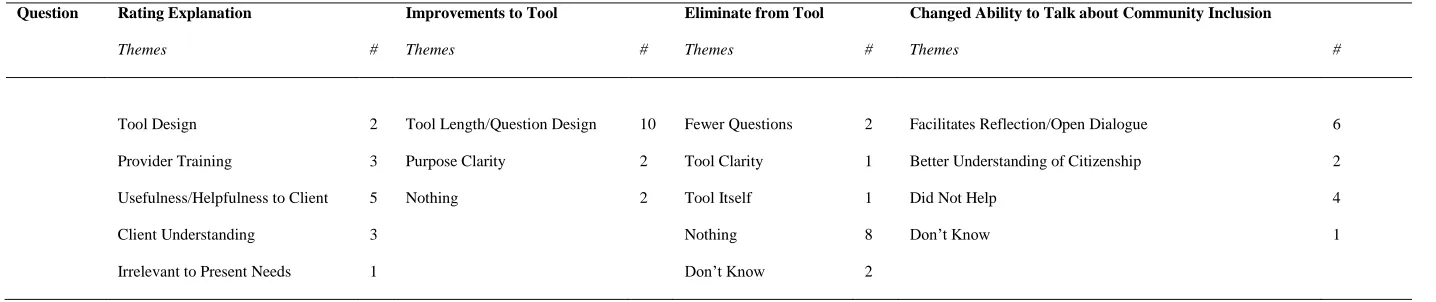
Quantitative responses to the tool itself were markedly average. On a scale of one to five, the average rating of the tool was 3.18, a trend that repeated itself in other responses with a slight favorability lean. As an example, on a scale of one to seven (in which seven was extremely likely), case managers reported an average score of four in their likelihood to recommend the tool to colleagues. The one response item that elicited a more negative response was related to the length of the tool (mean=3.13). This response repeated itself in qualitative responses. The main areas of value case managers reported the tool’s usefulness included assisting them in providing specific ideas that can be implemented into practice (n=5), helping case managers to do a better job (n=6), and enhancing levels of engagement with clients (n=7). Many case
managers also reported the tool provided clients with better knowledge and understanding upon which to base their own actions (n=8).
Open-ended Responses
While the participants generally provided mid-range ratings of the tool, they provided substantive feedback regarding the tool’s design and utility.
[Insert Table 1 around here]
noted that the tool’s drawbacks were directly linked to the client’s resource needs. This case manager indicated that the client was more interested in focusing on housing needs during their meeting than the tool. Another case manager similarly highlighted that she felt limited by her lack of training since “the questions gave the client insight on changes that she can make,” but without greater depth of understanding she felt unsure of how to “follow up as a support to the client other than making referrals.”
In line with the case manager’s feedback regarding client insight, eight of the respondents shared that the tool helped to facilitate reflection and open dialogue with their clients and helped facilitate a better understand of citizenship. This benefit of the tool was highlighted when
reporting what they liked most about the tool. One case manager commented on the tool’s utility in helping the client “in self-awareness and [encouraging] independence and self-sufficiency.” Another case manager noted that the tool “allowed the client to reflect.” Case managers also indicated that tool’s utility was contingent on clients’ cognitive abilities. One case manager said that while the tool was helpful, “the client was unable to answer the questions without guidance.” Another case manager noted that the questions were “hard for the client to understand.” Overall, though, the providers reported that they most liked that the tool helped to facilitate open
dialogue, provider thinking, and client thinking. One case manager mentioned that using the tool facilitated more open discussions because the case manager can now “reflect with the client on her answers.” Similarly, another case manager said that the tool initiates conversations about “planning day to day life, when out into the community to help manage their abilities and
strengths, also following rules and how to be more responsible.” Generally, the providers saw the tool as clinical assistance for community integration.
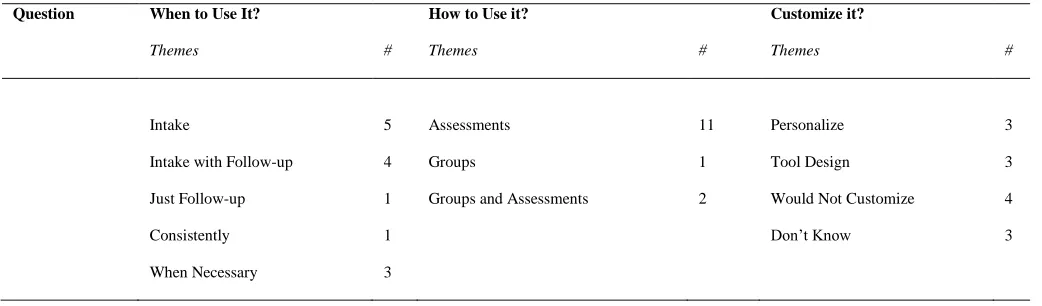
that they felt the tool was most appropriate for intake assessments (some also suggested using it during follow-up meetings as well).
[Insert Table 2 around here]
A couple respondents suggested using the tool during groups. Again, though, they suggested addressing tool design, whether through personalization or question reduction, as a necessary modification before further dissemination. One case manager encouraged including examples so that it could be “better relatable to the clients.”
Discussion
Despite the average review of the tool and criticisms of tool length and practical design elements, case managers who tested the tool with clients and responded to the survey reported a surge in open dialogue and reflection. This was apparent both in survey responses and open-ended responses and suggests that even in its earliest iteration, the tool provides utility in
enhancing knowledge and ideally critical thinking of community for clients and providers in the mental health and criminal justice systems. Nonetheless, the case managers provided critical feedback regarding tool modifications and enhancements. Much of what they reported hinged on tool clarity and design. They desired more instruction on when and how to use the tool. The large majority agreed the tool was better used as an intake or assessment measure, particularly as a way to inform treatment planning and service plans. That said, some suggested it had utility in group settings.
framework in diverse clinical settings. The framework draws on co-construction of citizenship narratives in the sense that citizenship is a universal concept, shared by providers and clients. Both providers and clients experience both the extent and the limits of the 5 R’s in their everyday lives. The universality of citizenship also means the tool can potentiate increased empathy as providers gain an understanding of their own citizenship experiences through applying the tool to their lives.
The 5 R’s of citizenship resonated for case managers and clients across a number of service areas in a variety of programs, including supportive housing, DCF-involved families, criminal justice, behavioral health, and foster care. The framework is particularly useful for clients in mandated or involuntary services, who feel that they have little or no choice or voice over what is happening to them, because it can help to frame an empowering discussion of rights that extend beyond engagement in mandated services. This discussion enables case managers to teach clients how to be their own advocates for their constructed outcomes. Discussion of the 5R’s through the citizenship tool has the potential to align funder, program and client goals in a way that makes clients active participants in their own treatment that extends beyond the clinic doors. Regardless of the restrictive nature of the environment, there is still the opportunity for choice, collaboration, and accepting responsibility. From the perspective of citizenship, the goal of case management is really for clients to live life on their own terms - a life that is rich in mutually supportive relationships, roles and vocations that are meaningful, and the resources to sustain it.
Implications and Future Directions U.S. Context
by the case managers. This will involve 1) development of a guide on how to use the tool that incorporates training vignettes; 2) simplification of the language and decreased redundancy of questions so that clients can self-administer the tool; 3) reformatting the tool so it is user friendly to all providers, peer supporters, and clients; and finally, 4) reevaluation of the tool with clients and providers/peer supporters in order to measure its effectiveness in assisting clients towards more citizenship oriented aspirations.
International Context
An additional aspect of the work involves examining the extent to which the tool can be transferred to other contexts and cultures. Colleagues in Scotland are in the early stages of developing their own citizenship measure, the results of which will be translated into a tool to be piloted by social care providers and the service users that they work with. Replicating the earlier stages of the process (Rowe, 2015), focus groups have been carried out with five groups of people with experience of a range of life disruptions including mental health conditions, experience of the criminal justice and probation system and long-term health conditions. In addition, two focus groups were conducted with people who did not identify as having
experienced life disruptions in the previous five years. Analysis of the data gathered during these focus groups is ongoing however, a number of similar themes to those identified by Rowe and colleagues earlier have emerged.
to play in supporting people to make connections and to undertake valued social roles, however there are also likely to be a number of challenges for workers, similar to those described by the case managers, such as resource and budget constraints and the increasingly strict eligibility criteria imposed by Local Authorities to manage this which means that often the ability to do preventative work is undermined (Stewart & MacIntyre, 2013). This is not to suggest that
creative and imaginative practice does not exist, but rather that staff require support to undertake this work.
Conclusion
Too often mental health services are narrowly conceptualized by focusing on symptom reduction and other clinical outcomes including stable housing or sobriety. Incorporating a citizenship tool into direct service provision helps case managers to understand their work as helping individuals to achieve life goals rather than just treatment goals; to perceive individuals in their broader ecological systems and as more than just patients or clients. Utilizing the
citizenship tool empowers case managers to see individuals as more than their mental illnesses or criminal justice histories and provides a guide for discussion regarding other areas of
individuals’ lives. The tool emphasizes individuals’ potential for connection to others, their communities, and other social institutions. With this new perspective, case managers can help individuals discover and develop new identities, new roles, new relationships, and opportunities to meaningfully contribute to society. These endeavors not only promote a sense of recovery and wellness, but a sense of wholeness as an individual. A citizenship framework allows for
References
Brekke, J. S., Ell, K., & Palinkas, L.A. (2007). Translational science at the National Institute of Mental Health: Can social work take its rightful place? Research on Social Work Practice, 17(1), 123-133.
Brownson, R. C., Kreuter, M. W., Arrington, B. A., & True, W. R. (2006). Translating Scientific Discoveries into Public Health Action: How Can Schools of Public Health Move Us Forward? Public Health Reports, 121(1), 97–103.
Committee on Quality of Health Care in America (2001). Crossing the quality chasm: a new health system for the 21st century. Washington, DC: Institute of Medicine; National Academies Press.
Damschroder, L. J., Aron, D. C., Keith, R. E., Kirsh, S. R., Alexander, J. A., & Lowery, J. C.
(2009). Fostering implementation of health services research findings into practice: a
consolidated framework for advancing implementation science. Implementation science,
4(1), 50. Available at:
https://implementationscience.biomedcentral.com/articles/10.1186/1748-5908-4-50.
Farquhar, J. W. (1995). The case for dissemination research in health promotion and disease
prevention. Canadian Journal of Public Health= Revue canadienne de sante publique,
87, S44-9.
Israel, B. A., Eng, E., Schulz, A. J., Parker, E. A. (2005). Introduction to methods in community-based participatory research for health. In: Israel, B. A., Eng, E., Schulz, A. J, Parker, E. A., editors. Methods in community-based participatory research for health (3-26). San Francisco: Jossey-Bass.
Community Building: Perspectives from Health Education and Social Work. In M. Minkler (Ed.), Community organizing and community building for health and welfare (37-58). New Brunswick, NJ: Rutgers University Press.
O’Connell, M. J., Clayton, A., & Rowe, M. (2017). Reliability and Validity of a Newly
Developed Measure of Citizenship Among Persons with Mental Illnesses. Community Mental Health Journal, 53(3), 367–374.
Ponce, A. N., Clayton, A., Gambino, M., & Rowe, M. (2016). Social and clinical dimensions of
citizenship from the mental health-care provider perspective. Psychiatric Rehabilitation Journal, 39(2), 161-166.
Rakfeldt, J., Sledge, W. H., Bailey, M. A. & Anderson, C. (1996). A Two-Tiered Approach to Case Management. Continuum: Developments in Ambulatory Mental Health Care, 3(1), 45-57.
Rowe, M. (1999). Crossing the border: Encounters between homeless people and outreach workers. Berkeley, CA: University of California Press.
Rowe, M. (2015). Citizenship and mental health. New York, NY: Oxford University Press.
Rowe, M., Benedict, P., Sells, D., Dinzeo, T., Garvin, C., Schwab, L., ... & Bellamy, C. (2009).
Citizenship, community, and recovery: A group-and peer-based intervention for persons
with co-occurring disorders and criminal justice histories. Journal of Groups in Addiction & Recovery, 4(4), 224-244.
Rowe, M., Clayton, A., Benedict, P., Bellamy, C., Antunes, K., Miller, R, … O’Connell, M. J. (2012). Going to the source: Creating a citizenship outcome measure by community-based participatory research methods. Psychiatric Services, 63, 445-450.
Rowe, M., Kloos, B., Chinman, M., Davidson, L., & Cross, A. B. (2001). Homelessness, mental illness, and citizenship. Social Policy and Administration, 35, 14–31.
Stewart, A., & MacIntyre, G. (2013). Care management in the twenty-first century: Persistent
challenges in implementation in the context of the emergence of self-care. Journal of Integrated Care, 21(2), 91-104.
Sledge, W. H., Astrachan, B., Thompson, K., Rakfeldt, J., & Leaf, P. (1995). Case management in psychiatry: an analysis of tasks. American Journal of Psychiatry, 152(9), 1259-1265. Wallerstein, N., & Duran, B. (2010). Community-based participatory research contributions to
Question Rating Explanation Improvements to Tool Eliminate from Tool Changed Ability to Talk about Community Inclusion
Themes # Themes # Themes # Themes #
Tool Design 2 Tool Length/Question Design 10 Fewer Questions 2 Facilitates Reflection/Open Dialogue 6
Provider Training 3 Purpose Clarity 2 Tool Clarity 1 Better Understanding of Citizenship 2
Usefulness/Helpfulness to Client 5 Nothing 2 Tool Itself 1 Did Not Help 4
Client Understanding 3 Nothing 8 Don’t Know 1
[image:18.792.69.787.126.277.2]Question When to Use It? How to Use it? Customize it?
Themes # Themes # Themes #
Intake 5 Assessments 11 Personalize 3
Intake with Follow-up 4 Groups 1 Tool Design 3
Just Follow-up 1 Groups and Assessments 2 Would Not Customize 4
Consistently 1 Don’t Know 3
[image:19.612.71.592.98.251.2]Appendix A: Citizenship Measure – 12 Items (Ponce, Clayton, Gambino, & Rowe, 2016)
1. You have responsibilities to others? (Responsibilities)
2. You have knowledge about your community (e.g., knowledge about current events, policies, services, social events, etc.)? (Resources)
3. Your personal decisions and choices are respected? (Rights, Responsibilities, Roles) 4. You have or would have access to jobs? (Resources)
5. You are connected to others? (Relationships, Responsibilities)
6. You are a part of something greater than yourself? (Roles, Responsibilities, Relationships)
7. You have freedom of worship? (Rights)
8. You have the right to protect yourself and others? (Rights, Roles, Relationships) 9. You have been or would be given second chances? (Roles)
10.You take care of family, friends, children, or pets? (Responsibilities, Roles) 11.You are free from discrimination? (Rights)
Appendix B: Citizens Tool – Engaging in Dialogue on Citizens Citizenship…
As we move towards becoming the persons we want to be, we can think of Citizenship as a process of becoming whole people that feel a sense of belonging and connection with ourselves and with our families, friends, communities, and the world.
We all are citizens. Enhancing our sense of and actual citizenship can only make us all better humans. Some understand this as the 5 Rs.
Rights…
Knowing our rights and how to navigate and negotiate in life is important in or order to attain a sense of full citizenship. Many people who have had struggles in life may feel their rights were stripped away at some point. Some of us take our rights for granted and some of us do not know our rights (such as our rights as tenants, our rights as patients, as our rights as voters, our rights as consumers of products, our rights as humans). Knowing, embracing and standing up for your rights empowers you as a citizen, and is important for becoming a healthy, contributing member of a society.
What rights do you have?
What rights are important to you in your life?
Have you felt that your rights have been taken away and if so which ones?
How might you learn about or regain a sense of feeling like you have rights that should be respected and honored as any other citizen?
Name three rights that you want to learn about and ways in which these rights can change the way you look at life.
Roles…
We all have roles. We have roles at home, at work, and in our communities. These roles are sometimes as simple as being a member of a church or as complex as being the parent of a child. What are some of the roles you have now?
What roles would you like to have in the next year? What would it take for you to obtain those roles? What could do?
What might others do to assist you in getting other roles? Responsibilities…
With each of our roles comes a set of responsibilities. For many people having responsibilities gives them something to look forward to every day, something to be accountable to, whether that is to the self or another person.
What are some of your responsibilities to yourself? How are you responsible to others?
Name 3 things that you would like to work on in the next year to gain or show more responsibility for yourself or others?
Resources…
Having resources can come in many forms, whether the resources are people we know or things we need.
Name three resources that you do have and why those resources are important to you. How do you look for new resources that you might need?
Name three resources that you might need to help you in the next year? Why do you need those resources? How might you obtain those resources?
Relationships…
Relationship with ourselves depends so much on how we are able to relate to others in society. We sometimes have relationships that may have gone sour or we might not feel like we can depend on relationships because of bad experiences in our lives.
Name three relationships that are important to you and why.
What might get in the way of you developing relationships with new people, with family members, with old friends, with clinicians, with others in the community?
Where and how do you create new relationships?
Are you currently doing anything to develop new relationships?
What would it take for you to develop new relationships or make old ones better? Belonging…
As people, we all have the need to belong to something outside of ourselves. What are places where you feel like you belong?
Are there places where you feel like you don’t belong and if so, what are those places? How do others let you know that you belong?
What does it feel like when you think you don’t belong? How do you feel when you feel like you belong?
Do you feel like you belong? Why or why not?
These questions are followed by: Summary/Priority Notes and a Citizens Aspirations Priority List
Summary/Priority Notes
Please list the R’s as identified by the individual completing the tool and then have the individual rate the level of control by asking: “Using a scale of 1 to 5, how much of this is in my control versus someone else’s?”
Citizens Aspirations Priority List
resources. This conversation also involved your citizenship and those things that you want for your life outside of the mental health center or this program. Now, let’s take a look at some of those things you mentioned. Let’s call them aspirations, things you aspire to be or to do. [After reviewing aspirations with individual….] You listed several aspirations; Let’s place some below that you want to achieve in the next 3-6 months. A table is provided with 4 columns with the following headings:
1). List Aspirations
2). To reach this aspiration, what role will you take in doing this? What do you need to do? 3). What role (if any) do you need others to take? Also, identify the person? (peer, friend, family, pastor, etc.)