City, University of London Institutional Repository
Citation
:
Spooner, A., Aitken, L. M. and Chaboyer, W. (2018). Implementation of an evidence-based practice nursing handover tool in intensive care using the knowledge-to-action framework. Worldviews on Evidence-Based Nursing, 15(2), pp. 88-96. doi:10.1111/wvn.12276
This is the accepted version of the paper.
This version of the publication may differ from the final published
version.
Permanent repository link: http://openaccess.city.ac.uk/19190/
Link to published version
:
http://dx.doi.org/10.1111/wvn.12276Copyright and reuse:
City Research Online aims to make research
outputs of City, University of London available to a wider audience.
Copyright and Moral Rights remain with the author(s) and/or copyright
holders. URLs from City Research Online may be freely distributed and
linked to.
City Research Online: http://openaccess.city.ac.uk/ [email protected]
Page 1 of 24 Descriptive title:
Implementation of an evidence-based practice nursing handover tool in intensive care using the knowledge-to-action framework.
Short title:
Implementation of an evidence-based practice nursing handover tool
Amy J. Spooner
RN, BN, Grad Dip ICU, PhD (Candidate), Nurse Researcher, Adult Intensive Care Services, The Prince Charles Hospital, Chermside, Australia. School of Nursing and Midwifery, Griffith University, Nathan, Australia.
0423 594 310, [email protected]
Leanne M. Aitken
IC Cert, B HSc (Nurs) Hons, Grad Cert Mgt, Grad Dip Sc Med (Clin Epi), PhD,
FACN, FAAN, Professor of Critical Care, National Centre of Research Excellence in Nursing (NCREN), Menzies Health Institute Queensland and School of Nursing and Midwifery, Griffith University, Nathan, Australia. Intensive Care Unit, Princess
Alexandra Hospital, Woolloongabba, Australia. School of Health Sciences, City, University of London, London, United Kingdom. +44 (0) 20 704 05968,
Wendy Chaboyer
Page 2 of 24 Griffith University, Gold Coast, Australia. (07) 5552 8518,
Corresponding author at:
Amy Spooner
Nursing and Midwifery Research Centre, Royal Brisbane and Women’s Hospital
Page 3 of 24 ABSTRACT
Background
Miscommunication during handover has been linked to adverse patient events and is an international patient safety priority. Despite the development of handover
resources, standardised handover tools for nursing team leaders in intensive care are limited.
Aims
The study aim was to implement and evaluate an evidence-based electronic
minimum dataset for nursing team leader shift-to-shift handover in the intensive care unit using the knowledge-to-action framework.
Methods
This study was conducted in a 21-bed medical/surgical intensive care unit in Queensland, Australia. Senior registered nurses involved in team leader handover were recruited. Three phases of the knowledge-to-action framework (select, tailor and implement interventions, monitor knowledge use and evaluate outcomes) guided the implementation and evaluation process. A post-implementation practice audit and survey were carried out to determine nursing team leader use and perceptions of the electronic minimum dataset three months after implementation. Results are presented using descriptive statistics (median, IQR, frequency and percentage). Results
Overall (86%, n=49), team leaders used the electronic minimum dataset for
Page 4 of 24 positively than team leaders giving handover (n=35). Benefits to using the electronic minimum dataset included the patient content (48%), suitability for short-stay
patients (16%), decreased time updating (12%) and printing the tool (12%). Almost half of the participants however, found the minimum dataset contained irrelevant information, reported difficulties navigating and locating relevant information and pertinent information was missing. Suggestions for improvement focused on modifications to the electronic handover interface.
Linking evidence to action
Prior to developing and implementing electronic handover tools, adequate
infrastructure is required to support knowledge translation and ensure clinician and organisational needs are met.
Page 5 of 24 INTRODUCTION
Until recently, there have been limited resources available to support nursing handover in the intensive care unit (ICU). Clinical handover is a top five preventable safety issue worldwide leading to adverse patient events and unnecessary healthcare expenditure (Starmer et al., 2013). Although research outlining various aspects of ICU handover is growing, there are limited standardised tools applicable to nursing team leader (TL) handover.
ICU nursing TLs oversee nurses at the bedside and are responsible for coordinating and managing care for multiple critically ill patients with complex healthcare needs. TLs rely on informative handovers to maintain care continuity following shift changes and play a pivotal role in ensuring ICU patients receive optimal care. Our previous work identified the content required in nursing TL handovers and informed the development of an electronic minimum dataset (eMDS) for shift-to-shift handover (Spooner, Aitken, Corley, & Chaboyer, 2017). Recently, electronic handover tools have received attention as a possible strategy to improve communication and reduce handover related incidents (Balka, Tolar, Coates, & Whitehouse, 2013; Staggers, Clark, Blaz, & Kapsandoy, 2011). Many health care areas have developed electronic templates that auto-populate content from multiple sources within the clinical
Page 6 of 24 The integration of evidenced-based strategies into practice, such as an eMDS for nursing TL handover can be challenging. Knowledge translation frameworks provide a structured and systematic approach to translate knowledge into practice, which promotes and sustains practice change (Davison, Ndumbe-Eyoh, & Clement, 2015; Field, Booth, Ilott, & Gerrish, 2014). The knowledge-to-action (KTA) framework is one of the most frequently cited conceptual frameworks used in healthcare settings to support researchers and clinicians implement evidence-base practice (Field et al., 2014). The framework incorporates existing change theories from health, social sciences, education and management fields to provide user-friendly action phases to consider during the knowledge translation process which was utilised in this
Page 7 of 24 Utilising the KTA framework, the study aim was to implement and evaluate an eMDS for ICU nursing TL shift-to-shift handover. This research sought to answer three questions:
1. What strategies should be used to implement an eMDS for handover? 2. To what extent did TLs use an eMDS for handover?
3. What were TL’s perceptions of an eMDS for handover?
METHODS
This study was conducted between January and June 2016 in a 21-bed adult medical/surgical ICU, specialising in cardiothoracic surgery at a tertiary referral hospital, in Queensland, Australia. Ethical approval was obtained by the institutional (HREC/10/QPCH/5) and university (NRS/09/13) Human Research Ethics Committee.
Setting
The ICU consists of three areas (ICU 1-cardiac surgical, 2 and 3–general); each area containing up to nine patients coordinated by one TL. There are 180 registered nurses employed in the ICU including 63 senior registered nurses working in TL roles. Handovers occurred at the nurses’ station within each area.
Participants
All nursing TLs were invited to participate. All TLs worked across the three ICU areas. Potential participants were told about the study at staff meetings. Written consent was obtained prior to study commencement and confirmed during data collection.
Page 8 of 24 An eMDS was built within the MetaVision (iMDsoft®, 2017) CIS over a 6-month period (June-December 2015) in collaboration with the on-site CIS coordinator and Hospital Health Service information technology department. The eMDS was structured using the ISBAR (Identify-Situation-Background-Assessment-Recommendation) mnemonic and additional content items considered pertinent to ICU nursing TL handover, identified in previous research (Spooner et al., 2017). Within the ‘Assessment’ category of the ISBAR mnemonic, TLs acknowledged and discussed significant detailed information within each body system (i.e., Respiratory system) to provide a thorough overview of the patient. For example, when TLs acknowledged the ‘social system’, information regarding family or care giver issues and needs were discussed. In addition to ISBAR, TLs mentioned alerts (allergies, infectious status, patient incidents) and patient management strategies (end-of-life plan, investigations). As TLs are also shift coordinators, they handed over managerial information regarding admissions, discharges, skill mix and theatre cases coming to ICU. An eMDS for each patient was generated and information was mostly auto-populated from multiple sources within the CIS. A free text box was provided with each eMDS to add additional information not included in the tool. Wi-Fi was unavailable during the study period; therefore, smart devices were not used. Instead, an eMDS for each patient was printed from the CIS to facilitate bedside handover.
Data collection
The Action cycle from the KTA framework guided knowledge translation. Phase four, five and six informed the implementation and evaluation process for this research.
Page 9 of 24 Our previous work identified the barriers and facilitators to eMDS use (Spooner, Aitken, & Chaboyer, In press). Barriers consisted of knowledge deficits regarding the ICU handover work unit guideline and an eMDS that was not user friendly, time consuming and contained too much information. Facilitators included TL familiarity with most work unit guidelines and a user-friendly eMDS that saves timed and contained relevant information. These findings informed four strategies selected to implement the eMDS into ICU. The investigators selected Interventions from recent systematic reviews and multiple strategies were utilised due to the cumulative and significant effect shown to promote practice change (Effective practice and
organisation of care, 2016; Grimshaw, Eccles, Lavis, Hill, & Squires, 2012). First, 30-minute interactive education sessions were used to target knowledge deficits. A video focused on safety issues, the national handover standard, the ICU handover work unit guideline, handover resources and real-life handover scenarios to critique. TLs were also given hands on training using the eMDS (Russell, Cornello, & Wright, 2007). Second, a small group of TLs and nursing management were recruited as ‘champions’ to be the driving force of change through developing positive
Page 10 of 24 handover. Consistent with the feedback intervention theory, a behavioural change theory, TLs were given feedback regarding their use of the eMDS and goals were set to redirect their focus of attention during handover to promote behaviour change and efficient use of the eMDS (Kluger & DeNisi, 1996). The research nurse also assisted staff with troubleshooting issues and gained feedback about the eMDS which
informed modifications to the tool electronic interface to ensure the eMDS was user friendly and efficient to navigate. This strategy relied on participant involvement to facilitate optimal use of the handover tool.
Phase 5: Monitor knowledge use
Three-months post eMDS implementation, 49 handovers were audited over 25 days (Monday-Friday) to determine the extent of TL use of the eMDS during handover. A random number generator sampled one TL per handover from the three ICU areas during the night-to-day (0700-0730hrs) and day-to-night shift (1900-1930hrs) handover. Handovers were observed if the oncoming and outgoing nurse provided consent to participate and had not been previously observed handing over. Nurses were observed once giving handover and any number of times receiving handover. The audit tool contained three sections 1) demographics, 2) general handover information and 3) adherence to the ISBAR mnemonic and other key content items (Spooner et al., 2017). The audit criteria were either met or not met.
Page 11 of 24 inter-rater reliability was established (≥ 80% agreement) between three auditors and then data collection commenced (Polit & Beck, 2012).
Phase six: Evaluation outcomes
A survey was distributed to all TLs (n=63) three months-post eMDS implementation to assess their perceptions of using the eMDS for handover. Surveys were placed on the ICU central desk along with an opaque envelope to collect completed surveys each day for three weeks. Email reminders were sent each week. The ‘Clinical Handover Staff Survey’ (O'Connell, Macdonald, & Kelly, 2008), widely used in handover research, was adapted to the ICU setting and consisted of four sections: 1) demographics, 2) TL perceptions of handover (25-items), 3) perceived strengths and limitations of handover and 4) suggestions for improvement. TLs were asked to rate their perceptions related to a series of statements on a 7-point Likert scale ranging from’ Strongly Disagree’ to ‘Strongly Agree’ and each item was given a score from 1 to 7. Nurses answered open ended questions relating to the strengths and limitations of the eMDS and made suggestions for improvement.
Although the survey tool has been previously assessed for face validity, the tool underwent further scrutiny by four expert nurses (two ICU nurses, a PhD student and PhD supervisor). During Phase 5 face validity (readability, understandability,
relevance, ease of response) and content validity (clarity, consistency and content) were assessed using a 2-point scale with ‘Clear’ or ‘Unclear’/‘Yes’ or ‘No’ responses (Imle & Atwood, 1988). Although the initial content validity index was more than 0.8 (clarity:0.89, consistency:0.89 and content:1.0 Scale-Content Validity
Page 12 of 24 achieved (Polit & Beck, 2012). The survey tool was pilot tested at two different time points by eight TLs in the ICU to establish test-retest reliability (83% of nursing TLs had perfect agreement or 1-point difference in responses at two time points).
Data analysis
Descriptive statistics were used to summarise data from the post
eMDS-implementation audit and survey. Data are presented as median, interquartile range, frequency and percentage. Responses to open ended questions and the frequency of recurring responses are summarised.
RESULTS
Phase 5: Monitor knowledge use
[image:14.595.73.426.93.524.2]
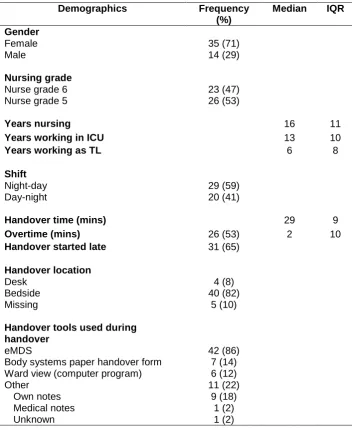
Page 13 of 24 Table 1 Post-implementation observation participant characteristics(n=49)
Demographics Frequency (%)
Median IQR
Gender Female Male 35 (71) 14 (29) Nursing grade
Nurse grade 6 Nurse grade 5
23 (47) 26 (53)
Years nursing 16 11
Years working in ICU 13 10
Years working as TL 6 8
Shift Night-day Day-night
29 (59) 20 (41)
Handover time (mins) 29 9
Overtime (mins) 26 (53) 2 10
Handover started late 31 (65)
Handover location Desk Bedside Missing 4 (8) 40 (82) 5 (10)
Handover tools used during handover
eMDS
Body systems paper handover form Ward view (computer program) Other Own notes Medical notes Unknown 42 (86) 7 (14) 6 (12) 11 (22) 9 (18) 1 (2) 1 (2)
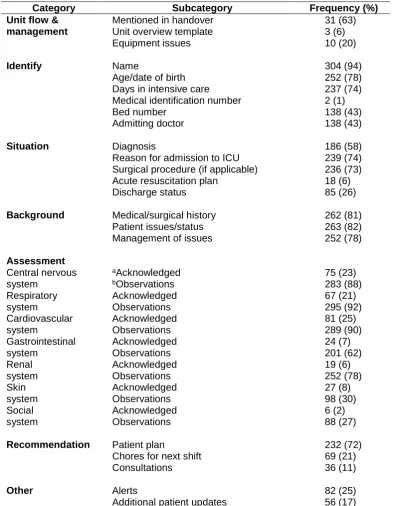
Page 14 of 24 resuscitation plans in the Situation category. Patient plan within the
[image:15.595.71.466.146.653.2]Recommendations category was the only item routinely discussed during handovers. Table 2 TLs’ use of the eMDS for handover (n=49)
Category Subcategory Frequency (%)
Unit flow & management
Mentioned in handover Unit overview template Equipment issues
31 (63) 3 (6) 10 (20)
Identify Name
Age/date of birth Days in intensive care Medical identification number Bed number Admitting doctor 304 (94) 252 (78) 237 (74) 2 (1) 138 (43) 138 (43)
Situation Diagnosis
Reason for admission to ICU Surgical procedure (if applicable) Acute resuscitation plan
Discharge status 186 (58) 239 (74) 236 (73) 18 (6) 85 (26)
Background Medical/surgical history Patient issues/status Management of issues
262 (81) 263 (82) 252 (78) Assessment Central nervous system Respiratory system Cardiovascular system Gastrointestinal system Renal system Skin system Social system aAcknowledged bObservations Acknowledged Observations Acknowledged Observations Acknowledged Observations Acknowledged Observations Acknowledged Observations Acknowledged Observations 75 (23) 283 (88) 67 (21) 295 (92) 81 (25) 289 (90) 24 (7) 201 (62) 19 (6) 252 (78) 27 (8) 98 (30) 6 (2) 88 (27)
Recommendation Patient plan
Chores for next shift Consultations
232 (72) 69 (21) 36 (11)
Other Alerts
Additional patient updates
82 (25) 56 (17)
aAcknowledged - stated the body system before discussing observations
Page 15 of 24 Phase six: Evaluation outcomes
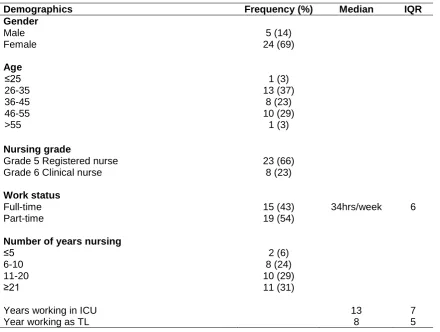
[image:16.595.74.515.200.532.2]Three months following eMDS implementation 35 (56%) nursing TLs completed a survey assessing their perceptions of the eMDS (Table 3). Most respondents were female and had extensive ICU experience.
Table 3 Post-implementation survey respondent characteristics (n=35)
Demographics Frequency (%) Median IQR
Gender Male Female 5 (14) 24 (69) Age ≤25 26-35 36-45 46-55 >55 1 (3) 13 (37) 8 (23) 10 (29) 1 (3) Nursing grade
Grade 5 Registered nurse Grade 6 Clinical nurse
23 (66) 8 (23) Work status Full-time Part-time 15 (43) 19 (54)
34hrs/week 6
Number of years nursing ≤5 6-10 11-20 ≥21 2 (6) 8 (24) 10 (29) 11 (31)
Years working in ICU 13 7
Year working as TL 8 5
[image:17.595.72.528.103.487.2]
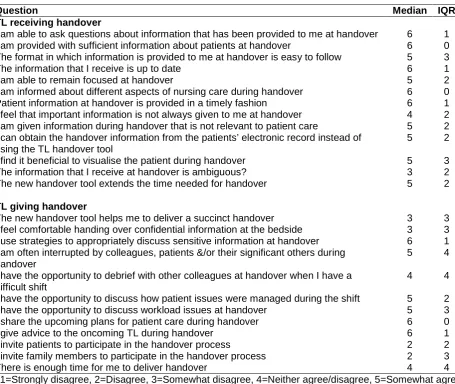
Page 16 of 24 Table 4 TL perceptions of an eMDS for handover (n=35)
Question Median IQR
TL receiving handover
I am able to ask questions about information that has been provided to me at handover 6 1
I am provided with sufficient information about patients at handover 6 0
The format in which information is provided to me at handover is easy to follow 5 3
The information that I receive is up to date 6 1
I am able to remain focused at handover 5 2
I am informed about different aspects of nursing care during handover 6 0
Patient information at handover is provided in a timely fashion 6 1
I feel that important information is not always given to me at handover 4 2
I am given information during handover that is not relevant to patient care 5 2
I can obtain the handover information from the patients’ electronic record instead of using the TL handover tool
5 2
I find it beneficial to visualise the patient during handover 5 3
The information that I receive at handover is ambiguous? 3 2
The new handover tool extends the time needed for handover 5 2
TL giving handover
The new handover tool helps me to deliver a succinct handover 3 3
I feel comfortable handing over confidential information at the bedside 3 3
I use strategies to appropriately discuss sensitive information at handover 6 1
I am often interrupted by colleagues, patients &/or their significant others during handover
5 4
I have the opportunity to debrief with other colleagues at handover when I have a difficult shift
4 4
I have the opportunity to discuss how patient issues were managed during the shift 5 2
I have the opportunity to discuss workload issues at handover 5 3
I share the upcoming plans for patient care during handover 6 0
I give advice to the oncoming TL during handover 6 1
I invite patients to participate in the handover process 2 2
I invite family members to participate in the handover process 2 3
There is enough time for me to deliver handover 4 4
1=Strongly disagree, 2=Disagree, 3=Somewhat disagree, 4=Neither agree/disagree, 5=Somewhat agree, 6=Agree, 7=Strongly agree
TLs described advantages and disadvantages to using the eMDS and suggested improvements. Responses provided three or more times by TLs are reported. Seventy-one percent (n=35) of respondents surveyed described the advantages to be content (48%), suitability for short-term patients (16%), saves time (12%) and easy to print (12%).
Page 17 of 24 populated into the tool. In addition, TLs found the eMDS time consuming (37%), difficult to print (23%), the eMDS relied on medical notes that were often not documented and missing and six (20%) nurses continued to write their handover notes.
Although several strategies were recommended, the most common related to the lay out of the eMDS (24%), using the body systems to structure the tool (14%),
incorporating the typed weekly medical summary (14%) and reporting trends in data such as vital signs rather than a snapshot at one point in time (14%).
DISCUSSION
Our study examined the implementation and evaluation of an evidence-based eMDS for ICU nursing TL shift-to-shift handover using the KTA framework. Participants were experienced ICU nurses. Multiple implementation strategies (education,
champions, reminders, ad hoc audit and feedback) were employed to overcome the barriers and complement the facilitators identified in previous literature.
Three-months post implementation most TLs used the eMDS to conduct handover however key content items were absent and additional documentation was used alongside the eMDS. Nurses receiving handover had more positive perceptions of the eMDS than nurses giving handover and open-ended questions revealed numerous
disadvantages relating to the electronic capability of the tool and suggestions for improvement were aimed at modifying the handover interface.
Page 18 of 24 translating research into practice), it is also a determinant framework (identifies the barriers and facilitators to implementation outcomes) that provides an
implementation process that proceeds in a step-wise linear fashion (Nilsen, 2015). The implementation process however, is a multifaceted and complex phenomenon and the KTA has been criticised for being too generic, providing limited support during the implementation process.
Although some improvements were seen in nursing TL handover, our findings indicate that there were multiple shortcomings with the implementation of an eMDS in the ICU. In addition to using the KTA to structure the project, strategies informed by other theoretical approaches may have provided the researchers with additional support to resolve unanticipated problems, thereby optimising the knowledge translation process. The incorporation of strategies based on behavioural theories such as the COM-B (Capability, Opportunity, Motivation and Behaviour) which
focuses on altering components of the behaviour system to promote change (Michie, van Stralen, & West, 2011) or the Transformation theory whereby clinicians learn how their experiences, perceptions and values lead to subsequent actions by using critical reflection and discourse (Matthew-Maich, Ploeg, Jack, & Dobbins, 2010) may have been a beneficial adjunct. Addressing emotions, attitudes and beliefs toward an intervention may have motivated nurses to embrace and sustain a new handover procedure.
Page 19 of 24 updated the electronic record (e.g. admission notes) or because the CIS was unable to integrate information (x-ray and magnetic resonance imaging results) from
external sources. A survey conducted by the Healthcare Information and
Management Systems Society reported that more than 90% of hospitals used six or more types of medical devices/databases and approximately a third integrated them with one another or the electronic medical record (Healthcare information and
management systems society, 2010). Furthermore, nurses were forced to print the eMDS for each patient as Wi-Fi was unavailable to accommodate portable devices. Nurses reported delays of up to two hours to upload and print eMDSs. Similar
findings were identified in an examination of the use of an electronic handover tool to improve doctors’ weekend patient handovers (Govier & Medcalf, 2012).
Page 20 of 24 include patient and family educational needs as this was conveyed by the bedside nurse. TLs discussed educational needs if related to managerial issues.
Recommendations for practice
Several key considerations for the development of electronic handover tools within CISs were identified in this study. Despite close collaboration between the
researchers and CIS coordinator to resolve issues with the handover interface, the infrastructure was inadequate to support the establishment of a handover tool that could meet end-user needs. Vendor support was critical to resolving the
technological issues however would have required additional funding that was not attainable or feasible for this research study. Similar issues were highlighted in Saleem et al’s study (2015) that evaluated commercial CIS for ICUs. The investigators suggested that efficient technical support is needed to positively support the application’s reliability and end-user satisfaction (Saleem et al., 2015). Purchasing regional CIS that contain local or on-site technological support may provide ongoing and timely assistance rather than enterprise level CISs, where
LINKING EVIDENCE TO ACTION
• Researchers and clinicians should consider using an overarching theoretical framework such as the KTA to embed knowledge into practice as it articulates a systematic approach.
• When implementing new practices, those leading the change should draw on multiples theories to challenge engrained attitudes and behaviours and to troubleshoot unanticipated issues which may assist to embed evidence-based practice into clinical settings.
• Prior to introducing evidence-based practices, healthcare settings need to ensure adequate infrastructure is in place to support and optimise the knowledge translation process.
Page 21 of 24 support is provided off-site, is either delayed or unavailable and frequently expensive to obtain.
When purchasing a CIS, organisations need to ensure that the system can integrate data from multiple sources, the architecture facilitates complex data mining and analysis (to make sense of patient data), incorporates a user friendly, visual display and an interface that will promote informed decisions about patient care and the delivery of quality care to patients (De Georgia et al., 2015). When developing and implementing electronic handover tools it is vital to work with a skilled information technology team to build a flexible interface that can be modified to accommodate user needs and meet national and local standards.
Limitations of the study
The study was conducted in one ICU therefore the results may not be generalizable but may be used to inform the development of electronic handover tools in other ICUs, especially given Australian ICUs are posited for wide spread use of
MetaVision. It is possible nurses may have changed their behaviour during observational audits of handover but several observations of nursing handovers have been conducted previously in the ICU for research and hospital-wide auditing and the investigators believe that nurses appeared comfortable being observed.
CONCLUSION
Our research examined the implementation and evaluation of an eMDS for nursing TL handover in the ICU. The KTA framework provided a structure to implement and evaluate an evidence-based eMDS for nursing TL shift-to-shift handover. The
Page 22 of 24 ICU. While interest in eMDSs is gaining momentum in healthcare facilities, adequate infrastructure is required prior to developing electronic interfaces in healthcare
settings. Electronic handover interfaces need to be flexible, modifiable, easy to navigate, contain content that promotes succinct and informative handovers of ICU patients to maintain continuity of care and improved patient outcomes.
ACKNOWLEDGEMENTS
The investigators would like to thank Mary Wheeldon, Leanne Parsons, Amanda Corley, Nicola Sharpe, Stephanie Dixon-Horler, Megan O’keefe, Allison Wallace, Barbara Taylor, Elena Hergott, Deepa Joy, India Lye, Daniel Mullany, Marc Ziegenfuss, medical and nursing staff from the ICU for their support, encouragement and participation in this project.
FUNDING
Page 23 of 24 REFERENCES
Balka, E., Tolar, M., Coates, S., & Whitehouse, S. (2013). Socio-technical issues and challenges in implementing safe patient handovers: insights from
ethnographic case studies. Int J Med Inform, 82(12), e345-357. doi:10.1016/j.ijmedinf.2012.11.001
Davison, C. M., Ndumbe-Eyoh, S., & Clement, C. (2015). Critical examination of knowledge to action models and implications for promoting health equity. Int J Equity Health, 14, 49. doi:10.1186/s12939-015-0178-7
De Georgia, M. A., Kaffashi, F., Jacono, F. J., & Loparo, K. A. (2015). Information technology in critical care: review of monitoring and data acquisition systems for patient care and research. ScientificWorldJournal, 2015, 727694.
doi:10.1155/2015/727694
Effective practice and organisation of care. (2016). The EPOC taxonomy of health systems interventions. Retrieved from https://epoc.cochrane.org/epoc-taxonomy
Field, B., Booth, A., Ilott, I., & Gerrish, K. (2014). Using the Knowledge to Action framework in practice: a citation analysis and systematic review. Implement Sci, 9, 172. doi:10.1186/s13012-014-0172-2
Govier, M., & Medcalf, P. (2012). Living for the weekend: electronic documentation improves patient handover. Clin Med (Lond), 12(2), 124-127.
Graham, I. D., Tetroe, J., & K. T. Theories Research Group. (2007). Some
theoretical underpinnings of knowledge translation. Acad Emerg Med, 14(11), 936-941. doi:10.1197/j.aem.2007.07.004
Grimshaw, J. M., Eccles, M. P., Lavis, J. N., Hill, S. J., & Squires, J. E. (2012). Knowledge translation of research findings. Implement Sci, 7, 50. doi:10.1186/1748-5908-7-50
Healthcare information and management systems society. (2010). Medical devices landscape: current and future adoption, integration with EMRs and
connectivity. Retrieved from Chicago:
iMDsoft®. (2017). Your clinical cockpit for intensive care. Retrieved from
http://www.imd-soft.com/products/intensive-care
Imle, M. A., & Atwood, J. R. (1988). Retaining qualitative validity while gaining quantitative reliability and validity: development of the Transition to Parenthood Concerns Scale. ANS Adv Nurs Sci, 11(1), 61-75. Kluger, A. N., & DeNisi, A. (1996). The effects of feedback interventions on
performance: a historical review, a meta-analysis, and a preliminary feedback intervention theory. Psychological Bulletin, 119, 254-284.
Li, P., Ali, S., Tang, C., Ghali, W. A., & Stelfox, H. T. (2013). Review of computerized physician handoff tools for improving the quality of patient care. J Hosp Med, 8(8), 456-463. doi:10.1002/jhm.1988
Lockwood, C., Stephenson, M., Lizarondo, L., van Den Hoek, J., & Harrison, M. (2016). Evidence implementation: Development of an online methodology from the knowledge-to-action model of knowledge translation. Int J Nurs Pract, 22(4), 322-329. doi:10.1111/ijn.12469
Page 24 of 24 Michie, S., van Stralen, M. M., & West, R. (2011). The behaviour change wheel: a
new method for characterising and designing behaviour change interventions. Implement Sci, 6, 42. doi:10.1186/1748-5908-6-42
Nilsen, P. (2015). Making sense of implementation theories, models and frameworks. Implement Sci, 10, 53. doi:10.1186/s13012-015-0242-0 O'Connell, B., Macdonald, K., & Kelly, C. (2008). Nursing handover: it's time for a
change. Contemp Nurse, 30(1), 2-11.
Polit, D. F., & Beck, C. T. (2012). Nursing research: Generating and assessing evidence for nursing practice (9th ed.). Philadelphia: Lippincott Williams & Wilkins.
Ryan, S., O'Riordan, J. M., Tierney, S., Conlon, K. C., & Ridgway, P. F. (2011). Impact of a new electronic handover system in surgery. Int J Surg, 9(3), 217-220. doi:10.1016/j.ijsu.2010.11.012
Saleem, J. J., Plew, W. R., Speir, R. C., Herout, J., Wilck, N. R., Ryan, D. M., . . . Phillips, T. (2015). Understanding barriers and facilitators to the use of Clinical Information Systems for intensive care units and Anesthesia Record Keeping: A rapid ethnography. Int J Med Inform, 84(7), 500-511.
doi:10.1016/j.ijmedinf.2015.03.006
Silvester, B. V., & Carr, S. J. (2009). A shared electronic health record: lessons from the coalface. Med J Aust, 190(11 Suppl), S113-116.
Spooner, A. J., Aitken, L. M., & Chaboyer, W. (In press). Barriers and facilitators to the implementation of an evidence-based electronic minimum dataset for nursing team leader handover: A survey. Aust Crit Car J.
Spooner, A. J., Aitken, L. M., Corley, A., & Chaboyer, W. (2017). Developing a minimum dataset for nursing team leader handover in the intensive care unit: A focus group study. Aust Crit Care. doi:10.1016/j.aucc.2017.01.005
Staggers, N., Clark, L., Blaz, J. W., & Kapsandoy, S. (2011). Why patient summaries in electronic health records do not provide the cognitive support necessary for nurses' handoffs on medical and surgical units: insights from interviews and observations. Health Informatics J, 17(3), 209-223.
doi:10.1177/1460458211405809
Starmer, A. J., Sectish, T. C., Simon, D. W., Keohane, C., McSweeney, M. E., Chung, E. Y., . . . Landrigan, C. P. (2013). Rates of medical errors and preventable adverse events among hospitalized children following