0022-538X/85/120743-07$02.00/0
Copyright
©1985,
American
Society
for Microbiology
Two
Independent Mutations Are Required for
Temperature-Sensitive Cell Transformation by
a
Rous
Sarcoma
Virus
Temperature-Sensitive
Mutant
MAKOTO
NISHIZAWA,' BRUCE J. MAYER,- TATSUO TAKEYA,3 TADASHI YAMAMOTO,' KUMAO
TOYOSHIMA,' HIDESABURO HANAFUSA,2
AND SADAAKIKAWAI1*
Inistitlite ofMedi(cal Science, University of Tokyo, Minato-ki, Tokyo 108, Jaipan'1; The Roclkefeller Universitv, Newt York,
News York
100212;
anid Inistitite
for
Cheiiical
Resear(ch, Kvoto
University,
Uji,
Kvoto
611,
Jaipaln3
Received 24April1985/Accepted 26 July 1985
We molecularly cloned the src coding region of tsNY68, a mutant of Rous sarcoma virus temperature
sensitive (ts) for transformation, and constructed a series of ts wild-type recombinant src genes. DNA containing the hybrid genes wastransfected into chickencellstogetherwithviral vector DNA andhelper viral DNA, and infectious transforming viruses were recovered. Characterization of these recombinant viruses indicated thatatleasttwomutationsarepresentinthe 3' halfof themutantsrcgene,bothofwhicharerequired forts. Nucleotide sequenceanalysis revealedthree differences inthededuced amino acidsequencecompared with the parental virus. Two of these changes, a deletion of amino acids 352 to 354 and an amino acid substitution atposition 461, areresponsible for the tsphenotype.
Thesn-c gene
of
thehighly oncogenic
avianretrovirus Rous sarcomavirus (RSV) encodes
atyrosine-specific protein
kinase, p60"''
(2, 5). The carboxy-terminal domain
of theprotein
ishighly
conservedamongthe
sn--relatedoncogenes and otherprotein
kinases,
whereas the amino terminuscontains
sequencesrequired
for membrane association(1,
23,
24). Association
of theprotein
with theplasma
mem-brane appearstoberequired
for transformation(7, 22,
35b).
Many
mutantsof
RSV temperature sensitive(ts)
fortransformation
havebeen isolated(16,
26, 28, 46).
tsNY68 is one of the mostwidely
used of these strains. Focusforma-tion
andsoft
agarcolony formation
of infectedchicken
embryo
fibroblasts(CEF)
aregreatly
reduced at thenonpermissive
temperature(41°C), generally
less than10-3
of that at
37°C.
Thephenotype
ofinfected cells israpidly
reversible aftertemperature shift in either direction
(16).
The mechanism of ts of tsNY68 is unknown. It was
reported
that,
intsNY68-infected
cells maintained at the nonpermissive temperature,p60"'.r
is found almostexclu-sively
as a solublecytoplasmic
proteintightly
bound totwocytosolic
proteins,
p50andp90,
which havebeenimplicated
in transport of
wild-type
(wt) sncprotein
to theplasma
membrane
(3,
6,37;
see reference 21 for a review). The failure of tsNY68 totransform
CEF
at41°C
could beexplained by (i)
an amino-terminal mutationleading
to decreased membraneassociation, (ii)
decreased kinaseac-tivity,
or(iii)
achange
in protein structureresulting
in aberrantinteraction with
thep5O-p90 complex.
We
molecularly
cloned the tsNY68 genome and the srccoding
regionofTK-15,
avirus strainderived from tsNY68. Toidentify
the sites of mutation, we sequenced the ts snc gene and constructed chimeric genes with ts and wt sn-c sequences. Inaddition,
theavailability of
a cloned ts srcgenewill beuseful in studies oftransformation insystems in
which
viralinfection is
notpractical.
*Correspondingauthor.
MATERIALSAND METHODS
Cells and virus.
Endogenous
virus-free CEFwereprepared
aspreviously
described(11, 17). Some fertilized
eggs weresupplied 'hy
Nippon
Institute ofBiological Science, Tokyo,
Japan.
TK-15 is amutant of RSV defective inpackaging
its owngenomic RNA ascharacterizedpreviously (17, 20, 33).
This mutant contains the ts snc gene of itsparental
virus,
tsNY68.
Molecular
cloning.
The ts src gene derived from tsNY68 wascloned from
bothintegrated
TK-15proviral
DNA and tsNY68 viral circular DNA. Chickengenomic
DNA wasprepared
fromTK-15-infected
CEFby
sodiumdodecyl
sulfate-proteinase
K treatment andphenol
extraction.This
was
digested with
EcoRIand
fractionated by
agarosegel
electrophoresis. Fragments
ofapproximately 3.1
kilobases wererecovered
by glass powder adsorption (47), ligated
toXgtWES
A
KBEcoRI
arms, andpackaged
in vitro.Plaques
were screened with
the
sn-specific insert
of pPviilI-E(9).
The
insert was subcloned intopBR322,
and thisplasmid,
pTK15EB-2,
was used for restrictionmapping,
in vitrorecombination,
and sequenceanalysis.
Thecloning
and characterization of thefull-length
genomeof tsNY68 will be described elsewhere.Briefly,
tsNY68 viral circular DNA waspartially digested with
EcoRIand
cloned
intothe
EcoRI site ofXgtWES
A
XB,
a clonecontaining
the entire viral genome wasisolated,
and thebiological
activityof the insert wasconfirmed by transfection of CEF.
The3.1-kilobase
EcoRI Bfragment subcloned into
pBR322, p68-13-1,
was usedfor
sequencedetermination.Plasmid construction. Recombinant snc genes were con-structed from
pTK15EB-2
andpTT107
(45),
asubclone
of the wtSchmidt-Ruppin
A(New
York)
strain of RSV(SR-A[NY])
containing
the EcoRI Bfragment.
Theparental
plasmids
weredigested
withrestriction
endonucleases which cleavetxice in thesn-containing
insert(Stiil,
MliiI)
orwith EcoRIplus
enzymesrecognizing
asingle
site (HincII,HgiAI, BglI). Fragments
werepurified
by
agarosegel
elec-743
on November 10, 2019 by guest
http://jvi.asm.org/
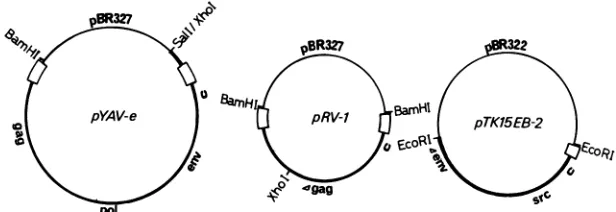
FIG. 1. Structuresof theplasmidsusedforthe transfectionassay.Bold linesrepresentvirally derivedsequences,and lighterlines indicate plasmidvector DNA.
trophoresis,
and
appropriate
ts
and wt
derived
fragments
were
ligated with T4 ligase to reconstruct hybrid src genes
(see
Fig.
2).
pICI-1
was
constructed
by exchanging
the
EcoRI-HgiAI
5'
fragment of the pB-2
insert with the
equiv-alent
fragment
of pS-2. pICI-2 was generated by ligation of
the
Stul
fragment of
pTK15EB-2
with
Stul-digested
pHg-2.
Transfection assay. We
developed a
transfection assay
system
todetermine the
biological activity of the hybrid
srcgenes.
The
plasmids
used
in this system are shown in
Fig.
1.pYAV-e
is
acomplete
helper virus clone
of Y73-associated
virus. This clone produces helper virus very efficiently on
transfection of CEF without restriction digestion.
pRV-1
is
aretroviral
vector
plasmid
containing all necessary
cis-acting
viral sequences, including the packaging signal, putative
dimer
linkage,
and
polypurine
tract
required for initiation
of
plus-strand viral
DNA
synthesis.
Uncut
pYAV-e,
XhoI-digested
pRV-1, and
EcoRI-digested hybrid
srcplasmid
were
combined in equal molar ratio, and 1
p.g
of the mix was
transfected
onto
CEF
in a60-mm
dish by
the
dimethyl
sulfoxide
and
polycation
method described
previously (18).
As
indicated by Miller
and Temin (30), transfected cells
mediate
ligation of physically
unlinked DNAs at
high
fre-quency.
We
expected that
afraction of the src-containing
EcoRI
fragments
would
ligate
to
the XhoI site
of
pRV-1
in an
appropriate orientation
so
that
the src gene would be
tran-scribed into viral
genomic
RNA. In
that case,
transforming
virus
would be recovered as
areplication-defective
virus
inthe
presence
of
helper YAV virus. However,
welater found
that,
evenin the
absence of
pRV-1
plasmid,
infectious
transforming virus
could
be recovered,
although
at alower
efficiency. Analysis of
the
virus thus recovered
suggested
that
pYAV-e
recombined
with the
EcoRI
fragment
topro-duce
areplication-competent transforming virus,
possibly
mediated
by
homologous sequences present in both DNAs.
Therefore,
the
transforming
viruses
recovered from
the
transfected
cultures and used for determination of
tsof the
recombinant
srcgenes
would be
amixture
of
replication-defective and
replication-competent
viruses. The
structuresof the recovered
viruses,
efficiency of
viral recovery
of
this
system,
and
construction of
pYAV-e and pRV-1 will be
published
elsewhere. The titer of the recovered viruses
wasassayed
at37
and
41°C.
DNA
sequence analysis.
The
entire
srccoding
regions of
pTK15EB-2
and
p68-13-1
weresequenced
by
the
Sanger
dideoxy
method with M13
mp8,
mpl8,
and
mpl9
ascloning-sequencing
vectors(29).
RESULTS
Sequences required
for ts.We
did
notdetect any
differ-ences
between the restriction maps of the
tsand
wt srcclones
(data
notshown);
this indicates that the lesions
involved in ts are small
alterations. This is in agreement with
the results of
previous studies on
tsNY68-infected cells,
which showed that the apparent molecular weight of the
mutant
src gene
product in sodium
dodecyl
sulfate-polyacrylamide gels after
immunoprecipitation with
tumor-bearing rabbit
serumis
indistinguishable
from that of wt
RSV.
To
define the
regions
of the gene
responsible
for the
tsphenotype,
weconstructed
aseries of
plasmids in which
fragments of the pTK15EB-2 insert were substituted with the
corresponding
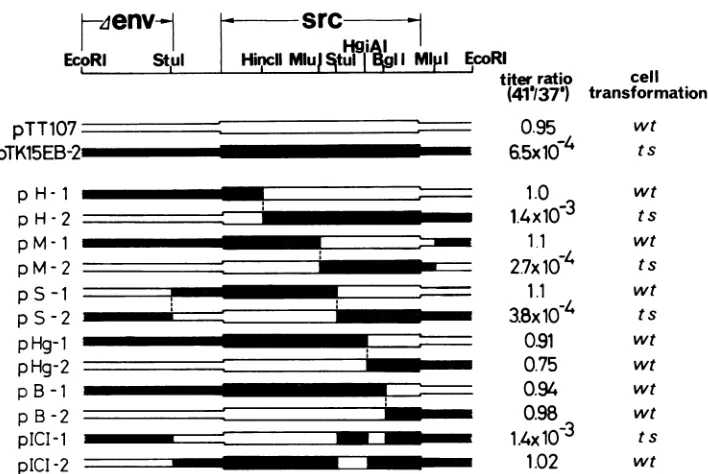
wtfragments from pTT107. Figure 2
summa-rizes the
plasmids
constructed in the present study.
Transfection of CEF with the
src-containing EcoRI B
fragment (which contains no promoter)
induces
transforma-tion
at avery low
frequency. In addition, the
morphology
of
transfectants
varies, probably owing to
differences in the
level
of src
transcription.
Therefore,
to test
the transforming
activity of the chimeric
srcgenes, we
developed
a
conve-nient
transfection system which results in the
production of
infectious
transforming viruses.
Recombinant src-containing
plasmids were
transfected
onto
CEF together with complete
helper
virus DNA and retroviral vector sequences, and
infectious
transforming viruses containing
the
chimeric
srcgenes
wereproduced.
Viruses collected from
plasmid-transfected cultures
wereassayed for focus formation
onCEF
atthe
permissive
and
nonpermissive
temperatures.
Transfection
with
src-containing
EcoRI
fragments
derived
from
wtand
ts mutantRSV
(pTT107 and pTK15EB-2)
reproducibly produced
wtand
tstransforming viruses,
re-spectively,
indicating
that
this system is useful
for
testing
the
ts
of
recombinant
srcgene
products (Fig.
2).
Clones
pH-1,
pM-1, and
pS-1 generated
wtviruses with similar
focus-forming
ability
at37 and
41°C, whereas the reciprocal
constructs
pH-2,
pM-2,
and
pS-2 generated
tstransforming
viruses. These results
indicate
that the
mutations
responsi-ble
for
tsreside in the
carboxy-terminal
half
of
the
ts srcgene.
Unexpectedly,
the
reciprocal
ts-wt constructsex-changed
atthe
HgiAI
(pHg-1, pHg-2)
and
BglI
(pB-i,
pB-2)
sites all
generated
wttransforming viruses.
There
were nomorphological
differences
betweeen
cells
transformed
by
these
recombinant viruses and
wtRSV. To
confirm the
structures
of these four
plasmids,
wereconstructed the
original
ts srcsequence
from
pHg-1
and
pHg-2
and
from
pB-1 and pB-2. The
reconstructed
plasmids generated
tstransforming
viruses (not
shown).
These results
define
tworegions
of the
tssrcgene,
both
of
which
arerequired
for
ts.The
first is bounded
by
the
StuI and
HgiAI
sites,
and the
second extends
from the
BglI
site
tothe
carboxy
terminus.
This
wasconfirmed
by
the
construction
of
twoadditional
chimeric
plasmids, pICI-1
and
pICI-2.
Nucleotide
sequence
of the ts srcgene. The
nucleotide
sequence
of the tsNY68-derived
srcgene
wasdetermined
on November 10, 2019 by guest
http://jvi.asm.org/
[image:2.612.162.470.75.181.2][zenv '1
src
uHgil
EcoRI
Stul
Hincil
MluJ§tul
IMI
I EcoRi
titer
ratio cell(41
/37')
transformation
0.95
6.5x10⁴
wt ts
1.0
wt
1.4x1073
ts1.1
wt27x
4
ts
1.1
wt
3.8x
104
t
s0.91
wt
0.75
wt0.94
wt0.98
wt
.4x103
ts
1.02
wtFIG. 2. Construction ofhybridsrcgenesandtsoffocus-forming ability. Restriction sites usedinconstruction of theplasmidsareshown
atthetopof thefigure. Shaded portions werederived from the ts src subclonepTK15EB-2;open portions werederived from thewt src
subclone pTT107 (45). CEFweretransfected with EcoRIfragments containing the hybridsrcgenesin thepresenceofpRV-1 and pYAV-e DNAsby the polybrene and dimethyl sulfoxide method (18). Transfected cultureswereagaroverlaidtheday after transfection. Seven days later, theagar was removed and cultures weretransferred. Culture fluidswerecollected12days after transfection and wereusedtoinfect fresh CEFtomakefully transformed cultures. Stocks harvested from these fully transformed culturesweresubjectedtotitrationassayatthe permissive (37°C) and nonpermissive (41°C)temperatures. Titersofthese virus stocksrangedfrom 1 x 10⁵to1.5 x 106focus-forming units
permlat 37°C.
twice,
with twoindependently cloned
isolates of the gene(pTK15EB-15 and p68-13-1).
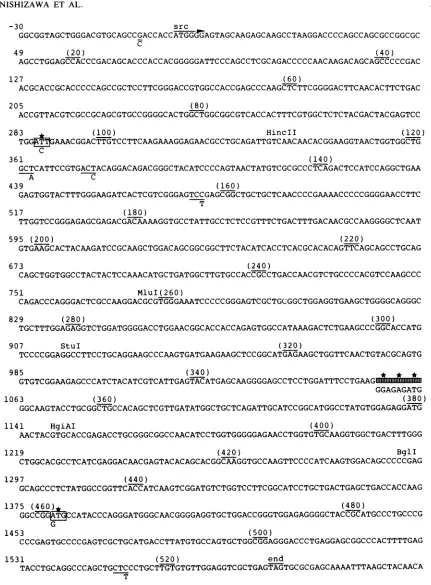
The entire sequence of the ts srccoding region
isshown
inFig.
3. The location of the translation initiation and termination codons ofwtp6Osr' arewell established (8, 38, 42). We found
acorresponding
openreading frame which
usesthe
sameinitiation and termination
codons.
Thenucleotide
sequences revealed adeletion
of ninebases and six
(pTKl5EB-2)
or seven(p68-13-1) point
mutations
inthe
tssrccoding region compared
with thewt. Inaddition,
several basesubstitutions
andafive-base inser-tion were found in thenoncoding flanking
sequences(not
shown). Of
thesemutations, only
the nine-basedeletion
andtwo
point
mutations affect the deduced amino acidsequenceof
p6O,rc.
Thefirst,
aC-to-Ttransversion,
would lead tothesubstitution of isoleucine for threonine
atamino acid
posi-tion 96.
However, since
thisposition
is 5' totheHincll site,
the in
vitro recombination experiments described above
demonstrated that this
mutation
is notinvolved
in ts.The
second
lesion
is adeletion of nine bases resulting in the
deletion of threeamino acid residues, Gly-Glu-Met,
atpositions
352 to354.
Thisposition
islocated between the
StuI and
HgiAI
sites. The thirdmutation
is aG-to-A base
change, resulting
in thesubstitution ofmethionine for valine
atposition
461. Thischange
islocated between the BglI site
and the
carboxyl
terminusof
the srccoding region. The
sequence of the two
independently isolated
ts src genes differedatonly
oneposition
withinthe coding region
(nucle-otide1371);
the deduced amino acidsequences wereidenti-cal.
DISCUSSION
In this
study
we reportthat twomutations in
theputative
tyrosine kinase domain
areessential for
thetsphenotype
of
RSV
mutanttsNY68.
Chimeric
src geneswhich contain
either of thetwomutations aloneareindistinguishable from
thewtintheirtransforming
activity, suggesting
that thetwomutations interact to
affect
protein
structure atthe
nonpermissive
temperature. Asimilar
phenomenon has been
observed in
hybrid
viral-cellularsrcgenes.C-src,
the cellu-larhomolog
of the viral src gene(v-src), contains
seven scattered amino acidchanges
compared with
v-srcand
a substitution of 19 aminoacids for the
carboxy-terminal 12
amino acids ofv-src
(43, 44).
Whenc-srcishighly expressed
in CEF it isnontransforming and has low kinase activity
(12-14). However, chimeric
genesinwhich the
c-srccoding
sequence is
replaced by
thehomologous
v-src sequence either upstream or downstream of theBgII
site have fulltransforming activity (12, 14).
Theobservation that elimina-tion of one of the two essential mutationsof tsNY68
is sufficient to restore the wtphenotype
issupported by
previous
recombinationexperiments
withtransformation-defective srcdeletionmutants
(15).
Itwasfound that tdlO8,
which retains 225 bases
of the 3'
srccoding
sequence(48), andtdlO9,
which retains296 basesof 3'
srcinformation (35),
couldgeneratetemperature-insensitive transforming viruses
when
coinfected
withtsNY68. Both of these
transformation-defective mutants would be able to
repair the downstream
but not theupstream
mutation of tsNY68 through
recombi-nation events. The
partial
tsphenotype of the recombinant
viruses between tsNY68
and
tdlO7 which
wasreported
previously (15)
could beexplained by
asecondary mutation
causedby
therecombination orpreexisting
in the transfor-mation-defective virus.It has been
reported
thatp6Osr(
intsNY68-infected cells is
found
primarily
in thecytoplasm
at41°C;
at thepermissive
temperature,however,
themajority
is localized on thepTT107
pTK15EB-2
p H -
1
p
H-2
p
M
-1
p
M
-2
BI
pS-1i
p
S-2
pHg-i
p
Hg-2
p
B -1
p
B
-2
pICI
-1
pICI
-2
9
---.r-I---ll%..
-1 5
-I
--7M
a
0
on November 10, 2019 by guest
http://jvi.asm.org/
[image:3.612.121.475.73.310.2]-30 src
GGCGGTAGCTGGGACGTGCAGCCGACCACCATGGtGAGTAGCAAGAGCAAGCCTAAGGACCCCAGCCAGCGCCGGCGC
49 (20) (40)
AGCCTGGAGCCACCCGACAGCACCCACCACGGGGGATTCCCAGCCTCGCAGACCCCCAACAAGACAGCAGCCCCCGAC
127 (60)
ACGCACCGCACCCCCAGCCGCTCCTTCGGGACCGTGGCCACCGAGCCCAAGCTCTTCGGGGACTTCAACACTTCTGAC
205 (80)
ACCGTTACGTCGCCGCAGCGTGCCGGGGCACTGGCTGGCGGCGTCACCACTTTCGTGGCTCTCTACGACTACGAGTCC
283 (100) HincII (120)
TGG
,AAACGGACTTGTCCTTCAAGAAAGGAGAACGCCTGCAGATTGTCAACAACACGGAAGGTAACTGGTGGCTG
C361 (140)
GCTCATTCCGTGACTACAGGACAGACGGGCTACATCCCCAGTAACTATGTCGCGCCCTCAGACTCCATCCAGGCTGAA
A C
439 (160)
GAGTGGTACTTTGGGAAGATCACTCGTCGGGAGTCCGAGCGGCTGCTGCTCAACCCCGAAAACCCCCGGGGAACCTTC T
517 (180)
TTGGTCCGGGAGAGCGAGACGACAAAAGGTGCCTATTGCCTCTCCGTTTCTGACTTTGACAACGCCAAGGGGCTCAAT
595 (200) (220)
GTGAAGCACTACAAGATCCGCAAGCTGGACAGCGGCGGCTTCTACATCACCTCACGCACACAGTTCAGCAGCCTGCAG
673 (240)
CAGCTGGTGGCCTACTACTCCAAACATGCTGATGGCTTGTGCCACCGCCTGACCAACGTCTGCCCCACGTCCAAGCCC
751 MluI(260)
CAGACCCAGGGACTCGCCAAGGACGCGTGGGAAATCCCCCGGGAGTCGCTGCGGCTGGAGGTGAAGCTGGGGCAGGGC
829 (280) (300)
TGCTTTGGAGAGGTCTGGATGGGGACCTGGAACGGCACCACCAGAGTGGCCATAAAGACTCTGAAGCCCGGCACCATG
907 StuI (320)
TCCCCGGAGGCCTTCCTGCAGGAAGCCCAAGTGATGAAGAAGCTCCGGCATGAGAAGCTGGTTCAACTGTACGCAGTG
985 (340)
GTGTCGGAAGAGCCCATCTACATCGTCATTGAGTACATGAGCAAGGGGAGCCTCCTGGATTTCCTGAAG
GGAGAGATG
1063 (360) (380)
GGCAAGTACCTGCGGCTGCCACAGCTCGTTGATATGGCTGCTCAGATTGCATCCGGCATGGCCTATGTGGAGAGGATG
1141 HgiAI (400)
AACTACGTGCACCGAGACCTGCGGGCGGCCAACATCCTGGTGGGGGAGAACCTGGTGTGCAAGGTGGCTGACTTTGGG
1219 (420) BglI
CTGGCACGCCTCATCGAGGACAACGAGTACACAGCACGGCAAGGTGCCAAGTTCCCCATCAAGTGGACAGCCCCCGAG
1297 (440)
GCAGCCCTCTATGGCCGGTTCACCATCAAGTCGGATGTCTGGTCCTTCGGCATCCTGCTGACTGAGCTGACCACCAAG
1375 (460)
(480)
GGCCG-G,C
CATACCCAGGGATGGGCAACGGGGAGGTGCTGGACCGGGTGGAGAGGGGCTACCGCATGCCCTGCCCG
G1453 (500)
CCCGAGTGCCCCGAGTCGCTGCATGACCTTATGTGCCAGTGCTGGCGGAGGGACCCTGAGGAGCGGCCCACTTTTGAG
1531 (520) end
TACCTGCAGGCCCAGCTGCTCCCTGCTTGTGTGTTGGAGGTCGCTGAGTAGTGCGCGAGCAAAATTTAAGCTACAACA
T
FIG. 3. Nucleotide sequence of thetsNY68-derivedsrcgene. Thenumberingof thenucleotides(leftendof eachline)oramino acids(in parentheses) beginswith thefirstnucleotide or amino acid of thesrccoding region.Thenucleotide sequence of thewtsrcgene of the New York strain of SR-A(42, 43) is shown under the sequence of thetssrcgeneonlywheretheydiffer. Asterisks mark amino aciddifferences.
The shaded boxindicates thenine-base-pairdeletionfound in thets srcgene.
plasma
membrane (3, 6, 10). Since membrane association
in tsNY68.
Although
wefound
asubstitution
atposition
96
in
has been correlated with
transforming activity, and since
thethe
amino-terminal
domain,
ourresults demonstrate that this
amino-terminal domain of the protein
isinvolved in
mem-mutation does
notaffect
thetransforming activity
of the
brane
binding (7,
22),
welooked for
anamino-terminal lesion
gene.It
should be noted that the
srcprotein
of the San
on November 10, 2019 by guest
http://jvi.asm.org/
[image:4.612.103.534.55.640.2]Francisco strain of
SR-A
[SR-A(SF)] contains isoleucine
at
position 96,
as
does tsNY68 (8). In
addition,
recent
results
indicate
that the
amino-terminal
14
amino acids
of
p60src
are
sufficient
for myristylation and membrane
association of a
hybrid
protein
(35a,
35b).
These
residues
are
identical
in
tsNY68
and
wt
RSV.
It
therefore
seems
unlikely
that the ts
membrane
association of
tsNY68 is due to
intrinsic inability
to
bind
to the membrane at
41°C.
Newly
synthesized
wt src
protein
is transiently complexed
with cellular proteins
p50
and
p90
before
association with the
plasma membrane (3, 6). At both the
permissive
and
nonpermissive temperatures, a larger proportion
of
p6Osrc
from
tsNY68-infected
cells
is found
in
this soluble complex
compared with
the wt. At
41°C, virtually all of
the ts src
protein is complexed with p50
and
p90
(3, 6). It
is possible
that the
two
essential mutations
of
tsNY68
affect
the
struc-ture
of
the
protein in
a
manner that renders the complex
much more stable than
in
the
case
of
wt
p6Osrc
,
especially
at
the
nonpermissive
temperature. The
site
of complex binding
is considered
to be
within the
carboxyl domain of the
src
protein, since antisera
raised against
the
carboxy terminus of
p60rc do
not
precipitate
the
complex
as
well as does
tumor-bearing rabbit
serum
(40), and in
vitro-constructed
src
(A) ts-src: Leu Lys mon mEw mmm Gly Lys
wt-src: (350) Leu Lys Gly Glu Met Gly Lys
yes: (634) Leu Lys Glu Gly Glu Gly Lys fgr: (487) Leu Lys Asp Gln Glu Gly Gln
ros: (341) Leu Arg GlyjGln Lys Phe Gln
Ala Arg Lys
fps: (1018) Leu Arg Ser Lys Gly Pro Arg
erbB: (222) Ile Arg Glu His Lys Asp Asn
abl: (446) Leu Arg Glu Cys Asn Arg Gln
(B) ts-src: Gly Arg Met Pro Tyr
wt-src: (459) Gly Arg Val Pro Tyr
yes: (743) Gly Arg Val Pro Tyr fgr: (696) Gly Arg Val Pro Tyr
ros: (462) Gly Gln Gln Pro Tyr fps: (1127) Gly Ala Val Pro Tyr
[image:5.612.49.284.336.647.2]erbB: (331) Gly Ser Lys Pro Tyr abl: (555) Gly Leu Asn Pro Tyr
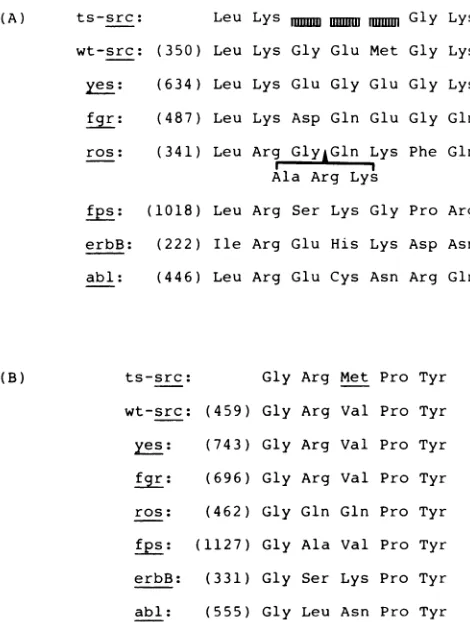
FIG. 4. Comparison of the amino acidsequences ofthe protein kinaseoncogenesin thevicinity of thetwocarboxy-terminal
muta-tions of thetsNY68-derived srcgene. Amino acidswerealignedto
give maximumhomology. In A, therosproteinsequencecontains aninsertion ofthree aminoacids; the shaded boxesrepresentamino acidsdeleted in thetssrcprotein. Amino acid numbersaregiven in parentheses. The deduced amino acid sequences are from the following references: src (42),yes(19), fgr (31), ros(32), fps (41),
erbB(49), and abl (36).
mutants
with
extensive amino-terminal deletions
have
been reported
to
associate transiently with
the
complex
(7).
In
addition, the fps and yes transforming proteins, which
contain tyrosine kinase domains homologous
to
that
of
src, have been
found associated with
p50 and p90 (27),
suggesting
that it
is
the
conserved kinase
domain
which is
recognized.
In
addition
to
its aberrant subcellular
localization,
the src
protein
of
tsNY68
has been
reported
to have
lower in
vitro
kinase
activity
(4, 10,
25, 39) and
to
be
more
thermolabile in
vitro (34) compared
with
the wt. The two
essential
mutations
we
have
defined are both within the conserved kinase
domain.
When
the
amino acid
sequences of the
conserved
domains
of
the
kinase
oncogene
products
are
compared, it
is
noticed that there are
variable,
not
strictly
conserved
amino
acids
as
well as
invariable, strictly
conserved
residues.
The
strictly conserved amino acids
may be
essential for
the
function
of
these
proteins. On the other hand, structural
changes
caused
by substitution
or
deletion
of the variable
amino acids
may
be nonlethal.
A
comparison of amino acid
sequences in the
vicinity of
the two
mutations
of
the tsNY68
src
gene
with the
corresponding regions of other kinase
oncogenes
(Fig. 4)
shows that the
deletion
(Fig.
4A)
and
substitution
(Fig. 4B)
occurred at
amino acids
which
are not
strictly conserved.
In
this
sense,
it
may not
be
surprising
that
both
mutations are
required for
ts;
either of
the two
alone
may not cause a
structural alteration
profound enough
to
bring
about a
change in
phenotypic expression of
the src
gene.
Since
kinase
activity
and
complex
binding both
map to the
same
region of
the
protein,
the
inability of
the src
protein of
tsNY68
to
transform
at
the
nonpermissive
temperature
could
therefore
be due to
either
decreased
kinase
activity
or
more
stable
binding
to
the
p50-p90 complex.
To
distinguish
be-tween
these
possibilities, analyses of
the
protein kinase
activity and
p50-p90
complex formation of
the
products of
the ts-wt
recombinant
srcgenes would
be
helpful.
ACKNOWLEDGMENTS
We thank H. Shinno for excellent technical assistance. Wealso
thank K. Chida, S.
Iguchi,
and T.IkedaforDNApreparation and valuable discussion.Thisresearch wassupported in partby agrant-in-aid forcancer
researchfromthe Ministry of Education,
Science,
andCulture of Japan and by Public Health Service grant CA14935 from theNational CancerInstitute toH.H.
LITERATURE CITED
1. Brugge, J.S., and D. Darrow. 1984. Analysis ofthe catalytic domain of
phosphotransferase
activity oftwo avian sarcomavirus-transforming proteins. J. Biol. Chem.259:4550-4557. 2. Brugge, J. S., and R. L. Erikson. 1977. Identification of a
transformation-specific antigen induced by an avian sarcoma
virus. Nature(London)269:346-348.
3. Brugge, J., W. Yonemoto, and D. Darrow. 1983. Interaction
between the Rous sarcoma virustransforming proteinandtwo cellularphosphoproteins: analysis oftheturnover and
distribu-tion of this complex.Mol. Cell. Biol. 3:9-19.
4. Collett, M.S., and R. L. Erikson. 1978. Protein kinaseactivity associated withtheaviansarcomavirussrcgeneproduct. Proc. Natl. Acad. Sci. USA 75:2021-2024.
5. Collett, M. S.,A. F. Purchio,and R. L. Erikson. 1980. Avian sarcoma virus-transforming protein,
pp60src
shows proteinkinase activity specific for tyrosine. Nature (London) 285: 167-169.
6. Courtneidge,S.A., andJ.M.Bishop.1982. Transit ofpp60srcto
on November 10, 2019 by guest
http://jvi.asm.org/
the plasma membrane. Proc. Natl. Acad. Sci. USA 79: 7117-7121.
7. Cross,F. R., E. A. Garber, D.Peliman, and H. Hanafusa. 1984. A short sequence in thep6Osrc N terminus is required for p60src myristylation and membrane association and for cell transfor-mation. Mol. Cell. Biol.4:1834-1842.
8. Czernilofsky, A. P., A. D. Levinson, H. E. Varmus, J. M. Bishop, E. Tischer,and H. Goodman. 1983. Corrections to the nucleotide sequence of the src gene of Rous sarcoma virus. Nature (London) 301:736-738.
9. DeLorbe, W. J., P. A. Luciw, H. M. Goodman, H. E. Varmus, and J. M. Bishop.1980. Molecular cloning andcharacterization
of avian sarcoma virus circular DNA molecules. J. Virol. 36:50-61.
10. Garber, E. A., J. G.Krueger, H. Hanafusa, andA. R. Goldberg. 1983.Temperature-sensitive membrane association ofpp60src in tsNY68-infected cells correlates with increased tyrosine phos-phorylation of membrane-associated proteins. Virology 126: 73-86.
11. Hanafusa, H. 1969. Rapid transformation of cells by Rous sarcoma virus. Proc. Natl. Acad. Sci. USA 63:318-325. 12. Hanafusa, H., H. Iba, T. Takeya, and F. R. Cross. 1984.
Transforming activity of the c-src gene, p. 1-7. In G. F. Vande Woude, A. J. Levin, W. C. Topp, and J. D. Watson (ed.), Cancer cells, vol. 2. Cold Spring Harbor Laboratory, Cold Spring Harbor, N.Y.
13. Iba, H., F. R. Cross, E. A. Garber, and H. Hanafusa. 1985. Low level of cellular protein phosphorylation by nontransforming
overproduced p60-src. Mol. Cell. Biol. 5:1058-1066.
14. Iba,H., T. Takeya, F. R. Cross, T. Hanafusa, and H. Hanafusa. 1984. Rous sarcoma virus variants that carry the cellular src gene instead of the viral src gene cannot transform chicken embryo fibroblasts. Proc. Natl. Acad. Sci. USA 81:4424-4428.
15. Kawai, S., P. H. Duesberg, and H. Hanafusa. 1977.
Transforma-tion-defective mutants of Rous sarcoma virus with src gene deletions of varying length. J. Virol. 24:910-914.
16. Kawai, S., and H. Hanafusa. 1971. The effects of reciprocal changes in temperature on the transformed state of cells in-fected with a Rous sarcoma virus mutant. Virology 46:470-479.
17. Kawai, S., and T. Koyama. 1984. Characterization of Rous sarcoma virus mutant defective in packagingits own genomic RNA:biological properties of mutant TK15 andmutant-induced
transformants. J. Virol. 51:147-153.
18. Kawai, S., and M. Nishizawa. 1984. New procedure for DNA transfection with polycation and dimethylsulfoxide. Mol. Cell.
Biol.4:1172-1174.
19. Kitamura, N., A. Kitamura, K. Toyoshima, Y. Hirayama, and M.Yoshida. 1982. Avian sarcomavirus Y73 genome sequence andstructural similarityofitstransforminggeneproductto that ofRous sarcoma virus. Nature (London) 297:205-208. 20. Koyama, T., F. Harada, and S. Kawai. 1984. Characterization of
aRous sarcoma virus mutant defective in packaging ofits own genomic RNA: biochemical properties of mutant TK15 and mutant-induced transformants. J. Virol. 51:154-162.
21. Krueger, J. G., E. A. Garber, and A. R. Goldberg. 1983. Subcellular localization of pp605s' in RSV-transformed cells. Curr. Top. Microbiol. Immunol. 107:51-124.
22. Krueger, J. G., E. A. Garber, A. R. Goldberg, and H. Hanafusa. 1982. Changes in amino-terminal sequences ofpp605'' lead to decreased membrane association and decreased in vivo tumorigenicity. Cell28:889-896.
23. Krueger, J. G., E. Wang, and A. R. Goldberg. 1980. Evidence that the src gene product of Rous sarcoma virus is membrane associated. Virology 101:25-40.
24. Levinson, A. D., S. A. Courtneidge, and J. M. Bishop. 1981. Structural and functional domains of the Rous sarcoma virus transforming protein (pp60Ws'). Proc. Natl. Acad. Sci. USA
78:1624-1628.
25. Levinson, A. D., H. Oppermann, L. Levintow, H. E. Varmus, and J. M. Bishop. 1978. Evidence that the transforming gene of aviansarcoma virus encodes a protein kinase associated with a
phosphoprotein. Cell 15:561-572.
26. Linial, M., and D. Blair. 1982. Genetics of retroviruses, p. 649-783. In R.Weiss, N. Teich, H. Varmus, and J. Coffin (ed.), RNA tumor viruses. Cold Spring Harbor Laboratory, Cold
Spring Harbor, N.Y.
27. Lipsich, L. A., J. R. Cutt, and J. S. Brugge. 1982.Association of the transforming proteins of Rous, Fujinami, and Y73 avian sarcomaviruses with the same two cellular proteins. Mol. Cell. Biol. 2:875-880.
28. Martin, G. S. 1970. Roussarcomavirus: afunction required for thetransformed state. Nature (London) 227:1021-1023. 29. Messing, J. 1983. New M13 vectors for cloning. Methods
Enzymol. 101:20-78.
30. Miller, C. K., and H. M. Temin. 1983.High-efficiency ligation
and recombination of DNA fragments by vertebrate cells. Science 220:606-609.
31. Naharro, G., K. C. Robbins, and E. P. Reddy. 1984. Gene product ofv-fgronc: hybrid proteincontaining a portion of actin and atyrosine-specific protein kinase. Science223:63-66. 32. Neckameyer, W. S., and L.-H. Wang. 1985. Nucleotide
se-quence of avian sarcoma virus UR2 and comparison of its transforming gene with othermembers of the tyrosine protein kinase oncogene family. J. Virol. 53:879-884.
33. Nishizawa, M., T. Koyama, and S. Kawai. 1985. Unusual features of the leader sequence of the Rous sarcoma virus packaging mutant, TK15. J.Virol. 55:881-885.
34. Owada, M., and K. Moelling. 1980. Temperature-sensitive
kinase activity associated with various mutants of avian sar-comaviruses which are temperature sensitive for transforma-tion. Virology 101:157-168.
35. Parvin, J. D., and L.-H. Wang. 1984. Mechanism for the
generation of src-deletion mutants and recovered sarcoma vi-ruses: identification of viral sequences involved in src deletions and in recombination with c-src sequences. Virology 138: 236-245.
35a.Pellman,D., E.A. Garber, F. R. Cross, and H. Hanafusa. 1985. AnN-terminal peptide fromp60src can directmyristylationand plasma membrane localization when fused to heterologous
proteins. Nature (London) 314:374-377.
35b.Pellman,D., E. A. Garber, F. R. Cross, and H. Hanafusa.1985.
Fine structural mapping of a critical NH2-terminal region of p6Osrc. Proc. Natl. Acad. Sci. USA 82:1623-1627.
36. Reddy, E. P., M. J. Smith, and A. Srinivasan. 1983.Nucleotide
sequence of Abelsonmurineleukemia virusgenome:structural
similarity of its transforming gene product to otheronc gene products with tyrosine specific kinase activity. Proc. Natl. Acad. Sci. USA80:3623-3627.
37. Rohrschneider, L. R. 1980. Adhesion plaques of Rous sarcoma virus-transformed cells contain the src gene product. Proc. NatI. Acad. Sci. USA 77:3514-3515.
38. Schwartz, D. E., R. Tizard, and W. Gilbert. 1983. Nucleotide sequenceofRous sarcomavirus. Cell 32:853-869.
39. Sefton, B. M., T. Hunter, and K.Beemon. 1980. Temperature-sensitive transformation by Rous sarcoma virus and tempera-ture-sensitive protein kinaseactivity. J. Virol. 33:220-229. 40. Sefton, B. M., and G. Walter. 1982. Antiserumspecificfor the
carboxy terminus of thetransforming protein of Rous sarcoma virus. J.Virol. 44:467-474.
41. Shibuya, M., and H. Hanafusa. 1982. Nucleotide sequence of Fujinami sarcoma virus: evolutionary relationshipof its trans-forminggene withtransforminggenesofothersarcomaviruses. Cell 30:787-795.
42. Takeya, T., R. A. Feldman, and H. Hanafusa. 1982. DNA sequence of the viral and cellular src gene of chickens 1.
Complete nucleotide sequence ofanEcoRIfragment of recov-ered avian sarcoma virus which codes forgp37and
pp6Osrc.
J. Virol. 44:1-11.43. Takeya, T., and H. Hanafusa. 1982. DNA sequence of the viral and cellular src geneof chickensII.Comparisonof thesrcgenes
of two strains of avian sarcoma virus and of the cellular homolog. J. Virol. 44:12-18.
44. Takeya, T., and H. Hanafusa. 1983. Structure andsequencing of
the cellular gene homologous to the RSV src gene and the
on November 10, 2019 by guest
http://jvi.asm.org/
mechanism for generating the transforming virus. Cell 32: 881-890.
45. Takeya, T., H. Hanafusa, R. P. Junghans, G. Ju, and A. M. Skalka. 1981.Comparison between the viral transforminggene
(src)ofrecovered aviansarcomavirus and itscellularhomolog.
Mol. Cell. Biol. 1:1024-1037.
46. Toyoshima, K., and P. K. Vogt. 1969. Temperature sensitive
mutantsofanaviansarcomavirus. Virology 39:930-931.
47. Vogelstein,B., andD.Gillespie. 1979.Preparative andanalytical
purificationof DNA fromagarose. Proc. Nat]. Acad. Sci. USA 76:615-619.
48. Wang, L.-H., B.Edelstein, and B.J. Mayer. 1984. Inductionof
tumors and generation of recovered sarcoma viruses by, and
mapping of deletions in, two molecularly cloned src deletion
mutants.J. Virol. 50:904-913.
49. Yamamoto,T., T. Nishida, N. Miyajima, S. Kawai,T.Ooi,and K.Toyoshima. 1983. The erbBgeneof avian erythroblastosis is
amember of thesrcgenefamily. Cell 35:71-78.