COMMISSION OF THE EUROPEAN COMMUNITIES
Brussels, 28.10.2009 SEC(2009) 1500 final
COMMISSION STAFF WORKING DOCUMENT
TABLE OF CONTENTS
1. Introduction ... 6
1.1. World Supply and Demand... 6
1.2. World Prices... 7
2. Coal in a European Context ... 7
2.1. European Overview... 7
2.2. Coal in the EU Strategic Energy Reviews ... 8
2.3. European Electricity Generation ... 8
2.4. Emissions of CO2 from Coal in the EU... 11
3. General Considerations ... 13
3.1. Reserves ... 13
3.2. Demand Drivers ... 16
3.3. Coal and Gas Prices ... 17
3.4. Emissions Trading... 18
3.5. Reservoir Levels for Hydro Generation... 18
3.6. Currencies ... 19
3.7. Coal Derivatives and Forward Prices for Steam Coal ... 21
3.8. Transport Infrastructure ... 22
3.9. Market Concentration ... 22
3.10. Steel Industry Developments ... 23
4. Hard Coal – Production and Consumption in the EU ... 24
4.1. EU Production Trends... 24
4.2. Consumption ... 26
5. Coke – Production and Consumption in the EU ... 26
5.1. EU Production Trends... 26
6. International Hard Coal and Coke Markets ... 27
6.1. Major Hard Coal Producers ... 27
6.2. Hard Coal Trade... 29
6.3. Steam Coal Trade... 30
6.4. Coking Coal Trade ... 30
6.5. Coke Trade ... 31
6.6. Imports to the EU ... 31
6.7. International Price Trends ... 32
6.10. Freight Considerations ... 36
7. Lignite and Peat – Production and Consumption... 37
7.1. World Context... 37
7.2. EU Production Trends... 37
7.3. Consumption ... 39
7.4. Peat Production ... 39
7.5. Oil Shale... 39
8. State aid to the indigenous hard coal industry in the EU ... 39
9. Conclusions ... 40
9.1. World Context... 40
9.2. European Context... 40
9.3. Coal in EU Electricity Generation ... 41
9.4. EU Reserves of Coal and Lignite... 41
9.5. EU Hard Coal Production and Consumption ... 41
9.6. World Hard Coal Trade... 41
9.7. EU Hard Coal Imports ... 41
9.8. International Coal Prices ... 41
Figures and Tables
Figure 1 - World Total Primary Energy Supply... 6
Figure 2 – EU Solid Fuel Supply in 2007 (Mtce) ... 7
Figure 3 – Electricity Generation by Fuel Source 2006... 9
Figure 4 – Electricity Generation Capacity Planned, Under Development, and Under Construction in the EU... 11
Figure 5 – CO2 Emissions from Combustion of Solid Fuels ... 11
Figure 6 - World Reserves of Coal... 13
Figure 7 – Europe’s Fossil Fuel Reserves Map... 16
Figure 8 - Coal and Gas Prices to UK Power Producers... 17
Figure 9 – EU ETS Carbon Prices ... 18
Figure 10 - Scandinavian Reservoir Levels – 2007 and 2008 (Percent) ... 19
Figure 11 - Exchange Rates for Key Currencies... 20
Figure 12 – Movements in Exchange Rates... 21
Figure 13 - Historic Spot and Forward Swap Prices... 22
Figure 14 – Growth in World Crude Steel Production... 23
Figure 15 – Top Ten World Steel Producers 2007... 24
Figure 16 - EU Hard Coal Production Trends... 25
Figure 17 – EU Consumption Trends for Hard Coal (Mt)... 26
Figure 18 – EU Coke Production Trends ... 27
Figure 19 – Hard Coal Seaborne Trade 2007... 29
Figure 20 - World Seaborne Hard Coal Trade ... 30
Figure 21 – EU Import Sources... 31
Figure 22 – EU Import Volumes by Member State ... 32
Figure 23 – North West Europe Steam Coal Prices ... 32
Figure 24 – Price of Steam Coal Imported from Third Countries ... 33
Figure 27 - Spot Sea Freight Rates... 36
Figure 28 – EU Lignite Production Trends ... 38
Table 1 – Electricity Generation by Fuel Source 2006 (TWh) ... 9
Table 2 – Emissions of CO2 in 2006 from Combustion of Solid Fuels ... 11
Table 3 – European Coal Reserves ... 15
Table 4 – Major World Hard Coal Producers ... 27
Table 5 – Price Trends in Coking Coal ... 34
Table 6 – Major World Lignite Producers ... 37
Table 7 – State Aid 2003-2008 - amounts actually granted by Member States... 40
Annexes Summary of EU-27 Data………. - 42 -
Supplies and Deliveries in the EU of Hard Coal, Coke and Lignite in 2006 and 2007...- 43 - This document has been produced using data provided by the Member States and observations from market participants up to August 2008. Where data has not been available, clearly indicated estimations have been made by the Commission services. Note that the data may differ from that of Eurostat.
1. INTRODUCTION
Article 7 paragraph (c) of the Council Regulation (EC) No 405/2003 of 27 February 2003 concerning Community monitoring of imports of hard coal originating in third countries, requires the Commission to report regularly and in an appropriate form on the market in solid fuels in the Community together with a market outlook. Following the enlargement of the EU on 1st January 2007, data has also been included for the two new member states for the preceding year. 1
1.1. World Supply and Demand
[image:6.595.123.509.296.527.2]In 2007 total world coal production (hard coal and lignite) increased by 5.6%. This was lower than the growth of 7.6% in 2006 but remains well above the 10-year average growth trend of 3.4%.2 The following graph illustrates the long term growth in coal demand compared to other energy sources.
Figure 1 - World Total Primary Energy Supply
World Total Primary Energy Supply
0 500 1000 1500 2000 2500 3000 3500 4000 4500 197 1
1973197 5
1977 19791981 1983198 5
1987 1989199119931995 19971999200120032005
M il li o n Ton ne s of O il E qui v a le n t
Coal Oil Natural gas Nuclear Hydro Comb. renew & waste
Source – IEA (2008)
Hard coal production in 2007 increased by 6.5% to 5,542 million tonnes (Mt), following an increase of 5.6% in 2006. Cumulative growth since 1995 is 52.0%. Brown coal and lignite production increased by 0.9% to 945 Mt in 2007, the same level of growth as in 2006, and remains just 2.0% above the 1995 production level. Updated analysis of proven coal and lignite reserve data indicates that, at current world production levels, there are approximately 157 years of reserves available.1
1
Total coal demand increased by 6.2%, or 272 million tonnes coal equivalent3 (Mtce) in 2007 following a four year trend of annual increases averaging 6.6%.
Global trade in hard coal also continued to grow in 2007, with hard coal exports up 6.0% (52 Mt) to 917 Mt following a 55 Mt increase in 2006. Steam coal exports in 2007 rose 4.2% to 670 Mt after 8.0% growth in 2006, whereas coking coal exports showed stronger growth of 10.9% to 247 Mt after lower growth of 3.2% in the previous year.
1.2. World Prices
During 2007 average CIF4 steam coal prices increased by 17.8% to $82.21/tonne in Europe, and by 12% to $70.92/tonne in Japan. This compared to 2006 when prices reduced by 2.1% in Europe and increased by just 1.0% in Japan. The majority of average steam coal FOB5 costs increased in 2007 when compared to 2006. Significant increases were 28.9% in Indonesia, 11.2% in Colombia and 11.0% in South Africa.
2. COAL IN A EUROPEAN CONTEXT
2.1. European Overview
Europe is the third largest region worldwide in terms of coal consumption, after China and the USA. In the European Union around sixty percent of consumption is derived from indigenous production, with 155 million tonnes of hard coal and 446 million tonnes of lignite6 produced in 2007. (Production figures expressed on a common basis of tonnes coal equivalent (tce) are 130 Mtce of hard coal and 134 Mtce of lignite). Coal covers around one sixth of the primary energy demands in the European Union; about 30% of power generation is based on coal.7
The chart below illustrates the contribution of indigenous hard coal and lignite, together with imported hard coal, to total EU solid fuel supply, all expressed in tonnes of coal equivalent.8
Figure 2 – EU Solid Fuel Supply in 2007 (Mtce)
3
IEA definition of 1 million tonne coal equivalent equals 0.7 tonnes oil equivalent, or 7 million kilocalories
4
Cost, insurance and freight
5
Free on board
6
For the purposes of the EU statistics in this report and the attached tables, lignite, brown coal and peat are grouped together and included in a single EU total. (Production of oil shale is not included in the solid fuel totals but figures are reported later in section 7.)
7
Source – Eurostat 2006 data
2.2. Coal in the EU Strategic Energy Reviews
In the first Strategic Energy Review the concept of the Energy Triangle was introduced, often described as a ‘trilemma', illustrated by the diagram below.
In the Second Strategic Energy Review, published in November 2008, the Commission stated that “All cost-effective measures that can be taken to promote the development and use of indigenous resources should form an important element of an EU Energy Security and Solidarity Action Plan”, and made the further comment about coal: “Coal remains an essential component of Europe's domestic energy supply and an important alternative to oil and gas. It is available in large quantities from numerous suppliers around the world, and it can be relatively easily stored. Coal-based electricity generation is growing in importance across much of the world and continued substantial use of coal and lignite in generation in Europe is projected.”
In its conclusions the EU Commission called on Parliament and Council to welcome, inter alia, “The Commission's intention to promote the environmentally-compatible development of the EU's indigenous fossil fuel resources and to encourage the Berlin Fossil Fuel Forum to develop a concrete set of recommendations regarding the action necessary to further this objective.”
2.3. European Electricity Generation
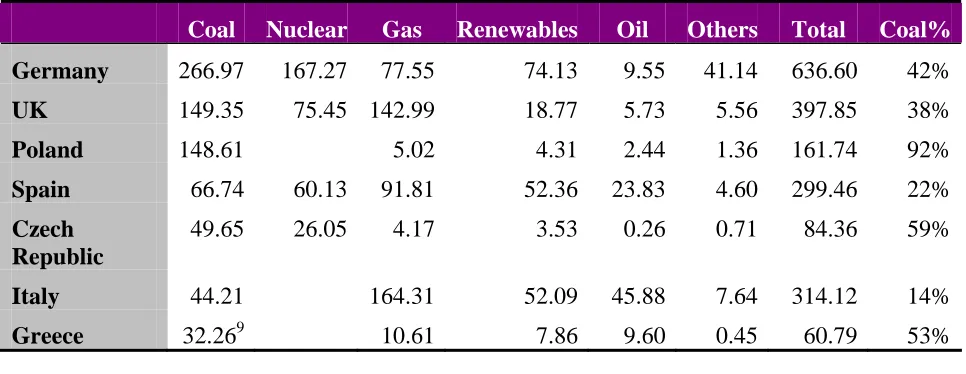
The use of coal in electricity generation varies widely across the EU member states. In Poland over 90% of electricity is generated from coal and lignite whereas in France 4% is generated from coal and 78% is nuclear (2006 data).
The use of coal and lignite in power generation in 2006, compared to other fuels, is illustrated by the following chart. This shows all the member states, ranked by their coal usage in electricity generation.
Figure 3 – Electricity Generation by Fuel Source 2006
Source - Eurostat
The corresponding figures and percentages are given in Table 1 below. Table 1 – Electricity Generation by Fuel Source 2006 (TWh)
Coal Nuclear Gas Renewables Oil Others Total Coal%
Germany 266.97 167.27 77.55 74.13 9.55 41.14 636.60 42%
UK 149.35 75.45 142.99 18.77 5.73 5.56 397.85 38%
Poland 148.61 5.02 4.31 2.44 1.36 161.74 92%
Spain 66.74 60.13 91.81 52.36 23.83 4.60 299.46 22%
Czech Republic
49.65 26.05 4.17 3.53 0.26 0.71 84.36 59%
Italy 44.21 164.31 52.09 45.88 7.64 314.12 14%
Greece 32.269 10.61 7.86 9.60 0.45 60.79 53%
[image:9.595.57.540.542.729.2]Romania 25.15 5.63 11.95 18.36 1.61 62.70 40%
Denmark 24.63 9.42 10.06 1.61 45.72 54%
Netherlands 23.74 3.47 59.43 9.51 2.10 0.15 98.39 24%
Finland 22.96 22.91 12.96 22.51 0.48 0.48 82.30 28%
France 22.89 450.19 25.28 63.79 7.13 5.28 574.56 4%
Bulgaria 19.08 19.49 2.28 4.26 0.38 0.35 45.84 42%
Portugal 14.96 12.34 16.02 5.25 0.48 49.04 31%
Estonia 8.79 0.78 0.13 0.03 9.73 90%
Ireland 8.02 13.91 2.47 2.71 0.37 27.48 29%
Hungary 7.00 13.46 13.25 1.59 0.52 0.04 35.86 20%
Austria 6.98 12.03 39.80 1.64 3.05 63.50 11%
Belgium 6.85 46.65 25.39 3.73 1.38 1.55 85.54 8%
Slovenia 5.44 5.55 0.37 3.70 0.05 0.01 15.12 36%
Slovakia 5.31 18.01 2.33 4.83 0.72 0.17 31.37 17%
Sweden 0.88 66.98 1.24 71.92 1.67 0.61 143.30 1%
Cyprus 4.65 4.65 0%
Latvia 2.10 2.79 0.01 4.89 0%
Lithuania 8.65 2.46 0.44 0.33 0.60 12.48 0%
Luxembourg 3.25 0.27 0.81 4.33 0%
Malta 2.30 2.30 0%
Total 960.47 989.89 707.23 489.23 131.86 75.41 3354.02 29%
Percentages 28.6% 29.5% 21.1% 14.6% 3.9% 2.2% 100.0% Source – Eurostat
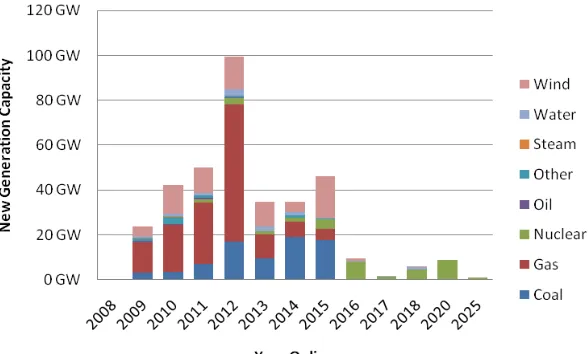
Figure 4 – Electricity Generation Capacity Planned, Under Development, and Under Construction in the EU
Source – Platts
2.4. Emissions of CO2 from Coal in the EU
The split in estimated emissions of CO2 in 2006 from combustion of coal, lignite and
[image:11.595.121.443.384.595.2]peat between EU member states is illustrated by the following chart10. Figure 5 – CO2 Emissions from Combustion of Solid Fuels
Source - IEA
Detailed figures are given in Table 2 below
Table 2 – Emissions of CO2 in 2006 from Combustion of Solid Fuels
Million Tonnes CO2 Total (Sectoral Approach) Electricity and Heat
Austria 15.4 5.7
Belgium 17.7 10.6
Bulgaria 28.4 23.2
Cyprus 0.1 0.0
Czech Republic 78.1 52.9
Denmark 21.6 20.6
Estonia 10.3 9.8
Finland 30.7 22.8
France 50.4 22.6
Germany 339.3 265.1
Greece 34.6 33.0
Hungary 12.4 9.0
Ireland 9.7 6.9
Italy 62.4 49.3
Latvia 0.3 0.0
Lithuania 1.1 0.0
Luxembourg 0.4 0.0
Malta 0.0 0.0
Netherlands 28.9 23.8
Poland 216.0 154.0
Portugal 13.0 12.9
Romania 36.5 26.9
Slovakia 16.2 6.0
Slovenia 6.0 5.5
Spain 66.6 57.9
Sweden 9.0 4.4
UK 157.6 128.6
Total 1,262.6 951.4
Source – IEA CO2 Emissions from Fuel Combustion 2008 Edition
The IEA calculates total CO2 emissions both by the ‘sectoral approach’ based on
consumption in each sector and by the reference approach based on overall national fuel balances. The figures given here are from the sectoral approach; the chart above is based on the total of all the sectors whereas Table 2 also gives emissions from the electricity and heat sector.
On this basis, total EU emissions of CO2 from combustion of solid fuels in 2006
3. GENERAL CONSIDERATIONS
3.1. Reserves
[image:13.595.114.462.257.615.2]Europe possesses substantial reserves of coal and lignite, which represent around 80% of Europe’s fossil fuel reserves. There are a number of different ways of assessing these deposits, but whichever way the assessment is carried out, the figures are substantial. The World Energy Council11 gives estimates of proven recoverable reserves in Europe (at the end of 2005) of around 30 billion tonnes (Bt), including around 8.5 Bt hard coal and 21.5 Bt lignite (including sub-bituminous coal). The German Federal Institute for Geosciences and Natural Resources (BGR), which uses different classifications, gives reserves12 of 18 Bt and resources13 of 476 Bt of hard coal, and reserves of 53 Bt and resources of 99 Bt of lignite14 at the end of 2007. The following maps illustrate the world distribution of reserves of hard coal and lignite. Figure 6 - World Reserves of Coal
Source – BGR Reserves, Resources and Availability of Energy Resources 2007
11
Source – World Energy Council 2007 Survey of Energy Resources
12
According to the BGR reserves are defined as the quantity that can be recovered economically from a mineral deposit at current prices with current technology
13
According to the BGR resources are defined as demonstrated quantities that cannot be recovered at current prices with current technology but might be recoverable in the future, as well as quantities that are geologically possible but have not been demonstrated
Table 3 – European Coal Reserves
(Mt)
Hard Coal Reserves Hard Coal Resources Lignite Reserves Lignite Resources
Austria 333
Bulgaria 68 1320 1,928 4,194
Czech Republic 3,112 21,106 185 772
France 160 114
Germany 118 82,947 40,818 36,760
Greece 2,876 3,554
Hungary 276 5,075 2,633 2,704
Italy 10 600 7 22
Netherlands 497 2750
Poland 12,459 167,000 3,870 41,000
Romania 14 2,373 408 7,947
Slovakia 97 386 83 525
Slovenia 56 39 315 341
Spain 868 3363 319
United Kingdom 432 186,700 1,000
EU Total 18,026 475,965 53,475 99,299
Albania 794
Bosnia Herzegovina
484 146 2,369 1,814
Croatia 300
Macedonia 332 300
Serbia Montenegro
296 615 7,523 3,750
Europe Total 19,243 477,587 64,493 105,462
A comparison between reserves of coal and lignite with other fossil fuels is illustrated by the following map15.
Figure 7 – Europe’s Fossil Fuel Reserves Map
Source – European Commission
3.2. Demand Drivers
Coal demand in Europe is dominated by the power sector, accounting for 68% of overall consumption in the case of hard coal and 95% for lignite. Demand is driven by a complex set of factors and constraints. The starting point is demand for electricity, which is mainly impacted by the energy intensity of the economy, the level of industrial activity, the changing behaviour of consumers, and the weather. The prime determinant as to how demand for electricity can be met is the available capacity of different forms of generation.
For a given level of generation capacity, the market will broadly optimise the system, depending on competing fuel prices, the price of CO2 permits under the EU
Emissions Trading System, and environmental constraints. As a generality, hydro, nuclear and renewable generation will always run if it is available. Shortages or problems in any of these sectors are likely to lead to increased coal-based generation. Scandinavian reservoir levels, for example, are an important factor in coal demand in Northern Europe. Oil generation will only run in circumstances of extremely high demand or where it is all that is available.
Whilst much coal capacity runs ‘base load’, at times when there is an excess of generating plant available in the system, coal tends to compete with gas for ‘mid-merit’ operation (i.e. during those periods when there is sufficient margin between demand and potential supply for choices to be made). The market choice between generation from coal or gas depends on the relationship between the coal price and the gas price, together with the impact on each of the carbon price, usually expressed as the difference between the ‘clean dark spread’ and the ‘clean spark spread’.
The following paragraphs deal with some of these demand drivers in more detail.
3.3. Coal and Gas Prices
The dramatic increases in gas prices in recent years have made coal-fired generation significantly more attractive where there is a choice of capacity, for example in the UK and in Spain. This led to high coal demand in 2006. But as gas prices reduced during 2007, coal demand fell back; during 2008 it was further constrained by environmental factors.
[image:17.595.119.467.418.653.2]Coal and gas prices to major power producers in the UK are illustrated by the following chart.16
Figure 8 - Coal and Gas Prices to UK Power Producers
Source – BERR Energy Statistics (UK)
3.4. Emissions Trading
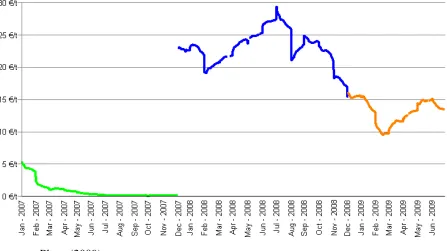
The EU Emissions Trading System came into effect from 2005. Initially, certificate prices increased rapidly but once all member states were fully integrated into the trading mechanisms, and following the release of the first year’s supply/demand data for allowances, the price fell sharply from the 2nd quarter of 2006, and was close to zero up to the end of the first phase.
[image:18.595.119.566.256.507.2]The second phase started in 2008 and prices initially ranged between €20 to €30. However, the economic downturn has again led to a fall in demand and to corresponding price changes with permits trading at around €15 at the end of 2008. Prices for the end of the first phase and the beginning of the second phase are illustrated in the following chart17.
Figure 9 – EU ETS Carbon Prices
Source – Platts (2009)
At the lower levels of CO2 prices, seen at the end of 2008, it might be expected that
coal would continue to run ahead of gas, increasing coal demand. However, a dramatic reduction in gas prices, coupled with the economic downturn, may be expected to reverse this trend.
3.5. Reservoir Levels for Hydro Generation
At the end of 2006 Spanish reservoir levels surged to over 50% causing an easing in coal demand. Drier conditions at the end of 2007 saw hydro reservoirs fall to 35% capacity around the end of the year, the lowest level for four years. However, while some of the shortfall in hydro generation was covered by coal, gas generation was expected to benefit most, and Spanish coal imports were expected to fall back in 2008.
median levels towards the end of 2008. Levels were not low enough, however, to point to a significantly increased coal demand through the winter.
Figure 10 - Scandinavian Reservoir Levels – 2007 and 2008 (Percent)
Source – Nordpool
3.6. Currencies
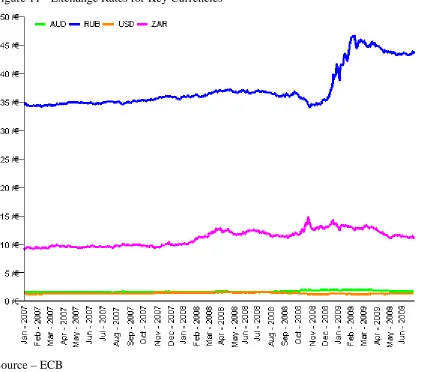
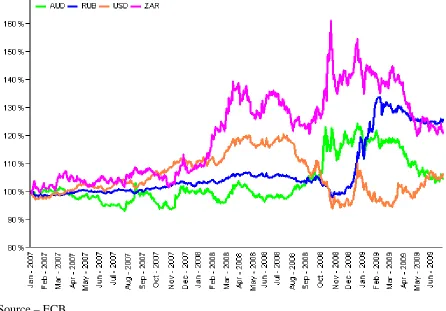
Internationally traded coal is generally priced in US dollars. However, the exchange rate of the dollar to currency in the producing country is important both in setting market prices and in determining competitiveness and profitability of suppliers. For example, where the South African rand is falling against the dollar, it makes it easier for South African coals to compete and profitability increases against the same dollar price. The Currency movements against the Euro are illustrated by the following chart19.
18
Source – Nordpool
19
Figure 11 - Exchange Rates for Key Currencies
Source – ECB
Figure 12 – Movements in Exchange Rates
Source – ECB
3.7. Coal Derivatives and Forward Prices for Steam Coal
Over recent years we have seen the emergence and rapid growth of trading in coal derivatives – ‘paper trading’ – with swaps based on indices such as API 2 (the North West Europe index) and API 4 (the South African index).
The liquidity of the market in coal derivatives has been helped by the increased number of participants. Banks and finance houses began to trade coal swaps in addition to the major buyers, sellers and traders. The volume of the paper trade has increased dramatically in recent years, and in 2007 amounted to 2½ to 3 times the amount of the total physical steam coal trade. Currently the paper trade is mainly concentrated in the Atlantic market.
The following chart shows the forward values of coal swaps for North West Europe as at the end of 2008, compared to historic prices.20
Figure 13 - Historic Spot and Forward Swap Prices
Source – McCloskey Coal Information Services
3.8. Transport Infrastructure
Infrastructure constraints are a major factor in both the development of new coal resources around the world and in meeting surges in current demand. With the rapid growth in recent years of bulk commodities as a whole, and of coal in particular, there have been major bottlenecks in both loading and discharging ports, and domestic railway lines.
The chance to exploit market opportunities arising from the increasing demand in coal has triggered plans for a worldwide expansion of the infrastructure across all of the links of the transport chain. Expansion projects have been launched by almost all of the major countries involved in world coal trade.
In summary, supply constraints are expected to ease over the medium term as new infrastructure comes on line. However, most of these developments did not come on stream in time to resolve the supply/demand imbalances in 2008, which contributed to the very high freight rates and international coal prices, covered in section 5.
3.9. Market Concentration
nevertheless be concerned about loss of market share. Some of this has indeed been lost more recently to their Russian, Chinese, and Indonesian competitors.
In the period from 2000 to 2007, world trade increased by about 270 Mt. Of this increased amount, Indonesia supplied about 140 Mt, Russia about 60 Mt and China together with Vietnam about 25 Mt. (This occurred despite the fact that China's exports have declined by 30 Mt in the period since 2004.) These sources accounted for almost 85% of the increased capacity, but of this volume very little is under the control of the coal majors.22
Any suggestion that evolving producer power resulting from industry consolidation would exert an undue influence over the supply side has, to date, not manifested itself. Whereas major coal companies have consolidated their positions globally, the emergence of the three countries – Indonesia, China, and Russia – that now account for almost 55% of export supply, has a balancing effect in the market. The roles played initially by China and more recently by Indonesia and Russia have meant that supply has not been as tight as it might have been.
In the case of coking coal – above all, hard coking coal – Australia has created a strongly dominant position with almost 68% market share, which in turn is in the hands of just a few producers. However, another player – CVRD – has stepped onto the coking coal scene. CVRD is developing into another market participant through projects in Mozambique and Venezuela as well as the entry into Australian coal mining. The significant further consolidation which would have arisen from the planned takeover of Rio Tinto by BHP Billiton is no longer in prospect.
3.10. Steel Industry Developments
Crude steel production around the world rose by 95 million tonnes from 1.249 billion tonnes to 1.344 billion tonnes in 2007 (+7.6%), illustrated by the table below23. China alone had a share of 69% of the growth in this sector. The growth continued for the first part of 2008, but plummeted at the end of the year with the economic downturn. China still increased output over the year as a whole, by 2.2%, but the rest of the world saw a 2.9% reduction.
Figure 14 – Growth in World Crude Steel Production
2006 2007 2008
Mt % Mt % Mt %
China 423 +19 489 +15 500 +2
Rest of World 826 +5 855 +4 830 -3
Total 1,249 +9 1,344 +8 1,330 -1
Source – World Steel Association
In the last quarter of 2008 European steel production was more than 30% down on the previous year. In the case of Poland, December’s production of hot metal was 66% lower than in December 2007.
22
Source – Global Insight
Following the creation of Arcelor Mittal Steel in 2006 and the acquisition of Corus Group by Tata Steel in 2007, there has been no further significant consolidation in the steel sector in 2008. The following chart shows how Arcelor Mittal (AM) produced almost as much steel as the four next-largest companies combined during 2007.24 However, it should be noted that these top ten producers still accounted for just 27% of total world production.
Figure 15 – Top Ten World Steel Producers 2007 (Mt crude steel)
Source – World Steel Association
4. HARD COAL –PRODUCTION AND CONSUMPTION IN THE EU
4.1. EU Production Trends
Figure 16 - EU Hard Coal Production Trends
Hard coal production reduced by 5.4% in 2007, to 154.8 Mt compared to 163.6 Mt in 2006. Detailed figures are given in the Annexes at the end of this report.
The average calorific value of European hard coal is estimated at 24.69 GJ per tonne25. On this basis, hard coal production in 2007, expressed in standard units of coal equivalent, was 130.4 Mtce.
The largest reduction in production from 2006 to 2007, in both absolute and percentage terms was in Poland, with production reducing by 7 Mt (7.4%). The number of mines reduced from 33 to 31, and all of the mining groups saw reduced production levels. It is becoming increasingly evident that mines have suffered from a lack of investment in recent decades for the development of new reserves. There is no significant progress with privatisation, and the economic downturn is likely to lead to further obstacles in sourcing capital for investment. Production figures for 2008 are expected to show a further reduction to 83 Mt.
In Germany, production was stable from 2006 to 2007. However, the passing of the Hard Coal Financing Act, on 27th December 2007, set the conditions for an orderly end to German mining by 2018, although a revision clause provides for a review of the energy industry situation for domestic coal in 2012. In 2008 production reduced by 5 Mt to 19 Mt, a more rapid decline than planned, with the sharp reduction in production at the Ensdorf mine in the Saar region following earth tremors. After the closure of the Walsum mine in June 2008, there were seven mines remaining at the end of the year.
UK production reduced by 1 Mt in 2007 but a number of factors combined to stabilise production and show a small increase in 2008. Mining companies had more success in gaining planning permission for surface mines than in recent years, and the Hatfield deep mine was reopened. The Daw Mill mine achieved a record production level of 3.2 Mt from a single coal face in 2008. At the end of 2008 there were six major deep mines in operation together with a number of small underground mines and around 30 surface mines of various sizes.
Production in the Czech Republic decreased slightly in 2007 and remained at similar levels in 2008. Coking coal accounts for around 60% of production volumes. All the Czech hard coal mines were acquired by OKD in 2006 and the company was planning major investments to develop new reserves. It remains to be seen whether the downturn in coking coal demand and the associated effect on prices will impact these plans.
In Spain production reduced by 0.5 Mt to 11 Mt in 2007. Although coal extraction has decreased in recent years, the possibility of increasing coal mining again is being discussed.
4.2. Consumption
[image:26.595.122.457.268.470.2]Trends in total consumption of hard coal are illustrated by the following chart. Figure 17 – EU Consumption Trends for Hard Coal
(Mt)
Total hard coal consumption was 375.7 Mt in 2007 compared to 380.5 Mt in 2006. Consumption continues to be dominated by the power sector at 68% followed by coke production at 17%. Power station consumption was down by 1.2% in 2007 compared to 2006, whilst use for coke production was up by 2.1%.
Whilst there were no dramatic changes in demand for the EU27 as a whole, with power station demand down by 3.3 Mt in 2007, individual member states showed some significant differences. In 2007 consumption by UK power stations reduced by 4.8 Mt (-8.6%). Other significant reductions were 1.5 Mt in Denmark (-16.8%) and 0.9 Mt in Spain (-3.2%). These reductions were partly offset by increased power station consumption in a number of other countries, including Germany with an increase of 1.6 Mt (+3.1%)
The increased demand of 1.4 Mt from coking plants in 2007 was mainly accounted for by Poland where demand increased by 1.2 Mt (+11.3%).
5. COKE –PRODUCTION AND CONSUMPTION IN THE EU
Figure 18 – EU Coke Production Trends
Total EU production of coke was 51.4 Mt in 2007 compared to 51.7 Mt in 2006, a reduction of 0.5%. Total EU consumption of coke in 2007 was 53.6 Mt compared to 53.8 Mt in 2006, also a reduction of 0.5 %. At 5.3 Mt, coke imports supply around 9% of the market.
As can be seen from the chart above, production of coke is widespread around Europe and has remained relatively stable.
6. INTERNATIONAL HARD COAL AND COKE MARKETS
6.1. Major Hard Coal Producers
World hard coal production continued to show strong growth in 2007, after four years of record growth. It was again driven by growth in production from non-OECD countries, with an 8.8% growth in 2007, following five years of annual growth averaging 13%. Production increased in China, India, Russia, Indonesia, Colombia, Vietnam and Korea DPR, but declined marginally in South Africa, Kazakhstan and Ukraine.
[image:27.595.80.489.576.739.2]The following table shows figures for the largest producers26. Table 4 – Major World Hard Coal Producers
(Mt)
2005 2006 2007
PR of China 2158.9 2320.2 2549.2
United States 962.4 991.5 980.8
India 403 428.2 451.6
Australia 300.2 299.7 323.0
South Africa 245 244.8 243.6
Russia 202.9 210.4 241.4
Indonesia 152.2 193.4 231.2
Poland 97.9 95.2 90.2
Kazakhstan 82.8 91.6 83.1
Colombia 59.1 65.6 71.7
Ukraine 60 61.4 58.8
Others 203.8 202.9 218.3
Total 4928.2 5204.9 5542.9
Source – IEA Coal Information 2008
China accounts for around 46% of world coal production. Output grew by 9.9% in 2007, accounting for nearly 70% of the increase in world hard coal production. China’s production has more than doubled since 2000 which allows the country to meet fast growing demand for coal-fired generation and steel making. However, as a major coal exporter, China gradually moved from the second largest coal exporter in 2001 to the sixth in 2007.
The importance of coal in China cannot be underestimated, in terms of its key role in enabling economic growth in the country, its impact on wider international coal markets and its implication for world climate change policies.
China can be summarised as being a country with vast reserves, thousands of small, low-productivity mines, new, larger mines being developed with productivity levels improving (but generally falling still short of international standards), and a growing economy heavily dependent on coal for energy. While there are a small number of very large independent producers, the majority of the coal-mining industry is still owned by the government or regional or local administrations.
Most coal in China is shipped on rail for at least part of its journey from mine to consumer, and most of the coal is produced in the north and consumed in the south. The main bulk of both rail capacity and all the rivers run east to west. Coal is moved eastwards by rail to the ports to be shipped coastwise to the south. In these circumstances it is sometimes more profitable for producers to export rather than ship coal coastwise to Chinese customers; conversely it is often cheaper for Chinese customers in the south to import from both Indonesia and Vietnam.
Coal production in the United States declined by 1.1% in 2007 after 3.0% growth in 2006. Overall 2007 coal production in North America of 1,024.6 Mt showed a decrease for the first time after three years of steady growth.
India showed growth in output of 5.5% in 2007, but is increasingly dependent on imports because of its rapidly growing power requirements.
Australia remains the largest hard coal exporter and increased production by 7.8% in 2007, compared to virtually no change in production between 2005 and 2006.
South Africa accounts for 98% of Africa’s hard coal production and is the world’s fifth largest coal exporter. Production continued to fall back slightly, by 0.5% in 2007 compared to a 0.1% reduction in 2006.
Indonesia is the seventh largest producer but second largest exporter in the world (and the largest exporter of steam coal). Coal production continued to show strong growth, up by 19.5%, or 37.8 Mt, in 2007.
Colombian production increased by 9.2% in 2007 following an increase of 9.0% in 2005 and 11% in 2006. In 2007 Colombia overtook South Africa to become the fourth largest exporter in the world.
6.2. Hard Coal Trade
A high proportion of world coal production is consumed within the country of origin – around 85%, and this is especially true of the two largest producers, China and the USA. Relatively small proportional changes in supply and demand in these countries can have a major impact on international market dynamics.
The major steam coal exporting nations are Indonesia, Australia, Russia, Colombia and South Africa, whereas for coking coal the major exporters are Australia, the United States and Canada.
[image:29.595.121.481.325.486.2]Major world coal trade flows are illustrated by the following diagram27. Figure 19 – Hard Coal Seaborne Trade 2007
Source – Verein der Kohlenimporteure Annual Report 2008
Trends in seaborne hard coal trade are illustrated by the following chart28.
27
Source – Verein der Kohlenimporteure Annual Report 2008
Figure 20 - World Seaborne Hard Coal Trade
Source – IEA Coal Information 2008 6.3. Steam Coal Trade
Total world steam coal exports rose by 27.3 Mt (4.2%) in 2007 to reach 670.0 Mt. Exports from Indonesia, Australia, Russia, Colombia, Vietnam and the United States rose in 2007, whereas South Africa, China, Kazakhstan and Poland saw declining exports.
In 2007 Indonesia became the largest steam coal exporter with 25.5% of world exports. Australia, Russia, Colombia and South Africa followed with respective shares of 16.7%, 12.7% 10.0% and 9.8%.
Over the last few years, and particularly in 2008, international coal supply has been slightly tighter than historically, especially in the period 1998 to 2003. Some of this arose from producers slowing down projects following a period of excess capacity, but some of the tightness was unplanned. Infrastructure failures in Australia, South Africa’s failure to invest in new mines as the ownership of mines changed, and China’s reduced export licenses all took coal from the market. Nevertheless, 2008 figures are expected to show further growth in the international steam coal trade.
6.4. Coking Coal Trade
The world trade in coking coal increased by 10.9% to 247.2 Mt in 2007.29 Australia remained, by far, the largest exporter at 132.0 Mt, with exports up by 11.5 Mt compared to the previous year.
Early 2008 saw a dramatic tightening of the coking coal market with increasing demand coinciding with supply disruptions caused by the floods in Australia. However, towards the end of the year a slump in coking coal demand was becoming apparent because of the impact of the worldwide recession on the steel industry, and a number of major mining companies were reducing output at coking coal mines. Semi-soft and other non-prime coking coals can also be readily diverted to steam coal markets to go some way towards balancing supply and demand.
6.5. Coke Trade
The OECD30 countries’ imports of coke increased by 1.5% in 2007 to 18.4 Mt.31 Germany, the United States, Japan, Austria and France were the five major OECD coke importers in 2007, accounting for 62.0% of coke imports.
With most coke produced close to where it is used for steelmaking, international coke trade is extremely sensitive to levels of activity in the steel market. Demand for imported coke is expected to fall to very low levels with the economic downturn.
6.6. Imports to the EU
[image:31.595.121.450.310.497.2]Imports of hard coal to the EU in 2007 of 217.6 Mt reduced by 0.2% compared to 218.0 Mt in the previous year and represented 58% of total supply. The major exporting countries to the EU were Russia (25.2%), South Africa (21.1%), Australia (13.4%), Colombia (13.4%), the USA (9.3%), Indonesia (7.7%) and Canada (3.1%). The split of these imports between supplying countries is illustrated by the following chart.
Figure 21 – EU Import Sources
Russia has been the largest supplier to the EU since 2006. Amongst the major importers, the UK took 49% of its imports from Russia in 2007 and Germany took 23%. Russia was also the main supplier to most of the Eastern and South Eastern European member states. South Africa remained an important supplier, principally to Spain where it accounted for 36% of its imports, and also to Netherlands (27%), France (24%), Italy (21%) and Germany (20%).
Major European importing countries are illustrated by the following chart.
30
Organisation of Economic Cooperation and Development
Figure 22 – EU Import Volumes by Member State
(Mt)
The UK remained Europe’s largest coal importer in 2007 but showed a 12% fall in imports compared to 2006. This reduction was, however, offset mainly by increased imports in Germany (+11%) and the Netherlands (+14%).
6.7. International Price Trends
The following graph illustrates the development of spot steam coal prices delivered to North West Europe32.
Figure 23 – North West Europe Steam Coal Prices
Source – McCloskey Coal Information Services (MCIS) basis 6,000 kcal NAR ARA
[image:32.595.119.444.417.639.2]Although there was some change in the fundamentals – the costs of mining and transport – associated with high oil prices, this would be insufficient to drive prices to these high levels. The massive and rapid increase in prices appeared to have been driven by a combination of tightness in the supply/demand balance and the views and expectations of traders in the market. Continued demand growth was coupled with a number of supply disruptions. There was also some ‘pull’ from the coking coal market where supplies were very tight following floods in Australia at the beginning of the year; some coals normally destined for the steam coal market were prepared as ‘semi-soft’ coking coals.
Whilst a correlation with oil prices has not generally been apparent in the past, very high oil prices provided ‘headroom’ for movement in coal prices and it is noteworthy that coal and oil prices both peaked and fell back at around the same time in July. The rapid fall in coal prices as a result of the economic downturn was even more marked than the increase earlier in the year, although it should be noted that prices ended the year at levels which were still high by historical standards.
[image:33.595.120.480.338.587.2]Import prices for steam coal reported to the European Commission are illustrated by the following chart.
Figure 24 – Price of Steam Coal Imported from Third Countries
Source – EuropeanCommission
It is important to note that the prices illustrated in Figure 23 are spot prices and refer to deliveries ninety days ahead. There is therefore a time lag before these spot prices are reflected in current prices paid by customers such as those reported to the
European Commission illustrated in Figure 24. The short-term volatility of
international prices is also smoothed out where buyers have entered into longer-term contracts, reflecting prices which were current or anticipated when contracts were negotiated.
6.8. Coking Coal Prices
Unlike in thermal coal markets, pricing for coking coal is largely determined in annual contact negotiations and is strongly influenced by the resulting benchmark prices which emerge during the annual negotiating round. There are no established price indices and no derivatives. This makes pricing of met coal significantly less transparent than in thermal markets. Stringent quality considerations in the coking market mean that the commodity is not sufficiently fungible to support a liquid index and derivatives-based market.
Over recent years the most significant driver of coking coal prices has been the supply/demand balance. This was most clearly illustrated by events in early 2008, with major floods in Queensland, Australia. The relatively small number of suppliers of prime coking coals, together with the burgeoning demand growth, means that any perceived perturbation to the market can have major impacts on prices. The massive rise in steam coal prices also had an effect, as suppliers sought to maintain the premium on coking coal (including semi-soft and PCI), both reflecting its scarcity and the increased costs of preparation for the market.
The following table illustrates the development of prices for internationally traded coking coal, based on Australian contract prices.
Table 5 – Price Trends in Coking Coal33
(US $/Tonne FOB Australia)
Contract Prices* 2004/5 2005/6 2006/7 2007/8 2008/9
Hard Coking Coal 59 125 112 96 300
Semi-soft Coking Coal 43 80 58 65 240
PCI 47 102 68 71 250
*April to March basis
The global recession – and the associated major downturn in steel production – is expected to have a significant impact on negotiations for coking coal prices in 2009/10, although these will be complicated to some degree by tonnages contracted at the higher prices for 2008/9 and not accepted for delivery by customers.
Figure 25 – Price of Coking Coal Imported from Third Countries
Source – European Commission
Between the second semester of 2007 and the second semester of 2008 average prices increased by 96% to €182/tce.
6.9. Coke Prices
Developments in coke prices to the end of 2008 (fob 12-12.5% ash), are illustrated by the following chart34.
Figure 26 - Spot Chinese Coke Prices
Source – Euracoal
[image:35.595.100.437.481.711.2]The development of coke prices reacted in a similar manner to coking coal, reflecting an overheating steel market followed by collapse as the recession took hold.
6.10. Freight Considerations
Delivered prices to Europe comprise both free on board (fob) prices from the country of loading and sea freight rates.
[image:36.595.122.422.211.418.2]The following chart shows the development of rates from the beginning of 2004 to the end of 200835.
Figure 27 - Spot Sea Freight Rates
Richards Bay (South Africa) to Rotterdam
Source – Euracoal
Freight rates react rapidly to supply/demand dynamics and have shown major volatility in recent years. The benchmark freight rate from Richards Bay to Rotterdam ended 2008 around 10% of its peak value in the middle of the year.
The peaks in prices seen at various times in recent years were caused by shortages in capacity, resulting from congestion at ports, on top of a rapid growth in the market both in terms of volumes and distances travelled. It is important to note that bulk carriers are used both for coal and for iron ore, for example with Chinese demand for iron ore relying heavily on long-distance deliveries from Brazil.
7. LIGNITE AND PEAT –PRODUCTION AND CONSUMPTION
7.1. World Context
The world supply of lignite36 went up by 0.8% in 2007 and reached 945.2 Mt. Increases in Germany, Australia, Turkey and Bulgaria more than offset decreases in Russia, the United States, Poland and Serbia-Montenegro.
[image:37.595.106.487.205.524.2]The following table shows figures for the largest producers37. Table 6 – Major World Lignite Producers
(Mt)
2005 2006 2007
Germany 177.9 176.3 180.4
Russia 73.7 74.1 72.3
Australia 67.2 67.7 72.3
United States 76.2 76.4 71.2
Turkey 56.2 61.9 70.0
Greece 69.4 64.5 64.4
Poland 61.6 60.8 57.5
Czech Republic 54.9 54.7 54.5
Canada 36.8 36.5 36.6
Serbia-Montenegro 35.1 36.8 35.6
Romania 31.1 34.9 35.5
India 30.2 31.3 32.8
Bulgaria 24.7 25.7 28.3
Others* 134.1 135.7 133.8
Total 929.1 937.3 945.2
*IEA figures also include oil shale production in Estonia
Source – IEA Coal Information 2008
Many European nations feature amongst the top producing countries in the world. Europe is responsible for around 50% of world production, where it represents an energy resource of key importance.
7.2. EU Production Trends
European production of lignite was 446.0 Mt in 2007 compared to 450.8 Mt in 2006. Production reduced by 1.1% in 2007 compared to the previous year. Production trends are illustrated by the following chart38.
36
In this report the term ‘lignite’ also includes brown coal
Figure 28 – EU Lignite Production Trends
The average calorific value of European lignite (including peat) is estimated at 8.77 GJ per tonne39. On this basis, lignite production in 2007, expressed in standard units of coal equivalent was 133.5 Mtce.
It can be seen from the chart that as well as being fairly static for the EU as a whole, the split of production between member states has not changed significantly. An increase of 4.1 Mt (+2.3%) in Germany and 2.8 Mt (+11.1%) in Bulgaria from 2006 to 2007 was offset by a reduction of 3.2 Mt (-5.4%) in Poland. The reduction in production from ‘others’ in the chart above relates mainly to peat, covered in section 7.4 below.
In 2007 Germany increased its lignite production by 4.1 Mt (+2.3%) to 180.4 Mt. Production remained centred in four mining regions – the Rhineland around Cologne, Aachen and Mönchengladbach (99.8 Mt), the Lusatian mining area in south-east Brandenburg and north-east Saxony (59.5 Mt), the central German mining area in the South East of Saxony-Anhalt and in north-west Saxony (19.1 Mt) and the Helmstedt mining area in Lower Saxony (2.1 Mt).40
Greece is the EU’s second largest lignite producer, in tonnage terms, and in 2007 production increased by 3% to 66.5 Mt. Production came mainly from the West Macedonia Lignite Centre in the north of the country (49.3 Mt) and from the Megalopolis Centre in the Peloponnese (14.1 Mt).41
In Poland, lignite production reduced by 3.2 Mt (-5.4%) to 57.5 Mt. Two lignite operations are located in central Poland with a third in the south-western region of the country. The Belchatów mine in central Poland produced 31 Mt. In the Konin-Adamów, basin between Warsaw and Poznan, 15.1 Mt was produced from two mines. In the South West some 11 Mt was produced from the Turoszów basin.42
38
For the purposes of the EU statistics in this report and the attached tables, lignite, brown coal and peat are grouped together and included in a single EU total. (Production of oil shale is not included in the solid fuel totals but figures are reported later in section 7 and included in IEA figures)
39
Based on data in IEA Coal Information 2008
40
Production in the Czech Republic was stable in 2007, increasing by just 0.05% to 49.3 Mt. The main lignite basin and the largest mining area is the Northern Bohemian Brown Coal Basin in the North West of the country, with production from around ten mines. Romania also has a number of lignite mines of varying sizes, mainly in the South West of the country in the Oltenia Basin; production in 2007 was stable at 32.6 Mt. In Bulgaria, most of the production comes from the Maritsa East coalfield in the South East of the country, where 23.7 Mt was produced in 2007 from three mines43, out of the national total of 28.4 Mt.
7.3. Lignite Consumption
Total EU consumption of lignite in 2007 was 454.2 Mt, an increase of 1.2% compared to 449.0 Mt in 2006. Around 95% of lignite is used in power stations with the remainder being largely used for district heating plants and domestic heating, mainly in the form of briquettes.
There is little trade in lignite because of its low heat value and resulting high unit transportation costs. This means generally that power stations burning lignite are situated close to the mines with supply and demand being closely matched. Total EU imports of lignite in 2007 were 1.2 Mt, only 0.3% of total supply.
7.4. Peat Production and Consumption
Within the overall lignite figures, production and consumption of peat is included. Production comes mainly from Finland, Ireland, Sweden, Estonia and Lithuania. In 2007, 8.6 Mt of peat was produced, a fall of 9.8 Mt compared to production of 18.4 Mt in 2006. The major reduction was in Finland (-8.8 Mt) where production was badly hit by heavy rain.
The consumption of peat in 2007 was more stable, at 15.3 Mt, an increase of 0.8 Mt compared to consumption of 14.5 Mt in 2006. The peat consumption continues to be dominated by the power sector being burned in power stations close to the mines. Nearly all of peat is used in power stations, district and domestic heating. There is no trade in peat in the EU.
7.5. Oil Shale
Oil shale statistics are not included in any of the tables or figures in this report. In 2007, 16.5 Mt of oil shale was produced in Estonia compared to 14.1 Mt in 2006 (+17.4%). Total availability was 17.0 Mt including recoveries of 0.3 Mt and imports of 0.2 Mt from the Russian Federation. Oil shale consumption of 17.0 Mt was used mainly in the power generation sector where consumption was 13.5 Mt. In 2006 consumption was 14.0 Mt including 10.7 Mt in power generation.
8. STATE AID TO THE INDIGENOUS HARD COAL INDUSTRY IN THE EU
In line with Council Regulation on State aid to the coal industry44, the amount of current production aid continued to decline. At the same time, Member States continued to finance measures related to restructuring and consolidation of their coal sectors. A large part of the financing was directed to environmental clean-up measures or early retirement schemes – so called exceptional costs according to the before mentioned Regulation.
43
Source – Euracoal
Table 7 – State Aid 2003-2008 - amounts granted by Member States45
Country 2003 2004 2005 2006 2007 2008
Germany
- current production aid
- aid related to exceptional costs
2639 780 2483 556 2114 602 1472 882 1347 994 727 1055 Spain
- current production aid
- aid related to exceptional costs
569 550 340 573 502 582 467 345 448 359 434 654 Poland
- aid related to exceptional costs 903 913 369 60 87 167
Romania
- current production aid n/a n/a n/a n/a 112 93
Hungary
- current production aid n/a 44 39 38 36 34
9. CONCLUSIONS
9.1. World Context
In 2007 total world coal production increased by 5.6%., following an increase in 2005 of 5.7%. This was lower than the growth of 7.6% in 2006 but remains well above the 10-year average growth trend of 3.4%. Updated analysis of proven coal reserve data indicates that, at current world production levels, there is approximately 157 years of coal available. Global trade in hard coal also continued to grow in 2007 with hard coal exports up 52 Mt to 917 Mt.
9.2. European Context
Europe is the third largest region worldwide in terms of coal consumption, after China and the USA. In the European Union around sixty percent of consumption is derived from indigenous production, with 155 million tonnes of hard coal and 446 million tonnes of lignite produced in 2007. In the Second Strategic Energy Review, published in November 2008, the European Commission stated that “All cost-effective measures that can be taken to promote the development and use of indigenous resources should form an important element of an EU Energy Security and Solidarity Action Plan”, and made the further comment about coal: “Coal remains an essential component of Europe's domestic energy supply and an important alternative to oil and gas.
9.3. Coal in EU Electricity Generation
The use of coal in electricity generation varies widely across the EU member states. In Poland over 90% of electricity is generated from coal and lignite whereas in France 4% is generated from coal and 78% is nuclear (2006 data). The split of generation for the EU 27 in 2006 was coal 28.6%, nuclear 29.5%, gas 21.1%, renewables 14.6%, oil and others 6.2%.
9.4. EU Reserves of Coal and Lignite
Europe possesses substantial reserves of coal and lignite which represent around 80% of Europe’s fossil fuel reserves. World Energy Council figures show EU reserves of hard coal at 8.5 billion tonnes and lignite at 21.5 billion tonnes. The largest hard coal reserve is in Poland, representing 69% of the EU total. In the case of lignite, reserves are present in a swathe from Germany through Central Europe and the Balkans, to Greece. Within the EU, Germany has the largest deposit, with major reserves also in Poland, Greece, Hungary, and Bulgaria.
9.5. EU Hard Coal Production and Consumption
Indigenous European production of hard coal has continued its decline, and is forecast to decline further in 2008. Production reduced by 5.4% in 2007 to 154.8 Mt. Consumption continues to be dominated by the power sector at 68% followed by coke production at 17%.
9.6. World Hard Coal Trade
A high proportion of world coal production is consumed within the country of origin – around 85%, and this is especially true of the two largest producers, China and the USA. Relatively small proportional changes in supply and demand in these countries can have a major impact on international market dynamics. The major steam coal exporting nations are Indonesia, Australia, Russia, Colombia and South Africa, whereas for coking coal the major exporters are Australia, the United States and Canada.
Total world steam coal exports rose by 27.6 Mt or 4.2% in 2007 to reach 670.0 Mt. In 2007 Indonesia became the largest steam coal exporter with 25.5% of world exports. Australia, Russia, Colombia and South Africa followed with respective shares of 16.7%, 12.7% 10.0% and 9.8%. World trade in coking coal increased by 10.9% to 247.2 Mt in 2007. Australia remained, by far, the largest exporter at 132.0 Mt. Towards the end of 2008 a slump in coking coal demand was becoming apparent because of the impact of the worldwide recession on the steel industry, and a number of major mining companies were reducing output at coking coal mines.
9.7. EU Hard Coal Imports
Imports of hard coal to the EU in 2007 of 217.6 Mt reduced by 0.2% compared with the previous year and represented 58% of total supply. The major exporting countries to the EU were Russia (25.2%), South Africa (21.1%), Australia (13.4%), Colombia (13.4%), the USA (9.3%), Indonesia (7.7%) and Canada (3.1%).
9.8. International Coal Prices
even more dramatic than the increase earlier in the year, although it should be noted that prices ended the year at levels which were still high by historical standards. Coking coal prices and coke prices displayed similar trends. The benchmark sea freight rate from Richards Bay (South Africa) to Rotterdam ended 2008 around 10% of its peak value in the middle of the year.
9.9. Lignite and Peat
Annex – Summary of EU-27 Data (Mt) *Including industrial and pithead power stations
2006 2007 % Change
Hard Coal
Availabilities
Production 163.6 154.8 -5.4
Recoveries 2.1 2.0 -5.6
Imports from third countries 218.0 217.6 -0.2
Total 383.6 374.4 -2.4
Deliveries
Power Stations* 260.3 257.2 -1.2
Coking Plants 64.2 65.5 2.1
Others 56.0 53.0 -5.5
Exports to third countries 1.5 1.1 -27.5
Total 382.0 376.8 -1.4
Coke
Availabilities
Production 51.7 51.4 -0.5
Imports from third countries 5.1 5.3 3.4
Total 56.7 56.7 -0.1
Deliveries
Steel Industry 45.6 43.6 -4.4
Others 8.3 10.0 21.0
Exports to third countries 2.4 1.5 -38.5
Total 56.3 55.1 -2.1
Lignite
Availabilities
Production 450.8 446.0 -1.1
Imports from third countries 1.0 1.3 24.9
Total 451.8 447.3 -1.0
Deliveries
Power Stations* 421.5 430.4 2.1
Briquetting Plants 16.9 14.3 -15.5
Others 10.6 9.6 -9.8