~·.
***
*
*
.
*
*
.
*
*
.
*
*
*
Joint
A
nnual Repo
r
t
2
008
on the D
e
velopment
C
ooperation between
Republic of
F
iji Islands
and
the European Commission
as foreseen
b
y
the Cotonou Partnership AgreementTABI.f: OF CO"'TEi\TS
I.
EXECUTIVE SU,l\IARY ...
.. 1
2.
OVERVIEW OF POLITICAL A"'D ECONOMIC DEVELOP~
lEN I
... 2
2.1.
Political Dewlopment.
...'
2.2.
Economic Dcwlopment ... 3
2.3.
Trade
2.4.
Powrty
'
.
_,),
Governance ... .
2.6.
Budget Support ..
2.7.
Coordination and Cooperation ... ..
3.
0\'FR \'ll'W OF Till' I'!\ST ,\'ID OMiOI'IG CO-OPERA 110'1.
.J
.1.
Fimmcial Pcrfonnancl' ..
.J
2.
Projects and Prot.!Jammes in the Focal and Non Foc<ll Areas ..
.
'
3.3.
Other Co-operation.
..4
.. 5
.. 5
..6
.6
. 7
.. 7
.. 7
. s
4.
POLICY COIJEJ{,\'ICF FOR DE\'EI.OP\111\T ... .
. ... 10
1.
E\:ECTTIYE SDL\L\IlYThe consultation process in the frame\York of the Council Decisions of 18 April 2007
and 1st October 2007 \Yas continued throughout the year \\'ith the EL
1Troika meeting
\Yith the interim GoYernmenL mainly on the lew I of Permanent Secretaries. but also \Yith
the interim prime l\tinister. The European Commission continued to support the
preparations for elections through proYision of the Chief Technical J\dyisor to the
SuperYisor of the Elections. Towards end of 2008 it became obYious that no elections
would be held by :\larch 2009.
The National Council for Building a Beller Fiji continued the preparations and national
consultations on the Peoples' Charter for Change. Peace and Progress and the Report on
the State of the Nation and Economy. The Charter and the Report were submilled to the
President and approved by him in December 2008. The PCCPP supplemented
by
the
Report represent the policy document of the interim Go\·ernment tOr the way fon\ard.
·1 he econolll) grC\\ in 2008 by 1.2% \\ith a budget deficit of 1.5% of CJDP. The )Jational
Budget 2009 is based on a projected grm\"lh rate of2.2% with Jiscal dcticit of 3%. At the
end of NoYembcr 2008 the official resen·es \\ere around FJD824.7 million, sufficient to
cowr 3.1 months of imports. The annual rate of intlation stood at 7.7% at the end of
::W08, as compared to ..J-:4% in 2007.
The track balance for year 2008 w8s ncgatiw with FJD 2.130iv1 (t'910i\1). Exports
amounted to LIDL-171i'vl (f629id) and the imports to FJD3.601:\I(€L539.\·1). The trade
defic1t 2007 amounted tu F.ID1680.\I (f718\l). l·iji together \\ith PI\(J initJallcd the
interim I·:P.-\ in late 2007 \\·ith the \ie\\. of completing the negotiations un the
comprehcnsi\·o..: LP.-\ by end of 2008 ·1 his did not e\·entuate and the interim LPA \vas
still being fine-tuned for signature at the end of 2008. Follo\ving an inspection mission
b) the European Food and VetcrinaJ"y Office in 2007, Fiji was eliminated from the list of
third countries eligible to export 1ish and tishery products to European Markets. A
project put in place
by the Competent Authority to remedy the situation was supported by
technical assistance from the EC funded Special Fisheries Programme.
35% of the population liYe in poYcrty as measured in terms of Basic Needs PoYcrty Line.
\Vith the global economic meltdown the poverty incidence in fiji is expected to \viden.
Fiji's Human Dcwlopment Index (HDI) is 0.762, with which Fiji ranks 9th amongst 117
countries.
The completion of the negotiatiOns on the I Oth EDF Country Support Strategy and
National Indicative Programme (€30.20.1) remained subjected to the appropriate
measures enshrined in the Council Decision of 1st October, 2007. The programme
implementation under the 9
1h EDF and of the 2006 Financing Agreement for
Accompanying :\1easurcs tOr Sugar Reform Adaptation continued. In addition Fiji
benefitted from grant awards from the European InitiatiYe for Human Rights and
Democracy thematic budget line.
Fiji benefits of se\eral regional programmes implanted by the Pacitic Islands Forum
Secretariat and other regional bodies as well as of a few Intra- and All-ACP programmes.
The coordination with l\Iember States is smooth and regular \Yhereas the donor
coordination takes place on needs and ad-hoc basis.
2.
0\
Eln IE\\' OF I'OLITIC.-\L .-\'\1) EC0'\0:\IIC DF:\'ELOP,\IENT2.1.
Political Denlopment
The 1-:_uropean Union concluded that the military coup of December 2006 demonstrated a
breach of Article 8 of the Cotonou Agreement and began consultations \\·ith the interim
Government in accordance with the procedure described in Article 96 of the Agreement.
and \\-ith Article 37 of the De\-clopment Cooperation Instrument. DeriYing from this
consultation process the interim GO\ ernmcnt made commitments to the European Union
on maintenance of human rights. rule of law and return to constitutional democracy.
These commitments were formalised into a Council Decision on 18 April 2007. In
addition. the European Council adopted appropriate measures in order to enforce the
adherence to the commitments made (Council Decision of 1
11October
2007)
\\'hich. inter
alia. subjected the disbursement of the Accompanying 1\'leasures to Sugar Trade Reform
and linalisation of the 10
111EDF Counll') Support Strategy to the progress in return to
democratic ruling. The Jinalisation and appro\·al of the I 0
111EDF Country Support
Strateg) remained suspended at the end of 2008. The 2007 sugar allocation was zero. and
the 2008 allocation had not been made a\·ailablc during 2008.
A high-le\·el Troika comprising the EU Presidency (Siownia). the European Council [lnd
the European Commission conducted a mission to Fiji in June 2008 followed by a
Ruk-of-l.aw nussion in July. From 28
I\
m-ember to I December. 2008. a delegation fi·om the
1-"tnopt'<m Parliament"s Committee on De,·eloprnent \-!sited the Republic ot" the Fi_ji
lsl<mds on a li1ct-finding mission. The delegation noted that it had been two years since
the military took pO\\er and cstnblished the mterim Go\·ernment.
It
also noted that the
COilllllllment
or
the intcnm
Gon~rnmcntto enable fi·ee and fair elections by !\larch
~009would not be honoured .. , he delegation
\Y<ISalso unable to confirm that credible and
timely preparations for elections \\ere underway. a condition which is necessar) lOr the
resumption of financial support from the European Union to the Fijian economy.
During the year the National Council for Building a Bt'ttcr Fiji (NCBBF) prepared the
People's Charter for Change. Peace and Progress. whose objectiYes are to promote the
e\·olution
to
a non-racittl society. light corruption and create an enabling cnYironment for
economic growth. The Charter details the required changes to the system of go\'crnment.
constitution. laws. economic and resources development policies, community relations,
and institutional reforms. The interim Government inYited a broad representation to
participate in the work of the NCBBF. However, some political parties, in particular
those which had formed the former government, the 1\lcthodist. Hindu and Muslim
religious organisations and some NGOs turned do\vn the invitation. The 34 members of
the total
40
member NCBBF represented civil society and comnnmity organizations and
private sector, in addition to :vtinisters from the interim Government. The NCCBF \\·as
co-chaired by the interim Prime Minister and Archbishop of the Catholic Church. On
June 24. 2008. the NCBBF made a number of recommendations. \\'hich included.
abolishing
communal
electoral
rolls.
and
replacing
them
\Vith
proportional
representation. abolishing compulsory Yoting, reducing the voting age to 18, and new
anti-discrimination laws.
On August 6
1h2008. the draft Charter document \,vas released to the public and meetings
were held in public venues, and the Charter was advertised in the media. There were
consultations by public relations teams at grassroots lew! in all the villages and
settlements throughout the country. The Charter \Yas finally apprm eel by the Pres1dcnt in
December
::was,
and it \\·ill now be implemented b) the interim goYernment. which is
committed to implementing electoral reforms before holding an election.
2.2.
Economic Development
The impact of the global financial crisis on fiji will be via the impact on its major
trading partner economies. \\'hich
\\·ill
lower the demand for exports and reduce financial
inJ1mvs. Any slo\\-dO\m in tourism would impact on the \Yholesale and retail trade. hotels
and restaurant sector and the air transport sector. Also a reduction in remittance tlows
could suppress consumption expenditure. Similarly, lmYer financial tlo\\'S (particularly
FDI) could lead to a decline in im·estment, especially in the building and construction
sectors. Thus. domestic demand may be affected as a result of the global financial crisis
and it is like!) the crisis will have some impact on fiji's grm\th prospects.
The Fijian economy is largely agricultural. with sugar being an important part.
accounting for
22
per cent of its exports. constituting 8 percent of GOP and employing
around
200.000
people either directly or indirectly. Economic gro\\'th for
:wos
is nO\\
forecast at
1.7
percent. compared to a decline of 6.6% in
2007.
The dO\\llward re\·isions
to growth forecasts were mainly due to dcYclopments in the sugar industry. whose
production leYcls in
20a8
were ncgatiYcly affected by Cyclone Gene .
.-\tthe end ofNoYembcr
::was.
official rcsen·es \\ere around
:£82·L7
million. sufficient to
coYer
3.1
months of imports of goods. The aYcragc annual rate of in11ation for the
12
months to December 2008. stood at
7.7~-o. compared to 4.4% m 2007In the medium term managing the macro-economy
\\·ill
require fiscal discipline to keep
the gro\\th in operating expenditures belo\\' the gro\\th of operating re\'Cnucs. careful
debt management public sector reforms to strengthen efliciency and accountability. and
improYemcnts in the inYcstment climate to encourage private sector development.
It
is in the real economy that the Government of Fiji f'lccs its greatest medium and long
term challenges. Its long term strategy depends too hem·iiy on reYersing the long term
decline of the sugar industry and facing the challenges of the loss of preferential access to
the EU market. Increased milling elliciency and field productivity, accelerated cane
replanting. improYed inti·astructure, mechanisation and measures to accelerate
cogeneration and ethanol production are all necessary, but arc not likely to offset the loss
of the protected EU market and competition from lower cost producers.
Fiji has also been ncgatiYely affected by the abolition of the Multi Fibre Arrangement
(MFA), which gave local producers privileged access via quotas to developed economy
markets. Exports of garments have halved since the concessions were remo\·ed in
2005,
and although there is potential for growth through the exploitation of niche markets,
competition from China and other Asian producers with remain severe.
The underperformance of the private sector combined with less than impressi\'e export
earnings suggest the need for economic reform packages to address issues of greater
efficiency and competiwness. Goyernment needs to create an enabling enYironment that
provides adequate incentiYes for efticient and competitiYe industries to emerge. and that
al!O\\'S the capabilities to be dew loped to ensure the gro\\'lh of a dynamic pri\'ate sector.
In the medium to longer term issues relating to the increasing land utilisation and rural
deH'lopment
,,-ill
need to be addressed, in addition to issues related to de\'elopments in
the tourism sector.
The country has a \lational Disaster !'vlanagemcnt Committee and a }\;"ational Disaster
i'danagement Office in the :t\Iinistry of Defence, which is responsible for mitig<1ting the
impact of natural disasters on both the population and the economy.
Science and Technology
The University of the South Pacific at Sm·a, founded in 1968, has schools of agriculture
and pure and applied science. Other institutions of higher education are the fiji College
of Agriculture at Nausori, and the Fiji Institute of Technology and the Fiji School of
Medicine. both at Suva. The major learned societies are the Fiji Society, concerned \Yith
subjects of historic and scientific interest to Fiji and other Paci!ic islands. and the Fiji
J\1cdical Association, both in Suva.
2.3.
Trade
Total imports llH
:zoos
\\Crc 3.601..--1- million FJD(C1.539\1). compared \Yitll imports
for
1007.
''hich \\·ere :2,890.1 million FJD(€1.235.ll'vl), an increase of 23?{ •. Cioods nnd
mcrclwndisc imports consist of mineral fuels and oils. machinery and equipment
lll<lllUI~Kturcdgood') <!nd
food.
The main sources of imports are Singapore for mineral fuels and oil. and Australia and
New Zealand for manufactured goods and food.
Turning to exports, the total exports amounted to 1,471.0 million FJD (€628.6!\1),
compared to total exports of 1,209.8 million FJD (€517.0!\·1) in 2007, an increase of
21.6%.
The mnjor e'\pons nrc JOod (mainly sugar). manutSctured goods ,,-hich arc mainly
textiles . .:>nd the re-export of pCiroleum products to other Pacific Islands. Food and
manutSctured good arc exported to the
LK. L'SA.
Australia,
~C\\ ..leal and and Japan.
·r --
Value (FJD
. million)
' Category
'
1523.4
I
Food
_ _
_
!Beverages and Tobacco
125.2
r
1\lanufactured Goods
11~3~.8~---· %
of Total value of ·
Exports
136.0
9.0
8.0
33.0
%Change
Between 2007 and
2008
·---l
1.3
128.0
Re-Exports (petroleum 1488
1
~)roduc-ts_J
_ _
Others
1220 4
IHI II
---bo
(14.4)
-lOlA I
21
.h
.!_ _____ .
In Dcccmber 2007. Fiji together with PNCi initialled an interim
l~conomic Partnership.-\grc.:m<:nt (1-I:P,\) \\ilh the
l~uropean Lnion. saiCguarding its future sugar exports to theLU \\-ith an increased quota of30,000 mtn in 2008/2009. The Interim EPA CO\"ers goods
only with improved Rules of Origin and aimed at concluding the full EPA by end of
2008. Under the 1-FPA Fiji will liberalise its market access for European products.
Luropean Union in turn opened its markets for the Fijian products in .hmuary 2008.
2.4.
Poverty
35% of all population lives in poverty measured in terms of Basic Needs Poverty Line
(BSPL) \\ith variation of 44% of rural Indo- Fijians to 24% in the cohort of "rural/other
ctlmicity''. Geographically the poverty incident reaches 53% in the Western Division as
compared to 26% in the Central Division.
2.5.
Con·numcc
A Gmunance Analytical Matrix was established for Fiji in 2006 in preparation for the
I Oth European Fund programming period. Following the events of December 2006. the
political dialogue \\ith the interim Government has been guided by the commitments
made by the interim government to the European L'nion (Council Decision of 18th April
2007.
Fiji's Human Dewlopmcnt Index (HDI), is 0.762. \Yhich gives the country a rank of92nd
out of 177 countries with data. The I IDI ranking has steadily declined since 1996 when it
was ranked 44th. PoYerty and inequality continue to be a major challenge and at least
12% of the population live in informal settlements. Land tenure challenges and the
expiry ofland leases are major contributors to the increasing size of these settlements in
urban areas. \\·hich pose a significant social and economic challenge to de\'elopment. In
order to combat the increase in poverty the Government of Fiji poYerty allcYiation
programmes for 2008 focused on ensuring that the poor and disad\'antaged hm·e betler
access to education and training. social welfare schemes, finance and credit, and
impro,·ecl social ser\'ices and physical infrastructure.
2.6.
Budget Support
The EC has encouraged the country to continue the preparations for budget support. and
it is planned to assess the Public Finance l\.lanagemcnt based on the Performance
l\.Jeasuremcnt
Frame\\·ork
of the
PEFA
(Public
Expenditure
and
Financial
:\ccountabilit) l that has been deyeloped by the World Bank. the !Mr. the European
Commission and other donors. This ,,·ill assist the EC and other stakeholders to assess
the gon:rnment's eligibility for budgetar) support.
2.7.
Coordination and Cooperation
T\'one of the EU Member States operates any major dcYclopment actiYities in
Fiji.
Apart
ti·01n FC support the key donors are Australia, T\'e\\" Zealand, Japan and China. as well as
the den:lopmcnt banks (World Bank and ADB). Australia is acti\·e in the education
sector, \Yhcrc it proYidcs policy support. equipment and material and a scholarship
programme. The EDF funded Fiji Education Programme works in coordination \Vith the
.-\LSAid funded programme. NZAid provides an envelope ofl\"ZD 7.2l\.1 (f3.li\·l) o\'Cr
2007./2009. The aid focuses on goYernance. ndncrability to pOYerty. health and customs.
External aid is managed by the "Aid Coordinating Committee". An r\id Unit. attached to
the \,linistry of Finance is the secretariat responsible for coordim1ting all requests for
external aid. The effectiYcncss of the Aid Lnit is constrained by inadequate stalling
lc\·cls. Currently, only four of its nine established posts arc filled. and one of its existing
staff members has been temporarily J11l)\'ed to another section.
Relations bcl\n~en the EC and the deputy T\'AOs hme been close and constructive and the
lc\el of cooperation is generally good. The deputy NAOs are im·o]\'ed in preparation and
implementation of all
I~C cooperation. both at NIP and project level. The fact that thefunctions of the NAO are being performed by the staff of the Aid Unit ollice ensures a
degree of co-ordination with the activities of other donors. There is a need for the
goYernment to reintroduce the Donor Co-ordination Consultations (or Donor
Roundtable). as the last meeting was held in 2004.
It
has been holding annual meetings
with Australia and New Zealand to discuss development issues, but meetings \\·ith other
donors arc only held on an ad-hoc basis.
The international development partners meet occasionally and on an informal basis. The
trade officials of the Delegation, Australian and New Zealand High Commission meet for
monthly lunches. Similarly the officials in charge of the political file rrom the ElJ
member states meet for monthly updates as well as the deputies of Australian, British.
New Zealand lligh Commission, French Embassy and the Delegation. The Paris
Declaration on Aid EffectiYcness and Donor Harmonisation is not currently being
proactiwl) pursued in Fiji.
Apart fi·om programme based meetings \\'ith non-state actors and local authorities in the
context of the thematic budget line programmes and given the particular circumstances in
Fiji, the Delegation meets on an ad-hoc bases with different civil society actors.
3.
0\
ER\"IE\\' OF TilE P.-\ST .-\\'0 0\GOING CO~OPER.-\TIO\'3.1.
Financial Performance
Aggregate global commitments at the end of 2008
\YClTeuro 26,222,078, and
seeonclar~commitments were euro
23,235,241. whilst payments were euro 13,024,953. The delays
experienced by the Fiji Education Sector Programme, resulted in it only ha\'ing spent
euro
11.376.339 by the end of 2008. Consequently the NAO requested that both the
operational period of the financing agreement and period of execution of the programme
estimate be extended until the end of:-.Jowmber 2010.
3.2.
Projects and Programmes in the Focal and Non ·Focal Areas
Rc\·ision of the draft CSP
10
111EDF \\'as continued in
~008
but its finali7ation remains
subjected to the appropriate measures embodied in the Council Decision of I
stOctober
2007.
The Fiji Education Sector Programme (FESP;
9(
11EDF;
€21
\1))
objective is to
achieYC equitable access. participation and achievement in
lifc~longeducation for
dism.h-antaged communities in Fiji and improye educational quality and outcomes. The
progrnmme concentrates on education priorities in rural <lnd in disad\'antaged urban areas
and on complementary actiYities such as: infrastructure dcYc[opment (classrooms.
teachers· quarters. libraries and laboratories. water, sanitation, electricity and
communications): training at
various lc\·els: community
non~formaleducation
programmes: strengthening the lvfinistry of Education (MoE) and the I'dinistry of '{outh
(i'I'IOYl
and capacity building
of:-.Jon~State Actors (NSA). The project is managed by aProject i\lanagement Unit. headed by an internationally recruited Director. and the J\'on
State Actor component is also managed
by
a Pl'v1U located at the :-.lAO's office. also with
an internationally recruited Director.
The infrastructural component targeted
300 schools that would either receive
nc\\-buildings or rehabilitation of existing structures as well as water and electricity. By the
end of
2008, 88 schools ha\'e had works completed for ne\\ buildings or extensive
reno\·ations \\hils! an additional
40 schools had \York on-going. Delays were experienced
following the
2006 coup and also problems with tenders, contractors and supervisors
were experienced. Consequently the NAO requested an extension to both the project
financing agreement and the final programme estimate so as to allmv all the targeted
schools to benefit from the project interventions.
The project has achieved tangible results with the pro\'ision of training for TVET on
competency based assessment, the provision of school diaries to all secondary and high
schools in
2007 and 2008, the proyision of library resources and laboratory equipment,
the provision of photocopying and duplication equipment, the provision of physical
education equipment and school furniture. Solar power equipment for
38 schools ha\'e
been procured in
2008 and will be installed shortly.
A separate NSA Programme Estimate was signed on August 16
1h2007. \vhich cffectiYely
set up the new NSA Programme :rvtanagement Unit within the office of the NAO.
Implementation of activities to date has resulted in the award of grant contracts to
25
NSAs that are \\·orking to promote education and training \\·ith the view to secure formal
and informal employment for youth and adults. Furthermore, as a result of another Call
for Proposals. 3 NSAs were awarded contracts for the installation of \\·ater and sanitation
systems and other minor infrastructure \\·orks in 29 schools across the country . ..-\
l\lonitoring
&
Evaluation exercise concluded that a good number of :-IS As were able to
e!TectiYely undertake their project and manage their budgets.
Fiji Solid Waste- Lami
Dump
Hchabilitation
(9
111EDF;
€2.7 \I)).
Follo\\·ing Fiji's
eligibility to fLEX support, it was decided to usc the B-envelope (€2.1 00,000) and the
remaining uncommitted funds of the 9th
EDf
for rehabilitation of this environmentally
risky \\·aste depot. The tender for the recruitment of Technical Assistance was launched
in October 2008.
Technical Cooperation Facility (9th EDF; €1.1
l\1). The remammg funds,
approximately €400.000 after closure of some ongoing contracts, are being used to
provide short-term technical assistance to the NAO's office starting from the second half
of 2008 until mid-1\'ovember 2009. and to earrv out a feasibilitv and identification studv
to the Water
&
Sanitation sector in preparation for the inten·entions under the 1Oth
ED
f ...
National Initiative fo1· Civic Education (:'-l"ICE; 9th EDF; €0.8 ."\1)). The Contribution
Agreement with
U:--JDP
was signed on
13
December 2007 and the programme
management unit sl<.lrtcd its operations during the second qwuter of
:ZOOS. :\
stakeholder
meeting held on the 18th September 2008. endorsed a Community Ci\·ic
l~ducation
Framework. which co\·ers areas such as democracv. human ril.';hts and go\·crnance \\hich
.
-
-\\ill form the basis of
a
Civic Education Curriculum for 1-iji. that \\ill be dewlopcd by
NICE and its Ci\ il Society Organisation partners.
NICE
commissioned
a
Perception
Index Study \\hich was conducted by lJni\'Crsity of the South Pacilic. The study
confirmed that the people of Fiji viC\\- ci\·ic education and information on democracy as
important. and that the majority support democracy and its institutions and arc \\i!!ing to
participate in elections.
3.3.
Other Co-operation
Sugar. Fiji's financial cnwlope for the sugar assistance, including the 2006 initial
contribution. amounts to €64,026 million broken dom1 to annual allocations as follows:
[
)-'~ar
· Allocation
The Sugar \tulti-t\nnuallndicatiYe Programme (MIP) 2008-2010 \\·as approved by DCJ
committee on ll July 2008. Annual Action Plan (AAP) 2008 was appro\·ed by DCJ on
23 October ~008. but incorporates a suspension clause subject to conditions stipulated in
the Council Decision of l't October 2007. In the beginning of the year payments on 2006
sugar envelope \\·ere subjected to progress on the political front but were later released
for regular commitments and disbursements.
During 2008. the Accelerated Cane Replanting Programme suffered delays due to the
adverse \\"Cather conditions during the planting season. A total of 2,583 hectares out of
the target 3,500 had been replanted by the end of 2008. While the programme has
initially experienced a slow response from the fanners, the demand has increased
significantly over the year. Support was also proYided to the Sugar Research Institute in
the form of vehicles and equipment. The first hot water treatment unit was established by
the Sugar Research Institute in order to sterilise sugar cane seeds from any contaminants.
SRIF has conducted weekly meetings on technology transfer in 36 sectors. A surwy on
150 fanners was conducted to assess fanners' needs. In 2008. an Economic Viability
Stud) \\as conducted. The study concluded that ewn under the best case scenario which
unpiies a reduction of the cane production to 2.3 mt from 4.2mt targeted in the findings
of the ST:\f study. the industry would still operate at a loss in the range of F$
25m.annually. The Programme Management Cnit established at the Sugar Commission
of Fiji in Lautoka. continued to manage the interventions.
Elections. The Chief Technical Ad\'isor to the Supervisor of Elections took up his duties
on 14 July 2008. The CTA is the first TA deployment under the EUR730.000 financial
envelope under the Instrument for Stability. Since there is no roadmap nor date for the
elections, no further technical support has been deployed neither has the iG requested for
any. for the same reason the upgraded Concept Note which proposed increasing the
financial support to EL'R 1.8 million, was not processed to a decision.
It
is likely that the
contract or the CTA \Yill be extended provided the interim GoYernmcnt requests for
extension.
Exports of fishery products to EU: DG SAN CO conducted in July 2007 an Inspection
mission to Fiji to eya]uate the control systems in place governing the production of
Jishcry products intended for export to EU markets. Since the findings presented serious
deficiencies and failed to meet Community requirements. DG SANCO decided to
proceed to a Commission Decision to de-list Fiji from the list .\nne.'\ II of Regulation
(IT)
1076'2005. !he
H_'
Regulation de-listing l·iji entered into force on
~1May
1008.
Technical assistance to the Competent Authority has been proYickd b) SFP (Special
l·isheries Progrmnme) and DEVFISII. The Competent Authority is aiming at one
compliant supply chain bdOre it \viii in\'itc the FVO mission to the country. This
1snO\\"
prm isionall) scheduled rm June 1009.
EIB The European lnwstment Bank (FIB) signed a €24.51\-1 loan agreement in
NO\ember
1006.
with the Fiji Electricity Authority (FEA) to finance a 38l'v1\V hydro
po\\'Ct' plant at Nadarivatu.
Contracts for the construction work were signed in
:-.Jovember 2008. The hydro pO\\Tr plant aims to replace the FEA's use of diesel
generation b)· 2012. The Em-subsidised loan is financing half the total project cost of
f49m. The project is being co-financed by the Asian Oe\'elopmcnt Bank and the World
Bank.
1:\TRA-
ACP
PROJECT:TACKLE
(TACKLING CHILD L.-\BOLIR TIIROLGII EDt:CATIO:"\)The Financing Agreement for the intra ACP project
Tackling Child Labour through
Education (TACKLE)
was signed on 13 December 2007 allocating a sum of 1.068.850
Euro for Fiji alone. The Partnership Protocol was signed on 29 ivlay 2008 bel\\·een the
Delegation and the International Labour Organization to begin implementation.
Management positions ha\·e been filled. A Child Labour Committee comprising key
goYernment partners such as the Ministry of Labour, Industrial Relations
&
Emplo) ment,
Local Government, Urban DeYelopment and Housing and the Ministry of Education.
J\ationallleritage. Culture and Arts. Youth and Sports with ciYil society key partners has
been established to implement planned activities. In December. a three day "National
Child Labour Forum was organised which brought together key middle to senior level
policy makers from GoYernment Ministries, ci\'il society partners (already involved in
skills building), local media and other social partners to discuss, exchange information
and plan to implement activities for 2009. The recruitment process for a policy expert to
review the current legislative and policy framework is under way.
The PRIDE (Pacific Regional Initiati\'es for the Delivery of Basic Education) Pl\fU
proYided technical assistance in the form of a resource person on a Library subproject
:'-Jo. Fij_OJO Teacher/Librarian Train the Trainers workshop held in the last quarter or
2008.
Fiji participated in a capacity building \\·orkshop organised by PRIDE with the
coordinators of subprojects on the
M&E requirements. particularly on
the
progress/completion reports and acquittals. This \\·orkshop was held in the last quarter of
2008.
Altogether in 2008. PRIDE supported Fiji in the implementation of 10 subprojects. They
co\"Cr the
dcn~lopmentof ECE curriculum Guidelines, establishment of distance
education centres, implementation of the language policy and review of the education
act. The majority of sub-projects focused on capacity building of Yarious education
personnel. community leaders. school heads, education leaders and school librarians.
BrocE-,
l.t:\t·:s/TIIE.,IATIC
PROGR-\:\IMES:A
Call for Proposals was launched in Fiji on
14
July 2008 under the Luropean Instrument
for Democracy
and llumilll Rights which \\ill result in
the award of a
number
of gnmt
contracts in early 2009. ·1 here ha\ e been a small number of other grant projects operating
in FiJi
und1.~rthematic programmes in 2008. most notably t\\'O projects implemented by
LiY...: and Learn Lndronmental h!ucation. 'CTowrning Water' and 'lm<clgining Tomorro\\ '.
-L POLICY COIIEIU:\CE FOR DD"ELOP:"IIL""\T
1-iji bcnclits from the Pacific Regional Economic Integration Programme (Pr\CREIP)
\\-hich through its six components facilitates and supports trade negotiations, legislative
and regulatory harmonisation and regional cooperation in economic areas. Beside
Pt\CREIP. Fiji benefits from a trade policy adYiser financed through the Tracle.com
facilities and based in the Fiji ~vlinistry for Industry, Tourism, Trade and Communication.
The Lami Dump Rehabilitation project under the 9
111EDF will continue the
erwironmcntal strategy of 8
1hEDF CSP. \Vater and Sanitation is proposed as a focal
sector under the 1 0
1h
EDF CSP.
Fiji has been eligible to export 1ish to Europe and was included in the Annex II of the
Regulation (EC) 2076/2005 regarding imports of fishery products to Europe. Follo"·ing
the ncgatiYe outcomes of the inspection mission in July 2007, Fiji was excluded from the
Annex II list. The Delegation has given proactive support to the Competent Authority
and sector stakeholders in remedying the situation and in getting Fiji back to the eligible
countries list.
Sugar is together with tourism and remittances the major source of foreign currenC)-'
earning for Fiji. The Commission is supporting the revitalisation e1Torts of the sector
through the Accompanying l\leasures to the RefOrm of the Sugar Trade Regime. Pillar II
of the
~ationalAdaptation Strategy and EC .\1ulti-annual Programme tOcus on
agricultural diversification in an effort to broaden the commercial agriculture base.
(
Good gcn
ernanc~and
non-stat~actors
ar~ support~dthrough
S~\·cralprojectc; funded
b~Community
I
hcmruic 13udgl't Lines and
I
:
DF (Fl::SP. l\
I
CE).
Lool-.ing into the internal
~.:oortlinarionon
political
aspel'
t
s.
the
l
·U
I
roil-.a
meets
regular!~and the
spirit Of
the meet
i
ngs
i:,
l'O
n
struc
ti
\'C.
'ig
n
alll
r
cs
Sll\
a.
Fiji
I
s
l
ands. on
6
--\{\
kj
U')
-
\
)
l
t
uL~~L.,
~
8
~
{
(
~
·ationnl
Authorising Ofliccr
11
~
/;
~ ~
(
l~
I le
ad of
Ddcgation
RITV~
S
ALLM
E
N
A"'NEX 1:
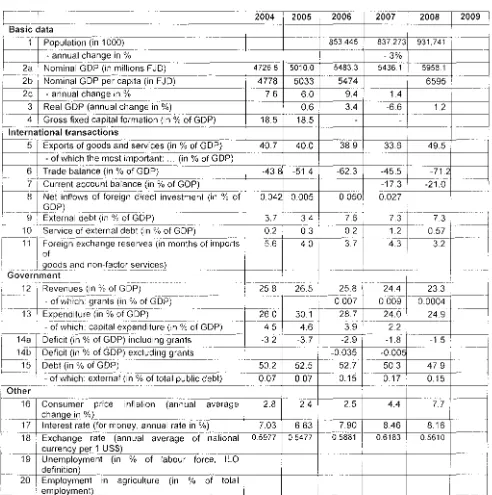
TABLE OF \lACRO-ECONO\IIC INDlCATORS
,----T
' BaSTc~d~a~t~a--0)-1 2004
-4726.8
2005
2006
----853.445
---5010 0 5483 3
2007 2008
I
2009
-837.273 931,741
-3%
5436 1 5958.1
-
,
-FJD) 4778 5033 5474 6595
2b Nominal GOP per cap:ta (in
-n %)
R
3c -annual change in %
Real GOP (annual change i
4 , Gross fixed capital formatio n {in% of GOP)
lnter~ational transactions _
5 Exports of goods and servic
-of which the most importa
es (in %of GOP}
nt: (in% of GOP)
. 6 , Trade balance (In% of GOP
I
-
i-j
~urrent accountbarance_
(in HTNet inflows of foreign direc
---%of GOP)
t investment (in % of-
j
7.6 6.0
-' 0.6
·-
"-18.5 18 5
40.7 40.0
'
-43.8- -51 .4
0.04 0.005
'
9.4 1.4
-3.4 6.6 1.2
-
--
-·---
-38.9 33.6 49.5 '
--62.3 -45.5 71
- -
-17.3 -21.0
0.050: 0.027
---. - --- - -- 1
~(;[)PJ
-· ~J , External debt (in % of GOP) -+-;3~.7~---'3 4 , 7.6 7.3 7 3 1 1 0 Service of external debt (in % of GOP) 0 2 0.3 0 2 •1-_23 --- 03.572 ri
---=-~.-.
· __
I
1
---11--~
Forei-Qrl exchange reserves (1f1 months of impOI-i-s '5c_6~--4~0-c---
3 7cf ,
I ________ j_good~9nd non-f§l_s:tor ~~rv1c~_~)
---1--- _
Government :
I 12 -1 Re-,-erlues (Ill 0/o of GOP) - ---,-5 s---26.5 25_8 I --
--,-.-_4-~--2-3_.3_:_ -~
r
~·-
.1d
~~{:~~::~~;:, ::~~;~~~~P)
...
~ 2~ ~r~~f-,2~6~
I
0
20;0~
I
0o,o.o:
j
~
14 4
__
~~
0
Deflclt(in%ofGDP)includlnggrants
j
-3.2 -37 ·- -2.9 -1.8 --- -15 _ _ 'c ~elicit (in % of GOP) excluding grants --· 0.035 ___ -;0;0;0'+--~=+
15 Debt(in%ofGDP) 50.2 52.5 52_7 503 479
~_
0
_
1
~-:;-,-,-~-:o:f~'_'~h~ic-'h_:_
e:':t:ec:o_•_'t~"~?~~o-f_t_ot-a.-1
public debt)0.0_7+--'0~.0~7-+_-0._1_5-1--
Q_!? __
1 ____
0~-~1~5+-~--16 Consumer price inflation (annual average
1 2.8 2.4 2.5 4.4 7.7
,-+;cchanae
i~
%)_~--~~=+~
~=+-~=+-~~1-17 Interest rate 0_or money, annual rate 1n %) =+~7~.0~3+"'7C-+--; 8.46 8.16 __ _ 18 , Exchange rate (annual average of national o 5977 0_6183 0 5610
currency pe~_1_ US$}
19'-+.C:unemployment"''(~in'-c,,c-,---co"t"la~b~o~o~t
-,forcec-,--I"L"O-+---l---defmitloni __20.-+'"Employment
lco--ca~g~ti~c~ol"to~c~e-o(~io~'"Y,----cof--cto~t~a~l
+ + ' -' employment} ___ _i__ _ _ _j_ _ _ __l_: ___ _6.63 7.90
0 5477 0.5881 I -i ' - --- --
~---+--f---i
_ _ L _ _ _ L _ _ _ j _ _
[image:14.588.35.527.72.567.2]ANNEX 2: MONITORING COUNTRY PERFORMANCE
Ke}- indicators
1990
---2~o_o_s_.L
1
z_o_o_6 ___
2007]
1
_2_o_o_s __
.,_l
~2~"~"''~'cc··
·
IT.r~oportiOil
ofpopuldtion
be]O\\ 29°-·0 34°'o ·50~-o
19'JO[_~PI
, (2003)1
\alu~
'2.
Pre\'alence ofunde1wcight 11
15~-o 50°o 1990
child
1
,,_,~•~• ~~~---.~---.
._,j.~~~-+---\'llw
3.
Under 5
-~hild
mortality
27.8
18__
i
25.8
22.-1
= t : j " o
.t.
HIV pre\·alencc rate of\\omen 0.00 0.01 0.04l_i1g_ed 15-24 _ _
j
I 5. Proportion ofbi11hs attended b; 98 99 99 ... ,· 100"
_ skilled health Rersonnel
___
---~~-+.
_
'6 Propunion of 1 )Car old children , 86 70 ~ 100°u
L~!~!_l:mise~~-against rn~nsles
---+-- __
-+.
· 7. \Jet enmlmcnt rillio in primal)
_l
· ·
···-1011°a~
cduca\1011 92°u 97~-o
r
8. R<tiio o(girJ-:--io bt))'i
in!)-;:i;mH)--
i -
0:86--
o"<J~J-L--cc;cc-
I I
'and sccundar) educatiun
---+
~----
1.06 1.06-1··
.
, 9. Pr11nary school compktion rate _ 86. l ~
r-10.
p;:oportion o(population \\tlh --.-17~-o
. -91J
0o. ~ustainable access to an imprrH"ed
I
\\<Iter suurcc
+-
~
I
~~1-. Fi\.cd lines and mobile --- , -.. -- 1 -I-ll -- --- '
I,
~clephonc_pcr
1_000
inhab!tflnt:::.__ ·_j_
j
12. Formal cost rcqturcd lOr
----t---- · --
1 - · . .--~~~~-J~O~o~'
~~i~:~s_s ~tart ~tp F~)-)
__ _
_ __
j _
_
'
. ____ _
l
lJ. ltmcrcqutn:d lorbus1ncssstart 1 -16 '
up (dflys) ;
change FJJ) _ __ _ , (B-2%) .
(g.7o~~)
I
all season road1
15. 1\cccss of rural populati~on to an
~1_o~J-~~l~>c~JI~d~c~l-cc_t_•"'ifl~ati0n
rate __ ---l_
I1-::xplan{l.tion:
Compared to previous years. 6 ne\\ indicators have been added. pro\·iding additional
information on the modernisation and economic gro\vth process. These indicators are
based on a set of indicators harmonised between the EC. The World Bank and the
African Development Bank for measuring perfOrmance at the country lew!.
Poverty Indicators
The incidence of Poverty ("/o) Usin:z Difft•rcntiatcd Values for the BNPL
Rural:Urban
Ethnicity
])!vision
All Fiji Urban Rural Fijian Indian Others
Rura!Fi_jians
Rurallndo-Fijians Cl'ntral
l.a~tcrn\\'<..:stern l\'orthern
35% 40% 2(;)1% 34°/(J
37%
24(Yo
38%
44(%
26(~/() ~ -o--_,) /()
53%
37%
Province
Ba Bua Cakaudrove Kadavu Lau Lomaiviti Macw.lta Nadroga!Navosa :-Juitasiri l\amosi
Ru Rewa Rotuma Scrua Tailcvu
34% 63%
51%
27% 44%
32%
50%
39%
27%
34% 50% 19%
56% 35%
31
(Yo
BNPL Values per household of 4 Adult Equivalentj2002-JOj
Rural Fijians Rurallndo-Fijians Urhan Fijians Urban Indo- Fijians
$124.60
$126.34
$138.39
S149.89
Vulnerability to the Global Crisis
1.
Five of the Pacific
economies~FederatedStates of Micronesia, Kir"1bat"1. Marshall
Islands, Palau and
Tuvalu~havesubstantial public savings invested in offshore equity markets
that bore a large decline in market value in 2008. The impact of this decline can however be
deferred, by allowing public saving funds to deplete earlier than originally planned. This appears
to be the response to-date. such that there has been little immediate impact on economic
activity from the decline in offshore equity markets. The deterioration in offshore capital markets
has resulted in the loss of some large investment projects. and in some Pacific economies an
Increase in the cost of funds and a tightening in the availability of credit
2.
The main immediate impacts from the global financial and economic crisis have.
however, been via the collapse of commodity markets The Pacific's commodity
exporters~Papua New Guinea. Solomon Islands and Timor-Leste-bore a decline in commodity prices and
then, most notably for the Solomon Islands. in volumes. Papua New Guinea and Timor-Leste
have accumulated sufficient public savings and economic momentum through the commodity
boom to support their economies over 2009 and into 2010. Solomon Islands however lacks this
cushion and is facing severe economic conditions now that logging activity is falling
3.
Of the other Pacific economies, out-of country data point to a small. overall impact in
2008 from the slowdown in the global real economy. The trends are nonetheless clearly
negative. Australian tourism to the Pacific held up over 2008, while New Zealand numbers
eased slightly over 2008 but only very late in the year. Tour"1sm departures to the Pacific from
Asia and the US fell by the order of 10% over 2008, with a downward trend apparent from early
2008. A similar pattern is apparent in employment within these neighboring economies: 1 e .. US
employment fell early in 2008, New Zealand employment declined markedly late in the year with
Australia the last major job market to weaken These employment trends suggest that
downward pressure on remittances to the Pacific built over 2008. but may only become
not1ceable in 2009.
4.
For the non-commodity Pacific economies. the northern economies are likely to be the
first to see the adverse impact of the slowdown in the global real economy. Palau in particular
has already shown the exposure resulting from a dependence on Asian tourism The southern
economies of Cook Islands, Samoa and Tonga are likely to follow, given they have the
strongest links with New Zealand. The Fiji Islands and Vanuatu are likely
to
be the next
economies to weaken, as they have the relatively strongest links with the Australian real
economy.
5.
Over time. structural issues can be expected to become more important in determining
the impact of the global financial and economic crisis. Those with the deepest structural
weaknesses, particularly on the fiscal side. may welt bear the largest impacts as they will find it
hard to adjust to the external deterioration. Kiribati and Tuvalu for example need to adjust their
fiscal position to match the decline in the offshore value of their investments. The longer th.ls
adjustment is deferred. the greater the overall impact is likely to be.
2
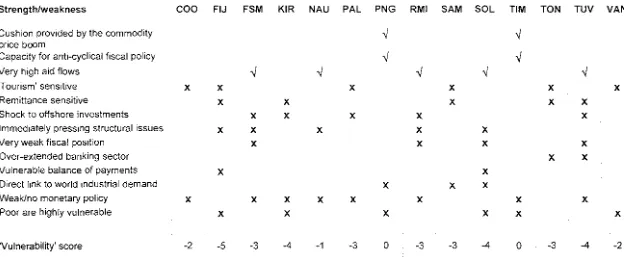
Table 1:
Preliminary Assessment of Vulnerability to the Global Economic and Financial Crisis
Strength/weakness
coo
FIJ
FSM
KIR
NAU
PAL
PNG
RMI
SAM
SOL
TIM
TON
TUV
VAN
Cushion provided by the commodity
'
'
price boom
Capacity for anti-cyclical fiscal policy
'
'
Very high aid flows
'
'
'
'
'
'Tourism' sens1tive X X X X X X
Remittance sensitive X X X X X
Shock to offshore investments X X X X X
Immediately pressing structural issues X X X X X
Very weak fiscal position X X X X
Over-extended banking sector X X
Vulnerable balance of payments X X
Direct link to world industrial demand X X X
Weak/no monetary policy X X X X X X X X
Poor are highly vulnerable X X X X X X
'Vulnerability' score -2
-5
-3
-4 -1-3
0
-3
-3
-40
-3 -4 -2ro
0 0 N
if
c
:;::9 ~ ~
1---'"---+-++-H --
!r-
,d++-H+++-H+-+---1
[j .~ ~ ~
0
-
-1--+--H--
0-hom-+tt+++--IH
N0
0
c
i
0" I!cf-'w"~'---j-_j_j_j_j
__
lf--j_j_j_j_j_j_j_j_j_j_j_j__ir---1~
~ ~
''-'"'---+-++++ '
,:f-8-++++++++++
"~
"
, 0
' E
'~
'
'
,.
uo
0
•
'
1
> 0w
0
w
§
00
•
0
u
0
•
.-c:Z., u.
D
i
0
EN"''""'"'t5~o<>.
t\ ~ ~.!: [0:-U.:>::D<ll
~~.:!G!'i~~~;;::~;;::
1
-'
u
'
0 u•
uJmafi~Jal donor mat"•
indicative planned donor disbursements in Fiji 2010
in Euro x 1 m•ll•on
donor
"
Edu~a•on& Tram1ng
35
Governance Pohq Management
total EU
--,-Australia New Zealand Taiwan Ch1na Japan Korea UNICEF UNFPA
W"O
UNDP
w'
,total others
total all donors
r--f--·
Health
""
"
O.C"
Water& San•tation
'
'
Agn~ulture & Forestry
' ' a··, I
"'
Env.ronment I ICommun1ly
! Dev~lopment
0 :;
.. ---1
'
I
j
---Roads, Transport Commun1catn. Ener<:Jy
...
--,.,
iPrivate s~ctor
multi-sector
]rood a1d
...
'
'
'
tonanc1al donor matnx
current donor presence in sectors in Fiji as per 31/12/2008
donor
"
Italy
total EU
Australia New Zealand Ta1wan China Japan Korea UNICEF UNFPA
W"O
UNDP we
total others
total all donors
Educa1011& Tram1nq
0
0
0
'
Governance !Health Pol1cy
Management
0
---
,,
0t
-L _j_
0
"
0=:k
L(1)
(1) National llliiiJ\rvc 111 C1v1c Education c;o funded by UNDP. 1\u,~ld ~nd EC
Water& San1tation
Th" matrix IS used to present donor roles per sector and per donor as tollows:
Agriculture & Forestry
0
I
Environmentl
0
'
0 0'
;Commun1ty
I""''''""'
i
-'
_l
LPad donor Active donor
Roads,
I"'
Transport Pnvate Communlcatn_ Sector Encf'<jy
"
~
I
=t
lo
0
Pass1ve (Silent) donor
EXIt strategy for th1s donor in this sector
~multi-
I
JfOod a1d I human. sector o.Oi
-I
~ ' ~
'
,,'
,,'
5
'
~
'
t
w
~
0
§_ §
'
'
"
"
0
z
,,
'
'
H
g
z
0
'
'
~
"
z
w
•
'
!
j
.
!
'
> <
"
0
!
§_ §_!
'
'
''
'
§_ ~'
~
0
N
§
-a·-•
g'
8 ''
;j ~'
'
N
~
"
~
I
<
v
!
w
"
i
0
w w
Q
w
0
5 !
•
'
'
,,!
' 0 §_!
'
'
o,'
' ' ''·'
'
'
0 ' ~ ~- ' 8_ '!
' 0!
'
' ' ' R ' '~- §_ ' g_
!
'
g g
§!
I
~ ' §_ §_"
!
'
'
'
''
'
'
!il
g !
' '
'
i
1
§'
!
'
~-'
.
' '~~·
---
"-YEAR of ACCOUNTING 0 TITLE GLOBAL COMMITMENT
GLOB. NUMBER of
; Commit. GLOBAL
commit. N"IC TITLE INDIVIDUAL COMMITMENT
; _ , ,
______
" " " " · -!,1995 9ACP FIJ7 0 ( EX 07 P007 ) ( EX 05 P035)
SIXTH MICROPROJECT PROGRAMME
1995 9ACP FIJ7 1 ( EX 07 P007 C001 ) (EX OS
P035 C001 ) WORKS
i!
2000PROGRAMME
9ACP FIJ8 0 (EX 07 P026) RURAL
;;
PRIMARY SCHOOLS
:: 2000 9ACP FIJ8 1 ( EX 07 P026 C001 ) WP
;' 2000/2001 FIJI RURAL
;t
SCHOOLS PROGRAMM
:: 20o3 9ACP FIJ4 0 (EX 06 P039) ASSISTANCE
ii
FOR CYCLONE AMI REHABILITATION!!;! 2003 9ACP FIJ4 1 (EX 06 P039 C001 ) WP
ii
2003/2004 (30/04/03-29/04/04),!i
2004 9ACP FIJ1 0 FIJI EDUCATION SECTOR' PROGRAMME {FESP-EU)
,,
,,'
,, 2004 9ACP FIJ1 2 PROGRAMME ESTIMATE 2
::
16,405,005.00 FJD" 2004 9ACP FIJ1 3 SERVICES- AUDIT- PRICE
WATERHOUSE COOPERS 61,250.00 FJO
20D4 9ACP FIJ1 5 SERVICES- NOKUTHULA
LUCAS 189,000.00
EUR
2004 9ACP FIJ1 6 PROGRAMME ESTIMATE 3
;' 23,091,545.00 FJO
i,i 2004 9ACP FIJ1 7 PROGRAMME ESTIMATE
1-NSA 3,250,000.00
2005 9ACP FIJ2 0 TECHNICAL COOPERATION
FACILITY TCF
2005 9ACP FIJ2 1 AUDIT - KPMG
EUR 7497.00
Pnnted on: 06/08/2009
EDF FORECASTS DECOMMITMENTS 2009
-1st SEM -2~o-o-g- ~-=- .:-o~---2-n~'·s·EM2009 =---~
····-"--=-·----=---=-- ·-" ----
----..--.---,---
- - - ' " " " " - - - --==-~-·---Initial
RAC
InitialRAP
67,366 0 28,922 70 5,000 1 122,781 0 28,929 72,529Initial RAC Decommrtrnents
' from :he Prorect
'
Decommitmentsfrom !he Prorect
Forecasted RAP after
D ecomrn rtments Decommrtment to\ D 1 ecommrtments . Decommrtment to
~ NewRAC after
Oecommitt & Payment
New RAP after
Decommrt' &
Payment
payments forecasted
2009·2010 payments
""
re-use on the ; . re-use on the
from the Prorec: p ~ from the Project p .
. · rorect ' rorect
---' - - "' -· ---'- ,,,_
r-.. -- - - o
.... _
o
79,863 493,217i67,36ST "--- .,.. r . 67 366
.
.
•"(fi
'
D
o;
0::28,922[ 28,922:i
D 70 70
5,000! 5,000
o::
D 1 f
{'
122,781! 615,998
'
D
Oi
028,929
0'
072,000 529, 529
o:·
8,606,734 8,606,734 Ot 0
792,688 300,000
39,542
7,497 0
1/2
492,6881
39,542;
7,497!
492,688! 0.
39,54i;
7,497 0
t.UFtOPEAID
=T(I'<~( 1·s~··s·EM
2oo8·
-_,---=-2"aS-EM.20-Qg
-=,._., ::
:=-"'.'... """"" =o_-=:--'=-'--===--· ---·~-
-
·----
''--___ _
. YEAR of ACCOUNTING " GLOB. NUMBER of
:!Commit. GLOBAL
commit.
i
-~
I; 2005"- 9ACP Fl·j·2_
:!
2005 9ACP FIJ2'i
! 2006 9ACP FIJ3
2006 9ACP FIJ3
2007 9ACP FIJ5
2007 9ACP FIJ6
0
N"IC
8
9
0
1
0
0
Printed on· 06/08/2009
TITLE GLOBAL COMMITMENT Initial
RAC
Initial RAC' Decommitments · from the Proiect
Decommitments from ~he Project
1 .. 1 Forecas\ed RAP after . 0 . Oeco'llmttmcni to: 0 .
_ n1t1a ' ecommttmen:s , ecommttments
TITLE INDIVIDUAL COMMITMEN RAP payments forecasted :
1 P• . re-use on the : I p .
200 20•0 , .rom the -OJect p . rom the roject
... --- __ ·---... ~-·----~-":.e_~L~-- _, ____ ____ _ ----~?Ject ... _
FRAMEWORK CONTRACT
_--TA--- -
77,954·--·- -77,954·--- ---QT- ---.... - - - - ...TO NAO
FRAMEWORK CONTRACT- 67,886 67,886 0
PARSONS (TAF)
-169,716.00 EURO
NATIONAL INITIATIVE FOR 0 0•
CIVIC EDUCATION- NICE
CONTR.AGREEMENT- 556,000 497,500 58,500'
U.N.O.P. 800,000_00
EURO
FIJI SOLID WASTE- LAM I 623,226 623,226
DUMP REHABILITATION
FIJI SOLID WASTE- LAM I 2,100,000 2,100,000
DUMP REHABILITATION
2/2
j-Decommitment tot re-use on the
I
Project
!
I
1
'
'
I
1
I
New RAC after Decommitt &
Payment
New RAP alter
Dewmmtl1 &
Paym~~-~·c·
-=--=..o·;
0
0.
58,500':':
623,226:
2,100,000'
~
'
§~
'
l 8
'
i
~ ~ ~ 'i:
~ ~I
-1
g!
~ ,-, f_•
~:
l
_,
'
5•
!
I_
'
·;
.
;
~•
:~
!
.,
,,
~'
•!
•
..
I "'
••
"
,
.
,_
~
,,
~ ~:
'
'
§~ ---~ .. -~ --~-~
:
,_.
'
0
!
~
;i
.
8_
~
'
f
I
'
"
'
'
'
~§
-.
i
0
---;,-g_
I i
"
'
'
!
~!
~ ~
!
~~
'
~
~-~
'
~-'
;
'I
l
'
I
~'
I
I~
I
!
'
.
'.
~~
!
!
'I
'
!
l
'
J
'
H_,'
0'
'i
,... ~I'
.
.:l!I
'!
!
!
,,
l
•
'
,,
~
!
~!
I
~"
t
~
~:
.
l
'
j
'
'
l"
'
!
!
~'!_
'
'
;
'
;
'
'
.
'
n
..'
~ . ~!
'
0!
'
'
~
'
,_~;.t~
;'
.@ •
b
!c:i
"'
og
II~ l~i
"-I
0
;;
0
"
·-•
6" '--- 0
0
~-0 N
0
g_
0
0
0
0
0
0
§_
,,
g_
•
0
R2_
N N
0
0
~-
0-- ·o·
~
N
---·a-~
0
0 0
0 0
f
0 N
0 0
8_
8
0
0 0 0
888
o o_ e: §~§
i.
.
0 0 0