Kaszlikowski, D and Lim, J Y and Oi, D K L and Willeboordse, F H and
Gopinathan, A and Kwek, L C (2005) Quantum tomographic cryptography
with Bell diagonal states: nonequivalence of classical and quantum
distillation protocols. Physical Review A, 71 (1). -. ISSN 1094-1622 ,
http://dx.doi.org/10.1103/PhysRevA.71.012309
This version is available at
https://strathprints.strath.ac.uk/35334/
Strathprints is designed to allow users to access the research output of the University of Strathclyde. Unless otherwise explicitly stated on the manuscript, Copyright © and Moral Rights for the papers on this site are retained by the individual authors and/or other copyright owners. Please check the manuscript for details of any other licences that may have been applied. You may not engage in further distribution of the material for any profitmaking activities or any commercial gain. You may freely distribute both the url (https://strathprints.strath.ac.uk/) and the content of this paper for research or private study, educational, or not-for-profit purposes without prior permission or charge.
Any correspondence concerning this service should be sent to the Strathprints administrator: [email protected]
The Strathprints institutional repository (https://strathprints.strath.ac.uk) is a digital archive of University of Strathclyde research outputs. It has been developed to disseminate open access research outputs, expose data about those outputs, and enable the
arXiv:quant-ph/0408088v2 1 Sep 2004
classical and quantum distillation protocols
Dagomir Kaszlikowski,1 Jenn Yang, Lim,1 D. K. L. Oi,2 Frederick H. Willeboordse,1 Ajay Gopinathan,3, 1 and L. C. Kwek3, 1 1
Department of Physics, National University of Singapore, Singapore 117 542, Singapore
2
Centre for Quantum Computation, Department of Applied Mathematics and Theoretical Physics, University of Cambridge, Cambridge CB3 0WA, U.K.
3
National Institute of Education, Nanyang Technological University, Singapore 639 798, Singapore
We present a generalized tomographic quantum key distribution protocol in which the two parties share a Bell diagonal mixed state of two qubits. We show that if an eavesdropper performs a coherent measurement on many quantum ancilla states simultaneously, classical methods of secure key distillation are less effective than quantum entanglement distillation protocols. We also show that certain Bell diagonal states are resistant to any attempt of incoherent eavesdropping.
PACS numbers: 03.67. -a,89.70. +c
INTRODUCTION
The security of quantum key distribution (QKD) [1, 2] is an important consequence of the application of the laws of physics to information and communication theory. A one-time pad provides perfect cryptographic security for sending messages between two parties but relies on being able to distribute a shared secret key [3, 4]. Classically, it is impossible to amplify a set of shared randomness, but quantum mechanics allows this to be done by the trans-mission of quantum states [5]. The full power of quantum cryptography rests on the ability to place upper bounds on the knowledge of a potential eavesdropper (Eve) about the distributed key shared by the legitimate parties (Al-ice and Bob). In this paper we present a generalization of the so-called tomographic quantum key distribution pro-tocol [6]. We consider the situation where Alice and Bob use qubits in a maximally entangled state distributed by a central source. The qubits undergo a quantum channel that converts the state to a Bell diagonal mixed state.
We analyze the security of this protocol under two broad scenarios. In the first scenario, Alice and Bob agree on a cryptographic key if the correlations between their measurement results are stronger than any possi-ble correlations between one of them and Eve, under the assumption that Eve has full control over the source of entangled qubits but she can only perform incoherent measurements. The tomographic element of the protocol allows Alice and Bob to compute the maximal strength of correlations between Eve and any one of them. The Csisz´ar-K¨orner [8] theorem then guarantees that if the correlations between Alice and Bob are stronger than those between Eve and either of them, a secure key can be established throughone-way error correcting codes.
In the second scenario, we examine the situation when Eve’s correlations are initially stronger than Alice and Bob’s. It was shown that in some cases it is still possible to obtain a secure key [9]. The idea is that by means of
two-way communication Alice and Bob can strengthen their correlations with respect to Eve’s so that the CK theorem can be applied again. This procedure is called
advantage distillation (AD).
There are two possible strategies for Eve within the second scenario: incoherent and coherent measurements. The first case was examined in [10] where it was shown that advantage distillation is possible as long as the two-qubit state shared by Alice and Bob is entangled. We re-derive this result using different reasoning than the one presented in [10].
In the second case, we show that the above result no longer holds in the case of coherent measurements by Eve. Indeed, if the qubits are affected by too many errors (caused by Eve’s actions), advantage distillation fails de-spite Alice and Bob still sharing an entangled state. In such cases the only way for Alice and Bob to obtain a secure key is to revert to quantum entanglement distilla-tion.
TOMOGRAPHIC QKD
In a tomographic QKD scheme, a central source dis-tributes entangled qubits to Alice and Bob. They inde-pendently and randomly choose to measure three tomo-graphically complete observables σx, σy and σz (Pauli matrices) on each qubit. At the end of the transmission, they publicly announce their choice of observables for each qubit pair. They then proceed to divide their surement results according to those for which their surement bases match, and those for which their mea-surement bases do not match. Exchanging a subset of their measurements allows Alice and Bob to tomograph-ically reconstruct the density operator of the two-qubit state they share.
2
|ψideali= √1
2(|z0, z0i+|z1, z1i), (1)
where |zki is the eigenstate of σz with the eigenvalue (−1)k, and Alice (Bob) possesses the left (right) qubit. The results for matching bases can then be used to gen-erate a cryptographic key as they are either perfectly correlated ( for x andz bases) or anti-correlated (for y basis).
However, Alice and Bob cannot realistically expect to obtain the maximally entangled state Eq. (1) because ei-ther the source is not ideal, the channel conveying the qubits is noisy, or there is an eavesdropper tampering with the source. For security analysis, we assume that Eve has total control over the source and that all the errors are caused by her when she tries to extract infor-mation about the key.
To constrain Eve’s information, Alice and Bob use part of their measurements to perform full tomography on the state distributed by the source. The protocol we consider here is such that Alice and Bob agree to communicate if and only if they see the Bell diagonal state
̺AB =
1
X
a,b=0
pab|zabihzab|, (2)
where
|zabi = √1 2
1
X
k=0
ωkb|zk, zk+ai (3)
and P1
a,b=0pab = 1, ω =−1. Following the nomencla-ture of [11] we call athe amplitude bit and b the phase bit. Here, we assume thatp00> 12 [7].
The above state can be obtained from the maximally entangled state Eq. (1) assuming that the travelling qubits undergo bit and phase flips. The so-called Werner state, i.e., the maximally entangled state with white noise, is a special case where p01 = p10 = p11. There-fore, the protocol presented here is more general than the one studied in [6, 12] where only Werner states were considered.
As Alice and Bob perform their measurements in the three bases x, y and z, it is convenient to express the state̺AB in thexandy bases. This can easily be done using the transformation rules on the Bell states,
|zabi=ωab|xbai= (−i)aωab|ya+b+1ai. (4)
Writing out (2) in the other bases, we have
̺AB = 1
X
a,b=0
pba|xabihxab|= 1
X
a,b=0
pb a+b+1|yabihyab|. (5)
We can then compute the probability of Alice and Bob obtaining correlated results conditional on a particular choice of basis:
Prob(correlation|xbasis) = p00+p11 Prob(correlation|y basis) = p01+p10
Prob(correlation|zbasis) = p00+p11, (6)
and also the probability of getting anti-correlated results:
Prob(anti-correlation|xbasis) = p01+p10 Prob(anti-correlation|ybasis) = p00+p11 Prob(anti-correlation|zbasis) = p01+p10. (7)
Since p00 > 12, Alice and Bob are more likely to ob-tain correlated results when they measure in the xand z bases, and anti-correlated results in they basis; Alice and Bob will thus make use of correlation to generate their key when they measure in thex andz bases, and anti-correlation to generate their key when in theybasis.
EAVESDROPPING
In order to obtain as much information as possible about the key generated by Alice and Bob, Eve entangles their qubits with ancilla states |eabi in her possession. The best she can do is to prepare the following tripartite pure state
|ψABEi= 1
X
a,b=0 √
pab|zabi|eabi, (8)
where heab|ecdi = δa,cδb,d. Tracing out Eve gives the mixed state Eq. (2) that Alice and Bob measures, and this purification is the most general one as far as inco-herent attacks are concerned.
Eve’s purifications, when expressed in different bases, read
|ψABEi = √1 2
1
X
k,a=0
|zk, zk+ai 1
X
b=0 √
pabωkb|eabi
!
= √1 2
1
X
k,a=0
|xk, xk+ai 1
X
b=0
√pbaωkbωab |ebai
!
= √1 2
1
X
k,a=0
|yk, yk+ai
1
X
b=0
√pb a+b+1(−i)bωkbωb(a+b+1)|eb a+b+1i
!
,
We can express Eq. (9) more conveniently as
|ψABEi = 1
X
k,a=0
r
pa
2 |zk, zk+ai|f z kai
= 1
X
k,a=0
r
qa
2 |xk, xk+ai|f x kai
= 1
X
k,a=0
r
ra
2 |yk, yk+ai|f y
kai, (10)
where
pa = 1
X
b=0 pab
qa = 1
X
b=0 pba
ra = 1
X
b=0
pb a+b+1 (11)
and the normalized kets
|fkaz i = √1 pa
1
X
b=0
√pabωkb |eabi
|fkaxi = 1 √qa
1
X
b=0 √
pbaωkbωab|ebai
|fkay i = √1 ra
1
X
b=0
√pb a+b+1(−i)bωkbωb(a+b+1)|eb a+b+1i
(12)
are such that their inner products are given by
hf0az|f1az i = pa0−pa1 pa0+pa1 ≡λ
z a
hf0ax|f1axi = p0a−p1a p0a+p1a ≡λ
x a
hf0ay |f1ay i = p0a+1−p1a p0a+1+p1a ≡
λya. (13)
The ancillas with differenta’s are orthogonal.
Eve’s eavesdropping strategy proceeds as follows. Af-ter Alice and Bob announce their measurement bases, Eve knows on which pairs of qubits they measured the same observables and that her ancilla is a mixture of four possible states. Formally this can be viewed as a transmission of information from Alice and Bob to Eve encoded in the quantum state of Eve’s ancilla. To find the optimal eavesdropping strategy, she has to maximize this information transfer by a choice of a suitable gener-alized measurement known as a Positive Operator Value Measure (POVM). For example, if Alice and Bob mea-sured in thexbasis, Eve will obtain the following mixed
state of her ancilla,
̺xE= 1
X
k,a=0 qa
2 |f x
kaihfkax|. (14)
This is equivalent to Alice and Bob “communicating” to Eve that they measured {00,01,10,11} by sending her the quantum states {|f00xi,|f01xi,|f11xi,|f10xi} with prior probabilities {q0
2, q1
2, q1
2, q0
2} respectively. Eve has to find the optimal measurement that will extract from the transmission as much information as possible, called the
accessible information. Note that this is not equivalent to finding a measurement that minimizes the error of dis-tinguishing between these states [15].
INCOHERENT ATTACK
We first assume that Eve carries out anincoherent at-tack in which she performs measurements on her ancillas one at a time. In contrast, in a coherent attack, she would measure joint observables of more than one an-cilla, or construct her initial state Eq. (8) so that more than one pair of qubits were entangled with each ancilla. The ancilla states for each basis can be divided into two groups. The first group corresponds toa = 0 and refers to the case when Alice and Bob obtain correlated results. The second group corresponds to the casea= 1 and refers to the case when Alice and Bob obtain anti-correlated results.
For example, if Alice and Bob both measure in the y basis, Eve will have the state
̺yE= 1
X
k,a=0 ra
2 |f y kaihf
y
ka|. (15)
The first groupa= 0 occurs with probabilityr0and the second groupa= 1 occurs with probabilityr1. Similarly, if they measure in thex(z) basis, the first group occurs with probability q0 (p0) while the second group occurs with probabilityq1 (p1). The ancillas in the first group |fk0mi(m=x, y, z) are orthogonal to those in the second group|fk1mi.
For the purpose of applying the Csisz´ar-K¨orner theo-rem, we need only to compute the mutual information between Eve and Bob and compare this with the mutual information between Alice and Bob; Eve would have to optimize her measurements on her ancilla so that it max-imizes the information she gains about Bob’s measure-ment results.
4
more information about the result of Bob’s measurement. After that, depending on the outcome of the projection (a = 0 or a = 1), Eve has an equiprobable mixture of two non-orthogonal ancilla states each corresponding to Alice and Bob’s result. For example, if the chosen mea-surement basis was thezbasis, Eve will receive the mixed state
̺zE = 1
X
k,a=0 pa
2 |f z
kaihfkaz |. (16)
Projecting into either the a = 0 or a = 1 orthogonal subspaces (depending on Alice and Bob’s measurement outcomes), she will obtain one of the two equiprobable mixtures of non-orthogonal ancilla states
̺z0= 1 2|f
z
00ihf00z|+ 1 2|f
z
10ihf10z| if Alice and Bob obtained
correlated results,a= 0;
̺z1=1 2|f
z
01ihf01z|+ 1 2|f
z
11ihf11z| if Alice and Bob obtained
anti-correlated results,a= 1. (17)
Next, she applies the measurement that maximizes the accessible information encoded in the mixture of the two ancilla states given by the outcome of her projective mea-surement. In the case of two equally likely states, this optimum measurement is given by the so-called square-root measurement[13, 14]. The outcome probabilities of the square-root measurement are
ηax = 1 2
1 +p
1−(λx a)2
ηya = 1 2
1 +q1−(λya)2
ηza = 1 2
1 +p1−(λz a)2
, (18)
whereηamis the probability of correctly inferring a given ancilla state in the m basis (m = x, y, z). The index a refers to the correlation/anti-correlation subspace in which the ancilla lies.
It is straightforward to compute the mutual informa-tion between Bob and Eve:
IBE = 1 3I
x BE+
1 3I
y BE+
1 3I
z
BE, (19)
whereIm
BE is the mutual information when Alice and Bob measure in the same basism. We have
IBEx = q0(1−H(η0x)) +q1(1−H(ηx1)) IBEy = r0(1−H(η0y)) +r1(1−H(η
y 1))
IBEz = p0(1−H(η0z)) +p1(1−H(η1z)). (20)
Here,H(ηma ) = −ηma log2ηam−(1−ηma) log2(1−ηam) is thebinary entropy of the respective probability distribu-tions. Also, the mutual information between Alice and
Bob is given by
IAB = 1−13(H(p0) +H(q0) +H(r0)). (21)
We are interested in the conditions for which our pro-tocol is secure against Eve’s incoherent eavesdropping at-tack. Now, even if Eve obtains some information about the transmitted key through her incoherent measure-ment, Alice and Bob can still obtain a secure key with a few additional steps. According to the Csisz´ar-K¨orner (CK) theorem, a secure key can be generated from a raw key sequence by means of a suitably chosen error-correcting code and classical one-way communication be-tween Alice and Bob if the mutual information bebe-tween Alice and Bob exceeds that between Eve and either one of them (the CK regime). For the protocol considered, the mutual information between Alice and Eve, and Bob and Eve, are the same so that security is assured as long as
IAB > IBE. (22)
QUANTUM ENTANGLEMENT DISTILLATION
If there is too much noise in the two-qubit state, the CK theorem is not immediately applicable. Instead, Al-ice and Bob need to either select a subsequence of their bit values in a systematic way or pre-process their two-qubit state before measuring, so that the CK theorem is applicable once more. One method of doing this is quan-tum entanglement distillation (QED), a quantum proce-dure by which many weakly entangled qubit pairs are distilled into a smaller number of more strongly entan-gled qubit pairs by means of local operations and classical communication.
Alice and Bob’s two-qubit state Eq. (2) can be distilled successfully using local operations and classical commu-nication as long as they satisfy the Peres–Horodecki par-tial transposition criterion [17]: A two-qubit state ̺ is quantum distillable if and only if it is a non-positive partial transposed (NPPT) state. A state ̺ is NPPT if ̺TB 6≥ 0 so that it has at least one negative eigen-value. Here,̺TB denotes the transposition with respect to Bob’s basis only. The partial transpose of each of our Bell states gives,
|zklihzkl| −→ 1
2− |zk+1l+1ihzk+1l+1|. (23)
Applying the Peres–Horodecki criterion to our Bell di-agonal mixture, we find that the state Eq. (2) is quantum distillable provided that
max ab pab >
1
ADVANTAGE DISTILLATION
Instead of manipulating their qubits in QED, Alice and Bob can process the raw key sequence they have estab-lished in the protocol in order to obtain a more secure key sequence. One such procedure is known asadvantage distillation (AD).
In the AD protocol, Alice and Bob divide their raw key sequence into blocks of lengthL. For each block, Alice generates a random bit and adds this, modulo 2, to each bit of the block. She then sends this processed block to Bob via a public channel. After receiving the block, Bob subtracts his corresponding block from it (modulo 2). If all the bit values are the same, it is a deemed a good block. Otherwise it is a bad block. Bob then informs Alice whether the block he received was good or bad. If it is a good block, Alice will record the random bit she initially generated into her distilled bit sequence while Bob enters into his distilled sequence the common bit value he found after subtraction. If it is a bad block, they will both reject the bits and it plays no further part in the distillation procedure.
Now for a good block, two cases can occur:
(I) Alice and Bob’s distilled bits are the same;
(II) Alice and Bob’s distilled bits are different.
Case (I) occurs when Alice and Bob started out with an identical raw block (i.e. their lengthLblocks are perfectly correlated). On the other hand, Case (II) occurs when Alice and Bob start out with rawL-blocks that are anti-correlated with each other.
Now, for large L, there will be approximately L 3 bits in the good block that result from Alice and Bob’s z basis measurement. For these, p0 is the probabil-ity that Alice and Bob obtain correlated results while p1 is the probability that they obtain anti-correlated results. Similarly, L3 bits will result from x (y) ba-sis measurement — q0 (r0) is the probability that Al-ice and Bob obtain correlated results while q1 (r1) is the probability that they obtain anti-correlated results. Thus for a good block, Case (I) occurs with
probabil-ity p
L/3
0 q
L/3
0 r
L/3 1
pL/3
0 q
L/3
0 r
L/3
1 +p
L/3
1 q
L/3
1 r
L/3 0
while Case (II) occurs with
probability p
L/3
1 q
L/3
1 r
L/3 0
pL/3
0 q
L/3
0 r
L/3
1 +p
L/3
1 q
L/3
1 r
L/3 0
(remember that for the y basis, Alice and Bob generate their raw key from anti-correlation, which corresponds to probability r1). The error rate for Alice and Bob (the proportion of Case (II) blocks) is given by
EAB = p
L/3 1 q
L/3 1 r
L/3 0
pL/30 qL/30 rL/31 +pL/31 qL/31 r0L/3, (25)
which forL≫1,p1< p0 andq1< q0(since p00> 12) is
approximately
EAB ≈
p1q1r0 p0q0r1
L/3
. (26)
Eve is able to intercept the processed blocks that Alice sends to Bob via the classical channel. From their public communication, she will also be able to know which of the blocks are accepted or rejected. For the good blocks, she has to deduce the distilled bit for each block. To do this, she can either resort to incoherent or coherent measurements on her ancillas.
Incoherent Attack on Advantage Distillation
In the incoherent attack, Eve performs a square root measurement to distinguish her ancillas one by one and, from her results, tries to deduce what Alice and Bob mea-sured for each entry in anL-block. She then subtracts Alice’s transmitted block from her own corresponding block, as Bob does. Typically, Eve’s block will be inho-mogeneous after subtraction so she decides by majority voting which bit value to assign to a particular block – she bets on the value which occurs most frequently in her block, and if there are the same number of 0s as 1s, she picks one of them at random.
Consider Case (I) blocks, i.e. Alice and Bob start out with correlated raw blocks. From her square-root mea-surement, Eve guesses each entry in the block correctly with the following probabilities:
• η0xif Alice and Bob measured in thexbasis;
• η1y if they measured in they basis;
• ηz
0 if they measured in thez-basis.
She guesses an entry incorrectly with probabilities
• 1−ηx0 if Alice and Bob measured in thexbasis;
• 1−ηy1 if they measured in they basis;
• 1−ηz
0 if they measured in the z-basis.
6
rate:
EBE(I) = X
P
iei>L2
L 3 ex
(1−η0x)ex(η0x) L
3−ex
×
L 3 ey
(1−ηy1)ey(ηy 1)
L
3−ey
×
L 3 ez
(1−ηz0)ez(ηz0) L
3−ez
+1 2
X
P
iei=L2
L 3 ex
(1−η0x)ex(η0x) L
3−ex
×
L 3 ey
(1−ηy1)ey(ηy 1)
L
3−ey
×
L 3 ez
(1−ηz0)ez(ηz0) L
3−ez, (27)
where ei is the number of errors made in the ith basis. The second summation arises from the situation when Eve has to assign 0 or 1 at random to the block because the number of 0s and 1s in the block are equal.
For L ≫ 1, we can lower bound the summations in Eq. (27) by approximating them with the main con-tributing terms, i.e., terms for which the binomial factor
L 3 em
,(m=x, y, z) has its peak:
EBE(I) ∼
L 3 L 6
(1−η0x) L
6(ηx
0) L 6 × L 3 L 6
(1−ηy1)L6(ηy
1) L 6 × L 3 L 6
(1−ηz0) L
6(ηz
0) L
6. (28)
By applying Stirling’s approximation we have
EBE(I) ∼2L(ηx
0ηy1ηz0(1−η0x)(1−η1y)(1−η0z)) L
6
. (29)
Similarly for Case (II) blocks in which Alice and Bob start out with anti-correlated raw blocks, we can obtain the error rate for Eve:
EBE(II)∼2L(ηx1η0yη z
1(1−ηx1)(1−ηy0)(1−η z 1))
L
6
. (30)
Finally, the total error rate for Eve is given by
EBE ∼ p
L 3 0 q L 3 0 r L 3 1 p L 3 0 q L 3 0 r L 3
1 +p L 3 1q L 3 1 r L 3 0 EBE(I)
+ p L 3 1 q L 3 1 r L 3 0 p L 3 0q L 3 0 r L 3
1 +p L 3 1 q L 3 1 r L 3 0
EBE(II) (31)
Since the coefficient in front of EBE(I) goes to 1 while the coefficient in front ofEBE(II)goes to 0, we are left with
EBE ≈2L(η0xη y
1ηz0(1−η0x)(1−η y
1)(1−η0z)) L
6
. (32)
By comparing the error rates [9], we can obtain the condition for AD to be successful under an incoherent attack:
lim L→∞
EAB
EBE <1 (33)
which reduces to
p1 p0
q1 q0
r0 r1 <8
q
ηx 0η
y
1η0z(1−ηx0)(1−η y
1)(1−η0z). (34)
For the special case of Werner states (p01 = p10 = p11 = 1−p00
3 , so that p0 = q0 = r1, p1 = q1 = r0 and ηx0 =η
y
1 =η0z), we find that Eq. (34) reduces to
p1 p0 < 2
q
ηz
0(1−η0z). (35)
A similar result was obtained by Bruß et al. [12].
Coherent Attack on Advantage Distillation
We consider a particularly simple scheme of coherent attack that is similar to that presented in [16]. Eve’s strategy is as follows.
For each good block, Eve has a corresponding set of ancilla states and rather than measuring her ancillas one-by-one (an incoherent attack), she performs a joint mea-surement on all L of them to acquire knowledge about the value that Alice assigned to the block. By also mak-ing use of the classical information that is exchanged be-tween Alice and Bob during the distillation process, Eve can learn a lot more than if she were to measure her ancillas one by one.
Consider first a Case (I) block. As an example, sup-pose that Alice and Bob start out with the same block 01001 forL= 5, and Alice’s random bit is 1. After ad-dition (modulo 2), she sends the processed block 10110 to Bob via the public channel which Eve is able to inter-cept. Eve can also project her block of ancilla states into the orthogonal subspace corresponding to Alice and Bob having a correlated or anti-correlated block. Doing this, she can know that Alice and Bob started out with the same raw blocks (i.e. Case (I) blocks). From this, Eve can then deduce the following possibilities:
1. If Alice’s random bit is ‘0’, Alice and Bob must have started out with raw blocks 10110. If Alice and Bob had measured in the basesx, y, y, z, xfor the respective entries in the block, the ancilla state that she holds will be|fx
11i|f y 01i|f
y
10i|f11zi|f00xi.
2. If Alice’s random bit is ‘1’, Alice and Bob must have started out with raw blocks 01001. If x, y, y, z, x is the order of basis measurements for the en-tries, the ancilla state that she holds will then be |f00(x)i|f
y 10i|f
y
The mutual inner product between the two ancilla states is (λx
0)nx(λ y
1)ny(λz0)nz, where na is the number of times the basisawas measured. The optimal measurement to distinguish these two states is again the square root mea-surement. In general, for each Case (I) block of lengthL, Eve needs to distinguish just 2 possible L-ancilla states with mutual inner product (λx0)nx(λy1)ny(λz0)nz.
Now, for largeL, we havenx, ny, nz≈L3. Eve’s prob-ability of correctly inferring a particular L-ancilla state is given by
1 2
1 +
q
1−(λx 0λ
y 1λz0)
2L
3
≈1−14(λx0λy1λz0)23L. (36)
Her error rate for Case (I) blocks is thus
EBE(I) ≈14(λx0λ y 1λz0)
2L
3 . (37)
Similarly when we consider Case (II) blocks, Eve’s er-ror rate is
EBE(II)≈1 4(λ
x 1λy0λz1)
2L
3 . (38)
Eve’stotal error rate is thus
EBE = p
L
3
0 q L
3
0 r L
3
1
p L
3
0 q L
3
0 r L
3
1 +p L
3
1q L
3
1 r L
3
0 EBE(I)
+ p
L
3
1 q L
3
1 r L
3
0
p L
3
0q L
3
0 r L
3
1 +p L
3
1 q L
3
1 r L
3
0 EBE(II)
≈ 14(λx0λ y 1λ
z 0)
2L
3 (39)
since once again, the coefficient in front ofEBE(I) goes to 1 while the coefficient in front ofEBE(II)goes to 0.
Finally by comparing error rates (Eq. (33)), we obtain the condition for AD to be possible under a coherent attack by Eve:
p1 p0
q1 q0
r0 r1 <(λ
x 0λ
y 1λz0)
2
. (40)
DISCUSSION
We now analyze the above results. A Bell diagonal density matrix is characterized by four real parameters and a normalization condition so we can parameterize such a state by the probability p00 (the amount of the state|z00iin the Bell mixture) and two anglesθ, φ char-acterizing the remaining three probabilitiesp01, p10, p11:
p01 = (1−p00) cos2θcos2φ p10 = (1−p00) sin2θcos2φ
p11 = (1−p00) sin2φ. (41)
This means that for a fixedp00, all the quantities such as IAB, IBE, EAB, EBE for incoherent and coherent attacks are two-argument functions.
First, for each p00 we can plot a region character-izing all the Bell diagonal states which lead to secure
raw keys. As long as p00 is greater than around 0.765 all corresponding states are secure. Below this, fewer and fewer states are secure (white regions in Fig. 1) until, for p00 = 12, the Bell diagonal mixture becomes separable and no secret bits can be obtained. Even then we can still identify certain states that are resis-tant against incoherent eavesdropping as long as p00 is greater than half. These are states of the form p00|z00ihz00|+p01|z01ihz01|, p00|z00ihz00|+p10|z10ihz10| andp00|z00ihz00|+p11|z11ihz11|. It is interesting to note that this threshold of 0.765, below which it is no longer possible to generate secure keys for every state, is the same threshold as that for the Werner state — this means that the Werner state will be the first state to become insecure as thep00threshold is exceeded.
Second, using Eq. (34) we verified the results presented in [10], namely that QED is equivalent to AD if Eve can only perform incoherent attacks. In other words, as long as p00 is greater than 1
2, Alice and Bob do not need QED because AD works equally well and does not require collective operations on qubits, which are difficult to realize experimentally.
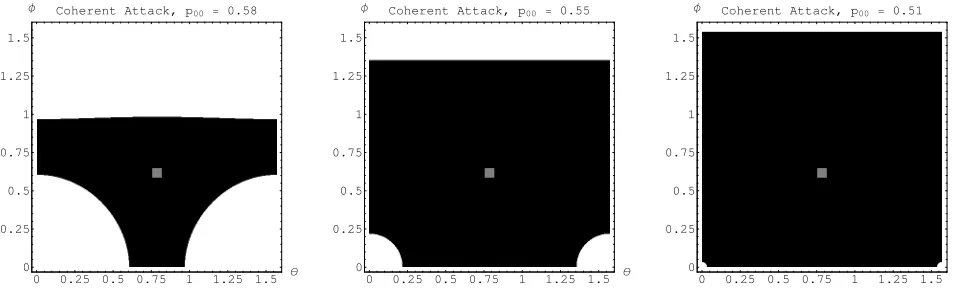
However, if Eve is capable of carrying out a coherent attack, QED is much more powerful than AD (Fig. 2). We see that asp00 → 1
2, more states fall into the black regions where AD fails and only QED is possible. As before, the same states that are resistant to incoherent attack in the CK regime are resistant to the above co-herent attack on AD.
CONCLUSION
We have generalized the tomographic QKD scheme to Bell diagonal states and analyzed its resistance to various eavesdropping attacks, both in the CK regime and when Alice and Bob perform advantage distillation. We have shown the inequivalence of advantage distillation and en-tanglement distillation in the presence of coherent mea-surement by a potential eavesdropper. It still remains to be seen whether Eve can further increase her information gain by entangling more than one pair of Alice and Bob’s qubits with her ancilla.
8
[1] C. H. Bennett and G. Brassard, Proceedings of IEEE Conference on Computers, Systems, and Signal Process-ing, Bangalore, India (IEEE, New York, 1984), p. 175. [2] A. K. Ekert, Phys. Rev. Lett.67, 661 (1991).
[3] G. S. Vernam, J. AIEE45, 109 (1926)
[4] D. Walsh, “Codes and Cryptography”, (OUP, Oxford, 1988)
[5] C. H. Bennettet al., J. Crypt.5, 3 (1992)
[6] Yeong Cherng Liang, Dagomir Kaszlikowski, Berthold-Georg Englert, Leong Chuan Kwek, and C. H. Oh, Phys. Rev. A68, 022324 (2003).
[7] Here we are assuming that one of the pab’s must be
greater than 1
2 as otherwise the state is separable and thus insecure. Without loss of generality, we can always assume thatp00 >
1
2 with the corresponding state|z00i
being Alice and Bob’s “ideal” state.
[8] I. Csisz´ar and J. K¨orner, IEEE-IT24339 (1978). [9] U. M. Maurer, IEEE-IT39, 733 (1993).
[10] Antonio Ac´ın, Lluis Masanes, Nicolas Gisin, Phys. Rev. Lett.91, 167901 (2003).
[11] C. H. Bennett, D. P. DiVicenzo, J. A. Smolin, W. K. Wootters, Phys. Rev. A,54, 3824 (1996)
[12] D. Bruß, M. Christandl, A. Ekert, B.-G. Englert, D. Kaszlikowski, and C. Machiavello, Phys. Rev. Lett.91, 097901 (2003).
[13] A. Chefles, Contemp. Phys.41, 401 (2000).
[14] C. W. Helstrom, Quantum Detection and Estimation Theory (Academic Press, New York, 1976).
[15] P. W. Shor, eprint arXiv/quant-ph/0206068 (2002). [16] D. Kaszlikowski, J. Y. Lim, L. C. Kwek, B.-G. Englert,
0 0.25 0.5 0.75 1 1.25 1.5 0
0.25 0.5 0.75 1 1.25 1.5
Θ Φ CK Regime, p
00 = 0.58
0 0.25 0.5 0.75 1 1.25 1.5 0
0.25 0.5 0.75 1 1.25 1.5
Θ Φ CK Regime, p
00 =0.55
0 0.25 0.5 0.75 1 1.25 1.5 0
0.25 0.5 0.75 1 1.25 1.5
Θ Φ CK Regime, p
[image:10.612.69.547.59.208.2]00 = 0.51
FIG. 1: Comparison of secure regions for the protocol for different values ofp00 under an incoherent attack. White regions in the plot represent states that are secure against incoherent attacks by Eve in the scenario when Alice and Bob do not attempt AD or QED (CK regime). Whenp00→
1
2 the white areas disappear with the exception of the certain points that never become black. These points correspond to the statesp00|z00ihz00|+p01|z01ihz01|(θ = 0,φ= 0),p00|z00ihz00|+p10|z10ihz10|(θ=
π
2,
φ= 0) andp00|z00ihz00|+p11|z11ihz11|(φ=
π
2). These states are resistant to any incoherent attack. As reference, the grey areas (exaggerated in the figure) indicate Werner states.
0 0.25 0.5 0.75 1 1.25 1.5 0
0.25 0.5 0.75 1 1.25 1.5
Θ Φ Coherent Attack, p
00 = 0.58
0 0.25 0.5 0.75 1 1.25 1.5 0
0.25 0.5 0.75 1 1.25 1.5
Θ Φ Coherent Attack, p
00 =0.55
0 0.25 0.5 0.75 1 1.25 1.5 0
0.25 0.5 0.75 1 1.25 1.5
Θ Φ Coherent Attack, p
00 = 0.51
FIG. 2: Comparison of secure regions in advantage distillation for different values ofp00under a coherent attack. White regions in the plot represent states that are secure against coherent attacks by Eve in the scenario when Alice and Bob perform AD. Black regions correspond to states for which AD fails under coherent attack. As the state becomes more mixed (p00→
1 2), the white areas disappear with the exception of the certain points that never become black. As with the CK regime forp00→
1 2, the surviving states arep00|z00ihz00|+p01|z01ihz01|,p00|z00ihz00|+p10|z10ihz10|andp00|z00ihz00|+p11|z11ihz11|. In comparison, with only incoherent attacks all states withp00>
1
[image:10.612.67.544.424.573.2]