Remanufacturing: A Key Strategy for Sustainable
Development
Winifred L. Ijomah1, Steve Childe2, Chris McMahon 3
1 & 3
Department of Mechanical Engineering, University of Bath, Bath, United Kingdom.
2
Department of Computer, Communication and Electronic Engineering, University of Plymouth, Plymouth, United Kingdom.
Abstract
Remanufacturing is a process of bringing used products to Òlike-newÓ functional state with warranty to match. It recovers a substantial proportion of the resource incorporated in a used product in its first manufacture, at low additional cost, thus reducing the price of the resulting product. The key remanufacturing problem is the ambiguity in its definition leading to paucity of knowledge and research in the process. Also, few remanufacturing tools and techniques have been developed to improve its efficiency and effectiveness. This paper addresses these issues by describing the findings of in-depth UK case studies, including, a robust remanufacturing definition and an analytic model of the generic remanufacturing business process for improving remanufacturing knowledge and expertise.
1 INTRODUCTION
The major cause of continued deterioration of the global environment is the unsustainable pattern of consumption and production, particularly in industrialised countries [1]. In Europe, a raft of legislation, of increasing severity, has been designed to reduce waste from a list of European priority waste streams. The concept of ÔProducer ResponsibilityÕ requires original equipment manufacturers (OEMs) to "take back" an equivalent used product for each one sold. The significance of remanufacturing is that it combines profitability and sustainable development benefits by reducing landfilling, as well as the level of virgin material, energy and specialised labour used in production [2,3,4,5]. Research indicates that up to 85% of the weight of remanufactured products may be obtained from used components, and that such products have comparable quality to equivalent new products but require 50% to 80% less energy to produce [2]. Its economic benefits include having low entry barriers, and providing 20% to 80% cost savings in comparison to conventional manufacturing [6]. Companies will increasingly require remanufacturing expertise as it extends the life of used products and avoids costly landfilling. Because it profitably integrates waste back into the manufacturing cycle, remanufacturing offers producers a method of avoiding waste limitation penalties whilst maximising their profits.
unable to differentiate between remanufacturing, repair and reconditioning and refuse to purchase remanufactured products because they are unsure of their quality. Remanufacturers also perceive the scarcity of effective remanufacturing-specific tools as a key threat to their industry [4] and research shows that there is a need for analytic models of remanufacturing [8]. This paper presents a robust remanufacturing definition and a comprehensive generic remanufacturing business process model that can be used to improve remanufacturing expertise.
2 THE RESEARCH METHODOLOGY
To ensure manageability of the research, its scope was limited to the mechanical and electromechanical sector of the UK remanufacturing industry. The definition of remanufacturing as ÒThe process of bringing a used product to like-new condition through replacing and rebuilding component partsÓ [9] was adopted as a working definition which could be altered as the research uncovered further information. The eleven companies involved in the research were selected because their activities fitted the working definition.
The research was undertaken via a three-phase research approach that followed EisenhardtÕs case study methodology [10]. There were three groups of case study companies, the Phase 1, the Phase 2 and the Phase 3 case study companies. Information about the companies is presented in Tables 1 and 2.
The Phase 1 research sought, firstly, to define remanufacturing and differentiate it from repair and reconditioning and, secondly, to describe remanufacturing so that others would correctly understand it. The first objective was achieved through literature survey and a series of one-day observational case studies where the researcher investigated the remanufacturing operation via observation of remanufacturing companies supported by interviews with key company personnel. Here, the working definition of remanufacturing was analysed by comparing actual remanufacturing, repair and reconditioning practices. The second objective was achieved by providing information to illustrate how the remanufacturing operation functions. This involved using observation of remanufacturing operations and interview of remanufacturing practitioners to obtain a list of company-specific flow charts of the remanufacturing operation. These flow charts were then compared so that similarities between them could be drawn out and used to develop generic flow charts.
Table 1. The phase 1 case study companies
Table 2. The phase 2 case study companies
The third research phase ensured that the research findings would be useful to others by presenting it in a format that both academics and remanufacturers could use to solve their remanufacturing-related problems. This was achieved by developing a robust model of the generic remanufacturing business process using the IDEF0 modelling technique. The rationale for developing a business process model was that business process modelling is known to be useful where Òthere is a need for a shared understanding of what the business does and also where information is required to assist improvement change programsÓ [11]. At the same time the model had to be generic because the research sought findings that would be valid to remanufacturers in general rather than to a specific one. IDEF0 was chosen as the most
Company A
Company A rebuilds rolling stock. Its capabilities range from remanufacturing (rebuilding to at least original specification from the customerÕs perspective) to reconditioning and repairing (rebuilding back to a range of satisfactory working condition that may be below the original specification).
Company B
Company B rebuilds quarrying equipment. It provides a wide variety of engineering services including individual assignments, production runs of mechanical components and fabrications as well as a parts repair and remanufacturing service.
Company C
A supplier of remanufactured products for the soft drinks and brewingindustries with core activity in the supply of fully remanufactured process and packaging lines in the brewing and soft drinks industry.
Company D
Company D is a transmissions remanufacturer and undertakes all three processes of remanufacturing, repairing and reconditioning.
Company E
Company E remanufactures open and semi-hermetic compressors for the refrigeration industry.
Company F
Company F remanufactures compressors for the refrigeration industry.
Company G
Company G is an international supplier of new and remanufactured transmissions systems, electronic control units (ECUÕs) and replacement parts.
Company H
appropriate model technique because it provides a complete picture of a process in a concise and consistent manner [12] and has been used successfully in many areas of business process undertaking [13].
A key part of the model development process was the use of a Phase 3 case study to develop a company-specific model of the remanufacturing business process. One of the Phase 2 companies, Company F, was also the Phase 3 case study company. This was necessary to ensure that the initial model was developed in:
1. A genuine remanufacturing organisation. The Phase 2 Case study companies were known remanufacturers. In fact they were ÒAÓ class remanufacturers because they held remanufacturing contracts from Original Equipment Manufacturing companies (OEMs). 2. An environment where there was a high probability of finding characteristics that were
common at least to all the case study companies. Because the Phase 2 companies had validated results from the Phase 1 companies it was likely that both sets of companies shared some characteristics.
Once a model that satisfied the Phase 3 company was obtained it was assessed against the practices of the Phases 1 and 2 case study companies to implement any alterations that would make it valid for a wider range of remanufacturers. The reason here was to enhance the modelÕs scope of application towards being generic.
The last part of the research tested whether the research findings were valid and useful. This was achieved by exploring whether the research had obtained correct results that would be useful to practitioners. In this instance practitioners were remanufacturers and academics because they sought remanufacturing knowledge and expertise. This involved having a panel of practitioners, consisting of case study companies, non-case study companies and academics use the Òvalidation by reviewÓ method [14] to assess whether the model satisfied the ÒThe needs of practitionersÓ [15]. The validating criteria were the usefulness, sufficiency and clarity of the model.
3 MAJOR CASE STUDY FINDINGS
The major research findings were a robust definition of remanufacturing and a generic model of the remanufacturing business process. The definition was obtained from the Phase 1 research and was validated by the Phase 2 research. The validated definition was used as a stepping-stone for developing the model through the Phase 3 research.
3.1 A new robust definition of remanufacturing
3.1.1 Shortcomings of popular current definitions of remanufacturing
The inconsistency in the definition of secondary market processes and the ambiguity of remanufacturing definitions can be illustrated by examining two of the most popular definitions of remanufacturing, one by Amezquita et al. [16] and the other our working definition, by Haynesworth and Lyons [9]. Amezquita et al. [16] describe remanufacturing as
In the same paper they describe reconditioning as a process that is different from remanufacturing and that produces products that are inferior in quality to those produced by remanufacturing. However, since remanufacturers state that the quality of a product is governed by the quality of its individual components, a product that has within it reconditioned components can be described as remanufactured only if remanufacturing and reconditioning describe the same process. If, on the other hand, as proposed by Amezquita et al. [16], remanufacturing is indeed superior to reconditioning, then a product that has reconditioned components (i.e. components that are below the quality standards of remanufacturing), must itself be below the standards of the remanufacturing process. Such a product can therefore not be described as remanufactured. Because the definition above has not differentiated remanufacturing from reconditioning the authors believe that the definition by Amezquita et al. [16] is ambiguous. Our working definition of remanufacturing as ÒThe process of bringing a product to like-new condition through replacing and rebuilding component partsÓ was published by Haynesworth and Lyons [9]. They go on to explain that ÒProducts that have been remanufactured have quality that is equal to and sometimes superior to that of the original productÓ. The case studies undertaken during this research indicate that this bringing of remanufactured products to at least OEM original specification
is one of the important factors that practitioners use to distinguish remanufacturing from repair and reconditioning. Because of this, it is proposed that Haynesworth and Lyons [9] have provided one of the most precise remanufacturing definitions. However, this definition does not provide a method for the purchaser to easily recognise that remanufactured products have higher quality than repaired and reconditioned alternatives, or that remanufactured products have similar quality to new alternatives. Because of this it is proposed that the Haynesworth and Lyons [9] definition of remanufacturing is also insufficient.
According to UK trade organisations, such as the Department of Trade and Industry (DTI) and Federation of Automotive Transmission Engineers (FATE), the legal performance requirement for secondary market products, where such regulations exist, stipulates guidance about minimum quality levels only and producers are held to account on the warranty that they give their products. The case studies showed that practitioners believe that a warranty serves as a guide to a productÕs quality. In fact, they stated that they give their remanufactured products at least the same warranty as the OEM equivalent as a method of indicating that the quality of their product is similar to that of the OEM equivalent. The practitioners believed that remanufacturing, repair and reconditioning involve dissimilar work content and produce products of dissimilar quality. They also believed that remanufacturing obtains the highest quality of products followed by reconditioning, then repair. The indicated that the operations could be differentiated using two factors:
1. The level of quality of the secondary market product when compared to that of an equivalent new product.
2. The standard of the warranty of the secondary market product in comparison to that given to the equivalent new product.
3.1.2 Proposed new definition of remanufacturing
Table 3 presents the new definition along with the proposed definitions of repair and reconditioning. Table 4 shows the three operations on a hierarchy based on the work content that they typically require, the performance that should be obtained from them and the value of the warranty that they normally carry.
Table 3. Proposed definitions of the alternative secondary market processes
Table 4. A proposed hierarchy of secondary market production processes Remanufacturing
The process of returning a used product to at least OEM original performance specification from the customersÕ perspective and giving the resultant product a warranty that is at least equal to that of a newly manufactured equivalent.
Reconditioning
The process of returning a used product to a satisfactory working condition that may be inferior to the original specification. Generally, the resultant product has a warranty that is less than that of a newly manufactured equivalent. The warranty applies to all major wearing parts.
Repair
Repairing is simply the correction of specified faults in a product. When repaired products have warranties, they are less than those of newly manufactured equivalents. Also, the warranty may not cover the whole product but only the component that has been replaced.
Remanufacturing
Work content: Greatest degree of work content because of the total dismantling of the product and the restoration and replacement of its components.
Performance: At least to OEM original performance specification from the customerÕs perspective.
Warranty: At least equal to that of new alternative.
Reconditioning
Work content: Less work content than remanufacturing, but more than that of repairing. All major components that have failed or that are on the point of failure will be rebuilt or replaced, even where the customer has not reported or noticed faults in those components.
Performance: Rebuilding of major components to a working condition that is generally expected to be inferior to that of the original model
Warranty: less than those of newly manufactured equivalents
Repair
Work content: Lowest work content as only specified fault need be attended to
Performance: Inferior to those of remanufactured and reconditioned alternatives
3.2 The generic model
3.2.1 The IDEF0 background and concept
IDEF0 is a process modelling technique that illustrates the component activities and flows of a system thereby helping the modeller to identify what activities are performed, how the
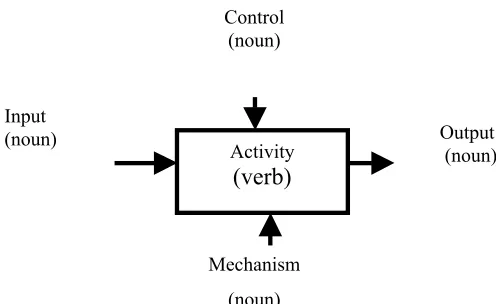
activities are performed as well the rights and wrongs of the existing system. Its main advantage is that it enhances involvement and decision making using simplified graphical methods. IDEF0 was based on a well-established graphical language, the Structured Analysis and Design Technique (SADT), and was developed in the 1970s for modelling missile development activities for The United States Air Force. It was subsequently modified for business use and in 1993 was released as a standard for Function modelling in FIPS Publication 183 by the National Institute of Standards and Technology (NIST). Its benefits include helping in organising the analysis of a system, improving communication between the analyst and the customer and establishing the scope of an analysis. An example node of an IDEF0 model diagram [17,18,19], is shown in Figure 1.
The inputs (things transformed into outputs by the activity) are shown on the left side of the activity box. The input arrowhead points towards the activity box to indicate that the input data or object is going into the activity. An example of an input would be the material used in making a product.
The outputs (the transformed inputs) are shown on the right side of the activity box. The output arrowhead points away from the activity box to indicate that the flow is emerging from the activity. Examples of outputs include warranty and the product made by the process.
Controls are inputs such as constraints or rules that govern the conditions of the transformation, for example, technical skills, and legal requirements. These are indicated at the top of the activity box and their arrowhead points towards the activity box.
[image:7.595.165.413.524.676.2]Mechanisms are the means by which the activity is performed, for example, robots, conveyors or people, and are illustrated below the activity box with their arrowhead pointing towards the activity box.
Figure 1. Example IDEF0 model diagram
Output (noun) Input
(noun)
Control (noun)
Mechanism
(noun) Activity
3.2.1.1 Example of decomposition in IDEF0
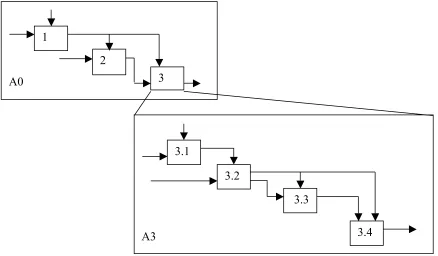
The model shows a top-down decomposition from the context diagram. Figure 2 is an illustration of the use of decomposition to break an activity into its basic elements so that it can be examined in detail and fully understood.
[image:8.595.79.517.210.466.2]The first level decomposition breaks the context diagram (A-0) down into subordinate activities. These subordinate activities may also be decomposed in the same way. There is no limit to the number of levels of decompositions. Each level of decomposition presents increasingly detailed information about the activity in question. The title of a decomposition diagram is taken from the box that it represents. Activities can be described as being parent or a child.
Figure 2. Decomposition in IDEF0
3.2.2 Description of the generic remanufacturing model
The model is a comprehensive document that unambiguously displays the resource required in all areas of the remanufacturing process, including the activities of all its sub processes, as well as the interrelationships between those sub processes. Its boundaries begin with the activities involved in the customer ordering a remanufactured product, goes through those involved in the company producing that remanufactured product, and ends with the activities of delivering the product to the customer. It consists of a series of embedded diagrams where top-level diagrams give basic overview of the system and lower level diagram give increasingly more detailed information. Because of this "Russian doll" characteristics it may be used as a tool for planning and controlling remanufacturing operations and could be used to help to design and implement effective and efficient remanufacturing businesses as well as to improve the efficiency and effectiveness of existing remanufacturing operations. For example, level diagrams give the macro-view of the remanufacturing process that top-level managers need to facilitate their strategic decision taking. The lower top-level diagrams provide detailed operational information to support shop floor workers in their everyday
A0
A3 1
2
3
3.1
3.2
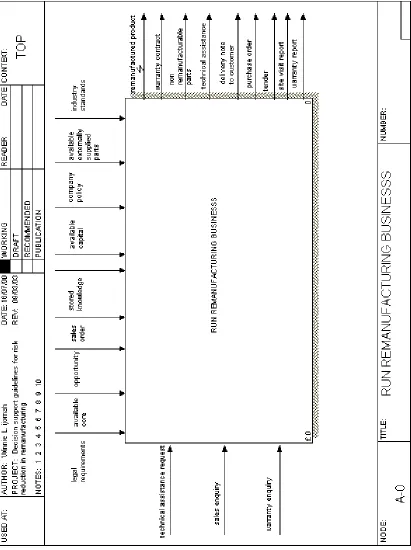
tasks. Figures 3 and 4 show the A0 and A-0 diagrams from the generic remanufacturing model.
Figure 3 is the basic diagram (A-0) of the environment of the remanufacturing business.
Figure 3. A-0 diagram
¥ Inputs such as technical assistance request, sales and warranty requests from customers
¥ Outputs such as remanufactured products and warranty
¥ Controls such as industry standards
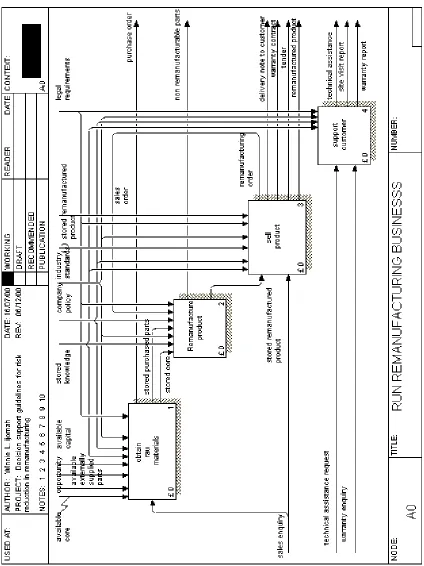
[image:10.595.86.510.127.693.2]This A-0 diagram can be decomposed to give A0 shown in Figure 4.
The A0 diagram displays the four major remanufacturing activities: obtain raw materials; remanufacture product; sell product and support customer. Each of these major sub-activities are given with their various flows (inputs, outputs, control and mechanisms). They can also be decomposed themselves to reveal more detailed remanufacturing information.
4 VALIDATION OF THE GENERIC REMANUFACTURING MODEL
The model was validated by the review method [14] to assess its ability to satisfy the needs of practitioners [15]. If they found the model insufficient (a poor representation), unclear (incomprehensible) or inappropriate (unusable) then the research would have failed because the model would have been unable to fulfil the purpose for which it was developed. The validating panel was from the electromechanical sector of the UK remanufacturing industry and academics in remanufacturing-related disciplines because the research was geared towards them. All participants were middle management and above to ensure that they had adequate knowledge of the remanufacturing business process required for proper assessment of the model. The panel was independent of the research and the researcherÕs university and consisted of roughly equal numbers of academics, case-study companies and non-case study companies. This format permitted case study and non-case study practitioners to debate remanufacturing practices, and reach a consensus opinion in the event of anomalies being identified in the model by either type of remanufacturer. The validation was undertaken at the researcher's university so that the participants would not be distracted by their normal work duties. The close proximity permitted the panel's understanding of the IDEF0 modelling method to be monitored and also helped to ensure guiding of the discussion to ensure a systematic and rigorous validation. The researcher and research supervisor were present throughout the validation to take notes and to provide any additional support that participants may need by for example, answering queries and concerns. The information gathering media were white board, flip chart, tape recorder, common note taking and feedback sheets. There were two types of feedback sheets, the initial and the secondary feedback sheet. The panel handed in their initial feedback sheets, before leaving the session but retained the secondary feedback sheets which would be returned later with any further improvement suggestions that may emerge when they had discussed the model with their work colleagues. During the validation any amendment suggestions to model diagrams or to the model as a whole was recorded and debated by the panel to obtain a consensus opinion. The validation was successful because the model satisfied the validating criteria of usefulness, clarity and sufficiency. The validating panel believed that the model was accurate in its representation of the remanufacturing business process. They also found the model easy to understand and felt that it could help satisfy their requirements. All members of the panel believed that the model would be an effective tool for enhancing the efficiency and effectiveness of new and existing remanufacturing facilities.
5. Conclusion
easily comprehended manner and can be used as a tool for delivering remanufacturing knowledge and expertise as well as for analysing remanufacturing so that its efficiency and effectiveness can be enhanced.
The findings were successfully validated by practitioners using the review method [14], the validation criteria being usability, clarity and sufficiency as required by ÒThe needs of practitionersÓ [15]. The validating panel indicated that the model was a good representation of remanufacturing and that they found it easy to understand and use and also that it could help them manage remanufacturing. The uses that the practitioners proposed for the model include training, documentation, and simulation. In the case of training, the modelÕs advantage is that it does not rely on conversational language. This reduces ambiguity to allow people at whatever level of skills to receive the same quality of information thus improving communication and understanding of remanufacturing. In the case of documentation, as the model displays the interaction of the various company activities it could help employees to gain a whole system view of the company therefore promoting company-wide synergy. Such benefits would improve remanufacturing effectiveness and efficiency. The robustness of the findings was assured through the rigor of the research approach and the quality of the research design. For example, the research design stipulated extensive validation of all phases of the research by practitioners in consideration of the paucity of available remanufacturing publications against which the findings could be compared. Also, the finding passed the test for replication logic when assessed by practitioners and academics that were independent of the research and uninvolved in the actual case studies.
REFERENCES
1 United Nations (1999) ÒSustainable development Ð Agenda 21Ó
http://www.un.org/esa/susdev/agenda21.htm
2 Lund, R.T. (1984) ÒRemanufacturing: The experience of the U.S.A. and implications for the Developing CountriesÓ World Bank Technical Paper No. 3.
3 Lund, R.T. (1996) ÒThe remanufacturing industry: hidden giantÓ Boston University
4 Guide (1999) ÒRemanufacturing production planning and control: U.S industry best practice and research issuesÓ, Second International Working Paper on Re-use, Eindhoven, pp 115-128.
5 Hormozi, A. (1996) ÒRemanufacturing and its consumer, economic and environmental benefitsÓ APEX Remanufacturing Symposim, May 20-22, USA, pp. 5-7.
6 McCaskey, D. (1994) ÒAnatomy of adaptable manufacturing in the remanufacturing environmentÓ APICS Remanufacturing Seminar Proceedings, USA., pp 42-45
7 Melissen, F.W. and Ron, A. J. de (1999) ÒDefinitions in recovery practisesÓ
International Journal of Environmentally Conscious Design and Manufacturing, 8(2), 1-18.
8 Guide and Gupta (1999) ÒA queuing network model for a remanufacturing environmentÓ Second International Working Paper on Re-use, Eindhoven, pp. 129-140.
9 Haynsworth, H.C. and Lyons, R.T. (1987) ÒRemanufacturing by design, the missing linkÓ Production & Inventory Management; Second quarter, pp. 24 - 28
1 0 Eisenhardt, K. (1998) ÒBuilding theory from case study researchÓ Academy of Management Review Vol. 14, No. 4: 532-550.
international workshop on modeling techniques for business process re-engineering and benchmarking, 18-19 April 1996, Bordeaux, France., edited by Doumeingts G and Brown J. London: Chapman & Hall pp.71-81
12 Smart et al. (1995) ÒGuidelines for linking activity and information models of business processes-IDEF0 to IDEf1xÓ EPSRC Grant GR/J95010, working paper WP/GR/J95010-7.
13 AMICE ESPRIT, 1989, CIM-OSA Reference Architecture.
1 4 Landry, M., Malouin, J.L. and Oral, M. (1983) Ò Model validation in operations researchÓ; European Journal of Operational Research 14, pp. 207-220
15 Thomas, K.W. and Tymon, W.G. (1982) ÒNecessary properties of relevant research: Lessons from recent criticism of organisational scienceÓ Academy of Management Review, Vol. 7 No3. 345-352
16 Amezquita, T., Hammond, R., Salazar, M. and Bras, B. (1996),Ó Characterizing the remanufacturability of engineering systemsÓ, Proceedings of ASME advances in design automation Conference, September 17-20, Boston, Massachusettes, USA, DE-vol.82, pp.271-278.
17 Bennett et al. (1995) Ò Different types of manufacturing processes and IDEF0 models describing standard business processesÓ, Working paper WP/Gr/jJ5010-6, EPSRC Grant GR/J 95010, August 1995, Deliverable 3. UK
1 8Dorador J and Young R (2000) Ò Application of IDEF0, IDEF3 and UML methodologies in the creation of information modelsÓ International Journal of Computer Integrated Manufacturing, 2000, vol. 13 No. 5, 430-445.