This is a repository copy of
Linear response theory for Gogny interaction
.
White Rose Research Online URL for this paper:
http://eprints.whiterose.ac.uk/148490/
Version: Published Version
Article:
davesne, dany, Navarro, Jesus and Pastore, Alessandro orcid.org/0000-0003-3354-6432
(2019) Linear response theory for Gogny interaction. Acta Physica Polonica B. ISSN
0587-4254
[email protected] https://eprints.whiterose.ac.uk/
Reuse
Items deposited in White Rose Research Online are protected by copyright, with all rights reserved unless indicated otherwise. They may be downloaded and/or printed for private study, or other acts as permitted by national copyright laws. The publisher or other rights holders may allow further reproduction and re-use of the full text version. This is indicated by the licence information on the White Rose Research Online record for the item.
Takedown
If you consider content in White Rose Research Online to be in breach of UK law, please notify us by
LINEAR RESPONSE THEORY FOR THE GOGNY
INTERACTION
∗
D. Davesne
Université de Lyon, Université Lyon 1
43 Bd. du 11 Novembre 1918, 69622 Villeurbanne cedex, France and
CNRS-IN2P3, UMR 5822, Institut de Physique Nucléaire de Lyon, France
J. Navarro
IFIC (CSIC-Universidad de Valencia) Apartado Postal 22085, 46.071 Valencia, Spain
A. Pastore
Department of Physics, University of York Heslington, York, Y010 5DD, United Kingdom
(Received December 21, 2018)
We present the formalism of the linear response theory in symmetric nuclear matter for a finite-range central interaction including zero-range spin–orbit and tensor components.
DOI:10.5506/APhysPolBSupp.12.549
1. Introduction
Symmetric nuclear matter (SNM) is a spin-saturated system composed of an equal amount of neutrons and protons with no finite-size effect. Although it may appear as a highly ideal system, the study of its excitation modes provides us with several useful guidelines on other systems such as atomic nuclei and neutron stars (NS).
In Ref. [1], we have in great detail presented the formalism of Linear Response (LR) theory for a Skyrme functional including both spin–orbit and tensor terms [2]. By studying the response function of the system to an external probe, we have been able to identify the critical densities and momenta at which instabilities occur in the system [3] and relate them to the
∗ Presented at the XXV Nuclear Physics Workshop “Structure and Dynamics of Atomic
Nuclei”, Kazimierz Dolny, Poland, September 25–30, 2018.
550 D. Davesne, J. Navarro, A. Pastore
appearance of finite-size instabilities in nuclei [4,5]. We have then provided in Refs. [6,7] a simple method based on LR in SNM to avoid such instabilities directly at the level of the fitting procedure.
The response functions of SNM, or more generally of asymmetric nuclear matter [8], have also direct application to study neutrino opacities in NS [9–11] which in turn have important effects on NS cooling [12].
In this article, we present an extension of the formalism of LR theory to the case of finite-range interactions with spin–orbit and tensor terms. The basic formalism has been discussed in Ref. [13], for the case of a central part of the Gogny interaction [14]. The authors of Ref. [15] have already discussed the LR of a Gogny interaction using continued fraction (CF) ap-proximation [16]. The main inconvenience of such a method is that most of the integrations required to obtain the response functions need to be performed numerically via Monte Carlo samplings. Moreover, in Ref. [15], the spin–orbit term has been neglected, which is only valid for low-transfer momenta, see discussion in Ref. [3]. The current formalism, being based on partial wave decomposition [17], offers us the opportunity of including all terms of the interaction. Compared to Ref. [15], our formalism requires more detailed analytical derivations of all matrix elements in the different channels, but it is numerically less expensive.
The article is organised as follows: in Sec. 2, we briefly introduce the LR formalism using multipolar expansion, while in Sec. 3, we illustrate our results for the case of a Gogny interaction. We present our conclusions in Sec. 4.
2. Formalism
The response function of the system is obtained by integrating, over the momentum, the RPA propagator [1, 18]. The latter is the solution of the Bethe–Salpeter equation in each spin (S), spin-projection (M) and isospin (I) channel, for brevity called α≡(S, M, I) in this paper. It reads
G(α)RPA(q, ω,k1) =GHF(q, ω,k1)
+GHF(q, ω,k1)
X
α′
Z d3k
2
(2π)3V (α,α′)
ph (q,k1,k2)G (α′)
RPA(q, ω,k2), (1)
where q is the transferred momentum and k1,k2 is the momentum of the
particle–hole pair andω the transferred energy. Vph(α,α′)(q,k1,k2) represents
GHF(q, ω,k1) =
X
l
GHFl (q, ω, k1)Yl0(cosθ1), (2)
Vph(α,α′)(q,k1,k2) = X
lm,l′m′
Vlm;l(α,α′m′)′(k1, k2)Ylm
ˆ k1
Y∗
l′m′
ˆ k2
, (3)
G(α)RPA(q, ω,k1) =
X
lm
G(α)lm(q, ω, k1)Ylm
ˆ k1
, (4)
whereYlm is the usual spherical harmonic. We then obtain the multipolar expansion of Eq. (1) as
G(α)lm(k1) =δm,0GHFl (k1) +
X
α′
X
l′m′
Z
dk2k22
(2π)3M (α,α′)
lm,l′m′(k1, k2)G (α′)
l′m′(k2), (5)
where, for simplicity, we have dropped the explicit dependence onq and ω. The matrix elementsMlm,l(α,α′′m)′ are defined as
Mlm,l(α,α′′m)′(k1, k2) =
X
l1l2
(2l2+ 1)(2l1+ 1)
4π(2l+ 1)
1/2
Cll010l20Cllm2m,l10
×GHFl
1 (k1)V
(α,α′)
lm;l′m′(k1, k2). (6)
The notation used here simplifies to the one of Ref. [13] in the case of a central interaction for which l = l′ and m = m′. Equation (5) actually
represents a system of coupled integral equations. To solve them, we dis-cretise the integrals over a uniform mesh over the range of k ∈ [0, q+kF] as done in Ref. [13] and then invert the matrix of the system. In principle, the size of the system is infinite, since a finite-range interaction contains all multipoles. However, as discussed in Ref. [13], the contribution of higher order multipoles becomes smaller and smaller. We have thus introduced a cut-off parameter Lmax to limit the number of equations we have to solve. In Sec.3, we discuss the convergence of our results withLmax.
3. Results
552 D. Davesne, J. Navarro, A. Pastore
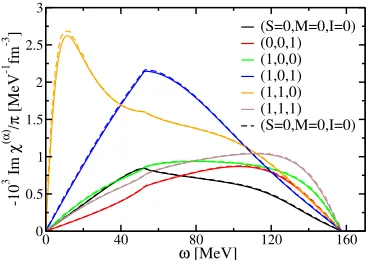
In Fig.1, we compare the response functions obtained with the method given in Eq. (5) (dashed lines) with those obtained by using the technique described in Ref. [1]. Both calculations are done at saturation density and transferred momentum q =kF. The results stay on top of each other: the small deviations are only due to the discretisation on a finite grid of Eq. (5). This example clearly proves the validity of our method based on multipolar expansion and we will now apply it to the case of finite-range interactions.
0 40 80 120 160
ω [MeV]
0 0.5 1 1.5 2 2.5 3 -10
3 Im
[image:5.454.135.318.166.296.2]χ (α) /π [MeV -1 fm -3 ] (S=0,M=0,I=0) (0,0,1) (1,0,0) (1,0,1) (1,1,0) (1,1,1) (S=0,M=0,I=0)
Fig. 1. Response functions−Imχ(α)/πin SNM calculated at saturation density and
transferred momentum q=kF for Skyrme T44 interaction. The small differences between solid and dashed lines are the consequence of the method (discretisation) used to solve Bethe–Salpeter equations. See the text for details.
In Figs. 2–3, we present the response functions in the different spin– isospin channels for different values of the maximum angular momentum Lmax in the case of Gogny D1S interaction [14]. The response functions are calculated at ρ = 0.16 fm−3 and at two different values of transferred
0 20 40 60 80
ω [MeV]
0.4 0.8 1.2 1.6 2 -10
3 Im
χ (α) /π [MeV -1 fm -3 ]
(0,0,0) LMax=1
(1,0,0) (1,1,0)
LMax=2
LMax=3
0 20 40 60 80
ω [MeV]
0.5 1 1.5 2 2.5 3 -10
3 Im
χ (α) /π [MeV -1 fm -3 ]
(0,0,1) LMax=1
(1,0,1) (1,1,1)
LMax=2
LMax=3
Fig. 2. Response function −Imχ(α)
/π in SNM calculated at ρ = 0.16 fm−3 and
[image:5.454.49.406.434.558.2]momentum q = 0.1kF, q = kF. Gogny D1S interaction is not equipped with a tensor term, thus the spin–orbit term only induces a splitting of the different projections of spinM = 0,±1. Since the transferred momentum is
still quite small, such a splitting is fully negligible as discussed in Ref. [15].
0 50 100 150 200
ω [MeV]
0.2 0.4 0.6 0.8 1 1.2 -10
3 Im
χ (α) /π [MeV -1 fm -3 ]
(0,0,0) LMax=1
(1,0,0) (1,1,0)
LMax=2
LMax=3
0 50 100 150 200
ω [MeV]
0.5 1 1.5 2
-10
3 Im
χ (α) /π [MeV -1 fm -3 ]
[image:6.454.49.407.127.268.2](0,0,1) LMax=1 (1,0,1) (1,1,1) LMax=2 LMax=3
Fig. 3. The same as Fig.2, but forq=kF.
We clearly observe that Lmax = 2 is sufficient to obtain a reasonable description of the response function, confirming the results of Ref. [13].
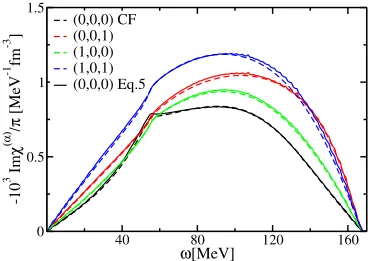
Finally, we compare in Fig. 4 our calculations obtained using Eq. (1) with a cut-off ofLmax= 2with the ones of Ref. [15], based on the Continued Fraction (CF) approximation [16]. Following Ref. [15], the terms included in the calculations are the central part of Gogny D1S interaction. The density isρ= 0.174fm−3 and the transferred momentumq=k
F. Without tensor or spin–orbit terms, there is no longer a splitting in the differentM projections of the total spinS. For such a reason, we present only results withM = 0. We can see that both methods are in excellent agreement, thus proving the validity of our results.
40 80 120 160
ω[MeV] 0 0.5 1 1.5 -10
3 Im
χ (α) /π [MeV -1 fm -3 ] (0,0,0) CF (0,0,1) (1,0,0) (1,0,1) (0,0,0) Eq.5
Fig. 4. Response function for the central term of Gogny D1S interaction. The calculations are done atρ= 0.174 fm−3 andq=k
[image:6.454.135.319.430.561.2]554 D. Davesne, J. Navarro, A. Pastore
It is also interesting to compare theS = 0channels from Fig.3and Fig.4
since we can observe a non-negligible difference of the low-energy part of the isoscalar response function. To understand the role of spin–orbit in this channel, it is useful to observe the expression of the response function given in Ref. [3]: due to the spin–orbit term, the interaction terms of the S = 1 do contribute in the S = 0channel and the term mixing the two channels is typically proportional to the transferred momentum to the power of 4. As a consequence, when the transferred momentum is small, we can neglect such a term, but for large transferred momenta, this term starts playing an important role.
A very important aspect of the LR formalism is the detection of poles in the response functions. In Fig.5, we considered the example of Gogny D1S interaction and showed the evolution of the response function in the channel (0,0,1) for different values of transferred momentum. The calculations have been performed atρ= 1.5ρ0,ρ0 being the saturation density of Gogny D1S interaction because it is known (see Ref. [15]) that at this particular value of density, D1S exhibits a pole at qc = 2.53 fm−1. Effectively, we can observe the shape evolution of the response function whenq approaches the critical valueqc, showing the stability of our numerical approach and the ability of the formalism to detect instabilities.
50 100 150 200 250 300
ω [MeV
0 2 4 6 8 10
-10
3 χ
(0,0,1)
/π
[MeV
-1 fm
-3 ] q=1.84 fm
-1
q=1.99 fm-1
q=2.15 fm-1
[image:7.454.139.314.330.453.2]q=2.30fm-1
Fig. 5. Response functions for Gogny D1S interaction for the channel (0,0,1) and different values of the transferred momentum. See the text for details.
4. Conclusions
the result for the case of a Gogny interaction with Ref. [15]. In this case, the results are in excellent agreement as well. The advantage of our technique (compared to Ref. [15]) is the explicit inclusion of spin–orbit term in the residual interaction. As explicitly shown, this may lead to non-negligible effects on the response function since it induces an extra coupling between theS= 0 and S= 1 channels.
Finally, we have explored how the current formalism describes the pres-ence of poles in the response function. The goal is to continue in that direc-tion so that we can include directly a test to detect instabilities in the fitting procedure itself. This can be important in the context of a future Gogny-like parametrisation devoted to nuclear astrophysics for instance [21,22].
The work of J.N. has been supported by grant FIS2017-84038-C2-1-P, Mineco (Spain). The work of A.P. is supported by the UK Science and Tech-nology Facilities Council under grants No. ST/L005727 and ST/M006433.
REFERENCES
[1] A. Pastore, D. Davesne, J. Navarro, Phys. Rep. 563, 1 (2015).
[2] T. Lesinskiet al., Phys. Rev. C76, 014312 (2007).
[3] A. Pastoreet al., Phys. Rev. C85, 054317 (2012).
[4] V. Hellemanset al., Phys. Rev. C88, 064323 (2013).
[5] A. Pastore, D. Tarpanov, D. Davesne, J. Navarro,Phys. Rev. C 92, 024305 (2015).
[6] A. Pastoreet al., Phys. Scr. T154, 014014 (2013).
[7] P. Beckeret al.,Phys. Rev. C96, 044330 (2017).
[8] D. Davesne, A. Pastore, J. Navarro, Phys. Rev. C89, 044302 (2014).
[9] N. Iwamoto, C.J. Pethick,Phys. Rev. D 25, 313 (1982).
[10] A. Pastoreet al., Phys. Rev. C86, 044308 (2012).
[11] A. Pastoreet al., Phys. Rev. C90, 025804 (2014).
[12] P.S. Shterninet al.,Mon. Not. R. Astron. Soc. Lett. 412, L108 (2011).
[13] J. Margueron, Nguyen Van Giai, J. Navarro,Phys. Rev. C72, 034311 (2005).
[14] J. Dechargé, D. Gogny,Phys. Rev. C 21, 1568 (1980).
[15] A. De Pace, M. Martini,Phys. Rev. C94, 024342 (2016).
[16] J. Margueron, J. Navarro, Nguyen Van Giai, P. Schuck,Phys. Rev. C77, 064306 (2008).
[17] D. Davesne, J. Meyer, A. Pastore, J. Navarro,Phys. Scr. 90, 114002 (2015).
[18] C. García-Recio, J. Navarro, L.L. Salcedo, Nguyen Van Giai,Ann. Phys.
556 D. Davesne, J. Navarro, A. Pastore
[19] P. Beckeret al., J. Phys. G: Nucl. Part. Phys.42, 034001 (2015).
[20] D. Davesne, P. Becker, A. Pastore, J. Navarro, Ann. Phys. 375, 288 (2016).
[21] X. Viñaset al.,arXiv:1810.07469 [nucl-th].