A Multi-Agent Based System to Enable Strategic and
Operational Design Coordination
Robert Ian Whitfield, Graham Coates, Alex H.B. Duffy, Bill Hills
Abstract
This paper presents two systems which individually focus on different aspects of design coordination, namely strategic and operational. The systems were developed in parallel and individually contain related models that represent specific frames from a Design Coordination Framework developed by Andreasen et al. [1].
The focus of the strategic design management system is the management of design tasks, decisions, information, goals and rationale within the design process, whereas the focus of the operational design coordination system is the coordination of tasks and activities with respect to the near-optimal utilisation of available resources. A common interface exists which enables the two systems to be integrated and used as a single system with the aim of managing both strategic and operational design coordination. Hence, the objective of this work is to enable the design process to be conducted in a timely and appropriate manner.
1
Introduction
Design coordination is a relatively new concept within the engineering design community, which is aimed at improving the performance of the engineering design process. One of the most prominent frameworks associated within design coordination is the Design Coordination Framework (DCF) - Andreasen et al. [1]. The DCF presents a number of frames, each of which is aimed at representing different aspects of design coordination. The DCF also describes the management of the links between the frames. There currently exists no implementation of the DCF and consequently the concepts have not been validated.
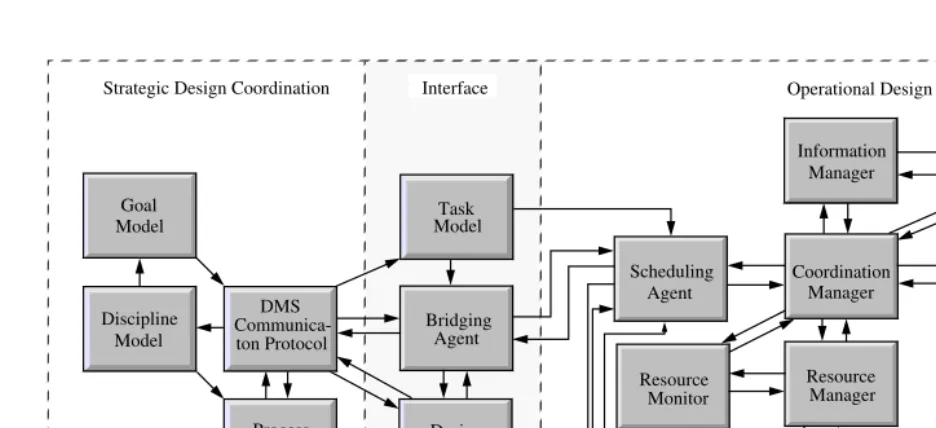
This research has identified that certain elements of the DCF can be divided into two distinct areas, namely strategic and operational design coordination. Strategic coordination may be viewed as the management of the control mechanisms that govern a design process. The frames within the DCF associated with strategic coordination have been identified as the Goal/Result Model and the Discipline/Technology Model. These models have been implemented within the Design Management System (DMS). Operational coordination can be thought of as performing tasks in a near optimal manner with respect to time, and the allocation and utilisation of resources. The Resource Model and the Activity/Plan Model of the DCF are viewed as being associated with operational design coordination. These models have been implemented within the Design Coordination System (DCS). The Task Model frame within the DCF has been identified as the interface between strategic and operational coordination, and is common within both systems. Figure 1 represents the DMS and DCS which includes the frames within the DCF mentioned and the respective agent architectures.
2
Strategic Design Coordination
The Design Management System (DMS) was produced to enable distributed design activities to be coordinated in a strategic manner. This was achieved through the management of constraints, decisions, tasks and goals such that design activities may be conducted by the right person and for the right reason - Andreasen et al. [1]. The requirement for a framework to coordinate distributed design activity is becoming increasingly important as the design of large made-to-order products is being distributed globally in order to reduce costs, gain competitive advantage and utilise external expertise and resources. Within these globally distributed design teams, individual designers specialise within their domain producing solutions to a distinct part of the overall design problem using the tools and techniques with which they are familiar. These tools rarely facilitate concurrency, producing solutions within a particular discipline without using or sharing information from other disciplines or aspects of the product model, and seldom considering stages within the product’s life-cycle other than conceptual, embodiment or detail. Conventional management and maintenance of consistency throughout the product model can subsequently become difficult to achieve since there are many factors that need to be simultaneously considered whilst making a change to the product model. Factors such as the propagation of change, management of constraints, and consideration of requirements require management and coordination for the design process to be performed successfully.
2.1 DMS Architecture
The DMS was developed as an agent-oriented architecture to enable design activities to be distributed as well as providing a means of utilising existing legacy software. However the focus of this work was not the construction of the agent architecture, but the mechanisms that would enable an agent architecture to be coordinated within an engineering design environment.
DMS Discipline
Model
Process Builder Goal
Model
Bridging Agent
Information Manager
Task Manager
Activity Director Scheduling
Agent
Resource Monitor
Resource Manager
Resource Model
Activity/Plan Model Coordination
Manager
Agents Design Task Model
[image:2.792.73.541.83.297.2]Operational Design Coordination Strategic Design Coordination Interface
Figure 1. Strategic and Operational Design Coordination Systems
The control mechanisms within agent-oriented architectures were discussed by Jennings [2] and were considered within the development of the coordination mechanisms of the DMS. Three scenarios were proposed by Jennings:
• unlimited resources for agents such that each agent has a complete representation of its own and all other agents goals, tasks etc.,
• limited resources for agents such that each agent has a partial representation of its own and all other agents goals, tasks etc., and,
• limited resources with one agent having a complete representation of the goals and tasks that need to be achieved and undertaken such that it may govern the action of the other agents.
Jennings discussed the benefits and limitations of each scenario and concluded that the second scenario would be most suitable for distributed architectures due the removal of communication bottlenecks, the limited resource availability, and the graceful degradation in performance due to the loss of an agent. Malone [3] proposed that agent-based systems should; not try to solve complex problems by themselves, have a flexible boundary between themselves and humans, and not try to do things that humans could easily do. Malone further suggested that agent-based systems should provide mechanisms which would enable humans to see and modify the same information and reasoning processes that the agents are using.
The management of control within the DMS was split into two stages following the discussions of Jennings and Malone. The first stage provides mechanisms that enables the designer to represent the design process within a centralised framework. The process produced directly represents the activities, reasoning and goals that will be performed, undertaken and achieved by the agents. It also allows the process to be constructed manually rather than by providing complex mechanisms that allow the agents to autonomously determine the structure of the problem. The process may then be enacted in a distributed manner, using the centralised control framework to ensure that the process is capable of satisfying the required goals in a timely and appropriate manner. The second stage involves the communication of the centralised control knowledge to the agents, such that the control, as well as the activities are distributed. Managing the coordination in this manner:
• removes the necessity of providing complicated coordination mechanisms to enable the agents to determine between themselves where their activities fit into the process,
• reduces the time taken to produce a representation of the design process,
• provides a representation of the process that is easily understandable by humans, and,
• enables the future distribution of the control knowledge removing communication bottlenecks and provides graceful degradation in the event of an agent failure.
A number of frames were identified from the Design Coordination Framework developed by Andreasen et al. [1] as being useful within the development of a strategic design coordination methodology. These frames were the discipline/technology model, the task model and the goal/ result model.
2.2 The Discipline/Technology Model
capable of undertaking. When a design agent becomes available, the agent describes the design activities that it is capable of performing to the DMS. A formalism of a design task was developed which could be applied to any level of abstraction and enabled the generic application of the discipline/technology model. It also allowed the agents to describe their capabilities in terms of low level tasks such as; calculate the stress of a component, or as higher level tasks, such as; design a component that meets the stress requirements. The task formalism was described as having the following characteristics:
• prerequisites that must be satisfied before the task may be undertaken, • arguments that the task may operate upon,
• a description of the task, • the associated discipline, and,
• outcomes resulting from the enactment of the task.
Using this formalism, it is possible to represent the tasks and design activities in terms of the associated disciplines, and when represented within the task model, to enable the interactions between disciplines as well as between tasks to be determined.
2.3 The Design Process Builder and Task Model
A graphical user interface was developed which would enable the designer to define the design process at any level of abstraction using information obtained from the discipline/ technology model. A number of different events were defined such as; perform file operation, perform task, branching operations (to facilitate concurrency), and decision events, which could be used to define the process as well as coordinate the activities of the design agents. These events as well as the connections and dependencies between the events are represented within a design structure matrix. Design structure matrices were used to represent the task model, and were extended to support the management of decisions as well as iteration loops.
2.4 The Goal/Result Model
The goal/result model has not yet been implemented within the DMS but is intended to provide a representation of the specifications defining the requirements of the design solution. These specifications are broken down such that they may be related to particular parts of the design process. Each task within the design process has been formalised as having an outcome or result. Combining tasks within a process may be regarded as representing the activity that needs to be undertaken to satisfy a goal. These goals will subsequently be used to determine the appropriate design activity for meeting the specifications, as well as providing a measurement of how well the design solution satisfies the specification.
3
Operational Design Coordination
can exist between tasks, there may be an optimal order in which activities should be performed to complete the tasks. Consideration to this fact will assist in identifying those activities that can be performed concurrently and those that must be carried out sequentially. When an agent is performing an activity it may be appropriate to do so in a certain location. This consideration may be of particular importance and relevance when agents are working in the same team, or related teams, to complete the same task, or related tasks. In addition, design may be undertaken in distributed locations. For any activity, timeliness is usually of paramount importance.
The Design Coordination System (DCS) aims to optimise the scheduling and planning of the tasks involved within the design process with respect to the allocation and utilisation of available resources. The DCS operates in conjunction with the DMS by performing the scheduling and planning activities upon the tasks that have been determined by the DMS to achieve a particular goal. The DCS consists of a number of different types of agents, each fulfilling a particular role and performing several different tasks with reference to the planning and scheduling of the design process.
• The Coordination Manager registers agents and provides an introduction service such that related agents can locate each other.
• The Resource Manager is responsible for ensuring that at all times optimal utilisation is made of the available resources in the design environment.
• The Scheduling Agent, on instruction from the Resource Manager, invokes an optimisation package to create a schedule.
• Activity Directors act on this schedule by directing Task Managers to complete their tasks by performing the required activities.
• Prior to executing their tasks, Task Managers request input from their related Information Manager.
• Resource Monitors constantly review their associated resource and inform the Resource Manager of any change.
3.1 Coordination Manager
All of the agents within the DCS framework initially register their services by sending a message to the Coordination Manager. Information contained within this initial communication relates to the agent’s attributes, facilitates inter-agent communication and enables agents to work cooperatively. This feature of agents having the ability to communicate directly with any other agent allows efficient message passing, removes communication bottlenecks, and promotes coordination. Message passing is efficient as communication only occurs when necessary. The Coordination Manager facilitates the decentralisation of communication amongst agents. Consequently, message bottlenecks are avoided and communication can occur directly and concurrently between agents, rather than via some centralised agent.
The Coordination Manager is also responsible for constructing an agent matrix, which aids the replacement of agents which may have failed. The agent replacement mechanism exists which enables any agent that becomes unavailable to be replaced such that negative impact on the effectiveness of the agent community is minimised.
3.2 Information Manager
resource at the right time. Other duties include ensuring that any information associated with the task to which it has been assigned are made available to the related Task Manager. After a Task Manager has performed its associated activity to complete its task on a particular input, and prior to preparing another input, the Information Manager coordinates the output from the previous task. That is, the output may be removed from one resource and placed on another as input in preparation for the next activity to be performed. This procedure needs to be carried out after every activity is performed to avoid delays on any of the resources.
3.3 Task Manager
A relationship exists between a Task Manager and an Information Manager if they are associated with the same task. A Task Manager’s responsibilities include requesting inputs from its related Information Manager and subsequently supervising or performing the activity to complete the task on the input of the assigned resource. Once a task has been completed by a Task Manager the related Information Manager coordinates the output. Inputs continue to be requested from the Information Manager by the related Task Manager until all have been dispensed and each activity has been performed on them, and hence all tasks have been completed. That is, the design process is complete.
3.4 Resource Manager
The Resource Manager is responsible for managing the available resources in the form of a resource model as shown in Table 2. The resource model contains a status flag Sj and an efficiency measure Ej, where j = {1,2,3,...,m} and m is the number of resources within the design environment.
A status flag is an indication of the availability of a resource, such that Sj= {0, 1}∀j. The efficiency is a relative measure of the speed of a resource, such that 0≤ Εj≤ 1 ∀j. The Resource
Manager updates the resource model following the notification of a change in a particular resource’s efficiency by the associated Resource Monitor.
The Resource Manager may then instruct the Scheduler to produce a new schedule following the change in efficiency of a resource below a threshold value. Similarly, the Resource Manager may also consider requesting a new schedule if a resource’s efficiency increases above a threshold causing it to be more efficient than a resource currently being utilised. The decision making process concerning whether or not to re-schedule, involves the Resource Manager taking into account several factors. The number of inputs remaining to be considered and the likelihood that a new schedule will be adhered to for the remainder of the design process should also be taken into account.
Resource Status Efficiency
R1 S1 E1
R2 S2 E2
R3 S3 E3
... ... ...
[image:6.792.225.388.422.504.2]Rm Sm Em
3.5 Scheduler
The Scheduler uses a Multiple Criteria Genetic Algorithm (MCGA) to facilitate the optimum utilisation of the available resources. The Scheduler views the scheduling problem as the minimisation of the total design time of a given number of tasks, with interdependencies between them, by assigning them to be performed on an optimum number of the most efficient resources. The Scheduler prepares the information required for the MCGA using information held in the resource model, and the task model, which is supplied by the DMS. When instructed by the Resource Manager, the Scheduler executes the MCGA to produce a Pareto optimal set of schedules. A prescribed criteria is then used to select the most appropriate schedule to enable the optimum utilisation of the available resources.
3.6 Resource Monitor
A Resource Monitor exists which continuously monitors and records the efficiency and status of its associated resource. If a Resource Monitor observes a change in the status or efficiency of its associated resource, it will inform the Resource Manager providing the latest statistics. This may result in the Resource Manager deciding to either add or remove that particular resource from the design environment and request that a new schedule be produced.
3.7 Activity Director
An Activity Director is responsible for ensuring that the appropriate activities taking place on its associated resource are carried out in the correct order at the right time by the right Task Manager. In order to achieve this, each Activity Director constructs an Activity/Plan model based upon information provided by the Scheduler. Once the Task Manager receives this instruction it proceeds to perform the activity on a given input. On completion, the Task Manager informs the Activity Director that it has finished. The Activity Director then proceeds to instruct the next Task Manager in the local schedule to perform its activity on a particular input, and so on.
4
Implementation
Design work commences with the design agents registering with the Design Management System (DMS). Agent details are registered within the discipline/technology model of the DMS. This initial communication will inform the DMS that the specified agent is available to undertake some design activity. The DMS requests that the agent model provides information regarding the nature of the design activity that it can undertake. This information will take the form of a list of tasks, details of files or parameters that the task may require, constraints that need to be satisfied prior to task enactment, and files and criterion that result from the enactment of the task. These task details may be either low-level or high-level terms and may describe an individual atomic task or a group of tasks depending upon the level of concern of the design engineer using the system. The designer would use the DMS to design the design process by decomposing it in terms of the relevant tasks available.
requirement. The task model is subsequently transferred to the Design Coordination System (DCS). Upon receipt of the task model, the DCS produces a near optimal schedule for the tasks to be completed. Depending on the behaviour of the resources within the design environment, one or more near optimal schedules may be created and implemented throughout the period of the design process. Once a schedule is constructed it is divided into the appropriate number of activity/plan models. Task enactment is then directed by the agents within the DCS such that the design agents concerned can proceed in completing the tasks.
5
Conclusions
The Design Management System and Design Coordination System are complimentary CAD packages, which aim to encapsulate characteristics of coordination and implement them such that the design process can be performed efficiently. Indeed, the primary objective of the combined effort of these two systems is to enable design to be conducted in a managed and controlled fashion at both a strategic and operational level. Using a case study related to the design of turbine blades, early indications from the use of these two systems in conjunction with each other are that the design process can be coordinated at both a strategic and operational level with the outcome of a more efficient performance of the associated design process.
Acknowledgements
The authors gratefully acknowledge the support given by the Engineering and Physical Science Research Council who provided the grant RES/4741/0929 that enabled this work to be undertaken.
References
1. Andreasen, M.M., Duffy, A.H.B., MacCallum, K.J., Bowen, J., & Storm, T., “The Design Co-ordination Framework: key elements for effective product development”, International
engineering design debate: The design productivity debate, Meeting; 1st Sept. 1996,
Glasgow, pp. 151-174.
2. Jennings, N.R., “Coordination Techniques for Distributed Artificial Intelligence”,
Foundations of Distributed Artificial Intelligence(eds. G.M.P. O’Hare and N.R. Jennings),
Wiley, 1996, pp. 187-210.
3. Malone, T.W., Lai, K., & Grant, K.R., “Agent for Information Sharing and Coordination: A History and Some Reflections”, Software Agents, AAAI Press, 1997, pp. 109-143.
Dr. R.I. Whitfield, Mr. G. Coates, Prof. B. Hills, Dr. A.H.B. Duffy Newcastle Engineering Design Centre, CAD Centre,
Armstrong Building, James Weir Building, University of Newcastle upon Tyne, Montrose Street,
Tyne and Wear, NE1 7RU, England. University of Strathclyde, Tel.: +44 (0)191 222 8556 Glasgow, G1 1XJ, Scotland. Fax: +44 (0)191 261 6059 Tel.: +44 (0)141 548 3005 E-mail: [email protected] Fax: +44 (0)141 552 3148